

Predicting Outcome in Internet-Based Cognitive Behaviour Therapy for Major Depression: A Large Cohort Study of Adult Patients in Routine Psychiatric Care
Open accessThe DOI matches its Crossref record; 55 of the 56 references it cites were found in a registry or an index.
Abstract
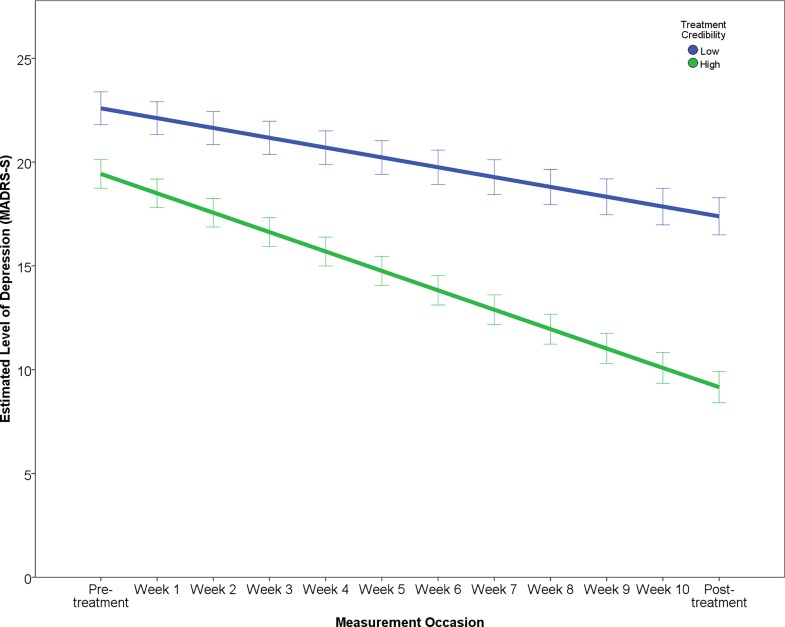
BACKGROUND: Although the effectiveness of therapist-guided internet-based cognitive behaviour therapy (ICBT) for treating depression has been well documented, knowledge of outcome predictors and risk factors associated with lower treatment response is limited, especially when the treatment has been conducted within a naturalistic clinical setting. Identification of such factors is important for clinicians when making treatment recommendations. METHODS: Data from a large cohort (N = 1738) of adult outpatients having been treated with ICBT for depression at an outpatient psychiatric clinic were analysed. A multilevel modelling approach was used to identify patient and treatment variables associated with the speed of recovery during treatment using weekly measurements of the Montgomery Åsberg Depression Rating Scale Self-Rated (MADRS-S). OUTCOMES: Adhering to the treatment, perceiving it as credible and working full-time emerged as predictors of a faster pace of recovery and were also associated with a lower level of depression at the end of treatment. Higher pre-treatment depression and sleep problems were associated with a greater improvement rate, but predicted higher depression after treatment. Having a history of psychotropic medication was associated with both slower improvement and higher post-treatment depression. CONCLUSION: Perceived credibility of ICBT is a strong predictor of treatment response. Assessing patient beliefs and expectations may be a useful aid for clinicians when identifying those who are more or less likely to benefit from ICBT. Helping patients improve expectations prior to treatment may be an important goal for clinicians during the initial assessment phase.
Overview
The claims and statistics of this paper haven’t been checked yet.
Free: it reads the open-access text and checks the first 5 claims that cite a source we can check. Create a free account to check every claim.
Integrity signals
Registry
Cites
Statistics
Figures



Verification
Claims the paper makes
The claims and statistics of this paper haven’t been checked yet.
Free: it reads the open-access text and checks the first 5 claims that cite a source we can check. Create a free account to check every claim.
Claims other papers make about this one
Each is checked against this paper’s own text: does it say what the citing paper says it does?
In the citing paper
“Associations with adherence have been demonstrated for a range of outcomes, including depression [105,106] and anxiety [107,108].”
From The therapeutic alliance in digital mental health interventions for serious mental illnesses: narrative review (2020) · cites this paper as [106]
Self-check
Percentages, sums and reported differences re-computed from the paper’s own numbers.
The self-check needs the paper’s full text.
Citations
Cites
Kessler, R. C., Berglund, P., Demler, O., Jin, R., Merikangas, K. R., & Walters, E. E. (2005) · Archives of General Psychiatry · doi:10.1001/archpsyc.62.6.593 · Cited by 20,391
(1998) · The Journal of Clinical Psychiatry · Cited by 19,139
(1998) · PubMed · Cited by 10,216
Validation of the Insomnia Severity Index as an outcome measure for insomnia research
Bastien, C. (2001) · Sleep Medicine · doi:10.1016/s1389-9457(00)00065-4 · Cited by 8,067 · cited 1×
“The clinical characteristics domain included the Clinical Global Impression–Severity Scale [37] (CGI-S) which was rated on a 7-point scale; the AUDIT [38] and the DUDIT [39] which were used to screen for alcohol problems or drugmisuse; sleep problems measured with the insomnia severity index [40, 41], duration of illn…”
MethodThe empirical status of cognitive-behavioral therapy: A review of meta-analyses
Butler, A. C., Chapman, J. E., Forman, E. M., & Beck, A. T. (2006) · Clinical Psychology Review · doi:10.1016/j.cpr.2005.07.003 · Cited by 3,215 · cited 1×
“Cognitive behavioural therapy (CBT) is an effective treatment for depression [4].”
BackgroundInternet-based cognitive behaviour therapy for symptoms of depression and anxiety: A meta-analysis
SPEK, V., CUIJPERS, P., NYKLÍČEK, I., RIPER, H., KEYZER, J., & POP, V. (2007) · Psychological Medicine · doi:10.1017/s0033291706008944 · Cited by 1,586 · cited 1×
“On the other hand, one study found no relation between initial level of depression and outcome [16] and in other studies it has been linked to better response [17, 18].”
BackgroundCredibility of analogue therapy rationales
Borkovec, T. D., & Nau, S. D. (1972) · Journal of Behavior Therapy and Experimental Psychiatry · doi:10.1016/0005-7916(72)90045-6 · Cited by 1,553
Andrews, G., Cuijpers, P., Craske, M. G., McEvoy, P., & Titov, N. (2010) · PLoS ONE · doi:10.1371/journal.pone.0013196 · Cited by 1,311 · cited 1×
“To increase accessibility of CBT, onlinemethods of treatment delivery such as therapist-guided internet-basedCBT (ICBT) has been recognised as a promising administration format yielding effect sizes at par with conventional face-to-face CBT [5, 6].”
BackgroundBerman, A. H., Bergman, H., Palmstierna, T., & Schlyter, F. (2005) · European Addiction Research · doi:10.1159/000081413 · Cited by 977 · cited 1×
“The clinical characteristics domain included the Clinical Global Impression–Severity Scale [37] (CGI-S) which was rated on a 7-point scale; the AUDIT [38] and the DUDIT [39] which were used to screen for alcohol problems or drugmisuse; sleep problems measured with the insomnia severity index [40, 41], duration of illn…”
MethodSvanborg, P., & Åsberg, M. (1994) · Acta Psychiatrica Scandinavica · doi:10.1111/j.1600-0447.1994.tb01480.x · Cited by 693 · cited 9×
“PrimaryOutcomeMeasure The primary outcome measure was the Montgomery Åsberg Depression Rating Scale SelfRated (MADRS-S) [36].”
BackgroundMethodInfluentialHedman, E., Ljótsson, B., & Lindefors, N. (2012) · Expert Review of Pharmacoeconomics & Outcomes Research · doi:10.1586/erp.12.67 · Cited by 672
Self-citation(1996) · American Journal of Psychiatry · doi:10.1176/ajp.153.8.1009 · Cited by 655
The ESEMeD/MHEDEA 2000 investigators, Alonso, J., Angermeyer, M. C., Bernert, S., Bruffaerts, R., Brugha, T. S., Bryson, H., de Girolamo, G., de Graaf, R., Demyttenaere, K., et al. (2004) · Acta Psychiatrica Scandinavica · doi:10.1111/j.1600-0047.2004.00329.x · Cited by 580
(1991) · American Journal of Psychiatry · doi:10.1176/ajp.148.8.997 · Cited by 580
Shapiro, D. A., Barkham, M., Rees, A., Hardy, G. E., Reynolds, S., & Startup, M. (1994) · Journal of Consulting and Clinical Psychology · doi:10.1037/0022-006x.62.3.522 · Cited by 485 · cited 1×
“being in a relationship has been associated with a better response [7, 8]) while higher illness severity has been found to predict a worse outcome in some studies [7, 9–11] but not in others [12, 13].”
ResultCognitive Therapy and Pharmacotherapy for Depression: Singly and in Combination
Hollon, S. D. (1992) · Archives of General Psychiatry · doi:10.1001/archpsyc.1992.01820100018004 · Cited by 481
PROUDFOOT, J., GOLDBERG, D., MANN, A., EVERITT, B., MARKS, I., & GRAY, J. A. (2003) · Psychological Medicine · doi:10.1017/s0033291702007225 · Cited by 389 · cited 1×
“On the other hand, one study found no relation between initial level of depression and outcome [16] and in other studies it has been linked to better response [17, 18].”
BackgroundMeta-analysis of the placebo response in antidepressant trials.
Rief, W., Nestoriuc, Y., Weiss, S., Welzel, E., Barsky, A. J., & Hofmann, S. G. (2009) · Journal of Affective Disorders · doi:10.1016/j.jad.2009.01.029 · Cited by 346
Fournier, J. C., DeRubeis, R. J., Shelton, R. C., Hollon, S. D., Amsterdam, J. D., & Gallop, R. (2009) · Journal of Consulting and Clinical Psychology · doi:10.1037/a0015401 · Cited by 340
Guided and unguided self-help for social anxiety disorder: randomised controlled trial
Furmark, T., Carlbring, P., Hedman, E., Sonnenstein, A., Clevberger, P., Bohman, B., Eriksson, A., Hållén, A., Frykman, M., Holmström, A., et al. (2009) · British Journal of Psychiatry · doi:10.1192/bjp.bp.108.060996 · Cited by 256
Geraghty, A. W. A., Wood, A. M., & Hyland, M. E. (2010) · Social Science & Medicine · doi:10.1016/j.socscimed.2010.03.007 · Cited by 241
Hedman, E., Ljótsson, B., Kaldo, V., Hesser, H., El Alaoui, S., Kraepelien, M., Andersson, E., Rück, C., Svanborg, C., Andersson, G., et al. (2014) · Journal of Affective Disorders · doi:10.1016/j.jad.2013.10.023 · Cited by 224
Self-citationHedman, E., Ljótsson, B., Rück, C., Furmark, T., Carlbring, P., Lindefors, N., & Andersson, G. (2010) · Computers in Human Behavior · doi:10.1016/j.chb.2010.01.010 · Cited by 220 · cited 1×
“Data was collected both during a structured diagnostic interview with a psychiatrist prior to treatment, and from weekly online measurements before, after and during treatment, which have previously been documented as a valid administration format [35].”
MethodSelf-citationSotsky, S. M., Glass, D. R., Shea, M. T., Pilkonis, P. A., Collins, F., Elkin, I., Watkins, J. T., Imber, S. D., Leber, W. R., Moyer, J., et al. (2006) · Focus · doi:10.1176/foc.4.2.278 · Cited by 196 · cited 2×
“beingmarried has been linked to a better outcome [7, 8]), we found that being single was associated with a worse end state.”
BackgroundResultHilvert-Bruce, Z., Rossouw, P. J., Wong, N., Sunderland, M., & Andrews, G. (2012) · Behaviour Research and Therapy · doi:10.1016/j.brat.2012.04.001 · Cited by 193
Blom, K., Jernelöv, S., Kraepelien, M., Bergdahl, M. O., Jungmarker, K., Ankartjärn, L., Lindefors, N., & Kaldo, V. (2015) · Sleep · doi:10.5665/sleep.4412 · Cited by 193 · cited 1×
“Although sleep problems were associated with a slightly steeper improvement rate (perhaps since addressing sleep problems is addressed during treatment in a module specifically devoted to this problem area), we also found that these patients were more depressed after treatment which is in line with previous findings t…”
ResultSelf-citationCognitive therapy of depression
Hamilton, K. E., & Dobson, K. S. (2002) · Clinical Psychology Review · doi:10.1016/s0272-7358(02)00106-x · Cited by 191 · cited 1×
“In a study from 2004 on outcome predictors of ICBT for depression with 71 participants [14], a weak negative relationship between outcome and those who have had repeated episodes of depression was found, suggesting in line with previous depression research [15] that the level of illness severity is related to treatmen…”
ResultValidation of the insomnia severity index as a web-based measure
Thorndike, F. P., Ritterband, L. M., Saylor, D. K., Magee, J. C., Gonder-Frederick, L. A., & Morin, C. M. (2011) · Behavioral Sleep Medicine · doi:10.1080/15402002.2011.606766 · Cited by 186
Ruwaard, J., Schrieken, B., Schrijver, M., Broeksteeg, J., Dekker, J., Vermeulen, H., & Lange, A. (2009) · Cognitive Behaviour Therapy · doi:10.1080/16506070802408086 · Cited by 183
Hallgren, M., Kraepelien, M., öjehagen, A., Lindefors, N., Zeebari, Z., Kaldo, V., & Forsell, Y. (2015) · British Journal of Psychiatry · doi:10.1192/bjp.bp.114.160101 · Cited by 162
Self-citationHedman, E., Ljótsson, B., Rück, C., Bergström, J., Andersson, G., Kaldo, V., Jansson, L., Andersson, E., Andersson, E., Blom, K., et al. (2013) · Acta Psychiatrica Scandinavica · doi:10.1111/acps.12079 · Cited by 144
Self-citationHowland, R., Rush, A., Wisniewski, S., Trivedi, M., Warden, D., Fava, M., Davis, L., Balasubramani, G., McGrath, P., & Berman, S. (2009) · Drug and Alcohol Dependence · doi:10.1016/j.drugalcdep.2008.08.010 · Cited by 141 · cited 1×
“Some pharmacotherapy trials in the treatment of depression have found that substance use disorder was associated with worse outcomes [20, 21] whereas other studies have not identified this relationship [22].”
ResultPredictors of response to an attention modification program in generalized social phobia.
Amir, N., Taylor, C. T., & Donohue, M. C. (2011) · Journal of Consulting and Clinical Psychology · doi:10.1037/a0023808 · Cited by 130
Hedman, E., Andersson, E., Ljótsson, B., Andersson, G., Andersson, E., Schalling, M., Lindefors, N., & Rück, C. (2012) · Acta Psychiatrica Scandinavica · doi:10.1111/j.1600-0447.2012.01834.x · Cited by 114
Self-citationJarrett, R. B., Eaves, G., Grannemann, B. D., & Rush, A. J. (1991) · Psychiatry Research · doi:10.1016/0165-1781(91)90061-s · Cited by 105 · cited 2×
“beingmarried has been linked to a better outcome [7, 8]), we found that being single was associated with a worse end state.”
BackgroundResultCourse and outcome of depressive disorders in primary care: a prospective 18-month study
Vuorilehto, M. S., Melartin, T. K., & Isometsä, E. T. (2009) · Psychological Medicine · doi:10.1017/s0033291709005182 · Cited by 104 · cited 1×
“However, there are a number of studies on the natural course of depression who report that a significant proportion of patients within primary care generally do not recover spontaneously [52, 53].”
BackgroundTreatment of social phobia through pure self-help and therapist-augmented self-help
Rapee, R. M., Abbott, M. J., Baillie, A. J., & Gaston, J. E. (2007) · British Journal of Psychiatry · doi:10.1192/bjp.bp.106.028167 · Cited by 104
Severity of depression and response to cognitive behavior therapy
(1991) · American Journal of Psychiatry · doi:10.1176/ajp.148.6.784 · Cited by 100
El Alaoui, S., Hedman, E., Kaldo, V., Hesser, H., Kraepelien, M., Andersson, E., Rück, C., Andersson, G., Ljótsson, B., & Lindefors, N. (2015) · Journal of Consulting and Clinical Psychology · doi:10.1037/a0039198 · Cited by 99
Self-citationEl Alaoui, S., Ljótsson, B., Hedman, E., Kaldo, V., Andersson, E., Rück, C., Andersson, G., & Lindefors, N. (2015) · PLOS ONE · doi:10.1371/journal.pone.0124258 · Cited by 98 · cited 1×
“A recent study of outcome predictors of ICBT for social anxiety disorder found that patients’ expectations of treatment success and the perceived credibility of ICBT is strongly associated with the rate of improvement, where higher levels of perceived credibility predicts a steeper rate of improvement [30].”
BackgroundSelf-citationDavis, L. L., Wisniewski, S. R., Howland, R. H., Trivedi, M. H., Husain, M. M., Fava, M., McGrath, P. J., Balasubramani, G. K., Warden, D., & Rush, A. J. (2009) · Drug and Alcohol Dependence · doi:10.1016/j.drugalcdep.2009.10.003 · Cited by 91 · cited 1×
“Some pharmacotherapy trials in the treatment of depression have found that substance use disorder was associated with worse outcomes [20, 21] whereas other studies have not identified this relationship [22].”
ResultWhy we should not seek individual informed consent for participation in health services research
Cassell, J., & Young, A. (2002) · Journal of Medical Ethics · doi:10.1136/jme.28.5.313 · Cited by 91 · cited 1×
“Since passive consent does not violate the option of providing choice and increases the likelihoodof having a representative sample, this approach is considered to be an efficient procedure for registry data [46, 47].”
MethodOutcome predictors in guided and unguided self-help for social anxiety disorder
Nordgreen, T., Havik, O. E., Öst, L. G., Furmark, T., Carlbring, P., & Andersson, G. (2012) · Behaviour Research and Therapy · doi:10.1016/j.brat.2011.10.009 · Cited by 87
Allen, J. P., Reinert, D. F., & Volk, R. J. (2001) · Preventive Medicine · doi:10.1006/pmed.2001.0910 · Cited by 87
Group treatment of depression: Individual predictors of outcome.
Hoberman, H. M., Lewinsohn, P. M., & Tilson, M. (1988) · Journal of Consulting and Clinical Psychology · doi:10.1037//0022-006x.56.3.393 · Cited by 77
Improving Care for Depression in Patients With Comorbid Substance Misuse
Watkins, K. E., Paddock, S. M., Zhang, L., & Wells, K. B. (2006) · American Journal of Psychiatry · doi:10.1176/appi.ajp.163.1.125 · Cited by 56 · cited 1×
“Some pharmacotherapy trials in the treatment of depression have found that substance use disorder was associated with worse outcomes [20, 21] whereas other studies have not identified this relationship [22].”
ResultSimons, A. D., Gordon, J. S., Monroe, S. M., & Thase, M. E. (1995) · Journal of Consulting and Clinical Psychology · doi:10.1037//0022-006x.63.3.369 · Cited by 52
Andersson, G., Bergström, J., Holländare, F., Ekselius, L., & Carlbring, P. (2004) · Verhaltenstherapie · doi:10.1159/000080914 · Cited by 50 · cited 2×
“We found no significant relationship between gender and rate of improvement, which is in line with previous predictor studies on ICBT for depression where no association could be detected between gender and therapeutic outcome [14, 50].”
ResultAydos, L., Titov, N., & Andrews, G. (2009) · Australasian Psychiatry · doi:10.1080/10398560903284943 · Cited by 49
Predicting outcome of Internet-based treatment for depressive symptoms
Warmerdam, L., Van Straten, A., Twisk, J., & Cuijpers, P. (2013) · Psychotherapy Research · doi:10.1080/10503307.2013.807377 · Cited by 49
Smits, J. A. J., Hofmann, S. G., Rosenfield, D., DeBoer, L. B., Costa, P. T., Simon, N. M., O'Cleirigh, C., Meuret, A. E., Marques, L., Otto, M. W., et al. (2013) · Journal of Consulting and Clinical Psychology · doi:10.1037/a0034120 · Cited by 46 · cited 2×
“Also, all predictor variables were standardized prior to analysis in order to facilitate comparison of slope coefficients for the different predictors [45].”
MethodThe short-term outcome of depressive disorder in adolescents attending primary care: a cohort study
Gledhill, J. A., & Garralda, M. E. (2010) · Social Psychiatry and Psychiatric Epidemiology · doi:10.1007/s00127-010-0271-6 · Cited by 38
Registries and Informed Consent
Clark, A. M., Jamieson, R., & Findlay, I. N. (2004) · New England Journal of Medicine · doi:10.1056/nejm200408053510621 · Cited by 21
Gajecki, M., Berman, A. H., Sinadinovic, K., Andersson, C. R., Ljótsson, B., Hedman‐Lagerlöf, E., Rück, C., & Lindefors, N. (2014) · PLoS ONE · doi:10.1371/journal.pone.0104615 · Cited by 20 · cited 2×
“With regard to substance use, a study from 2014 that included 770 of patients (also included in the present study) treated for depression with ICBT did not detect any effect of problematic substance use on depression outcomes after having excluded patients with substance use disorder [19].”
ResultSelf-citationComputerised cognitive behaviour therapy for major depression: a reply to the REEACT trial
Andrews, G., Hobbs, M. J., & Newby, J. M. (2016) · Evidence Based Mental Health · doi:10.1136/eb-2015-102293 · Cited by 10
Cited by
Tremain, H., McEnery, C., Fletcher, K., & Murray, G. (2020) · JMIR Mental Health · doi:10.2196/17204 · Cited by 193
Hornstein, S., Zantvoort, K., Lueken, U., Funk, B., & Hilbert, K. (2023) · Frontiers in Digital Health · doi:10.3389/fdgth.2023.1170002 · Cited by 134
Folker, A. P., Mathiasen, K., Lauridsen, S. M., Stenderup, E., Dozeman, E., & Folker, M. P. (2018) · Internet Interventions · doi:10.1016/j.invent.2018.02.001 · Cited by 116
“Regarding patients' attitudes it has been found that patients worry about the clinical effectiveness of iCBT (Topooco et al., 2017) which has been shown to correlate with poorer treatment outcome (El Alaoui et al., 2016).”
BackgroundA systematic review of digital and face-to-face cognitive behavioral therapy for depression
Kambeitz-Ilankovic, L., Rzayeva, U., Völkel, L., Wenzel, J., Weiske, J., Jessen, F., Reininghaus, U., Uhlhaas, P. J., Alvarez-Jimenez, M., & Kambeitz, J. (2022) · npj Digital Medicine · doi:10.1038/s41746-022-00677-8 · Cited by 103
Edmonds, M., Hadjistavropoulos, H. D., Schneider, L. H., Dear, B. F., & Titov, N. (2018) · Journal of Anxiety Disorders · doi:10.1016/j.janxdis.2018.01.003 · Cited by 75
Metadata
- Authors
- El Alaoui, S., Ljótsson, B., Hedman, E., Svanborg, C., Kaldo, V., & Lindefors, N.
- Affiliations
- Karolinska Institutet (SE)
- Venue
- PLOS ONE
- Publisher
- Public Library of Science (PLoS)
- Published
- 2016-09-12
- Volume
- 11
- Issue
- 9
- Pages
- e0161191
- ISSN
- 1932-6203 (ISSN-L)
- PMC
- PMC5019371
- OpenAlex
- W2519669391
- Cited by
- 51
- References
- 56
- Citations by year
- 2026: 6 · 2025: 4 · 2024: 2 · 2023: 4 · 2022: 13 · 2021: 5 · 2020: 2 · 2019: 4 · 2018: 10 · 2017: 1
- FWCI
- 7.71
- Type
- journal article
- Language
- en
- Open access
- gold
- doi.org
- Licence
- Locations
- PLoS ONE (publishedVersion, cc-by)
- Europe PMC (PubMed Central) (publishedVersion, cc-by)
- PubMed Central (publishedVersion, cc-by)
- PubMed (publishedVersion)
- DOAJ (DOAJ: Directory of Open Access Journals) (submittedVersion)
- Funders
- Stockholms Läns Landsting (ALF 20130413)
- Topics
- Social Sciences › Psychology › Applied Psychology › Digital Mental Health Interventions
- Social Sciences › Psychology › Experimental and Cognitive Psychology › Anxiety, Depression, Psychometrics, Treatment, Cognitive Processes
- Social Sciences › Psychology › Clinical Psychology › Psychotherapy Techniques and Applications
- Keywords
- internet-based cognitive behavioral therapy, major depressive disorder, treatment outcome prediction, treatment response, medication adherence, full-time employment, sleep disorders, outpatient psychiatric care, patient expectations
- MeSH terms
- Adult, Depressive Disorder, Major, Major Depressive Disorder, Female, Humans, Male, Middle Aged, Outpatients, Cohort Studies, Cognitive Behavioral Therapy, Treatment Outcome, Internet
About these checks
Registry, retraction, Cites and statistics results are computed, not judged, with one exception: a printed reference that no index lists is read once by a model before it counts as a citation error. Claims are extracted by a model and kept only when their quote appears verbatim in the text; each cited source is then checked, with a model’s help, for whether it says what the claim relies on. Those verdicts can be wrong — read the claim’s quote and the cited source before relying on one.
Statistics and arithmetic are recomputed, not judged.
Confidence bands are shown only for fields calibrated on our annotated test set. None is calibrated yet, so no band is shown.
What counts as a claim ›How we measure confidence ›How we check this ›
Are you an author, or do you see a problem with this page? Request a review
Data sources
Bibliographic data: Semantic Scholar, OpenAlex, Crossref.
Contains information from the Semantic Scholar Academic Graph Datasets, made available under the ODC Attribution License (ODC-BY 1.0).
Semantic Scholar’s data is described in: Kinney, R., et al. (2023). The Semantic Scholar Open Data Platform. arXiv:2301.10140.
