

Relationship between Research Outcomes and Risk of Bias, Study Sponsorship, and Author Financial Conflicts of Interest in Reviews of the Effects of Artificially Sweetened Beverages on Weight Outcomes: A Systematic Review of Reviews
Open accessThe DOI matches its Crossref record; 63 of the 65 references it cites were found in a registry or an index; 12 of the 33 sources its claims cite were checked for support.
Abstract
BACKGROUND: Artificially sweetened beverage consumption has steadily increased in the last 40 years. Several reviews examining the effects of artificially sweetened beverages on weight outcomes have discrepancies in their results and conclusions. OBJECTIVES: To determine whether risk of bias, results, and conclusions of reviews of effects of artificially sweetened beverage consumption on weight outcomes differ depending on review sponsorship and authors' financial conflicts of interest. METHODS: We performed a systematic review of reviews of the effects of artificially sweetened beverages on weight. Two assessors independently screened articles for inclusion, extracted data, and assessed risks of bias. We compared risk of bias, results and conclusions of reviews by different industry sponsors, authors' financial conflict of interest and journal sponsor. We also report the concordance between review results and conclusions. RESULTS: Artificial sweetener industry sponsored reviews were more likely to have favorable results (3/4) than non-industry sponsored reviews (1/23), RR: 17.25 (95% CI: 2.34 to 127.29), as well as favorable conclusions (4/4 vs. 15/23), RR: 1.52 (95% CI: 1.14 to 2.06). All reviews funded by competitor industries reported unfavorable conclusions (4/4). In 42% of the reviews (13/31), authors' financial conflicts of interest were not disclosed. Reviews performed by authors that had a financial conflict of interest with the food industry (disclosed in the article or not) were more likely to have favorable conclusions (18/22) than reviews performed by authors without conflicts of interest (4/9), RR: 7.36 (95% CI: 1.15 to 47.22). Risk of bias was similar and high in most of the reviews. CONCLUSIONS: Review sponsorship and authors' financial conflicts of interest introduced bias affecting the outcomes of reviews of artificially sweetened beverage effects on weight that could not be explained by other sources of bias.
Overview
CoChat Summary
TL;DR
In a systematic review of 31 reviews, artificial sweetener industry sponsorship and author financial conflicts of interest were associated with favorable results and conclusions about artificially sweetened beverages and weight. Risk of bias was similarly high across sponsorship groups, so the authors conclude funding-related bias was not explained by other risk-of-bias criteria.
Key findings
- Artificial sweetener industry-sponsored reviews were more likely to have favorable results (3/4) than non-industry-sponsored reviews (1/23), RR 17.25 (95% CI 2.34–127.29), and favorable conclusions (4/4 vs 15/23), RR 1.52 (95% CI 1.14–2.06).
- All four reviews funded by competitor industries reported unfavorable conclusions (4/4), while all four artificial sweetener industry-funded reviews had favorable conclusions.
- Reviews with authors having food-industry financial conflicts of interest, disclosed or not, were more likely to have favorable conclusions (18/22) than reviews by authors without conflicts (4/9), RR 7.36 (95% CI 1.15–47.22); 42% (13/31) had undisclosed author conflicts.
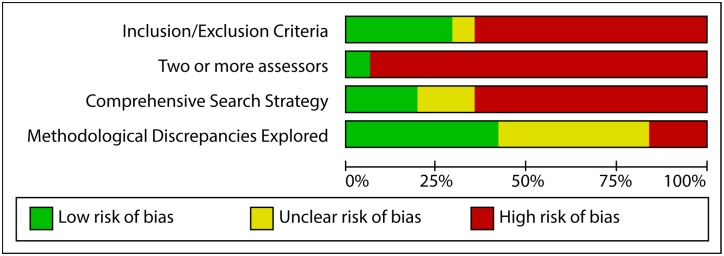
- Risk of bias was similar and high across groups: 26/31 reviews had overall high risk; artificial sweetener industry-sponsored reviews had high risk in 3/4 vs 20/23 non-industry-sponsored reviews, RR 0.86 (95% CI 0.48–1.55). Reviews in industry or mixed-funded journals more often had favorable conclusions (11/12) than those in non-industry-funded journals (8/19), RR 2.18 (95% CI 1.25–3.79).
Methods
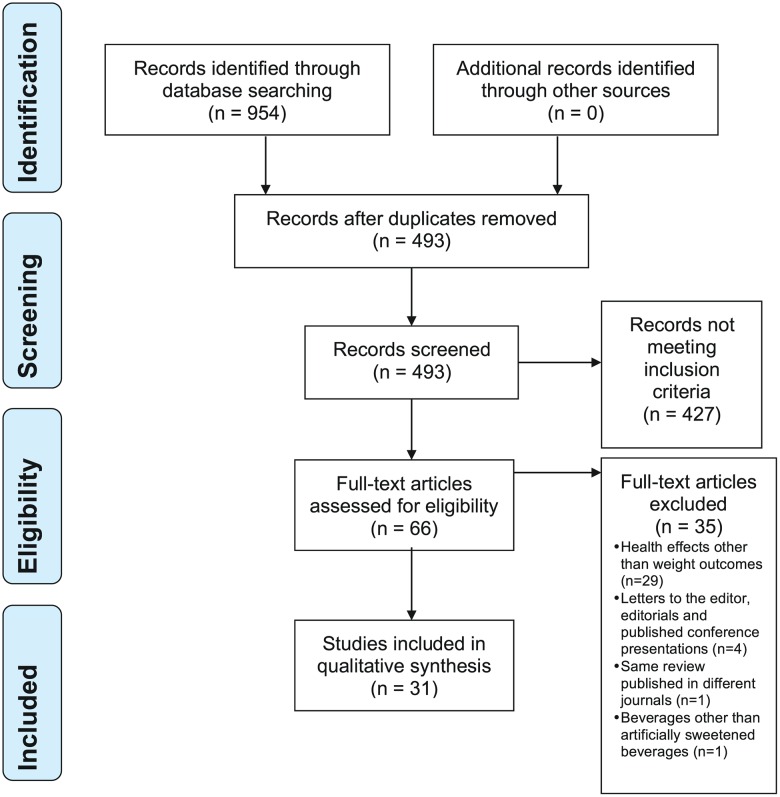
- Systematic review of reviews with a priori selection criteria, data extraction, and analyses; searched Pubmed, Embase, Scopus, Web of Science, and Sociological Abstracts through 22 August 2014, including 31 reviews published between 1978 and 2014.
- Two assessors independently screened articles, extracted data, and assessed risk of bias using four Cochrane funding-bias criteria; overall risk was coded high if fewer than three criteria were met. Results and conclusions were compared by review sponsorship, author financial conflicts of interest, and journal funding using risk ratios with 95% confidence intervals.
- Four reviews included meta-analyses, but quantitative effect estimates could not be pooled because of different study designs and populations.
Limitations
- Stated: the analysis relies on how included reviews defined funding and author financial conflicts of interest; other financial interests or funding sources may have been present; the sample size was small; categorizing industry funding into artificial sweetener, competitor, and other industry produced small subgroups; and food-industry funding classification is complicated, as illustrated by the American Diabetes Association being classified as non-profit despite corporate supporters.
- Stated/evident: most included reviews had high or unclear risk of bias, 12 reviews had results coded as unclear because reporting was confusing or incomplete, and subgroup analyses had small samples with no pooled meta-analysis.
- Evident: the study reports associations, not causal effects; reliance on searches for undisclosed author conflicts may miss financial ties; and comparisons do not adjust for confounders beyond the assessed risk-of-bias domains.
Model-written summary. Check it against the paper before relying on it.
Integrity signals
Registry
Cites
Statistics
Figures
Verification
Claims the paper makes
4 Valid · 1 Not valid · 11 Not checked · 81 Own results and interpretations
The cited sources support only part of this claim — read each source’s verdict below.
In the paper
“Industry sponsorship of both original research and review articles is associated with favorable outcomes for the sponsor in a variety of areas including clinical drug trials [29, 30], studies of the health effects of tobacco [31, 32], medical procedures [33, 34] and pre-clinical animal studies [35, 36].”
§ Relationship between Research Outcomes and Risk of Bias, Study Sponsorship, and Author Financial Conflicts of Interest in Reviews of the Effects of Artificially Sweetened Beverages on Weight Outcomes: A Systematic Review of Reviews > Introduction
What the sources say
- Not checked yetcites [29] Lundh A, Sismondo S, Lexchin J, Busuioc OA, Bero L. Industry sponsorship and research outcome. The Cochrane database of systematic reviews. 2012; 12: Mr000033 Epub 2012/12/14. 10.1002/14651858.MR000033.pub2. 23235689
- Partly supportedcites [30] Yank V, Rennie D, Bero LA. Financial ties and concordance between results and conclusions in meta-analyses: retrospective cohort study. BMJ (Clinical research ed). 2007; 335(7631): 1202– 5. Epub 2007/11/21. 10.1136/bmj.39376.447211.BE; PubMed Central PMCID: PMCPmc2128658. 18024482 PMC2128658 sourceExperimental — accuracy not yet measured
The Results (Characteristics of included meta-analyses; page unavailable) report that financial ties to one drug company were associated with favourable conclusions in drug meta-analyses, but not with favourable results. The Discussion (page unavailable) also reports an association between tobacco-industry affiliations and the conclusions of passive-smoking review articles. Our copy does not establish the claimed association for medical procedures or pre-clinical animal studies. (LLM, conf=0.87)
- Not checked yetcites [31] Barnes DE, Bero LA. Why review articles on the health effects of passive smoking reach different conclusions. JAMA: the journal of the American Medical Association. 1998; 279(19): 1566– 70. 9605902 source
- Supportedcites [32] Barnes DE, Bero LA. Scientific quality of original research articles on environmental tobacco smoke. Tob Control. 1997; 6(1): 19– 26. Epub 1997/04/01. 9176982 PMC1759539 source
For the tobacco-studies portion of the citing sentence, the paper’s discussion (section labeled Coefficient; page unavailable) says that environmental-tobacco-smoke symposium articles tend to support the tobacco industry’s position that such smoke is not harmful. Its introduction (section labeled Abstract; page unavailable) also notes that symposia are often industry sponsored. The paper does not establish the sentence’s claims about drug trials, medical procedures, or animal studies, which are assigned to other citations. (LLM, conf=0.84)
- Supportedcites [33] Popelut A, Valet F, Fromentin O, Thomas A, Bouchard P. Relationship between sponsorship and failure rate of dental implants: a systematic approach. PLOS one. 2010; 5(4): e10274 Epub 2010/04/28. 10.1371/journal.pone.0010274 20422000 PMC2858083 source
The citation is attached to the medical-procedures example. The Discussion reports that industry-associated dental implant trials had a significantly lower annual implant failure rate than non-industry-associated trials (OR = 0.21), supporting an association between sponsorship and outcomes favorable to the sponsor. (LLM, conf=0.91)
- Not checked yetcites [34] Shah RV, Albert TJ, Bruegel-Sanchez V, Vaccaro AR, Hilibrand AS, Grauer JN. Industry support and correlation to study outcome for papers published in Spine. Spine (Phila Pa 1976). 2005; 30(9): 1099– 104; discussion 105. Epub 2005/05/03.. 15864166 source
plainstates an association- Asserted: passes — The authors put it forward as true.
- Checkable: passes — It can be checked against evidence.
- Load-bearing: passes — The paper’s conclusions depend on it.
- Based: passes — The paper gives a reason why it holds.
The cited sources support only part of this claim — read each source’s verdict below.
In the paper
“Reviews of the health effects of sugar sweetened beverages that are performed by authors with financial ties to food companies are five times more likely to conclude that there is no association of sugar consumption with weight gain compared to those with other sponsors (relative risk: 5.0, 95% CI: 1.3–19.3)[42].”
§ Relationship between Research Outcomes and Risk of Bias, Study Sponsorship, and Author Financial Conflicts of Interest in Reviews of the Effects of Artificially Sweetened Beverages on Weight Outcomes: A Systematic Review of Reviews > Introduction
What the sources say
- Partly supportedcites [42] Bes-Rastrollo M, Schulze MB, Ruiz-Canela M, Martinez-Gonzalez MA. Financial conflicts of interest and reporting bias regarding the association between sugar-sweetened beverages and weight gain: a systematic review of systematic reviews. PLOS Med. 2013; 10(12): e1001578; dicsussion e. Epub 2014/01/07. 10.1371/journal.pmed.1001578 24391479 PMC3876974 sourceExperimental — accuracy not yet measured
The Results (Tables 2–3) report that reviews with food-industry conflicts of interest were five times as likely to conclude there was no positive association (RR 5.00, 95% CI 1.29–19.34) as reviews without such conflicts. But the Methods define that category to include insufficient evidence or inconclusive results, not necessarily a conclusion that no association exists. The comparator was reviews without food-industry conflicts, not specifically reviews with other sponsors. (LLM, conf=0.88)
plainstates an association- Asserted: passes — The authors put it forward as true.
- Checkable: passes — It can be checked against evidence.
- Load-bearing: passes — The paper’s conclusions depend on it.
- Based: passes — The paper gives a reason why it holds.
- Partly supported
The cited sources support only part of this claim — read each source’s verdict below.
In the paper
“Our results are also in line with the consolidated evidence that industry sponsorship of various types of research is associated with favorable outcomes for the sponsor in both human [29, 31–34] and animal studies[35, 36].”
§ Relationship between Research Outcomes and Risk of Bias, Study Sponsorship, and Author Financial Conflicts of Interest in Reviews of the Effects of Artificially Sweetened Beverages on Weight Outcomes: A Systematic Review of Reviews > Discussion
What the sources say
- Not checked yetcites [29] Lundh A, Sismondo S, Lexchin J, Busuioc OA, Bero L. Industry sponsorship and research outcome. The Cochrane database of systematic reviews. 2012; 12: Mr000033 Epub 2012/12/14. 10.1002/14651858.MR000033.pub2. 23235689
- Not checked yetcites [31] Barnes DE, Bero LA. Why review articles on the health effects of passive smoking reach different conclusions. JAMA: the journal of the American Medical Association. 1998; 279(19): 1566– 70. 9605902 source
- Supportedcites [32] Barnes DE, Bero LA. Scientific quality of original research articles on environmental tobacco smoke. Tob Control. 1997; 6(1): 19– 26. Epub 1997/04/01. 9176982 PMC1759539 source
The Abstract states that several studies have shown research sponsored by interested parties tends to produce results favorable to sponsors. This supports the sponsorship–outcome association for which this paper is cited in the human-studies citation group; the animal-studies claim has separate citations. (LLM, conf=0.87)
- Supportedcites [33] Popelut A, Valet F, Fromentin O, Thomas A, Bouchard P. Relationship between sponsorship and failure rate of dental implants: a systematic approach. PLOS one. 2010; 5(4): e10274 Epub 2010/04/28. 10.1371/journal.pone.0010274 20422000 PMC2858083 source
The Discussion reports that industry-associated dental implant trials had a significantly lower annual failure rate than non-industry-associated trials, supporting the claim's human-study portion. The citing sentence assigns animal studies to separate citations, so this source need not address them. (LLM, conf=0.91)
- Not checked yetcites [34] Shah RV, Albert TJ, Bruegel-Sanchez V, Vaccaro AR, Hilibrand AS, Grauer JN. Industry support and correlation to study outcome for papers published in Spine. Spine (Phila Pa 1976). 2005; 30(9): 1099– 104; discussion 105. Epub 2005/05/03.. 15864166 source
- Partly supportedcites [35] Abdel-Sattar M, Krauth D, Anglemyer A, Bero L. The Relationship between Risk of Bias Criteria, Research Outcomes, and Study Sponsorship in a Cohort of Preclinical Thiazolidinedione Animal Studies: A Meta-Analysis. Evid Based Preclin Med. 2014; 1(1): 11– 20. Epub 2015/02/03. 10.1002/ebm2.5 25642330 PMC4306285 sourceExperimental — accuracy not yet measured
The Discussion (page not provided) reports exaggerated efficacy estimates in industry-sponsored TZD animal studies, supporting the animal-study portion in part. It also reports increased harms in those studies, while the Results find no clear difference in the proportion of favorable results by sponsorship. This source therefore does not establish the broader claim that industry sponsorship is associated with sponsor-favorable outcomes across animal research; the sentence cites other sources for human studies. (LLM, conf=0.86)
- Partly supportedcites [36] Krauth D, Anglemyer A, Philipps R, Bero L. Nonindustry-Sponsored Preclinical Studies on Statins Yield Greater Efficacy Estimates Than Industry-Sponsored Studies: A Meta-Analysis. PLOS Biol. 2014; 12(1): e1001770 10.1371/journal.pbio.1001770 24465178 PMC3897361 sourceExperimental — accuracy not yet measured
The Introduction and Discussion report that industry sponsorship is associated with sponsor-favorable outcomes in clinical research. For the animal statin studies examined here, however, the Discussion reports greater efficacy estimates in nonindustry-sponsored studies. The Results find more sponsor-favorable conclusions in industry-sponsored studies, but not more favorable quantitative results, so the animal-studies portion needs that distinction. (LLM, conf=0.87)
plainstates an association- Asserted: passes — The authors put it forward as true.
- Checkable: passes — It can be checked against evidence.
- Load-bearing: unclear — It is unclear whether the paper’s conclusions depend on it.
- Based: passes — The paper gives a reason why it holds.
The cited sources support only part of this claim — read each source’s verdict below.
In the paper
“This lack of disclosure is consistent with the lack of transparency and compliance with conflict of interest disclosure policies reported in several fields [48, 55–58].”
§ Relationship between Research Outcomes and Risk of Bias, Study Sponsorship, and Author Financial Conflicts of Interest in Reviews of the Effects of Artificially Sweetened Beverages on Weight Outcomes: A Systematic Review of Reviews > Discussion
What the sources say
- Partly supportedcites [48] Forsyth SR, Odierna DH, Krauth D, Bero LA. Conflicts of interest and critiques of the use of systematic reviews in policymaking: an analysis of opinion articles. Syst Rev. 2014; 3: 122 Epub 2014/11/25. 10.1186/2046-4053-3-122; PubMed Central PMCID: PMCPmc4241194. 25417178 PMC4241194 sourceExperimental — accuracy not yet measured
The Discussion reports that 42% of the studied opinion articles had no COI or funding disclosures, and the Results note that most journals had disclosure policies at the time of the study. This supports the lack-of-transparency point, but the paper does not establish that the articles violated policies in force when they were published; it also studies one type of literature rather than several fields. (LLM, conf=0.82)
- Supportedcites [55] Ruff K. Scientific journals and conflict of interest disclosure: what progress has been made? Environmental Health. 2015; 14: 45 10.1186/s12940-015-0035-6. PMC4450857. 26024916 PMC4450857 source
The Background sections on Annals of Occupational Hygiene, Current Opinion in Pulmonary Medicine, Critical Reviews in Toxicology, and the International Journal of Environmental Research and Public Health describe undisclosed conflicts or failures to follow disclosure requirements. These examples across journals support the cited claim about lack of transparency and compliance. Page numbers are not available in our copy. (LLM, conf=0.91)
- Partly supportedcites [56] Resnik DB. Science and money: problems and solutions. Journal of microbiology & biology education. 2014; 15(2): 159. 25574269 PMC4278468 sourceExperimental — accuracy not yet measured
In “Science and Money: Problems and Solutions” (page unavailable), Resnik describes a case in which financial interests were not properly disclosed and recommends penalizing violations of disclosure policies. The paper does not report a broader pattern of noncompliance with conflict-of-interest disclosure policies across several fields. (LLM, conf=0.82)
- Partly supportedcites [57] Baethge C. The effect of a conflict of interest disclosure form using closed questions on the number of positive conflicts of interest declared–a controlled study. PeerJ. 2013; 1: e128 10.7717/peerj.128 24024081 PMC3746959 sourceExperimental — accuracy not yet measured
The Introduction reports underreporting of conflicts of interest in several studies, and the Discussion says disclosures are often inaccurate or incomplete. Those passages concern medical publishing; they do not establish a lack of compliance with disclosure policies across several fields. (LLM, conf=0.83)
- Not checked yetcites [58] Roseman M, Milette K, Bero LA, Coyne JC, Lexchin J, Turner EH, et al Reporting of conflicts of interest in meta-analyses of trials of pharmacological treatments. JAMA: the journal of the American Medical Association. 2011; 305(10): 1008– 17. Epub 2011/03/10. 10.1001/jama.2011.257. 21386079 source
plainstates an association- Asserted: passes — The authors put it forward as true.
- Checkable: passes — It can be checked against evidence.
- Load-bearing: unclear — It is unclear whether the paper’s conclusions depend on it.
- Based: passes — The paper gives a reason why it holds.
- Partly supported
A result the paper reports from its own data — it cites no other source for it, so there is none to check. The quote shows it is in the paper.
In the paper
“Of the 18 reviews with disclosed funding sources, 10 stated that the sponsor was involved at some stage during the development of the manuscript.”
§ Relationship between Research Outcomes and Risk of Bias, Study Sponsorship, and Author Financial Conflicts of Interest in Reviews of the Effects of Artificially Sweetened Beverages on Weight Outcomes: A Systematic Review of Reviews > Results > Review characteristics
plain- Asserted: passes — The authors put it forward as true.
- Checkable: passes — It can be checked against evidence.
- Load-bearing: unclear — It is unclear whether the paper’s conclusions depend on it.
- Based: passes — The paper gives a reason why it holds.
48 more claims
Create a free account to see all 97 claims and to verify the 21 references still open.
- It may state two separate claims as one. 27
- Probably not a substantial claim. 25
Claims other papers make about this one
Each is checked against this paper’s own text: does it say what the citing paper says it does?
The cited source says what the claim attributes to it.
In the citing paper
“Research has shown that industry-sponsored studies in the sector can introduce bias and are more likely to arrive at conclusions favorable to the financial interests of their sponsors (e.g., Fabbri et al. 2018; Mandrioli et al. 2016).”
From Corporate concentration and power matter for agency in food systems (2025) · cites this paper as Mandrioli et al. 2016
Self-check
Percentages, sums and reported differences re-computed from the paper’s own numbers.
Each contradiction between two passages listed here was confirmed by an independent check.
Rated minor: it would not touch a result — a value no result rests on, a p-value that stays on the same side of the significance level, or a conflict that is clerical, resolved elsewhere in the paper, or outside its own findings.
In the paper
§ Relationship between Research Outcomes and Risk of Bias, Study Sponsorship, and Author Financial Conflicts of Interest in Reviews of the Effects of Artificially Sweetened Beverages on Weight Outcomes: A Systematic Review of Reviews > Results > Relationship between author financial conflicts of interest and review results
“Reviews performed by authors with a conflict of interest with the food industry were more likely to report unclear results (11/22) than reviews performed by authors without conflicts of interest (1/8) RR: 4.50 (95% CI: 0.68 to 29.92).”
§ Relationship between Research Outcomes and Risk of Bias, Study Sponsorship, and Author Financial Conflicts of Interest in Reviews of the Effects of Artificially Sweetened Beverages on Weight Outcomes: A Systematic Review of Reviews > Results > Relationship between author financial conflicts of interest and review results
“we compared the 9 reviews including only authors that had no conflicts of interest with the food industry with 22 reviews performed by authors with disclosed or non-disclosed conflicts of interest (Table 4).”
Rated minor: it would not touch a result — a value no result rests on, a p-value that stays on the same side of the significance level, or a conflict that is clerical, resolved elsewhere in the paper, or outside its own findings.
In the paper
§ Relationship between Research Outcomes and Risk of Bias, Study Sponsorship, and Author Financial Conflicts of Interest in Reviews of the Effects of Artificially Sweetened Beverages on Weight Outcomes: A Systematic Review of Reviews > Results > Relationship between author financial conflict of interest and review conclusions
“Reviews performed by authors with a conflict of interest with the food industry were more likely to have favorable conclusions (18/22) than reviews performed by authors without conflicts of interest (4/9), RR: 7.36 (95% CI: 1.15 to 47.22).”
§ Relationship between Research Outcomes and Risk of Bias, Study Sponsorship, and Author Financial Conflicts of Interest in Reviews of the Effects of Artificially Sweetened Beverages on Weight Outcomes: A Systematic Review of Reviews > Results > Relationship between author financial conflicts of interest and review results
“| Favorable | 19 | 18 | 1 |”
Rated minor: it would not touch a result — a value no result rests on, a p-value that stays on the same side of the significance level, or a conflict that is clerical, resolved elsewhere in the paper, or outside its own findings.
In the paper
§ Relationship between Research Outcomes and Risk of Bias, Study Sponsorship, and Author Financial Conflicts of Interest in Reviews of the Effects of Artificially Sweetened Beverages on Weight Outcomes: A Systematic Review of Reviews > Results > Review characteristics
“Eleven disclosed non-industry funding and 13 disclosed no funding sources; these 2 groups were combined for analysis.”
§ Relationship between Research Outcomes and Risk of Bias, Study Sponsorship, and Author Financial Conflicts of Interest in Reviews of the Effects of Artificially Sweetened Beverages on Weight Outcomes: A Systematic Review of Reviews > Results > Review characteristics
“| | 31 | 4 | 3 | 1 | 7 | 3 | 13 |”
Citations
Cites
ADOLESCENTS, E. P. O. I. G. F. C. H. A. R. R. I. C. A. (2011) · Pediatrics · doi:10.1542/peds.2009-2107c · Cited by 2,585
Artificial sweeteners induce glucose intolerance by altering the gut microbiota
Suez, J., Korem, T., Zeevi, D., Zilberman-Schapira, G., Thaiss, C. A., Maza, O., Israeli, D., Zmora, N., Gilad, S., Weinberger, A., et al. (2014) · Nature · doi:10.1038/nature13793 · Cited by 2,067
Industry sponsorship and research outcome
Lundh, A., Lexchin, J., Mintzes, B., Schroll, J. B., & Bero, L. (2017) · Cochrane Database of Systematic Reviews · doi:10.1002/14651858.mr000033.pub3 · Cited by 1,697
Self-citationImamura, F., O’Connor, L., Ye, Z., Mursu, J., Hayashino, Y., Bhupathiraju, S. N., & Forouhi, N. G. (2015) · BMJ · doi:10.1136/bmj.h3576 · Cited by 977
Imamura, F., O'Connor, L., Ye, Z., Mursu, J., Hayashino, Y., Bhupathiraju, S. N., & Forouhi, N. G. (2016) · British Journal of Sports Medicine · doi:10.1136/bjsports-2016-h3576rep · Cited by 956
Scientific Opinion on Dietary Reference Values for carbohydrates and dietary fibre
EFSA Panel on Dietetic Products, N. (2010) · EFSA Journal · doi:10.2903/j.efsa.2010.1462 · Cited by 898
Boutron, I. (2010) · JAMA · doi:10.1001/jama.2010.651 · Cited by 842
Conflict of Interest in Medical Research, Education, and Practice
(2009) · National Academies Press eBooks · doi:10.17226/12598 · Cited by 807
Sweetening of the global diet, particularly beverages: patterns, trends, and policy responses
Popkin, B. M., & Hawkes, C. (2016) · The Lancet Diabetes & Endocrinology · doi:10.1016/s2213-8587(15)00419-2 · Cited by 737
(2012) · PsycEXTRA Dataset · doi:10.1037/e531652012-001 · Cited by 697
Research works printed but not linked: 2
- BCC. Global Markets for Sugars and Sweeteners in Processed Foods and Beverages. BCC Research, 2015 Jun 2015. Report No.
- FDA. Guidance for Industry: Evidence-Based Review System for the Scientific Evaluation of Health Claims-Final. Retrieved from: Date Published: January. 2009.
Cited by
Béné, C. (2022) · World Development · doi:10.1016/j.worlddev.2022.105881 · Cited by 225
Debras, C., Chazelas, E., Sellem, L., Porcher, R., Druesne-Pecollo, N., Esseddik, Y., de Edelenyi, F. S., Agaësse, C., De Sa, A., Lutchia, R., et al. (2022) · BMJ · doi:10.1136/bmj-2022-071204 · Cited by 222
“22 For instance, a systematic review has specifically studied the issue of conflict of interest in this field 84 and revealed that reviews sponsored by the artificial sweetener industry were more inclined to show beneficial weight loss effects.”
Cawley, J., Thow, A. M., Wen, K., & Frisvold, D. (2019) · Annual Review of Nutrition · doi:10.1146/annurev-nutr-082018-124603 · Cited by 207
Mandrioli, D., Schlünssen, V., Ádám, B., Cohen, R. A., Colosio, C., Chen, W., Fischer, A., Godderis, L., Göen, T., Ivanov, I. D., et al. (2018) · Environment International · doi:10.1016/j.envint.2018.06.005 · Cited by 108
Self-citationArtificially Sweetened Beverages and the Response to the Global Obesity Crisis
Borges, M. C., Louzada, M. L., de Sá, T. H., Laverty, A. A., Parra, D. C., Garzillo, J. M. F., Monteiro, C. A., & Millett, C. (2017) · PLOS Medicine · doi:10.1371/journal.pmed.1002195 · Cited by 103
“Importantly, the authors estimated that “almost half of the reviews had authors that failed to disclose relevant conflicts of interest with the food industry” [56].”
Background
Metadata
- Authors
- Mandrioli, D., Kearns, C. E., & Bero, L. A.
- Affiliations
- Johns Hopkins University (US)
- University of California, San Francisco (US)
- The University of Sydney (AU)
- Corresponding author
- Mandrioli, Daniele
- Venue
- PLOS ONE
- Publisher
- Public Library of Science (PLoS)
- Published
- 2016-09-08
- Volume
- 11
- Issue
- 9
- Pages
- e0162198
- ISSN
- 1932-6203 (ISSN-L)
- PMC
- PMC5015869
- OpenAlex
- W2508801071
- Semantic Scholar
- 0a8bdadd3b8daaee19d5d1306d9974fcf2369093
- Cited by
- 160
- References
- 65
- Citations by year
- 2026: 6 · 2025: 13 · 2024: 13 · 2023: 13 · 2022: 16 · 2021: 22 · 2020: 21 · 2019: 25 · 2018: 14 · 2017: 14 · 2016: 3
- FWCI
- 3.30
- Type
- journal article
- Language
- en
- Update notices
- correction (2020-03-10)
- Open access
- gold
- doi.org
- Licence
- Locations
- PLoS ONE (publishedVersion, cc-by)
- Europe PMC (PubMed Central) (publishedVersion, cc-by)
- PubMed Central (publishedVersion, cc-by)
- PubMed (publishedVersion)
- RePEc: Research Papers in Economics (submittedVersion)
- DOAJ (DOAJ: Directory of Open Access Journals) (submittedVersion, cc-by-sa)
- Figshare (submittedVersion, cc-by)
- Funders
- Johns Hopkins University
- Johns Hopkins Bloomberg School of Public Health
- National Institute of Dental and Craniofacial Research (T32DE007306)
- Topics
- Health Sciences › Nursing › Issues, ethics and legal aspects › Pharmaceutical industry and healthcare
- Social Sciences › Decision Sciences › Statistics, Probability and Uncertainty › Meta-analysis and systematic reviews
- Health Sciences › Nursing › Nutrition and Dietetics › Biochemical Analysis and Sensing Techniques
- Keywords
- artificially sweetened beverages, weight outcomes, financial conflicts of interest, risk of bias, industry funding, food industry, author disclosure
- MeSH terms
- Authorship, Beverages, Body Weight, Humans, Judgment, Periodicals as Topic, Research Support as Topic, Review Literature as Topic, Risk, Sweetening Agents, Conflict of Interest, Publication Bias
About these checks
Registry, retraction, Cites and statistics results are computed, not judged, with one exception: a printed reference that no index lists is read once by a model before it counts as a citation error. Claims are extracted by a model and kept only when their quote appears verbatim in the text; each cited source is then checked, with a model’s help, for whether it says what the claim relies on. Those verdicts can be wrong — read the claim’s quote and the cited source before relying on one.
The claim verdicts this report counts are experimental: their accuracy is not yet measured.
A language model drew the claims from the paper on 2026-10-10, under version 3 of the claim definition (model deepseek-v4.1-flash, prompt extract-v3).
A second model labelled each claim on 2026-10-10 (model jev-1.13-20260917, definition revision gold-guideline-v0.2).
Cited sources are checked with a language model’s help (gpt-6-sol).
Statistics and arithmetic are recomputed, not judged.
Confidence bands are shown only for fields calibrated on our annotated test set. None is calibrated yet, so no band is shown.
What counts as a claim ›How we measure confidence ›How we check this ›
Are you an author, or do you see a problem with this page? Request a review
Data sources
Bibliographic data: Semantic Scholar, OpenAlex, Crossref.
Contains information from the Semantic Scholar Academic Graph Datasets, made available under the ODC Attribution License (ODC-BY 1.0).
Semantic Scholar’s data is described in: Kinney, R., et al. (2023). The Semantic Scholar Open Data Platform. arXiv:2301.10140.
