

Financial Conflicts of Interest and Reporting Bias Regarding the Association between Sugar-Sweetened Beverages and Weight Gain: A Systematic Review of Systematic Reviews
Open accessThe DOI matches its Crossref record; 50 of the 51 references it cites were found in a registry or an index.
Abstract
BACKGROUND: Industry sponsors' financial interests might bias the conclusions of scientific research. We examined whether financial industry funding or the disclosure of potential conflicts of interest influenced the results of published systematic reviews (SRs) conducted in the field of sugar-sweetened beverages (SSBs) and weight gain or obesity. METHODS AND FINDINGS: We conducted a search of the PubMed, Cochrane Library, and Scopus databases to identify published SRs from the inception of the databases to August 31, 2013, on the association between SSB consumption and weight gain or obesity. SR conclusions were independently classified by two researchers into two groups: those that found a positive association and those that did not. These two reviewers were blinded with respect to the stated source of funding and the disclosure of conflicts of interest. We identified 17 SRs (with 18 conclusions). In six of the SRs a financial conflict of interest with some food industry was disclosed. Among those reviews without any reported conflict of interest, 83.3% of the conclusions (10/12) were that SSB consumption could be a potential risk factor for weight gain. In contrast, the same percentage of conclusions, 83.3% (5/6), of those SRs disclosing some financial conflict of interest with the food industry were that the scientific evidence was insufficient to support a positive association between SSB consumption and weight gain or obesity. Those reviews with conflicts of interest were five times more likely to present a conclusion of no positive association than those without them (relative risk: 5.0, 95% CI: 1.3-19.3). An important limitation of this study is the impossibility of ruling out the existence of publication bias among those studies not declaring any conflict of interest. However, the best large randomized trials also support a direct association between SSB consumption and weight gain or obesity. CONCLUSIONS: Financial conflicts of interest may bias conclusions from SRs on SSB consumption and weight gain or obesity.
Overview
The claims and statistics of this paper haven’t been checked yet.
Free: it reads the open-access text and checks the first 5 claims that cite a source we can check. Create a free account to check every claim.
Integrity signals
Registry
Cites
Statistics
Figures
Verification
Claims the paper makes
The claims and statistics of this paper haven’t been checked yet.
Free: it reads the open-access text and checks the first 5 claims that cite a source we can check. Create a free account to check every claim.
Claims other papers make about this one
Each is checked against this paper’s own text: does it say what the citing paper says it does?
The source backs part of the claim, not all of it — or backs it for a different population, condition or comparison.
In the citing paper
“Reviews of the health effects of sugar sweetened beverages that are performed by authors with financial ties to food companies are five times more likely to conclude that there is no association of sugar consumption with weight gain compared to those with other sponsors (relative risk: 5.0, 95% CI: 1.3–19.3)[42].”
From Relationship between research outcomes and risk of bias, study sponsorship, and author financial conflicts of interest in reviews of the effects of artificially sweetened beverages on weight outcomes: a systematic review of reviews (2016) · cites this paper as [42]
Experimental — accuracy not yet measuredIn the citing paper
“Reviews of the health effects of sugar sweetened beverages performed by authors with financial ties to the sugar industry are five times more likely to conclude there is no association of sugar consumption with weight gain [42].”
Self-check
Percentages, sums and reported differences re-computed from the paper’s own numbers.
The self-check needs the paper’s full text.
Citations
Cites
Preferred Reporting Items for Systematic Reviews and Meta-Analyses: the PRISMA statement
Moher, D., Liberati, A., Tetzlaff, J., Altman, D. G., & for the PRISMA Group (2009) · BMJ · doi:10.1136/bmj.b2535 · Cited by 83,823
Preferred Reporting Items for Systematic Reviews and Meta-Analyses: The PRISMA Statement
Moher, D., Liberati, A., Tetzlaff, J., Altman, D. G., & The PRISMA Group (2009) · PLoS Medicine · doi:10.1371/journal.pmed.1000097 · Cited by 64,042 · cited 1×
“Methods Standard methods for conducting and reporting SRs were used [13].”
MethodPreferred reporting items for systematic reviews and meta-analyses: the PRISMA Statement.
(2009) · PubMed Central · Cited by 44,859
Preferred Reporting Items for Systematic Reviews and Meta-Analyses: The PRISMA Statement
Moher, D., Liberati, A., Tetzlaff, J., & Altman, D. G. (2009) · Journal of Clinical Epidemiology · doi:10.1016/j.jclinepi.2009.06.005 · Cited by 19,575
Intake of sugar-sweetened beverages and weight gain: a systematic review
Malik, V. S., Schulze, M. B., & Hu, F. B. (2006) · The American Journal of Clinical Nutrition · doi:10.1093/ajcn/84.2.274 · Cited by 2,100 · cited 1×
“Similarly, another food industry–funded SR [27] did not include one of the RCTs already included in a previous SR [28], and therefore available at the time of the literature search.”
BackgroundSelf-citationEffects of soft drink consumption on nutrition and health: a systematic review and meta-analysis
Vartanian, L. R., Schwartz, M. B., & Brownell, K. D. (2007) · American Journal of Public Health · doi:10.2105/ajph.2005.083782 · Cited by 1,863 · cited 1×
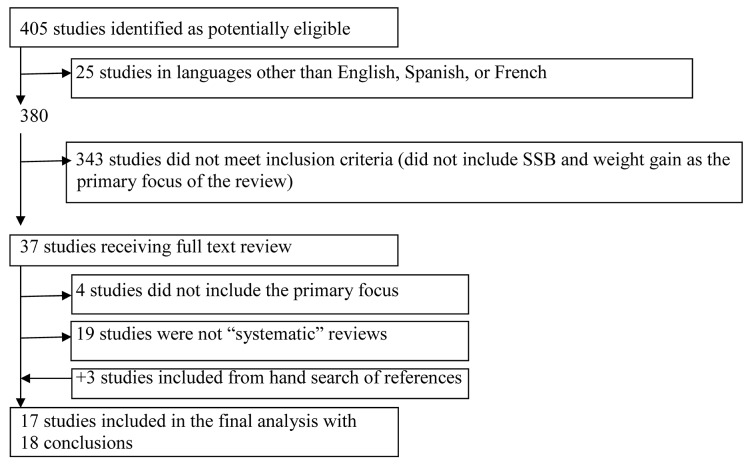
“Results Our final study was based on 17 out of 405 potentially eligible articles (Figure 1) [14–30].”
Scope and Impact of Financial Conflicts of Interest in Biomedical Research: A Systematic Review
Bekelman, J. E., Li, Y., & Gross, C. P. (2003) · JAMA · doi:10.1001/jama.289.4.454 · Cited by 1,816 · cited 2×
“This issue has been thoroughly discussed in pharmaceutical studies, where the dangers of the use of so-called scientific evidence in industry marketing and profit-making strategies have been noted [3–6].”
BackgroundMalik, V. S., Pan, A., Willett, W. C., & Hu, F. B. (2013) · The American Journal of Clinical Nutrition · doi:10.3945/ajcn.113.058362 · Cited by 1,668 · cited 3×
“We identified only two SRs [15,29] that specifically reported using the PRISMA guidelines as the standard method for conducting and reporting the meta-analysis.”
BackgroundMethodMoodie, R., Stuckler, D., Monteiro, C., Sheron, N., Neal, B., Thamarangsi, T., Lincoln, P., & Casswell, S. (2013) · The Lancet · doi:10.1016/s0140-6736(12)62089-3 · Cited by 1,663
Te Morenga, L., Mallard, S., & Mann, J. (2012) · BMJ · doi:10.1136/bmj.e7492 · Cited by 1,629 · cited 3×
“One of the reviews [15] was identified twice because the analyses were reported separately for adults and children/ adolescents and achieved different conclusions; therefore we included a total of 18 conclusions from the 17 SRs in the analysis.”
Method
Research works printed but not linked: 1
- Lesser LI (2009) Reducing potential bias in industry-funded nutrition research. Am J Clin Nutr 90: 699– 700. 19625682 · DOI
Cited by
Shamseer, L., Moher, D., Clarke, M., Ghersi, D., Liberati, A., Petticrew, M., Shekelle, P., Stewart, L. A., & the PRISMA-P Group (2015) · BMJ · doi:10.1136/bmj.g7647 · Cited by 13,120
The Global Syndemic of Obesity, Undernutrition, and Climate Change: The Lancet Commission report
Swinburn, B. A., Kraak, V. I., Allender, S., Atkins, V. J., Baker, P. I., Bogard, J. R., Brinsden, H., Calvillo, A., De Schutter, O., Devarajan, R., et al. (2019) · The Lancet · doi:10.1016/s0140-6736(18)32822-8 · Cited by 3,081
Fructose and sugar: A major mediator of non-alcoholic fatty liver disease
Jensen, T., Abdelmalek, M. F., Sullivan, S., Nadeau, K. J., Green, M., Roncal, C., Nakagawa, T., Kuwabara, M., Sato, Y., Kang, D.-H., et al. (2018) · Journal of Hepatology · doi:10.1016/j.jhep.2018.01.019 · Cited by 941
“Of note, studies funded by the food industry, and/ or in which the authors are funded by the food industry, often fail to show a relationship between sugar intake and metabolic disease.(155,156) Experimentally, the data that uric acidmay have a role in NAFLD is countered by a report in which exogenously administered u…”
Sugar consumption, metabolic disease and obesity: The state of the controversy
Stanhope, K. L. (2016) · Critical Reviews in Clinical Laboratory Sciences · doi:10.3109/10408363.2015.1084990 · Cited by 739
“Does this conflict of interest influence the conclusions? Two recent studies that examined whether industry funding or the disclosure of potential conflicts of interest influenced the results of published systematic reviews conducted in the field of sugar-sweetened beverages and weight gain or obesity suggest it may (…”
Sweetening of the global diet, particularly beverages: patterns, trends, and policy responses
Popkin, B. M., & Hawkes, C. (2016) · The Lancet Diabetes & Endocrinology · doi:10.1016/s2213-8587(15)00419-2 · Cited by 737
Metadata
- Authors
- Bes-Rastrollo, M., Schulze, M. B., Ruiz-Canela, M., & Martinez-Gonzalez, M. A.
- Affiliations
- German Institute of Human Nutrition (DE)
- ORCID
- Schulze, Matthias B.
- Venue
- PLoS Medicine
- Publisher
- Public Library of Science (PLoS)
- Published
- 2013-12-31
- Volume
- 10
- Issue
- 12
- Pages
- e1001578
- ISSN
- 1549-1277 (ISSN-L)
- 1549-1676
- PMC
- PMC3876974
- OpenAlex
- W2114549073
- Cited by
- 343
- References
- 51
- Citations by year
- 2026: 6 · 2025: 19 · 2024: 37 · 2023: 23 · 2022: 16 · 2021: 21 · 2020: 31 · 2019: 33 · 2018: 35 · 2017: 38 · 2016: 42 · 2015: 27 · 2014: 14 · 2013: 1
- FWCI
- 4.58
- Type
- journal article
- Language
- en
- Open access
- gold
- doi.org
- Licence
- Locations
- PLoS Medicine (publishedVersion, cc-by)
- PubMed Central (publishedVersion, cc-by)
- PubMed (publishedVersion)
- RePEc: Research Papers in Economics (publishedVersion)
- Deposito Adademico Digital Universidad De Navarra (University of Navarra) (submittedVersion, other-oa)
- DOAJ (DOAJ: Directory of Open Access Journals) (submittedVersion, cc-by-sa)
- Figshare (submittedVersion, cc-by)
- Topics
- Health Sciences › Nursing › Issues, ethics and legal aspects › Pharmaceutical industry and healthcare
- Health Sciences › Medicine › Public Health, Environmental and Occupational Health › Global Public Health Policies and Epidemiology
- Social Sciences › Decision Sciences › Statistics, Probability and Uncertainty › Meta-analysis and systematic reviews
- Keywords
- financial conflicts of interest, industry funding, sugar-sweetened beverages, weight gain, obesity, reporting bias, conflict of interest disclosure, publication bias
- MeSH terms
- Beverages, Humans, Obesity, Sweetening Agents, Weight Gain, Conflict of Interest
About these checks
Registry, retraction, Cites and statistics results are computed, not judged, with one exception: a printed reference that no index lists is read once by a model before it counts as a citation error. Claims are extracted by a model and kept only when their quote appears verbatim in the text; each cited source is then checked, with a model’s help, for whether it says what the claim relies on. Those verdicts can be wrong — read the claim’s quote and the cited source before relying on one.
Statistics and arithmetic are recomputed, not judged.
Confidence bands are shown only for fields calibrated on our annotated test set. None is calibrated yet, so no band is shown.
What counts as a claim ›How we measure confidence ›How we check this ›
Are you an author, or do you see a problem with this page? Request a review
How to cite
Cite CoChat for the checks on this page, and the paper for its own findings.
- This page
- CoChat. (2026). Citation check: Financial Conflicts of Interest and Reporting Bias Regarding the Association between Sugar-Sweetened Beverages and Weight Gain: A Systematic Review of Systematic Reviews. https://app.cochat.ai/papers/10.1371/journal.pmed.1001578
- The paper
- Bes-Rastrollo, M., Schulze, M. B., Ruiz-Canela, M., & Martinez-Gonzalez, M. A. (2013). Financial Conflicts of Interest and Reporting Bias Regarding the Association between Sugar-Sweetened Beverages and Weight Gain: A Systematic Review of Systematic Reviews. PLoS Medicine. https://doi.org/10.1371/journal.pmed.1001578
Data sources
Bibliographic data: Semantic Scholar, OpenAlex, Crossref.
Contains information from the Semantic Scholar Academic Graph Datasets, made available under the ODC Attribution License (ODC-BY 1.0).
Semantic Scholar’s data is described in: Kinney, R., et al. (2023). The Semantic Scholar Open Data Platform. arXiv:2301.10140.
