

The DOI matches its Crossref record; 65 of the 65 references it cites were found in a registry or an index.
On-Farm Diversity and Market Participation Are Positively Associated with Dietary Diversity of Rural Mothers in Southern Benin, West Africa
Open accessAbstract
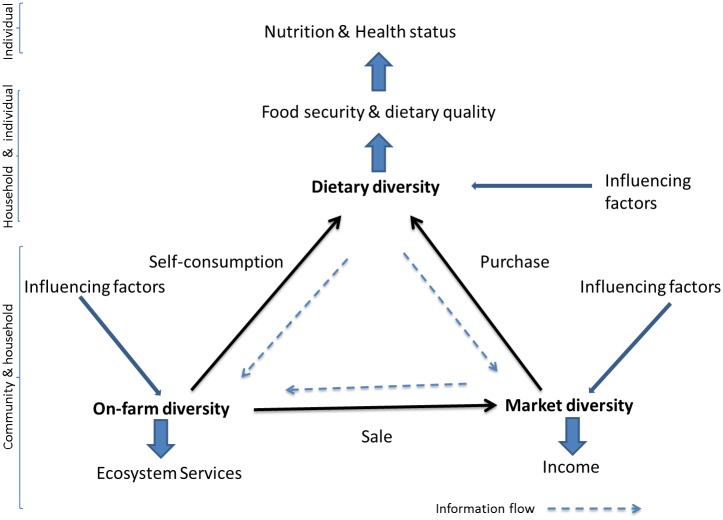
OBJECTIVE: The objective of this study is to test the extent to which, under different opportunities for market participation, the diversity of plant species rural households grow or collect (on-farm diversity), and the variety of foods mothers purchase (market diversity) are associated with their dietary diversity. METHODS: Rural households from three districts in southern Benin were interviewed during dry (n = 472) and wet (n = 482) seasons between 2011 and 2012. Villages within districts and their households were selected randomly according to market accessibility, with a mother selected from each household. Information on on-farm diversity was collected using a semi-structured questionnaire. Market diversity was obtained through a 7-day food frequency questionnaire that elicited if foods were purchased. Dietary diversity was derived from a quantitative 24-hour food recall. A system of three simultaneous equations via a Generalized Methods of Moments was estimated to address potential endogeneity between dietary diversity and on-farm diversity and market diversity. RESULTS: Results show rich on-farm diversity with more than 65 different edible plant species grown or collected by households. More than 70% of foods consumed by mothers were purchased in 55 market places. More than 50% of mothers met minimum dietary diversity with at least 5 food groups consumed. Diagnostic tests indicated the existence of endogeneity. Econometric results showed that on-farm and market diversities were positively associated with mothers' dietary diversity (p < 0.05) once market opportunities, seasonality and other socioeconomic factors were controlled for. CONCLUSION: Results provide evidence of a positive relationship between on-farm diversity and dietary diversity among participant mothers. They demonstrate the important contribution of market diversity to their dietary diversity. Links among these three facets of diversity suggest that production for self-consumption and food purchases complement rather than replace each other in their contribution to dietary diversity and thus dietary quality.
Overview
The claims and statistics of this paper haven’t been checked yet.
Run the check — free, no account needed. It reads the open-access text and checks the sources it cites.
Integrity signals
Registry
Cites
Statistics
Figures
Verification
Claims the paper makes
The claims and statistics of this paper haven’t been checked yet.
Run the check — free, no account needed. It reads the open-access text and checks the sources it cites.
Claims other papers make about this one
Each is checked against this paper’s own text: does it say what the citing paper says it does?
The cited source says what the claim attributes to it.
In the citing paper
“Numerous studies have found a positive relationship between diversified farming systems and human nutritional outcomes for smallholder farms (Jones et al., 2014;Powell et al., 2015;Bellon et al., 2016;Demeke et al., 2017).”
From Assessing Transitions to Sustainable Agricultural and Food Systems: A Tool for Agroecology Performance Evaluation (TAPE) (2020) · cites this paper as Bellon et al., 2016
Self-check
Percentages, sums and reported differences re-computed from the paper’s own numbers.
The self-check needs the paper’s full text.
Citations
Cites
Statistical power analyses using G∗Power 3.1: tests for correlation and regression analyses
Faul, F., Erdfelder, E., Buchner, A., & Lang, A.-G. (2009) · Behavior Research Methods · doi:10.3758/brm.41.4.1149 · Cited by 37,615
Microeconometrics: Methods and Applications
Cameron, A. C., & Trivedi, P. K. (2005) · doi:10.1017/cbo9780511811241 · Cited by 8,092 · cited 1×
“Diagnostic tests were carried out to determine the existence of endogeneity and to assess the validity of the instruments: Durbin–Wu–Hausman test for endogeneity, Sargan–Hansen test of overidentifying restrictions and the Weak Instrument test [61].”
MethodRegression Analysis of Count Data
Cameron, A. C., & Trivedi, P. K. (2013) · doi:10.1017/cbo9781139013567 · Cited by 6,640
The rise of supermarkets in Africa, Asia, and Latin America
Reardon, T., Timmer, C. P., Barrett, C. B., & Berdegué, J. (2003) · American Journal of Agricultural Economics · doi:10.1111/j.0092-5853.2003.00520.x · Cited by 1,346 · cited 1×
“Increased access and participation in markets present great opportunities, but also challenges, for rural societies [13, 14].”
BackgroundInstruments, Randomization, and Learning about Development
Deaton, A. (2010) · Journal of Economic Literature · doi:10.1257/jel.48.2.424 · Cited by 1,274 · cited 1×
“It should be stressed however, that while the variables we use as instruments are predetermined and we have argued for their exogeneity, there are neither statistical tests nor narrative justification to entirely insure that they are uncorrelated with all unobservable determinants of the final outcome, as good instrum…”
BackgroundSmallholder market participation: Concepts and evidence from eastern and southern Africa
Barrett, C. B. (2008) · Food Policy · doi:10.1016/j.foodpol.2007.10.005 · Cited by 1,246 · cited 3×
“Farmers will tend to specialize in the crops where they have a comparative advantage, due to more opportunities to sell agricultural products, while purchasing the foods they consume [15], particularly since markets provide more diverse foods than any individual HH can produce.”
BackgroundStructural Equations, Treatment Effects, and Econometric Policy Evaluation1
Heckman, J. J., & Vytlacil, E. (2005) · Econometrica · doi:10.1111/j.1468-0262.2005.00594.x · Cited by 1,220
Arimond, M., & Ruel, M. T. (2004) · The Journal of Nutrition · doi:10.1093/jn/134.10.2579 · Cited by 1,170 · cited 1×
“Indices of DD are considered good, simple, reliable indicators of nutritional quality and adequacy [5, 6, 7, 8].”
BackgroundIncreasing homogeneity in global food supplies and the implications for food security
Khoury, C. K., Bjorkman, A. D., Dempewolf, H., Ramirez-Villegas, J., Guarino, L., Jarvis, A., Rieseberg, L. H., & Struik, P. C. (2014) · Proceedings of the National Academy of Sciences · doi:10.1073/pnas.1313490111 · Cited by 1,114 · cited 1×
“Despite increasing homogenization of the crop species that contribute to global food supplies [1], at a local level millions of rural households (HHs) throughout the developing world continue to rely on a diversity of plant species to feed themselves and to support their livelihoods.”
BackgroundOperationalizing Dietary Diversity: A Review of Measurement Issues and Research Priorities
Ruel, M. T. (2003) · Journal of Nutrition · doi:10.1093/jn/133.11.3911s · Cited by 966 · cited 1×
“Dietary diversity (DD) is universally recognized as a key component of healthy diets and is strongly associated with nutrient adequacy [4, 5].”
Background
Cited by
Sorted by citations
Wezel, A., Herren, B. G., Kerr, R. B., Barrios, E., Gonçalves, A. L. R., & Sinclair, F. (2020) · Agronomy for Sustainable Development · doi:10.1007/s13593-020-00646-z · Cited by 926
“Application of the social values and dietary principle (9) impact nutrition directly, supported by maintaining and enhancing biodiversity (5) on fields and farms (Bellon et al. 2016; Bezner Kerr et al. 2019b; Demeke et al. 2017; Jones et al. 2014; Lachat et al. 2018; Powell et al. 2015).”
BackgroundSibhatu, K. T., & Qaim, M. (2018) · Food Policy · doi:10.1016/j.foodpol.2018.04.013 · Cited by 372
Can agroecology improve food security and nutrition? A review
Bezner Kerr, R., Madsen, S., Stüber, M., Liebert, J., Enloe, S., Borghino, N., Parros, P., Mutyambai, D. M., Prudhon, M., & Wezel, A. (2021) · Global Food Security · doi:10.1016/j.gfs.2021.100540 · Cited by 359
Jones, A. D. (2017) · Nutrition Reviews · doi:10.1093/nutrit/nux040 · Cited by 310
“This same trend was noted in Burkina Faso where local markets were observed to enhance agricultural biodiversity by providing an outlet for household production.(20) Furthermore, more highly diversified farms are commonly associated with higher household agricultural revenues, indicating the importance of diversificat…”
BackgroundResultInfluentialMottet, A., Bicksler, A., Lucantoni, D., De Rosa, F., Scherf, B., Scopel, E., López-Ridaura, S., Gemmil-Herren, B., Bezner Kerr, R., Sourisseau, J.-M., et al. (2020) · Frontiers in Sustainable Food Systems · doi:10.3389/fsufs.2020.579154 · Cited by 238
“Numerous studies have found a positive relationship between diversified farming systems and human nutritional outcomes for smallholder farms (Jones et al., 2014; Powell et al., 2015; Bellon et al., 2016; Demeke et al., 2017).”
Background
Metadata
- Authors
- Bellon, M. R., Ntandou-Bouzitou, G. D., & Caracciolo, F.
- Affiliations
- Alliance Bioversity International - CIAT (IT)
- University of Naples Federico II (IT)
- Corresponding author
- Bellon, Mauricio R.
- Venue
- PLoS ONE
- Publisher
- Public Library of Science (PLoS)
- Published
- 2016-09-08
- Volume
- 11
- Issue
- 9
- Pages
- e0162535
- ISSN
- 1932-6203 (ISSN-L)
- PMC
- PMC5015832
- OpenAlex
- W2515600722
- Cited by
- 146
- References
- 65
- Citations by year
- 2026: 7 · 2025: 14 · 2024: 21 · 2023: 15 · 2022: 17 · 2021: 21 · 2020: 16 · 2019: 17 · 2018: 9 · 2017: 8
- FWCI
- 11.87
- Type
- journal article
- Language
- en
- Open access
- gold
- doi.org
- Licence
- Locations
- PLoS ONE (publishedVersion, cc-by)
- Europe PMC (PubMed Central) (publishedVersion, cc-by)
- PubMed Central (publishedVersion, cc-by)
- PubMed (publishedVersion)
- CGSPace A Repository of Agricultural Research Outputs (Consultative Group for International Agricultural Research) (submittedVersion, cc-by)
- DOAJ (DOAJ: Directory of Open Access Journals) (submittedVersion, cc-by-sa)
- Figshare (submittedVersion, cc-by)
- Funders
- Bill and Melinda Gates Foundation (OPP53227)
- Topics
- Health Sciences › Nursing › Nutrition and Dietetics › Child Nutrition and Water Access
- Life Sciences › Agricultural and Biological Sciences › General Agricultural and Biological Sciences › Agricultural Innovations and Practices
- Life Sciences › Agricultural and Biological Sciences › General Agricultural and Biological Sciences › Food Security and Socioeconomic Dynamics
- Keywords
- on-farm diversity, market diversity, dietary diversity, rural households, mothers, food purchasing, market participation, food security, self-consumption, endogeneity, seasonal variation, southern Benin
- MeSH terms
- Farms, Adolescent, Adult, Benin, Child, Preschool, Diet, Family Characteristics, Food Supply, Humans, Infant, Middle Aged, Models, Theoretical, Mothers, Rural Population, Models, Econometric, Marketing, Young Adult
About these checks
Registry, retraction, Cites and statistics results are computed, not judged, with one exception: a printed reference that no index lists is read once by a model before it counts as a citation error. Claims are extracted by a model and kept only when their quote appears verbatim in the text; each cited source is then checked, with a model’s help, for whether it says what the claim relies on. Those verdicts can be wrong — read the claim’s quote and the cited source before relying on one.
Statistics and arithmetic are recomputed, not judged.
Confidence bands are shown only for fields calibrated on our annotated test set. None is calibrated yet, so no band is shown.
What counts as a claim ›How we measure confidence ›How we check this ›
Are you an author, or do you see a problem with this page? Request a review
