

The DOI matches its Crossref record; 39 of the 39 references it cites were found in a registry or an index.
Depression Amplifies the Influence of Central Obesity on 10-Year Incidence of Diabetes: Findings from MIDUS
Abstract
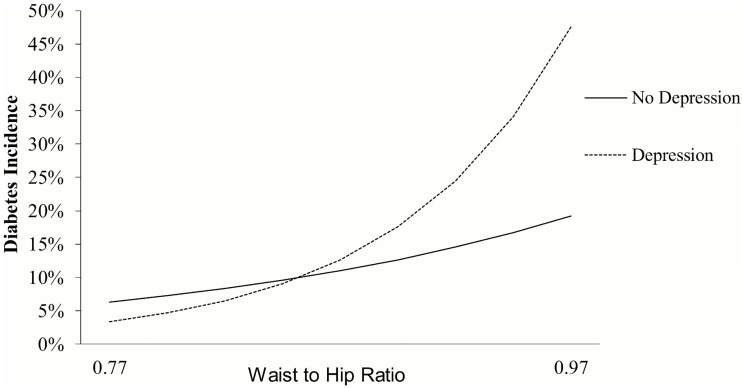
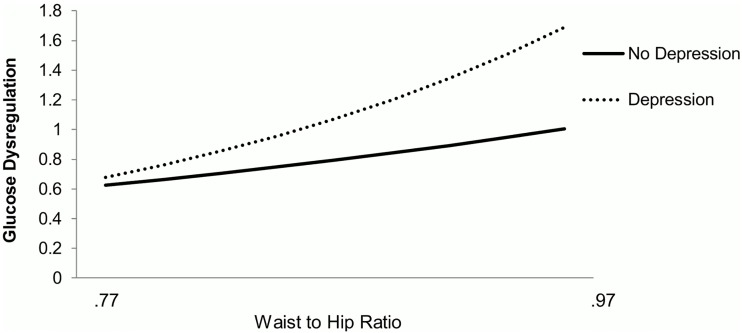
BACKGROUND: Central obesity is a major risk factor for diabetes but many obese individuals never develop diabetes, suggesting the presence of important effect modifiers. Depression has emerged as a key risk factor for poor glycemic control, but to our knowledge, no previous work has investigated whether depression amplifies the effect of central obesity on glucoregulation. METHODS AND FINDINGS: We used a national sample of adults without prevalent diabetes (MIDUS; N = 919) to test for synergy between central obesity and depression in the development of diabetes 10 years later. We found that depression amplified the association of waist-to-hip ratio (WHR) with incident diabetes adjusted for age, race, gender, education, physical activity, and sleep problems (p = 0.01 for test of interaction). The relative risk for incident diabetes per every 0.1 increment in WHR was 1.75 (95% CI: 1.31; 2.33) in those without depression and 3.78 in those with depression (95% CI: 2.14; 6.66). CONCLUSIONS: These results confirm the role of depression as a robust risk factor for the development of diabetes and for the first time, demonstrate a synergy between depression and central obesity. Identifying and addressing depression could prove to be an effective approach to preventing diabetes in at risk individuals. Ultimately, elucidating the interplay among risk factors from different domains will be key to understanding multifactorial diseases such as diabetes and informing theory-based, patient-centered interventions aimed at reducing diabetes risk.
Overview
The claims and statistics of this paper haven’t been checked yet.
Run the check — free, no account needed. It reads the open-access text and checks the sources it cites.
Integrity signals
Registry
Cites
Statistics
Figures
Verification
Claims the paper makes
The claims and statistics of this paper haven’t been checked yet.
Run the check — free, no account needed. It reads the open-access text and checks the sources it cites.
Claims other papers make about this one
Each is checked against this paper’s own text: does it say what the citing paper says it does?
In the citing paper
“In the case of a diabetes/depression syndemic previous studies have, as mentioned above, indicated that depression might influence both the occurrence and the consequences of diabetes”
From The syndemics of diabetes and depression in Brazil – An epidemiological analysis (2019) · cites this paper as Tsenkova & Karlamangla, 2016
In the citing paper
“and might also modify the effect of obesity on diabetes (Tsenkova & Karlamangla, 2016).”
From The syndemics of diabetes and depression in Brazil – An epidemiological analysis (2019) · cites this paper as Tsenkova & Karlamangla, 2016
Self-check
Percentages, sums and reported differences re-computed from the paper’s own numbers.
The self-check needs the paper’s full text.
Citations
Cites
Diagnostic and Statistical Manual of Mental Disorders
Williams, J. B. W., & First, M. (2013) · Encyclopedia of Social Work · doi:10.1093/acrefore/9780199975839.013.104 · Cited by 109,519
A Modified Poisson Regression Approach to Prospective Studies with Binary Data
Zou, G. (2004) · American Journal of Epidemiology · doi:10.1093/aje/kwh090 · Cited by 9,615
Diagnostic and Statistical Manual of Mental Disorders
Siegel, L. J., & Fletcher‐Janzem, E. (2008) · Encyclopedia of Special Education · doi:10.1002/9780470373699.speced0655 · Cited by 8,477
Mechanisms linking obesity to insulin resistance and type 2 diabetes
Kahn, S. E., Hull, R. L., & Utzschneider, K. M. (2006) · Nature · doi:10.1038/nature05482 · Cited by 5,448
Stress, adaptation, and disease. Allostasis and allostatic load
McEWEN, B. S. (1998) · Annals of the New York Academy of Sciences · doi:10.1111/j.1749-6632.1998.tb09546.x · Cited by 5,092
Economic Costs of Diabetes in the U.S. in 2002
American Diabetes Association (2003) · Diabetes Care · doi:10.2337/diacare.26.3.917 · Cited by 4,147
Classification and Diagnosis of Diabetes
Fajans, S. S. (1990) · Medical Entomology and Zoology · Cited by 2,356
Economic Costs of Diabetes in the U.S. in 2012
American Diabetes Association (2013) · Diabetes Care · doi:10.2337/dc12-2625 · Cited by 2,255
Prevalence of obesity in the United States, 2009-2010.
Ogden, C. L., Carroll, M. D., Kit, B. K., & Flegal, K. M. (2012) · PubMed · Cited by 2,061
Depression and poor glycemic control: a meta-analytic review of the literature.
Lustman, P. J., Anderson, R. J., Freedland, K. E., de Groot, M., Carney, R. M., & Clouse, R. E. (2000) · Diabetes Care · doi:10.2337/diacare.23.7.934 · Cited by 1,854
Depression and Type 2 Diabetes Over the Lifespan
Mezuk, B., Eaton, W. W., Albrecht, S., & Golden, S. H. (2008) · Diabetes Care · doi:10.2337/dc08-0985 · Cited by 1,558
Pathogenesis of type 2 diabetes mellitus
DeFronzo, R. A. (2004) · Medical Clinics of North America · doi:10.1016/j.mcna.2004.04.013 · Cited by 1,342
Stetler, C., & Miller, G. E. (2011) · Psychosomatic Medicine · doi:10.1097/psy.0b013e31820ad12b · Cited by 1,123
How healthy are we?: a national study of well-being at midlife
(2004) · Choice Reviews Online · doi:10.5860/choice.41-6842 · Cited by 1,029
Depression as a risk factor for the onset of type 2 diabetes mellitus. A meta-analysis
Knol, M. J., Twisk, J. W. R., Beekman, A. T. F., Heine, R. J., Snoek, F. J., & Pouwer, F. (2006) · Diabetologia · doi:10.1007/s00125-006-0159-x · Cited by 974
Examining a Bidirectional Association Between Depressive Symptoms and Diabetes
Golden, S. H. (2008) · JAMA · doi:10.1001/jama.299.23.2751 · Cited by 893
[Classification and diagnosis of diabetes].
Boulin (1953) · PubMed · Cited by 516
Rosmond, R., & Björntorp, P. (2000) · Journal of Internal Medicine · doi:10.1046/j.1365-2796.2000.00603.x · Cited by 510
Mechanisms of Glucocorticoid-Induced Insulin Resistance
Geer, E. B., Islam, J., & Buettner, C. (2014) · Endocrinology and Metabolism Clinics of North America · doi:10.1016/j.ecl.2013.10.005 · Cited by 392
Point: Visceral Adiposity Is Causally Related to Insulin Resistance
Lebovitz, H. E., & Banerji, M. A. (2005) · Diabetes Care · doi:10.2337/diacare.28.9.2322 · Cited by 328
A systematic review and meta-analysis of the association between depression and insulin resistance
Kan, C., Silva, N., Golden, S. H., Rajala, U., Timonen, M., Stahl, D., & Ismail, K. (2013) · Diabetes Care · doi:10.2337/dc12-1442 · Cited by 322
Prevalence of Depression in Individuals With Impaired Glucose Metabolism or Undiagnosed Diabetes
Nouwen, A., Nefs, G., Caramlau, I. O., Connock, M. J., Winkley, K., Lloyd, C. E., Peyrot, M. F., & Pouwer, F. (2011) · Diabetes Care · doi:10.2337/dc10-1414 · Cited by 275
VanItallie, T. B. (1996) · Endocrinology and Metabolism Clinics of North America · doi:10.1016/s0889-8529(05)70360-1 · Cited by 270
Metabolic syndrome and major depression
Marazziti, D., Rutigliano, G., Baroni, S., Landi, P., & Dell’Osso, L. (2013) · CNS Spectrums · doi:10.1017/s1092852913000667 · Cited by 217
Heraclides, A., Chandola, T., Witte, D. R., & Brunner, E. (2012) · Obesity · doi:10.1038/oby.2011.95 · Cited by 170
Holt, R. I. G., de Groot, M., Lucki, I., Hunter, C. M., Sartorius, N., & Golden, S. H. (2014) · Diabetes Care · doi:10.2337/dc13-2134 · Cited by 156
Depression Predicts All-Cause Mortality
Sullivan, M. D., O’Connor, P. J., Feeney, P. A., Hire, D. G., Simmons, D. L., Raisch, D. W., Fine, L. J., Narayan, K. M. V., Ali, M. K., & Katon, W. J. (2012) · Diabetes Care · doi:10.2337/dc11-1791 · Cited by 153
Vogelzangs, N., Beekman, A. T. F., Boelhouwer, I. G., Bandinelli, S., Milaneschi, Y., Ferrucci, L., & Penninx, B. W. J. H. (2011) · The Journal of Clinical Psychiatry · doi:10.4088/jcp.10m06559 · Cited by 100
Qiao, Q., & Nyamdorj, R. (2009) · European Journal of Clinical Nutrition · doi:10.1038/ejcn.2009.92 · Cited by 96
Tsenkova, V. K., Carr, D., Schoeller, D. A., & Ryff, C. D. (2010) · Annals of Behavioral Medicine · doi:10.1007/s12160-010-9238-9 · Cited by 93
Self-citationDepression and risk of type 2 diabetes: the potential role of metabolic factors
Schmitz, N., Deschênes, S. S., Burns, R. J., Smith, K. J., LESAGE, A. D., Strychar, I. M., RABASA-LHORET, R. P. R., Freitas, C., Graham, E. A., Awadalla, P., et al. (2016) · Molecular Psychiatry · doi:10.1038/mp.2016.7 · Cited by 71
Behavioral Manipulation of the Diabetic Phenotype in ob/ob Mice
Surwit, R. S., Feinglos, M. N., Livingston, E. G., Kuhn, C. M., & McCubbin, J. A. (1984) · Diabetes · doi:10.2337/diab.33.7.616 · Cited by 70
Joseph, J. J., Wang, X., Spanakis, E. K., Seeman, T. E., Wand, G. S., Needham, B. L., & Golden, S. H. (2015) · Psychoneuroendocrinology · doi:10.1016/j.psyneuen.2015.08.021 · Cited by 68
Liu, C., Carvalho, A., & McIntyre, R. (2015) · CNS & Neurological Disorders - Drug Targets · doi:10.2174/1871527313666141130204031 · Cited by 61
Pouwer, F., Knol, M. J., & Snoek, F. J. (2006) · Diabetologia · doi:10.1007/s00125-006-0420-3 · Cited by 17
Anger, adiposity, and glucose control in nondiabetic adults: findings from MIDUS II
Tsenkova, V. K., Carr, D., Coe, C. L., & Ryff, C. D. (2012) · Journal of Behavioral Medicine · doi:10.1007/s10865-012-9460-y · Cited by 14
Self-citationPlasma Epinephrine Predicts Fasting Glucose in Centrally Obese African‐American Women
Surwit, R. S., Williams, R. B., Lane, J. D., Feinglos, M. N., Kuhn, C. M., & Georgiades, A. (2010) · Obesity · doi:10.1038/oby.2010.43 · Cited by 9
Synergistic Effect of Neuroticism and Body Mass Index on Glucose Metabolism in Nondiabetic Adults
Tsenkova, V. K., Carr, D., Coe, C. L., & Ryff, C. D. (2012) · Psychotherapy and Psychosomatics · doi:10.1159/000337413 · Cited by 8
Self-citationGenetic and genomic studies of type 2 diabetes in mice
Attie, A. (2004) · International Congress Series · doi:10.1016/j.ics.2003.12.107 · Cited by 6
Cited by
Measures of depression and risk of type 2 diabetes: A systematic review and meta-analysis
Graham, E. A., Deschênes, S. S., Khalil, M. N., Danna, S., Filion, K. B., & Schmitz, N. (2020) · Journal of Affective Disorders · doi:10.1016/j.jad.2020.01.053 · Cited by 94
The syndemics of diabetes and depression in Brazil – An epidemiological analysis
Diderichsen, F., & Andersen, I. (2019) · SSM - Population Health · doi:10.1016/j.ssmph.2018.11.002 · Cited by 44
Tindle, H. A., Duncan, M. S., Liu, S., Kuller, L. H., Fugate Woods, N., Rapp, S. R., Kroenke, C. H., Coday, M., Loucks, E. B., Lamonte, M. J., et al. (2018) · Journal of Diabetes · doi:10.1111/1753-0407.12584 · Cited by 20
Metadata
- Authors
- Tsenkova, V. K., & Karlamangla, A.
- ORCID
- Tsenkova, Vera K.
- Venue
- PLOS ONE
- Publisher
- Public Library of Science (PLoS)
- Published
- 2016-10-18
- Volume
- 11
- Issue
- 10
- Pages
- e0164802
- ISSN
- 1932-6203
- PMC
- PMC5068737
- Cited by
- 14
- References
- 39
- Language
- en
- Funders
- National Institute on Aging (K01AG041179, P01-AG020166)
About these checks
Registry, retraction, Cites and statistics results are computed, not judged, with one exception: a printed reference that no index lists is read once by a model before it counts as a citation error. Claims are extracted by a model and kept only when their quote appears verbatim in the text; each cited source is then checked, with a model’s help, for whether it says what the claim relies on. Those verdicts can be wrong — read the claim’s quote and the cited source before relying on one.
Statistics and arithmetic are recomputed, not judged.
Confidence bands are shown only for fields calibrated on our annotated test set. None is calibrated yet, so no band is shown.
What counts as a claim ›How we measure confidence ›How we check this ›
Are you an author, or do you see a problem with this page? Request a review
Data sources
Bibliographic data: Semantic Scholar, OpenAlex, Crossref.
Contains information from the Semantic Scholar Academic Graph Datasets, made available under the ODC Attribution License (ODC-BY 1.0).
Semantic Scholar’s data is described in: Kinney, R., et al. (2023). The Semantic Scholar Open Data Platform. arXiv:2301.10140.
