

Optimal classifier for imbalanced data using Matthews Correlation Coefficient metric
Open accessThe DOI matches its Crossref record; 29 of the 29 references it cites were found in a registry or an index.
Abstract
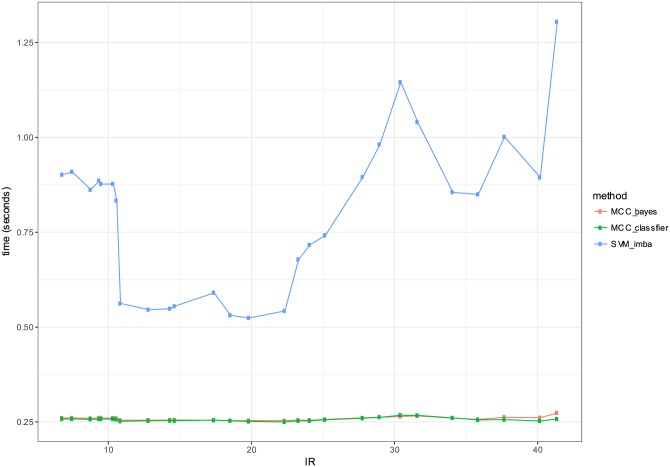
Data imbalance is frequently encountered in biomedical applications. Resampling techniques can be used in binary classification to tackle this issue. However such solutions are not desired when the number of samples in the small class is limited. Moreover the use of inadequate performance metrics, such as accuracy, lead to poor generalization results because the classifiers tend to predict the largest size class. One of the good approaches to deal with this issue is to optimize performance metrics that are designed to handle data imbalance. Matthews Correlation Coefficient (MCC) is widely used in Bioinformatics as a performance metric. We are interested in developing a new classifier based on the MCC metric to handle imbalanced data. We derive an optimal Bayes classifier for the MCC metric using an approach based on Frechet derivative. We show that the proposed algorithm has the nice theoretical property of consistency. Using simulated data, we verify the correctness of our optimality result by searching in the space of all possible binary classifiers. The proposed classifier is evaluated on 64 datasets from a wide range data imbalance. We compare both classification performance and CPU efficiency for three classifiers: 1) the proposed algorithm (MCC-classifier), the Bayes classifier with a default threshold (MCC-base) and imbalanced SVM (SVM-imba). The experimental evaluation shows that MCC-classifier has a close performance to SVM-imba while being simpler and more efficient.
Overview
The claims and statistics of this paper haven’t been checked yet.
Free: it reads the open-access text and checks the first 5 claims that cite a source we can check. Create a free account to check every claim.
Integrity signals
Registry
Cites
Statistics
Figures
Verification
Claims the paper makes
The claims and statistics of this paper haven’t been checked yet.
Free: it reads the open-access text and checks the first 5 claims that cite a source we can check. Create a free account to check every claim.
Claims other papers make about this one
Each is checked against this paper’s own text: does it say what the citing paper says it does?
The cited source says what the claim attributes to it.
In the citing paper
“since it has been shown to present a balanced score when dealing with imbalanced data [11, 6] as is our case with fewer manipulated images.”
From BioFors: A Large Biomedical Image Forensics Dataset (2021) · cites this paper as [6]
Self-check
Percentages, sums and reported differences re-computed from the paper’s own numbers.
The self-check needs the paper’s full text.
Citations
Cites
Advances in neural information processing systems 7
Cios, K., & Shields, M. (1997) · Neurocomputing · doi:10.1016/s0925-2312(97)90018-7 · Cited by 22,059
Comparison of the predicted and observed secondary structure of T4 phage lysozyme
Matthews, B. W. (1975) · Biochimica et Biophysica Acta (BBA) - Protein Structure · doi:10.1016/0005-2795(75)90109-9 · Cited by 5,399
A Probabilistic Theory of Pattern Recognition
Devroye, L., Györfi, L., & Lugosi, G. (1996) · Stochastic Modelling and Applied Probability · doi:10.1007/978-1-4612-0711-5 · Cited by 3,274
Assessing the accuracy of prediction algorithms for classification: an overview
Baldi, P., Brunak, S., Chauvin, Y., Andersen, C. A. F., & Nielsen, H. (2000) · Bioinformatics · doi:10.1093/bioinformatics/16.5.412 · Cited by 2,111
A sequential algorithm for training text classifiers
Lewis, D., & Gale, W. A. (1994) · arXiv (Cornell University) · doi:10.5555/188490.188495 · Cited by 1,731
A Sequential Algorithm for Training Text Classifiers
Lewis, D. D., & Gale, W. A. (1994) · SIGIR ’94 · doi:10.1007/978-1-4471-2099-5_1 · Cited by 1,208
Applying Support Vector Machines to Imbalanced Datasets
Akbani, R., Kwek, S., & Japkowicz, N. (2004) · Lecture Notes in Computer Science · doi:10.1007/978-3-540-30115-8_7 · Cited by 1,134
Yang, J., Roy, A., & Zhang, Y. (2013) · Bioinformatics · doi:10.1093/bioinformatics/btt447 · Cited by 1,035
MAQC Consortium (2010) · Nature Biotechnology · doi:10.1038/nbt.1665 · Cited by 889
Imbalanced Learning: Foundations, Algorithms, and Applications
(2013) · Wiley eBooks · doi:10.1002/9781118646106 · Cited by 831
Cited by
Items 701–800 of 1,000
A Data-Driven Method for Identifying Drought-Induced Crack-Prone Levees Based on Decision Trees
Chotkan, S., van der Meij, R., Klerk, W. J., Vardon, P. J., & Aguilar-López, J. P. (2022) · Sustainability · doi:10.3390/su14116820 · Cited by 6
Studziński, W., Przybyłek, M., & Gackowska, A. (2022) · Environmental Pollution · doi:10.1016/j.envpol.2022.120816 · Cited by 6
Luong, H. H., Tran, T. T., Nguyen, N. V., Le, A. D., Huyền, N. T. T., Nguyen, K. D., Tran, N. C., & Nguyễn, H. T. (2022) · Lecture notes in electrical engineering · doi:10.1007/978-981-16-2183-3_102 · Cited by 6
Automated classification of Chandra X-ray point sources using machine learning methods
Kumaran, S., Mandal, S., Bhattacharyya, S., & Mishra, D. (2023) · Monthly Notices of the Royal Astronomical Society · doi:10.1093/mnras/stad414 · Cited by 11
Danousis, M., & Goumopoulos, C. (2023) · Informatics · doi:10.3390/informatics10030059 · Cited by 10
Khattak, A., Zhang, J., Chan, P. W., Chen, F., & Almujibah, H. R. (2023) · Atmosphere · doi:10.3390/atmos15010020 · Cited by 10
Supervised learning-based multi-site lean blowout prediction for dry low emission gas turbine
Bahashwan, A. A., Ibrahim, R., Omar, M., & Amosa, T. I. (2023) · Expert Systems with Applications · doi:10.1016/j.eswa.2023.123035 · Cited by 9
ClustML: A measure of cluster pattern complexity in scatterplots learnt from human-labeled groupings
Hamza, M. M., Ullah, E., Baggag, A., Bensmail, H., Sedlmair, M., & Aupetit, M. J. M. (2024) · Information Visualization · doi:10.1177/14738716231220536 · Cited by 6
“We used 10-fold cross-validation on the training set, with 10 repetitions of the training with random initialization, To evaluate and select the best classifier on the test data, we computed the Matthews Correlation Coefficient (MCC), which is regarded as immune to large class imbalance [47, 48].”
MethodMoura, A. S., Halder, A. K., & Cordeiro, M. N. D. S. (2019) · Future Medicinal Chemistry · doi:10.4155/fmc-2018-0365 · Cited by 6
J Regularization Improves Imbalanced Multiclass Segmentation
Peña, F. A. G., Fernández, P. D. M., Tarr, P. T., Ren, T. I., Meyerowitz, E. M., & Cunha, A. (2020) · IEEE International Symposium on Biomedical Imaging (ISBI) · doi:10.1109/isbi45749.2020.9098550 · Cited by 34
“To compare the correlation between J and Matthews Correlation Coefficient, we used the settings for classifier C3 from [17].”
A multiple classifier system identifies novel cannabinoid CB2 receptor ligands
Ruano-Ordás, D., Burggraaff, L., Liu, R., van der Horst, C., Heitman, L. H., Emmerich, M., Méndez, J. R., Yevseyeva, I., & van Westen, G. J. P. (2019) · Journal of Cheminformatics · doi:10.1186/s13321-019-0389-9 · Cited by 6
“Concretely, we select Matthews Correlation Coefficient (MCC) [26, 27] and the Positive Predictive Value (PPV) [28–30] measures due to their demonstrated ability to minimize false negatives (FN) and false positives (FP) errors respectively.”
MethodA Two-Step Feature Space Transforming Method to Improve Credit Scoring Performance
Carta, S., Fenu, G., Ferreira, A., Recupero, D. R., & Saia, R. (2020) · Communications in computer and information science · doi:10.1007/978-3-030-66196-0_7 · Cited by 7
Chongomweru, H., & Kasem, A. (2021) · Lecture notes in electrical engineering · doi:10.1007/978-981-33-4069-5_21 · Cited by 6
On the applicability of search-based algorithms for software change prediction
Malhotra, R., & Khanna, M. (2021) · International Journal of Systems Assurance Engineering and Management · doi:10.1007/s13198-021-01099-7 · Cited by 6
“Also, many studies (Boughorbel et al. 2017; Chicco and Jurman 2020) have suggested the use of MCC performance metric for overcoming the class imbalance issue.”
BackgroundAbbaszadeh, B., Teixeira, C., & YAGOUB, M. C. E. (2021) · The Open Biomedical Engineering Journal · doi:10.2174/1874120702115010001 · Cited by 6
Best practices for supervised machine learning when examining biomarkers in clinical populations
Schultz, B. G., Joukhadar, Z., Nattala, U., Quiroga, M. D. M., Bolk, F., & Vogel, A. P. (2021) · Elsevier eBooks · doi:10.1016/b978-0-12-822884-5.00013-1 · Cited by 9
Robust multi-class model constructed for rapid quality control of Cordyceps sinensis
Guo, H., Yang, X. H., Jing, R., Li, Y., Tan, F., & Li, M. (2021) · Microchemical Journal · doi:10.1016/j.microc.2021.106825 · Cited by 6
Okyay, S., & Aygün, S. (2021) · PeerJ Computer Science · doi:10.7717/peerj-cs.784 · Cited by 6
Improving software fault prediction in imbalanced datasets using the under-sampling approach
Abaei, G., Tah, W. Z., Toh, J. Z. W., & Hor, E. S. J. (2022) · International Conference on Software and Computer Applications (ICSCA) · doi:10.1145/3524304.3524310 · Cited by 7
“[4] claimed that performing resampling would not be very desirable in some instances where the dataset is imbalanced and small.”
BackgroundKhan, R. N. M., Hussain, L., Alluhaidan, A. S., Majid, A., Lone, K. J., Verdiyev, R., Al‐Wesabi, F. N., & Duong, T. Q. (2022) · Waves in Random and Complex Media · doi:10.1080/17455030.2022.2091807 · Cited by 7
“F -measure is a continuous and monotonically increasing function of TPR, optimized by the threshold-based classifier [45], mathematically:”
ML-based reconfigurable symbol decoder: An alternative for next-generation communication systems
Srivastava, S., & Dash, P. P. (2022) · Engineering Applications of Artificial Intelligence · doi:10.1016/j.engappai.2022.105123 · Cited by 6
Machine Learning Empowered Efficient Intrusion Detection Framework
Shafique, H., Shah, A. A., Qureshi, M. A., Ehsan, M. K., & Amirzada, M. R. (2022) · VFAST Transactions on Software Engineering · doi:10.21015/vtse.v10i2.1017 · Cited by 9
CodeDoctor: multi-category code review comment generation
Li, Y., Wu, Y., Wang, Z., Huang, L., Wang, J., Li, J. K., & Huang, M. (2025) · Automated Software Engineering · doi:10.1007/s10515-025-00491-y · Cited by 8
“It is particularly suitable for imbalanced datasets(Boughorbel et al. 2017; Gaudreault and Branco 2024).”
Paixao, L. D. A. G., Rogers, W. P., & de Jesus, E. B. (2025) · Mining · doi:10.3390/mining5020024 · Cited by 6
“A dataset is considered imbalanced when the sample size in the data classes is un-evenly distributed [39] or, in other words, when it contains more occurrences from one class than the others [13].”
Diffusion GAN-Based Oversampling for Imbalanced Tabular Data
Ren, S., Ding, J., & Cheung, Y. (2025) · IEEE Transactions on Knowledge and Data Engineering · doi:10.1109/tkde.2025.3639433 · Cited by 7
Jlifi, B., Diaye, M., Guesmi, K., Ferjani, S., & Hamdi, N. (2026) · Computational Economics · doi:10.1007/s10614-025-11260-0 · Cited by 7
Kumar, S., Misra, S. K., Tiwari, A., Katiyar, A., Awasthi, A., Singh, S. K., Katiyar, A., Dhawan, A., & Kumar, A. (2026) · Talanta · doi:10.1016/j.talanta.2026.129802 · Cited by 7
A systematic approach for learning imbalanced data: enhancing zero-inflated models through boosting
Jeong, Y., Lee, K., Park, Y. W., & Han, S. (2024) · Machine Learning · doi:10.1007/s10994-024-06558-3 · Cited by 6
Corbacho-Abelaira, D., Casal-Guisande, M., Abelaira, F. C., Arnaiz-Fernández, M., López, C. T., Sánchez-Gracián, C. D., Sánchez-Montañés, M. A., Ruano‐Raviña, A., & Fernández‐Villar, A. (2024) · IEEE Access · doi:10.1109/access.2024.3424907 · Cited by 5
“…similar to that described by Casal-Guisande et al. [11], selecting the threshold value that maximises the Matthews correlation coefficient (Mcc) [41], [42], [43] Next, the associated receiver operating characteristic (ROC) curve and system operating point, which is related to the aforementioned…”
Towards prompt tuning-based software vulnerability assessment with continual learning
Xue, J., Chen, X., Wang, J., & Cui, Z. (2024) · Computers & Security · doi:10.1016/j.cose.2024.104184 · Cited by 7
Aziz, K., Chen, F., Khan, I., Ullah, Z., Jamjoom, M. M., & Khan, M. I. (2025) · Transportmetrica A Transport Science · doi:10.1080/23249935.2025.2542283 · Cited by 5
“In comparison to DES and static selection methods, traditional statistical models like MN Logit, GO Logit, and GO Probit models were less effective in capturing complex relationships in the data, as indicated by their lower Balanced Accuracy and MCC scores in Table 6.”
InfluentialEnhanced detection of patients with previous COVID-19: superiority of the double diffusion technique
Zavorsky, G. S., Barisione, G., Gille, T., Negro, R. W. D., Fernández, M. N., Seccombe, L. M., Imeri, G., Marco, F. D., Mortensen, J., Salvioni, E., et al. (2025) · BMJ Open Respiratory Research · doi:10.1136/bmjresp-2024-002561 · Cited by 8
“Agreement between classifications of DLNO ₅ₛ LLN 5 and DLCO ₅ₛ LLN 5 (where the LLN 5 is 5 th percentile) was evaluated using Cohen’s kappa, with 95% CIs obtained via bootstrap resampling and interpreted according to standard guidelines.”
Learning to Check Contract Inconsistencies
Zhang, S., Zhao, J., Wang, P., Xu, N., Yang, Y., Liu, Y., Huang, Y., & Feng, J. (2021) · Proceedings of the AAAI Conference on Artificial Intelligence · doi:10.1609/aaai.v35i16.17698 · Cited by 12
An ASR-Based Tutor for Learning to Read: How to Optimize Feedback to First Graders
Bai, Y., Tejedor-Garcı́a, C., Hubers, F., Catia Cucchiarini, A., & Strik, H. (2021) · Lecture notes in computer science · doi:10.1007/978-3-030-87802-3_6 · Cited by 5
Predictive Comparison Between Random Machines and Random Forests
Maia, M., de Azevedo, A. R., & Ara, A. (2021) · Journal of Data Science · doi:10.6339/21-jds1025 · Cited by 7
Koya, A. M., & Deepthi, P. P. (2021) · Journal of Ambient Intelligence and Humanized Computing · doi:10.1007/s12652-021-03543-9 · Cited by 5
“MCC denotes Matthews correlation coefficient (Boughorbel et al. 2017) and it is a binary classification rate that achieves a high score only if the predictor is able to correctly predict the majority of positive data instances and the majority of negative data instances.”
BackgroundRisk assessment of ICU patients through deep learning technique: A big data approach
Huang, X., Shan, S., Khan, Y. A., Salem, S. A. M., Mohamed, A., & Attia, E.-A. (2022) · Journal of Global Health · doi:10.7189/jogh.12.04044 · Cited by 6
A computational model of facilitation in online dispute resolution
Branting, L. K., McLeod, S., Howell, S., Weiss, B., Profitt, B., Tanner, J., Gross, I., & Shin, D. (2022) · Artificial Intelligence and Law · doi:10.1007/s10506-022-09318-7 · Cited by 22
“We measured predictive performance both in F1 and in Matthews Correlation Coefficient (MCC), which generally better compensates for class skew than F1 (Boughorbel et al. 2017).”
MethodThe Performance Index of Convolutional Neural Network-Based Classifiers in Class Imbalance Problem
Liu, Y., & Lai, K. W. C. (2022) · Pattern Recognition · doi:10.1016/j.patcog.2022.109284 · Cited by 7
A Dashboard to Provide Instructors with Automated Feedback on Students’ Peer Review Comments
Dood, A. J., Das, K., Qian, Z., Finkenstaedt-Quinn, S. A., Gere, A. R., & Shultz, G. V. (2023) · International Conference on Learning Analytics and Knowledge (LAK) · doi:10.1145/3576050.3576087 · Cited by 6
Black-grass (Alopecurus myosuroides) in cereal multispectral detection by UAV
Cox, J., Li, X., Fox, C., & Coutts, S. (2023) · Weed Science · doi:10.1017/wsc.2023.41 · Cited by 5
“Finally, we use a balance-corrected measure of the correlation between the observed data and the predictions, MCC (Equation 6) (Boughorbel et al. 2017; Matthews 1975).”
MethodAI-driven drowned-detection system for rapid coastal rescue operations
Dileep, P., Durairaj, M., Subudhi, S., Rao, V. V. R. M., Jayanthi, J. G., & Suganthi, D. (2023) · Spatial Information Research · doi:10.1007/s41324-023-00549-7 · Cited by 5
“MCC seems to be a numeri - cal measure with values ranging from − 1, which indicates a perfect forecast, to + 1, which indicates an inverted fore - casting [21 – 23].”
Soil physicochemical properties explain land use/cover histories in the last sixty years in China
Chen, H., Rahmati, M., Montzka, C., Gao, H., & Vereecken, H. (2024) · Geoderma · doi:10.1016/j.geoderma.2024.116908 · Cited by 6
Natural Language Processing in Education System
Bode, S. P., & Satpute, R. S. (2024) · DMIHER International Conference on Artificial Intelligence in Healthcare, Education and Industry (IDICAIHEI) · doi:10.1109/idicaiei61867.2024.10842725 · Cited by 12
Multi-domain Urdu fake news detection using pre-trained ensemble model
Harris, S., Hadi, H. J., Ahmad, N., & Alshara, M. A. (2025) · Scientific Reports · doi:10.1038/s41598-025-91054-4 · Cited by 9
“Additionally, we measure model performance using the Matthews Correlation Co-efficient (MCC) 64,65 , which concentrates on true negative values and insights far more accurate prediction performance.”
Casal-Guisande, M., Represas‐Represas, C., Golpe, R., Comesaña-Campos, A., Fernández-García, A., Torres‐Durán, M., & Fernández‐Villar, A. (2025) · International Journal of Intelligent Systems · doi:10.1155/int/5556476 · Cited by 5
XceptMPX: A Robust Deep Learning-Powered Web System for Mpox Detection and Classification
Ahmed, K. R., Sarkar, S. C., Masum, A. K. M., Khan, M. N. A., Hossain, Z., Miah, I., & Mahmud, F. U. (2025) · IEEE Access · doi:10.1109/access.2025.3600282 · Cited by 10
“The MCC was used as a strong statistical measure for concordance estimation of predicted vs actual classification, particularly in unbalanced data sets [9].”
Aging Detection of Electrical Point Machines Based on Support Vector Data Description
Sa, J., Choi, Y., Chung, Y., Lee, J., & Park, D. (2017) · Symmetry · doi:10.3390/sym9120290 · Cited by 5
“MCC returns a value between −1 and +1.”
MethodInfluentialA Deep Meta-learning Framework for Heart Disease Prediction
Salem, I., Fathalla, R., & Kholeif, M. (2019) · IEEE International Scientific Conference on Informatics (Informatics) · doi:10.1109/informatics47936.2019.9119268 · Cited by 5
“…they explore a number of ANN techniques to compare the results before and cross-validation as well as Matthews Correlation Coefficient (MCC) [30] to measure the quality of the classifications architecture, yielded about 99% of detecting accuracy 0.98 as the MCC figure, which significantly…”
MethodInfluentialIdentification of Antimicrobial Peptides from Macroalgae with Machine Learning
Caprani, M., Slattery, O., O’Keeffe, J., & Healy, J. (2020) · Advances in intelligent systems and computing · doi:10.1007/978-3-030-54568-0_1 · Cited by 5
Tuning intrinsic disorder predictors for virus proteins
Almog, G., Olabode, A. S., & Poon, A. F. Y. (2020) · Virus Evolution · doi:10.1093/ve/veaa106 · Cited by 5
“We used both the MCC (ranging from (cid:2) 1 to þ 1 (Boughorbel, Jarray, and El-Anbari 2017)) and area under the receiver-operator characteristic curve (AUC, ranging from 0 to 1) to quantify the performance of each predictor.”
MethodAn analysis of aggregated coupling's suitability for software defect prediction
Miholca, D.-L., & Marian, Z. (2020) · International Symposium on Symbolic and Numeric Algorithms for Scientific Computing (SYNASC) · doi:10.1109/synasc51798.2020.00032 · Cited by 5
“In order to have a better evaluation we have decided to consider in the experimental evaluation another metric, called the Matthews Correlation Coefficient (MCC), as well [33].”
MethodChayangkoon, N., & Srivihok, A. (2021) · International Journal of Power Electronics and Drive Systems/International Journal of Electrical and Computer Engineering · doi:10.11591/ijece.v11i4.pp3617-3628 · Cited by 6
“Performances testing We used 10-fold cross-validation for the measurement of TMTA performance using various metrics: accuracy [17], F-measure [18], AUC [19], Kappa [20], MCC [21, 22] and runtime [23].”
MethodGupta, K., Goldbaum, M. H., & Yousefi, S. (2021) · IEEE/CVF Conference on Computer Vision and Pattern Recognition Workshops (CVPRW) · doi:10.1109/cvprw53098.2021.00255 · Cited by 5
Research on Detection Method of Coating Defects Based on Machine Vision
Hui, Z., Lv, Y., Sha, J., Peng, R., Chen, Z., & Wang, G. (2021) · IEEE International Conference on Artificial Intelligence and Computer Applications (ICAICA) · doi:10.1109/icaica52286.2021.9498238 · Cited by 5
Application of BigML in the Classification Evaluation of Top Coal Caving
Wang, M., Tai, C., Zhang, Q., Yang, Z., Li, J., Shen, K., & Wang, K. (2021) · Shock and Vibration · doi:10.1155/2021/8552247 · Cited by 5
“*e comprehensive indicators mainly include F-measure (also known as F-score, F1) [40], Matthews correlation coefficient (Phi coefficient) [41], Kendall’s tau, and Spearman’s rho, used for binary classification.”
MethodRandom Forest Based Multiclass Classification Approach for Highly Skewed Particle Data
Yalçın, Ş. (2023) · Journal of Scientific Computing · doi:10.1007/s10915-023-02144-2 · Cited by 6
Gorzałczany, M. B., Piekoszewski, J., & Rudziński, F. (2018) · IEEE International Symposium on Industrial Electronics (ISIE) · doi:10.1109/isie.2018.8433664 · Cited by 5
“Despite of that, our approach, as shown in Table III, outperforms all of them in terms of the overall clustering accuracy and, even more importantly, also in terms of Matthews Correlation Coefficient (MCC), which is widely used performance metric designed to handle imbalanced data - see [20] for details.”
MethodUsing Bayesian Networks and Machine Learning to Predict Computer Science Success
Nudelman, Z., Moodley, D., & Berman, S. (2018) · Communications in computer and information science · doi:10.1007/978-3-030-05813-5_14 · Cited by 10
Heinsvig, P. J., Nielsen, L. S., & Lindholst, C. (2020) · Journal of Chromatography A · doi:10.1016/j.chroma.2020.460989 · Cited by 5
Artificial Intelligence in Medicine
Strümke, I., Hicks, S. A., Thambawita, V. L., Jha, D., Parasa, S., Riegler, M. A., & Halvorsen, P. (2021) · Springer eBooks · doi:10.1007/978-3-030-58080-3_163-1 · Cited by 6
Intercomparison of flood inundation models across land use types and hydrological flood stages
Nikrou, P., Seyvani, S., Cohen, S., Gangrade, S., Gutenson, J. L., Tian, D., Baruah, A., Follum, M. L., & Kao, S.-C. (2026) · Journal of Hydrology · doi:10.1016/j.jhydrol.2026.135410 · Cited by 10
Predição de sinistros agrícolas: uma abordagem comparativa utilizando aprendizagem de máquina
Mota, A. A. L., Miquelluti, D. L., & Ozaki, V. A. (2020) · Economia Aplicada · doi:10.11606/1980-5330/ea161194 · Cited by 9
“Como mostram Abd Elrahman & Abraham (2013) e Boughorbel et al. (2017): Precisão Categoria Negativa = VN VN + FN (6) Precisão Categoria Positiva = VP VP + FP (7) MCC = VP ×VN − FP × FN √ (VP + FP) (VP + FN ) (VN + FP) (VN + FN ) (8) A precisão foca na proporção de acertos na categoria positiva (ou…”
BackgroundResearch on Performance Metrics and Augmentation Methods in Lung Nodule Classification
Luo, D., Yang, I., Bae, J.-S., & Woo, Y. (2024) · Applied Sciences · doi:10.3390/app14135726 · Cited by 4
Forecasting Financial Distress for Shaping Public Policy: An Empirical Investigation
Sethi, S. R., & Mahadik, D. A. (2025) · Acta Informatica Pragensia · doi:10.18267/j.aip.253 · Cited by 6
Xiao-jie, H., Chen, J., & Liu, P. (2025) · Ecotoxicology and Environmental Safety · doi:10.1016/j.ecoenv.2025.117707 · Cited by 8
Duhan, N., & Kaundal, R. (2025) · Frontiers in Plant Science · doi:10.3389/fpls.2025.1411525 · Cited by 6
McGlinchey, C., Palenzuela, J. M. T., Vilas, L. G., Werther, M., Jiang, D., Tyler, A. N., Pazos, Y., & Spyrakos, E. (2025) · ISPRS Journal of Photogrammetry and Remote Sensing · doi:10.1016/j.isprsjprs.2025.06.017 · Cited by 3
“While class imbalance can affect the accuracy assessment of a classification for some metrics (Chicco and Jurman, 2020; Cao et al., 2020), the F1 score and MCC are more robust metrics for such scenarios (Boughorbel et al., 2017; Chicco et al., 2021; Diallo et al., 2024).”
Hausmann, F., & Kurtz, S. (2021) · Algorithms for Molecular Biology · doi:10.1186/s13015-021-00199-0 · Cited by 4
“MCCk is a single value characterizing a complete confusion table [52] even if the classes are very imbalanced [53].”
BackgroundBacong, J. R. C., & Juanico, D. E. (2021) · Frontiers in Plant Science · doi:10.3389/fpls.2021.613507 · Cited by 5
“The more false-positive or false-negative peaks that the model can classify, the lower its MCC value will be.”
MethodInfluentialRotation Invariance in Graph Convolutional Networks
Mac, N. A., & Nguyen, H. S. (2021) · Annals of Computer Science and Information Systems · doi:10.15439/2021f140 · Cited by 5
“Matthews Correlation Coefficient (MCC) or phi coefficient, much like F-Score, is a popular statistic in machine learning [31], [32].”
BackgroundXia, Y., Jiang, M., Luo, Y., Feng, G., Jia, G., Zhang, H., Wang, P., & Ge, R. (2022) · Journal of Computational Biology · doi:10.1089/cmb.2022.0109 · Cited by 4
“Matthews correlation coefficient (MCC) takes into account TP and FP and negatives and is generally regarded as a balanced measure that can be used even if the distribution is very unbalanced between positives and negatives (Boughorbel et al., 2017).”
DeepLux: A data-driven method and benchmark for 3D illuminance maps estimation
Tsesmelis, T., Carissimi, N., & Bue, A. D. (2023) · Lighting Research & Technology · doi:10.1177/14771535221148736 · Cited by 4
Sawadogo, Z., Dembélé, J. M., Mendy, G., & Ouya, S. (2023) · International Conference on Advanced Communication Technology · doi:10.23919/icact56868.2023.10079245 · Cited by 5
“It is useful when the classes are unbalanced[46].”
BackgroundImplementation of Ensemble Methods on Classification of CDK2 Inhibitor as Anti-Cancer Agent
Kurniawan, I., Anggraini, M. M., Aditsania, A., & Setiawan, E. B. (2023) · IJCCS (Indonesian Journal of Computing and Cybernetics Systems) · doi:10.22146/ijccs.78537 · Cited by 4
Abrasaldo, P. M. B., Zarrouk, S. J., & Kempa-Liehr, A. W. (2023) · Geothermics · doi:10.1016/j.geothermics.2023.102756 · Cited by 4
Abdollahifard, S., Farrokhi, A., Mowla, A., & Liebeskind, D. S. (2024) · Neurologic Clinics · doi:10.1016/j.ncl.2024.03.001 · Cited by 4
Developing a Generalizable Spectral Classifier for Rhodamine Detection in Aquatic Environments
Pérez-García, Á., Lorenzo, A. M., Hernández-Suárez, E., Rodríguez-Molina, A., van Emmerik, T. H. M., & Lopez, J. F. (2024) · Remote Sensing · doi:10.3390/rs16163090 · Cited by 6
“The F1 score is particularly useful with imbalanced class distributions, as it emphasizes the accuracy of the smaller classes [39].”
Li, Y., Guo, S., Guo, X., Zhao, P. F., Ren, X., & Wang, H. (2025) · Expert Systems with Applications · doi:10.1016/j.eswa.2025.126543 · Cited by 8
Halder, A. K., Pradhan, T., & Cordeiro, M. N. D. S. (2025) · Applied Sciences · doi:10.3390/app15031246 · Cited by 5
Priest, B. W., Pearce, R., & Sanders, G. (2018) · IEEE High Performance Extreme Computing Conference · doi:10.1109/hpec.2018.8547721 · Cited by 4
“(6) and is a balanced measure that returns a value in [−1, 1], where 0 indicates no better than random, −1 indicates total disagreement, and 1 indicates total agreement [28].”
BackgroundMethodEarly and Late Fusion of Classifiers for the MediaEval Medico Task.
Taschwer, M., Primus, M. J., Schoeffmann, K., & Marques, O. (2018) · MediaEval · Cited by 4
Geetha, R., & Priya, E. (2021) · Elsevier eBooks · doi:10.1016/b978-0-12-822271-3.00005-0 · Cited by 4
Variations in sustained home visiting care for mothers and children experiencing adversity
Kanda, K., Blythe, S. L., Grace, R., Elcombe, E. L., & Kemp, L. (2021) · Public Health Nursing · doi:10.1111/phn.13014 · Cited by 6
Efficient balanced focal loss function for manipulated images detection
Biach, F. Z. E., Iala, I., Laanaya, H., & Minaoui, K. (2021) · International Conference on Intelligent Computing in Data Sciences (ICDS) · doi:10.1109/icds53782.2021.9626750 · Cited by 4
Identifying User Behavior Profiles in Ethereum Using Machine Learning Techniques
Valadares, J. A., Oliveira, V. C., Sousa, J. E. D. A., Bernardino, H. S., Villela, S. M., Vieira, A. B., & Gonçalves, G. D. (2021) · IEEE International Conference on Blockchain (Blockchain) · doi:10.1109/blockchain53845.2021.00052 · Cited by 4
Biach, F. Z. E., Iala, I., Laanaya, H., & Minaoui, K. (2022) · International Journal of Advanced Computer Science and Applications · doi:10.14569/ijacsa.2022.0130162 · Cited by 4
Simulating urban growth through case-based reasoning
Ye, X., Yu, W., Yu, W. H., & Lv, L. (2022) · European Journal of Remote Sensing · doi:10.1080/22797254.2022.2056518 · Cited by 4
“(8; Boughorbel et al., 2017; Kantakumar et al., 2019).”
BackgroundZiane, A., Douaoui, A., Fernández, M. P., & Larid, M. (2022) · Journal of the Indian Society of Remote Sensing · doi:10.1007/s12524-022-01552-5 · Cited by 4
“This performance validation of the ANNs has been done by the application of three criteria: coefficient of correlation (Boughorbel et al., 2017), Root Mean Square Error (Chai & Draxler, 2014) and Lin’s Concordance Correlation Coefficient (Lawrence & Lin, 1989).”
MethodDetection of Adversarial Attacks by Observing Deep Features with Structured Data Algorithms
Puccetti, T., Ceccarelli, A., Zoppi, T., & Bondavalli, A. (2023) · ACM Symposium on Applied Computing · doi:10.1145/3555776.3577629 · Cited by 4
Circumventing data imbalance in magnetic ground state data for magnetic moment predictions
Sanspeur, R. Y., & Kitchin, J. R. (2024) · Machine Learning Science and Technology · doi:10.1088/2632-2153/ad23fb · Cited by 8
“While no one metric can summarize the effectiveness of a model, we have chosen the F1 score and MCC score since they have beneficial properties in the face of data imbalance [35] in the context of binary classification [36].”
MethodKheraif, A. A. A., Hashem, M., & Esawy, M. S. S. A. (2018) · Journal of Medical Systems · doi:10.1007/s10916-018-1049-8 · Cited by 4
Evolutionary deep belief networks with bootstrap sampling for imbalanced class datasets
Amri, A. A., Ismail, A. R., & Mohammad, O. A. (2019) · International Journal of Advances in Intelligent Informatics · doi:10.26555/ijain.v5i2.350 · Cited by 4
“The datasets are also chosen based on similar studies using the same datasets conducted by Weiss and Provost [1], Zhang et al. [46], Boughorbel et al. [47], and Lopez et al. [48].”
MethodMakarov, V., & Gorlin, A. (2019) · Computational Biology and Chemistry · doi:10.1016/j.compbiolchem.2019.06.008 · Cited by 4
Random Machines: A Bagged-Weighted Support Vector Model with Free Kernel Choice
Ara, A., Maia, M., Louzada, F., & Macêdo, S. (2021) · Journal of Data Science · doi:10.6339/21-jds1014 · Cited by 6
Performance Improvement of Convolutional Neural Network Using Random Under Sampling
Ghosh, K., Sarkar, A., Banerjee, A., & Chatterjee, S. (2021) · Lecture notes in networks and systems · doi:10.1007/978-981-15-9433-5_20 · Cited by 4
Leveraging an Efficient and Semantic Location Embedding to Seek New Ports of Bike Share Services
Wang, Y., Wang, C., Ling, Y., Yokoyama, K., Wu, H.-T., & Fang, Y. (2020) · IEEE International Conference on Big Data (BigData) · doi:10.1109/bigdata50022.2020.9378326 · Cited by 4
“Since the meta label data is in-balanced for each label, we evaluate the obtained location embedding vectors by using statistical metrics including precision, recall, F1-score [17] and Matthews correlation coefficient (MCC) [18].”
Data Mining and Machine Learning
Sasao, T. (2023) · Synthesis lectures on digital circuits and systems · doi:10.1007/978-3-031-35347-5_7 · Cited by 4
Predictive analytics in healthcare epileptic seizure recognition
Bhowmick, A., Abdou, T., & Bener, A. (2018) · Computer Science and Software Engineering · Cited by 7
Das, S. S. S., Shanto, S. K., Rahman, M., Islam, M. S., Rahman, A. H., Masud, M. M., & Ali, M. E. (2020) · arXiv (Cornell University) · Cited by 4
Metadata
- Authors
- Boughorbel, S., Jarray, F., & El-Anbari, M.
- Affiliations
- Sidra Medical and Research Center (QA)
- Conservatoire National des Arts et Métiers (FR)
- Corresponding author
- Boughorbel, Sabri
- Venue
- PLOS ONE
- Publisher
- Public Library of Science (PLoS)
- Published
- 2017-06-02
- Volume
- 12
- Issue
- 6
- Pages
- e0177678
- ISSN
- 1932-6203 (ISSN-L)
- PMC
- PMC5456046
- OpenAlex
- W2620760558
- Cited by
- 1,222
- References
- 29
- Citations by year
- 2026: 90 · 2025: 104 · 2024: 111 · 2023: 163 · 2022: 179 · 2021: 224 · 2020: 165 · 2019: 120 · 2018: 64 · 2017: 2
- FWCI
- 57.24
- Type
- journal article
- Language
- en
- Open access
- gold
- doi.org
- Licence
- Locations
- PLoS ONE (publishedVersion, cc-by)
- Europe PMC (PubMed Central) (publishedVersion, cc-by)
- PubMed Central (publishedVersion, cc-by)
- PubMed (publishedVersion)
- RePEc: Research Papers in Economics (submittedVersion)
- DOAJ (DOAJ: Directory of Open Access Journals) (submittedVersion, cc-by-sa)
- Figshare (submittedVersion, cc-by)
- Funders
- Qatar Foundation
- Topics
- Physical Sciences › Computer Science › Artificial Intelligence › Imbalanced Data Classification Techniques
- Physical Sciences › Computer Science › Artificial Intelligence › Machine Learning and Data Classification
- Physical Sciences › Computer Science › Artificial Intelligence › Data Stream Mining Techniques
- Keywords
- class imbalance, Matthews correlation coefficient, Fréchet derivative, binary classification, biomedical classification
- MeSH terms
- Algorithms, Bayes Theorem, Models, Theoretical, Computational Biology, Support Vector Machine
About these checks
Registry, retraction, Cites and statistics results are computed, not judged, with one exception: a printed reference that no index lists is read once by a model before it counts as a citation error. Claims are extracted by a model and kept only when their quote appears verbatim in the text; each cited source is then checked, with a model’s help, for whether it says what the claim relies on. Those verdicts can be wrong — read the claim’s quote and the cited source before relying on one.
Statistics and arithmetic are recomputed, not judged.
Confidence bands are shown only for fields calibrated on our annotated test set. None is calibrated yet, so no band is shown.
What counts as a claim ›How we measure confidence ›How we check this ›
Are you an author, or do you see a problem with this page? Request a review
Data sources
Bibliographic data: Semantic Scholar, OpenAlex, Crossref.
Contains information from the Semantic Scholar Academic Graph Datasets, made available under the ODC Attribution License (ODC-BY 1.0).
Semantic Scholar’s data is described in: Kinney, R., et al. (2023). The Semantic Scholar Open Data Platform. arXiv:2301.10140.
