

The DOI matches its Crossref record; 59 of the 61 references it cites were found in a registry or an index.
Epistemic beliefs’ role in promoting misperceptions and conspiracist ideation
Open accessAbstract
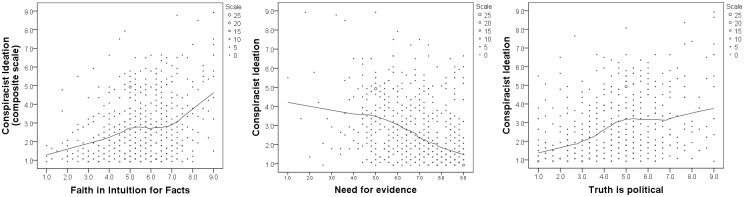
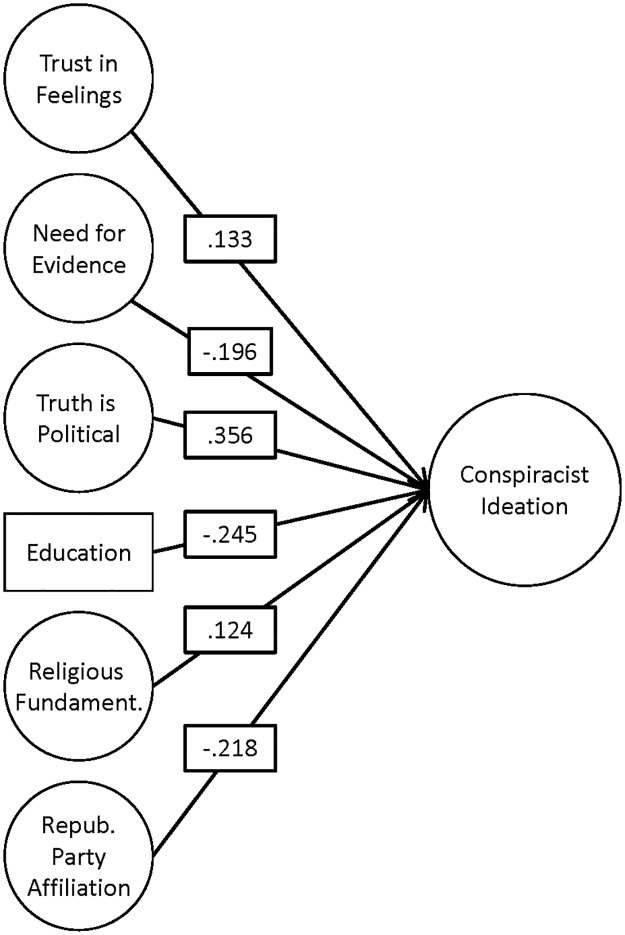
Widespread misperceptions undermine citizens' decision-making ability. Conclusions based on falsehoods and conspiracy theories are by definition flawed. This article demonstrates that individuals' epistemic beliefs-beliefs about the nature of knowledge and how one comes to know-have important implications for perception accuracy. The present study uses a series of large, nationally representative surveys of the U.S. population to produce valid and reliable measures of three aspects of epistemic beliefs: reliance on intuition for factual beliefs (Faith in Intuition for facts), importance of consistency between empirical evidence and beliefs (Need for evidence), and conviction that "facts" are politically constructed (Truth is political). Analyses confirm that these factors complement established predictors of misperception, substantively increasing our ability to explain both individuals' propensity to engage in conspiracist ideation, and their willingness to embrace falsehoods about high-profile scientific and political issues. Individuals who view reality as a political construct are significantly more likely to embrace falsehoods, whereas those who believe that their conclusions must hew to available evidence tend to hold more accurate beliefs. Confidence in the ability to intuitively recognize truth is a uniquely important predictor of conspiracist ideation. Results suggest that efforts to counter misperceptions may be helped by promoting epistemic beliefs emphasizing the importance of evidence, cautious use of feelings, and trust that rigorous assessment by knowledgeable specialists is an effective guard against political manipulation.
Overview
The claims and statistics of this paper haven’t been checked yet.
Run the check — free, no account needed. It reads the open-access text and checks the sources it cites.
Integrity signals
Registry
Cites
Statistics
Figures
Verification
Claims the paper makes
The claims and statistics of this paper haven’t been checked yet.
Run the check — free, no account needed. It reads the open-access text and checks the sources it cites.
Claims other papers make about this one
Each is checked against this paper’s own text: does it say what the citing paper says it does?
In the citing paper
“reliance on emotion is associated with misinformation sharing (Weeks, 2015) or believing in conspiracy theories (Garrett & Weeks, 2017;Martel et al., 2019)”
From The fingerprints of misinformation: how deceptive content differs from reliable sources in terms of cognitive effort and appeal to emotions (2022) · cites this paper as Garrett & Weeks, 2017
Self-check
Percentages, sums and reported differences re-computed from the paper’s own numbers.
The self-check needs the paper’s full text.
Citations
Cites
Hu, L., & Bentler, P. M. (1999) · Structural Equation Modeling A Multidisciplinary Journal · doi:10.1080/10705519909540118 · Cited by 108,788
(2011) · Cited by 14,317
Telling more than we can know: Verbal reports on mental processes.
Nisbett, R. E., & Wilson, T. D. (1977) · Psychological Review · doi:10.1037/0033-295x.84.3.231 · Cited by 11,317
(1994) · DigitalGeorgetown (Georgetown University Library) · Cited by 10,542
Laboratory Life: The Construction of Scientific Facts
Latour, B. (1986) · DigitalGeorgetown (Georgetown University Library) · Cited by 7,491
(2010) · Cited by 7,034
Why has Critique Run out of Steam? From Matters of Fact to Matters of Concern
Latour, B. (2004) · Critical Inquiry · doi:10.1086/421123 · Cited by 5,595
A Brief Tutorial on the Development of Measures for Use in Survey Questionnaires
Hinkin, T. R. (1998) · Organizational Research Methods · doi:10.1177/109442819800100106 · Cited by 4,095
(2011) · Choice Reviews Online · doi:10.5860/choice.48-6243 · Cited by 3,575
When Corrections Fail: The Persistence of Political Misperceptions
Nyhan, B., & Reifler, J. (2010) · Political Behavior · doi:10.1007/s11109-010-9112-2 · Cited by 3,173
Research works printed but not linked: 1
- M Hemingway, 2011, Lies, damned lies, and ‘fact checking’, The Weekly Standard, 17
Cited by
Sorted by citations
Science audiences, misinformation, and fake news
Scheufele, D. A., & Krause, N. M. (2019) · Proceedings of the National Academy of Sciences · doi:10.1073/pnas.1805871115 · Cited by 878
Reliance on emotion promotes belief in fake news
Martel, C., Pennycook, G., & Rand, D. G. (2020) · Cognitive Research: Principles and Implications · doi:10.1186/s41235-020-00252-3 · Cited by 470
Durably reducing conspiracy beliefs through dialogues with AI
Costello, T. H., Pennycook, G., & Rand, D. G. (2024) · Science · doi:10.1126/science.adq1814 · Cited by 354
van der Linden, S., Panagopoulos, C., Azevedo, F., & Jost, J. T. (2020) · Political Psychology · doi:10.1111/pops.12681 · Cited by 294
Ideological asymmetries in conformity, desire for shared reality, and the spread of misinformation
Jost, J. T., van der Linden, S., Panagopoulos, C., & Hardin, C. D. (2018) · Current Opinion in Psychology · doi:10.1016/j.copsyc.2018.01.003 · Cited by 242
Metadata
- Authors
- Garrett, R. K., & Weeks, B. E.
- Affiliations
- The Ohio State University (US)
- University of Michigan (US)
- Corresponding author
- Garrett, R. Kelly
- Venue
- PLOS ONE
- Publisher
- Public Library of Science (PLoS)
- Published
- 2017-09-18
- Volume
- 12
- Issue
- 9
- Pages
- e0184733
- ISSN
- 1932-6203 (ISSN-L)
- PMC
- PMC5603156
- OpenAlex
- W2756124350
- Cited by
- 167
- References
- 61
- Citations by year
- 2026: 15 · 2025: 23 · 2024: 31 · 2023: 27 · 2022: 24 · 2021: 15 · 2020: 17 · 2019: 8 · 2018: 6 · 2017: 1
- FWCI
- 22.34
- Type
- journal article
- Language
- en
- Open access
- gold
- doi.org
- Licence
- Locations
- PLoS ONE (publishedVersion, cc-by)
- PubMed Central (publishedVersion, cc-by)
- PubMed (publishedVersion)
- RePEc: Research Papers in Economics (submittedVersion)
- DOAJ (DOAJ: Directory of Open Access Journals) (submittedVersion)
- Figshare (submittedVersion, cc-by)
- Funders
- Division of Information and Intelligent Systems (1149599)
- Topics
- Social Sciences › Sociology and Political Science › Misinformation and Its Impacts
- Social Sciences › Psychology › Developmental and Educational Psychology › Educational Strategies and Epistemologies
- Social Sciences › Arts and Humanities › Philosophy › Epistemology, Ethics, and Metaphysics
- Keywords
- epistemological beliefs, conspiracist ideation, misunderstanding, conspiracy theories, faith in intuition, belief accuracy, political manipulation, scientific misinformation
- MeSH terms
- Culture, Decision Making, Humans, Politics, United States
About these checks
Registry, retraction, Cites and statistics results are computed, not judged, with one exception: a printed reference that no index lists is read once by a model before it counts as a citation error. Claims are extracted by a model and kept only when their quote appears verbatim in the text; each cited source is then checked, with a model’s help, for whether it says what the claim relies on. Those verdicts can be wrong — read the claim’s quote and the cited source before relying on one.
Statistics and arithmetic are recomputed, not judged.
Confidence bands are shown only for fields calibrated on our annotated test set. None is calibrated yet, so no band is shown.
What counts as a claim ›How we measure confidence ›How we check this ›
Are you an author, or do you see a problem with this page? Request a review
