

The DOI matches its Crossref record; 59 of the 61 references it cites were found in a registry or an index.
Epistemic beliefs’ role in promoting misperceptions and conspiracist ideation
Open accessAbstract
Widespread misperceptions undermine citizens' decision-making ability. Conclusions based on falsehoods and conspiracy theories are by definition flawed. This article demonstrates that individuals' epistemic beliefs-beliefs about the nature of knowledge and how one comes to know-have important implications for perception accuracy. The present study uses a series of large, nationally representative surveys of the U.S. population to produce valid and reliable measures of three aspects of epistemic beliefs: reliance on intuition for factual beliefs (Faith in Intuition for facts), importance of consistency between empirical evidence and beliefs (Need for evidence), and conviction that "facts" are politically constructed (Truth is political). Analyses confirm that these factors complement established predictors of misperception, substantively increasing our ability to explain both individuals' propensity to engage in conspiracist ideation, and their willingness to embrace falsehoods about high-profile scientific and political issues. Individuals who view reality as a political construct are significantly more likely to embrace falsehoods, whereas those who believe that their conclusions must hew to available evidence tend to hold more accurate beliefs. Confidence in the ability to intuitively recognize truth is a uniquely important predictor of conspiracist ideation. Results suggest that efforts to counter misperceptions may be helped by promoting epistemic beliefs emphasizing the importance of evidence, cautious use of feelings, and trust that rigorous assessment by knowledgeable specialists is an effective guard against political manipulation.
Overview
The claims and statistics of this paper haven’t been checked yet.
Run the check — free, no account needed. It reads the open-access text and checks the sources it cites.
Integrity signals
Registry
Cites
Statistics
Figures
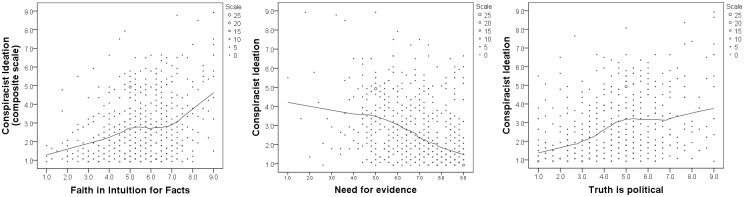
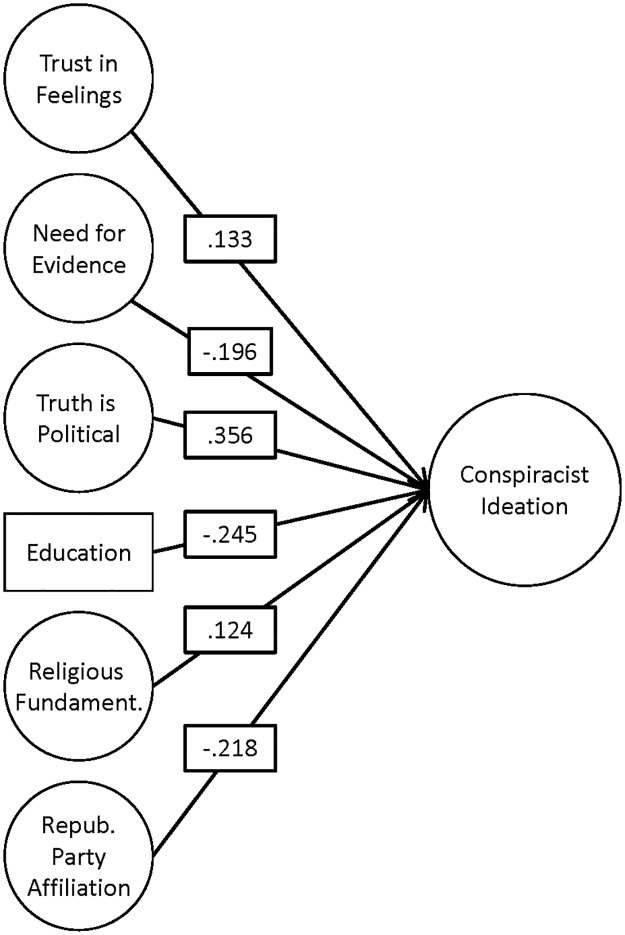
Verification
Claims the paper makes
The claims and statistics of this paper haven’t been checked yet.
Run the check — free, no account needed. It reads the open-access text and checks the sources it cites.
Claims other papers make about this one
Each is checked against this paper’s own text: does it say what the citing paper says it does?
In the citing paper
“reliance on emotion is associated with misinformation sharing (Weeks, 2015) or believing in conspiracy theories (Garrett & Weeks, 2017;Martel et al., 2019)”
From The fingerprints of misinformation: how deceptive content differs from reliable sources in terms of cognitive effort and appeal to emotions (2022) · cites this paper as Garrett & Weeks, 2017
Self-check
Percentages, sums and reported differences re-computed from the paper’s own numbers.
The self-check needs the paper’s full text.
Citations
Cites
Hu, L., & Bentler, P. M. (1999) · Structural Equation Modeling A Multidisciplinary Journal · doi:10.1080/10705519909540118 · Cited by 108,788
(2011) · Cited by 14,317
Telling more than we can know: Verbal reports on mental processes.
Nisbett, R. E., & Wilson, T. D. (1977) · Psychological Review · doi:10.1037/0033-295x.84.3.231 · Cited by 11,317
(1994) · DigitalGeorgetown (Georgetown University Library) · Cited by 10,542
Laboratory Life: The Construction of Scientific Facts
Latour, B. (1986) · DigitalGeorgetown (Georgetown University Library) · Cited by 7,491
(2010) · Cited by 7,034
Why has Critique Run out of Steam? From Matters of Fact to Matters of Concern
Latour, B. (2004) · Critical Inquiry · doi:10.1086/421123 · Cited by 5,595
A Brief Tutorial on the Development of Measures for Use in Survey Questionnaires
Hinkin, T. R. (1998) · Organizational Research Methods · doi:10.1177/109442819800100106 · Cited by 4,095
(2011) · Choice Reviews Online · doi:10.5860/choice.48-6243 · Cited by 3,575
When Corrections Fail: The Persistence of Political Misperceptions
Nyhan, B., & Reifler, J. (2010) · Political Behavior · doi:10.1007/s11109-010-9112-2 · Cited by 3,173
Research works printed but not linked: 1
- M Hemingway, 2011, Lies, damned lies, and ‘fact checking’, The Weekly Standard, 17
Cited by
Sorted by citations
Science audiences, misinformation, and fake news
Scheufele, D. A., & Krause, N. M. (2019) · Proceedings of the National Academy of Sciences · doi:10.1073/pnas.1805871115 · Cited by 878
Reliance on emotion promotes belief in fake news
Martel, C., Pennycook, G., & Rand, D. G. (2020) · Cognitive Research: Principles and Implications · doi:10.1186/s41235-020-00252-3 · Cited by 470
Durably reducing conspiracy beliefs through dialogues with AI
Costello, T. H., Pennycook, G., & Rand, D. G. (2024) · Science · doi:10.1126/science.adq1814 · Cited by 354
van der Linden, S., Panagopoulos, C., Azevedo, F., & Jost, J. T. (2020) · Political Psychology · doi:10.1111/pops.12681 · Cited by 294
Ideological asymmetries in conformity, desire for shared reality, and the spread of misinformation
Jost, J. T., van der Linden, S., Panagopoulos, C., & Hardin, C. D. (2018) · Current Opinion in Psychology · doi:10.1016/j.copsyc.2018.01.003 · Cited by 242
Bora, K., Das, D., Barman, B., & Borah, P. (2018) · Pathogens and Global Health · doi:10.1080/20477724.2018.1507784 · Cited by 215
Conservatives’ susceptibility to political misperceptions
Garrett, R. K., & Bond, R. M. (2021) · Science Advances · doi:10.1126/sciadv.abf1234 · Cited by 193
Self-citationFalse Equivalence: Are Liberals and Conservatives in the United States Equally Biased?
Baron, J., & Jost, J. T. (2019) · Perspectives on Psychological Science · doi:10.1177/1745691618788876 · Cited by 213
Arresting fake news sharing on social media: a theory of planned behavior approach
Pundir, V., Devi, E. B., & Nath, V. (2021) · Management Research Review · doi:10.1108/mrr-05-2020-0286 · Cited by 105
Carrasco-Farré, C. (2022) · Humanities and Social Sciences Communications · doi:10.1057/s41599-022-01174-9 · Cited by 84
Díaz, R., & Cova, F. (2021) · Cognition & Emotion · doi:10.1080/02699931.2021.1941783 · Cited by 88
Greifeneder, R., Jaffé, M. E., Newman, E. J., & Schwarz, N. (2020) · Routledge eBooks · doi:10.4324/9780429295379 · Cited by 114
On the Disposition to Think Analytically: Four Distinct Intuitive-Analytic Thinking Styles
Newton, C., Feeney, J. R., & Pennycook, G. (2023) · Personality and Social Psychology Bulletin · doi:10.1177/01461672231154886 · Cited by 120
Lyons, B. A., Mérola, V., & Reifler, J. (2018) · Health Communication · doi:10.1080/10410236.2018.1530526 · Cited by 72
Conspiracies Online: User Discussions in a Conspiracy Community Following Dramatic Events
Samory, M., & Mitra, T. (2018) · Proceedings of the International AAAI Conference on Web and Social Media · doi:10.1609/icwsm.v12i1.15039 · Cited by 67
Conspiracy beliefs and science rejection
(2022) · doi:10.1016/j.copsyc.2022.101392 · Cited by 62
Of precarity and conspiracy: Introducing a socio‐functional model of conspiracy beliefs
Adam‐Troian, J., Chayinska, M., Paladino, M. P., Uluğ, Ö. M., Vaes, J., & Wagner‐Egger, P. (2022) · British Journal of Social Psychology · doi:10.1111/bjso.12597 · Cited by 80
Nygren, T., Guath, M., Axelsson, A., & Frau‐Meigs, D. (2021) · Information · doi:10.3390/info12050201 · Cited by 73
Ten competencies for the science misinformation crisis
Allchin, D. (2023) · Science Education · doi:10.1002/sce.21746 · Cited by 62
Saling, L. L., Mallal, D., Scholer, F., Skelton, R., & Spina, D. (2021) · PLoS ONE · doi:10.1371/journal.pone.0255702 · Cited by 52
Wu, Y., Kuru, O., Campbell, S. W., & Baruh, L. (2022) · Health Communication · doi:10.1080/10410236.2021.2010891 · Cited by 59
Reliance on emotion promotes belief in fake news
Martel, C., Pennycook, G., & Rand, D. G. (2019) · doi:10.31234/osf.io/a2ydw · Cited by 49
Correcting the Misinformed: The Effectiveness of Fact-checking Messages in Changing False Beliefs
Carnahan, D., & Bergan, D. E. (2021) · Political Communication · doi:10.1080/10584609.2021.1963358 · Cited by 49
Mede, N. G., Schäfer, M. S., Metag, J., & Klinger, K. (2022) · PLoS ONE · doi:10.1371/journal.pone.0271204 · Cited by 46
Fuhrer, J., & Cova, F. (2020) · Judgment and Decision Making · doi:10.1017/s1930297500008123 · Cited by 42
Gjoneska, B. (2021) · Frontiers in Psychology · doi:10.3389/fpsyg.2021.736838 · Cited by 46
Conspiracy theories and climate change: A systematic review
Tam, K., & Chan, H. (2023) · Journal of Environmental Psychology · doi:10.1016/j.jenvp.2023.102129 · Cited by 59
The generic conspiracist beliefs scale – 5: A short-form measure of conspiracist ideation
Kay, C. S., & Slovic, P. (2022) · Journal of Research in Personality · doi:10.1016/j.jrp.2022.104315 · Cited by 43
Tang, Y., Luo, C., & Su, Y. (2023) · Online Information Review · doi:10.1108/oir-04-2023-0157 · Cited by 37
Do as the Romans do: On the authoritarian roots of pseudoscience
Fasce, A., Adrián‐Ventura, J., & Avendaño, D. (2020) · Public Understanding of Science · doi:10.1177/0963662520935078 · Cited by 42
Psychological profiles of anti-vaccination argument endorsement
Holford, D. L., Fasce, A., Costello, T. H., & Lewandowsky, S. (2023) · Scientific Reports · doi:10.1038/s41598-023-30883-7 · Cited by 34
Kirkpatrick, A. W. (2020) · Public Understanding of Science · doi:10.1177/0963662520966165 · Cited by 34
The Influence of Media Trust and Normative Role Expectations on the Credibility of Fact Checkers
Primig, F. (2022) · Journalism Practice · doi:10.1080/17512786.2022.2080102 · Cited by 37
Durably reducing conspiracy beliefs through dialogues with AI
Costello, T. H., Pennycook, G., & Rand, D. G. (2024) · doi:10.31234/osf.io/xcwdn · Cited by 28
The Psychological Appeal of Fake-News Attributions
Axt, J. R., Landau, M. J., & Kay, A. C. (2020) · Psychological Science · doi:10.1177/0956797620922785 · Cited by 28
Soares, F. B., Gruzd, A. A., & Mai, P. (2023) · Social Media + Society · doi:10.1177/20563051231220330 · Cited by 41
Understanding how the Australian vaccine‐refusal movement perceives itself
Rozbroj, T., Lyons, A., & Lucke, J. C. (2020) · Health & Social Care in the Community · doi:10.1111/hsc.13182 · Cited by 27
Margolin, D. (2020) · Communication Theory · doi:10.1093/ct/qtaa002 · Cited by 27
Margolin, D. (2019) · Communication Methods and Measures · doi:10.1080/19312458.2019.1639144 · Cited by 27
Schemer, C., Ziegele, M., Schultz, T., Quiring, O., Jackob, N., & Jakobs, I. (2021) · Journalism & Mass Communication Quarterly · doi:10.1177/10776990211063527 · Cited by 30
On the disposition to think analytically: Four distinct intuitive-analytic thinking stylesPreprint
Newton, C., Feeney, J. R., & Pennycook, G. (2021) · doi:10.31234/osf.io/r5wez · Cited by 24
Choung, H., Newman, T. P., & Stenhouse, N. (2020) · International Journal of Science Education Part B · doi:10.1080/21548455.2020.1774094 · Cited by 22
Chinn, S., & Hasell, A. (2023) · Harvard Kennedy School Misinformation Review · doi:10.37016/mr-2020-117 · Cited by 22
Young, D. G., Maloney, E. K., Bleakley, A., & Langbaum, J. B. S. (2022) · Journal of Social and Political Psychology · doi:10.5964/jspp.7823 · Cited by 22
State disinformation: emotions at the service of the cause
Sánchez, J. L. M., Amado, A., & Gómez-Iniesta, P. (2022) · Communication & Society · doi:10.15581/003.35.2.205-221 · Cited by 20
Patterns of belief and trust in climate change information
Johnson, V., Butterfuss, R., Harsch, R., & Kendeou, P. (2024) · Journal of Research in Science Teaching · doi:10.1002/tea.21967 · Cited by 18
Damian, A. J., & Gallo, J. J. (2020) · Harvard Kennedy School Misinformation Review · doi:10.37016/mr-2020-027 · Cited by 20
Both‐Sideology Endangers Democracy and Social Science
Jost, J. T. (2024) · Journal of Social Issues · doi:10.1111/josi.12633 · Cited by 23
Taurino, A., Colucci, M. H., Bottalico, M., Franco, T. P., Volpe, G., Violante, M., Grattagliano, I., & Laera, D. (2023) · Applied Cognitive Psychology · doi:10.1002/acp.4136 · Cited by 24
‘Blurred boundaries’: When nurses and midwives give anti-vaccination advice on Facebook
Green, J., Petty, J., Whiting, L. S., Orr, F., Smart, L., Brown, A., & Jones, L. (2022) · Nursing Ethics · doi:10.1177/09697330211041749 · Cited by 18
Processes of persuasion and social influence in conspiracy beliefs
Albarracín, D. (2022) · Current Opinion in Psychology · doi:10.1016/j.copsyc.2022.101463 · Cited by 16
Aspernäs, J., Erlandsson, A., & Nilsson, A. (2023) · Journal of Research in Personality · doi:10.1016/j.jrp.2023.104394 · Cited by 20
Hyman, I. E., & Jalbert, M. C. (2017) · Journal of Applied Research in Memory and Cognition · doi:10.1016/j.jarmac.2017.09.009 · Cited by 23
Lee, S. J., Lee, C., & Hwang, H. (2022) · Health Communication · doi:10.1080/10410236.2022.2125119 · Cited by 17
Spälti, A. K., Lyons, B. A., Stoeckel, F., Stöckli, S., Szewach, P., Mérola, V., Stednitz, C., González, P. L., & Reifler, J. (2023) · Public Understanding of Science · doi:10.1177/09636625231154131 · Cited by 17
Dyrendal, A., & Hestad, K. (2021) · Approaching Religion · doi:10.30664/ar.107485 · Cited by 9
Rudloff, J. P., Hutmacher, F., & Appel, M. (2022) · Journal of Personality · doi:10.1111/jopy.12706 · Cited by 22
Toeing the Party Lie: Ostracism Promotes Endorsement of Partisan Election Falsehoods
Garrett, R. K., Sude, D., & Riva, P. (2020) · Political Communication · doi:10.1080/10584609.2019.1666943 · Cited by 15
Self-citationMarkant, D. B., Rogha, M., Karduni, A., Wesslen, R. S., & Wenwen Dou, A. (2023) · CHI Conference on Human Factors in Computing Systems · doi:10.1145/3544548.3581330 · Cited by 16
On predictors of misconceptions about educational topics: A case of topic specificity
Asberger, J., Thomm, E., & Bauer, J. (2021) · PLoS ONE · doi:10.1371/journal.pone.0259878 · Cited by 15
The decision is in the details: Justifying decisions about socioscientific issues
Bader, J. D., Ahearn, K. A., Allen, B. A., Anand, D. M., Coppens, A. D., & Aikens, M. L. (2023) · Journal of Research in Science Teaching · doi:10.1002/tea.21854 · Cited by 14
Kim, J., & Lee, S.-Y. S. (2023) · American Behavioral Scientist · doi:10.1177/00027642231175637 · Cited by 14
Caroti, D., Adam‐Troian, J., & Arciszewski, T. (2022) · Applied Cognitive Psychology · doi:10.1002/acp.3969 · Cited by 14
Lee, T., Johnson, T. J., & Weaver, D. H. (2022) · Mass Communication & Society · doi:10.1080/15205436.2022.2046103 · Cited by 13
Yli‐Panula, E., Laakkonen, E., & Vauras, M. (2021) · Education Sciences · doi:10.3390/educsci11080440 · Cited by 12
Kont, J., Elving, W. J. L., Broersma, M., & Bozdağ, Ç. (2024) · Communications · doi:10.1515/commun-2023-0078 · Cited by 17
The political (a)symmetry of metacognitive insight into detecting misinformation.
Geers, M., Fischer, H., Lewandowsky, S., & Herzog, S. M. (2024) · Journal of Experimental Psychology General · doi:10.1037/xge0001600 · Cited by 11
Computational analysis of US congressional speeches reveals a shift from evidence to intuition
Aroyehun, S. T., Simchon, A., Carrella, F., Lasser, J., Lewandowsky, S., & García, D. (2025) · Nature Human Behaviour · doi:10.1038/s41562-025-02136-2 · Cited by 22
Correction by distraction: how high-tempo music enhances medical experts’ debunking TikTok videos
Li, M., Li, G., & Yang, S. (2024) · Journal of Computer-Mediated Communication · doi:10.1093/jcmc/zmae007 · Cited by 22
Validation of the Spanish Version of the Generic Conspiracist Beliefs Scale
Fasce, A., Avendaño, D., Dagnall, N., Denovan, A., & Escolà‐Gascón, Á. (2022) · The Spanish Journal of Psychology · doi:10.1017/sjp.2022.21 · Cited by 11
Rudloff, J. P., Hutmacher, F., & Appel, M. (2023) · Scientific Reports · doi:10.1038/s41598-023-31079-9 · Cited by 13
Robertson, C. (2021) · Journalism Studies · doi:10.1080/1461670x.2021.1904273 · Cited by 15
When liars are considered honest
Lewandowsky, S., García, D., Simchon, A., & Carrella, F. (2024) · Trends in Cognitive Sciences · doi:10.1016/j.tics.2024.03.005 · Cited by 10
“I’m Not a Conspiracy Theorist, But…”: Knowledge and Conservative Politics in Unsettled Times
Carlson, J. D., & Ramo, E. (2022) · Social Forces · doi:10.1093/sf/soac082 · Cited by 10
Alternative beliefs in psychedelic drug users
Lebedev, A. V., Acar, K., Horntvedt, O., Cabrera, A. E., Simonsson, O., Osika, W., Ingvar, M., & Petrović, P. (2023) · Scientific Reports · doi:10.1038/s41598-023-42444-z · Cited by 10
Hedged Language and Partisan Media Influence Belief in Science Claims
Butterfuss, R., Aubele, J. W., & Kendeou, P. (2020) · Science Communication · doi:10.1177/1075547020908598 · Cited by 10
Mus, M., Bor, A., & Petersen, M. B. (2022) · PLoS ONE · doi:10.1371/journal.pone.0265211 · Cited by 8
Of Precarity and Conspiracy: Introducing A Socio-Functional Model of Conspiracy BeliefsPreprint
Adam‐Troian, J., Chayinska, M., Paladino, M. P., Uluğ, Ö. M., Vaes, J., & Wagner‐Egger, P. (2021) · doi:10.31234/osf.io/mnfrd · Cited by 9
Holford, D. L., Lopez-Lopez, E., Fasce, A., Karlsson, L. C., & Lewandowsky, S. (2024) · Humanities and Social Sciences Communications · doi:10.1057/s41599-024-03416-4 · Cited by 11
Watch out for errors! factors related to ChatGPT skepticism: a cognitive perspective
Zhang, M., Ye, J., & Yang, X. (2025) · Interactive Learning Environments · doi:10.1080/10494820.2025.2454448 · Cited by 8
African Swine Fever—How to Unravel Fake News in Veterinary Medicine
Trotta, A., Marinaro, M., Cavalli, A., Cordisco, M., Piperis, A., Buonavoglia, C., & Corrente, M. (2022) · Animals · doi:10.3390/ani12050656 · Cited by 8
Continued influence of false accusations in forming impressions of political candidates
Cohen, M. S., Halewicz, V., Yıldırım, E., & Kable, J. W. (2024) · PNAS Nexus · doi:10.1093/pnasnexus/pgae490 · Cited by 6
Cadena-Nogales, P. D., Portolés, J. J. S., Sanz, Y. E., & López, V. S. (2022) · Journal of Baltic Science Education · doi:10.33225/jbse/22.21.398 · Cited by 7
Emotion, Digital Media, and Misinformation
Weeks, B. E. (2023) · Oxford University Press eBooks · doi:10.1093/oso/9780197520536.003.0022 · Cited by 9
Self-citationYoung, D., Molokach, B., & Oittinen, E. (2023) · Current Opinion in Psychology · doi:10.1016/j.copsyc.2023.101776 · Cited by 4
Conspiracy Theory Belief: A Sane Response to an Insane World?
Pierre, J. M. (2023) · Review of Philosophy and Psychology · doi:10.1007/s13164-023-00716-7 · Cited by 8
Preservice teachers’ evaluation of evidential support in causal arguments about educational topics
Lederer, A., Thomm, E., & Bauer, J. (2024) · Frontiers in Education · doi:10.3389/feduc.2024.1379222 · Cited by 7
Gökalp, A., Üztemur, S., Huang, P., Kartol, A., Tsai, H., Dinç, E., Griffiths, M. D., & Lin, C. (2025) · Brain and Behavior · doi:10.1002/brb3.70275 · Cited by 7
Jennings, F. J., Neville-Shepard, R., Jackson, D. B., Magusiak, A., & Sigrist, K. (2024) · Southern Communication Journal · doi:10.1080/1041794x.2024.2308892 · Cited by 6
Beck, S. J., Boldt, D., Dasch, H. K., Frescher, E., Hicketier, S., Hoffmann, K., Husemann, R., Kaul, S., Kustermann, J. N., Molitor, J., et al. (2020) · doi:10.23668/psycharchives.3149 · Cited by 6
AI tutors vs. tenacious myths: Evidence from personalised dialogue interventions in education
Corbett, B. J., & Tangen, J. M. (2025) · Computers in Human Behavior · doi:10.1016/j.chb.2025.108828 · Cited by 10
Khan, S. O., Ghafourian, T., & Patil, S. (2024) · Proceedings of the ACM on Human-Computer Interaction · doi:10.1145/3637403 · Cited by 6
Attention-Based Design and Selective Exposure Amid COVID-19 Misinformation Sharing
Amin, Z., Ali, N. M., & Smeaton, A. F. (2021) · Lecture notes in computer science · doi:10.1007/978-3-030-78468-3_34 · Cited by 5
Li, Q., Bond, R. M., & Garrett, R. K. (2023) · Journal of Communication · doi:10.1093/joc/jqad017 · Cited by 8
Self-citationTeachers and the Epistemology of History
Elmersjö, H. Å., & Zanazanian, P. (2024) · Springer eBooks · doi:10.1007/978-3-031-58056-7 · Cited by 5
Delving into depth: an empirical investigation of the ordinary concepts of depth and profundity
Cova, F., Schöpfer, C., & Bezat, M. M. (2024) · Synthese · doi:10.1007/s11229-024-04786-7 · Cited by 5
Caroti, D., Adam-Troian, J., Theraud, M., & Bagneux, V. (2025) · Contemporary Educational Psychology · doi:10.1016/j.cedpsych.2025.102413 · Cited by 3
Serrano, D. M., Crone, T. S., & Williams, P. S. (2023) · Science & Education · doi:10.1007/s11191-023-00447-2 · Cited by 6
Truth and Bias: Robust findings?Preprint
von Hohenberg, B. C. (2020) · OSF Preprints (OSF Preprints) · doi:10.31219/osf.io/yj2rn · Cited by 5
Development and Validation of the Evidence Intuition ScalePreprint
Abels, C. M., & Lewandowsky, S. (2024) · PsyArXiv (OSF Preprints) · doi:10.31234/osf.io/u4xka · Cited by 6
Metadata
- Authors
- Garrett, R. K., & Weeks, B. E.
- Affiliations
- The Ohio State University (US)
- University of Michigan (US)
- Corresponding author
- Garrett, R. Kelly
- Venue
- PLOS ONE
- Publisher
- Public Library of Science (PLoS)
- Published
- 2017-09-18
- Volume
- 12
- Issue
- 9
- Pages
- e0184733
- ISSN
- 1932-6203 (ISSN-L)
- PMC
- PMC5603156
- OpenAlex
- W2756124350
- Cited by
- 167
- References
- 61
- Citations by year
- 2026: 15 · 2025: 23 · 2024: 31 · 2023: 27 · 2022: 24 · 2021: 15 · 2020: 17 · 2019: 8 · 2018: 6 · 2017: 1
- FWCI
- 22.34
- Type
- journal article
- Language
- en
- Open access
- gold
- doi.org
- Licence
- Locations
- PLoS ONE (publishedVersion, cc-by)
- PubMed Central (publishedVersion, cc-by)
- PubMed (publishedVersion)
- RePEc: Research Papers in Economics (submittedVersion)
- DOAJ (DOAJ: Directory of Open Access Journals) (submittedVersion)
- Figshare (submittedVersion, cc-by)
- Funders
- Division of Information and Intelligent Systems (1149599)
- Topics
- Social Sciences › Sociology and Political Science › Misinformation and Its Impacts
- Social Sciences › Psychology › Developmental and Educational Psychology › Educational Strategies and Epistemologies
- Social Sciences › Arts and Humanities › Philosophy › Epistemology, Ethics, and Metaphysics
- Keywords
- epistemological beliefs, conspiracist ideation, misunderstanding, conspiracy theories, faith in intuition, belief accuracy, political manipulation, scientific misinformation
- MeSH terms
- Culture, Decision Making, Humans, Politics, United States
About these checks
Registry, retraction, Cites and statistics results are computed, not judged, with one exception: a printed reference that no index lists is read once by a model before it counts as a citation error. Claims are extracted by a model and kept only when their quote appears verbatim in the text; each cited source is then checked, with a model’s help, for whether it says what the claim relies on. Those verdicts can be wrong — read the claim’s quote and the cited source before relying on one.
Statistics and arithmetic are recomputed, not judged.
Confidence bands are shown only for fields calibrated on our annotated test set. None is calibrated yet, so no band is shown.
What counts as a claim ›How we measure confidence ›How we check this ›
Are you an author, or do you see a problem with this page? Request a review
