

Self-compassion moderates the perfectionism and depression link in both adolescence and adulthood
Open accessThe DOI matches its Crossref record; 65 of the 65 references it cites were found in a registry or an index.
Abstract
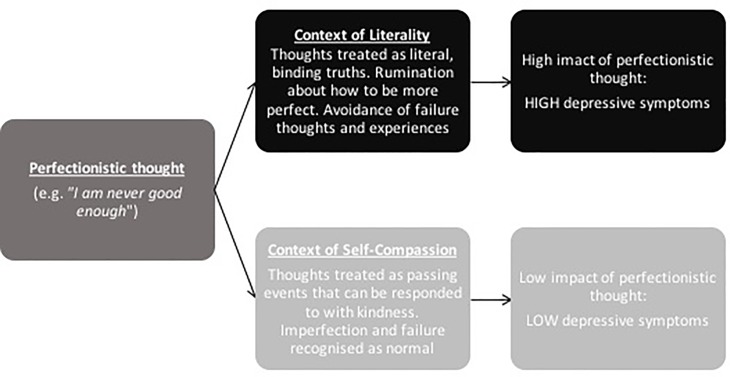
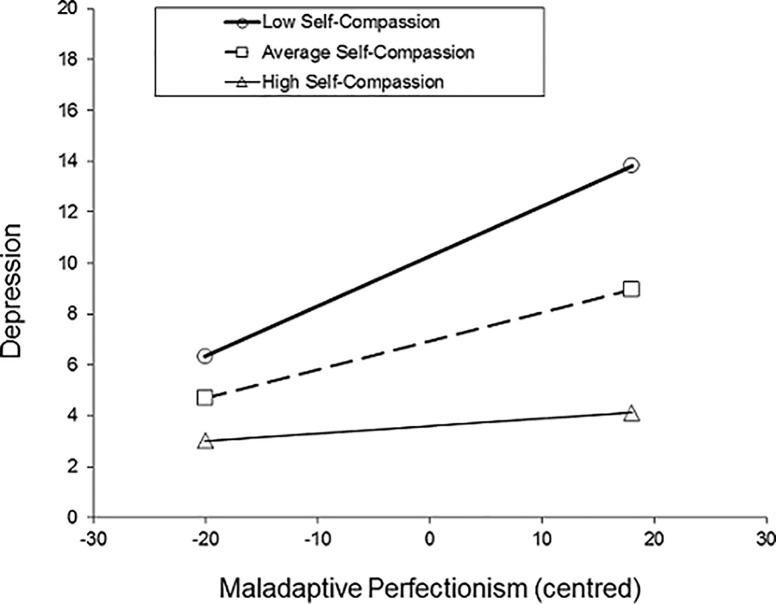
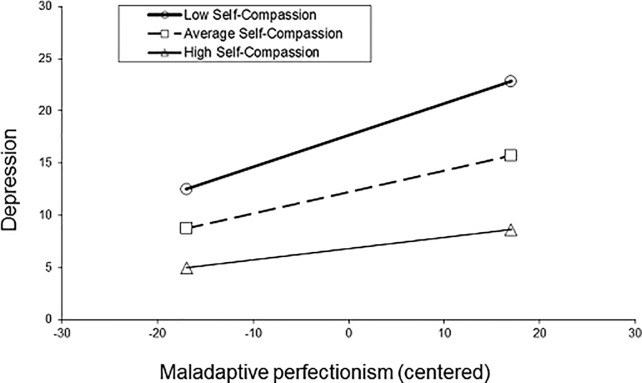
BACKGROUND: Psychological practitioners often seek to directly change the form or frequency of clients' maladaptive perfectionist thoughts, because such thoughts predict future depression. Indirect strategies, such as self-compassion interventions, that seek to change clients' relationships to difficult thoughts, rather than trying to change the thoughts directly could be just as effective. This study aimed to investigate whether self-compassion moderated, or weakened, the relationship between high perfectionism and high depression symptoms in both adolescence and adulthood. METHODS: The present study utilised anonymous self-report questionnaires to assess maladaptive perfectionism, depression, and self-compassion across two samples covering much of the lifespan. Questionnaires were administered in a high school setting for the adolescent sample (Study 1, Mage = 14.1 years, n = 541), and advertised through university and widely online to attract a convenience sample of adults (Study 2, Mage = 25.22 years, n = 515). RESULTS: Moderation analyses revealed that self-compassion reduced the strength of relationship between maladaptive perfectionism and depression in our adolescent Study 1 (β = -.15, p < .001, R2 = .021.) and our adult study 2 (β = -.14, p < .001, R2 = .020). LIMITATIONS: Cross-sectional self-reported data restricts the application of causal conclusions and also relies on accurate self-awareness and willingness to respond to questionnaire openly. CONCLUSIONS: The replication of this finding in two samples and across different age-appropriate measures suggests that self-compassion does moderate the link between perfectionism and depression. Self-compassion interventions may be a useful way to undermine the effects of maladaptive perfectionism, but future experimental or intervention research is needed to fully assess this important possibility.
Overview
The claims and statistics of this paper haven’t been checked yet.
Free: it reads the open-access text and checks the first 5 claims that cite a source we can check. Create a free account to check every claim.
Integrity signals
Registry
Cites
Statistics
Figures
Verification
Claims the paper makes
The claims and statistics of this paper haven’t been checked yet.
Free: it reads the open-access text and checks the first 5 claims that cite a source we can check. Create a free account to check every claim.
Claims other papers make about this one
Each is checked against this paper’s own text: does it say what the citing paper says it does?
The cited source says what the claim attributes to it.
In the citing paper
“Other studies have also demonstrated that self-compassion could buffer the effects of dysfunctional perfectionism on depressive moods.”
The cited source says what the claim attributes to it.
In the citing paper
“This buffering effect of self-compassion in the relationship between dysfunctional perfectionism and negative emotions is reported by several studies [39,40,45].”
Self-check
Percentages, sums and reported differences re-computed from the paper’s own numbers.
The self-check needs the paper’s full text.
Citations
Cites
Multiple regression: testing and interpreting interactions
(1992) · Choice Reviews Online · doi:10.5860/choice.29-3352 · Cited by 36,654
SPSS and SAS procedures for estimating indirect effects in simple mediation models
Preacher, K. J., & Hayes, A. F. (2004) · Behavior Research Methods, Instruments, & Computers · doi:10.3758/bf03206553 · Cited by 17,383 · cited 2×
“In both studies, we assessed moderation by conducting hierarchical multiple regression as recommended by Aiken and West [49] using the Preacher and Hayes PROCESS macros [50].”
Method(1991) · Cited by 7,187
The Development and Validation of a Scale to Measure Self-Compassion
NEFF, K. D. (2003) · Self and Identity · doi:10.1080/15298860309027 · Cited by 6,436 · cited 3×
“The Self-Compassion Scale [29] was used to measure levels of self-compassion.”
BackgroundMethodHenry, J. D., & Crawford, J. R. (2005) · British Journal of Clinical Psychology · doi:10.1348/014466505x29657 · Cited by 5,801
Self-Compassion: An Alternative Conceptualization of a Healthy Attitude Toward Oneself
NEFF, K. (2003) · Self and Identity · doi:10.1080/15298860309032 · Cited by 5,440 · cited 9×
“As noted by Neff [7], self-compassion is ‘a useful emotion regulation strategy, in which painful or distressing feelings are not avoided but are instead held in awareness with kindness, understanding, and a sense of shared humanity’ (p.”
BackgroundResultInfluentialLikert scales, levels of measurement, and the “laws” of statistics
Norman, G. (2010) · Advances in Health Sciences Education · doi:10.1007/s10459-010-9222-y · Cited by 4,850 · cited 1×
“However, as the sample size was large, transformation of the data did not produce any differences in results and therefore, non-transformed data was used in all analyses [51].”
MethodThe dimensions of perfectionism
Frost, R. O., Marten, P., Lahart, C., & Rosenblate, R. (1990) · Cognitive Therapy and Research · doi:10.1007/bf01172967 · Cited by 4,279 · cited 2×
“Perfectionism was measured using the combined score of four sub-scales from the Multidimensional Perfectionism Scale [9], as recommended by Kawamura and Frost [52].”
BackgroundMethodConstruction and factorial validation of a short form of the Self-Compassion Scale
Raes, F., Pommier, E., Neff, K. D., & Van Gucht, D. (2011) · Clinical Psychology & Psychotherapy · doi:10.1002/cpp.702 · Cited by 2,997
A pilot study and randomized controlled trial of the mindful self-compassion program
Neff, K. D., & Germer, C. K. (2013) · Journal of Clinical Psychology · doi:10.1002/jclp.21923 · Cited by 2,253
Cited by
Self-compassion interventions and psychosocial outcomes: a meta-analysis of RCTs
Ferrari, M., Hunt, C., Harrysunker, A., Abbott, M. J., Beath, A. P., & Einstein, D. A. (2019) · Mindfulness · doi:10.1007/s12671-019-01134-6 · Cited by 740
“This shift in cognitive patterns may be the mechanism through which selfcompassion treats multiple psychopathologies including depression (Ferrari et al. 2018; Krieger et al. 2016) and anxiety (MacBeth and Gumley 2012).”
BackgroundResultSelf-citationDevelopment and Validation of the Self-Compassion Scale for Youth
Neff, K. D., Bluth, K., Tóth-Király, I., Davidson, O., Knox, M. C., Williamson, Z., & Costigan, A. (2021) · Journal of Personality Assessment · doi:10.1080/00223891.2020.1729774 · Cited by 175
“Research indicates that self-compassion acts as a buffer for teens with trauma (Zeller, Yuval, Nitzan-Assayag, & Bernstein, 2015), non-suicidal self-injury (Jiang et al., 2016), and maladaptive perfectionism (Ferrari, Yap, Scott, Einstein, & Ciarrochi, 2018).”
BackgroundWakelin, K. E., Perman, G., & Simonds, L. M. (2022) · Clinical Psychology & Psychotherapy · doi:10.1002/cpp.2586 · Cited by 170
“Previous evidence suggests that self-compassion may have buffering effects against development of depression and intervention improvements in depression and self-compassion may be maintained afterwards (Ferrari et al., 2018, 2019).”
BackgroundLee, E. E., Govind, T., Ramsey, M., Wu, T. C., Daly, R., Liu, J., Tu, X. M., Paulus, M. P., Thomas, M. L., & Jeste, D. V. (2021) · Translational Psychiatry · doi:10.1038/s41398-021-01491-8 · Cited by 123
Egan, S. J., Rees, C. S., Delalande, J., Greene, D., Fitzallen, G., Brown, S., Webb, M., & Finlay-Jones, A. (2022) · Administration and Policy in Mental Health and Mental Health Services Research · doi:10.1007/s10488-021-01170-2 · Cited by 140
Metadata
- Authors
- Ferrari, M., Yap, K., Scott, N., Einstein, D. A., & Ciarrochi, J.
- Affiliations
- The University of Sydney (AU)
- Australian Catholic University (AU)
- RMIT University (AU)
- Macquarie University (AU)
- Corresponding author
- Ferrari, Madeleine
- Venue
- PLOS ONE
- Publisher
- Public Library of Science (PLoS)
- Published
- 2018-02-21
- Volume
- 13
- Issue
- 2
- Pages
- e0192022
- ISSN
- 1932-6203 (ISSN-L)
- PMC
- PMC5821438
- OpenAlex
- W2788088331
- Cited by
- 173
- References
- 65
- Citations by year
- 2026: 19 · 2025: 18 · 2024: 25 · 2023: 25 · 2022: 34 · 2021: 16 · 2020: 22 · 2019: 11 · 2018: 3
- FWCI
- 15.25
- Type
- journal article
- Language
- en
- Open access
- gold
- doi.org
- Licence
- Locations
- PLoS ONE (publishedVersion, cc-by)
- PubMed Central (publishedVersion, cc-by)
- PubMed (publishedVersion)
- RePEc: Research Papers in Economics (submittedVersion)
- RMIT Research Repository (RMIT University Library) (submittedVersion, other-oa)
- DOAJ (DOAJ: Directory of Open Access Journals) (submittedVersion)
- Figshare (submittedVersion, cc-by)
- Topics
- Social Sciences › Psychology › Clinical Psychology › Perfectionism, Procrastination, Anxiety Studies
- Social Sciences › Psychology › Clinical Psychology › Mindfulness and Compassion Interventions
- Social Sciences › Psychology › Experimental and Cognitive Psychology › Anxiety, Depression, Psychometrics, Treatment, Cognitive Processes
- Keywords
- self-compassion, maladaptive perfectionism, depression, moderation, adolescents, adulthood, self-compassion interventions, lifespan development
- MeSH terms
- Perfectionism, Adolescent, Adult, Child, Depression, Empathy, Female, Humans, Male, Young Adult
About these checks
Registry, retraction, Cites and statistics results are computed, not judged, with one exception: a printed reference that no index lists is read once by a model before it counts as a citation error. Claims are extracted by a model and kept only when their quote appears verbatim in the text; each cited source is then checked, with a model’s help, for whether it says what the claim relies on. Those verdicts can be wrong — read the claim’s quote and the cited source before relying on one.
Statistics and arithmetic are recomputed, not judged.
Confidence bands are shown only for fields calibrated on our annotated test set. None is calibrated yet, so no band is shown.
What counts as a claim ›How we measure confidence ›How we check this ›
Are you an author, or do you see a problem with this page? Request a review
How to cite
Cite CoChat for the checks on this page, and the paper for its own findings.
- This page
- CoChat. (2026). Citation check: Self-compassion moderates the perfectionism and depression link in both adolescence and adulthood. https://app.cochat.ai/papers/10.1371/journal.pone.0192022
- The paper
- Ferrari, M., Yap, K., Scott, N., Einstein, D. A., & Ciarrochi, J. (2018). Self-compassion moderates the perfectionism and depression link in both adolescence and adulthood. PLOS ONE. https://doi.org/10.1371/journal.pone.0192022
Data sources
Bibliographic data: Semantic Scholar, OpenAlex, Crossref.
Contains information from the Semantic Scholar Academic Graph Datasets, made available under the ODC Attribution License (ODC-BY 1.0).
Semantic Scholar’s data is described in: Kinney, R., et al. (2023). The Semantic Scholar Open Data Platform. arXiv:2301.10140.
