

Impacts of climate change on cropping patterns in a tropical, sub-humid watershed
Open accessThe DOI matches its Crossref record; 60 of the 61 references it cites were found in a registry or an index.
Abstract
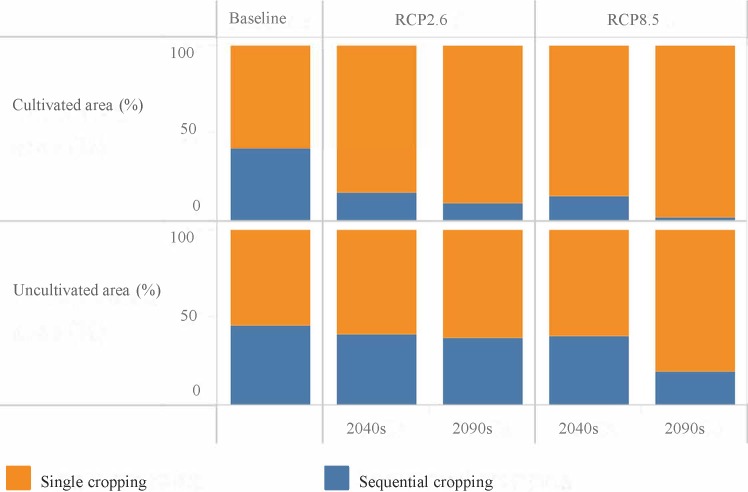
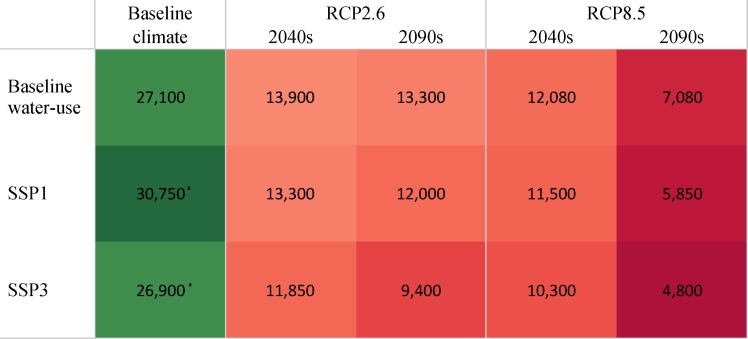
In recent decades, there have been substantial increases in crop production in sub-Saharan Africa (SSA) as a result of higher yields, increased cropping intensity, expansion of irrigated cropping systems, and rainfed cropland expansion. Yet, to date much of the research focus of the impact of climate change on crop production in the coming decades has been on crop yield responses. In this study, we analyse the impact of climate change on the potential for increasing rainfed cropping intensity through sequential cropping and irrigation expansion in central Benin. Our approach combines hydrological modelling and scenario analysis involving two Representative Concentration Pathways (RCPs), two water-use scenarios for the watershed based on the Shared Socioeconomic Pathways (SSPs), and environmental water requirements leading to sustained streamflow. Our analyses show that in Benin, warmer temperatures will severely limit crop production increases achieved through the expansion of sequential cropping. Depending on the climate change scenario, between 50% and 95% of cultivated areas that can currently support sequential cropping or will need to revert to single cropping. The results also show that the irrigation potential of the watershed will be at least halved by mid-century in all scenario combinations. Given the urgent need to increase crop production to meet the demands of a growing population in SSA, our study outlines challenges and the need for planned development that need to be overcome to improve food security in the coming decades.
Overview
The claims and statistics of this paper haven’t been checked yet.
Free: it reads the open-access text and checks the first 5 claims that cite a source we can check. Create a free account to check every claim.
Integrity signals
Registry
Cites
Statistics
Figures
Verification
Claims the paper makes
The claims and statistics of this paper haven’t been checked yet.
Free: it reads the open-access text and checks the first 5 claims that cite a source we can check. Create a free account to check every claim.
Claims other papers make about this one
Each is checked against this paper’s own text: does it say what the citing paper says it does?
In the citing paper
“Under climatic stress conditions, all of these approaches are very beneficial for crop adaptability [112,113,114,115].”
From Impact of Climate Change on Crops Adaptation and Strategies to Tackle Its Outcome: A Review (2019) · cites this paper as [112]
Self-check
Percentages, sums and reported differences re-computed from the paper’s own numbers.
The self-check needs the paper’s full text.
Citations
Cites
Very high resolution interpolated climate surfaces for global land areas
Hijmans, R. J., Cameron, S. E., Parra, J. L., Jones, P. G., & Jarvis, A. (2005) · International Journal of Climatology · doi:10.1002/joc.1276 · Cited by 19,825
Vicente-Serrano, S. M., Beguería, S., & López-Moreno, J. I. (2010) · Journal of Climate · doi:10.1175/2009jcli2909.1 · Cited by 9,493
The next generation of scenarios for climate change research and assessment
Moss, R. H., Edmonds, J. A., Hibbard, K. A., Manning, M. R., Rose, S. K., van Vuuren, D. P., Carter, T. R., Emori, S., Kainuma, M., Kram, T., et al. (2010) · Nature · doi:10.1038/nature08823 · Cited by 6,467
Climate Change Impacts on Global Food Security
Wheeler, T., & von Braun, J. (2013) · Science · doi:10.1126/science.1239402 · Cited by 3,487
World agriculture towards 2030/2050: the 2012 revision
Alexandratos, N., Bruinsma, J., Alexandratos, N., & Bruinsma, J. (2012) · RePEc: Research Papers in Economics · doi:10.22004/ag.econ.288998 · Cited by 3,093
Gassman, P. W., Reyes, M. R., Green, C. H., & Arnold, J. G. (2007) · Transactions of the ASABE · doi:10.13031/2013.23637 · Cited by 3,040
A new scenario framework for climate change research: the concept of shared socioeconomic pathways
O’Neill, B. C., Kriegler, E., Riahi, K., Ebi, K. L., Hallegatte, S., Carter, T. R., Mathur, R., & van Vuuren, D. P. (2014) · Climatic Change · doi:10.1007/s10584-013-0905-2 · Cited by 2,716
Climate models and their evaluation
Randall, D. A., & Fichefet, T. (2007) · MPG.PuRe (Max Planck Society) · Cited by 1,718
Implications of climate change for agricultural productivity in the early twenty-first century
Gornall, J., Betts, R., Burke, E., Clark, R., Camp, J., Willett, K., & Wiltshire, A. (2010) · Philosophical Transactions of the Royal Society B: Biological Sciences · doi:10.1098/rstb.2010.0158 · Cited by 1,104
Spatially explicit global population scenarios consistent with the Shared Socioeconomic Pathways
Jones, B., & O’Neill, B. C. (2016) · Environmental Research Letters · doi:10.1088/1748-9326/11/8/084003 · Cited by 817
Research works printed but not linked: 4
- IPCC. Climate Change 2013: The Physical Science Basis. Contribution of Working Group I to the Fifth Assessment Report of the Intergovernmental Panel on Climate Change In: Stocker TF, Qin D, Plattner G-K, Tignor M, Allen SK, Boschung J, et al, editors. Cambridge, UK and New York, NY, USA: Cambridge University Press; 2013 p. 1535.
- Niang I, Ruppel OC, Abdrabo MA, Essel A, Lennard C, Padgham J, et al Africa In: Barros VR, Field CB, Dokken DJ, Mastrandrea MD, Mach KJ, Bilir TE, et al, editors. Climate Change 2014: Impacts, Adaptation, and Vulnerability Part B: Regional Aspects Contribution of Working Group II to the Fifth Assessment Report of the Intergovernmental Panel on Climate Change Cambridge, UK and New York, NY, USA 2014 p. 1199– 265.
- Phillips E. Heat summation theory as applied to canning crops. The Canner. 1950; 27: 13– 5.
- Barnard J. Heat units as a measure of canning crop maturity. The Canner. 1948; 106(16): 28.
Cited by
Impact of Climate Change on Crops Adaptation and Strategies to Tackle Its Outcome: A Review
Raza, A., Razzaq, A., Mehmood, S. S., Zou, X., Zhang, X., Lv, Y., & Xu, J. (2019) · Plants · doi:10.3390/plants8020034 · Cited by 1,762
Climate change regulated abiotic stress mechanisms in plants: a comprehensive review
Chaudhry, S., & Sidhu, G. P. S. (2022) · Plant Cell Reports · doi:10.1007/s00299-021-02759-5 · Cited by 646
A Review of SWAT Model Application in Africa
Akoko, G., Le, T. H., Gomi, T., & Kato, T. (2021) · Water · doi:10.3390/w13091313 · Cited by 214
“The impact of climate change on the potential for increasing rain-fed cropping intensity through sequential cropping and irrigation expansion in central Benin was analyzed using the SWAT, and the results highlighted the need for planned development that need to be overcome to improve food security in the coming decade…”
MethodWarming reduces global agricultural production by decreasing cropping frequency and yields
Zhu, P., Burney, J., Chang, J., Jin, Z., Mueller, N. D., Xin, Q., Xu, J., Yu, L., Makowski, D., & Ciais, P. (2022) · Nature Climate Change · doi:10.1038/s41558-022-01492-5 · Cited by 212
Climate Resilient Development Pathways
(IPCC), I. P. O. C. C. (2023) · Cambridge University Press eBooks · doi:10.1017/9781009325844.027 · Cited by 152
Metadata
- Authors
- Duku, C., Zwart, S. J., & Hein, L.
- Affiliations
- Wageningen University & Research (NL)
- International Institute for Geo-Information Science and Earth Observation (NL)
- Corresponding author
- Duku, Confidence
- Venue
- PLOS ONE
- Publisher
- Public Library of Science (PLoS)
- Published
- 2018-03-07
- Volume
- 13
- Issue
- 3
- Pages
- e0192642
- ISSN
- 1932-6203 (ISSN-L)
- PMC
- PMC5841656
- OpenAlex
- W2793174932
- Cited by
- 66
- References
- 61
- Citations by year
- 2026: 5 · 2025: 4 · 2024: 19 · 2023: 6 · 2022: 9 · 2021: 10 · 2020: 9 · 2019: 2 · 2018: 2
- FWCI
- 4.84
- Type
- journal article
- Language
- en
- Open access
- gold
- doi.org
- Licence
- Locations
- PLoS ONE (publishedVersion, cc-by)
- PubMed Central (publishedVersion, cc-by)
- PubMed (publishedVersion)
- University of Twente Research Information (publishedVersion, cc-by)
- Socio-Environmental Systems Modeling (acceptedVersion, cc-by)
- CGSPace A Repository of Agricultural Research Outputs (Consultative Group for International Agricultural Research) (submittedVersion, other-oa)
- DOAJ (DOAJ: Directory of Open Access Journals) (submittedVersion, cc-by-sa)
- Figshare (submittedVersion, cc-by)
- University of Twente Research Information (submittedVersion, cc-by)
- Data Archiving and Networked Services (DANS) (submittedVersion, cc-by)
- Funders
- European Commission
- International Fund for Agricultural Development
- Wageningen University and Research
- Topics
- Life Sciences › Agricultural and Biological Sciences › Agronomy and Crop Science › Climate change impacts on agriculture
- Life Sciences › Agricultural and Biological Sciences › Soil Science › Irrigation Practices and Water Management
- Physical Sciences › Environmental Science › Water Science and Technology › Water resources management and optimization
- Keywords
- climate change impacts, cropping pattern, sequential cropping, rainfed agriculture, irrigation potential, crop production, Central Benin, RCP scenarios, Shared Socioeconomic Pathways, water use scenarios, river discharge, food security, sub-Saharan Africa
- MeSH terms
- Agriculture, Benin, Conservation of Natural Resources, Humidity, Models, Biological, Tropical Climate, Water, Ecosystem, Biomass, Crops, Agricultural, Climate Change
About these checks
Registry, retraction, Cites and statistics results are computed, not judged, with one exception: a printed reference that no index lists is read once by a model before it counts as a citation error. Claims are extracted by a model and kept only when their quote appears verbatim in the text; each cited source is then checked, with a model’s help, for whether it says what the claim relies on. Those verdicts can be wrong — read the claim’s quote and the cited source before relying on one.
Statistics and arithmetic are recomputed, not judged.
Confidence bands are shown only for fields calibrated on our annotated test set. None is calibrated yet, so no band is shown.
What counts as a claim ›How we measure confidence ›How we check this ›
Are you an author, or do you see a problem with this page? Request a review
Data sources
Bibliographic data: Semantic Scholar, OpenAlex, Crossref.
Contains information from the Semantic Scholar Academic Graph Datasets, made available under the ODC Attribution License (ODC-BY 1.0).
Semantic Scholar’s data is described in: Kinney, R., et al. (2023). The Semantic Scholar Open Data Platform. arXiv:2301.10140.
