

Using Bluetooth proximity sensing to determine where office workers spend time at work
Open accessThe DOI matches its Crossref record; 25 of the 25 references it cites were found in a registry or an index.
Abstract
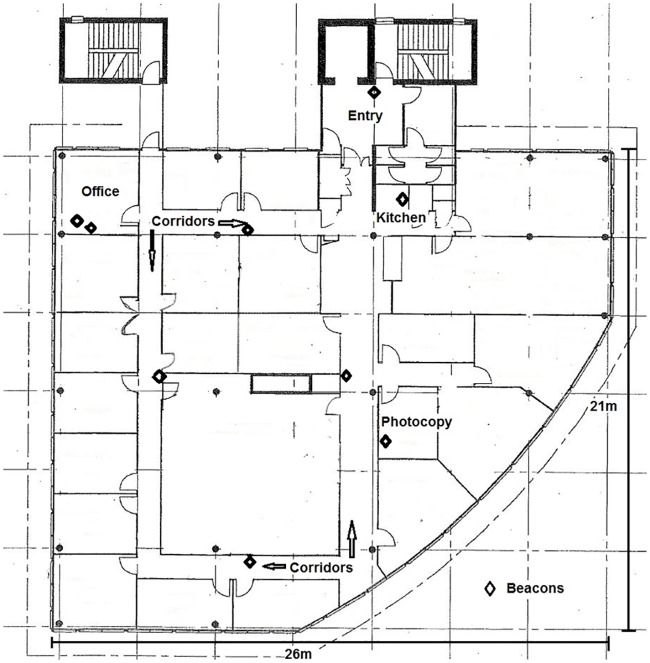
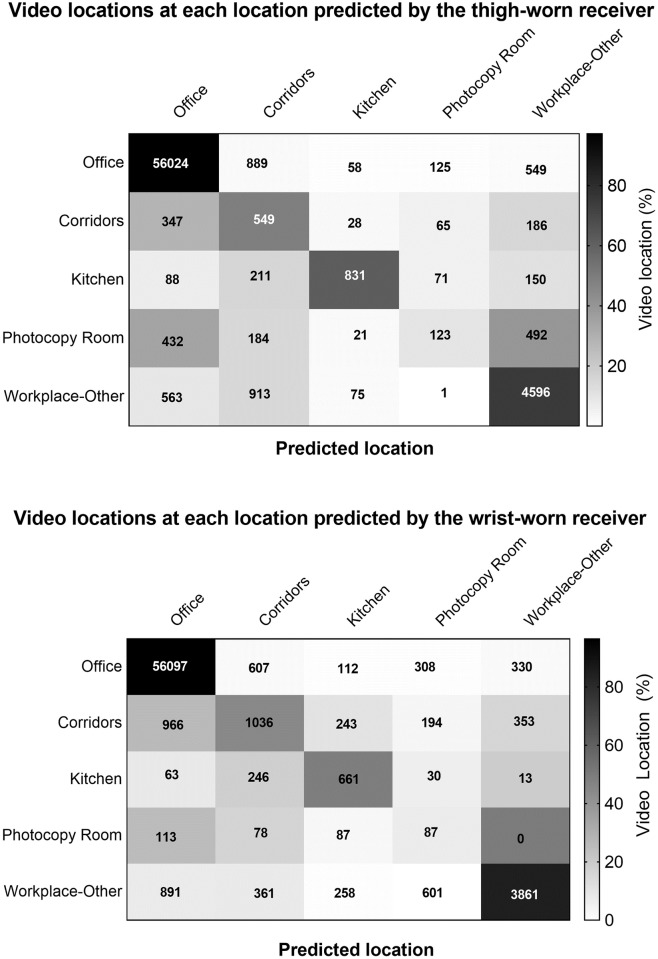
BACKGROUND: Most wearable devices that measure movement in workplaces cannot determine the context in which people spend time. This study examined the accuracy of Bluetooth sensing (10-second intervals) via the ActiGraph GT9X Link monitor to determine location in an office setting, using two simple, bespoke algorithms. METHODS: For one work day (mean±SD 6.2±1.1 hours), 30 office workers (30% men, aged 38±11 years) simultaneously wore chest-mounted cameras (video recording) and Bluetooth-enabled monitors (initialised as receivers) on the wrist and thigh. Additional monitors (initialised as beacons) were placed in the entry, kitchen, photocopy room, corridors, and the wearer's office. Firstly, participant presence/absence at each location was predicted from the presence/absence of signals at that location (ignoring all other signals). Secondly, using the information gathered at multiple locations simultaneously, a simple heuristic model was used to predict at which location the participant was present. The Bluetooth-determined location for each algorithm was tested against the camera in terms of F-scores. RESULTS: When considering locations individually, the accuracy obtained was excellent in the office (F-score = 0.98 and 0.97 for thigh and wrist positions) but poor in other locations (F-score = 0.04 to 0.36), stemming primarily from a high false positive rate. The multi-location algorithm exhibited high accuracy for the office location (F-score = 0.97 for both wear positions). It also improved the F-scores obtained in the remaining locations, but not always to levels indicating good accuracy (e.g., F-score for photocopy room ≈0.1 in both wear positions). CONCLUSIONS: The Bluetooth signalling function shows promise for determining where workers spend most of their time (i.e., their office). Placing beacons in multiple locations and using a rule-based decision model improved classification accuracy; however, for workplace locations visited infrequently or with considerable movement, accuracy was below desirable levels. Further development of algorithms is warranted.
Overview
The claims and statistics of this paper haven’t been checked yet.
Free: it reads the open-access text and checks the first 5 claims that cite a source we can check. Create a free account to check every claim.
Integrity signals
Registry
Cites
Statistics
Figures
Verification
Claims the paper makes
The claims and statistics of this paper haven’t been checked yet.
Free: it reads the open-access text and checks the first 5 claims that cite a source we can check. Create a free account to check every claim.
Claims other papers make about this one
Each is checked against this paper’s own text: does it say what the citing paper says it does?
The source backs part of the claim, not all of it — or backs it for a different population, condition or comparison.
In the citing paper
“The continuously recorded NBDC data represents a mixed signal that has been used to estimate individuals’ behaviors and statuses, including face-to-face social interactions [8-10], working status [11], mobility [12], and isolation and loneliness [13,14].”
From Predicting depressive symptom severity through individuals’ nearby Bluetooth device count data collected by mobile phones: preliminary longitudinal study (2021) · cites this paper as [11]
Experimental — accuracy not yet measuredIn the citing paper
“Activities in an independent sample of 98 participants (age 56.4 ± 15.7 years ; 53.1% female) from the US51”
From Association of wearable device-measured vigorous intermittent lifestyle physical activity with mortality (2022) · cites this paper as [52]
Self-check
Percentages, sums and reported differences re-computed from the paper’s own numbers.
The self-check needs the paper’s full text.
Citations
Cites
Evolution of accelerometer methods for physical activity research
Troiano, R. P., McClain, J. J., Brychta, R. J., & Chen, K. Y. (2014) · British Journal of Sports Medicine · doi:10.1136/bjsports-2014-093546 · Cited by 968
Sedentary behavior and health outcomes: an overview of systematic reviews.
Rezende, L. F. M. D., Rodrigues Lopes, M., Rey-López, J. P., Matsudo, V. K. R., & Luiz, O. D. C. (2014) · PLoS ONE · doi:10.1371/journal.pone.0105620 · Cited by 965
Model selection and overfitting
Lever, J., Krzywinski, M., & Altman, N. (2016) · Nature Methods · doi:10.1038/nmeth.3968 · Cited by 694
Sedentary Behaviors and Health Outcomes Among Adults
Proper, K. I., Singh, A. S., van Mechelen, W., & Chinapaw, M. J. M. (2011) · American Journal of Preventive Medicine · doi:10.1016/j.amepre.2010.10.015 · Cited by 633
Buman, M. P., Winkler, E. A. H., Kurka, J. M., Hekler, E. B., Baldwin, C. M., Owen, N., Ainsworth, B. E., Healy, G. N., & Gardiner, P. A. (2014) · American Journal of Epidemiology · doi:10.1093/aje/kwt292 · Cited by 427
Self-citationReplacing sitting time with standing or stepping: associations with cardio-metabolic risk biomarkers
Healy, G. N., Winkler, E. A. H., Owen, N., Anuradha, S., & Dunstan, D. W. (2015) · European Heart Journal · doi:10.1093/eurheartj/ehv308 · Cited by 310
Self-citationUtilization and Harmonization of Adult Accelerometry Data: Review and Expert Consensus
WIJNDAELE, K., WESTGATE, K., STEPHENS, S. K., BLAIR, S. N., BULL, F. C., CHASTIN, S. F. M., DUNSTAN, D. W., EKELUND, U., ESLIGER, D. W., FREEDSON, P. S., et al. (2015) · Medicine & Science in Sports & Exercise · doi:10.1249/mss.0000000000000661 · Cited by 297
Self-citationObesity and Trends in Life Expectancy
Walls, H. L., Backholer, K., Proietto, J., & McNeil, J. J. (2012) · Journal of Obesity · doi:10.1155/2012/107989 · Cited by 182
Doherty, A. R., Hodges, S. E., King, A. C., Smeaton, A. F., Berry, E., Moulin, C. J. A., Lindley, S., Kelly, P., & Foster, C. (2013) · American Journal of Preventive Medicine · doi:10.1016/j.amepre.2012.11.008 · Cited by 173
Kelly, P., Doherty, A., Berry, E., Hodges, S., Batterham, A. M., & Foster, C. (2011) · International Journal of Behavioral Nutrition and Physical Activity · doi:10.1186/1479-5868-8-44 · Cited by 130
Cited by
Stamatakis, E., Ahmadi, M. N., Gill, J. M. R., Thøgersen-Ntoumani, C., Gibala, M. J., Doherty, A., & Hamer, M. (2022) · Nature Medicine · doi:10.1038/s41591-022-02100-x · Cited by 336
“Activities in an independent sample of 98 participants (age 56.4 ± 15.7 years ; 53.1% female) from the US 51 (University of California Irvine Center for Machine Learning and Intelligent Systems Physical Activity Monitoring for Aging People study (published data), accessible at https://archive.ics.uci.edu/ml/datasets)…”
InfluentialZhang, Y., Folarin, A. A., Sun, S., Cummins, N., Ranjan, Y., Rashid, Z., Conde, P., Stewart, C., Laiou, P., Matcham, F., et al. (2021) · JMIR mHealth and uHealth · doi:10.2196/29840 · Cited by 68
“The continuously recorded NBDC data represents a mixed signal that has been used to estimate individuals’ behaviors and statuses, including face-to-face social interactions [8-10], working status [11], mobility [12], and isolation and loneliness [13,14].”
BackgroundDempsey, P. C., Hadgraft, N. T., WINKLER, E. A. H., Clark, B., Buman, M. P., Gardiner, P. A., Owen, N. G., Lynch, B. M., & Dunstan, D. W. (2018) · International Journal of Behavioral Nutrition and Physical Activity · doi:10.1186/s12966-018-0748-3 · Cited by 66
Self-citationKunhoth, J., Karkar, A., Al-Maadeed, S. A., & Al-Attiyah, A. A. (2019) · International Journal of Health Geographics · doi:10.1186/s12942-019-0193-9 · Cited by 60
“The most used position estimation techniques are lateration [10], BLE fingerprinting [11] and proximity sensing [12].”
MethodTrost, S. G., & Brookes, D. S. K. (2020) · Journal of Sports Sciences · doi:10.1080/02640414.2020.1826657 · Cited by 68
Self-citationDose Response of Incidental Physical Activity Against Cardiovascular Events and Mortality
Stamatakis, E., Biswas, R. K., Koemel, N. A., Sabag, A., Pulsford, R. M., Atkin, A. J., Stathi, A., Cheng, S. W. M., Thøgersen‐Ntoumani, C., Blodgett, J. M., et al. (2025) · Circulation · doi:10.1161/circulationaha.124.072253 · Cited by 60
Internet of Things technology applications in the workplace environment: a critical review
Nappi, I., & Ribeiro, G. D. C. (2020) · Journal of Corporate Real Estate · doi:10.1108/jcre-06-2019-0028 · Cited by 60
Sheldrick, M. P. R., Maitland, C., Mackintosh, K. A., Rosenberg, M., Griffiths, L. J., Fry, R. J., & Stratton, G. (2019) · International Journal of Environmental Research and Public Health · doi:10.3390/ijerph16214178 · Cited by 42
Ortmeyer, H. K., Robey, L., & McDonald, T. (2018) · Animals · doi:10.3390/ani8120230 · Cited by 28
“Although there are no published studies of using the proximity tagging features in dogs to date, a recent article examined the accuracy of proximity tagging to determine location in an office setting in 30 office workers [7].”
BackgroundTryner, J., Quinn, C. W., Rueda, E. M., Andales, M. J., L’Orange, C., Mehaffy, J., Carter, E. M., & Volckens, J. (2023) · Environmental Science & Technology · doi:10.1021/acs.est.3c02238 · Cited by 27
An IoT model for securing examinations from malpractices
Haque, S., Zeba, S., Haque, M. A., Kumar, K., & Basha, M. P. A. (2021) · Materials Today Proceedings · doi:10.1016/j.matpr.2021.03.413 · Cited by 23
vries, S. W. D., Gkaintatzi-Masouti, M., van Duijnhoven, J., Mardaljevic, J., & Aarts, M. M. (2024) · Lighting Research & Technology · doi:10.1177/14771535241248540 · Cited by 24
Data fusion in buildings: Synthesis of high-resolution IEQ and occupant tracking data
Pollard, B., Held, F. P., Engelen, L., Powell, L., & de Dear, R. (2021) · The Science of The Total Environment · doi:10.1016/j.scitotenv.2021.146047 · Cited by 20
Ortmeyer, H. K., & Katzel, L. I. (2020) · International Journal of Environmental Research and Public Health · doi:10.3390/ijerph17082674 · Cited by 18
“In a validation study comparing location by wearable cameras and proximity tagging in office workers, the most accurate detection was when the participant was stationary [21].”
BackgroundMethodPollard, B., Engelen, L., Held, F. P., Buskirk, J. V., Spinney, R. E., & de Dear, R. (2022) · Building and Environment · doi:10.1016/j.buildenv.2022.108812 · Cited by 22
Pollard, B., Engelen, L., Held, F. P., & de Dear, R. (2020) · Applied Ergonomics · doi:10.1016/j.apergo.2020.103341 · Cited by 17
Measuring lamb activity during lactation by actigraphy
Abecia, J. A., Canudo, C., Palacios, C., & Canto, F. (2022) · Chronobiology International · doi:10.1080/07420528.2022.2108715 · Cited by 14
“Proximity to another lamb was calculated based on BT signal presence (RSSI between −34 and −91 = 1) and signal absence (no RSSI reading = 0) as described by Clark et al. (2018), and measured as minutes per hour.”
MethodSugiyama, T., WINKLER, E. A. H., LaMontagne, A. D., Healy, G. N., Hadgraft, N. T., Dunstan, D. W., & Owen, N. G. (2019) · Journal of Occupational and Environmental Medicine · doi:10.1097/jom.0000000000001586 · Cited by 12
Self-citationActivity space, office space: Measuring the spatial movement of office workers
Pollard, B., Engelen, L., Held, F. P., & de Dear, R. (2021) · Applied Ergonomics · doi:10.1016/j.apergo.2021.103600 · Cited by 15
Tang, G., Yan, Y., Shen, C., Jia, X., Zinn, M., Trivedi, Z., Yingling, A., Westover, K. D., & Jiang, S. B. (2020) · Medical Physics · doi:10.1002/mp.14198 · Cited by 13
“One of the techniques that were applied to reduce cost in RTLS is the Bluetooth Low Energy (BLE) [15] [16] [17] [18], which has been widely used in wireless data transmission for years with iterative improvements in protocol and hardware implementation.”
MethodDonges, J., Morandi, F., Prada, A., Cappelletti, F., & Gasparella, A. (2023) · Building and Environment · doi:10.1016/j.buildenv.2023.111078 · Cited by 11
Clevenger, K. A., & Pfeiffer, K. A. (2021) · Journal of Early Childhood Research · doi:10.1177/1476718x211033641 · Cited by 13
“This could be accomplished using direct observation (Cosco et al., 2010; Nicaise et al., 2011, 2012) or monitor-based approaches, like Bluetoothenabled monitors (Clark et al., 2018) or Global Positioning Systems (Clevenger et al., 2019).”
BackgroundThe Importance of Research on Occupational Sedentary Behaviour and Activity Right Now
Clark, B., Brakenridge, C. L., & Healy, G. N. (2022) · International Journal of Environmental Research and Public Health · doi:10.3390/ijerph192315816 · Cited by 13
“Context can be gained using self-report data capture techniques such as online work diaries or momentary sampling [37], or through the use of additional devices such as workplace identification tags enabled for Bluetooth and radio frequency [38,39] or desk-height monitors for detecting sit–stand desk use [40].”
BackgroundSelf-citationACCESS - IoT enabled smart lock
Gadupu, H., Mokharji, O., Kankaria, R., Kumar, S., & Jayavel, K. (2021) · International Journal of Reconfigurable and Embedded Systems (IJRES) · doi:10.11591/ijres.v10.i3.pp176-185 · Cited by 12
“Concepts of Bluetooth and BLE have been widely used for proximity sensing experiments as depicted in [26] through the use of beacons.”
MethodThopate, K., Shinde, S., Mahajan, R., Bhagat, R., Joshi, P., Kalbhor, A., Kulkarni, A., & Jadhav, S. (2023) · International Journal on Recent and Innovation Trends in Computing and Communication · doi:10.17762/ijritcc.v11i8s.7187 · Cited by 6
Efficient BLE Fingerprinting through UWB Sensors for Indoor Localization
Zhang, Q., D’Souza, M., Balogh, U., & Smallbon, V. (2019) · IEEE SmartWorld, Ubiquitous Intelligence & Computing, Advanced & Trusted Computing, Scalable Computing & Communications, Cloud & Big Data Computing, Internet of People and Smart City Innovation (SmartWorld/SCALCOM/UIC/ATC/CBDCom/IOP/SCI) · doi:10.1109/smartworld-uic-atc-scalcom-iop-sci.2019.00065 · Cited by 6
“Indoor Localization has been widely used to provide various location-based services such as: indoor navigation in large shopping malls or airports [1], people and asset tracking in warehouse and hospitals [2], activity behaviour monitoring in workplace for health and safety [3].”
MethodA user-specific activity pattern generation framework for evidence-based ABW planning
Hoon, J., & Cha, S. H. (2020) · Building and Environment · doi:10.1016/j.buildenv.2020.107519 · Cited by 8
Pollard, B., Buskirk, J. V., Engelen, L., Held, F. P., & de Dear, R. (2022) · Applied Ergonomics · doi:10.1016/j.apergo.2022.103915 · Cited by 4
Pollard, B., McDonald, G., Held, F. P., & Engelen, L. (2021) · Ergonomics · doi:10.1080/00140139.2021.1980115 · Cited by 4
“The small number of physical activity studies undertaken in office workplaces have used systems with a low spatial resolution to provide broad locational context to accelerometer data collected over very short time periods (Clark et al. 2018; Magistro et al. 2018; Spinney et al. 2015).”
BackgroundMeasuring Time in the Office Using Bluetooth Sensors: Feasibility and Validity Considerations
Clark, B., Hadgraft, N. T., Sugiyama, T., & WINKLER, E. A. H. (2019) · Journal for the Measurement of Physical Behaviour · doi:10.1123/jmpb.2018-0046 · Cited by 3
Self-citationDistributed Intelligent Lighting System using BLE at the Workplace
Hajjaj, M., Miki, M., & Shimohara, K. (2019) · IEEE Global Conference on Consumer Electronics (GCCE) · doi:10.1109/gcce46687.2019.9015285 · Cited by 2
“Each user has an individual level of the luminance to work effectively at the office, and the lighting control system provides the amount level of luminance using the sensing devices [3].”
BackgroundMethodInfluentialRafferty, J., Synnott, J., Nugent, C., Cleland, I., Ennis, A., Catherwood, P. A., Orr, C., Selby, A., McDonald, G., & Morrison, G. (2018) · International Conference on Ubiquitous Computing and Ambient Intelligence (UCAmI) · doi:10.3390/proceedings2191218 · Cited by 2
“The RSSI scale for Bluetooth devices is between 0 dBm and −127 dBm [32,36].”
BackgroundMonitoring Worker Exposure to COVID-19 and Other Occupational Risks Using BLE Beacons
Gómez-de-Gabriel, J. M., Rey-Merchán, M. D. C., López-Arquillos, A., & Fernández‐Madrigal, J. (2022) · Journal of Sensors · doi:10.1155/2022/7254225 · Cited by 4
“Similarly, BLE beacons combined with accelerometer’s proximity features were tested to determine where office workers spend time at work [39].”
MethodHealy, G. N., Melendez-Calderon, A., Kaab, S. A., Bongers, N., Heseltine, K. A., Yue, C. H., Thomas, G., & Clark, B. (2025) · Applied Ergonomics · doi:10.1016/j.apergo.2025.104490 · Cited by 1
Self-citationMaylor, B. D., Small, S. R., Plekhanova, T., Brocklebank, L. A., van Duijvenboden, S., Sharman, R. L., Hill, E. A., Karpe, F., Kyle, S. D., & Doherty, A. (2025) · JMIR Research Protocols · doi:10.2196/78779 · Cited by 1
“Furthermore, the methods that we implement in this study overlap with past research [7, 38]; ongoing studies at the University of Oxford (S van Duijvenboden, unpublished data, December 2025); and future planned studies in low-and middle-income countries, such as India, South Africa, and Malaysia.”
A Survey of Passive Sensing for Workplace Wellbeing and Productivity
Nepal, S. K., Martinez, G. J., Pillai, A., Saha, K., Mirjafari, S., Swain, V. D., Xu, X., Audia, P. G., Choudhury, M. D., Dey, A. K., et al. (2025) · Lecture notes in computer science · doi:10.1007/978-3-031-93845-0_29 · Cited by 22
“…phone usage [28]; Computer activity [87,46,82]; Speech, calendar [46]; User activity, application usage, location, ringer mode [47]; Bluetooth [13]; Computer-assisted protected time [20,77] 4 Applications of Passive Sensing in the Workplace In this section, we explore how passive sensing…”
Reshaping of the retail environment due to internet as a global competitor
Gajanová, Ľ., & Nadányiová, M. (2020) · SHS Web of Conferences · doi:10.1051/shsconf/20207401005
Sheldrick, M. P. R. (2021) · Cronfa (Swansea University) · doi:10.23889/suthesis.58523 · Cited by 1
Das, S., & Das, A. (2023) · Soft Computing Research Society eBooks · doi:10.56155/978-81-955020-2-8-23
A Bluetooth Proximity-Based IoT Approach for Continuous Monitoring of Indoor Sedentariness
Girolami, M., Baronti, P., Crivello, A., Rosa, D. L., & Barsocchi, P. (2025) · IEEE World Forum on Internet of Things (WF-IoT) · doi:10.1109/wf-iot64238.2025.11270510
“For instance, the work in [10] demonstrate the utility of Bluetooth proximity sensing in discerning time spent by individuals in various office and nursing environments, laying the groundwork for using similar methodologies to quantify activity levels of older users.”
Metadata
- Authors
- Clark, B. K., Winkler, E. A., Brakenridge, C. L., Trost, S. G., & Healy, G. N.
- Affiliations
- The University of Queensland (AU)
- Queensland University of Technology (AU)
- Corresponding author
- Clark, Bronwyn K.
- ORCID
- Venue
- PLOS ONE
- Publisher
- Public Library of Science (PLoS)
- Published
- 2018-03-07
- Volume
- 13
- Issue
- 3
- Pages
- e0193971
- ISSN
- 1932-6203 (ISSN-L)
- PMC
- PMC5841797
- OpenAlex
- W2789492349
- Cited by
- 40
- References
- 25
- Citations by year
- 2025: 5 · 2024: 1 · 2023: 4 · 2022: 6 · 2021: 8 · 2020: 7 · 2019: 6 · 2018: 3
- FWCI
- 3.00
- Type
- journal article
- Language
- en
- Open access
- gold
- doi.org
- Licence
- Locations
- PLoS ONE (publishedVersion, cc-by)
- PubMed Central (publishedVersion, cc-by)
- PubMed (publishedVersion)
- QUT ePrints (Queensland University of Technology) (submittedVersion, cc-by)
- RePEc: Research Papers in Economics (submittedVersion)
- DOAJ (DOAJ: Directory of Open Access Journals) (submittedVersion, cc-by-sa)
- Figshare (submittedVersion, cc-by)
- Funders
- The University of Queensland (611434)
- Topics
- Physical Sciences › Computer Science › Computer Vision and Pattern Recognition › Context-Aware Activity Recognition Systems
- Physical Sciences › Engineering › Electrical and Electronic Engineering › Indoor and Outdoor Localization Technologies
- Social Sciences › Transportation › Human Mobility and Location-Based Analysis
- Keywords
- office workers, wearable activity trackers, Bluetooth beacons
- MeSH terms
- Adult, Algorithms, Behavior, Female, Humans, Male, Middle Aged, Models, Theoretical, Occupations, Task Performance and Analysis, Universities, Video Recording, Workplace, Actigraphy, Wireless Technology
About these checks
Registry, retraction, Cites and statistics results are computed, not judged, with one exception: a printed reference that no index lists is read once by a model before it counts as a citation error. Claims are extracted by a model and kept only when their quote appears verbatim in the text; each cited source is then checked, with a model’s help, for whether it says what the claim relies on. Those verdicts can be wrong — read the claim’s quote and the cited source before relying on one.
Statistics and arithmetic are recomputed, not judged.
Confidence bands are shown only for fields calibrated on our annotated test set. None is calibrated yet, so no band is shown.
What counts as a claim ›How we measure confidence ›How we check this ›
Are you an author, or do you see a problem with this page? Request a review
Data sources
Bibliographic data: Semantic Scholar, OpenAlex, Crossref.
Contains information from the Semantic Scholar Academic Graph Datasets, made available under the ODC Attribution License (ODC-BY 1.0).
Semantic Scholar’s data is described in: Kinney, R., et al. (2023). The Semantic Scholar Open Data Platform. arXiv:2301.10140.
