

Prevalence of psychotic disorders and its association with methodological issues. A systematic review and meta-analyses
Open accessThe DOI matches its Crossref record; 102 of the 102 references it cites were found in a registry or an index.
Abstract
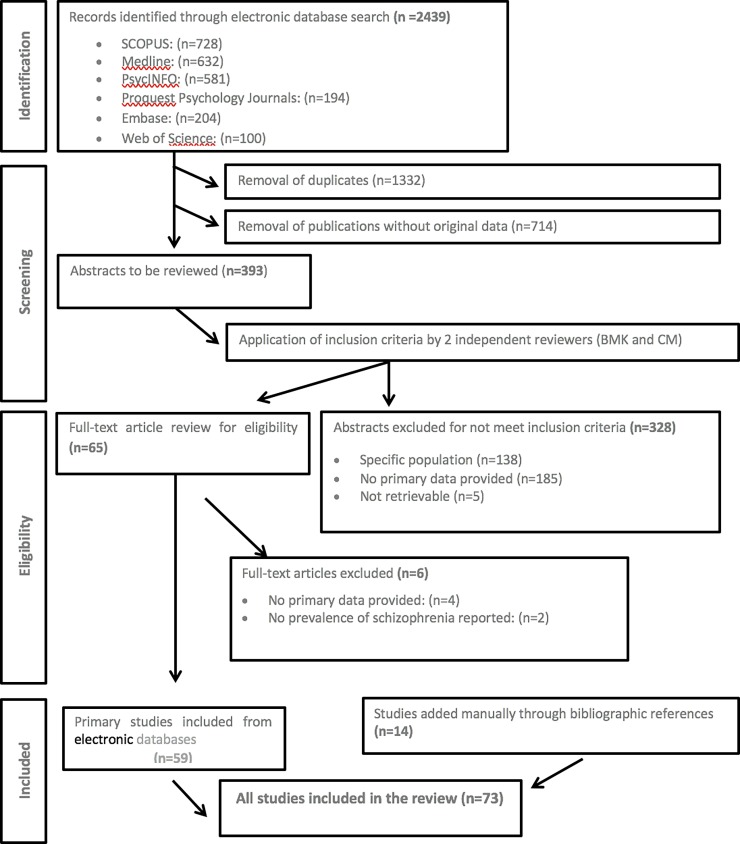
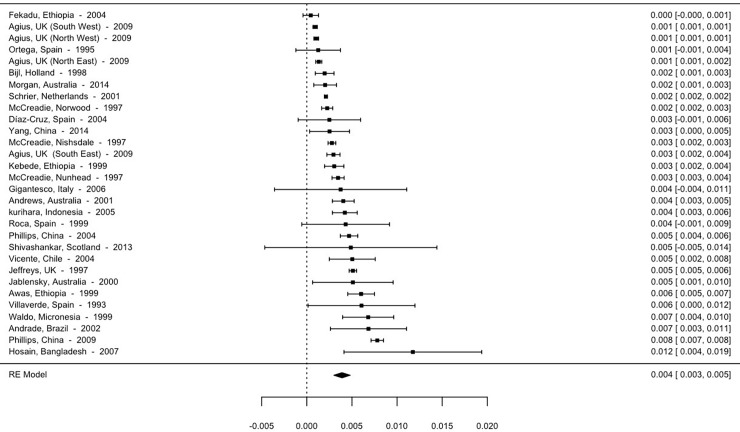
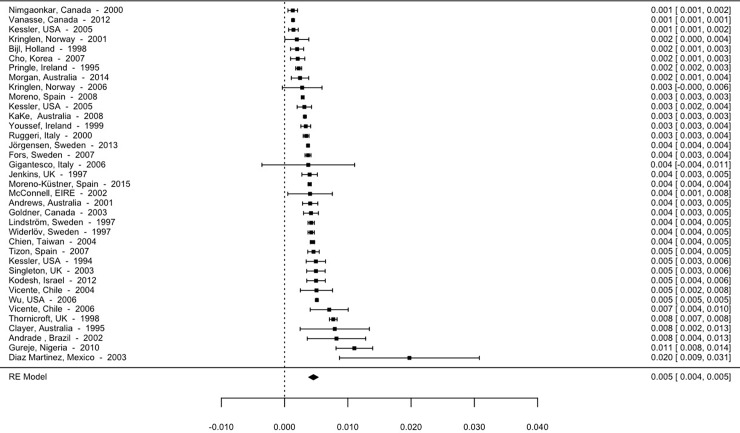
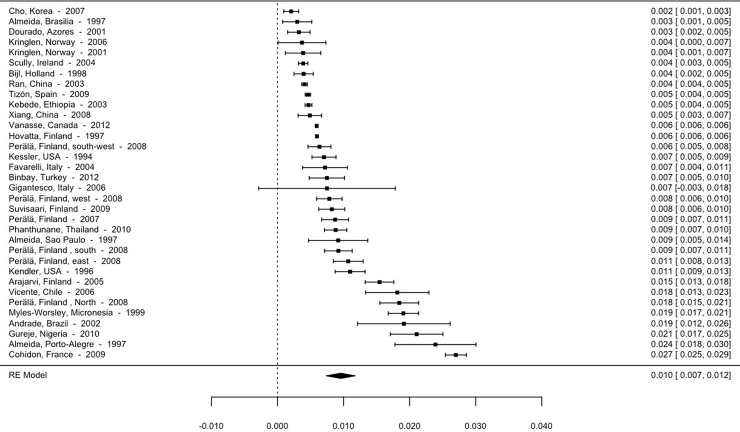
OBJECTIVES: The purpose of this study is to provide an updated systematic review to identify studies describing the prevalence of psychosis in order to explore methodological factors that could account for the variation in prevalence estimates. METHODS: Studies with original data related to the prevalence of psychosis (published between 1990 and 2015) were identified via searching electronic databases and reviewing manual citations. Prevalence estimates were sorted according to prevalence type (point, 12-months and lifetime). The independent association between key methodological variables and the mean effect of prevalence was examined (prevalence type, case-finding setting, method of confirming diagnosis, international classification of diseases, diagnosis category, and study quality) by meta-analytical techniques and random-effects meta-regression. RESULTS: Seventy-three primary studies were included, providing a total of 101 estimates of prevalence rates of psychosis. Across these studies, the pooled median point and 12-month prevalence for persons was 3.89 and 4.03 per 1000 respectively; and the median lifetime prevalence was 7.49 per 1000. The result of the random-effects meta-regression analysis revealed a significant effect for the prevalence type, with higher rates of lifetime prevalence than 12-month prevalence (p<0.001). Studies conducted in the general population presented higher prevalence rates than those carried out in populations attended in health/social services (p = 0.006). Compared to the diagnosis of schizophrenia only, prevalence rates were higher in the probable psychotic disorder (p = 0.022) and non-affective psychosis (p = 0.009). Finally, a higher study quality is associated with a lower estimated prevalence of psychotic disorders (p<0.001). CONCLUSIONS: This systematic review provides a comprehensive comparison of methodologies used in studies of the prevalence of psychosis, which can provide insightful information for future epidemiological studies in adopting the most relevant methodological approach.
Overview
The claims and statistics of this paper haven’t been checked yet.
Free: it reads the open-access text and checks the first 5 claims that cite a source we can check. Create a free account to check every claim.
Integrity signals
Registry
Cites
Statistics
Figures
Verification
Claims the paper makes
The claims and statistics of this paper haven’t been checked yet.
Free: it reads the open-access text and checks the first 5 claims that cite a source we can check. Create a free account to check every claim.
Claims other papers make about this one
Each is checked against this paper’s own text: does it say what the citing paper says it does?
The check wasn’t confident either way, so it gives no verdict — never disputed.
In the citing paper
“Although our search criteria included all DSM-5 schizophrenia-spectrum disorders, all of the SSD studies we located used samples diagnosed with schizophrenia and schizoaffective disorder, the two most common non-substance-related DSM-5 schizophrenia-spectrum disorders (American Psychiatric Association, 2013; Moreno-Küstner et al., 2018; Simeone et al., 2015).”
From Narrative identity in the psychosis spectrum: A systematic review and developmental model (2021) · cites this paper as Moreno-Küstner et al., 2018
Experimental — accuracy not yet measured
Self-check
Percentages, sums and reported differences re-computed from the paper’s own numbers.
The self-check needs the paper’s full text.
Citations
Cites
Preferred Reporting Items for Systematic Reviews and Meta-Analyses: the PRISMA statement
Moher, D., Liberati, A., Tetzlaff, J., Altman, D. G., & for the PRISMA Group (2009) · BMJ · doi:10.1136/bmj.b2535 · Cited by 83,823
Preferred Reporting Items for Systematic Reviews and Meta-Analyses: The PRISMA Statement
Moher, D., Liberati, A., Tetzlaff, J., Altman, D. G., & The PRISMA Group (2009) · PLoS Medicine · doi:10.1371/journal.pmed.1000097 · Cited by 64,042
Bias in meta-analysis detected by a simple, graphical test
Egger, M., Smith, G. D., Schneider, M., & Minder, C. (1997) · BMJ · doi:10.1136/bmj.315.7109.629 · Cited by 56,722
Preferred reporting items for systematic reviews and meta-analyses: The PRISMA statement
Moher, D., Liberati, A., Tetzlaff, J., Altman, D. G., & the PRISMA Group* (2009) · Annals of Internal Medicine · doi:10.7326/0003-4819-151-4-200908180-00135 · Cited by 37,554
Conducting Meta-Analyses in R with the metafor Package
Viechtbauer, W. (2010) · Journal of Statistical Software · doi:10.18637/jss.v036.i03 · Cited by 20,464
(1998) · The Journal of Clinical Psychiatry · Cited by 19,139
Wang, G., Ma, R., Qiao, G., Wada, K., Aizawa, Y., & Satoh, T. (2015) · Integrative Medicine International · doi:10.1159/000368408 · Cited by 18,657
James, S. L., Abate, D., Abate, K. H., Abay, S. M., Abbafati, C., Abbasi, N., Abbastabar, H., Abd-Allah, F., Abdela, J., Abdelalim, A., et al. (2018) · The Lancet · doi:10.1016/s0140-6736(18)32279-7 · Cited by 13,867
Vos, T., Abajobir, A. A., Abate, K. H., Abbafati, C., Abbas, K. M., Abd-Allah, F., Abdulkader, R. S., Abdulle, A. M., Abebo, T. A., Abera, S. F., et al. (2017) · The Lancet · doi:10.1016/s0140-6736(17)32154-2 · Cited by 13,220
Kessler, R. C. (1994) · Archives of General Psychiatry · doi:10.1001/archpsyc.1994.03950010008002 · Cited by 12,370
Research works printed but not linked: 4
- A Dourado, 2001, Reduced prevalence of psychoses in Santa Maria Island, Azores, Portugal, Am J Med Genet B, 96, 513
- I Hovatta, 1997, Schizophrenia in the genetic isolate of Finland, Am J Med Genet, 74, 353, 10.1002/(SICI)1096-8628(19970725)74:4<353::AID-AJMG3>3.0.CO;2-Q · doi:10.1002/(sici)1096-8628(19970725)74:4<353::aid-ajmg3>3.0.co;2-q
- MA Ortega, 1995, Morbilidad psíquica diagnóstica en la población general de La Rioja, Anales de Psiquiatría, 2, 320
- J Tizón, 2007, Schizophrenic disorders in primary care mental health, Atención Primaria, 39, 119
Cited by
Items 401–500 of 562
Adult ADHD in Schizophrenia Spectrum and Other Psychotic Disorders
Pallanti, S., & Salerno, L. (2020) · Springer eBooks · doi:10.1007/978-3-030-39051-8_8 · Cited by 1
Le milieu urbain : un facteur de risque pour les troubles psychotiques ?
Schürhoff, F., & Pignon, B. (2021) · Annales Médico-psychologiques revue psychiatrique · doi:10.1016/j.amp.2021.02.018 · Cited by 1
Diabetes mellitus in patients using psychotropic medications: How does it work?*
Kosmalski, M., Różycka-Kosmalska, M., Sikora, J., & Pietras, T. (2021) · Postępy Higieny i Medycyny Doświadczalnej · doi:10.5604/01.3001.0014.9330 · Cited by 2
Schizophrenie, schizoaffektive und wahnhafte Störungen
Eusterschulte, B. (2020) · Elsevier eBooks · doi:10.1016/b978-3-437-21273-4.00018-5 · Cited by 2
Schizophrenia and PCR-proved cases of COVID-19: A preliminary case-control study
Alghamdi, S. A. (2022) · Medical Science · doi:10.54905/disssi/v26i125/ms269e2069 · Cited by 1
Risk factors for violent behavior in people with psychotic disorders
Lamsma, J. (2021) · Utrecht University Repository (Utrecht University) · doi:10.33540/496 · Cited by 1
Escrivá, J. V. S. (2021) · Tesis Doctorals en Xarxa (Consorci de Serveis Universitaris de Catalunya) · doi:10.6035/14111.2021.301397 · Cited by 6
Ayari, F., Chaaben, A. B., Abbaza, H., Mihoub, O., Ouni, N., Mankaï, A., Boukouaci, W., kharat, M., Leboyer, M., & Tamouza, R. (2022) · Research Square · doi:10.21203/rs.3.rs-1678095/v1 · Cited by 1
Construct Validity of the Psychosis Screening Questionnaire in Ugandan AdultsPreprint
Kwagala, C., Ametaj, A., Kim, H. H., Kyebuzibwa, J., Rogers, O., Stevenson, A., Gelaye, B., & Akena, D. H. (2023) · Research Square · doi:10.21203/rs.3.rs-2482429/v1 · Cited by 1
Cristiano, V. B., Szortyka, M. F., & Belmonte-de-Abreu, P. S. (2023) · Preprints.org · doi:10.20944/preprints202308.1686.v1
Berglass, M., Goldman, S., Maki, D. G., Hennekens, C. H., & Wood, S. K. (2023) · The American Journal of Medicine · doi:10.1016/j.amjmed.2023.11.016 · Cited by 1
Xiang, Y., Lewis‐Fernández, R., Zhao, X., Bayardo, S. V., Li, W., & Zamora, R. L. (2024) · Springer eBooks · doi:10.1007/978-3-030-51366-5_78 · Cited by 1
Jolley, S., Carr, E., Nilsen, S., Shearer, J., Weaver, T. D., Duffy, J., & Metrebian, N. (2026) · Substance Use & Addiction Journal · doi:10.1177/29767342251406002 · Cited by 1
Lee, B., Baek, J. H., Cho, E. Y., Yang, S.-Y., Choi, Y. J., Lee, Y. S., Ha, K., & Hong, K. S. (2018) · Korean Journal of Schizophrenia Research · doi:10.16946/kjsr.2018.21.2.43 · Cited by 1
Shapiro, D. I., Li, H.-J., & Seidman, L. (2019) · Handbook of Attenuated Psychosis Syndrome Across Cultures · doi:10.1007/978-3-030-17336-4_1
Rowe, B., Chen, X., Wang, Z., Chen, J., & Amei, A. (2019) · Schizophrenia · doi:10.1038/s41537-019-0088-6 · Cited by 2
“75% with no significant differences across urban, rural, and mixed sites or genders.(1,2) While being a low prevalence disorder, it has substantial societal burden.”
BackgroundFractalkine signaling in psychiatric disorder : observations in the postmortem brain
Hill, S. L. (2019) · cIRcle (University of British Columbia) · doi:10.14288/1.0384590
“33 For fractalkine, we observed a significant effect of diagnosis (F(2, 102)=4.”
BackgroundPrescribing for the early symptoms of psychosis
Rae, S., Duncan, F., & Krishnadas, R. (2020) · Prescriber · doi:10.1002/psb.1835 · Cited by 1
Cognitive development and risk for psychopathology in 22q11.2 Deletion Syndrome
Morrison, S. (2019) · ORCA Online Research @Cardiff (Cardiff University)
McElroy, D. L. (2020) · HARVEST (University of Saskatchewan)
Góis, J. (2020) · Revista Portuguesa de Psiquiatria e Saúde Mental · doi:10.51338/rppsm.2020.v6.i2.140 · Cited by 2
Evolución en el diagnóstico del trastorno afectivo bipolar entre 2010 y 2015. Caldas, Colombia
Osório, J. H., Quenán, Y. E., & Acosta, M. A. (2020) · Universidad y Salud · doi:10.22267/rus.212301.210 · Cited by 2
“[23] de Enfermedades 10a versión (CIE-10).”
Defizite im verbalen Gedächtnis als transdiagnostisches Korrelat psychotischer Störungen
Gebhardt, N., & Ely, D. R. (2021) · Zeitschrift für Neuropsychologie · doi:10.1024/1016-264x/a000316
Costa-Dookhan, K. A. (2020) · TSpace (University of Toronto)
Hell, R. H., Nguedjo, M. W., Bilongo, C. S. M., Dibacto, R. E. K., Tchuente, B. R. T., Dimodi, H. T., Medoua, G. N., & Bassong, O. (2020) · Central African Journal of Public Health · doi:10.11648/j.cajph.20200606.18
“49% per 1000 individuals under antipsychotic drugs in 2018[6], to 26.”
BackgroundMcDermott, J. (2020) · Carolina Digital Repository (University of North Carolina at Chapel Hill) · doi:10.17615/nr4k-vr86
Wijewickrama, D. (2020) · PsyArXiv (OSF Preprints) · doi:10.31234/osf.io/9arzv
Psychosis and its Association with Autoimmune Disorders: A Review
Zaib, S. (2021) · Biomedical Journal of Scientific & Technical Research · doi:10.26717/bjstr.2021.34.005619
“The level of cytokines in different SHZ patients have been investigated and the results indicate an increased levels in cytokines such as tumor necrosis factor (TNF)-α, IL-1β, IL-12, interleukin (IL)-6, and transforming growth factor (TGF)-β [34].”
BackgroundApego, neurocognición y cognición social en el espectro de la esquizofrenia
Monfort-Escrig, C. (2021) · Tesis Doctorals en Xarxa (Consorci de Serveis Universitaris de Catalunya) · doi:10.6035/14109.2021.151500
Loureiro, C. M. (2021) · Digital Library of Theses and Dissertations (Universidade de São Paulo) · doi:10.11606/t.17.2021.tde-04082021-134444
Widinghoff, C., Berge, J., & Håkansson, A. (2021) · International Journal of Mental Health and Addiction · doi:10.1007/s11469-021-00636-6 · Cited by 3
“…psychotic disorders are reported to be about 4% in the general population, with a corresponding number of 7% in problem gamblers (Kim et al., 2018; Moreno-Kustner et al., 2018); hence, it is likely that many of the patients studied here were prescribed antipsychotic drugs on other indications…”
BackgroundCOVID-19 related Psychotic Disorder: Symptomatology in Infected and Uninfected Patients
Mohan, A., & Lahiri, D. (2021) · Integrative Journal of Medical Sciences · doi:10.15342/ijms.2021.489
“4 12-month prevalence rate of psychotic disorder per 1000 people in the population [55], and as compared to the millions of patients who have had COVID-19 infection, COVID-19 patients appear to develop psychotic disorder very rarely.”
BackgroundValencia, J. G., Agudelo, L. M., Cañas, M. C. Á., Castro-Campos, N., Ribero, O., & Gallego, J. A. (2021) · medRxiv · doi:10.1101/2021.11.22.21266701
“Introduction Schizophrenia is an illness with a prevalence rate of 0.33 to 0.75% of the population (Saha et al., 2005; Moreno-Küstner et al., 2018).”
BackgroundInfluentialAGING OF THE CHORNOBYL CATASTROPHE SURVIVORS AND PROBLEMS OF THEIR MENTAL HEALTH SURVEY
Gunko, N., Loganovsky, K., Buzunov, V., & Короткова, Н. В. (2021) · Проблеми радіаційної медицини та радіобіології = Problems of Radiation Medicine and Radiobiology · doi:10.33145/2304-8336-2021-26-162-187
Meyer, J. M., & Stahl, S. M. (2021) · Cambridge University Press eBooks · doi:10.1017/9781009002103.003
rédaction, L. (2020) · Revue d Épidémiologie et de Santé Publique · doi:10.1016/j.respe.2020.07.001
(2020) · Elsevier eBooks · doi:10.1016/b978-0-12-815002-3.00020-6
Connecting needs and care in psychosis: an illustration of decision support in psychosis care
Roebroek, L. O. (2022) · University of Groningen research database (University of Groningen / Centre for Information Technology) · doi:10.33612/diss.207593828
de Vries, B. (2020) · http://isrctn.com/ · doi:10.1186/isrctn14710049
Affect Dynamic Signatures of Psychosis Risk Across Multiple Timescales and ContextsPreprint
Li, L. Y., Schiffman, J. E., & Martin, E. A. (2021) · PsyArXiv (OSF Preprints) · doi:10.31234/osf.io/wxhyq
Analysis of gene expression and DNA methylation in a cognitive phenotype model of schizophrenia
Rutherford-Ymker, S. (2020) · Open Access Victoria University of Wellington | Te Herenga Waka (Figshare) · doi:10.26686/wgtn.17151464.v1
TLR2 genetic diversity and the risk of SchizophreniaPreprint
Ayari, F., Chaaben, A. B., Abbaza, H., Mihoub, O., Ouni, N., Mankaï, A., Boukouaci, W., kharat, M., Leboyer, M., & Tamouza, R. (2022) · Research Square · doi:10.21203/rs.3.rs-1678095/v2
Cristiano, V. B., Szortyka, M. F., & Belmonte-de-Abreu, P. S. (2022) · Research Square · doi:10.21203/rs.3.rs-1435300/v1
BİLGEN, Ç., Erdal, A., & Bilgili, N. (2020) · DergiPark (Istanbul University)
Srasuebkul, P., Walker, A. R., Cvejic, R. C., Trollor, J. N., Lappin, J., Curtis, J., Samaras, K., Dean, K., Ward, P. B., & Reppermund, S. (2022) · Australian & New Zealand Journal of Psychiatry · doi:10.1177/00048674221115642 · Cited by 1
“Psychotic disorders encompass multiple diagnostic categories or ‘subtypes’ (one of which includes schizophrenia and delusional disorders) that are increasingly recognised to be heterogeneous disorders, though there is also overlap in aetiological, cognitive and clinical profiles (Kravariti et al., 2012; Moreno-Küstner…”
BackgroundMa, C. F., Chien, W. T., Chan, S. K. W., & Wong, C. L. (2022) · Cochrane Database of Systematic Reviews · doi:10.1002/14651858.cd014970 · Cited by 1
Li, X., Geenjaar, E., Fu, Z., Plis, S., & Calhoun, V. D. (2022) · Annual International Conference of the IEEE Engineering in Medicine and Biology Society (EMBC) · doi:10.1109/embc48229.2022.9871803
“Schizophrenia is a lifelong mental disorder which affects perception and behavior with a prevalence of just under 1% in the population and it is among the top causes of disability worldwide [1], [2].”
BackgroundJuvonen, K. (2022) · Physician Assistant Clinics · doi:10.1016/j.cpha.2022.09.003
Wu, H., Xue, K., Peng, A., Chai, J., & Zhao, Y. (2022) · Medicine · doi:10.1097/md.0000000000032007
“75%.[1] It often strikes in youth or adulthood and has a long course.”
BackgroundMoritz, S., Krieger, E. C., Bohn, F., Elmers, J., & Veckenstedt, R. (2022) · Psychotherapie: Manuale · doi:10.1007/978-3-662-64467-6_2
Everaert, E. (2023) · Utrecht University Repository (Utrecht University) · doi:10.33540/1715 · Cited by 2
Erazo, J. M., Valencia, J. A. M., Latorre, M. J. M., Vanegas, V., Miranda, C., & Rivas, J. C. (2023) · Revista Colombiana de Psiquiatría · doi:10.1016/j.rcp.2023.04.005
Uso de sustancias psicoactivas como tratamiento de la psicosis
Serrano-Jiménez, E., & de Lucas-Moreno, M. G. (2023) · Revista de Neurología · doi:10.33588/rn.7611.2023077
“El National Institute of Mental Health estima que la esquizofrenia y los trastornos psicóticos presentan una prevalencia entre el 0,33 y el 0,75% de la población [2,3].”
Mental Health Matters: Mental Health Service Utilization Among African American Emerging Adults
Curry, T. M. (2022) · Louisiana State University · doi:10.31390/gradschool_dissertations.5865 · Cited by 1
Arraes, G. C., Barreto, F. S., Vasconcelos, G. S., Lima, C. N. D. C., da Silva, F. E. R., de Sousa, F. C. F., Furtado, C. L. M., & Macêdo, D. S. (2023) · Research Square · doi:10.21203/rs.3.rs-2973577/v1
Hanlon, C., & Fekadu, A. (2023) · Elsevier eBooks · doi:10.1016/b978-0-7020-7959-7.00076-2
Khandker, R. K., Prince, M. R. I., Chekani, F., Dexter, P. R., Boustani, M. A., & Miled, Z. B. (2023) · Information · doi:10.3390/info14090471 · Cited by 1
“Schizophrenia and bipolar disorder affect millions of people worldwide [1].”
BackgroundYamada, Y., & Sumiyoshi, T. (2023) · IntechOpen eBooks · doi:10.5772/intechopen.112742
Ho, P. A., Stull, T., & Noordsy, D. L. (2023) · Springer eBooks · doi:10.1007/978-3-031-36864-6_15
Immunological Changes and Brain Function over a Psychotic-Depressive Spectrum
Paul, E. R. (2023) · Linköping University medical dissertations · doi:10.3384/9789180753098
Psychotic experiences: Gift or illness?
van der Zeijst, M. C. E. (2023) · University of Groningen research database (University of Groningen / Centre for Information Technology) · doi:10.33612/diss.806987620
Chaidemenaki, L., & Giannouli, E. (2023) · The Arts in Psychotherapy · doi:10.1016/j.aip.2023.102093
Harvey, A., Moreau, C. A., Kumar, K., Guillaumeaf, Urchs, S. G. W., Sharmarke, H., Jizi, K., Martin, C.-O., Younis, N., Tamer, P., et al. (2023) · doi:10.31234/osf.io/srmx7
rTMS Shows Efficacy in Improving Negative Symptoms in Early Psychosis: A Systematic ReviewPreprint
Hrabok, M., Hinde, A. K., & Song, W.-Y. (2024) · doi:10.22541/au.170664170.00769024/v1
Effect of Psychoeducation on Reducing Burden Among Primary Caregivers of People with Schizophrenia
Zaman, F. T. Z. B., & Moni, M. J. (2024) · Jagannath University journal of life and Earth sciences. · doi:10.3329/jnujles.v9i1.72882
A case report on the impact of homoeopathic intervention in psychosis
Moorthi, S. K., Pertin, S., & Nithin, R. (2024) · Journal of Integrated Standardized Homoeopathy · doi:10.25259/jish_44_2023
Entendendo a psicose: desenvolvimento de um ebook interativo para a promoção da saúde mental
de Freitas, L. A. (2024) · Digital Library of Theses and Dissertations (Universidade de São Paulo) · doi:10.11606/d.22.2024.tde-19072024-094157
Are psychotic-like experiences associated with aberrant prosocial decision-making behavior?
Elmers, J., Gabbert, T., David, B., Scheunemann, J., & Moritz, S. (2024) · Frontiers in Psychology · doi:10.3389/fpsyg.2024.1387678 · Cited by 1
Time to treatment of first-episode psychosis: the role of early intervention teams
Hall, M., Mills, R., Watson, E., Nathan, R., & Stewart, A. (2024) · British Journal of Mental Health Nursing · doi:10.12968/bjmh.2023.0018
de Vries, B. (2024) · University of Groningen research database (University of Groningen / Centre for Information Technology) · doi:10.33612/diss.1084352057
A systematic review and meta-analysis of cortisol responses in psychosis
Kelly, L. J., Sooknarine, V., Hsu, A., O’Connor, M. J., Nasa, A., O’Hora, E., Gazzaz, A., Tan, H. Y. R., Riaz, S., Brady, C., et al. (2024) · doi:10.37766/inplasy2024.8.0133
An Item Response Theory Analysis of the Psychosis Screening Questionnaire in Ethiopia
Yared, M., Kim, H. H., Ametaj, A., Alemayehu, M., Stevenson, A., Milkias, B., Girma, E., Gelaye, B., & Teferra, S. (2024) · Early Intervention in Psychiatry · doi:10.1111/eip.13609
Firearm violence and individuals with serious mental illnesses
Ciak, J., & Cuddeback, G. S. (2024) · Elsevier eBooks · doi:10.1016/b978-0-323-95272-9.00008-5
Biondo, J., & Gerber, N. E. (2024) · Research Square · doi:10.21203/rs.3.rs-5261372/v1
Kieseppä, V., Leppänen, J., Healy, C., Lång, U., Veijola, J. M., & Kelleher, I. (2026) · Child Psychiatry & Human Development · doi:10.1007/s10578-026-01987-8
Thompson, E. A., Visser, K. F., Ward, M., & Gaudiano, B. A. (2025) · Cambridge University Press eBooks · doi:10.1017/9781009086264.017
Jen, Y., Yu, S., Hsiao, P., Kuo, P., Liu, C., Liu, C., Hwang, T., Hsieh, M. H., Chien, Y., Lin, Y.-T., et al. (2026) · Molecular Psychiatry · doi:10.1038/s41380-026-03731-z
“Schizophrenia (SZ) is a leading cause of disability worldwide [1], with a median lifetime prevalence of 6.35 per 1000 people [2].”
InfluentialWilson, J., Langcake, A., Bryant, Z., Freeman, T. P., Leung, J., Chan, G., Englund, A., Graham, M., & Stockings, E. (2025) · Systematic Reviews · doi:10.1186/s13643-024-02657-3 · Cited by 2
Moza, S., & Chrysostomou, S. (2025) · IntechOpen eBooks · doi:10.5772/intechopen.1009026
Jang, W.-H., Seo, S.-M., & Kim, S.-H. (2025) · Occupational Therapy International · doi:10.1155/oti/3566653
“The nature of the disease is one of long duration, with the possibility of recovery after onset, but a tendency toward chronicity due to repeated relapses, requiring lifelong management rather than a complete cure [5].”
Psychoses and psychotic disorders
Afzal, M., Hashem, S., & Cohen, C. I. (2025) · Oxford University Press eBooks · doi:10.1093/med/9780198874799.003.0019
Yamada, Y., Kishimoto, N., Tagata, H., Morimoto, T., Tomimoto, K., Sato, Y., Higuchi, Y., Hiejima, H., Ohshima, H., Kato, T., et al. (2025) · Clinical Psychopharmacology and Neuroscience · doi:10.9758/cpn.24.1258 · Cited by 2
“Schizophrenia remains an etiological and therapeutic challenge [1], affecting approximately 0.75% of the world ’ s population [2].”
InfluentialReal-World Evidence and Outcomes Associated with Pharmacotherapy in Schizophrenia
Dickson, M. C., Lambert, T. L., & Skrepnek, G. H. (2024) · Springer eBooks · doi:10.1007/978-3-031-40858-8_191-1
Schizophrenia and Na+/H+ Exchangers
Pruett, B. S. (2024) · Springer eBooks · doi:10.1007/978-3-031-32035-4_114-1
Agorinya, J., Asem-Ahiablee, E. E. A., Dzordzorme, E. A., Ayambila, J. N., Amaning, E. A., Ohakpougwu, C. E., Arhin, A., Obeng, K. M., & Lennox, B. (2025) · BJPsych International · doi:10.1192/bji.2025.7
Can we run away from the metabolic side effects of antipsychotics?
Akcan, M., & Wright, D. C. (2025) · Translational Exercise Biomedicine · doi:10.1515/teb-2025-0016
Kompella, S., Heaven, J. D., & Mathelier, G. (2025) · Springer eBooks · doi:10.1007/978-3-031-86114-7_11
Treatment non-compliance with antipsychotics in Pakistan
Khan, Z. A., Ishfaq, I., & Jabeen, T. (2025) · Journal of the Pakistan Medical Association · doi:10.47391/jpma.22300
Eckstein, K. N., Rosenbaum, D., Camera, A., Röhrig, L., Herrmann, M. L., & Wildgruber, D. (2025) · Scientific Reports · doi:10.1038/s41598-025-10439-7
Vivian, L. M. H., & Nomngcoyiya, T. (2025) · Hau Journal of Ethnographic Theory · doi:10.1086/736367
Schizophrenia and Na+/H+ Exchangers
Pruett, B. S. (2025) · Springer eBooks · doi:10.1007/978-3-031-73368-0_114
Mental health help-seeking by US college students with a diagnosis of psychosis
Godoy-Henderson, C., Denner, S., Flesaker, M., Weinberg, J., Dalhoe, M., & Lipson, S. K. (2026) · Social Psychiatry and Psychiatric Epidemiology · doi:10.1007/s00127-026-03102-7
“Psychosis is a severe mental illness that affects a small per - centage of the population, with global lifetime prevalence estimates of 7.49 per 1,000 persons [1].”
InfluentialWang, Q., Liang, T., & Zeng, X. (2025) · Journal of improved oil and gas recovery technology. · doi:10.53469/wjimt.2025.08(09).11
“Although the prevalence rate is not high, the disability rate is high, ranking 12th in the global disease burden study in 2016 [2,3].”
Öztürk, H. İ., Sabitay, I. K., İskender, G., & Dönmezler, S. (2025) · Frontiers in Psychiatry · doi:10.3389/fpsyt.2025.1682782
“This complex neuropsychiatric disorder, with a global lifetime prevalence of roughly 0.75% (4) and contributing to reduced lifespan, is characterized by a multifaceted aetiology.”
Influential
Metadata
- Authors
- Moreno-Küstner, B., Martín, C., & Pastor, L.
- Affiliations
- Andalusian Health Service (ES)
- Universidad de Málaga (ES)
- Venue
- PLOS ONE
- Publisher
- Public Library of Science (PLoS)
- Published
- 2018-04-12
- Volume
- 13
- Issue
- 4
- Pages
- e0195687
- ISSN
- 1932-6203 (ISSN-L)
- PMC
- PMC5896987
- OpenAlex
- W2797349527
- Cited by
- 562
- References
- 102
- Citations by year
- 2026: 61 · 2025: 72 · 2024: 78 · 2023: 92 · 2022: 78 · 2021: 72 · 2020: 73 · 2019: 28 · 2018: 8
- FWCI
- 6.92
- Type
- journal article
- Language
- en
- Open access
- gold
- doi.org
- Licence
- Locations
- PLoS ONE (publishedVersion, cc-by)
- Europe PMC (PubMed Central) (publishedVersion, cc-by)
- PubMed Central (publishedVersion, cc-by)
- PubMed (publishedVersion)
- RISalud Institutional Health Repository of Andalucía (submittedVersion, cc-by)
- RePEc: Research Papers in Economics (submittedVersion)
- DOAJ (DOAJ: Directory of Open Access Journals) (submittedVersion, cc-by-sa)
- Figshare (submittedVersion, cc-by)
- Repositorio Institucional de la Universidad de Málaga (University of Málaga) (submittedVersion, other-oa)
- Funders
- Consejería de Salud, Junta de Andalucía (PI-0338/08)
- Consejería de Economía, Innovación, Ciencia y Empleo, Junta de Andalucía (P10-CTS-5862)
- Ministerio de Economía y Competitividad (PI16/00647)
- Topics
- Health Sciences › Medicine › Psychiatry and Mental health › Schizophrenia research and treatment
- Health Sciences › Medicine › Psychiatry and Mental health › Mental Health Treatment and Access
- Social Sciences › Arts and Humanities › Philosophy › Mental Health and Psychiatry
- Keywords
- psychosis, prevalence, point prevalence, 12-month prevalence, lifetime prevalence, methodological bias, diagnostic confirmation, ICD classification, schizophrenia, non-affective psychosis, study quality
- MeSH terms
- Humans, Psychotic Disorders, Prevalence, Epidemiologic Studies
About these checks
Registry, retraction, Cites and statistics results are computed, not judged, with one exception: a printed reference that no index lists is read once by a model before it counts as a citation error. Claims are extracted by a model and kept only when their quote appears verbatim in the text; each cited source is then checked, with a model’s help, for whether it says what the claim relies on. Those verdicts can be wrong — read the claim’s quote and the cited source before relying on one.
Statistics and arithmetic are recomputed, not judged.
Confidence bands are shown only for fields calibrated on our annotated test set. None is calibrated yet, so no band is shown.
What counts as a claim ›How we measure confidence ›How we check this ›
Are you an author, or do you see a problem with this page? Request a review
Data sources
Bibliographic data: Semantic Scholar, OpenAlex, Crossref.
Contains information from the Semantic Scholar Academic Graph Datasets, made available under the ODC Attribution License (ODC-BY 1.0).
Semantic Scholar’s data is described in: Kinney, R., et al. (2023). The Semantic Scholar Open Data Platform. arXiv:2301.10140.
