

The DOI matches its Crossref record; 43 of the 45 references it cites were found in a registry or an index.
Questionable research practices in ecology and evolution
Open accessPublished version of a preprint
Abstract
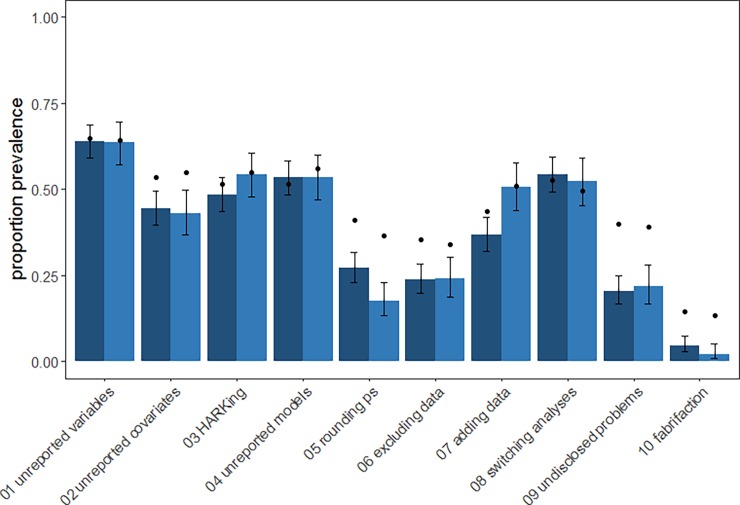
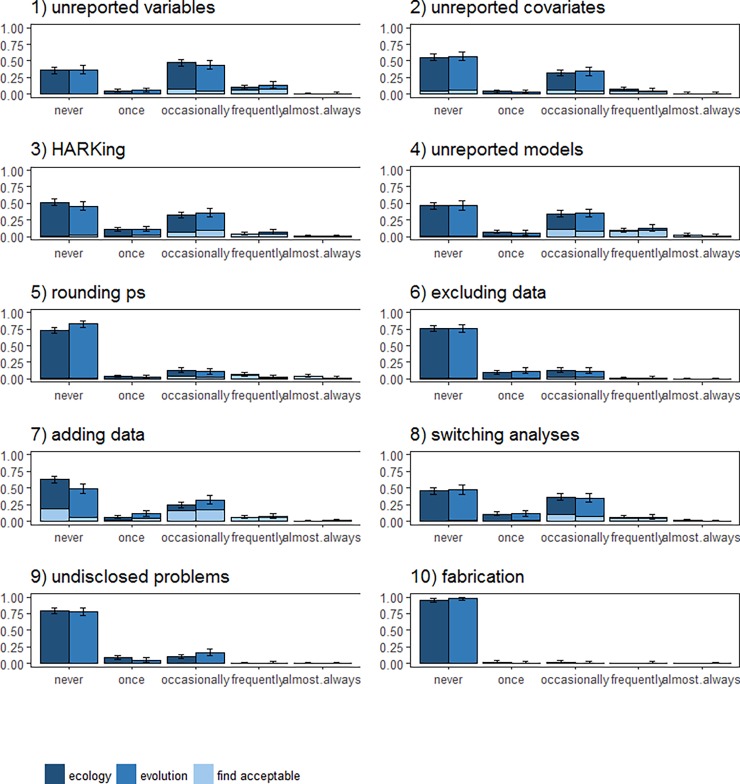
We surveyed 807 researchers (494 ecologists and 313 evolutionary biologists) about their use of Questionable Research Practices (QRPs), including cherry picking statistically significant results, p hacking, and hypothesising after the results are known (HARKing). We also asked them to estimate the proportion of their colleagues that use each of these QRPs. Several of the QRPs were prevalent within the ecology and evolution research community. Across the two groups, we found 64% of surveyed researchers reported they had at least once failed to report results because they were not statistically significant (cherry picking); 42% had collected more data after inspecting whether results were statistically significant (a form of p hacking) and 51% had reported an unexpected finding as though it had been hypothesised from the start (HARKing). Such practices have been directly implicated in the low rates of reproducible results uncovered by recent large scale replication studies in psychology and other disciplines. The rates of QRPs found in this study are comparable with the rates seen in psychology, indicating that the reproducibility problems discovered in psychology are also likely to be present in ecology and evolution.
Overview
The claims and statistics of this paper haven’t been checked yet.
Run the check — free, no account needed. It reads the open-access text and checks the sources it cites.
Integrity signals
Registry
Cites
Statistics
Figures
Verification
Claims the paper makes
The claims and statistics of this paper haven’t been checked yet.
Run the check — free, no account needed. It reads the open-access text and checks the sources it cites.
Claims other papers make about this one
Each is checked against this paper’s own text: does it say what the citing paper says it does?
The source backs part of the claim, not all of it — or backs it for a different population, condition or comparison.
In the citing paper
“however, researchers are often unfamiliar with the much larger systemic bias in the publication of research and in the reliability of certain findings and even of entire fields [33, 38–40].”
From The ARRIVE guidelines 2.0: Updated guidelines for reporting animal research (2020) · cites this paper as [39]
Experimental — accuracy not yet measured
Self-check
Percentages, sums and reported differences re-computed from the paper’s own numbers.
The self-check needs the paper’s full text.
Citations
Cites
R: A Language and Environment for Statistical Computing
R Core Team (2000) · doi:10.32614/r.manuals · Cited by 355,893
ggplot2: Elegant Graphics for Data Analysis
Wickham, H. (2009) · doi:10.1007/978-0-387-98141-3 · Cited by 14,447
Why Most Published Research Findings Are False
Ioannidis, J. P. A. (2005) · PLoS Medicine · doi:10.1371/journal.pmed.0020124 · Cited by 10,505
Estimating the reproducibility of psychological science
Open Science Collaboration (2015) · Science · doi:10.1126/science.aac4716 · Cited by 8,515
Simmons, J. P., Nelson, L. D., & Simonsohn, U. (2011) · Psychological Science · doi:10.1177/0956797611417632 · Cited by 6,567
Why Most Published Research Findings Are False
Ioannidis, J. P. A. (2005) · CHANCE · doi:10.1080/09332480.2005.10722754 · Cited by 4,702 · cited 1×
“However, the link between QRPs and irreproducibility is rooted in fundamental statistical theory [30] and so even in the absence of direct replication measures, a high prevalence of QRPs should alone raise sufficient concern to trigger editorial and institutional action.”
BackgroundMeasuring the Prevalence of Questionable Research Practices With Incentives for Truth Telling
John, L. K., Loewenstein, G., & Prelec, D. (2012) · Psychological Science · doi:10.1177/0956797611430953 · Cited by 2,239
A farewell to Bonferroni: the problems of low statistical power and publication bias
Nakagawa, S. (2004) · Behavioral Ecology · doi:10.1093/beheco/arh107 · Cited by 2,102
Self-citationThe preregistration revolution
Nosek, B. A., Ebersole, C. R., DeHaven, A. C., & Mellor, D. T. (2018) · Proceedings of the National Academy of Sciences · doi:10.1073/pnas.1708274114 · Cited by 1,998
HARKing: Hypothesizing after the results are known
Kerr, N. L. (1998) · Personality and Social Psychology Review · doi:10.1207/s15327957pspr0203_4 · Cited by 1,989
Research works printed but not linked: 2
- Reuters T. Thomson Reuters Research Analytics Unveils 2013 Edition of Its Journal Citation Reports. PR Newswire. Ipswich, MA; 2013.
- G Schneider, 2017, NSM3: Functions and Datasets to Accompany Hollander, Wolfe, and Chicken, Nonparametric Statistical Methods
Cited by
Sorted by citations
Items 201–300 of 344
Starkey, J. C., Koerber, A., Cummins, R. G., Ardon‐Dryer, K., Eko, L. S., & Kee, K. F. (2022) · Discover Education · doi:10.1007/s44217-022-00007-w · Cited by 3
The role of theory in mitigating the ‘reproducibility crisis’
Marone, L. (2024) · Ecología Austral · doi:10.25260/ea.24.34.1.0.2291 · Cited by 3
Enthusiast or sceptic? Social science consciousness among legal practitioners
Kuiper, M. E., van Rooij, B., & Folmer, C. R. (2025) · International Journal of Law in Context · doi:10.1017/s1744552325000084 · Cited by 2
Ford, A. L. B., Elmquist, M., Finestack, L. H., Pfeiffer, D. L., Rountrey, C. E., & Sterling, A. M. (2025) · Evidence-Based Communication Assessment and Intervention · doi:10.1080/17489539.2025.2592070 · Cited by 2
Rigour and reproducibility in Canadian research: call for a coordinated approach
Thibault, R. T., Munafo, M. R., & Moher, D. (2022) · FACETS · doi:10.1139/facets-2021-0162 · Cited by 3
Yoneya, K., Miki, T., & Katayama, N. (2023) · Ecology and Evolution · doi:10.1002/ece3.10270 · Cited by 2
Bissonette, J. A. (2021) · Wildlife Society Bulletin · doi:10.1002/wsb.1201 · Cited by 2
Preregistration and Transparency in the Research Process
Mellor, D. J. (2021) · American Educational Research Association Annual Meeting (AERA) · doi:10.3102/1679938 · Cited by 1
Meta-analysis challenges a textbook example of status signalling: evidence for publication biasPreprint
Sánchez‐Tójar, A., Nakagawa, S., Sánchez-Fortún, M., Martin, D. A., Ramani, S., Girndt, A., Bókony, V., Kempenaers, B., Liker, A., Westneat, D. F., et al. (2018) · bioRxiv (Cold Spring Harbor Laboratory) · doi:10.1101/283150 · Cited by 2
Self-citationA reckless guide to P-values: local evidence, global errors
Lew, M. J. (2019) · arXiv · doi:10.48550/arxiv.1910.02042 · Cited by 2
Introducing Preregistration of Research Design to ArchaeologyPreprint
Ross, S. A., & Ballsun-Stanton, B. (2021) · SocArXiv (OSF Preprints) · doi:10.31235/osf.io/sbwcq · Cited by 6
The impact of P-hacking on "Redefine statistical significance"Preprint
Crane, H. (2017) · PsyArXiv (OSF Preprints) · doi:10.31234/osf.io/bp2z4 · Cited by 2
Auer, S., Haelterman, N. A. T., Weissgerber, T. L., Erlich, J. C., Susilaradeya, D., Julkowska, M., Gazda, M. A., Abitua, A., Niraulu, A., Shah, A. P., et al. (2020) · OSF Preprints (OSF Preprints) · doi:10.31219/osf.io/dxw67 · Cited by 2
Evidence for HARKing in mouse behavioural tests of anxietyPreprint
Rosso, M., Herrera, A., Würbel, H., & Voelkl, B. (2022) · bioRxiv (Cold Spring Harbor Laboratory) · doi:10.1101/2022.12.01.518668 · Cited by 2
Registered Reports: A new chapter at Ecology & Evolution
Gya, R., Birkeli, K., Dahle, I. J., Foote, C. G., Geange, S. R., Lynn, J. S., Töpper, J. P., Vandvik, V., Zernichow, C., & Jenkins, G. B. (2023) · Ecology and Evolution · doi:10.1002/ece3.10023 · Cited by 2
Wu, N. C., Alton, L. A., Bovo, R. P., Carey, N., Currie, S. E., Lighton, J. R. B., McKechnie, A. E., Pottier, P., Rossi, G. S., White, C. R., et al. (2024) · doi:10.32942/x2402m · Cited by 2
Questionable Research Practices and Open Science in Quantitative CriminologyPreprint
Chin, J. M., Pickett, J. T., Vazire, S., & Holcombe, A. O. (2024) · CrimRxiv · doi:10.21428/cb6ab371.0d3ec44f · Cited by 3
Better reporting of science to improve regulatory decision-making
Ågerstrand, M. (2020) · elni Review · doi:10.46850/elni.2020.003 · Cited by 1
Replication and Reproducibility in Primate Cognition Research
Farrar, B. G., Krupenye, C., Motes‐Rodrigo, A., Tennie, C., Fischer, J., Altschul, D., & Ostojić, L. (2022) · Cambridge University Press eBooks · doi:10.1017/9781108955836.021 · Cited by 3
2. Open Science, Open Data: The ‘Open’ Movement in Scholarly Publishing
Kee, K. F., Koerber, A., Starkey, J. C., Ardon‐Dryer, K., Cummins, R. G., & Eko, L. S. (2023) · Open Book Publishers · doi:10.11647/obp.0364.03 · Cited by 1
Finnish Society of Forest Science, V. 6., & Nygren, P. (2024) · Silva Fennica · doi:10.14214/sf.24016 · Cited by 1
Intellectual piracy in management research practices
Bispo, M. D. S., & Vieira, A. M. (2024) · Cadernos EBAPE BR · doi:10.1590/1679-395120230050x · Cited by 1
Keaney, T. A., Jones, T. M., & Mulder, R. A. (2024) · Animal Behaviour · doi:10.1016/j.anbehav.2024.03.013 · Cited by 2
VRDOLJAK, J. E., Soto, I. M., Carreira, V. P., & Padró, J. (2025) · Journal of Evolutionary Biology · doi:10.1093/jeb/voaf006 · Cited by 1
Makel, M. C., Caroleo, S. A., Meyer, M. S., Pei, M. A., Fleming, J. I., Hodges, J., Cook, B. G., & Plucker, J. A. (2026) · Royal Society Open Science · doi:10.1098/rsos.251888 · Cited by 1
Questionable Research Practices: A Principled Classification and Ranking Based on Survey Data
Fanelli, D., Voodla, A., Andres, S., & Uusberg, A. (2026) · Science and Engineering Ethics · doi:10.1007/s11948-026-00589-w · Cited by 1
Scientific honesty and publicly shared lab notebooks
van Steensel, B. (2018) · EMBO Reports · doi:10.15252/embr.201846866 · Cited by 1
Bruna, E. M., Chazdon, R. L., Errington, T. M., & Nosek, B. A. (2021) · Biotropica · doi:10.1111/btp.12912 · Cited by 1
Introducing Preregistration of Research Design to Archaeology
Ross, S. A., & Ballsun-Stanton, B. (2022) · University Press of Florida eBooks · doi:10.2307/j.ctv2mwg3mj.6 · Cited by 1
Abdullah, S., Khan, Z. W., Fatima, S., Ali, N., Tauqeer, A., & Razzaq, J. A. (2023) · International Journal of Health Sciences · doi:10.53730/ijhs.v7ns1.14178 · Cited by 1
The replication crisis in science and its overlap into kinantropology: an introduction
Baloun, L., & Mališ, J. (2023) · Tělesná kultura · doi:10.5507/tk.2023.002 · Cited by 1
Ensuring reproducible science requires policies
Bartomeus, Í. (2025) · Peer Community In Ecology · doi:10.24072/pci.ecology.100778 · Cited by 1
Methods of Causal Analysis for Health Risk Assessment with Observational Data
Cox, L. A. (2020) · International series in management science/operations research/International series in operations research & management science · doi:10.1007/978-3-030-57358-4_9 · Cited by 1
Boosting Immunity of the Registered Reports System in Psychology to the Pandemic
Sasaki, K., & Yamada, Y. (2020) · Frontiers in Research Metrics and Analytics · doi:10.3389/frma.2020.607257 · Cited by 1
Is N-Hacking Ever OK? A simulation-based inquiryPreprint
Reinagel, P. (2019) · bioRxiv (Cold Spring Harbor Laboratory) · doi:10.1101/2019.12.12.868489 · Cited by 1
Ibaviosa, C. M., & Chin, J. M. (2022) · doi:10.31222/osf.io/tvcm6 · Cited by 1
Replication and Reproducibility in Primate Cognition ResearchPreprint
Farrar, B. G., Krupenye, C., Motes‐Rodrigo, A., Tennie, C., Fischer, J., Altschul, D., & Ostojić, L. (2021) · doi:10.31219/osf.io/z52er · Cited by 1
Bruna, E. M., Chazdon, R. L., Errington, T. M., & Nosek, B. A. (2017) · doi:10.31219/osf.io/dbpsz · Cited by 1
Mupepele, A., & Dormann, C. F. (2022) · BMC Ecology and Evolution · doi:10.1186/s12862-022-02016-7 · Cited by 1
Ganderton, P. (2022) · Oxford University Press eBooks · doi:10.1093/obo/9780199830060-0238 · Cited by 1
Rethinking replication in empirical legal researchPreprint
Chin, J. M., & Holcombe, A. O. (2022) · doi:10.31222/osf.io/4up65 · Cited by 1
Three steps to strengthen confidence in connectivity modelsPreprint
Riordan‐Short, E., Pither, J., & Pither, R. (2023) · doi:10.22541/au.167425247.78926731/v1 · Cited by 1
Bestiary of Questionable Research Practices in PsychologyPreprint
Nagy, T., Hergert, J., Elsherif, M. M., Wallrich, L., Schmidt, K., Waltzer, T., Payne, J. W., Gjoneska, B., Seetahul, Y., Wang, Y. A., et al. (2024) · PsyArXiv (OSF Preprints) · doi:10.31234/osf.io/fhk98 · Cited by 4
Background information for meta-analysis evaluation, Info 00-Info 06Preprint
Young, S. S., & Kindzierski, W. B. (2018) · arXiv (Cornell University)
Neuroscience publishing is too important to leave to publishers
Khoo, S. Y. (2019) · Neuroanatomy and Behaviour · doi:10.35430/nab.2019.e7
\texttt{code::proof}: Prepare for \emph{most} weather conditionsPreprint
Gray, C. T. (2019) · arXiv (Cornell University) · doi:10.48550/arxiv.1910.06964
code::proof: Prepare for Most Weather Conditions
Gray, C. T. (2019) · Communications in computer and information science · doi:10.1007/978-981-15-1960-4_2
Prentice, P. M., Mnatzaganian, C., Houslay, T. M., Thornton, A., & Wilson, A. J. (2020) · bioRxiv (Cold Spring Harbor Laboratory) · doi:10.1101/2020.05.19.103689
En busca de la p significativa. Su influencia sobre la credibilidad de lo publicado
Thierer, J. M. (2020) · Revista Argentina de Cardiología · doi:10.7775/rac.es.v88.i2.17555
Transparency and replication in alcohol research
Drax, K., & Munafo, M. R. (2021) · Elsevier eBooks · doi:10.1016/b978-0-12-816720-5.00005-0
Reproducibilidad y replicabilidad en la investigación en ciencias naturales: ¿Hay una crisis?
Gorla, D. E. (2021) · Ecología Austral · doi:10.25260/ea.21.31.1.0.1060
Inflated false-positive risk in common regression analyses: A combinatorial analysis of model setsPreprint
Christensen, J. D., Orquin, J. L., Perkovic, S., & Lagerkvist, C. J. (2021) · doi:10.31234/osf.io/cj3xq
Keeping Science Healthy: Research Integrity
Setchell, J. M. (2019) · Cambridge University Press eBooks · doi:10.1017/9781108368513.004
The Pragmatic American Revisited: A Direct Replication of Pickett and Baker (2014)Preprint
Jones, A. M., & Roche, S. P. (2021) · doi:10.31219/osf.io/wsk3a
Naguib, M., & Krause, E. T. (2020) · Springer eBooks · doi:10.1007/978-3-662-60415-1_2
Tourish, D. (2019) · Cambridge University Press eBooks · doi:10.1017/9781108616669.012
The pandemic threatens the Registered Reports system as well as human livesPreprint
Sasaki, K., & Yamada, Y. (2020) · PsyArXiv (OSF Preprints) · doi:10.31234/osf.io/6wdaz
Bucher, H., Stroppe, A.-K., Burger, A. M., Faas, T., Schoen, H., Debus, M., & Roßteutscher, S. (2022) · Politische Vierteljahresschrift · doi:10.1007/s11615-022-00436-0
Boettiger, S., & Luke, T. J. (2023) · doi:10.31234/osf.io/84fdg
Reducing Questionable Research Practices
Bennett, M. (2023) · Springer eBooks · doi:10.1007/978-981-19-9240-7_5
Lanerolle, G. D., Phiri, P., & Haroon, A. (2023) · Elsevier eBooks · doi:10.1016/b978-0-12-821787-0.00013-1
Nakagawa, S., Lagisz, M., Yang, Y., & Drobniak, S. M. (2023) · doi:10.31219/osf.io/h7ufg
Self-citationMay, J. (2023) · Oxford University Press eBooks · doi:10.1093/oso/9780197648087.002.0004
May, J. (2023) · Neuroethics · doi:10.1093/oso/9780197648087.002.0006
May, J. (2023) · Oxford University Press eBooks · doi:10.1093/oso/9780197648087.003.0010
May, J. (2023) · Neuroethics · doi:10.1093/oso/9780197648087.002.0007
May, J. (2023) · Oxford University Press eBooks · doi:10.1093/oso/9780197648087.003.0004
May, J. (2023) · Oxford University Press eBooks · doi:10.1093/oso/9780197648087.002.0008
May, J. (2023) · Neuroethics · doi:10.1093/oso/9780197648087.002.0003
May, J. (2023) · Oxford University Press eBooks · doi:10.1093/oso/9780197648087.003.0001
May, J. (2023) · Oxford University Press eBooks · doi:10.1093/oso/9780197648087.003.0009
May, J. (2023) · Oxford University Press eBooks · doi:10.1093/oso/9780197648087.003.0003
May, J. (2023) · Oxford University Press eBooks · doi:10.1093/oso/9780197648087.003.0002
May, J. (2023) · Oxford University Press eBooks · doi:10.1093/oso/9780197648087.003.0006
May, J. (2023) · Oxford University Press eBooks · doi:10.1093/oso/9780197648087.003.0005
May, J. (2023) · Oxford University Press eBooks · doi:10.1093/oso/9780197648087.003.0008 · Cited by 1
May, J. (2023) · Oxford University Press eBooks · doi:10.1093/oso/9780197648087.003.0007
May, J. (2023) · Neuroethics · doi:10.1093/oso/9780197648087.002.0010
Veri Toplamaya Hala Gerek Var Mı? Yoksa Ulusal Pazarlama Akademisi HARKING Tehlikesi Altında Mı?
Doğan, V., VATANDAEŞ, T., & MIHOĞLU, B. A. (2023) · Tüketici ve tüketim araştırmaları dergisi · doi:10.15659/ttad.15.1.170
Naguib, M., Wagner, G. F., Snijders, L., & Krause, E. T. (2023) · Springer eBooks · doi:10.1007/978-3-662-67792-6_2
Intellectual piracy in management research practices
Bispo, M. D. S., & Vieira, A. M. (2024) · Cadernos EBAPE BR · doi:10.1590/1679-395120230050 · Cited by 1
Sikorski, M., & Hominis, O. (2024) · Philosophical Psychology · doi:10.1080/09515089.2024.2330477
Metadata
- Authors
- Fraser, H., Parker, T., Nakagawa, S., Barnett, A., & Fidler, F.
- Affiliations
- The University of Melbourne (AU)
- Whitman College (US)
- UNSW Sydney (AU)
- Corresponding author
- Fraser, Hannah
- Venue
- PLOS ONE
- Publisher
- Public Library of Science (PLoS)
- Published
- 2018-07-16
- Volume
- 13
- Issue
- 7
- Pages
- e0200303
- ISSN
- 1932-6203 (ISSN-L)
- PMC
- PMC6047784
- OpenAlex
- W2793861965
- Cited by
- 346
- References
- 45
- Citations by year
- 2026: 17 · 2025: 29 · 2024: 42 · 2023: 51 · 2022: 37 · 2021: 51 · 2020: 57 · 2019: 45 · 2018: 15
- FWCI
- 83.45
- Type
- journal article
- Language
- en
- Open access
- gold
- doi.org
- Licence
- Locations
- PLoS ONE (publishedVersion, cc-by)
- Europe PMC (PubMed Central) (publishedVersion, cc-by)
- PubMed Central (publishedVersion, cc-by)
- PubMed (publishedVersion)
- EcoEvoRxiv (submittedVersion, cc-by)
- RePEc: Research Papers in Economics (submittedVersion)
- DOAJ (DOAJ: Directory of Open Access Journals) (submittedVersion, cc-by-sa)
- Figshare (submittedVersion, cc-by)
- Minerva Access (University of Melbourne) (submittedVersion, cc-by)
- EcoEvoRxiv (submittedVersion)
- OSF Preprints (OSF Preprints) (submittedVersion)
- Funders
- Australian Research Council Future Fellowship (FT150100297)
- Topics
- Social Sciences › Education › Academic integrity and plagiarism
- Social Sciences › Decision Sciences › Statistics, Probability and Uncertainty › Meta-analysis and systematic reviews
- Social Sciences › Library and Information Sciences › Academic Publishing and Open Access
- Keywords
- questionable research practices, cherry-picking, p-hacking, HARKing, research integrity, reproducibility, ecology, evolutionary biology, replication study, statistical significance
- MeSH terms
- Ecology, Biological Evolution, Humans, Surveys and Questionnaires, Research, Research Design, Research Personnel, Statistics as Topic, Reproducibility of Results, Scientific Misconduct
About these checks
Registry, retraction, Cites and statistics results are computed, not judged, with one exception: a printed reference that no index lists is read once by a model before it counts as a citation error. Claims are extracted by a model and kept only when their quote appears verbatim in the text; each cited source is then checked, with a model’s help, for whether it says what the claim relies on. Those verdicts can be wrong — read the claim’s quote and the cited source before relying on one.
Statistics and arithmetic are recomputed, not judged.
Confidence bands are shown only for fields calibrated on our annotated test set. None is calibrated yet, so no band is shown.
What counts as a claim ›How we measure confidence ›How we check this ›
Are you an author, or do you see a problem with this page? Request a review
