

The DOI matches its Crossref record; 43 of the 45 references it cites were found in a registry or an index.
Questionable research practices in ecology and evolution
Open accessPublished version of a preprint
Abstract
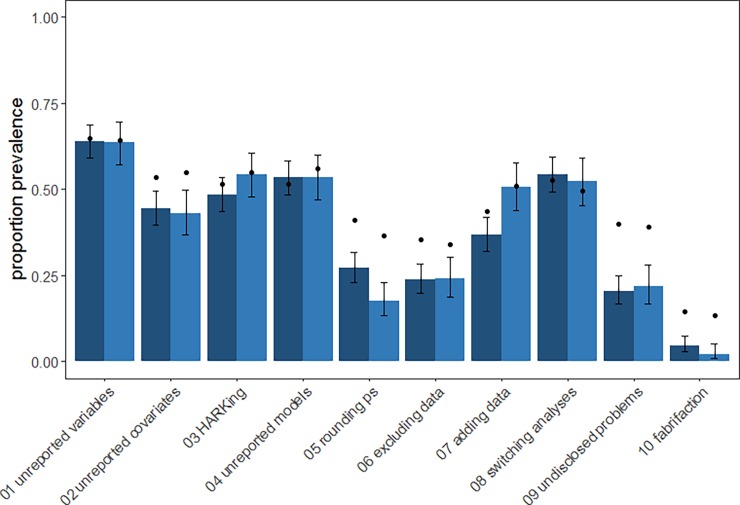
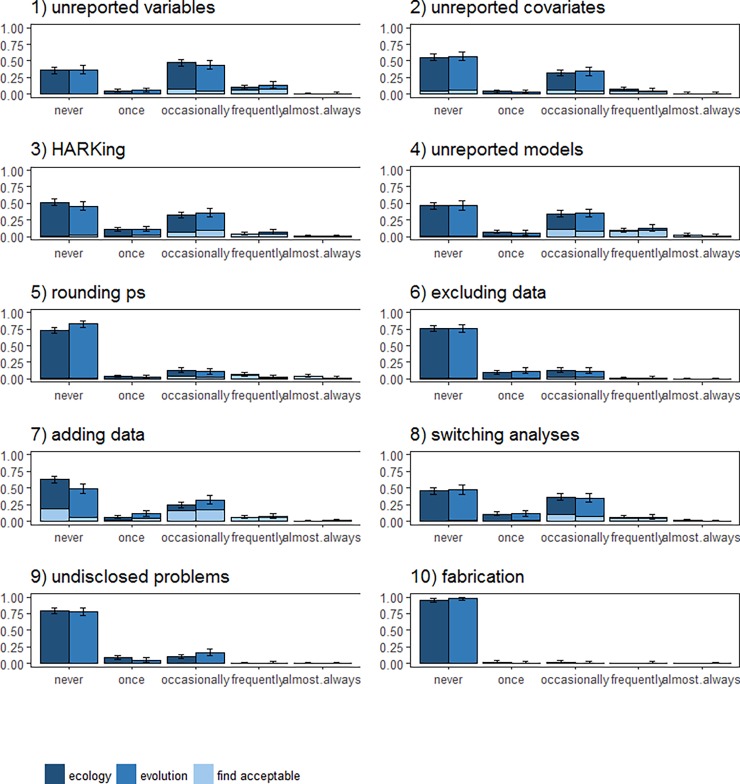
We surveyed 807 researchers (494 ecologists and 313 evolutionary biologists) about their use of Questionable Research Practices (QRPs), including cherry picking statistically significant results, p hacking, and hypothesising after the results are known (HARKing). We also asked them to estimate the proportion of their colleagues that use each of these QRPs. Several of the QRPs were prevalent within the ecology and evolution research community. Across the two groups, we found 64% of surveyed researchers reported they had at least once failed to report results because they were not statistically significant (cherry picking); 42% had collected more data after inspecting whether results were statistically significant (a form of p hacking) and 51% had reported an unexpected finding as though it had been hypothesised from the start (HARKing). Such practices have been directly implicated in the low rates of reproducible results uncovered by recent large scale replication studies in psychology and other disciplines. The rates of QRPs found in this study are comparable with the rates seen in psychology, indicating that the reproducibility problems discovered in psychology are also likely to be present in ecology and evolution.
Overview
The claims and statistics of this paper haven’t been checked yet.
Run the check — free, no account needed. It reads the open-access text and checks the sources it cites.
Integrity signals
Registry
Cites
Statistics
Figures
Verification
Claims the paper makes
The claims and statistics of this paper haven’t been checked yet.
Run the check — free, no account needed. It reads the open-access text and checks the sources it cites.
Claims other papers make about this one
Each is checked against this paper’s own text: does it say what the citing paper says it does?
The source backs part of the claim, not all of it — or backs it for a different population, condition or comparison.
In the citing paper
“however, researchers are often unfamiliar with the much larger systemic bias in the publication of research and in the reliability of certain findings and even of entire fields [33, 38–40].”
From The ARRIVE guidelines 2.0: Updated guidelines for reporting animal research (2020) · cites this paper as [39]
Experimental — accuracy not yet measured
Self-check
Percentages, sums and reported differences re-computed from the paper’s own numbers.
The self-check needs the paper’s full text.
Citations
Cites
R: A Language and Environment for Statistical Computing
R Core Team (2000) · doi:10.32614/r.manuals · Cited by 355,893
ggplot2: Elegant Graphics for Data Analysis
Wickham, H. (2009) · doi:10.1007/978-0-387-98141-3 · Cited by 14,447
Why Most Published Research Findings Are False
Ioannidis, J. P. A. (2005) · PLoS Medicine · doi:10.1371/journal.pmed.0020124 · Cited by 10,505
Estimating the reproducibility of psychological science
Open Science Collaboration (2015) · Science · doi:10.1126/science.aac4716 · Cited by 8,515
Simmons, J. P., Nelson, L. D., & Simonsohn, U. (2011) · Psychological Science · doi:10.1177/0956797611417632 · Cited by 6,567
Why Most Published Research Findings Are False
Ioannidis, J. P. A. (2005) · CHANCE · doi:10.1080/09332480.2005.10722754 · Cited by 4,702 · cited 1×
“However, the link between QRPs and irreproducibility is rooted in fundamental statistical theory [30] and so even in the absence of direct replication measures, a high prevalence of QRPs should alone raise sufficient concern to trigger editorial and institutional action.”
BackgroundMeasuring the Prevalence of Questionable Research Practices With Incentives for Truth Telling
John, L. K., Loewenstein, G., & Prelec, D. (2012) · Psychological Science · doi:10.1177/0956797611430953 · Cited by 2,239
A farewell to Bonferroni: the problems of low statistical power and publication bias
Nakagawa, S. (2004) · Behavioral Ecology · doi:10.1093/beheco/arh107 · Cited by 2,102
Self-citationThe preregistration revolution
Nosek, B. A., Ebersole, C. R., DeHaven, A. C., & Mellor, D. T. (2018) · Proceedings of the National Academy of Sciences · doi:10.1073/pnas.1708274114 · Cited by 1,998
HARKing: Hypothesizing after the results are known
Kerr, N. L. (1998) · Personality and Social Psychology Review · doi:10.1207/s15327957pspr0203_4 · Cited by 1,989
Research works printed but not linked: 2
- Reuters T. Thomson Reuters Research Analytics Unveils 2013 Edition of Its Journal Citation Reports. PR Newswire. Ipswich, MA; 2013.
- G Schneider, 2017, NSM3: Functions and Datasets to Accompany Hollander, Wolfe, and Chicken, Nonparametric Statistical Methods
Cited by
Sorted by citations
Items 301–344 of 344
Sjølie, H. K. (2024) · Silva Fennica · doi:10.14214/sf.24034
Model-based experiments as epistemic evidence in paleoecology
Traylor, W. (2024) · Ecological Modelling · doi:10.1016/j.ecolmodel.2024.110895
Winter, G., & Schielzeth, H. (2025) · Journal of Evolutionary Biology · doi:10.1093/jeb/voaf030
Key insights from 3D periotic morphology in odontocete taxonomy
Milano, V. N., VRDOLJAK, J. E., Buono, M. R., Gaetán, C. M., & Grandi, M. F. (2025) · Biological Journal of the Linnean Society · doi:10.1093/biolinnean/blaf013
Hariharan, S., Karanth, K. K., & Vasudev, D. (2025) · American Journal of Primatology · doi:10.1002/ajp.70042
Gépi tanulás alkalmazása a magatartástudományban és a pszichológiában: előnyök és hátrányok
Matuz, A. (2025) · Mentálhigiéné és Pszichoszomatika · doi:10.1556/0406.2025.00077
Transparency and reproducibility in invasion science
Mologni, F., & Pither, J. (2025) · NeoBiota · doi:10.3897/neobiota.100.143736
Replicability and transparency in physical therapy research: Time to wake upPreprint
Jabouille, F., Farajzadeh, A., Exertier, A. G., Martine, J., Sadek, N., Klinger, L. H., Iliut, C. M., Kapsa, V., & Boisgontier, M. P. (2025) · medRxiv · doi:10.1101/2025.09.23.25336497 · Cited by 1
DA CONDUTA ÉTICA À CIÊNCIA RESPONSÁVEL NA PESQUISA EM ADMINISTRAÇÃO
Costa, M. M., Sousa, M. D. M., Limongi, R., Torres, M. M., & Noll, P. R. E. S. (2025) · Revista de Administração de Empresas · doi:10.1590/s0034-759020250610x
Why social norms matter in science: Determinants of misconduct in German-speaking Europe
Oberhauser, V., Velicu, A., & Rauhut, H. (2025) · Social Science Research · doi:10.1016/j.ssresearch.2025.103292 · Cited by 1
Beyond the p < 0.05 trap: the adaptive integrity model for preventing and detecting P-hacking
Affognon, D. A. (2025) · Frontiers in Education · doi:10.3389/feduc.2025.1675991 · Cited by 1
Additional file 1 of The ARRIVE guidelines 2.0: Updated guidelines for reporting animal research
Percie du Sert, N., Hurst, V., Ahluwalia, A., Alam, S., Avey, M. T., Baker, M., Browne, W. J., Clark, A., Cuthill, I. C., Dirnagl, U., et al. (2020) · Figshare · doi:10.6084/m9.figshare.12650470
Additional file 1 of Evidence of questionable research practices in clinical prediction models
White, N. M., Parsons, R., Collins, G., & Barnett, A. G. (2024) · Figshare · doi:10.6084/m9.figshare.26615050
Self-citationAdditional file 6 of Evidence of questionable research practices in clinical prediction models
White, N. M., Parsons, R., Collins, G., & Barnett, A. G. (2024) · Figshare · doi:10.6084/m9.figshare.26615065
Self-citationHow can we overcome the barriers to researchers producing high quality, open research?
Tukanova, M., Hsing, P.-Y., Freeman, A., Fellows, T., Thompson, J., & Munafo, M. R. (2023) · PhilPapers (PhilPapers Foundation) · doi:10.57874/axc8-vs07
Additional file 4 of Evidence of questionable research practices in clinical prediction models
White, N. M., Parsons, R., Collins, G., & Barnett, A. G. (2024) · Figshare · doi:10.6084/m9.figshare.26615059
Self-citationAdditional file 7 of Evidence of questionable research practices in clinical prediction models
White, N. M., Parsons, R., Collins, G., & Barnett, A. G. (2024) · Figshare · doi:10.6084/m9.figshare.26615068
Self-citationAdditional file 4 of The ARRIVE guidelines 2.0: Updated guidelines for reporting animal research
Percie du Sert, N., Hurst, V., Ahluwalia, A., Alam, S., Avey, M. T., Baker, M., Browne, W. J., Clark, A., Cuthill, I. C., Dirnagl, U., et al. (2020) · Figshare · doi:10.6084/m9.figshare.12650479
Additional file 2 of Evidence of questionable research practices in clinical prediction models
White, N. M., Parsons, R., Collins, G., & Barnett, A. G. (2024) · Figshare · doi:10.6084/m9.figshare.26615053
Self-citationFreeing Social and Medical Scientists from the Replication CrisisPreprint
Hyman, M. R. (2024) · SSRN Electronic Journal · doi:10.2139/ssrn.4898637
Is the replication crisis a problem for biologists? A geometric morphometric approachPreprint
Vrdoljak, J., Sánchez, K. I., Arreola-Ramos, R., Huesa, E. G. D., Villagra, A., Ávila, L. J., & Morando, M. (2019) · bioRxiv (Cold Spring Harbor Laboratory) · doi:10.1101/862052
Additional file 3 of Evidence of questionable research practices in clinical prediction models
White, N. M., Parsons, R., Collins, G., & Barnett, A. G. (2024) · Figshare · doi:10.6084/m9.figshare.26615056
Self-citationAdditional file 5 of Evidence of questionable research practices in clinical prediction models
White, N. M., Parsons, R., Collins, G., & Barnett, A. G. (2024) · Figshare · doi:10.6084/m9.figshare.26615062
Self-citationAdditional file 2 of The ARRIVE guidelines 2.0: Updated guidelines for reporting animal research
Percie du Sert, N., Hurst, V., Ahluwalia, A., Alam, S., Avey, M. T., Baker, M., Browne, W. J., Clark, A., Cuthill, I. C., Dirnagl, U., et al. (2020) · Figshare · doi:10.6084/m9.figshare.12650473
A Bibliometric and Scoping Review of Research Integrity among Research Scholars
Das, J., Rout, S. K., -, B. S., Sahoo, P., Mahapatra, S., & Dash, S. (2025) · Asian Journal of Interdisciplinary Research · doi:10.54392/ajir25412
Individual and collective epistemic virtue in science
Tunç, D. U., & Pritchard, D. (2026) · Synthese · doi:10.1007/s11229-025-05396-7
Replication studies: a win-win for early-career training and behavioral ecology
Laskowski, K. L., O’Dea, R. E., & Pick, J. L. (2026) · Behavioral Ecology · doi:10.1093/beheco/araf158 · Cited by 1
Fortunato, C., Marjin, C., Briganti, G. L., Gallinoro, V., Raso, E., Traglia, F., Grieco, V., & Minutolo, G. (2026) · Annali di Igiene Medicina Preventiva e di Comunità · doi:10.7416/ai.2026.18355
de la Chica, A. G., Fernández‐Duque, E., & Fernández‐Juricic, E. (2026) · Animal Behaviour · doi:10.1016/j.anbehav.2026.123536
En dehors de la norme : déviation de l'optimalité écologique et originalité fonctionnelle
Grenié, M. (2020) · theses.fr (ABES) · doi:10.70675/f05ff132zfc27z4c70zbb53z73e833ab6182
Fine-scale modelling of the dynamics of phytoplankton communities
Picoche, C. (2022) · theses.fr (ABES) · doi:10.70675/fc1722e4z6066z40f0z8fdaz93eab2f9c461 · Cited by 1
Brown, M., Sacco, D. F., Raible, C., Wallace, K. J., & Lemacks, J. L. (2026) · Accountability in Research · doi:10.1080/08989621.2026.2659673
Guariento, R. D., Gripp, A. D. R., & Caliman, A. (2026) · Oikos · doi:10.1002/oik.12167
Flindall, I., Vlahiotis, K., & Gordon, I. D. (2026) · Science & Technology Libraries · doi:10.1080/0194262x.2026.2662996
Nekhaev, I. O., Ishayeva, A. A., & Vinarski, M. V. (2026) · Ecologica Montenegrina · doi:10.37828/em.2026.99.8
Supplementing Remedies to the Replication Crisis
Hyman, M. R. (2026) · Social Epistemology · doi:10.1080/02691728.2026.2697184
Replikationskrise und Open Science in der klinischen Psychologie
Mundorf, A., Peterburs, J., & Ocklenburg, S. (2026) · Springer eBooks · doi:10.1007/978-3-662-73259-5_2
Improving poor research: What should nursing prioritize?
Clark, A. M., & Thompson, D. R. (2026) · Nurse Education in Practice · doi:10.1016/j.nepr.2026.104950
da Conceicao, J. R., & Zorzal‐Almeida, S. (2026) · Limnology and Oceanography Bulletin · doi:10.1002/lob.70057
Research quality metrics as a complement to bibliometrics: an opinion paper
Hannerz, H., Hansen, K. S., Pejtersen, J. H., & Willadsen, H. K. (2026) · Scientometrics · doi:10.1007/s11192-026-05840-6
Metadata
- Authors
- Fraser, H., Parker, T., Nakagawa, S., Barnett, A., & Fidler, F.
- Affiliations
- The University of Melbourne (AU)
- Whitman College (US)
- UNSW Sydney (AU)
- Corresponding author
- Fraser, Hannah
- Venue
- PLOS ONE
- Publisher
- Public Library of Science (PLoS)
- Published
- 2018-07-16
- Volume
- 13
- Issue
- 7
- Pages
- e0200303
- ISSN
- 1932-6203 (ISSN-L)
- PMC
- PMC6047784
- OpenAlex
- W2793861965
- Cited by
- 346
- References
- 45
- Citations by year
- 2026: 17 · 2025: 29 · 2024: 42 · 2023: 51 · 2022: 37 · 2021: 51 · 2020: 57 · 2019: 45 · 2018: 15
- FWCI
- 83.45
- Type
- journal article
- Language
- en
- Open access
- gold
- doi.org
- Licence
- Locations
- PLoS ONE (publishedVersion, cc-by)
- Europe PMC (PubMed Central) (publishedVersion, cc-by)
- PubMed Central (publishedVersion, cc-by)
- PubMed (publishedVersion)
- EcoEvoRxiv (submittedVersion, cc-by)
- RePEc: Research Papers in Economics (submittedVersion)
- DOAJ (DOAJ: Directory of Open Access Journals) (submittedVersion, cc-by-sa)
- Figshare (submittedVersion, cc-by)
- Minerva Access (University of Melbourne) (submittedVersion, cc-by)
- EcoEvoRxiv (submittedVersion)
- OSF Preprints (OSF Preprints) (submittedVersion)
- Funders
- Australian Research Council Future Fellowship (FT150100297)
- Topics
- Social Sciences › Education › Academic integrity and plagiarism
- Social Sciences › Decision Sciences › Statistics, Probability and Uncertainty › Meta-analysis and systematic reviews
- Social Sciences › Library and Information Sciences › Academic Publishing and Open Access
- Keywords
- questionable research practices, cherry-picking, p-hacking, HARKing, research integrity, reproducibility, ecology, evolutionary biology, replication study, statistical significance
- MeSH terms
- Ecology, Biological Evolution, Humans, Surveys and Questionnaires, Research, Research Design, Research Personnel, Statistics as Topic, Reproducibility of Results, Scientific Misconduct
About these checks
Registry, retraction, Cites and statistics results are computed, not judged, with one exception: a printed reference that no index lists is read once by a model before it counts as a citation error. Claims are extracted by a model and kept only when their quote appears verbatim in the text; each cited source is then checked, with a model’s help, for whether it says what the claim relies on. Those verdicts can be wrong — read the claim’s quote and the cited source before relying on one.
Statistics and arithmetic are recomputed, not judged.
Confidence bands are shown only for fields calibrated on our annotated test set. None is calibrated yet, so no band is shown.
What counts as a claim ›How we measure confidence ›How we check this ›
Are you an author, or do you see a problem with this page? Request a review
