

The DOI matches its Crossref record; 43 of the 45 references it cites were found in a registry or an index.
Questionable research practices in ecology and evolution
Open accessPublished version of a preprint
Abstract
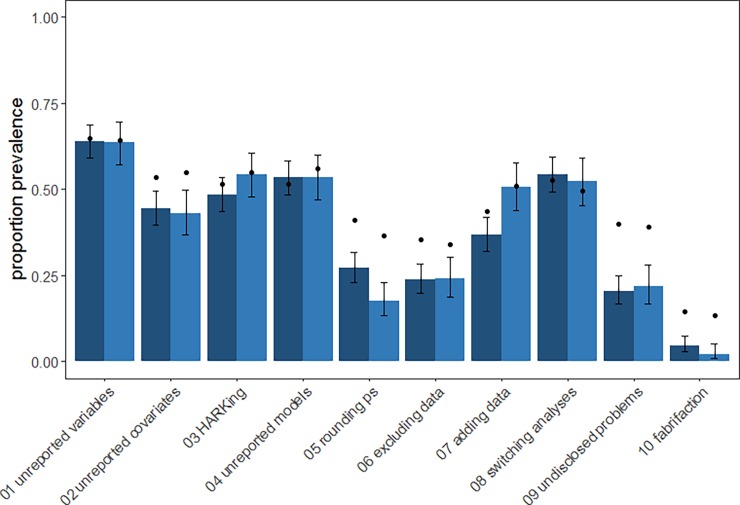
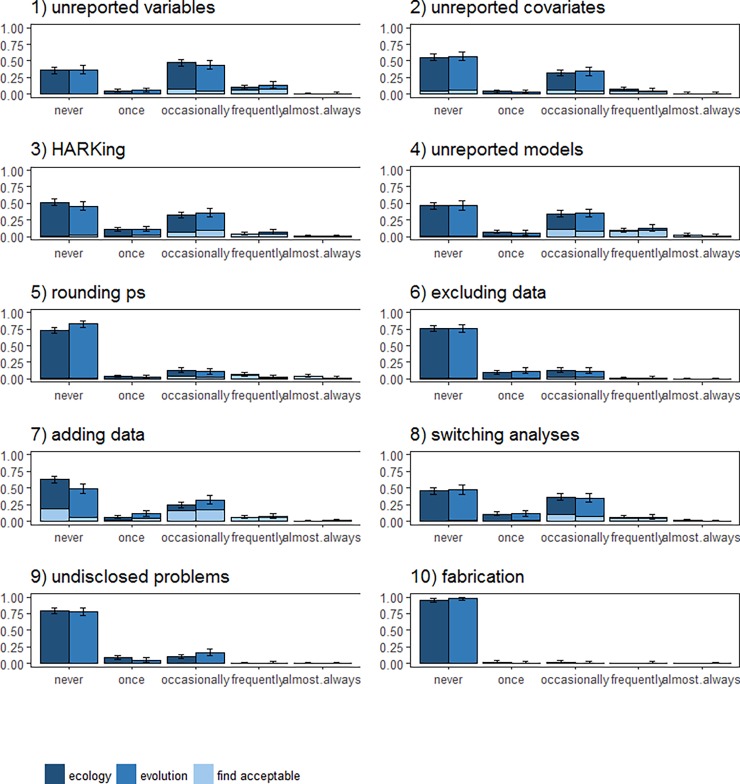
We surveyed 807 researchers (494 ecologists and 313 evolutionary biologists) about their use of Questionable Research Practices (QRPs), including cherry picking statistically significant results, p hacking, and hypothesising after the results are known (HARKing). We also asked them to estimate the proportion of their colleagues that use each of these QRPs. Several of the QRPs were prevalent within the ecology and evolution research community. Across the two groups, we found 64% of surveyed researchers reported they had at least once failed to report results because they were not statistically significant (cherry picking); 42% had collected more data after inspecting whether results were statistically significant (a form of p hacking) and 51% had reported an unexpected finding as though it had been hypothesised from the start (HARKing). Such practices have been directly implicated in the low rates of reproducible results uncovered by recent large scale replication studies in psychology and other disciplines. The rates of QRPs found in this study are comparable with the rates seen in psychology, indicating that the reproducibility problems discovered in psychology are also likely to be present in ecology and evolution.
Overview
The claims and statistics of this paper haven’t been checked yet.
Run the check — free, no account needed. It reads the open-access text and checks the sources it cites.
Integrity signals
Registry
Cites
Statistics
Figures
Verification
Claims the paper makes
The claims and statistics of this paper haven’t been checked yet.
Run the check — free, no account needed. It reads the open-access text and checks the sources it cites.
Claims other papers make about this one
Each is checked against this paper’s own text: does it say what the citing paper says it does?
The source backs part of the claim, not all of it — or backs it for a different population, condition or comparison.
In the citing paper
“however, researchers are often unfamiliar with the much larger systemic bias in the publication of research and in the reliability of certain findings and even of entire fields [33, 38–40].”
From The ARRIVE guidelines 2.0: Updated guidelines for reporting animal research (2020) · cites this paper as [39]
Experimental — accuracy not yet measured
Self-check
Percentages, sums and reported differences re-computed from the paper’s own numbers.
The self-check needs the paper’s full text.
Citations
Cites
R: A Language and Environment for Statistical Computing
R Core Team (2000) · doi:10.32614/r.manuals · Cited by 355,893
ggplot2: Elegant Graphics for Data Analysis
Wickham, H. (2009) · doi:10.1007/978-0-387-98141-3 · Cited by 14,447
Why Most Published Research Findings Are False
Ioannidis, J. P. A. (2005) · PLoS Medicine · doi:10.1371/journal.pmed.0020124 · Cited by 10,505
Estimating the reproducibility of psychological science
Open Science Collaboration (2015) · Science · doi:10.1126/science.aac4716 · Cited by 8,515
Simmons, J. P., Nelson, L. D., & Simonsohn, U. (2011) · Psychological Science · doi:10.1177/0956797611417632 · Cited by 6,567
Why Most Published Research Findings Are False
Ioannidis, J. P. A. (2005) · CHANCE · doi:10.1080/09332480.2005.10722754 · Cited by 4,702 · cited 1×
“However, the link between QRPs and irreproducibility is rooted in fundamental statistical theory [30] and so even in the absence of direct replication measures, a high prevalence of QRPs should alone raise sufficient concern to trigger editorial and institutional action.”
BackgroundMeasuring the Prevalence of Questionable Research Practices With Incentives for Truth Telling
John, L. K., Loewenstein, G., & Prelec, D. (2012) · Psychological Science · doi:10.1177/0956797611430953 · Cited by 2,239
A farewell to Bonferroni: the problems of low statistical power and publication bias
Nakagawa, S. (2004) · Behavioral Ecology · doi:10.1093/beheco/arh107 · Cited by 2,102
Self-citationThe preregistration revolution
Nosek, B. A., Ebersole, C. R., DeHaven, A. C., & Mellor, D. T. (2018) · Proceedings of the National Academy of Sciences · doi:10.1073/pnas.1708274114 · Cited by 1,998
HARKing: Hypothesizing after the results are known
Kerr, N. L. (1998) · Personality and Social Psychology Review · doi:10.1207/s15327957pspr0203_4 · Cited by 1,989
Research works printed but not linked: 2
- Reuters T. Thomson Reuters Research Analytics Unveils 2013 Edition of Its Journal Citation Reports. PR Newswire. Ipswich, MA; 2013.
- G Schneider, 2017, NSM3: Functions and Datasets to Accompany Hollander, Wolfe, and Chicken, Nonparametric Statistical Methods
Cited by
Sorted by citations
Items 101–200 of 344
A Path to Greater Credibility: Large-Scale Collaborative Education Research
Makel, M. C., Smith, K. N., McBee, M. T., Peters, S. J., & Miller, E. M. (2019) · AERA Open · doi:10.1177/2332858419891963 · Cited by 27
meeûs, C. D., Boshuizen, B., Oosterlinck, M., van de Winkel, D., Spiegelaere, W. D., de Bruijn, C. M., Goethals, K., Vanderperren, K., & Delesalle, C. J. G. (2021) · PLoS ONE · doi:10.1371/journal.pone.0249922 · Cited by 20
Open Science Practices in Communication Sciences and Disorders: A Survey
Amin, M. E., Borders, J. C., Long, H. L., Keller, M. A., & Kearney, E. (2022) · Journal of Speech Language and Hearing Research · doi:10.1044/2022_jslhr-22-00062 · Cited by 26
Why sharing data and code during peer review can enhance behavioral ecology research
Fernández‐Juricic, E. (2021) · Behavioral Ecology and Sociobiology · doi:10.1007/s00265-021-03036-x · Cited by 18
Bestiary of Questionable Research Practices in Psychology
Nagy, T., Hergert, J., Elsherif, M. M., Wallrich, L., Schmidt, K., Waltzer, T., Payne, J. W., Gjoneska, B., Seetahul, Y., Wang, Y. A., et al. (2025) · Advances in Methods and Practices in Psychological Science · doi:10.1177/25152459251348431 · Cited by 32
Farangi, M. R., & Nejadghanbar, H. (2024) · System · doi:10.1016/j.system.2024.103427 · Cited by 20
Doing reliable research in comparative psychology: Challenges and proposals for improvement.
Tecwyn, E. C. (2021) · Journal of comparative psychology · doi:10.1037/com0000291 · Cited by 17
Prediction in ecology and evolution
Hendry, A. P. (2023) · BioScience · doi:10.1093/biosci/biad083 · Cited by 16
Samota, E. K., & Davey, R. (2021) · Frontiers in Research Metrics and Analytics · doi:10.3389/frma.2021.678554 · Cited by 23
A Blockchain-Based Architecture for Trust in Collaborative Scientific Experimentation
Coelho, R., Braga, R. M. M., David, J., Ströele, V., Campos, F., & Dantas, M. A. R. (2022) · Journal of Grid Computing · doi:10.1007/s10723-022-09626-x · Cited by 15
Kambouris, S., Wilkinson, D. P., Smith, E. T., & Fidler, F. M. (2024) · PLoS ONE · doi:10.1371/journal.pone.0300333 · Cited by 23
Self-citationRegistered Reports in Special Education: Introduction to the Special Series
Cook, B. G., Maggin, D. M., & Robertson, R. E. (2021) · Remedial and Special Education · doi:10.1177/0741932521996459 · Cited by 14
Farrar, B. G., Ostojić, L., & Clayton, N. S. (2021) · PLoS ONE · doi:10.1371/journal.pone.0256607 · Cited by 20
VRDOLJAK, J. E., Sánchez, K. I., Arreola-Ramos, R., Huesa, E. G. D., Villagra, A., Ávila, L. J., & Morando, M. M. (2020) · Biological Journal of the Linnean Society · doi:10.1093/biolinnean/blaa079 · Cited by 14
Tempest in a teacup: An analysis of p-Hacking in organizational research
Gupta, A., & Bosco, F. A. (2023) · PLoS ONE · doi:10.1371/journal.pone.0281938 · Cited by 17
Kedron, P., Holler, J., & Bardin, S. (2023) · Annals of the American Association of Geographers · doi:10.1080/24694452.2023.2276115 · Cited by 13
Environmental sciences benefit from robust evidence irrespective of speed
Roche, D. G., Bennett, J., Provencher, J. F., Rytwinski, T., Haddaway, N., & Cooke, S. J. (2019) · The Science of The Total Environment · doi:10.1016/j.scitotenv.2019.134000 · Cited by 14
Questionable Research Practices and Open Science in Quantitative CriminologyPreprint
Chin, J. M., Pickett, J. T., Vazire, S., & Holcombe, A. O. (2021) · SocArXiv (OSF Preprints) · doi:10.31235/osf.io/bwm7s · Cited by 12
Cuff, J. P., Barrett, M., Gray, H., Fox, C. W., Watt, A. D., & Aimé, E. (2024) · Agricultural and Forest Entomology · doi:10.1111/afe.12617 · Cited by 14
Spurious Precision in Meta-Analysis of Observational ResearchPreprint
Iršová, Z., Bom, P. R. D., Havránek, T., & Rachinger, H. J. (2023) · MetArXiv (OSF Preprints) · doi:10.31222/osf.io/3qp2w · Cited by 11
How to measure interdisciplinary research? A systemic design for the model of measurement
Cantone, G. G. (2024) · Scientometrics · doi:10.1007/s11192-024-05085-1 · Cited by 18
Qualitative research at the crossroads of open science and big data: Ethical considerations
Stegenga, S. M., Steltenpohl, C. N., Lustick, H. A., Meyer, M. S., Renbarger, R., Reyes, L. S., & Lee, L. E. (2023) · Social and Personality Psychology Compass · doi:10.1111/spc3.12912 · Cited by 16
Lew, M. J. (2019) · Handbook of experimental pharmacology · doi:10.1007/164_2019_286 · Cited by 13
Truth, Proof, and Reproducibility: There’s No Counter-Attack for the Codeless
Gray, C. T., & Marwick, B. (2019) · Communications in computer and information science · doi:10.1007/978-981-15-1960-4_8 · Cited by 11
Three Persistent Myths about Open Science
Syed, M. (2024) · Journal of Trial and Error · doi:10.36850/mr11 · Cited by 13
A mixed methodology for evaluating use of evidence in conservation planning
Stevens, M. T., & Norris, D. R. (2021) · Conservation Biology · doi:10.1111/cobi.13876 · Cited by 11
Exploring the scientific impact of negative results
Tian, D., Hu, X., Qian, Y., & Li, J. (2024) · J. Informetrics · doi:10.1016/j.joi.2023.101481 · Cited by 7
Yan, A., Huang, C., Lee, J., & Palmer, C. L. (2020) · Proceedings of the Association for Information Science and Technology · doi:10.1002/pra2.218 · Cited by 11
Subjective modeling choices and the robustness of impact evaluations in conservation science
Desbureaux, S. (2021) · Conservation Biology · doi:10.1111/cobi.13728 · Cited by 11
Preregistration of Randomized Controlled Trials
Cook, B. G., Wong, V. C., Fleming, J. I., & Solari, E. J. (2022) · Research on Social Work Practice · doi:10.1177/10497315221121117 · Cited by 11
Lakens, D. (2023) · PsyArXiv (OSF Preprints) · doi:10.31234/osf.io/dtvs7 · Cited by 16
The Impact of P -hacking on “Redefine Statistical Significance”
Crane, H. (2018) · Basic and Applied Social Psychology · doi:10.1080/01973533.2018.1474111 · Cited by 11
Slicing: A sustainable approach to structuring samples for analysis in long‐term studies
van Lieshout, S. H. J., Froy, H., Schroeder, J., Burke, T. A., Simons, M. J. P., & Dugdale, H. L. (2020) · Methods in Ecology and Evolution · doi:10.1111/2041-210x.13352 · Cited by 10
An Interactionist Approach to Cognitive Debiasing
Bland, S. (2020) · Episteme · doi:10.1017/epi.2020.9 · Cited by 10
A Systematic Review on the Evolution of Power Analysis Practices in Psychological Research
Vankelecom, L., Schacht, O., Laroy, N., Loeys, T., & Moerkerke, B. (2025) · Psychologica Belgica · doi:10.5334/pb.1318 · Cited by 17
A toolkit for open and pluralistic conservation science
Burgman, M. A., Chiaravalloti, R. M., Fidler, F. M., Huan, Y., McBride, M. F., Marcoci, A., Norman, J., Vercammen, A., Wintle, B. C., & Yu, Y. (2022) · Conservation Letters · doi:10.1111/conl.12919 · Cited by 12
Self-citationLinking host plants to damage types in the fossil record of insect herbivory
Schachat, S. R., Payne, J. L., & Boyce, C. K. (2023) · Paleobiology · doi:10.1017/pab.2022.35 · Cited by 9
Illing, B., Severati, A., Hochen, J., Boyd, P., Raison, P., Mather, R., Downie, A. T., Rummer, J. L., Kroon, F. J., & Humphrey, C. A. (2020) · Conservation Physiology · doi:10.1093/conphys/coaa131 · Cited by 9
Public Perception of the Vegetative State/Unresponsive Wakefulness Syndrome: A Crowdsourced StudyPreprint
Kondziella, D., Cheung, M., & Dutta, A. (2018) · Preprints.org · doi:10.20944/preprints201812.0082.v1 · Cited by 9
Wu, N. C., Alton, L. A., Bovo, R. P., Carey, N., Currie, S. E., Lighton, J. R. B., McKechnie, A. E., Pottier, P., Rossi, G. S., White, C. R., et al. (2024) · Comparative Biochemistry and Physiology Part A Molecular & Integrative Physiology · doi:10.1016/j.cbpa.2024.111688 · Cited by 9
A harm reduction approach to improving peer review by acknowledging its imperfections
Cooke, S. J., Young, N., Peiman, K. S., Roche, D. G., Clements, J. C., Kadykalo, A. N., Provencher, J. F., Raghavan, R., DeRosa, M. C., Lennox, R. J., et al. (2024) · FACETS · doi:10.1139/facets-2024-0102 · Cited by 10
Mundinger, C., Schulz, N. K. E., Singh, P., Janz, S., Schurig, M., Seidemann, J., Kurtz, J., Müller, C., Schielzeth, H., von Kortzfleisch, V. T., et al. (2025) · PLoS Biology · doi:10.1371/journal.pbio.3003019 · Cited by 8
May, J. (2023) · doi:10.1093/oso/9780197648087.001.0001 · Cited by 10
Poor hypotheses and research waste in biology: learning from a theory crisis in psychology
Nakagawa, S., Armitage, D. W., Froese, T., Yang, Y., & Lagisz, M. (2025) · BMC Biology · doi:10.1186/s12915-025-02134-w · Cited by 13
Self-citationForensic science needs registered reports
Chin, J. M., McFadden, R., & Edmond, G. (2019) · Forensic Science International Synergy · doi:10.1016/j.fsisyn.2019.10.005 · Cited by 8
A modern method of multiple working hypotheses to improve inference in ecology
Yanco, S. W., McDevitt, A., Trueman, C. N., Hartley, L., & Wunder, M. B. (2020) · Royal Society Open Science · doi:10.1098/rsos.200231 · Cited by 8
Spanish Scientists’ Opinion about Science and Researcher Behavior
Navarro, M. D. F., Pascual‐Soler, M., Perezgonzalez, J. D., Monterde-i-Bort, H., & Pascual‐Llobell, J. (2021) · The Spanish Journal of Psychology · doi:10.1017/sjp.2020.59 · Cited by 8
Open Science, Replicability, and Transparency in Modelling
Prike, T. (2021) · Methodos series · doi:10.1007/978-3-030-83039-7_10 · Cited by 12
Prentice, P. M., Mnatzaganian, C., Houslay, T. M., Thornton, A., & Wilson, A. J. (2022) · Animal Behaviour · doi:10.1016/j.anbehav.2022.04.009 · Cited by 8
Darmawati, D., Nizwan-Siregar, T., Kamil, H., & Tahlil, T. (2020) · Enfermería Clínica · doi:10.1016/j.enfcli.2020.11.002 · Cited by 8
Replicability in Empirical Legal Research
Chin, J. M., & Zeiler, K. (2021) · Annual Review of Law and Social Science · doi:10.1146/annurev-lawsocsci-121620-085055 · Cited by 18
Open Science 2.0: Large-Scale Collaborative Education ResearchPreprint
Makel, M. C., Smith, K. N., McBee, M. T., Peters, S. J., & Miller, E. M. (2019) · PsyArXiv (OSF Preprints) · doi:10.31234/osf.io/ypmjg · Cited by 9
Cherry picking, HARKing, and P-hacking
Elston, D. M. (2021) · Journal of the American Academy of Dermatology · doi:10.1016/j.jaad.2021.06.844 · Cited by 9
Supporting study registration to reduce research waste
Purgar, M., Glasziou, P., Klanjšček, T., Nakagawa, S., & Čulina, A. (2024) · Nature Ecology & Evolution · doi:10.1038/s41559-024-02433-5 · Cited by 15
Self-citationMake like a glass frog: In support of increased transparency in herpetology
Marshall, B. M. (2021) · Herpetological Journal · doi:10.33256/31.1.3545 · Cited by 9
Preparing Scientists, Policymakers, and Managers for a Fast-Forward Future
Norgaard, R. B., Wiens, J. A., Brandt, S. B., Canuel, E. A., Collier, T. K., Dale, V. H., Fernando, H. J. S., Holzer, T., Luoma, S. N., & Resh, V. H. (2020) · San Francisco Estuary and Watershed Science · doi:10.15447/sfews.2021v19iss2art2 · Cited by 7
Make like a glass frog: In support of increased transparency in herpetologyPreprint
Marshall, B. M., & Strine, C. T. (2020) · OSF Preprints (OSF Preprints) · doi:10.31219/osf.io/74frd · Cited by 8
Fox, N. W., Honeycutt, N., & Jussim, L. J. (2018) · doi:10.31234/osf.io/3v7hx · Cited by 7
Dujon, A. M., Biro, P. A., Újvári, B., & Frédéric Thomas, A. (2025) · Royal Society Open Science · doi:10.1098/rsos.250840 · Cited by 6
Perspective: Scientific rigor or ritual? Statistical significance in pest management science
Alexander, B. C. S., & Davis, A. S. (2021) · Pest Management Science · doi:10.1002/ps.6668 · Cited by 6
Febria, C., Donaldson, C., Ives, J. T., & Keeshig, K. (2022) · Advances in ecological research/Advances in Ecological Research · doi:10.1016/bs.aecr.2022.04.007 · Cited by 6
The Pragmatic American Revisited: A Direct Replication of Pickett and Baker (2014)
Jones, A. M., & Roche, S. P. (2022) · International Journal of Offender Therapy and Comparative Criminology · doi:10.1177/0306624x221133007 · Cited by 6
A plea for preregistration in taxonomy
Conix, S., Cuypers, V., Zachos, F. E., Artois, T., & Monnens, M. (2023) · Megataxa · doi:10.11646/megataxa.10.1.1 · Cited by 7
Reinagel, P. (2023) · PLoS Biology · doi:10.1371/journal.pbio.3002345 · Cited by 6
Neuropeptide manipulation has behavioural and cascading fitness consequences in wild-living fish
Stiver, K. A., Marsh‐Rollo, S. E., & Alonzo, S. H. (2019) · Animal Behaviour · doi:10.1016/j.anbehav.2019.08.020 · Cited by 6
Steps toward preregistration of research on research integrity
Sijtsma, K., Emons, W. H. M., Steneck, N. H., & Bouter, L. M. (2021) · Research Integrity and Peer Review · doi:10.1186/s41073-021-00108-4 · Cited by 8
Clark, A. M., & Thompson, D. R. (2022) · European Journal of Cardiovascular Nursing · doi:10.1093/eurjcn/zvac012 · Cited by 6
Replication alert: behavioural lateralisation in a detour test is not repeatable in fishesPreprint
Roche, D. G., Amcoff, M., Morgan, R., Sundin, J., Andreassen, A. H., Finnøen, M. H., Lawrence, M. J., Henderson, E., Norin, T., & Speers‐Roesch, B. (2019) · doi:10.32942/osf.io/6kcwa · Cited by 6
The Benefits of Preregistration and Registered ReportsPreprint
Lakens, D., Mesquida, C., Rasti, S., & Ditroilo, M. (2024) · doi:10.31234/osf.io/dqap7 · Cited by 6
Lakens, D. (2025) · International Review of Social Psychology · doi:10.5334/irsp.1038 · Cited by 9
Pfeiffer, D. L., Thompson, A. R., Ciullo, B., Hirsch, M. E., Amin, M. E., Ford, A. L. B., Riccardi, J. S., & Kearney, E. (2024) · Journal of Speech Language and Hearing Research · doi:10.1044/2024_jslhr-24-00378 · Cited by 5
Donnelly, N.-A., Brent, L., Hickey, P., Masterson, S., Deasy, C., Moloney, J., Linvill, M., Zaidan, R., Simpson, A., & Doyle, F. (2025) · European Journal of Trauma and Emergency Surgery · doi:10.1007/s00068-024-02694-6 · Cited by 5
Allen, R. B., Forsyth, D. M., MacKenzie, D. I., & Peltzer, D. A. (2022) · New Zealand Journal of Ecology · doi:10.20417/nzjecol.47.3503 · Cited by 5
Is Social Work Research in Crisis?
Dunleavy, D. J., & Lacasse, J. R. (2023) · Research on Social Work Practice · doi:10.1177/10497315231188684 · Cited by 5
Vandeleest, J. J., Wooddell, L. J., Nathman, A. C., Beisner, B. A., & McCowan, B. (2025) · PeerJ · doi:10.7717/peerj.19113 · Cited by 6
Tebbe, J., Humble, E., Stoffel, M. A., Tewes, L. J., Müller, C., Forcada, J., Caspers, B. A., & Hoffman, J. I. (2020) · PeerJ · doi:10.7717/peerj.10131 · Cited by 5
Fox, N. W., Honeycutt, N., & Jussim, L. J. (2022) · Meta-Psychology · doi:10.15626/mp.2020.2601 · Cited by 6
Farrar, B. G., Ostojić, L., & Clayton, N. S. (2021) · PsyArXiv (OSF Preprints) · doi:10.31234/osf.io/fwvpe · Cited by 6
Validation of the predation‐stress hypothesis in a large mammal
Rey, B. (2020) · Functional Ecology · doi:10.1111/1365-2435.13557 · Cited by 4
Rodrı́guez, R. L., & Soley, F. G. (2024) · Animal Behaviour · doi:10.1016/j.anbehav.2024.08.016 · Cited by 4
Marshall, B. M., & Duthie, A. B. (2024) · bioRxiv (Cold Spring Harbor Laboratory) · doi:10.1101/2024.06.19.599733 · Cited by 4
MATES: A tool for appraising the completeness with which a meta-analysis has been reported
Morrison, K., Pottier, P., Pollo, P., Ricolfi, L., Williams, C., Yang, Y., Beillouin, D., Cardoso, S. J., Ferreira, V., Gallagher, B., et al. (2025) · Environment International · doi:10.1016/j.envint.2025.109935 · Cited by 4
Self-citationThe Challenges of Identifying Significant Epistemic Failure in Science
Lehmann, T., Borggräfe, M., & Gläser, J. (2022) · Brill | mentis eBooks · doi:10.30965/9783969752487_012 · Cited by 3
Nakagawa, S., & Lagisz, M. (2023) · BMC Biology · doi:10.1186/s12915-023-01567-5 · Cited by 3
Self-citationAlém da manipulação: ciência aberta e a nova era da confiabilidade científica
Limongi, R., Rogers, P., Bandeira, P., & Lula, C. D. S. G. (2025) · Internext · doi:10.18568/internext.v20i1.819 · Cited by 3
The Outmost Affect Factor to the Job Performance During COVID-19
Saad, N. F. S. B. M., & Besar, T. B. H. T. (2024) · The European Proceedings of Social & Behavioural Sciences · doi:10.15405/epsbs.2024.05.46 · Cited by 3
Wojan, T. R., & Lambert, D. M. (2025) · PLoS ONE · doi:10.1371/journal.pone.0313826 · Cited by 3
Les pratiques de recherche ouvertes en psychologie
Lantian, A. (2020) · Psychologie Française · doi:10.1016/j.psfr.2020.09.001 · Cited by 6
No effect of model distribution on long-term trends, even with underdispersion
Schneider-Bruchon, T., Gaba, S., & Bretagnolle, V. (2023) · Ecological Informatics · doi:10.1016/j.ecoinf.2023.102222 · Cited by 3
What should comparative cognition expect from direct replication studies?Preprint
Farrar, B. G., & Clayton, N. S. (2019) · doi:10.31234/osf.io/4urm8 · Cited by 3
The Effect of Preregistration on Trust in Empirical Research FindingsPreprint
Field, S. M., Wagenmakers, E., Kiers, H. A. L., Hoekstra, R., Ernst, A. F., & van Ravenzwaaij, D. (2018) · PsyArXiv (OSF Preprints) · doi:10.31234/osf.io/8sqf5 · Cited by 3
Developing Surveys on Questionable Research Practices: Four Challenging Design Problems
Berggren, C., Gerdin, B., & Karabağ, S. F. (2024) · Journal of Academic Ethics · doi:10.1007/s10805-024-09565-0 · Cited by 4
Pressure to publish introduces large‐language model risks
Johnson, T. F., Simmons, B. I., Millard, J. W., Strydom, T., Danet, A., Sweeny, A. R., & Evans, L. C. (2024) · Methods in Ecology and Evolution · doi:10.1111/2041-210x.14397 · Cited by 2
Jeanjean, L., Caspers, B. A., Schmoll, T., & Gilles, M. (2024) · Journal of Avian Biology · doi:10.1111/jav.03365 · Cited by 2
Emerging Topics and New Directions in Statistical Ecology
Altwegg, R., Salau, S., Abadi, F., Cervantes, F., Clark, A. E., Distiller, G. B., Giménez, O., Henry, D. A. W., Johnston, A., Joo, R., et al. (2025) · Journal of Statistical Theory and Practice · doi:10.1007/s42519-025-00460-4 · Cited by 4
What is critical metascience and why is it important?
Rubin, M. (2026) · Frontiers in Psychology · doi:10.3389/fpsyg.2026.1860740 · Cited by 2
Statistical Analysis of Microbiome Data
Savva, G. M., & Ponsero, A. J. (2025) · Springer protocols handbooks/Springer protocols · doi:10.1007/978-1-0716-5009-7_12 · Cited by 2
Using the STRANGE framework to improve replicability in animal behaviour research and allied fields
Webster, M. H., Hobaiter, C., Langley, E., Ruxton, G. D., Voelkl, B., Würbel, H., & Rutz, C. (2026) · Animal Behaviour · doi:10.1016/j.anbehav.2026.123660 · Cited by 2
En busca de la p significativa. Su influencia sobre la credibilidad de lo publicado
Thierer, J. M. (2020) · Revista Argentina de Cardiología · doi:10.7775/rac.88.i2.17555 · Cited by 1
Open Science and Special Education Research
Cook, B. G., Beahm, L. A., Myers, A. M., VanUitert, V. J., & Wilson, S. E. (2021) · Emerald Group Publishing Limited eBooks · doi:10.1108/s0735-004x20210000031005 · Cited by 2
Metadata
- Authors
- Fraser, H., Parker, T., Nakagawa, S., Barnett, A., & Fidler, F.
- Affiliations
- The University of Melbourne (AU)
- Whitman College (US)
- UNSW Sydney (AU)
- Corresponding author
- Fraser, Hannah
- Venue
- PLOS ONE
- Publisher
- Public Library of Science (PLoS)
- Published
- 2018-07-16
- Volume
- 13
- Issue
- 7
- Pages
- e0200303
- ISSN
- 1932-6203 (ISSN-L)
- PMC
- PMC6047784
- OpenAlex
- W2793861965
- Cited by
- 346
- References
- 45
- Citations by year
- 2026: 17 · 2025: 29 · 2024: 42 · 2023: 51 · 2022: 37 · 2021: 51 · 2020: 57 · 2019: 45 · 2018: 15
- FWCI
- 83.45
- Type
- journal article
- Language
- en
- Open access
- gold
- doi.org
- Licence
- Locations
- PLoS ONE (publishedVersion, cc-by)
- Europe PMC (PubMed Central) (publishedVersion, cc-by)
- PubMed Central (publishedVersion, cc-by)
- PubMed (publishedVersion)
- EcoEvoRxiv (submittedVersion, cc-by)
- RePEc: Research Papers in Economics (submittedVersion)
- DOAJ (DOAJ: Directory of Open Access Journals) (submittedVersion, cc-by-sa)
- Figshare (submittedVersion, cc-by)
- Minerva Access (University of Melbourne) (submittedVersion, cc-by)
- EcoEvoRxiv (submittedVersion)
- OSF Preprints (OSF Preprints) (submittedVersion)
- Funders
- Australian Research Council Future Fellowship (FT150100297)
- Topics
- Social Sciences › Education › Academic integrity and plagiarism
- Social Sciences › Decision Sciences › Statistics, Probability and Uncertainty › Meta-analysis and systematic reviews
- Social Sciences › Library and Information Sciences › Academic Publishing and Open Access
- Keywords
- questionable research practices, cherry-picking, p-hacking, HARKing, research integrity, reproducibility, ecology, evolutionary biology, replication study, statistical significance
- MeSH terms
- Ecology, Biological Evolution, Humans, Surveys and Questionnaires, Research, Research Design, Research Personnel, Statistics as Topic, Reproducibility of Results, Scientific Misconduct
About these checks
Registry, retraction, Cites and statistics results are computed, not judged, with one exception: a printed reference that no index lists is read once by a model before it counts as a citation error. Claims are extracted by a model and kept only when their quote appears verbatim in the text; each cited source is then checked, with a model’s help, for whether it says what the claim relies on. Those verdicts can be wrong — read the claim’s quote and the cited source before relying on one.
Statistics and arithmetic are recomputed, not judged.
Confidence bands are shown only for fields calibrated on our annotated test set. None is calibrated yet, so no band is shown.
What counts as a claim ›How we measure confidence ›How we check this ›
Are you an author, or do you see a problem with this page? Request a review
