

The DOI matches its Crossref record; 47 of the 48 references it cites were found in a registry or an index.
Human gut bacteria as potent class I histone deacetylase inhibitors in vitro through production of butyric acid and valeric acid
Open accessAbstract
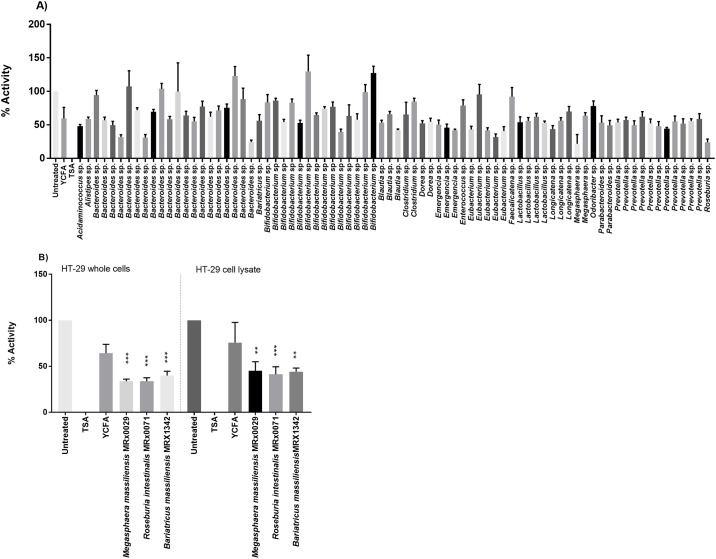
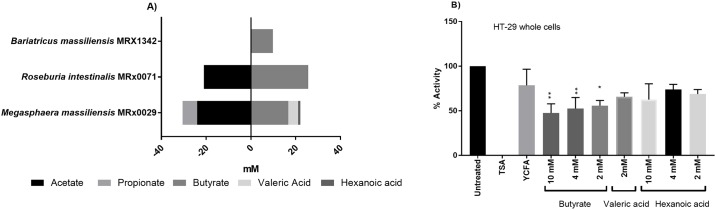
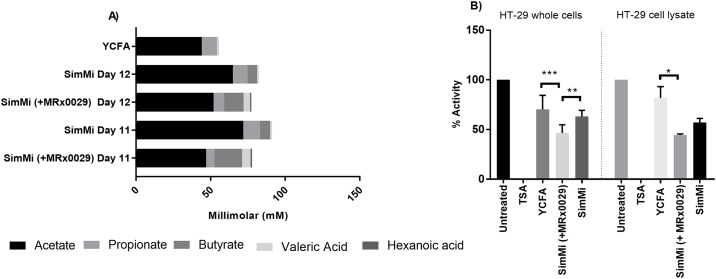
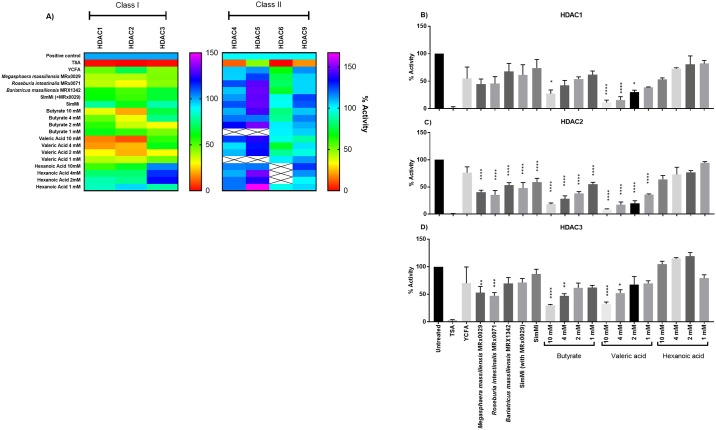
Overexpression of histone deacetylase (HDAC) isoforms has been implicated in a variety of disease pathologies, from cancer and colitis to cardiovascular disease and neurodegeneration, thus HDAC inhibitors have a long history as therapeutic targets. The gut microbiota can influence HDAC activity via microbial-derived metabolites. While HDAC inhibition (HDI) by gut commensals has long been attributed to the short chain fatty acid (SCFA) butyrate, the potent metabolic reservoir provided by the gut microbiota and its role in host physiology warrants further investigation in a variety of diseases. Cell-free supernatants (CFS) of 79 phylogenetically diverse gut commensals isolated from healthy human donors were screened for their SCFA profile and their total HDAC inhibitory properties. The three most potent HDAC inhibiting strains were further evaluated and subjected to additional analysis of specific class I and class II HDAC inhibition. All three HDAC inhibitors are butyrate producing strains, and one of these also produced substantial levels of valeric acid and hexanoic acid. Valeric acid was identified as a potential contributor to the HDAC inhibitory effects. This bacterial strain, Megasphaera massiliensis MRx0029, was added to a model microbial consortium to assess its metabolic activity in interaction with a complex community. M. massiliensis MRx0029 successfully established in the consortium and enhanced the total and specific HDAC inhibitory function by increasing the capacity of the community to produce butyrate and valeric acid. We here show that single bacterial strains from the human gut microbiota have potential as novel HDI therapeutics for disease areas involving host epigenetic aberrations.
Overview
The claims and statistics of this paper haven’t been checked yet.
Run the check — free, no account needed. It reads the open-access text and checks the sources it cites.
Integrity signals
Registry
Cites
Statistics
Figures
Verification
Claims the paper makes
The claims and statistics of this paper haven’t been checked yet.
Run the check — free, no account needed. It reads the open-access text and checks the sources it cites.
Claims other papers make about this one
Each is checked against this paper’s own text: does it say what the citing paper says it does?
In the citing paper
“This SCFA is rather a rare bacterial metabolite generated by low-abundant commensals such as Megasphaera massiliensis, which we have classified as a pentanoate-producing bacterial species21.”
From Microbial short-chain fatty acids modulate CD8+ T cell responses and improve adoptive immunotherapy for cancer (2021) · cites this paper as [21]
In the citing paper
“Our broad screening approach revealed that among the commensal strains tested, only a few bacterial species exhibited a strong pan-HDAC inhibitory capacity21.”
From Microbial short-chain fatty acids modulate CD8+ T cell responses and improve adoptive immunotherapy for cancer (2021) · cites this paper as [21]
Self-check
Percentages, sums and reported differences re-computed from the paper’s own numbers.
The self-check needs the paper’s full text.
Citations
Cites
Shrestha, S., & Offer, S. M. (2016) · Medical Epigenetics · doi:10.1159/000444713 · Cited by 8,951
Gut microbiota, metabolites and host immunity
Rooks, M. G., & Garrett, W. S. (2016) · Nature reviews. Immunology · doi:10.1038/nri.2016.42 · Cited by 3,409
Formation of propionate and butyrate by the human colonic microbiota
Louis, P., & Flint, H. J. (2017) · Environmental Microbiology · doi:10.1111/1462-2920.13589 · Cited by 3,028
Epigenetic modifications and human disease
Portela, A., & Esteller, M. (2010) · Nature Biotechnology · doi:10.1038/nbt.1685 · Cited by 2,938
The gut microbiota influences blood-brain barrier permeability in mice
Braniste, V., Al-Asmakh, M., Kowal, C., Anuar, F., Abbaspour, A., Tóth, M., Korecka, A., Bakocevic, N., Ng, L. G., Kundu, P., et al. (2014) · Science Translational Medicine · doi:10.1126/scitranslmed.3009759 · Cited by 2,530
Disentangling type 2 diabetes and metformin treatment signatures in the human gut microbiota
MetaHIT consortium, Forslund, K., Hildebrand, F., Nielsen, T., Falony, G., Le Chatelier, E., Sunagawa, S., Prifti, E., Vieira-Silva, S., Gudmundsdottir, V., et al. (2015) · Nature · doi:10.1038/nature15766 · Cited by 2,116
New and emerging HDAC inhibitors for cancer treatment
West, A. C., & Johnstone, R. W. (2014) · Journal of Clinical Investigation · doi:10.1172/jci69738 · Cited by 1,404
New evidences on the altered gut microbiota in autism spectrum disorders
Strati, F., Cavalieri, D., Albanese, D., De Felice, C., Donati, C., Hayek, J., Jousson, O., Leoncini, S., Renzi, D., Calabrò, A., et al. (2017) · Microbiome · doi:10.1186/s40168-017-0242-1 · Cited by 1,040
Gut microbes and the brain: paradigm shift in neuroscience
Mayer, E. A., Knight, R., Mazmanian, S. K., Cryan, J. F., & Tillisch, K. (2014) · The Journal of Neuroscience · doi:10.1523/jneurosci.3299-14.2014 · Cited by 1,033
Exogenous Stimuli Maintain Intraepithelial Lymphocytes via Aryl Hydrocarbon Receptor Activation
Li, Y., Innocentin, S., Withers, D. R., Roberts, N. A., Gallagher, A., Grigorieva, E. F., Wilhelm, C., & Veldhoen, M. (2011) · Cell · doi:10.1016/j.cell.2011.09.025 · Cited by 837
Cited by
Sorted by citations
The Effect of Probiotics on the Production of Short-Chain Fatty Acids by Human Intestinal Microbiome
Markowiak‐Kopeć, P., & Śliżewska, K. (2020) · Nutrients · doi:10.3390/nu12041107 · Cited by 1,314
Luu, M., Riester, Z., Baldrich, A., Reichardt, N., Yuille, S., Busetti, A., Klein, M., Wempe, A., Leister, H., Raifer, H., et al. (2021) · Nature Communications · doi:10.1038/s41467-021-24331-1 · Cited by 771
Self-citationThe gut-bone axis: How bacterial metabolites bridge the distance
Zaiss, M. M., Jones, R. M., Schett, G., & Pacifici, R. (2019) · Journal of Clinical Investigation · doi:10.1172/jci128521 · Cited by 403
The interaction among gut microbes, the intestinal barrier and short chain fatty acids
Ma, J., Piao, X., Mahfuz, S. U., Long, S., & Wang, J. (2021) · Animal nutrition · doi:10.1016/j.aninu.2021.09.012 · Cited by 432
Nomura, M., Nagatomo, R., Doi, K., Shimizu, J., Baba, K., Saito, T., Matsumoto, S., Inoue, K., & Muto, M. (2020) · JAMA Network Open · doi:10.1001/jamanetworkopen.2020.2895 · Cited by 396
Metadata
- Authors
- Yuille, S., Reichardt, N., Panda, S., Dunbar, H., & Mulder, I. E.
- Corresponding author
- Mulder, Imke E.
- Venue
- PLOS ONE
- Publisher
- Public Library of Science (PLoS)
- Published
- 2018-07-27
- Volume
- 13
- Issue
- 7
- Pages
- e0201073
- ISSN
- 1932-6203 (ISSN-L)
- PMC
- PMC6063406
- OpenAlex
- W2884838967
- Cited by
- 257
- References
- 48
- Citations by year
- 2026: 23 · 2025: 23 · 2024: 46 · 2023: 48 · 2022: 34 · 2021: 27 · 2020: 37 · 2019: 18 · 2018: 1
- FWCI
- 7.38
- Type
- journal article
- Language
- en
- Open access
- gold
- doi.org
- Licence
- Locations
- PLoS ONE (publishedVersion, cc-by)
- Europe PMC (PubMed Central) (publishedVersion, cc-by)
- PubMed Central (publishedVersion, cc-by)
- PubMed (publishedVersion)
- DOAJ (DOAJ: Directory of Open Access Journals) (submittedVersion)
- Topics
- Life Sciences › Biochemistry, Genetics and Molecular Biology › Molecular Biology › Gut microbiota and health
- Life Sciences › Biochemistry, Genetics and Molecular Biology › Molecular Biology › Histone Deacetylase Inhibitors Research
- Life Sciences › Agricultural and Biological Sciences › Food Science › Probiotics and Fermented Foods
- Keywords
- histone deacetylase inhibitors, gut microbiota, class I HDACs, class II HDACs, short-chain fatty acids, butyrate, valeric acid, hexanoic acid, cell-free supernatant, microbial consortia, epigenetic regulation, host-microbe interactions
- MeSH terms
- Gastrointestinal Microbiome, Culture Media, Histone Deacetylases, Humans, Pentanoic Acids, Cell Culture Techniques, HT29 Cells, Butyric Acid, Megasphaera, Histone Deacetylase Inhibitors
About these checks
Registry, retraction, Cites and statistics results are computed, not judged, with one exception: a printed reference that no index lists is read once by a model before it counts as a citation error. Claims are extracted by a model and kept only when their quote appears verbatim in the text; each cited source is then checked, with a model’s help, for whether it says what the claim relies on. Those verdicts can be wrong — read the claim’s quote and the cited source before relying on one.
Statistics and arithmetic are recomputed, not judged.
Confidence bands are shown only for fields calibrated on our annotated test set. None is calibrated yet, so no band is shown.
What counts as a claim ›How we measure confidence ›How we check this ›
Are you an author, or do you see a problem with this page? Request a review
