

Transcriptomic and proteomic host response to Aspergillus fumigatus conidia in an air-liquid interface model of human bronchial epithelium
Open accessThe DOI matches its Crossref record; 97 of the 97 references it cites were found in a registry or an index.
Abstract
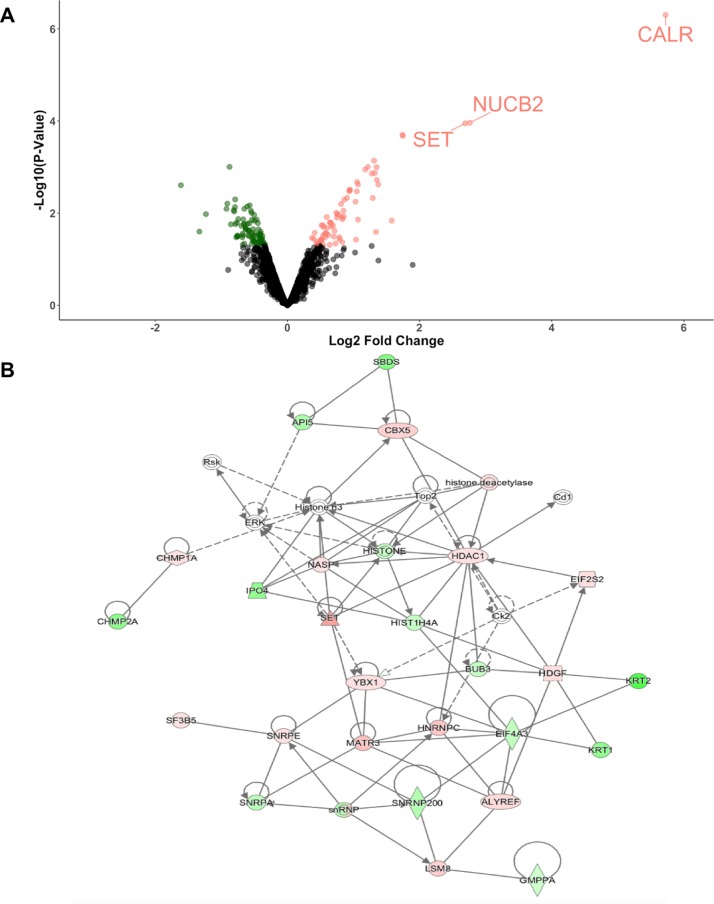
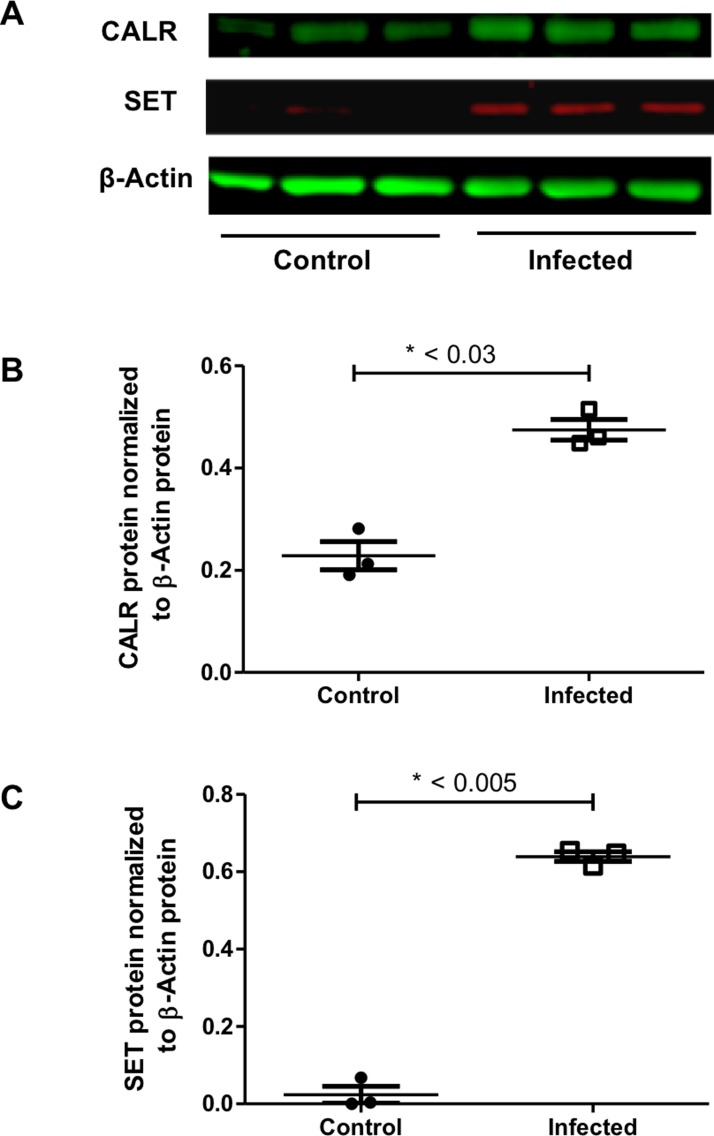
Aspergillus fumigatus (A. fumigatus) is a wide-spread fungus that is a potent allergen in hypersensitive individuals but also an opportunistic pathogen in immunocompromised patients. It reproduces asexually by releasing airborne conidiospores (conidia). Upon inhalation, fungal conidia are capable of reaching the airway epithelial cells (AECs) in bronchial and alveolar tissues. Previous studies have predominantly used submerged monolayer cultures for studying this host-pathogen interaction; however, these cultures do not recapitulate the mucocililary differentiation phenotype of the in vivo epithelium in the respiratory tract. Thus, the aim of this study was to use well-differentiated primary human bronchial epithelial cells (HBECs) grown at the air-liquid interface (ALI) to determine their transcriptomic and proteomic responses following interaction with A. fumigatus conidia. We visualized conidial interaction with HBECs using confocal laser scanning microscopy (CLSM), and applied NanoString nCounter and shotgun proteomics to assess gene expression changes in the human cells upon interaction with A. fumigatus conidia. Western blot analysis was used to assess the expression of top three differentially expressed proteins, CALR, SET and NUCB2. CLSM showed that, unlike submerged monolayer cultures, well-differentiated ALI cultures of primary HBECs were estimated to internalize less than 1% of bound conidia. Nevertheless, transcriptomic and proteomic analyses revealed numerous differentially expressed host genes; these were enriched for pathways including apoptosis/autophagy, translation, unfolded protein response and cell cycle (up-regulated); complement and coagulation pathways, iron homeostasis, nonsense mediated decay and rRNA binding (down-regulated). CALR and SET were confirmed to be up-regulated in ALI cultures of primary HBECs upon exposure to A. fumigatus via western blot analysis. Therefore, using transcriptomics and proteomics approaches, ALI models recapitulating the bronchial epithelial barrier in the conductive zone of the respiratory tract can provide novel insights to the molecular response of bronchial epithelial cells upon exposure to A. fumigatus conidia.
Overview
The claims and statistics of this paper haven’t been checked yet.
Free: it reads the open-access text and checks the first 5 claims that cite a source we can check. Create a free account to check every claim.
Integrity signals
Registry
Cites
Statistics
Figures
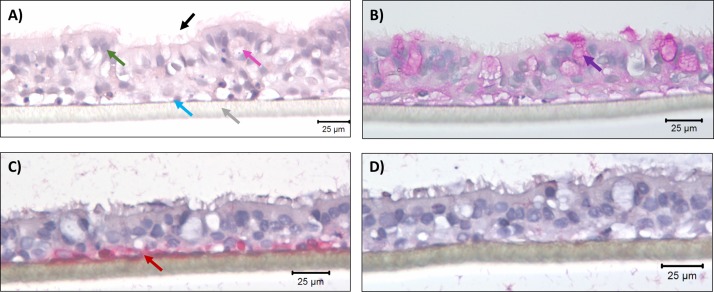
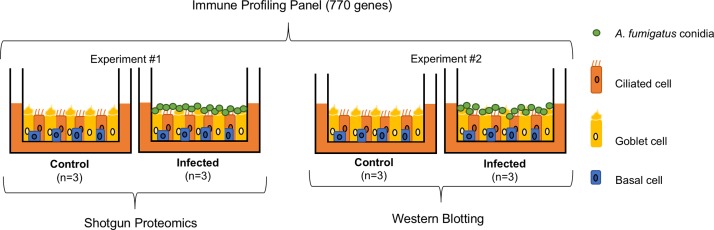
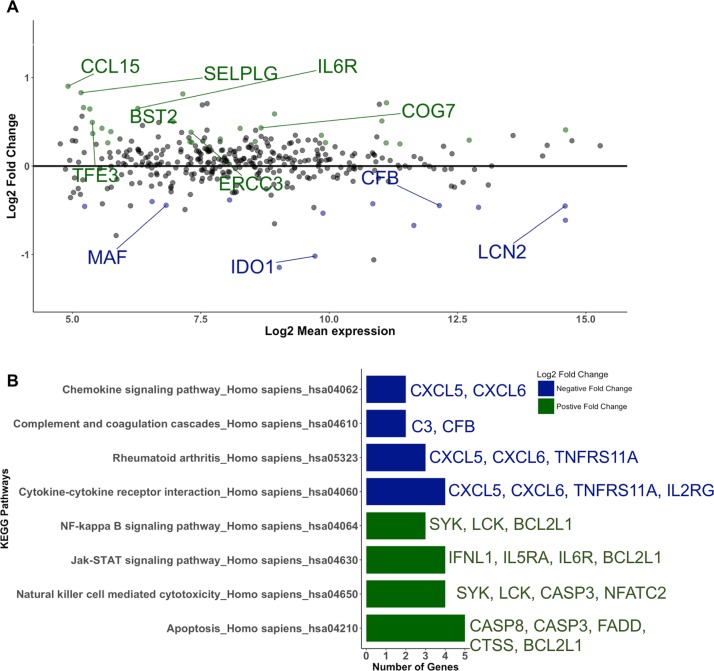
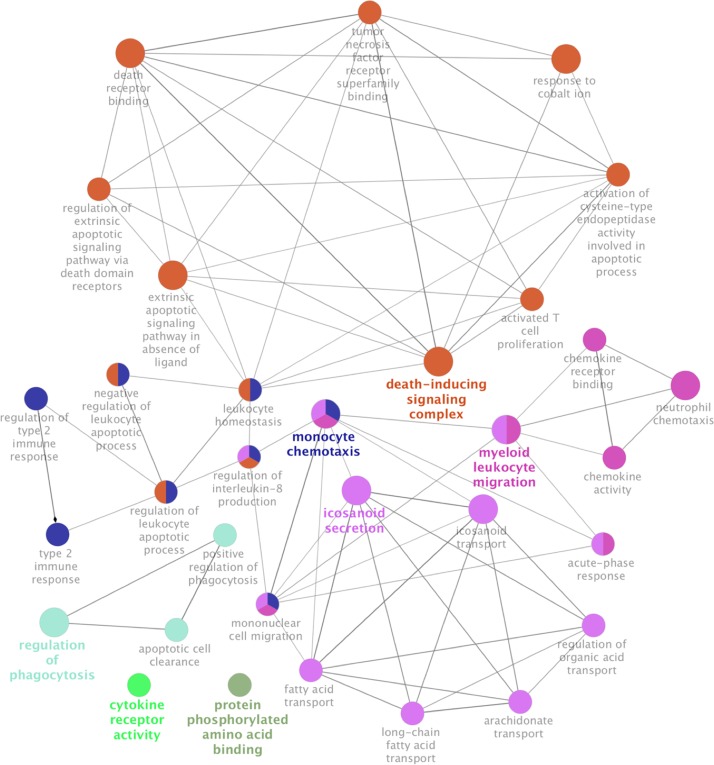
Verification
Claims the paper makes
The claims and statistics of this paper haven’t been checked yet.
Free: it reads the open-access text and checks the first 5 claims that cite a source we can check. Create a free account to check every claim.
Claims other papers make about this one
Each is checked against this paper’s own text: does it say what the citing paper says it does?
In the citing paper
“and (ii) the unique ability of germinating conidia to cross epithelia via an actin-mediated process in the absence of damage to the epithelial cell (Fig. 7).”
From Aspergillus fumigatus and Aspergillosis in 2019 (2019) · cites this paper as [227]
In the citing paper
“Importantly, recent in vivo studies in immunocompetent mice (226) and in primary human respiratory EC air-liquid cultures (204, 227) clearly demonstrated (i) the lack of phagocytic activity of ECs”
From Aspergillus fumigatus and Aspergillosis in 2019 (2019) · cites this paper as [227]
In the citing paper
“Importantly, recent in vivo studies in immunocompetent mice (226) and in primary human respiratory EC air-liquid cultures (204, 227) clearly demonstrated (i) the lack of phagocytic activity of ECs and (ii) the unique ability of germinating conidia to cross epithelia via an actin-mediated process in the absence of damage to the epithelial cell (Fig. 7).”
From Aspergillus fumigatus and Aspergillosis in 2019 (2019) · cites this paper as [227]
Self-check
Percentages, sums and reported differences re-computed from the paper’s own numbers.
The self-check needs the paper’s full text.
Citations
Cites
Gene Ontology: tool for the unification of biology
Ashburner, M., Ball, C. A., Blake, J. A., Botstein, D., Butler, H., Cherry, J. M., Davis, A. P., Dolinski, K., Dwight, S. S., Eppig, J. T., et al. (2000) · Nature Genetics · doi:10.1038/75556 · Cited by 43,206
Enrichr: a comprehensive gene set enrichment analysis web server 2016 update
Kuleshov, M. V., Jones, M. R., Rouillard, A. D., Fernandez, N. F., Duan, Q., Wang, Z., Koplev, S., Jenkins, S. L., Jagodnik, K. M., Lachmann, A., et al. (2016) · Nucleic Acids Research · doi:10.1093/nar/gkw377 · Cited by 10,799
Enrichr: interactive and collaborative HTML5 gene list enrichment analysis tool
Chen, E. Y., Tan, C. M., Kou, Y., Duan, Q., Wang, Z., Meirelles, G. V., Clark, N. R., & Ma’ayan, A. (2013) · BMC Bioinformatics · doi:10.1186/1471-2105-14-128 · Cited by 7,814
Bindea, G., Mlecnik, B., Hackl, H., Charoentong, P., Tosolini, M., Kirilovsky, A., Fridman, W.-H., Pagès, F., Trajanoski, Z., & Galon, J. (2009) · Bioinformatics · doi:10.1093/bioinformatics/btp101 · Cited by 6,280
Causal analysis approaches in Ingenuity Pathway Analysis
Krämer, A., Green, J., Pollard, J., & Tugendreich, S. (2014) · Bioinformatics · doi:10.1093/bioinformatics/btt703 · Cited by 5,724
Rappsilber, J., Mann, M., & Ishihama, Y. (2007) · Nature Protocols · doi:10.1038/nprot.2007.261 · Cited by 4,641
The unfolded protein response: controlling cell fate decisions under ER stress and beyond
Hetz, C. (2012) · Nature Reviews Molecular Cell Biology · doi:10.1038/nrm3270 · Cited by 4,093
Global and Multi-National Prevalence of Fungal Diseases-Estimate Precision
Bongomin, F., Gago, S., Oladele, R., & Denning, D. (2017) · Journal of Fungi · doi:10.3390/jof3040057 · Cited by 2,953
Aspergillus fumigatus and Aspergillosis
Latgé, J.-P. (1999) · Clinical Microbiology Reviews · doi:10.1128/cmr.12.2.310 · Cited by 2,307
TEER Measurement Techniques for In Vitro Barrier Model Systems
Srinivasan, B., Kolli, A. R., Esch, M. B., Abaci, H. E., Shuler, M. L., & Hickman, J. J. (2015) · SLAS Technology · doi:10.1177/2211068214561025 · Cited by 2,145
Research works printed but not linked: 2
- Wasylnka JA, Moore MM. Uptake of Aspergillus fumigatus Conidia by Phagocytic and Nonphagocytic Cells In Vitro: Quantitation Using Strains Expressing Green Fluorescent Protein. Infect Immun. 2002 6; 70(6): 3156– 63. 10.1128/IAI.70.6.3156-3163.2002 12011010 PMC127978 · DOI · Paper page
- Zheng J, Zuo J, Han Y, Zhang L, Yan L, Shen L, et al Gliotoxin produced by Aspergillus fumigatus induces apoptosis of human bronchial epithelial cells via the Bcl-2 pathway. Int J Clin Exp Med. 2017 6 30; 10: 8854– 65.
Cited by
Aspergillus fumigatus and Aspergillosis in 2019
Latgé, J.-P., & Chamilos, G. (2019) · Clinical Microbiology Reviews · doi:10.1128/cmr.00140-18 · Cited by 1,400
Ball, B., Bermas, A., Carruthers‐Lay, D., & Geddes‐McAlister, J. (2019) · Journal of Fungi · doi:10.3390/jof5020052 · Cited by 67
Arunachalam, D., Ramanathan, S. M., Menon, A., Madhav, L., Ramaswamy, G., Prajna, N. V., Lalitha, P., & Dharmalingam, K. (2022) · BMC Genomics · doi:10.1186/s12864-021-08218-5 · Cited by 54
In vitroinfection models to study fungal–host interactions
Last, A., Maurer, M., Mosig, A. S., Gresnigt, M. S., & Hube, B. (2021) · FEMS Microbiology Reviews · doi:10.1093/femsre/fuab005 · Cited by 49
Development of lung tissue models and their applications
Petpiroon, N., Netkueakul, W., Sukrak, K., Wang, C., Liang, Y. T., Wang, M., Liu, Y., Li, Q., Kamran, R., Naruse, K., et al. (2023) · Life Sciences · doi:10.1016/j.lfs.2023.122208 · Cited by 44
Metadata
- Authors
- Toor, A., Culibrk, L., Singhera, G. K., Moon, K.-M., Prudova, A., Foster, L. J., Moore, M. M., Dorscheid, D. R., & Tebbutt, S. J.
- Affiliations
- University of British Columbia (CA)
- Simon Fraser University (CA)
- Corresponding author
- Tebbutt, Scott J.
- ORCID
- Venue
- PLOS ONE
- Publisher
- Public Library of Science (PLoS)
- Published
- 2018-12-27
- Volume
- 13
- Issue
- 12
- Pages
- e0209652
- ISSN
- 1932-6203 (ISSN-L)
- PMC
- PMC6307744
- OpenAlex
- W2907002983
- Cited by
- 32
- References
- 96
- Citations by year
- 2026: 3 · 2025: 3 · 2024: 1 · 2023: 3 · 2022: 4 · 2021: 8 · 2020: 7 · 2019: 3
- FWCI
- 3.40
- Type
- journal article
- Language
- en
- Open access
- gold
- doi.org
- Licence
- Locations
- PLoS ONE (publishedVersion, cc-by)
- Europe PMC (PubMed Central) (publishedVersion, cc-by)
- PubMed Central (publishedVersion, cc-by)
- PubMed (publishedVersion)
- DOAJ (DOAJ: Directory of Open Access Journals) (submittedVersion, cc-by-sa)
- Figshare (submittedVersion, cc-by)
- Funders
- BC Proteomics Network
- Natural Sciences and Engineering Research Council of Canada (RGPIN-2015-05043)
- Topics
- Health Sciences › Medicine › Infectious Diseases › Antifungal resistance and susceptibility
- Life Sciences › Biochemistry, Genetics and Molecular Biology › Molecular Biology › Fungal and yeast genetics research
- Health Sciences › Medicine › Pulmonary and Respiratory Medicine › Asthma and respiratory diseases
- Keywords
- Aspergillus fumigatus, fungal conidia, host-pathogen interaction, air-liquid interface, human bronchial epithelial cells, epithelial barrier function, transcriptomics, proteomics, calreticulin, sets, NUCB2, unfolded protein response, complement and coagulation pathways, iron homeostasis
- MeSH terms
- Aspergillosis, Aspergillus fumigatus, Humans, Spores, Fungal, Computational Biology, Proteome, Respiratory Mucosa, Gene Expression Profiling, Proteomics, Host-Pathogen Interactions, Transcriptome, Gene Ontology
About these checks
Registry, retraction, Cites and statistics results are computed, not judged, with one exception: a printed reference that no index lists is read once by a model before it counts as a citation error. Claims are extracted by a model and kept only when their quote appears verbatim in the text; each cited source is then checked, with a model’s help, for whether it says what the claim relies on. Those verdicts can be wrong — read the claim’s quote and the cited source before relying on one.
Statistics and arithmetic are recomputed, not judged.
Confidence bands are shown only for fields calibrated on our annotated test set. None is calibrated yet, so no band is shown.
What counts as a claim ›How we measure confidence ›How we check this ›
Are you an author, or do you see a problem with this page? Request a review
How to cite
Cite CoChat for the checks on this page, and the paper for its own findings.
- This page
- CoChat. (2026). Citation check: Transcriptomic and proteomic host response to Aspergillus fumigatus conidia in an air-liquid interface model of human bronchial epithelium. https://app.cochat.ai/papers/10.1371/journal.pone.0209652
- The paper
- Toor, A., Culibrk, L., Singhera, G. K., Moon, K.-M., Prudova, A., Foster, L. J., Moore, M. M., Dorscheid, D. R., & Tebbutt, S. J. (2018). Transcriptomic and proteomic host response to Aspergillus fumigatus conidia in an air-liquid interface model of human bronchial epithelium. PLOS ONE. https://doi.org/10.1371/journal.pone.0209652
Data sources
Bibliographic data: Semantic Scholar, OpenAlex, Crossref.
Contains information from the Semantic Scholar Academic Graph Datasets, made available under the ODC Attribution License (ODC-BY 1.0).
Semantic Scholar’s data is described in: Kinney, R., et al. (2023). The Semantic Scholar Open Data Platform. arXiv:2301.10140.
