

CiiiDER: A tool for predicting and analysing transcription factor binding sites
Open accessPublished version of a preprint
The DOI matches its Crossref record; 34 of the 34 references it cites were found in a registry or an index.
Abstract
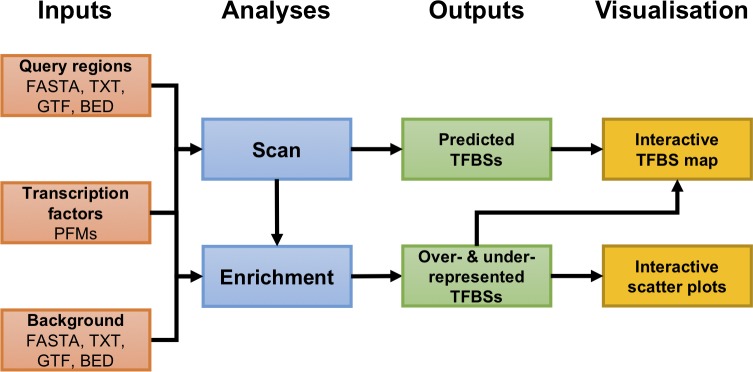
The availability of large amounts of high-throughput genomic, transcriptomic and epigenomic data has provided opportunity to understand regulation of the cellular transcriptome with an unprecedented level of detail. As a result, research has advanced from identifying gene expression patterns associated with particular conditions to elucidating signalling pathways that regulate expression. There are over 1,000 transcription factors (TFs) in vertebrates that play a role in this regulation. Determining which of these are likely to be controlling a set of genes can be assisted by computational prediction, utilising experimentally verified binding site motifs. Here we present CiiiDER, an integrated computational toolkit for transcription factor binding analysis, written in the Java programming language, to make it independent of computer operating system. It is operated through an intuitive graphical user interface with interactive, high-quality visual outputs, making it accessible to all researchers. CiiiDER predicts transcription factor binding sites (TFBSs) across regulatory regions of interest, such as promoters and enhancers derived from any species. It can perform an enrichment analysis to identify TFs that are significantly over- or under-represented in comparison to a bespoke background set and thereby elucidate pathways regulating sets of genes of pathophysiological importance.
Overview
The claims and statistics of this paper haven’t been checked yet.
Free: it reads the open-access text and checks the first 5 claims that cite a source we can check. Create a free account to check every claim.
Integrity signals
Registry
Cites
Statistics
Figures


Verification
Claims the paper makes
The claims and statistics of this paper haven’t been checked yet.
Free: it reads the open-access text and checks the first 5 claims that cite a source we can check. Create a free account to check every claim.
Claims other papers make about this one
Each is checked against this paper’s own text: does it say what the citing paper says it does?
The check wasn’t confident either way, so it gives no verdict — never disputed.
In the citing paper
“The analysis revealed that the majority of TFBS enriched in these sequences are found within sub-regions of the enhancer that are conserved between mouse and human”
From Viral manipulation of functionally distinct interneurons in mice, non-human primates and humans (2020) · cites this paper as [42]
Experimental — accuracy not yet measured
Self-check
Percentages, sums and reported differences re-computed from the paper’s own numbers.
The self-check needs the paper’s full text.
Citations
Cites
limma powers differential expression analyses for RNA-sequencing and microarray studies
Ritchie, M. E., Phipson, B., Wu, D., Hu, Y., Law, C. W., Shi, W., & Smyth, G. K. (2015) · Nucleic Acids Research · doi:10.1093/nar/gkv007 · Cited by 40,458
An integrated encyclopedia of DNA elements in the human genome
The ENCODE Project Consortium (2012) · Nature · doi:10.1038/nature11247 · Cited by 18,072
pROC: an open-source package for R and S+ to analyze and compare ROC curves
Robin, X., Turck, N., Hainard, A., Tiberti, N., Lisacek, F., Sanchez, J.-C., & Müller, M. (2011) · BMC Bioinformatics · doi:10.1186/1471-2105-12-77 · Cited by 13,697
Heinz, S., Benner, C., Spann, N., Bertolino, E., Lin, Y. C., Laslo, P., Cheng, J. X., Murre, C., Singh, H., & Glass, C. K. (2010) · Molecular Cell · doi:10.1016/j.molcel.2010.05.004 · Cited by 13,382 · cited 2×
“While there are existing and publicly available programs that can perform enrichment anal- yses, these tools are typically web-based (e.g. MotifViz [10]), restricted to command-line use (e.g. Clover [11] and HOMER [12]) or offer web-based and command-line versions (e.g. Pscan [13], oPOSSUM [14] and the MEME suite [15]…”
BackgroundNCBI GEO: archive for functional genomics data sets—update
Barrett, T., Wilhite, S. E., Ledoux, P., Evangelista, C., Kim, I. F., Tomashevsky, M., Marshall, K. A., Phillippy, K. H., Sherman, P. M., Holko, M., et al. (2012) · Nucleic Acids Research · doi:10.1093/nar/gks1193 · Cited by 10,418
Bailey, T. L., Johnson, J., Grant, C. E., & Noble, W. S. (2015) · Nucleic Acids Research · doi:10.1093/nar/gkv416 · Cited by 5,269
GEOquery: a bridge between the Gene Expression Omnibus (GEO) and BioConductor
Davis, S., & Meltzer, P. S. (2007) · Bioinformatics · doi:10.1093/bioinformatics/btm254 · Cited by 3,303
Predicting the sequence specificities of DNA- and RNA-binding proteins by deep learning
Alipanahi, B., Delong, A., Weirauch, M. T., & Frey, B. J. (2015) · Nature Biotechnology · doi:10.1038/nbt.3300 · Cited by 2,873
Chen, X., Xu, H., Yuan, P., Fang, F., Huss, M., Vega, V. B., Wong, E., Orlov, Y. L., Zhang, W., Jiang, J., et al. (2008) · Cell · doi:10.1016/j.cell.2008.04.043 · Cited by 2,501
TRANSFAC(R) and its module TRANSCompel(R): transcriptional gene regulation in eukaryotes
Matys, V. (2006) · Nucleic Acids Research · doi:10.1093/nar/gkj143 · Cited by 2,166
MatInspector and beyond: promoter analysis based on transcription factor binding sites
Cartharius, K., Frech, K., Grote, K., Klocke, B., Haltmeier, M., Klingenhoff, A., Frisch, M., Bayerlein, M., & Werner, T. (2005) · Bioinformatics · doi:10.1093/bioinformatics/bti473 · Cited by 1,979
JASPAR: an open-access database for eukaryotic transcription factor binding profiles
Sandelin, A. (2004) · Nucleic Acids Research · doi:10.1093/nar/gkh012 · Cited by 1,790
De novo assembly of bacterial transcriptomes from RNA-seq data
Tjaden, B. (2015) · Genome Biology · doi:10.1186/s13059-014-0572-2 · Cited by 1,717
Khan, A., Fornes, O., Stigliani, A., Gheorghe, M., Castro-Mondragon, J. A., van der Lee, R., Bessy, A., Chèneby, J., Kulkarni, S. R., Tan, G., et al. (2018) · Nucleic Acids Research · doi:10.1093/nar/gkx1126 · Cited by 1,471
Type I Inteferon Gene Induction by the Interferon Regulatory Factor Family of Transcription Factors
Honda, K., Takaoka, A., & Taniguchi, T. (2006) · Immunity · doi:10.1016/j.immuni.2006.08.009 · Cited by 1,393
MATCHTM: a tool for searching transcription factor binding sites in DNA sequences
Kel, A. E. (2003) · Nucleic Acids Research · doi:10.1093/nar/gkg585 · Cited by 1,091
Mathelier, A., Fornes, O., Arenillas, D. J., Chen, C.-Y., Denay, G., Lee, J., Shi, W., Shyr, C., Tan, G., Worsley-Hunt, R., et al. (2016) · Nucleic Acids Research · doi:10.1093/nar/gkv1176 · Cited by 937
INTERFEROME v2.0: an updated database of annotated interferon-regulated genes
Rusinova, I., Forster, S., Yu, S., Kannan, A., Masse, M., Cumming, H., Chapman, R., & Hertzog, P. J. (2012) · Nucleic Acids Research · doi:10.1093/nar/gks1215 · Cited by 878
Self-citationUse of the ‘Perceptron’ algorithm to distinguish translational initiation sites in E. coli
Stormo, G. D., Schneider, T. D., Gold, L., & Ehrenfeucht, A. (1982) · Nucleic Acids Research · doi:10.1093/nar/10.9.2997 · Cited by 651
Silencing of Irf7 pathways in breast cancer cells promotes bone metastasis through immune escape
Bidwell, B. N., Slaney, C. Y., Withana, N. P., Forster, S., Cao, Y., Loi, S., Andrews, D., Mikeska, T., Mangan, N. E., Samarajiwa, S. A., et al. (2012) · Nature Medicine · doi:10.1038/nm.2830 · Cited by 487
Self-citationJolma, A., Kivioja, T., Toivonen, J., Cheng, L., Wei, G., Enge, M., Taipale, M., Vaquerizas, J. M., Yan, J., Sillanpää, M. J., et al. (2010) · Genome Research · doi:10.1101/gr.100552.109 · Cited by 441
Detection of functional DNA motifs via statistical over-representation
Frith, M. C. (2004) · Nucleic Acids Research · doi:10.1093/nar/gkh299 · Cited by 424
Zambelli, F., Pesole, G., & Pavesi, G. (2009) · Nucleic Acids Research · doi:10.1093/nar/gkp464 · Cited by 402 · cited 1×
“Pscan [13], oPOSSUM [14] and the MEME suite [15]).”
MethodKwon, A. T., Arenillas, D. J., Hunt, R. W., & Wasserman, W. W. (2012) · G3 Genes|Genomes|Genetics · doi:10.1534/g3.112.003202 · Cited by 282
INTERFEROME: the database of interferon regulated genes
Samarajiwa, S. A., Forster, S., Auchettl, K., & Hertzog, P. J. (2009) · Nucleic Acids Research · doi:10.1093/nar/gkn732 · Cited by 265
Self-citationSurveying Saccharomyces Genomes to Identify Functional Elements by Comparative DNA Sequence Analysis
Cliften, P. F., Hillier, L. W., Fulton, L., Graves, T., Miner, T., Gish, W. R., Waterston, R. H., & Johnston, M. (2001) · Genome Research · doi:10.1101/gr.182901 · Cited by 237
The Next Generation of Transcription Factor Binding Site Prediction
Mathelier, A., & Wasserman, W. W. (2013) · PLoS Computational Biology · doi:10.1371/journal.pcbi.1003214 · Cited by 197
Marinescu, V. D., Kohane, I. S., & Riva, A. (2005) · BMC Bioinformatics · doi:10.1186/1471-2105-6-79 · Cited by 197
Multiple sources of bias confound functional enrichment analysis of global -omics data
Timmons, J. A., Szkop, K. J., & Gallagher, I. J. (2015) · Genome Biology · doi:10.1186/s13059-015-0761-7 · Cited by 180
Boeva, V. (2016) · Frontiers in Genetics · doi:10.3389/fgene.2016.00024 · Cited by 174
Russ, B. E., Olshansky, M., Li, J., Nguyen, M. L. T., Gearing, L. J., Nguyen, T. H. O., Olson, M. R., McQuilton, H. A., Nüssing, S., Khoury, G., et al. (2017) · Cell Reports · doi:10.1016/j.celrep.2017.11.097 · Cited by 65
Self-citationA novel method for improved accuracy of transcription factor binding site prediction
Khamis, A. M., Motwalli, O., Oliva, R., Jankovic, B. R., Medvedeva, Y. A., Ashoor, H., Essack, M., Gao, X., & Bajic, V. B. (2018) · Nucleic Acids Research · doi:10.1093/nar/gky237 · Cited by 54
MotifViz: an analysis and visualization tool for motif discovery
Fu, Y., Frith, M. C., Haverty, P. M., & Weng, Z. (2004) · Nucleic Acids Research · doi:10.1093/nar/gkh426 · Cited by 48
Eisermann, K., Tandon, S., Bazarov, A., Brett, A., Fraizer, G. C., & Piontkivska, H. (2008) · BMC Genomics · doi:10.1186/1471-2164-9-337 · Cited by 29
Research works printed but not linked: 1
- Collaborative data science [Internet]. Plotly Technologies Inc 2015 Available from: https://plot.ly/.
Cited by
JASPAR 2022: the 9th release of the open-access database of transcription factor binding profiles
Castro-Mondragon, J. A., Riudavets-Puig, R., Rauluseviciute, I., Berhanu Lemma, R., Turchi, L., Blanc-Mathieu, R., Lucas, J., Boddie, P., Khan, A., Manosalva Pérez, N., et al. (2022) · Nucleic Acids Research · doi:10.1093/nar/gkab1113 · Cited by 1,935
“Some of these tools include: (i) the MEME suite, allowing various motif enrichment and discovery analysis (20), (ii) TFBSshape allowing investigation of DNA shape features for TFBSs to provide insight on the mechanism of protein–DNA interaction (21,22), (iii) CiiiDER (23) for TFBS prediction and analysis such as enric…”
Yang, K., Fan, M., Wang, X., Xu, J., Wang, Y., Tu, F., Gill, P. S., Ha, T., Liu, L., Williams, D. L., et al. (2022) · Cell Death & Differentiation · doi:10.1038/s41418-021-00841-9 · Cited by 798
A tumor-derived type III collagen-rich ECM niche regulates tumor cell dormancy
Di Martino, J. S., Nobre, A. R., Mondal, C., Taha, I., Farias, E. F., Fertig, E. J., Naba, A., Aguirre-Ghiso, J. A., & Bravo-Cordero, J. J. (2021) · Nature Cancer · doi:10.1038/s43018-021-00291-9 · Cited by 322
Torrence, M. E., MacArthur, M. R., Hosios, A. M., Valvezan, A. J., Asara, J. M., Mitchell, J. R., & Manning, B. D. (2021) · eLife · doi:10.7554/elife.63326 · Cited by 237
Viral manipulation of functionally distinct interneurons in mice, non-human primates and humans
Vormstein-Schneider, D., Lin, J. D., Pelkey, K. A., Chittajallu, R., Guo, B., Arias-Garcia, M. A., Allaway, K., Sakopoulos, S., Schneider, G., Stevenson, O., et al. (2020) · Nature Neuroscience · doi:10.1038/s41593-020-0692-9 · Cited by 235
Metadata
- Authors
- Gearing, L. J., Cumming, H. E., Chapman, R., Finkel, A. M., Woodhouse, I. B., Luu, K., Gould, J. A., Forster, S. C., & Hertzog, P. J.
- Affiliations
- Hudson Institute of Medical Research (AU)
- Corresponding author
- Hertzog, Paul J.
- Venue
- PLOS ONE
- Publisher
- Public Library of Science (PLoS)
- Published
- 2019-09-04
- Volume
- 14
- Issue
- 9
- Pages
- e0215495
- ISSN
- 1932-6203 (ISSN-L)
- PMC
- PMC6726224
- OpenAlex
- W2972262750
- Cited by
- 221
- References
- 34
- Citations by year
- 2026: 12 · 2025: 22 · 2024: 38 · 2023: 47 · 2022: 45 · 2021: 40 · 2020: 16 · 2019: 1
- FWCI
- 8.43
- Type
- journal article
- Language
- en
- Open access
- gold
- doi.org
- Licence
- Locations
- PLoS ONE (publishedVersion, cc-by)
- bioRxiv (Cold Spring Harbor Laboratory) (acceptedVersion, cc-by)
- Europe PMC (PubMed Central) (publishedVersion, cc-by)
- PubMed Central (publishedVersion, cc-by)
- PubMed (publishedVersion)
- Monash University Research Portal (Monash University) (submittedVersion, cc-by)
- Minerva Access (University of Melbourne) (submittedVersion, cc-by)
- DOAJ (DOAJ: Directory of Open Access Journals) (submittedVersion, cc-by-sa)
- Figshare (submittedVersion, cc-by)
- Funders
- State Government of Victoria
- Topics
- Life Sciences › Biochemistry, Genetics and Molecular Biology › Molecular Biology › Genomics and Chromatin Dynamics
- Life Sciences › Biochemistry, Genetics and Molecular Biology › Molecular Biology › Bioinformatics and Genomic Networks
- Life Sciences › Biochemistry, Genetics and Molecular Biology › Molecular Biology › Genomics and Phylogenetic Studies
- Keywords
- transcription factor binding sites, binding site prediction, transcription factor binding motifs, promoter analysis, enhancer analysis, gene expression regulation, graphical user interface
- MeSH terms
- Chromatin Immunoprecipitation Sequencing, Algorithms, Binding Sites, Protein Binding, Software, Transcription Factors, Computational Biology, Workflow
About these checks
Registry, retraction, Cites and statistics results are computed, not judged, with one exception: a printed reference that no index lists is read once by a model before it counts as a citation error. Claims are extracted by a model and kept only when their quote appears verbatim in the text; each cited source is then checked, with a model’s help, for whether it says what the claim relies on. Those verdicts can be wrong — read the claim’s quote and the cited source before relying on one.
Statistics and arithmetic are recomputed, not judged.
Confidence bands are shown only for fields calibrated on our annotated test set. None is calibrated yet, so no band is shown.
What counts as a claim ›How we measure confidence ›How we check this ›
Are you an author, or do you see a problem with this page? Request a review
Data sources
Bibliographic data: Semantic Scholar, OpenAlex, Crossref.
Contains information from the Semantic Scholar Academic Graph Datasets, made available under the ODC Attribution License (ODC-BY 1.0).
Semantic Scholar’s data is described in: Kinney, R., et al. (2023). The Semantic Scholar Open Data Platform. arXiv:2301.10140.
