

Global reach of ageism on older persons' health: a systematic review
Open accessThe DOI matches its Crossref record; 166 of the 169 references it cites were found in a registry or an index; 18 of the 61 sources its claims cite were checked for support.
Abstract
OBJECTIVE: Although there is anecdotal evidence of ageism occurring at both the structural level (in which societal institutions reinforce systematic bias against older persons) and individual level (in which older persons take in the negative views of aging of their culture), previous systematic reviews have not examined how both levels simultaneously influence health. Thus, the impact of ageism may be underestimated. We hypothesized that a comprehensive systematic review would reveal that these ageism levels adversely impact the health of older persons across geography, health outcomes, and time. METHOD: A literature search was performed using 14 databases with no restrictions on region, language, and publication type. The systematic search yielded 13,691 papers for screening, 638 for full review, and 422 studies for analyses. Sensitivity analyses that adjusted for sample size and study quality were conducted using standardized tools. The study protocol is registered (PROSPERO CRD42018090857). RESULTS: Ageism led to significantly worse health outcomes in 95.5% of the studies and 74.0% of the 1,159 ageism-health associations examined. The studies reported ageism effects in all 45 countries, 11 health domains, and 25 years studied, with the prevalence of significant findings increasing over time (p < .0001). A greater prevalence of significant ageism-health findings was found in less-developed countries than more-developed countries (p = .0002). Older persons who were less educated were particularly likely to experience adverse health effects of ageism. Evidence of ageism was found across the age, sex, and race/ethnicity of the targeters (i.e., persons perpetrating ageism). CONCLUSION: The current analysis which included over 7 million participants is the most comprehensive review of health consequences of ageism to date. Considering that the analysis revealed that the detrimental impact of ageism on older persons' health has been occurring simultaneously at the structural and individual level in five continents, our systematic review demonstrates the pernicious reach of ageism.
Overview
CoChat Summary
TL;DR
This systematic review of 422 studies and 1,159 ageism-health associations found that ageism predicted significantly worse health in 95.5% of studies and 74.0% of associations across 45 countries, 11 health domains, and 25 years. It concludes that ageism operates at both structural and individual levels and is a global social determinant of older persons’ health.
Key findings
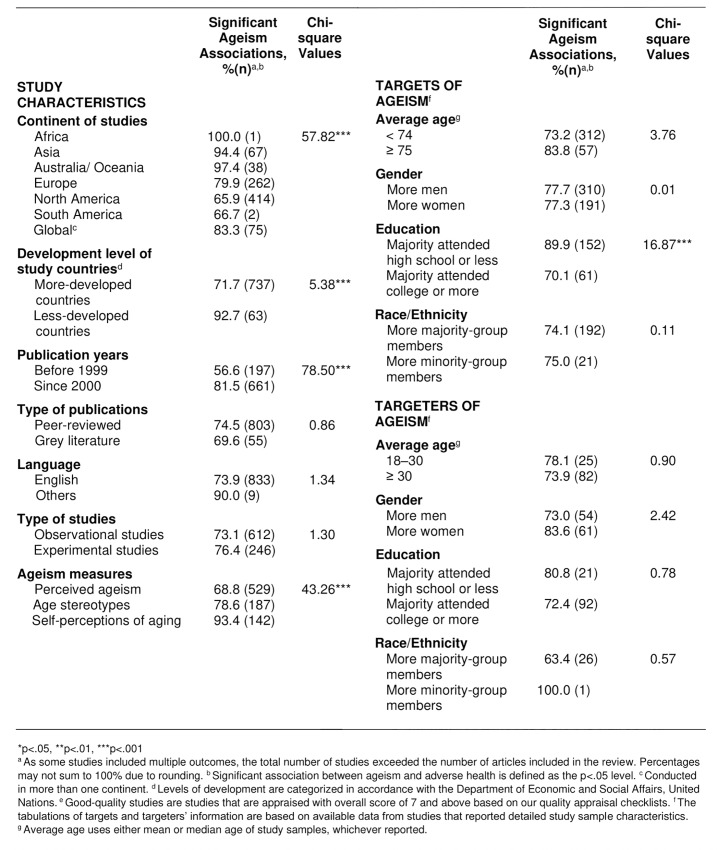
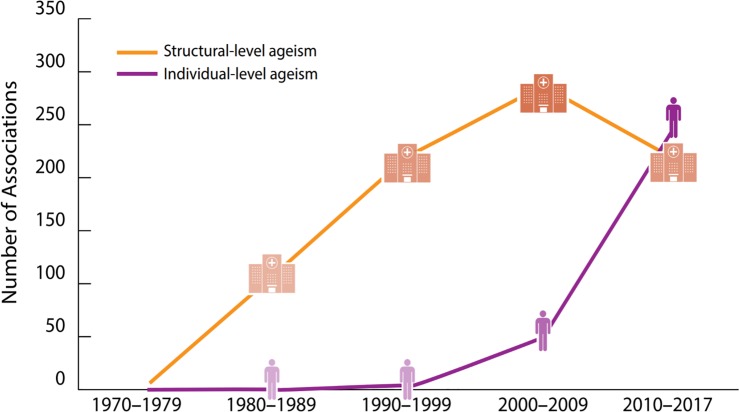
- Ageism was significantly associated with worse health in 95.5% of the 422 studies and 74.0% of the 1,159 associations; evidence appeared in all 11 health domains, all 45 countries, six continents, and every year studied. The proportion of significant associations increased over time: 51.3% (1970–1989), 69.6% (1990–2009), and 85.3% (2010–2017), p < .0001.
- Significant associations were more prevalent in less-developed than more-developed countries (92.7% vs. 71.7%, p = .0002). Less-educated targets were more likely to experience adverse health effects of ageism (89.8% vs. 70.1%, p < .0001), and findings were highest when ageism was operationalized as self-perceptions of aging (93.4%) compared with age stereotypes (78.6%) and perceived ageism (68.8%), p < .0001.
- A secondary model estimated 6.33 million global cases of depression attributable to ageism among persons aged 50 and over: 831,041 in more-developed countries and 5.6 million in less-developed countries.
- Mediation analyses in 25 studies across eight countries found significant pathways; the psychological pathway was supported by the most studies (9 longitudinal, 8 cross-sectional, 2 experimental priming), followed by behavioral (4 studies) and physiological (2 studies).
Methods
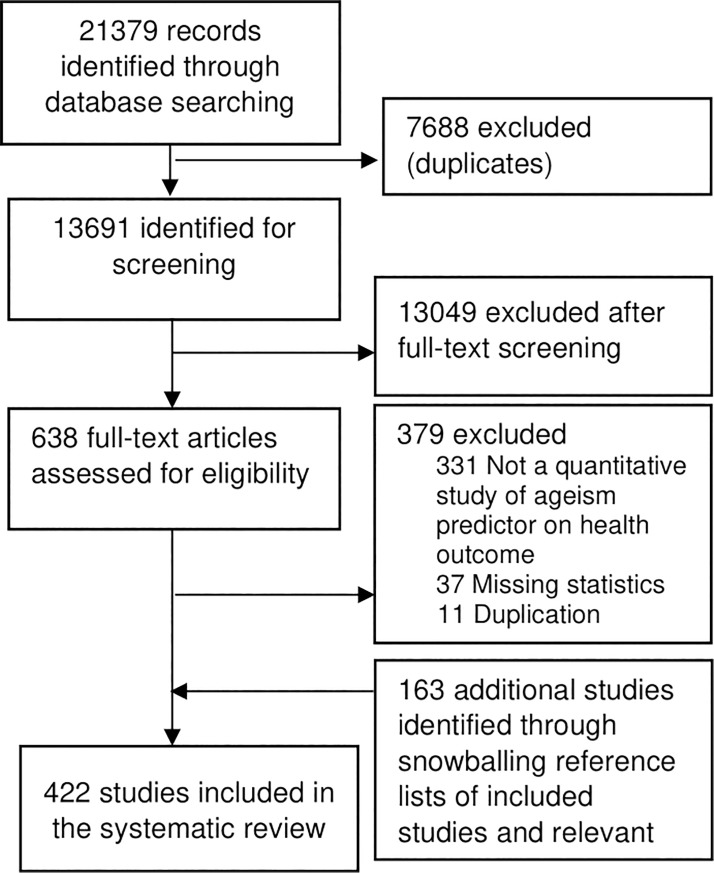
- Systematic review conducted per PRISMA, registered as PROSPERO CRD42018090857. Searches used 14 databases with no restrictions on region, language, or publication type, covering records after 1969 through December 2017; 21,379 citations were retrieved, reduced to 13,691 after duplicates, then 638 full-text reviews and 422 included studies.
- Inclusion criteria required quantitative analysis of ageism effects on health, control for age and relevant covariates or an age-matched design, and ageism targets aged 50 years or older. Data were extracted independently by two investigators; quality was appraised with Newcastle-Ottawa for observational studies and Downs and Black for experimental studies.
- Analyses were descriptive and bivariate chi-squared at study and association levels; evidence of ageism was defined as more than 50% of ageism-health associations being significant. Sensitivity analyses used good-quality studies scoring 7 or above (n = 317; 75.1%) and multivariate logistic regression controlling for study size; the depression estimate used the most homogeneous outcome subset (n = 17, 82.4% using CES-D).
Limitations
- The paper states that significant heterogeneity of study outcomes made a meta-analysis infeasible, and that qualitative studies were not included.
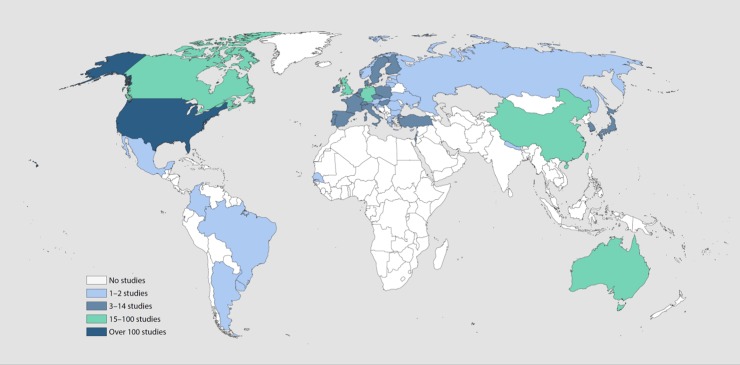
- The paper also notes gaps evident in the literature: only one study took place in Africa, only 8.6% of studies were conducted in less-developed countries despite 92.7% of associations there being significant, few studies (n = 18) formally tested effect modifiers, only four studies examined ageism within dyads, and research attention to structural-level ageism declined since 2010.
Model-written summary. Check it against the paper before relying on it.
Integrity signals
Registry
Cites
Statistics
Figures
Verification
Claims the paper makes
16 Valid · 0 Not valid · 15 Not checked · 79 Own results and interpretations
The cited sources support only part of this claim — read each source’s verdict below.
In the paper
“previous systematic reviews have not examined how both levels simultaneously influence health”
- Also stated in: § Introduction · plain
“Yet, previous ageism studies, and the reviews based on them, have focused on the consequences of ageism operating at the individual level, without assessing the structural sources of ageism.”
§ Global reach of ageism on older persons’ health: A systematic review > Abstract > Objective
What the sources say
- Not checked yetcites [11] Levy BR, Slade MD, Chang ES, Kannoth S, Wang SY. Ageism amplifies cost and prevalence of health conditions. Gerontologist 2018; published online November 13. 10.1093/geront/gny131 30423119 PMC7182003
- Not checked yetcites [12] Horton S, Baker J, Pearce G, Deakin JM. On the malleability of performance- implications for seniors. J Appl Gerontol. 2008; 27: 446– 65. source
- Not checked yetcites [13] Westerhof GJ, Miche M, Brothers AF, et al The influence of subjective aging on health and longevity: a meta-analysis of longitudinal data. Psychol Aging. 2014; 29: 793– 802. 10.1037/a0038016 25365689 source
- Partly supportedcites [14] Lamont RA, Swift HJ, Abrams D. A review and meta-analysis of age-based stereotype threat: negative stereotypes, not facts, do the damage. Psychol Aging. 2015; 30: 180– 93. 10.1037/a0038586 25621742 PMC4360754 sourceExperimental — accuracy not yet measured
The Method sections (Literature Search and Article Selection Criteria; page unavailable) show that this is a review of age-based stereotype threat that selected studies with objective performance measures, not a review of structural and individual ageism jointly influencing health. It therefore serves as an example of a review that did not examine both levels together, but it does not establish the claim about previous systematic reviews generally. (LLM, conf=0.78)
- Not checked yetcites [15] Meisner BA. A meta-analysis of positive and negative age stereotype priming effects on behavior among older adults. J Gerontol B Psychol Sci Soc Sci. 2012; 67: 13– 17. 10.1093/geronb/gbr062 21746872 source
plain- Asserted: passes — The authors put it forward as true.
- Checkable: passes — It can be checked against evidence.
- Load-bearing: passes — The paper’s conclusions depend on it.
- Based: passes — The paper gives a reason why it holds.
- Also stated in: § Introduction · plain
The cited sources support only part of this claim — read each source’s verdict below.
In the paper
“According to SET, these three components of ageism deleteriously influence the health of older persons through psychological, behavioral, and physiological pathways [10].”
§ Global reach of ageism on older persons’ health: A systematic review > Introduction
What the sources say
- Partly supportedcites [10] Levy BR. Stereotype embodiment: a psychosocial approach to aging. Curr Dir Psychol Sci. 2009; 18: 332– 36. 10.1111/j.1467-8721.2009.01662.x 20802838 PMC2927354 sourceExperimental — accuracy not yet measured
The pathway half of the claim is squarely in our copy: 'Utilization of Multiple Pathways' states that 'Age stereotypes appear to exert their influence along three tracks: psychological, behavioral, and physiological,' with examples of detrimental effects on older individuals' health (expectations/self-fulfilling prophecies, reduced healthy practices and self-efficacy, heightened cardiovascular response and events). However, the source nowhere describes 'three components of ageism'; the abstract of Levy (2009) specifies that the theory has FOUR components (internalization across the life span, unconscious operation, salience gain from self-relevance, utilization of multiple pathways), and its object is age stereotypes held by older individuals rather than a tripartite structure of ageism — the only ageism material is the 'Salience Gain From Self-relevance' section on interpersonal/institutional cues. Additionally, the paper hedges ('appear to,' 'likely involves'), which the citing sentence renders as flat causation. (LLM, conf=0.72)
plainstates a cause- Asserted: passes — The authors put it forward as true.
- Checkable: passes — It can be checked against evidence.
- Load-bearing: passes — The paper’s conclusions depend on it.
- Based: passes — The paper gives a reason why it holds.
- Partly supported
The cited sources support only part of this claim — read each source’s verdict below.
In the paper
“five meta-analyses that showed negative age beliefs can adversely affect the health of older persons [11–15]”
§ Global reach of ageism on older persons’ health: A systematic review > Introduction
What the sources say
- Not checked yetcites [11] Levy BR, Slade MD, Chang ES, Kannoth S, Wang SY. Ageism amplifies cost and prevalence of health conditions. Gerontologist 2018; published online November 13. 10.1093/geront/gny131 30423119 PMC7182003
- Not checked yetcites [12] Horton S, Baker J, Pearce G, Deakin JM. On the malleability of performance- implications for seniors. J Appl Gerontol. 2008; 27: 446– 65. source
- Not checked yetcites [13] Westerhof GJ, Miche M, Brothers AF, et al The influence of subjective aging on health and longevity: a meta-analysis of longitudinal data. Psychol Aging. 2014; 29: 793– 802. 10.1037/a0038016 25365689 source
- Partly supportedcites [14] Lamont RA, Swift HJ, Abrams D. A review and meta-analysis of age-based stereotype threat: negative stereotypes, not facts, do the damage. Psychol Aging. 2015; 30: 180– 93. 10.1037/a0038586 25621742 PMC4360754 sourceExperimental — accuracy not yet measured
Lamont, Swift & Abrams (2015) is indeed a meta-analysis showing that negative age stereotypes harm older adults, but the harm it measures is underperformance on stereotype-relevant tasks, not health: the Coding Procedure (Method) defines the outcome set as memory, cognitive, physical, skill-acquisition and driving performance, and the Conclusions state the supported effects are on memory (d = .21) and cognitive performance (d = .68), with the Discussion (Stereotyped Performance Domains) reporting nonsignificant effects for physical performance, driving and skill acquisition. No passage in our copy reports a health outcome (morbidity, mortality, physiological or clinical health) as an effect size or conclusion; health appears only as an unmeasured sample characteristic in the Limitations and as a cited reference (Auman et al., 2005) not pooled here. So the 'adversely affect the health of older persons' element attributed to this source is not supported by it, while the meta-analytic demonstration of harm to cognitive/memory performance is. (LLM, conf=0.70)
- Not checked yetcites [15] Meisner BA. A meta-analysis of positive and negative age stereotype priming effects on behavior among older adults. J Gerontol B Psychol Sci Soc Sci. 2012; 67: 13– 17. 10.1093/geronb/gbr062 21746872 source
plainstates a cause- Asserted: passes — The authors put it forward as true.
- Checkable: passes — It can be checked against evidence.
- Load-bearing: passes — The paper’s conclusions depend on it.
- Based: passes — The paper gives a reason why it holds.
The cited sources support only part of this claim — read each source’s verdict below.
In the paper
“Our current study draws on stereotype embodiment theory (SET) [10], which explains how three distinct, yet interrelated, components of ageism can impact health: age discrimination (i.e., detrimental treatment of older persons); negative age stereotypes (i.e., beliefs about older persons in general); and negative self-perceptions of aging (i.e., beliefs held by older persons about their own aging).”
§ Global reach of ageism on older persons’ health: A systematic review > Introduction
What the sources say
- Partly supportedcites [10] Levy BR. Stereotype embodiment: a psychosocial approach to aging. Curr Dir Psychol Sci. 2009; 18: 332– 36. 10.1111/j.1467-8721.2009.01662.x 20802838 PMC2927354 sourceExperimental — accuracy not yet measured
Our copy of Levy (2009) supports two of the three components the citing sentence attributes to SET: the Abstract defines the approach as 'based on age stereotypes (i.e., beliefs about older people in general)' and reports that negative age stereotypes held earlier in life predict worse health (cardiovascular events over 38 years, Internalization of Stereotypes Across the Life Span), and that stereotypes directed at oneself in old age 'can be classified as self-perceptions of aging' with long-term functional-health and 7.5-year longevity effects (Abstract, Salience Gain From Self-relevance). However, the paper presents the theory as having four components — internalization across the life span, unconscious operation, salience gain from self-relevance, and utilization of multiple pathways (psychological, behavioral, physiological) — not three components of ageism. Age discrimination is discussed only as a source of societal cues (patronizing speech; denial of employment or appropriate medical treatment on the institutional level, Salience Gain From Self-relevance) and as a form of prejudice alongside racism and sexism; no passage treats detrimental treatment itself as a distinct pathway by which ageism impacts health. That element of the claim is therefore not supported by this source. (LLM, conf=0.72)
plainstates a cause- Asserted: passes — The authors put it forward as true.
- Checkable: passes — It can be checked against evidence.
- Load-bearing: passes — The paper’s conclusions depend on it.
- Based: passes — The paper gives a reason why it holds.
- Partly supported
Every source the paper cites for this claim was checked and supports it.
In the paper
“The structural-level and individual-level ageism are inextricably linked because disparaging views of aging, that are propagated by word and deed at the structural level, are assimilated at the individual level [10].”
§ Global reach of ageism on older persons’ health: A systematic review > Introduction
What the sources say
- Supportedcites [10] Levy BR. Stereotype embodiment: a psychosocial approach to aging. Curr Dir Psychol Sci. 2009; 18: 332– 36. 10.1111/j.1467-8721.2009.01662.x 20802838 PMC2927354 source
The Abstract section of Levy (2009) states the core of stereotype embodiment theory: 'stereotypes are embodied when their assimilation from the surrounding culture leads to self-definitions,' and that the process runs 'top-down (from society to the individual) and over time' — i.e., structural/societal propagation and individual assimilation are one linked process. The 'Internalization of Stereotypes Across the Life Span' and 'Salience Gain From Self-relevance' sections elaborate it, describing the 'age stereotypes that permeate society' and pejorative societal cues encountered on interpersonal and institutional levels that individuals absorb. The citing sentence is a faithful paraphrase; only the vocabulary ('structural-level/individual-level ageism') differs from the source's 'surrounding culture/society' and 'institutional level'. (LLM, conf=0.86)
plainstates an association- Asserted: passes — The authors put it forward as true.
- Checkable: passes — It can be checked against evidence.
- Load-bearing: unclear — It is unclear whether the paper’s conclusions depend on it.
- Based: passes — The paper gives a reason why it holds.
- Supported
77 more claims · 10 with their cited sources checked
Create a free account to see all 110 claims and to verify the 43 references still open.
- Probably not a substantial claim. 13
- It may state two separate claims as one. 17
Claims other papers make about this one
Each is checked against this paper’s own text: does it say what the citing paper says it does?
The cited source says what the claim attributes to it.
In the citing paper
“The negative consequences of both structural and individual level ageism on older adults' health have been extensively documented (Chang et al., 2020).”
From Algorithmic harms and digital ageism in the use of surveillance technologies in nursing homes (2022) · cites this paper as Chang et al., 2020
Self-check
Percentages, sums and reported differences re-computed from the paper’s own numbers.
Rated major: it would touch a result — a value a result rests on, reported and recomputed p-values on opposite sides of the significance level, two passages that conflict with no sign which is right, or a cited work retracted before this paper was published.
In the paper
“In 84.6% of the studies and 63.0% of the associations, age dictated whom receives certain procedures or treatments.”
§ Global reach of ageism on older persons’ health: A systematic review > Results > Impact of ageism on health of older persons: Structural level
Reported 63 · recomputed 68.990826
Citations
Cites
The CES-D Scale: A Self-Report Depression Scale for Research in the General Population
Radloff, L. S. (1977) · Applied Psychological Measurement · doi:10.1177/014662167700100306 · Cited by 53,267
Liberati, A., Altman, D. G., Tetzlaff, J., Mulrow, C., Gøtzsche, P. C., Ioannidis, J. P. A., Clarke, M., Devereaux, P. J., Kleijnen, J., & Moher, D. (2009) · PLoS Medicine · doi:10.1371/journal.pmed.1000100 · Cited by 28,164
Liberati, A., Altman, D. G., Tetzlaff, J., Mulrow, C., Gotzsche, P. C., Ioannidis, J. P. A., Clarke, M., Devereaux, P. J., Kleijnen, J., & Moher, D. (2009) · BMJ · doi:10.1136/bmj.b2700 · Cited by 17,648
(2014) · Medical Entomology and Zoology · Cited by 17,633
Methods for the thematic synthesis of qualitative research in systematic reviews
Thomas, J., & Harden, A. (2008) · BMC Medical Research Methodology · doi:10.1186/1471-2288-8-45 · Cited by 9,312
Downs, S. H., & Black, N. (1998) · Journal of Epidemiology and Community Health · doi:10.1136/jech.52.6.377 · Cited by 8,252
Racial Differences in Physical and Mental Health: Socio-economic Status, Stress and Discrimination
Williams, D. R., Yu, Y., Jackson, J. S., & Anderson, N. B. (1997) · Journal of Health Psychology · doi:10.1177/135910539700200305 · Cited by 4,786
Evaluating non-randomised intervention studies
Deeks, J., Dinnes, J., D'Amico, R., Sowden, A., Sakarovitch, C., Song, F., Petticrew, M., & Altman, D. (2003) · Health Technology Assessment · doi:10.3310/hta7270 · Cited by 2,907
Intersectionality and research in psychology
Cole, E. R. (2009) · American Psychologist · doi:10.1037/a0014564 · Cited by 2,722 · cited 1×
“Second, in line with intersectional research [163,164], there is a need to better understand how intersecting systems of power reinforce ageism directed at marginalized groups within older populations.”
Cohort Profile: the Health and Retirement Study (HRS)
Sonnega, A., Faul, J. D., Ofstedal, M. B., Langa, K. M., Phillips, J. W., & Weir, D. R. (2014) · International Journal of Epidemiology · doi:10.1093/ije/dyu067 · Cited by 2,318
Age-Ism: Another Form of Bigotry
Butler, R. N. (1969) · The Gerontologist · doi:10.1093/geront/9.4_part_1.243 · Cited by 2,291 · cited 2×
“…that health inequities among older persons due to ageism can operate at both the structural level (i.e., in which societal institutions promote bias against older persons) and the individual level (i.e., in which older persons assimilate negative beliefs about aging from their culture) [8–10].”
Popay, J., Roberts, H., Sowden, A., Petticrew, M., Arai, L., Rodgers, M., Britten, N., Roen, K., & Duffy, S. (2006) · Lancaster University · doi:10.13140/2.1.1018.4643 · Cited by 2,070
Black sexual politics: African Americans, gender, and the new racism
(2005) · Choice Reviews Online · doi:10.5860/choice.42-3729 · Cited by 1,947 · cited 1×
“Congruent with intersectionality theories that posit the converging health effects of multiple marginalizing characteristics [99, 100], minority racial/ethnic background can intensify the injurious effects of ageism.”
Multiple Jeopardy, Multiple Consciousness: The Context of a Black Feminist Ideology
King, D. K. (1988) · Signs: Journal of Women in Culture and Society · doi:10.1086/494491 · Cited by 1,881
Stereotype Embodiment: A Psychosocial Approach to Aging
Levy, B. (2009) · Current Directions in Psychological Science · doi:10.1111/j.1467-8721.2009.01662.x · Cited by 1,822
Cohort profile: The English longitudinal study of ageing
Steptoe, A., Breeze, E., Banks, J., & Nazroo, J. (2013) · International Journal of Epidemiology · doi:10.1093/ije/dys168 · Cited by 1,779
A systematic review of empirical research on self-reported racism and health
Paradies, Y. (2006) · International Journal of Epidemiology · doi:10.1093/ije/dyl056 · Cited by 1,681
Black Sexual Politics: African Americans, Gender, and the New Racism
Hill Collins, P. (2004) · doi:10.4324/9780203309506 · Cited by 1,667
Longevity increased by positive self-perceptions of aging
Levy, B. R., Slade, M. D., Kunkel, S. R., & Kasl, S. V. (2002) · Journal of Personality and Social Psychology · doi:10.1037/0022-3514.83.2.261 · Cited by 1,508
Self-citationThe Philadelphia Geriatric Center Morale Scale: A Revision
Lawton, M. P. (1975) · Journal of Gerontology · doi:10.1093/geronj/30.1.85 · Cited by 1,500 · cited 1×
“…experienced unequal treatments due to age; for assessing negative-age-stereotype included the Expectations Regarding Aging Survey [29]; and for assessing negative self-perceptions of aging included the Attitude Toward Own Aging subscale of the Philadelphia Geriatric Center Morale Scale [30, 31].”
Guidance on the conduct of narrative synthesis in sytematic reviews
Popay, J., Roberts, H. M., Sowden, A. J., Petticrew, M. P., Arai, L., Rodgers, M., & Britten, N. (2006) · Cited by 1,378
Discrimination and Health Inequities
Krieger, N. (2014) · International Journal of Health Services · doi:10.2190/hs.44.4.b · Cited by 953
Priest, N., Paradies, Y., Trenerry, B., Truong, M., Karlsen, S., & Kelly, Y. (2013) · Social Science & Medicine · doi:10.1016/j.socscimed.2012.11.031 · Cited by 877
Improving memory in old age through implicit self-stereotyping.
Levy, B. R. (1996) · Journal of Personality and Social Psychology · doi:10.1037//0022-3514.71.6.1092 · Cited by 840
Self-citationThe health gap: the challenge of an unequal world
Marmot, M. (2015) · The Lancet · doi:10.1016/s0140-6736(15)00150-6 · Cited by 820
Nations, U. (2014) · Statistical Papers - United Nations (Ser. A), Population and Vital Statistics Report · doi:10.18356/30d0966c-en · Cited by 805
Representation of the Elderly, Women, and Minorities in Heart Failure Clinical Trials
Heiat, A., Gross, C. P., & Krumholz, H. M. (2002) · Archives of Internal Medicine · doi:10.1001/archinte.162.15.1682 · Cited by 723
(2010) · doi:10.1002/9780470561119 · Cited by 649
The health gap: the challenge of an unequal world
(2016) · Choice Reviews Online · doi:10.5860/choice.195387 · Cited by 605
Lamont, R. A., Swift, H. J., & Abrams, D. (2015) · Psychology and Aging · doi:10.1037/a0038586 · Cited by 583 · cited 1×
“These cognitive-impairment studies, conducted in China, Germany, Ireland, and the United States [85–89], complement the numerous experimental studies that found ageism predicted the cognitive performance of older persons [90, 91], a conclusion supported by two meta-analyses [12,14].”
Longitudinal Benefit of Positive Self-Perceptions of Aging on Functional Health
Levy, B. R., Slade, M. D., & Kasl, S. V. (2002) · The Journals of Gerontology Series B: Psychological Sciences and Social Sciences · doi:10.1093/geronb/57.5.p409 · Cited by 580
Self-citationState-Level Policies and Psychiatric Morbidity In Lesbian, Gay, and Bisexual Populations
Hatzenbuehler, M. L., Keyes, K. M., & Hasin, D. S. (2009) · American Journal of Public Health · doi:10.2105/ajph.2008.153510 · Cited by 538
SOCIAL CLASS, SUSCEPTIBILITY AND SICKNESS
SYME, S. L., & BERKMAN, L. F. (1976) · American Journal of Epidemiology · doi:10.1093/oxfordjournals.aje.a112268 · Cited by 530
Reducing Cardiovascular Stress With Positive Self-Stereotypes of Aging
Levy, B. R., Hausdorff, J. M., Hencke, R., & Wei, J. Y. (2000) · The Journals of Gerontology Series B: Psychological Sciences and Social Sciences · doi:10.1093/geronb/55.4.p205 · Cited by 483
Self-citationAgeism Amplifies Cost and Prevalence of Health Conditions
Levy, B. R., Slade, M. D., Chang, E.-S., Kannoth, S., & Wang, S.-Y. (2020) · The Gerontologist · doi:10.1093/geront/gny131 · Cited by 412
Self-citationThe influence of subjective aging on health and longevity: a meta-analysis of longitudinal data
Westerhof, G. J., Miche, M., Brothers, A. F., Barrett, A. E., Diehl, M., Montepare, J. M., Wahl, H.-W., & Wurm, S. (2014) · Psychology and Aging · doi:10.1037/a0038016 · Cited by 403
Meisner, B. A. (2012) · The Journals of Gerontology Series B: Psychological Sciences and Social Sciences · doi:10.1093/geronb/gbr062 · Cited by 384
Filial Piety and Psychological Well-Being in Well Older Chinese
Cheng, S.-T., & Chan, A. C. M. (2006) · The Journals of Gerontology Series B: Psychological Sciences and Social Sciences · doi:10.1093/geronb/61.5.p262 · Cited by 382
Morris, J. N. (2007) · International Journal of Epidemiology · doi:10.1093/ije/dym227 · Cited by 348
Kotter-Grühn, D., Kleinspehn-Ammerlahn, A., Gerstorf, D., & Smith, J. (2009) · Psychology and Aging · doi:10.1037/a0016510 · Cited by 347
Pachankis, J. E., Hatzenbuehler, M. L., Hickson, F., Weatherburn, P., Berg, R. C., Marcus, U., & Schmidt, A. J. (2015) · AIDS · doi:10.1097/qad.0000000000000724 · Cited by 319
Toward Reducing Ageism: PEACE (Positive Education about Aging and Contact Experiences) Model
Levy, S. R. (2018) · The Gerontologist · doi:10.1093/geront/gnw116 · Cited by 309
Self-citationNurses' attitudes towards older people: a systematic review
Liu, Y.-E., Norman, I. J., & While, A. E. (2013) · International Journal of Nursing Studies · doi:10.1016/j.ijnurstu.2012.11.021 · Cited by 306 · cited 1×
“For instance, two recent systematic reviews showed that nurses’ as well as nurse-trainees’ attitudes toward older persons have grown more negative over the last decade [126, 127].”
Psychological predictors of mortality in old age
Maier, H., & Smith, J. (1999) · The Journals of Gerontology Series B: Psychological Sciences and Social Sciences · doi:10.1093/geronb/54b.1.p44 · Cited by 291
Economic scarcity alters the perception of race
Krosch, A. R., & Amodio, D. M. (2014) · Proceedings of the National Academy of Sciences · doi:10.1073/pnas.1404448111 · Cited by 286
Hamel, M. B., Teno, J. M., Goldman, L., Lynn, J., Davis, R. B., Galanos, A. N., Desbiens, N., Connors, A. F., Wenger, N., Phillips, R. S., et al. (1999) · Annals of Internal Medicine · doi:10.7326/0003-4819-130-2-199901190-00005 · Cited by 273
Ng, R., Allore, H. G., Trentalange, M., Monin, J. K., & Levy, B. R. (2015) · PLOS ONE · doi:10.1371/journal.pone.0117086 · Cited by 256
Self-citationElderspeak communication: impact on dementia care
Williams, K. N., Herman, R., Gajewski, B., & Wilson, K. (2009) · American Journal of Alzheimer's Disease & Other Dementias® · doi:10.1177/1533317508318472 · Cited by 251
Dispelling Ageism: The Cross-Cutting Intervention
BUTLER, R. N. (1989) · The ANNALS of the American Academy of Political and Social Science · doi:10.1177/0002716289503001011 · Cited by 237
Sargent-Cox, K. A., Anstey, K. J., & Luszcz, M. A. (2012) · Psychology and Aging · doi:10.1037/a0027578 · Cited by 236
Grey matter: ageing in developing countries
Shetty, P. (2012) · The Lancet · doi:10.1016/s0140-6736(12)60541-8 · Cited by 224
The Structure of the Philadelphia Geriatric Center Morale Scale: a Reinterpretation
Liang, J., & Bollen, K. A. (1983) · Journal of Gerontology · doi:10.1093/geronj/38.2.181 · Cited by 223
Levy, B. R., Pilver, C., Chung, P. H., & Slade, M. D. (2014) · Psychological Science · doi:10.1177/0956797614551970 · Cited by 214
Self-citationAgeism and the Older Worker: A Scoping Review
Harris, K., Krygsman, S., Waschenko, J., & Laliberte Rudman, D. (2018) · The Gerontologist · doi:10.1093/geront/gnw194 · Cited by 214 · cited 1×
“Further, previous reviews that have documented ageism at the structural level have not simultaneously assessed how this impacts the health of older persons [16, 17].”
Memory Shaped by Age Stereotypes over Time
Levy, B. R., Zonderman, A. B., Slade, M. D., & Ferrucci, L. (2012) · The Journals of Gerontology Series B: Psychological Sciences and Social Sciences · doi:10.1093/geronb/gbr120 · Cited by 206
Self-citationDevelopment of the 12-Item Expectations Regarding Aging Survey
Sarkisian, C. A., Steers, W. N., Hays, R. D., & Mangione, C. M. (2005) · The Gerontologist · doi:10.1093/geront/45.2.240 · Cited by 198
A culture-brain link: negative age stereotypes predict Alzheimer's disease biomarkers
Levy, B. R., Ferrucci, L., Zonderman, A. B., Slade, M. D., Troncoso, J., & Resnick, S. M. (2016) · Psychology and Aging · doi:10.1037/pag0000062 · Cited by 198
Self-citationAssociation Between Positive Age Stereotypes and Recovery From Disability in Older Persons
Levy, B. R., Slade, M. D., Murphy, T. E., & Gill, T. M. (2012) · JAMA · doi:10.1001/jama.2012.14541 · Cited by 194
Self-citationBarker, M., O'Hanlon, A., McGee, H. M., Hickey, A., & Conroy, R. M. (2007) · BMC Geriatrics · doi:10.1186/1471-2318-7-9 · Cited by 192
Marchiondo, L. A., Gonzales, E. G., & Williams, L. J. (2017) · The Journals of Gerontology Series B · doi:10.1093/geronb/gbx095 · Cited by 190
Han, J., & Richardson, V. (2014) · Aging & Mental Health · doi:10.1080/13607863.2014.962007 · Cited by 183
Stereotype threat among older employees: relationship with job attitudes and turnover intentions
von Hippel, C., Kalokerinos, E. K., & Henry, J. D. (2013) · Psychology and Aging · doi:10.1037/a0029825 · Cited by 182
Wurm, S., & Benyamini, Y. (2014) · Psychology & Health · doi:10.1080/08870446.2014.891737 · Cited by 181
São José, J. M. S., Amado, C. A. F., Ilinca, S., Buttigieg, S. C., & Taghizadeh Larsson, A. (2019) · The Gerontologist · doi:10.1093/geront/gnx020 · Cited by 179
Perceived Discrimination and Physical, Cognitive, and Emotional Health in Older Adulthood
Sutin, A. R., Stephan, Y., Carretta, H., & Terracciano, A. (2015) · The American Journal of Geriatric Psychiatry · doi:10.1016/j.jagp.2014.03.007 · Cited by 178
Ageism and Depression: Perceptions of Older People as a Burden in China
Bai, X., Lai, D. W. L., & Guo, A. (2016) · Journal of Social Issues · doi:10.1111/josi.12154 · Cited by 178
Relationships Among Self-perception of Aging, Physical Functioning, and Self-efficacy in Late Life
Tovel, H., Carmel, S., & Raveis, V. H. (2017) · The Journals of Gerontology Series B · doi:10.1093/geronb/gbx056 · Cited by 175
Racial-ethnic biases, time pressure, and medical decisions
Stepanikova, I. (2012) · Journal of Health and Social Behavior · doi:10.1177/0022146512445807 · Cited by 168
Freeman, A., Santini, Z. I., Tyrovolas, S., Rummel‐Kluge, C., Haro, J. M., & Koyanagi, A. (2016) · Journal of Affective Disorders · doi:10.1016/j.jad.2016.03.042 · Cited by 166
Konrat, C., Boutron, I., Trinquart, L., Auleley, G.-R., Ricordeau, P., & Ravaud, P. (2012) · PLoS ONE · doi:10.1371/journal.pone.0033559 · Cited by 165
Stewart, T. L., Chipperfield, J. G., Perry, R. P., & Weiner, B. (2012) · Psychology & Health · doi:10.1080/08870446.2011.630735 · Cited by 162
Keep Up the Good Work! Age-Moderated Mediation Model on Intention to Retire
Dordoni, P., Van der Heijden, B., Peters, P., Kraus-Hoogeveen, S., & Argentero, P. (2017) · Frontiers in Psychology · doi:10.3389/fpsyg.2017.01717 · Cited by 150
Negative perceptions of aging predict longitudinal decline in cognitive function
Robertson, D. A., King-Kallimanis, B. L., & Kenny, R. A. (2016) · Psychology and Aging · doi:10.1037/pag0000061 · Cited by 147
Wight, R. G., LeBlanc, A. J., Meyer, I. H., & Harig, F. A. (2015) · Social Science & Medicine · doi:10.1016/j.socscimed.2015.10.066 · Cited by 146
Beyer, A.-K., Wolff, J. K., Warner, L. M., Schüz, B., & Wurm, S. (2015) · Psychology & Health · doi:10.1080/08870446.2015.1014370 · Cited by 141
Longitudinal change of self-perceptions of aging and mortality
Sargent-Cox, K. A., Anstey, K. J., & Luszcz, M. A. (2014) · The Journals of Gerontology Series B: Psychological Sciences and Social Sciences · doi:10.1093/geronb/gbt005 · Cited by 141
Physicians are less willing to treat suicidal ideation in older patients
Uncapher, H., & Areán, P. A. (2000) · Journal of the American Geriatrics Society · doi:10.1111/j.1532-5415.2000.tb03910.x · Cited by 137
Integrating intersectionality and biomedicine in health disparities research
Kelly, U. A. (2009) · Advances in Nursing Science · doi:10.1097/ans.0b013e3181a3b3fc · Cited by 137 · cited 1×
“Second, in line with intersectional research [163,164], there is a need to better understand how intersecting systems of power reinforce ageism directed at marginalized groups within older populations.”
Older people’s expectations regarding ageing, health‐promoting behaviour and health status
Kim, S. H. (2008) · Journal of Advanced Nursing · doi:10.1111/j.1365-2648.2008.04841.x · Cited by 131
North, M. S., & Fiske, S. T. (2016) · Journal of Social Issues · doi:10.1111/josi.12159 · Cited by 119
Are Older Adults Missing From Low Back Pain Clinical Trials? A Systematic Review and Meta‐Analysis
Paeck, T., Ferreira, M. L., Sun, C., Lin, C. C., Tiedemann, A., & Maher, C. G. (2014) · Arthritis Care & Research · doi:10.1002/acr.22261 · Cited by 114
Age-stereotype Paradox: Opportunity for Social Change
Levy, B. R. (2017) · The Gerontologist · doi:10.1093/geront/gnx059 · Cited by 102
Relationship between respiratory mortality and self-perceptions of aging
Levy, B. R., & Myers, L. M. (2005) · Psychology & Health · doi:10.1080/14768320500066381 · Cited by 101
Self-citationKlusmann, V., Sproesser, G., Wolff, J. K., & Renner, B. (2017) · The Journals of Gerontology Series B · doi:10.1093/geronb/gbx139 · Cited by 100 · cited 1×
“To illustrate, studies found age-ism could lead to adverse health outcomes due to the mediators of decreased levels of self-efficacy [95, 102–104], less perceived control [93] and purpose of life [74].”
Elderspeak's influence on resistiveness to care: focus on behavioral events
Herman, R. E., & Williams, K. N. (2009) · American Journal of Alzheimer's Disease & Other Dementias® · doi:10.1177/1533317509341949 · Cited by 99
Hofstetter, H., & Cohen, A. G. (2014) · Personnel Review · doi:10.1108/pr-03-2012-0054 · Cited by 94
On the Malleability of Performance: Implications for Seniors
Horton, S., Baker, J., Pearce, G. W., & Deakin, J. M. (2008) · Journal of Applied Gerontology · doi:10.1177/0733464808315291 · Cited by 93 · cited 1×
“These cognitive-impairment studies, conducted in China, Germany, Ireland, and the United States [85–89], complement the numerous experimental studies that found ageism predicted the cognitive performance of older persons [90, 91], a conclusion supported by two meta-analyses [12,14].”
Jennens, R. R., Giles, G. G., & Fox, R. M. (2006) · Internal Medicine Journal · doi:10.1111/j.1445-5994.2006.01033.x · Cited by 90
Are psychiatrists guilty of ?ageism? when it comes to taking a sexual history?
Bouman, W. P., & Arcelus, J. (2001) · International Journal of Geriatric Psychiatry · Cited by 90
Working past 65 in the UK and the USA: segregation into ‘Lopaq’ occupations?
Lain, D. (2012) · Work, Employment and Society · doi:10.1177/0950017011426312 · Cited by 89 · cited 1×
“For instance, British and American employers were significantly more likely to put older workers than younger workers with similar qualifications in positions with low pay and low responsibility [55].”
Schoenmaker, N., & Van Gool, W. A. (2004) · The Lancet Neurology · doi:10.1016/s1474-4422(04)00884-1 · Cited by 86
Rider, G. N. (2014) · Culture, Health & Sexuality · doi:10.1080/13691058.2013.872316 · Cited by 86
Health professionals' attitudes toward older people and older patients: a systematic review
Liu, Y.-E., While, A. E., Norman, I. J., & Ye, W. (2012) · Journal of Interprofessional Care · doi:10.3109/13561820.2012.702146 · Cited by 82
Ageism and caring attitudes among nurses in oncology
Schroyen, S., Missotten, P., Jérusalem, G., Gilles, C., & Adam, S. (2015) · International Psychogeriatrics · doi:10.1017/s1041610215001970 · Cited by 82
The effects of the Great Recession on the retirement security of older workers
Munnell, A. H., & Rutledge, M. S. (2013) · The Annals of the American Academy of Political and Social Science · doi:10.1177/0002716213499535 · Cited by 81
The structure of the PGC morale scale;A reinterpretation
Liang, J. (1983) · The Journals of Gerontology Series A · Cited by 80
Positive Attitudes Toward Older People and Well-being Among Chinese Community Older Adults
Lu, L., Kao, S., & Hsieh, Y.-H. (2010) · Journal of Applied Gerontology · doi:10.1177/0733464809343289 · Cited by 78
Lower prevalence of psychiatric conditions when negative age stereotypes are resisted
Levy, B. R., Pilver, C. E., & Pietrzak, R. H. (2014) · Social Science & Medicine · doi:10.1016/j.socscimed.2014.06.046 · Cited by 77
Self-citationFasbender, U., & Wang, M. (2017) · Frontiers in Psychology · doi:10.3389/fpsyg.2016.02057 · Cited by 76
Older patients are still under-represented in clinical trials of Alzheimer's disease
Banzi, R., Camaioni, P., Tettamanti, M., Bertele’, V., & Lucca, U. (2016) · Alzheimer's Research & Therapy · doi:10.1186/s13195-016-0201-2 · Cited by 74 · cited 1×
“To illustrate, in the context of dementia on a structural level, older patients–particularly the oldest-old–remained disproportionally under-represented in clinical trials of Alzheimer’s disease [129–131].”
Age Bias: Physical Therapists and Older Patients
Kvitek, S. D. B., Shaver, B. J., Blood, H., et al. (1986) · Journal of Gerontology · doi:10.1093/geronj/41.6.706 · Cited by 73
Long-Term Effects of Age Discrimination on Mental Health: The Role of Perceived Financial Strain
Shippee, T. P., Wilkinson, L. R., Schafer, M. H., & Shippee, N. D. (2017) · The Journals of Gerontology Series B · doi:10.1093/geronb/gbx017 · Cited by 71
Levy, B. R., & Bavishi, A. A. (2016) · The Journals of Gerontology Series B · doi:10.1093/geronb/gbw035 · Cited by 70
Self-citationCommunication of healthcare professionals: Is there ageism?
Schroyen, S., Adam, S., Marquet, M., Jerusalem, G., Thiel, S., Giraudet, A.-L., & Missotten, P. (2018) · European Journal of Cancer Care · doi:10.1111/ecc.12780 · Cited by 68
(2004) · PubMed Central · Cited by 66
Age discrimination in the UK labour market. Does race moderate ageism? An experimental investigation
Drydakis, N., MacDonald, P., Chiotis, V., & Somers, L. A. (2017) · Applied Economics Letters · doi:10.1080/13504851.2017.1290763 · Cited by 66
Systematic review: representativeness of participants in RCTs of acetylcholinesterase inhibitors
Leinonen, A., Koponen, M., & Hartikainen, S. (2015) · PLoS ONE · doi:10.1371/journal.pone.0124500 · Cited by 64
Hajjar, I., Miller, K., & Hirth, V. (2002) · The Journals of Gerontology Series A: Biological Sciences and Medical Sciences · doi:10.1093/gerona/57.8.m487 · Cited by 64
Physicians' response to sexual dysfunction presented by a younger vs. An older adult
Gewirtz‐Meydan, A., & Ayalon, L. (2016) · International Journal of Geriatric Psychiatry · doi:10.1002/gps.4638 · Cited by 63
Attitudes of Australian therapists toward older clients: educational and training imperatives
Helmes, E., & Gee, S. (2003) · Educational Gerontology · doi:10.1080/03601270390225640 · Cited by 62
Prescribers’ attitudes toward elderly breast cancer patients. Discrimination or empathy?
Protière, C., Viens, P., Rousseau, F., & Moatti, J. P. (2010) · Critical Reviews in Oncology/Hematology · doi:10.1016/j.critrevonc.2009.09.007 · Cited by 59
Mortality and the attribution of health problems to aging among older adults
Rakowski, W., & Hickey, T. (1992) · American Journal of Public Health · doi:10.2105/ajph.82.8.1139 · Cited by 58
Kim, I., Noh, S., & Chun, H. (2015) · Osong Public Health and Research Perspectives · doi:10.1016/j.phrp.2015.11.012 · Cited by 57
Older participants are frequently excluded from Parkinson's disease research
Fitzsimmons, P., Blayney, S., Mina-Corkill, S., & Scott, G. O. (2012) · Parkinsonism & Related Disorders · doi:10.1016/j.parkreldis.2012.03.003 · Cited by 56
Exclusion of Elderly Women From Published Randomized Trials of Stress Incontinence Surgery
Morse, A. N., Labin, L. C., Young, S. B., Aronson, M. P., & Gurwitz, J. H. (2004) · Obstetrics and Gynecology · doi:10.1097/01.aog.0000136484.37027.79 · Cited by 52
Gu, D., Brown, B. L., & Qiu, L. (2016) · BMC Geriatrics · doi:10.1186/s12877-016-0348-5 · Cited by 52
The relationship of tobacco and alcohol use with ageing self-perceptions in older people in Ireland
Villiers‐Tuthill, A., Copley, A. M., McGee, H. M., & Morgan, K. (2016) · BMC Public Health · doi:10.1186/s12889-016-3158-y · Cited by 51
O’Shea, D. M., Dotson, V. M., & Fieo, R. A. (2016) · International Journal of Geriatric Psychiatry · doi:10.1002/gps.4584 · Cited by 51
Differences in Psychologists' Ratings of Older and Younger Clients
Ray, D. C., McKinney, K. A., & Ford, C. V. (1987) · The Gerontologist · doi:10.1093/geront/27.1.82 · Cited by 46
The Right to Health of Older People
Baer, B., Bhushan, A., Taleb, H., et al. (2016) · The Gerontologist · doi:10.1093/geront/gnw039 · Cited by 46
Social Workers’ Attitudes towards Intimate Partner Abuse in Younger vs. Older Women
Yechezkel, R., & Ayalon, L. (2013) · Journal of Family Violence · doi:10.1007/s10896-013-9506-0 · Cited by 45
“Granny dumping”: Acceptability of sacrificing the elderly in a simulated moral dilemma
Kawai, N., Kubo, K., & Kubo‐Kawai, N. (2014) · Japanese Psychological Research · doi:10.1111/jpr.12049 · Cited by 44
Placing patients in the queue for coronary surgery
Naylor, C. D., Levinton, C. M., Baigrie, R. S., & Goldman, B. S. (1992) · Journal of General Internal Medicine · doi:10.1007/bf02599450 · Cited by 44
Bidirectional Associations Between Self-Perceptions of Aging and Processing Speed Across 3 Years
Seidler, A. L., & Wolff, J. K. (2017) · GeroPsych · doi:10.1024/1662-9647/a000165 · Cited by 44
Harries, C., Forrest, D., Harvey, N., McClelland, A., & Bowling, A. (2007) · Quality and Safety in Health Care · doi:10.1136/qshc.2006.018036 · Cited by 43
Will elderly patients stand aside for younger patients in the queue for cardiac services?
Mariotto, A., Leo, D. D., Buono, M. D., et al. (1999) · The Lancet · doi:10.1016/s0140-6736(98)12192-x · Cited by 42
Han, J. (2017) · Journal of Aging and Health · doi:10.1177/0898264317711609 · Cited by 40
Age bias: a cause of underutilization of breast conservation treatment.
Madan, A. K., Aliabadi‐Wahle, S., & Beech, D. J. (2001) · PubMed · doi:10.1080/08858190109528720 · Cited by 39 · cited 2×
“…of patients awaiting breast-cancer surgeries, a series of studies found that compared to younger patients with matched histories, older patients were significantly more likely to be denied treatment by new and advanced medical students as well as surgical and internal medicine residents [96–98].”
Ageism in Medical Studentsʼ Treatment Recommendations
Madan, A. K., Aliabadi‐Wahle, S., & Beech, D. J. (2001) · Academic Medicine · doi:10.1097/00001888-200103000-00019 · Cited by 39
Receipt of Care and Depressive Symptoms in Later Life: The Importance of Self-Perceptions of Aging
Kwak, M., Ingersoll-Dayton, B., & Burgard, S. (2014) · The Journals of Gerontology Series B: Psychological Sciences and Social Sciences · doi:10.1093/geronb/gbt128 · Cited by 39
Age Bias, Referral for Psychological Assistance and the Private Physician
Kucharski, L. T., White, R. M., & Schratz, M. (1979) · Journal of Gerontology · doi:10.1093/geronj/34.3.423 · Cited by 38
Clinical judgment in geropsychology practice.
Settin, J. M. (1982) · Psychotherapy · doi:10.1037/h0088451 · Cited by 37
Gum, A. M., & Ayalon, L. (2017) · International Journal of Geriatric Psychiatry · doi:10.1002/gps.4826 · Cited by 37
Influence of Age of Patients Who Wish to Die on Treatment Decisions by Physicians and Nurses
Barnow, S., Linden, M., Lucht, M. J., & Freyberger, H. J. (2004) · American Journal of Geriatric Psychiatry · doi:10.1097/00019442-200405000-00004 · Cited by 36
Self-perception of uselessness and mortality among older adults in China
Gu, D., Dupre, M. E., & Qiu, L. (2017) · Archives of Gerontology and Geriatrics · doi:10.1016/j.archger.2016.10.015 · Cited by 36
Zhao, Y., Dupre, M. E., Qiu, L., & Gu, D. (2017) · BMC Public Health · doi:10.1186/s12889-017-4479-1 · Cited by 36
Yeom, H. (2013) · Journal of Clinical Nursing · doi:10.1111/jocn.12419 · Cited by 32
Couples' shared beliefs about aging and implications for future functional limitations
Mejía, S. T., & Gonzalez, R. (2017) · The Gerontologist · doi:10.1093/geront/gnx071 · Cited by 32
Older Persons' Exclusion From Sexually Transmitted Disease Risk-Reduction Clinical Trials
Levy, B. R., Ding, L., Lakra, D. C., et al. (2007) · Sexually Transmitted Diseases · doi:10.1097/01.olq.0000253342.75908.05 · Cited by 31
Self-citationDo Treatment Attitudes and Decisions of Psychotherapists-in-Training Depend on a Patient’s Age?
Kessler, E., & Schneider, T. (2017) · The Journals of Gerontology Series B · doi:10.1093/geronb/gbx078 · Cited by 31
Li, X., Lv, Q., Li, C., Zhang, H., Li, C., & Jin, J. (2013) · Journal of Nursing Scholarship · doi:10.1111/jnu.12036 · Cited by 29
Bowling, A., Mariotto, A., & Evans, O. (2002) · Age and Ageing · doi:10.1093/ageing/31.3.187 · Cited by 29
Oldsters and Ngrams: Age Stereotypes across Time
Mason, S. E., Kuntz, C. V., & McGill, C. M. (2015) · Psychological Reports · doi:10.2466/17.10.pr0.116k17w6 · Cited by 26
Self-Perception of Aging and Satisfaction With Children’s Support
Cheng, S. (2016) · The Journals of Gerontology Series B · doi:10.1093/geronb/gbv113 · Cited by 25
Pietrzak, R. H., Zhu, Y. L., Slade, M. D., Qi, Q., Krystal, J. H., Southwick, S. M., & Levy, B. R. (2016) · Journal of the American Geriatrics Society · doi:10.1111/jgs.14452 · Cited by 24
Self-citationLinden, M., & Kurtz, G. (2009) · Current Gerontology and Geriatrics Research · doi:10.1155/2009/475958 · Cited by 23
Bilinska, P., Wegge, J., & Kliegel, M. (2016) · Journal of Personnel Psychology · doi:10.1027/1866-5888/a000144 · Cited by 20
Cultural and Contextual Analysis of Quality of Life Among Older Nepali Women
Shrestha, S., & Zarit, S. H. (2012) · Journal of Cross-Cultural Gerontology · doi:10.1007/s10823-012-9167-0 · Cited by 17
Does the Experience of Discrimination Affect Health? A Cross-Sectional Study of Korean Elders
Chun, H., Kang, M., Cho, S., Jung‐Choi, K., Jang, S., & Khang, Y. (2013) · Asia Pacific Journal of Public Health · doi:10.1177/1010539513506602 · Cited by 17
Viitasalo, N., & Nätti, J. (2015) · Journal of Occupational & Environmental Medicine · doi:10.1097/jom.0000000000000468 · Cited by 17
Townsend, P. D. (1986) · International Journal of Health Services · doi:10.2190/4nxy-aw8r-hfbk-ufx1 · Cited by 16
Ageism in breast cancer surgical options by medical students.
Madan, A. K., Cooper, L., Gratzer, A., & Beech, D. J. (2006) · PubMed · Cited by 16
Wiseman, D. B. (2007) · Journal of Applied Social Psychology · doi:10.1111/j.1559-1816.2007.00251.x · Cited by 15
Priming effects of age stereotypes on memory of older adults in Korea
Lee, K. E., & Lee, H. (2018) · Asian Journal Of Social Psychology · doi:10.1111/ajsp.12343 · Cited by 14 · cited 1×
“These cognitive-impairment studies, conducted in China, Germany, Ireland, and the United States [85–89], complement the numerous experimental studies that found ageism predicted the cognitive performance of older persons [90, 91], a conclusion supported by two meta-analyses [12,14].”
ATTITUDES TOWARD THE AGED AND IDENTIFIED EMPLOYMENT PREFERENCES OF THERAPEUTIC RECREATION STUDENTS
MacNeil, R. D. (1991) · Educational Gerontology · doi:10.1080/0360127910170602 · Cited by 13
Attributions of competence mediate the behaviors of caregivers and older adults
Bustillos, A., & Fernández Ballesteros, R. (2013) · GeroPsych · doi:10.1024/1662-9647/a000089 · Cited by 11
Quality of Life and Attitudes Toward Aging Among Older Women in Turkey
Top, M., Eriş, H., & Kabalcıoğlu, F. (2012) · Affilia · doi:10.1177/0886109912464477 · Cited by 11
Spangenberg, L., Zenger, M., Glaesmer, H., Brähler, E., & Strauss, B. M. (2017) · European Journal of Ageing · doi:10.1007/s10433-017-0432-5 · Cited by 11
Are critically ill older patients treated differently than similarly ill younger patients?
Stillman, A. E., Braitman, L. E., & Grant, R. (1998) · PubMed · Cited by 10
Votron, L., D’Hoore, W., Swine, C., et al. (2004) · Clinical Oncology · doi:10.1016/j.clon.2004.06.012 · Cited by 9
Japanese study of aging and retirement : JSTAR first results 2009 report
市村, 英., 橋本, 英., & 清水谷, 諭. (2009) · Medical Entomology and Zoology · Cited by 8
Kim, H. (2015) · Cited by 6
Physicians’ Responses to Clinical Scenarios Involving Life-Threatening Illness Vary by Patients’ Age
Johnson, M. F., & Kramer, A. M. (2000) · The Journal of Clinical Ethics · doi:10.1086/jce200011406 · Cited by 5
Han, J. (2011) · OhioLink ETD Center (Ohio Library and Information Network) · Cited by 5
(2001) · Pure Amsterdam UMC · doi:10.1002/1099-1166(200101)16:1 · Cited by 3
Research works printed but not linked: 6
- Levy B. Unconscious ageism In: Palmore EB, Branch LG, Harris DK, editors. Encyclopedia of ageism. New York: Haworth Pastoral Press; 2005 p. 335– 9.
- Butler RN. Ageism. Generations. 2005; 29(3): 84– 6.
- Organisation for Economic Cooperation and Development. Live longer, work longer: A synthesis report. Paris, France: OECD Publishing 2006.
- Higgins J, Green S. Cochrane handbook for systematic reviews for interventions, version 5.1.0. London: The Cochrane Collaboration, 2011.
- Gupta P, Shekhar R, O'Mahony MS. Ageism and sexism in clinical research: are we making any progress? Age Ageing. 2013; 42S3: 12.
- United Nations, Department of Economic and Social Affairs, Population Division. World population ageing 2015.
Cited by
Karlsen, T. H., Sheron, N., Zelber-Sagi, S., Carrieri, P., Dusheiko, G., Bugianesi, E., Pryke, R., Hutchinson, S. J., Sangro, B., Martin, N. K., et al. (2022) · The Lancet · doi:10.1016/s0140-6736(21)01701-3 · Cited by 652
Determinants of Ageism against Older Adults: A Systematic Review
Marques, S., Mariano, J., Mendonça, J., De Tavernier, W., Hess, M., Naegele, L., Peixeiro, F., & Martins, D. (2020) · International Journal of Environmental Research and Public Health · doi:10.3390/ijerph17072560 · Cited by 313
COVID-19 and ageism: How positive and negative responses impact older adults and society.
Monahan, C., Macdonald, J., Lytle, A., Apriceno, M., & Levy, S. R. (2020) · American Psychologist · doi:10.1037/amp0000699 · Cited by 256
Self-citationOlder adults can use technology: why healthcare professionals must overcome ageism in digital health
Mace, R. A., Mattos, M. K., & Vranceanu, A.-M. (2022) · Translational Behavioral Medicine · doi:10.1093/tbm/ibac070 · Cited by 231
“Ageism has deep roots in our society, and it negatively impacts older patients [16].”
BackgroundUnderstanding unequal ageing: towards a synthesis of intersectionality and life course analyses
Holman, D., & Walker, A. (2021) · European Journal of Ageing · doi:10.1007/s10433-020-00582-7 · Cited by 200
Metadata
- Authors
- Chang, E.-S., Kannoth, S., Levy, S., Wang, S.-Y., Lee, J. E., & Levy, B. R.
- Affiliations
- Yale University (US)
- Corresponding author
- Levy, Becca R.
- Venue
- PLOS ONE
- Publisher
- Public Library of Science (PLoS)
- Published
- 2020-01-15
- Volume
- 15
- Issue
- 1
- Pages
- e0220857
- ISSN
- 1932-6203 (ISSN-L)
- PMC
- PMC6961830
- OpenAlex
- W3000728195
- Semantic Scholar
- b947b2885089ddf627a4c02d71c7653a95809b0e
- Cited by
- 912
- References
- 169
- Citations by year
- 2026: 158 · 2025: 200 · 2024: 157 · 2023: 134 · 2022: 127 · 2021: 91 · 2020: 43
- FWCI
- 17.40
- Type
- journal article
- Language
- en
- Open access
- gold
- doi.org
- Licence
- Locations
- PLoS ONE (publishedVersion, cc-by)
- Europe PMC (PubMed Central) (publishedVersion, cc-by)
- PubMed Central (publishedVersion, cc-by)
- PubMed (publishedVersion)
- RePEc: Research Papers in Economics (submittedVersion)
- DOAJ (DOAJ: Directory of Open Access Journals) (submittedVersion, cc-by-sa)
- Figshare (submittedVersion, cc-by)
- Funders
- World Health Organization
- Yale University
- National Institutes of Health (5u01ag032284-08, UL1TR001863)
- Agency for Healthcare Research and Quality (1K01HS023900, K01 HS023900)
- Yale School of Public Health, Yale University
- National Institute on Aging (#U01AG032284, P30AG021342)
- National Center for Advancing Translational Sciences
- Topics
- Social Sciences › Psychology › Developmental and Educational Psychology › Aging and Gerontology Research
- Social Sciences › Demography › Retirement, Disability, and Employment
- Social Sciences › Health › Health disparities and outcomes
- Keywords
- ageism, health outcomes, educational attainment, developed and developing countries
- MeSH terms
- Aged, Aged, 80 and over, Aging, Depression, Female, Humans, Male, Peer Review, Social Behavior, Databases, Factual, Ageism, Social Discrimination
About these checks
Registry, retraction, Cites and statistics results are computed, not judged, with one exception: a printed reference that no index lists is read once by a model before it counts as a citation error. Claims are extracted by a model and kept only when their quote appears verbatim in the text; each cited source is then checked, with a model’s help, for whether it says what the claim relies on. Those verdicts can be wrong — read the claim’s quote and the cited source before relying on one.
The claim verdicts this report counts are experimental: their accuracy is not yet measured.
A language model drew the claims from the paper on 2026-10-10, under version 3 of the claim definition (model deepseek-v4.1-flash, prompt extract-v3).
A second model labelled each claim on 2026-10-10 (model jev-1.13-20260917, definition revision gold-guideline-v0.2).
Cited sources are checked with a language model’s help (gpt-6-sol and qwen3.8-omni-flash).
Statistics and arithmetic are recomputed, not judged.
Confidence bands are shown only for fields calibrated on our annotated test set. None is calibrated yet, so no band is shown.
What counts as a claim ›How we measure confidence ›How we check this ›
Are you an author, or do you see a problem with this page? Request a review
Data sources
Bibliographic data: Semantic Scholar, OpenAlex, Crossref.
Contains information from the Semantic Scholar Academic Graph Datasets, made available under the ODC Attribution License (ODC-BY 1.0).
Semantic Scholar’s data is described in: Kinney, R., et al. (2023). The Semantic Scholar Open Data Platform. arXiv:2301.10140.
