

Detection and prognostic relevance of circulating tumour cells (CTCs) in Asian breast cancers using a label-free microfluidic platform
Open accessThe DOI matches its Crossref record; 44 of the 44 references it cites were found in a registry or an index.
Abstract
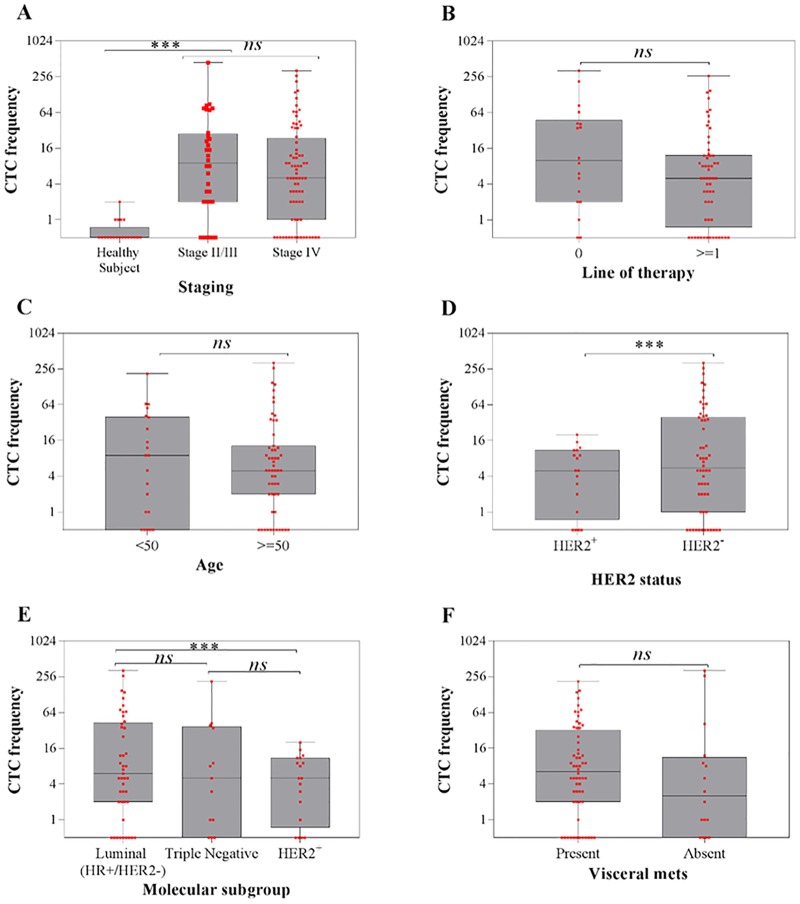
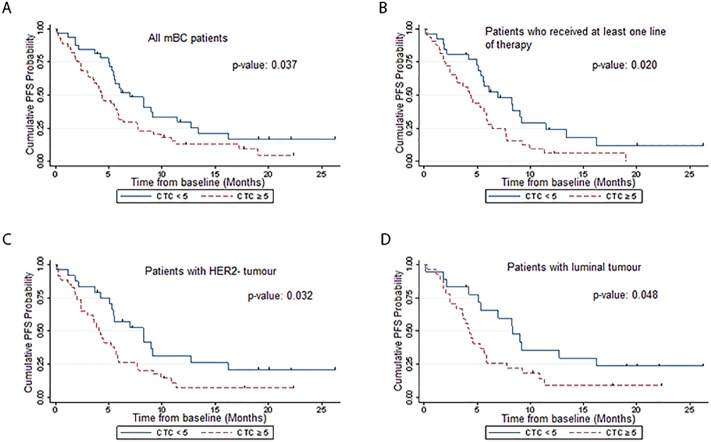
OBJECTIVES: We aimed to study the prevalence of CTCs in breast cancer (BC) patients undergoing neoadjuvant or palliative therapy with a label-free microfluidic platform (ClearCell FX), and its prognostic relevance in metastatic BC (mBC). MATERIALS AND METHODS: Peripheral blood samples were collected from 108 BC patients before starting a new line of treatment ("baseline"), majority of whom had mBC (76/108; 70.4%). CTCs were retrieved by dean flow fractionation that enriched for larger cells, and enumerated using immunofluorescence-based staining. Progression-free survival (PFS) in mBC patients was analysed using Kaplan-Meier method; cox proportional hazard models were used for univariable and multivariable analyses. RESULTS: The detection rate of CTCs before starting a new line of treatment was 75.9% (n = 108; median: 8 CTCs/7.5 ml blood) at a cut off of ≥2 CTCs. PFS was inferior for mBC patients with baseline CTC count ≥5 CTCs/7.5 ml blood vs. those with < 5 CTCs/7.5 ml blood (median PFS: 4.3 vs. 7.0 months; p-value: 0.037). The prognostic relevance of CTCs was most significant in patients with HER2- mBC (median PFS: 4.1 vs. 8.3 months; p-value: 0.032), luminal (HR+HER2-) subtype (median PFS: 4.2 vs. 8.3 months; p-value: 0.048), and patients who had one or more prior treatments (median PFS: 4.2 vs. 7.0 months; p-value: 0.02). On multivariable analysis, baseline CTC level (hazard ratio (HR): 1.84, p-value: 0.02) and pre-treatment status (HR: 1.87, p-value: 0.05) were independent predictors of PFS. CONCLUSIONS: This work demonstrates the prognostic significance of CTCs in mBC detected using a label-free size-based enrichment platform.
Overview
The claims and statistics of this paper haven’t been checked yet.
Free: it reads the open-access text and checks the first 5 claims that cite a source we can check. Create a free account to check every claim.
Integrity signals
Registry
Cites
Statistics
Figures
Verification
Claims the paper makes
The claims and statistics of this paper haven’t been checked yet.
Free: it reads the open-access text and checks the first 5 claims that cite a source we can check. Create a free account to check every claim.
Claims other papers make about this one
Each is checked against this paper’s own text: does it say what the citing paper says it does?
The source backs part of the claim, not all of it — or backs it for a different population, condition or comparison.
In the citing paper
“These cells are precise representations of primary and metastatic tumors that convey information for the detection, diagnosis (monitoring) and the treatment of cancer [145].”
From Tumor microenvironment complexity and therapeutic implications at a glance (2020) · cites this paper as [145]
Experimental — accuracy not yet measured
Self-check
Percentages, sums and reported differences re-computed from the paper’s own numbers.
The self-check needs the paper’s full text.
Citations
Cites
Circulating Tumor Cells, Disease Progression, and Survival in Metastatic Breast Cancer
Cristofanilli, M., Budd, G. T., Ellis, M. J., Stopeck, A., Matera, J., Miller, M. C., Reuben, J. M., Doyle, G. V., Allard, W. J., Terstappen, L. W. M. M., et al. (2004) · New England Journal of Medicine · doi:10.1056/nejmoa040766 · Cited by 4,593 · cited 4×
“Long-term patient outcomes are influenced by biological risk factors such as cancer subtypes, the extent and site of metastatic lesion, and the level of circulating tumour cells (CTCs) [1, 2].”
BackgroundResultInfluentialHammond, M. E. H., Hayes, D. F., Dowsett, M., Allred, D. C., Hagerty, K. L., Badve, S., Fitzgibbons, P. L., Francis, G., Goldstein, N. S., Hayes, M., et al. (2010) · Journal of Clinical Oncology · doi:10.1200/jco.2009.25.6529 · Cited by 4,213
Wolff, A. C., Hammond, M. E. H., Hicks, D. G., Dowsett, M., McShane, L. M., Allison, K. H., Allred, D. C., Bartlett, J. M. S., Bilous, M., Fitzgibbons, P., et al. (2013) · Journal of Clinical Oncology · doi:10.1200/jco.2013.50.9984 · Cited by 4,030 · cited 2×
“The determination of estrogen receptor (ER), progesterone receptor (PR) and human epidermal growth factor receptor 2 (HER2) status by immunohistochemistry in this study was based on the latest recommendations by the American Society of Clinical Oncology and the College of American Pathologists.”
MethodAllard, W. J., Matera, J., Miller, M. C., Repollet, M., Connelly, M. C., Rao, C., Tibbe, A. G. J., Uhr, J. W., & Terstappen, L. W. M. M. (2004) · Clinical Cancer Research · doi:10.1158/1078-0432.ccr-04-0378 · Cited by 2,542
Circulating Breast Tumor Cells Exhibit Dynamic Changes in Epithelial and Mesenchymal Composition
Yu, M., Bardia, A., Wittner, B. S., Stott, S. L., Smas, M. E., Ting, D. T., Isakoff, S. J., Ciciliano, J. C., Wells, M. N., Shah, A. M., et al. (2013) · Science · doi:10.1126/science.1228522 · Cited by 2,476 · cited 3×
“EMT has been widely described in BC [14] and elevated level of mesenchymal-like CTCs has been associated with treatment failure [15].”
BackgroundCirculating Tumor Cells: A Novel Prognostic Factor for Newly Diagnosed Metastatic Breast Cancer
Cristofanilli, M., Hayes, D. F., Budd, G. T., Ellis, M. J., Stopeck, A., Reuben, J. M., Doyle, G. V., Matera, J., Allard, W. J., Miller, M. C., et al. (2005) · Journal of Clinical Oncology · doi:10.1200/jco.2005.08.140 · Cited by 1,135 · cited 1×
“Subsequent studies further confirmed that high CTC levels in patients who had undergone treatment predicted the risk of metastatic spread [3, 4].”
BackgroundHammond, M. E. H., Hayes, D. F., Dowsett, M., Allred, D. C., Hagerty, K. L., Badve, S., Fitzgibbons, P. L., Francis, G., Goldstein, N. S., Hayes, M., et al. (2010) · Archives of Pathology & Laboratory Medicine · doi:10.5858/134.7.e48 · Cited by 1,042
Hayes, D. F., Cristofanilli, M., Budd, G. T., Ellis, M. J., Stopeck, A., Miller, M. C., Matera, J., Allard, W. J., Doyle, G. V., & Terstappen, L. W. W. M. (2006) · Clinical Cancer Research · doi:10.1158/1078-0432.ccr-05-2821 · Cited by 1,030
Hammond, M. E. H., Hayes, D. F., Dowsett, M., Allred, D. C., Hagerty, K. L., Badve, S., Fitzgibbons, P. L., Francis, G., Goldstein, N. S., Hayes, M., et al. (2010) · Archives of Pathology & Laboratory Medicine · doi:10.5858/134.6.907 · Cited by 895
Isolation and retrieval of circulating tumor cells using centrifugal forces
Hou, H. W., Warkiani, M. E., Khoo, B. L., Li, Z. R., Soo, R. A., Tan, D. S.-W., Lim, W.-T., Han, J., Bhagat, A. A. S., & Lim, C. T. (2013) · Scientific Reports · doi:10.1038/srep01259 · Cited by 736 · cited 1×
“Briefly, within a proprietary spiral microfluidic chip, Dean drag forces will cause smaller hematologic cells (leukocytes) to migrate along the Dean vortices towards the inner wall of the spiral channels, then back to outer wall again, while the larger CTCs experience additional strong inertial lift forces that will f…”
BackgroundSelf-citation
Cited by
Tumor microenvironment complexity and therapeutic implications at a glance
Baghban, R., Roshangar, L., Jahanban-Esfahlan, R., Seidi, K., Ebrahimi-Kalan, A., Jaymand, M., Kolahian, S., Javaheri, T., & Zare, P. (2020) · Cell Communication and Signaling · doi:10.1186/s12964-020-0530-4 · Cited by 1,784
“These cells are precise representations of primary and metastatic tumors that convey information for the detection, diagnosis (monitoring) and the treatment of cancer [145] .”
BackgroundA Review of Circulating Tumour Cell Enrichment Technologies
Rushton, A. J., Nteliopoulos, G., Shaw, J. A., & Coombes, R. C. (2021) · Cancers · doi:10.3390/cancers13050970 · Cited by 197
“The ClearCell FX1 platform (Biolidics, Singapore) is a spiral microfluidic device which uses Dean Flow Fractionation (DFF) principles (dean forces and lift forces) to focus and retain larger CTCs at the inner side of the spiral channel whilst the remaining blood components flow through the chip via the outer side of t…”
BackgroundMethodInfluentialCirculating Tumor Cells in Early and Advanced Breast Cancer; Biology and Prognostic Value
Fabisiewicz, A., Szostakowska-Rodzoś, M., Zaczek, A. J., & Grzybowska, E. A. (2020) · International Journal of Molecular Sciences · doi:10.3390/ijms21051671 · Cited by 81
Heterogeneity of Circulating Tumor Cells in Breast Cancer: Identifying Metastatic Seeds
Menyailo, M. E., Tretyakova, M. S., & Denisov, E. V. (2020) · International Journal of Molecular Sciences · doi:10.3390/ijms21051696 · Cited by 79
“Several studies reported that CTCs can be observed in non-cancer volunteers [28,29]; however, its number is extremely rare and can be a false-positive rate of the used CTC detection methods.”
Yang, L., Yan, X., Chen, J., Zhan, Q., Hua, Y., Xu, S., Li, Z., Wang, Z., Dong, Y., Zuo, D., et al. (2021) · Proceedings of the National Academy of Sciences · doi:10.1073/pnas.2012228118 · Cited by 63
Huang, D., & Xiang, N. (2021) · Lab on a Chip · doi:10.1039/d0lc01223h · Cited by 60
Fridrichová, I., Kalinkova, L., & Čierniková, S. (2022) · International Journal of Molecular Sciences · doi:10.3390/ijms232012141 · Cited by 32
“In addition, this method proved the prognostic potential of counting CTCs before treatment as an independent predictor of PFS in MBC patients [150].”
MethodUse and application of organ-on-a-chip platforms in cancer research
Yu, Y., Zhou, T., & Cao, L.-L. (2023) · Journal of Cell Communication and Signaling · doi:10.1007/s12079-023-00790-7 · Cited by 31
Application of Microfluidic Systems for Breast Cancer Research
Frankman, Z. D., Jiang, L., Schroeder, J. A., & Zohar, Y. (2022) · Micromachines · doi:10.3390/mi13020152 · Cited by 32
Nzeteu, G. A. N., Geismann, C., Arlt, A., Hoogwater, F. J. H., Nijkamp, M. W., Meyer, N. H., & Bockhorn, M. (2022) · Cancers · doi:10.3390/cancers14225483 · Cited by 27
Ex vivo expansion of circulating tumour cells (CTCs)
Mohamed, B. M., Ward, M. P., Bates, M., Spillane, C. D., Kelly, T. E., Martin, C. M., Gallagher, M. F., Heffernan, S., Norris, L., Kennedy, J., et al. (2023) · Scientific Reports · doi:10.1038/s41598-023-30733-6 · Cited by 23
Szostakowska-Rodzoś, M., Fabisiewicz, A., Wakuła, M., Tabor, S., Szafron, L. M., Jagiełło-Gruszfeld, A., & Grzybowska, E. A. (2024) · Scientific Reports · doi:10.1038/s41598-024-63679-4 · Cited by 17
Mir, R., Javid, J., Ullah, M. F., Alrdahe, S. S., Albalawi, I. A., Mustafa, S. K., Jalal, M. M., Altayar, M. A., Albalawi, A. D., Abunab, M. K., et al. (2025) · Medical Oncology · doi:10.1007/s12032-025-02945-5 · Cited by 15
“They are key players in metastatic dissemination, multidrug resistance (MDR) [74], and cancer recurrence [75].”
Martel, A., Mograbi, B., Roméo, B., Gastaud, L., Lalvée, S., Zahaf, K., Fayada, J., Nahon‐Estève, S., Bonnetaud, C., Salah, M., et al. (2023) · International Journal of Molecular Sciences · doi:10.3390/ijms241311075 · Cited by 14
“ClearCell FX (ClearBridge, Biolidics, Singapore) is another microfluidic platform based on the inertial focusing process [42].”
BackgroundA sandwich electrochemiluminescence immunoassay based on 1T-MoS2@dual MOFs for detecting CA153
Qu, L., Zhao, W., Liu, J., Wang, J., Li, J., & Pan, H. (2023) · Talanta · doi:10.1016/j.talanta.2023.125412 · Cited by 14
Liu, T., Zhang, W., Zhang, Y., Liu, Y., Gao, S., Zuo, Y., Zhu, L. W., Li, C., & Yu, Y. (2025) · Analytical Chemistry · doi:10.1021/acs.analchem.4c05517 · Cited by 10
Emerging Technologies in CTC Detection: Revolutionizing Cancer Management and Treatment
Talukder, M. A. A., Huang, Q., Shi, J., Yanyu, C., Guo, Y., & Zhang, Q. (2025) · Journal of Nanotechnology · doi:10.1155/jnt/1391389 · Cited by 8
Microfluidics engineering towards personalized oncology—a review
Mishra, S., & Kumarasamy, M. (2023) · In vitro models · doi:10.1007/s44164-023-00054-z · Cited by 3
Circulating Tumor Cells: Pathological, Molecular and Functional Characteristics
Grzybowska, E. A. (2024) · International Journal of Molecular Sciences · doi:10.3390/ijms25158198 · Cited by 3
Wei, Z., Ge, S., He, Y., Mu, L., Yan, S., Cheng, Y., Gao, T., Xie, K., Zhang, M., Wang, S., et al. (2026) · Biomacromolecules · doi:10.1021/acs.biomac.6c00122 · Cited by 2
Circulating Tumor Cell and Regulator T-Lymphocyte in Core Biopsy for Breast Cancer
Panigoro, S. S., Kartini, D., Wulandari, D., & Supono, A. (2020) · The New Ropanasuri Journal of Surgery · doi:10.7454/nrjs.v5i1.1071 · Cited by 1
“A recent study of Yap et al.,19 suggested that positive baseline CTC count correlated with poorer outcomes.”
BackgroundHorton, C. E., & Razaq, H. (2020) · Clinical Oncology and Cancer Biology · doi:10.31487/j.cocb.2020.01.05
“05) were independent prognostic factors in this study [33].”
BackgroundOsei, E. K. (2020) · Journal of Radiotherapy in Practice · doi:10.1017/s1460396920000746
Impact de la biopsie liquide dans le mélanome uvéal primitif et métastatique
Martel, A. (2023) · theses.fr (ABES) · doi:10.70675/c0aac92cz9902z4d94z829eza774cebb9b28
Özkayar, G., Usman, I. N., Yakın, E., Kraan, J., David, M. K., Bosma, D., Martens, J. W. M., ten Dijke, P., Pesch, G. R., & Boukany, P. E. (2026) · The Analyst · doi:10.1039/d6an00976j
Metadata
- Authors
- Yap, Y.-S., Leong, M. C., Chua, Y. W., Loh, K. W. J., Lee, G. E., Lim, E. H., Dent, R., Ng, R. C. H., Lim, J. H.-C., Singh, G., Tan, A., Guan, G., Wu, A., Lee, Y. F., Bhagat, A. A. S., & Lim, D. W.-T.
- Affiliations
- National Cancer Centre Singapore (SG)
- Singapore General Hospital (SG)
- Agency for Science, Technology and Research (SG)
- Corresponding author
- Yap, Yoon-Sim
- ORCID
- Venue
- PLOS ONE
- Publisher
- Public Library of Science (PLoS)
- Published
- 2019-09-25
- Volume
- 14
- Issue
- 9
- Pages
- e0221305
- ISSN
- 1932-6203 (ISSN-L)
- PMC
- PMC6760773
- OpenAlex
- W2976283796
- Cited by
- 23
- References
- 44
- Citations by year
- 2026: 1 · 2025: 3 · 2024: 2 · 2023: 5 · 2022: 3 · 2021: 3 · 2020: 6
- FWCI
- 0.95
- Type
- journal article
- Language
- en
- Open access
- gold
- doi.org
- Licence
- Locations
- PLoS ONE (publishedVersion, cc-by)
- PubMed Central (publishedVersion, cc-by)
- PubMed (publishedVersion)
- DOAJ (DOAJ: Directory of Open Access Journals) (submittedVersion, cc-by-sa)
- Figshare (submittedVersion, cc-by)
- National University of Singapore (submittedVersion)
- Funders
- National Cancer Centre of Singapore
- Topics
- Life Sciences › Biochemistry, Genetics and Molecular Biology › Cancer Research › Cancer Genomics and Diagnostics
- Health Sciences › Medicine › Oncology › Cancer Cells and Metastasis
- Life Sciences › Biochemistry, Genetics and Molecular Biology › Cancer Research › Breast Cancer Treatment Studies
- Keywords
- circulating tumor cells, breast cancer, metastatic breast cancer, prognostic factors, progression-free survival, HER2-negative breast cancer, luminal breast cancer, Asian patients, neoadjuvant therapy, palliative care
- MeSH terms
- Progression-Free Survival, Adult, Aged, Breast Neoplasms, Cell Count, Female, Humans, Immunohistochemistry, Middle Aged, Neoplastic Cells, Circulating, Prognosis, Prospective Studies, Singapore, Erb-b2 Receptor Tyrosine Kinases, Receptor, ErbB-2, Microfluidics, Asian People, Kaplan-Meier Estimate
About these checks
Registry, retraction, Cites and statistics results are computed, not judged, with one exception: a printed reference that no index lists is read once by a model before it counts as a citation error. Claims are extracted by a model and kept only when their quote appears verbatim in the text; each cited source is then checked, with a model’s help, for whether it says what the claim relies on. Those verdicts can be wrong — read the claim’s quote and the cited source before relying on one.
Statistics and arithmetic are recomputed, not judged.
Confidence bands are shown only for fields calibrated on our annotated test set. None is calibrated yet, so no band is shown.
What counts as a claim ›How we measure confidence ›How we check this ›
Are you an author, or do you see a problem with this page? Request a review
Data sources
Bibliographic data: Semantic Scholar, OpenAlex, Crossref.
Contains information from the Semantic Scholar Academic Graph Datasets, made available under the ODC Attribution License (ODC-BY 1.0).
Semantic Scholar’s data is described in: Kinney, R., et al. (2023). The Semantic Scholar Open Data Platform. arXiv:2301.10140.
