

The DOI matches its Crossref record; 70 of the 70 references it cites were found in a registry or an index.
Total sleep deprivation increases pain sensitivity, impairs conditioned pain modulation and facilitates temporal summation of pain in healthy participants
Open accessAbstract
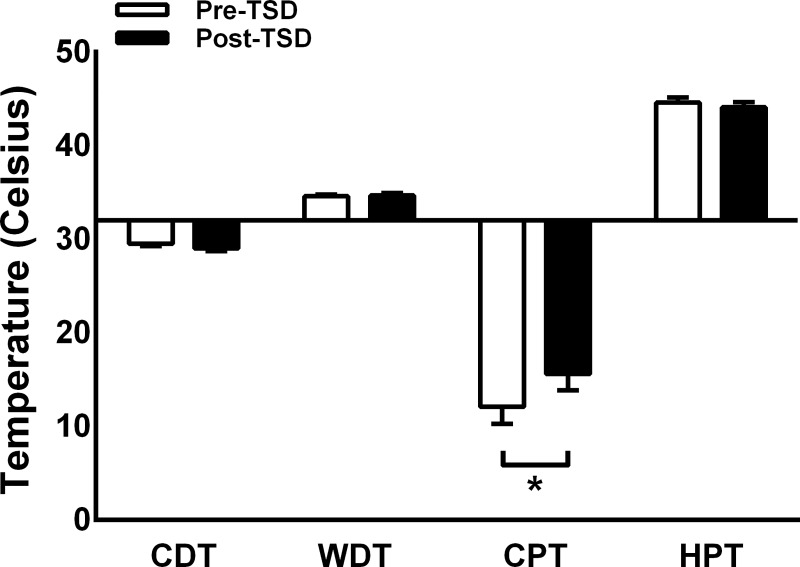
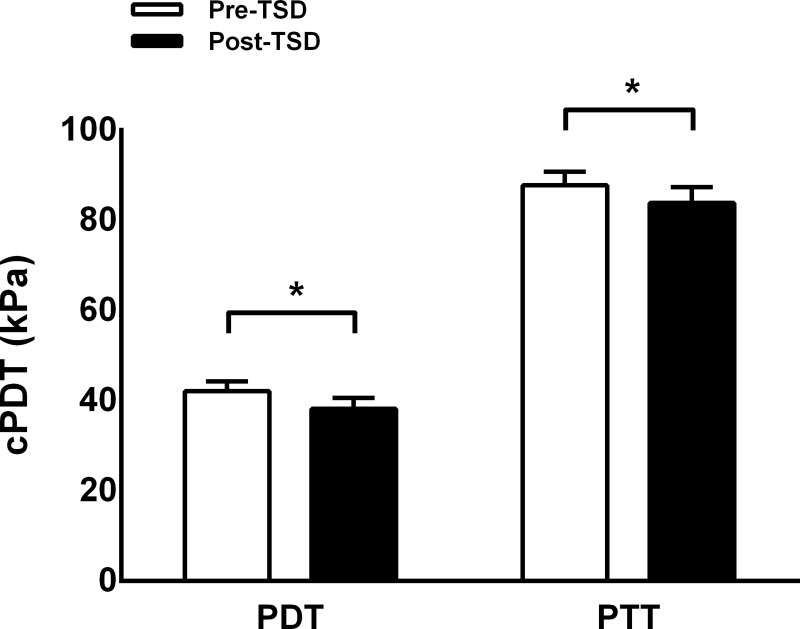
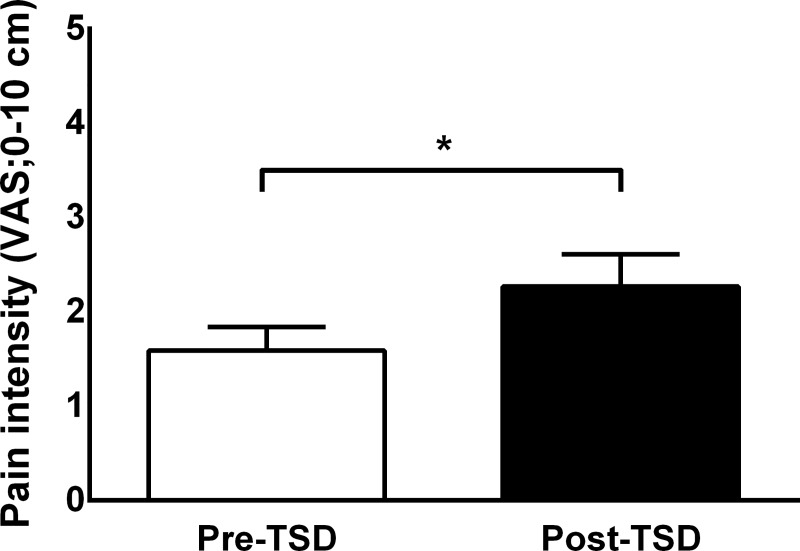
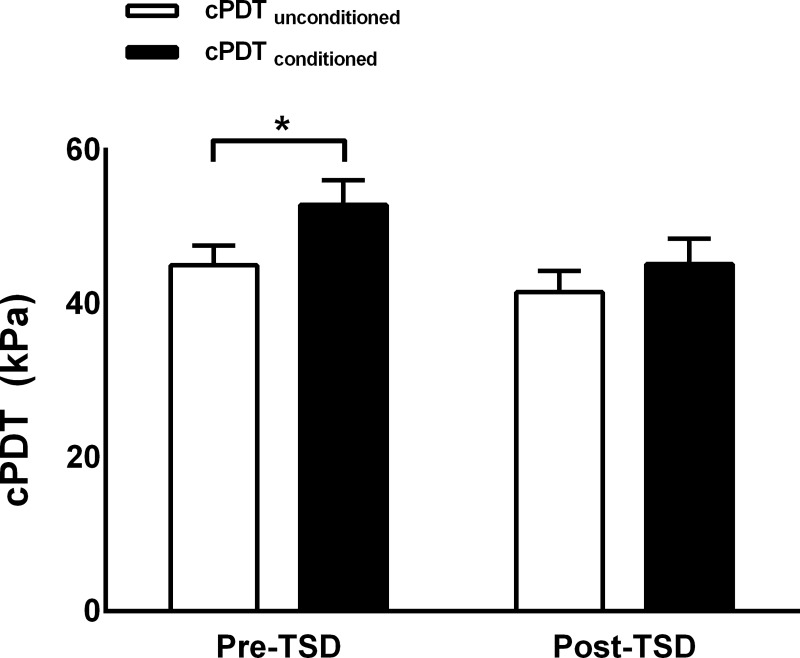
Chronic pain patients often suffer from insomnia or impaired sleep which has been associated with increased pain sensitivity, but a limited amount of studies have investigated the effects of total sleep deprivation on central pain mechanisms. Therefore, the aim of this study was to determine the effects of total sleep deprivation on temporal summation, conditioned pain modulation, thermal and pressure pain sensitivity in healthy participants. Twenty-four healthy participants took part in this two-session trial. The measurements were conducted after a night of habitual sleep (baseline) and following 24 hours of total sleep deprivation. Detection thresholds for cold and warmth and pain thresholds for cold and heat were assessed. Cuff induced pressure pain detection and tolerance thresholds, temporal summation and conditioned pain modulation were assessed with user-independent, computer-controlled cuff algometry. Conditioned pain modulation was significantly impaired, temporal summation was significantly facilitated and pain sensitivity to pressure and cold pain were significantly increased at follow-up compared with baseline. In conclusion, this study found that one night of total sleep deprivation impaired descending pain pathways, facilitated spinal excitability and sensitized peripheral pathways to cold and pressure pain. Future studies are encouraged to investigate if sleep therapy might normalize pain sensitivity in sleep-deprived chronic pain patients.
Overview
The claims and statistics of this paper haven’t been checked yet.
Run the check — free, no account needed. It reads the open-access text and checks the sources it cites.
Integrity signals
Registry
Cites
Statistics
Figures
Verification
Claims the paper makes
The claims and statistics of this paper haven’t been checked yet.
Run the check — free, no account needed. It reads the open-access text and checks the sources it cites.
Claims other papers make about this one
Each is checked against this paper’s own text: does it say what the citing paper says it does?
The cited source says what the claim attributes to it.
In the citing paper
“Sleep-related variables have been shown to predict pain-related outcomes such as disability [74], and sleep disruption is related to increased pain sensitivity and lowered pain thresholds [75].”
From ACTsmart: Guided Smartphone-Delivered Acceptance and Commitment Therapy for Chronic Pain—A Pilot Trial. (2021) · cites this paper as [75]
Self-check
Percentages, sums and reported differences re-computed from the paper’s own numbers.
The self-check needs the paper’s full text.
Citations
Cites
The Pittsburgh Sleep Quality Index: a new instrument for psychiatric practice and research
Buysse, D. J., Reynolds, C. F., Monk, T. H., Berman, S. R., & Kupfer, D. J. (1989) · Psychiatry Research · doi:10.1016/0165-1781(89)90047-4 · Cited by 35,234 · cited 1×
“The PSQI is a validated tool for assessment of sleep quality [40] in which participants evaluate their sleep based on a four-point Likert-type scale (ranging from 0 = “not at all” to 3 = “three times or more per week”), with high scores indicating poor sleep quality [41].”
MethodRolke, R., Baron, R., Maier, C., Tölle, T. R., Treede, R., Beyer, A., Binder, A., Birbaumer, N., Birklein, F., Bötefür, I. C., et al. (2006) · Pain · doi:10.1016/j.pain.2006.01.041 · Cited by 2,606
The association of sleep and pain: an update and a path forward
Finan, P. H., Goodin, B. R., & Smith, M. T. (2013) · The Journal of Pain · doi:10.1016/j.jpain.2013.08.007 · Cited by 1,620 · cited 1×
“In addition, CPM has been shown to be impaired following sleep impairment [4,23].”
BackgroundInfluentialSmith, M. T., & Haythornthwaite, J. A. (2004) · Sleep Medicine Reviews · doi:10.1016/s1087-0792(03)00044-3 · Cited by 914 · cited 3×
“In addition, CPM has been shown to be impaired following sleep impairment [4,23].”
BackgroundInfluentialFactor structure, reliability, and validity of the Pain Catastrophizing Scale
Osman, A., Barrios, F. X., Kopper, B. A., Hauptmann, W., Jones, J., & O'Neill, E. (1997) · Journal of Behavioral Medicine · doi:10.1023/a:1025570508954 · Cited by 881 · cited 1×
“The PCS questionnaire is a validated tool for assessment of thoughts regarding pain [42,43] based on a five-point Likert-type scale (ranging from 0 = “not at all” to 4 = “all the time”) with a high score indicating a high level of catastrophizing thoughts concerning pain [44].”
MethodAssessment and manifestation of central sensitisation across different chronic pain conditions
Arendt‐Nielsen, L., Morlion, B., Perrot, S., Dahan, A., Dickenson, A., Kress, H. G., Wells, C., Bouhassira, D., & Drewes, A. M. (2018) · European Journal of Pain · doi:10.1002/ejp.1140 · Cited by 695
Price, D. D., Hu, J. W., Dubner, R. A., & Gracely, R. H. (1977) · Pain · doi:10.1016/0304-3959(77)90035-5 · Cited by 589
Conditioned Pain Modulation in Populations With Chronic Pain: A Systematic Review and Meta-Analysis
Lewis, G. N., Rice, D. A., & McNair, P. J. (2012) · Journal of Pain · doi:10.1016/j.jpain.2012.07.005 · Cited by 564 · cited 1×
“It is well-established that patients suffering from back pain [19], fibromyalgia [20], or severe osteoarthritis [21] exhibit reduced descending pain inhibitory control and that impaired CPM is associated with worsening of pain [22].”
BackgroundAssessment of mechanisms in localized and widespread musculoskeletal pain
Graven‐Nielsen, T., & Arendt‐Nielsen, L. (2010) · Nature Reviews Rheumatology · doi:10.1038/nrrheum.2010.107 · Cited by 547
The effects of sleep deprivation on pain inhibition and spontaneous pain in women
Smith, M. T., Edwards, R. R., McCann, U. D., & Haythornthwaite, J. A. (2007) · Sleep · doi:10.1093/sleep/30.4.494 · Cited by 539
Research works printed but not linked: 2
- Michael T. Smith, 2007, The Effects of Sleep Deprivation on Pain Inhibition and Spontaneous Pain in Women, 30, 494
- MY Ağargün, Sleep quality and pain threshold in patients with fibromyalgia, Compr Psychiatry, 40, 226, 10.1016/S0010-440X(99)90008-1 · DOI
Cited by
Sorted by citations
Kurien, T., Arendt‐Nielsen, L., Petersen, K. K., Graven‐Nielsen, T., & Scammell, B. E. (2018) · Journal of Pain · doi:10.1016/j.jpain.2018.05.011 · Cited by 139
Chang, J. R., Fu, S.-N., Li, X., Li, S. X., Wang, X., Zhou, Z., Pinto, S. M., Samartzis, D., Karppinen, J. I., & Wong, A. Y. L. (2022) · Sleep Medicine Reviews · doi:10.1016/j.smrv.2022.101695 · Cited by 120
Irwin, M. R., Straub, R. H., & Smith, M. T. (2023) · Nature Reviews Rheumatology · doi:10.1038/s41584-023-00997-3 · Cited by 79
Mouraux, A., Bannister, K., Becker, S., Finn, D. P., Pickering, G. P., Pogatzki-Zahn, E. M., & Graven‐Nielsen, T. (2021) · European Journal of Pain · doi:10.1002/ejp.1730 · Cited by 64
“While disrupted sleep leads to an increased sensitivity to experimental pain (Seminowicz et al., 2019; Staffe et al., 2019), disturbed pain can also predict the development and maintenance of persistent pain (Finan et al.”
BackgroundEffect of sleep loss on pain—New conceptual and mechanistic avenues
Kourbanova, K., Alexandre, C., & Latrémolière, A. (2022) · Frontiers in Neuroscience · doi:10.3389/fnins.2022.1009902 · Cited by 59
“Indeed, the increase in heat and mechanical pain caused by sleep loss persists in humans (Roehrs et al., 2006; Tiede et al., 2010; Faraut et al., 2015; Matre et al., 2015, 2016; Odegard et al., 2015; Staffe et al., 2019) and even aggravates in rodents (Page et al.”
BackgroundInfluential
Metadata
- Authors
- Staffe, A. T., Bech, M. W., Clemmensen, S. L. K., Nielsen, H. T., Larsen, D. B., & Petersen, K. K.
- Affiliations
- Aalborg University (DK)
- Corresponding author
- Petersen, Kristian Kjær
- Venue
- PLoS ONE
- Publisher
- Public Library of Science (PLoS)
- Published
- 2019-12-04
- Volume
- 14
- Issue
- 12
- Pages
- e0225849
- ISSN
- 1932-6203 (ISSN-L)
- PMC
- PMC6892491
- OpenAlex
- W2991704716
- Cited by
- 150
- References
- 70
- Citations by year
- 2026: 22 · 2025: 30 · 2024: 21 · 2023: 22 · 2022: 25 · 2021: 22 · 2020: 6 · 2019: 1
- FWCI
- 9.23
- Type
- journal article
- Language
- en
- Open access
- gold
- doi.org
- Licence
- Locations
- PLoS ONE (publishedVersion, cc-by)
- Europe PMC (PubMed Central) (publishedVersion, cc-by)
- PubMed Central (publishedVersion, cc-by)
- PubMed (publishedVersion)
- VBN Forskningsportal (Aalborg Universitet) (submittedVersion, cc-by)
- DOAJ (DOAJ: Directory of Open Access Journals) (submittedVersion, cc-by-sa)
- Figshare (submittedVersion, cc-by)
- Funders
- Danmarks Grundforskningsfond (DNRF121)
- Aalborg Universitet (771126)
- Topics
- Health Sciences › Medicine › Physiology (medical) › Pain Mechanisms and Treatments
- Social Sciences › Psychology › Experimental and Cognitive Psychology › Sleep and Work-Related Fatigue
- Health Sciences › Medicine › Anesthesiology and Pain Medicine › Pain Management and Treatment
- Keywords
- total sleep deprivation, pain sensitivity, conditioned pain modulation, temporal summation, descending pain modulation, thermal pain, pressure pain, cold pain, pain detection threshold, pain tolerance, spinal cord excitability, chronic pain, insomnia, sleep therapy
- MeSH terms
- Adult, Denmark, Female, Humans, Male, Pain Measurement, Sleep, Sleep Deprivation, Thermosensing, Pain Threshold, Young Adult, Public Health Surveillance
About these checks
Registry, retraction, Cites and statistics results are computed, not judged, with one exception: a printed reference that no index lists is read once by a model before it counts as a citation error. Claims are extracted by a model and kept only when their quote appears verbatim in the text; each cited source is then checked, with a model’s help, for whether it says what the claim relies on. Those verdicts can be wrong — read the claim’s quote and the cited source before relying on one.
Statistics and arithmetic are recomputed, not judged.
Confidence bands are shown only for fields calibrated on our annotated test set. None is calibrated yet, so no band is shown.
What counts as a claim ›How we measure confidence ›How we check this ›
Are you an author, or do you see a problem with this page? Request a review
