

Mental health problems and social media exposure during COVID-19 outbreak
Open accessThe DOI matches its Crossref record; 14 of the 14 references it cites were found in a registry or an index; 10 of the 24 sources its claims cite were checked for support.
Abstract
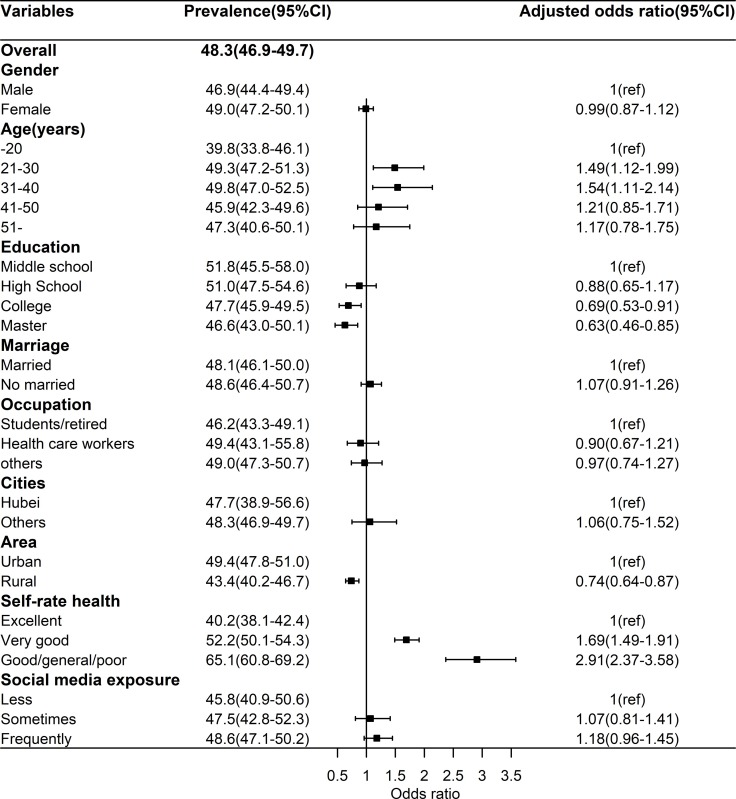
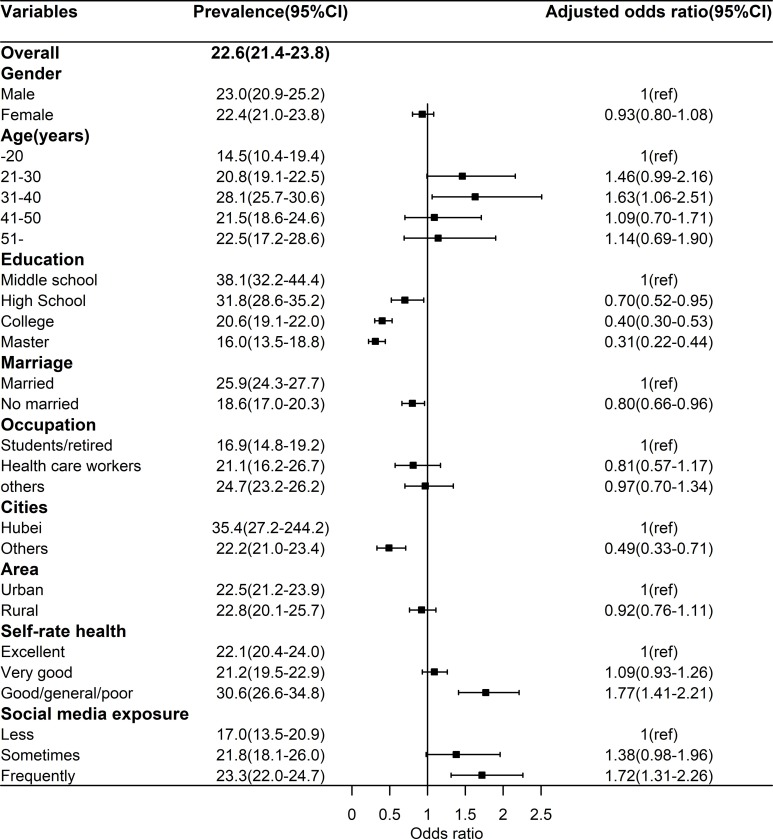
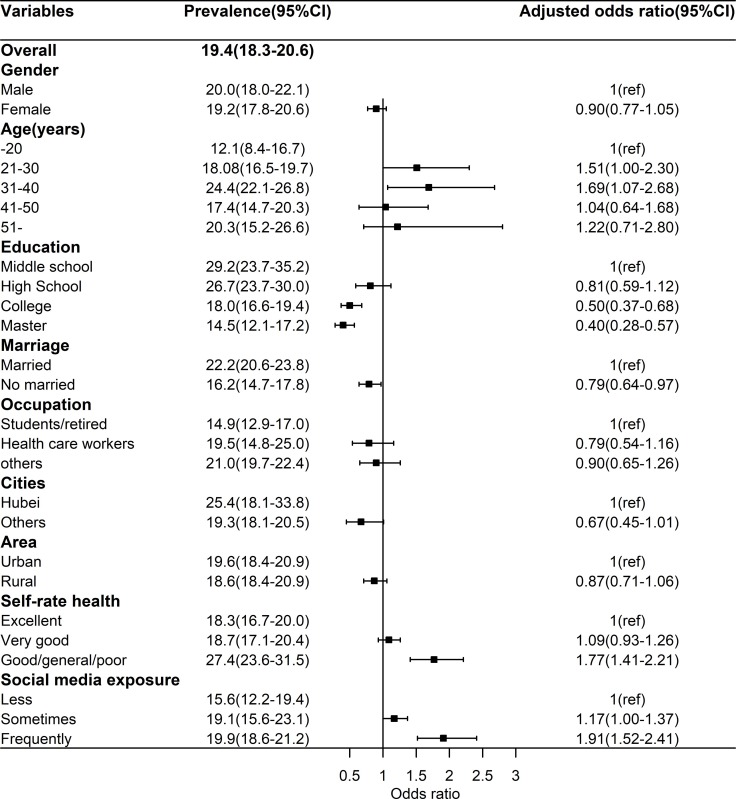
Huge citizens expose to social media during a novel coronavirus disease (COVID-19) outbroke in Wuhan, China. We assess the prevalence of mental health problems and examine their association with social media exposure. A cross-sectional study among Chinese citizens aged≥18 years old was conducted during Jan 31 to Feb 2, 2020. Online survey was used to do rapid assessment. Total of 4872 participants from 31 provinces and autonomous regions were involved in the current study. Besides demographics and social media exposure (SME), depression was assessed by The Chinese version of WHO-Five Well-Being Index (WHO-5) and anxiety was assessed by Chinese version of generalized anxiety disorder scale (GAD-7). multivariable logistic regressions were used to identify associations between social media exposure with mental health problems after controlling for covariates. The prevalence of depression, anxiety and combination of depression and anxiety (CDA) was 48.3% (95%CI: 46.9%-49.7%), 22.6% (95%CI: 21.4%-23.8%) and 19.4% (95%CI: 18.3%-20.6%) during COVID-19 outbroke in Wuhan, China. More than 80% (95%CI:80.9%-83.1%) of participants reported frequently exposed to social media. After controlling for covariates, frequently SME was positively associated with high odds of anxiety (OR = 1.72, 95%CI: 1.31-2.26) and CDA (OR = 1.91, 95%CI: 1.52-2.41) compared with less SME. Our findings show there are high prevalence of mental health problems, which positively associated with frequently SME during the COVID-19 outbreak. These findings implicated the government need pay more attention to mental health problems, especially depression and anxiety among general population and combating with "infodemic" while combating during public health emergency.
Overview
CoChat Summary
## TL;DR
This cross-sectional online survey of 4,872 Chinese adults during the COVID-19 outbreak found high prevalence of depression, anxiety, and co-occurring depression/anxiety. Frequent social media exposure was positively associated with anxiety and with the combination of depression and anxiety, but not significantly with depression alone after adjustment.
## Key findings
- Among 4,827 participants in the results, the prevalence was 48.3% for depression, 22.6% for anxiety, and 19.4% for combination of depression and anxiety (CDA).
- 82.0% of participants reported frequent social media exposure; only 8.8% reported less exposure and 9.2% reported sometimes exposure.
- After controlling for covariates, frequent SME was associated with higher odds of anxiety (OR = 1.72, 95% CI 1.31–2.26) and CDA (OR = 1.91, 95% CI 1.52–2.41) compared with less SME.
- Frequent SME was not significantly associated with depression after adjustment.
- Depression, anxiety, and CDA were all reported as much higher than the cited national sample estimates in China during the same period.
## Methods
- Design: Cross-sectional online survey conducted Jan 31 to Feb 2, 2020 during the COVID-19 outbreak.
- Sample/data: Chinese citizens aged 18 years or older recruited via the Wenjuanxing platform; 5,851 participated and 4,872 completed questionnaires from 31 provinces and autonomous regions were included.
- Measures/analysis: Depression was assessed with the WHO-5 (score <13), anxiety with the GAD-7 (score ≥10), and social media exposure was categorized as less, sometimes, or frequently. The authors used chi-square/trend tests and multivariable logistic regression adjusting for demographic and other covariates.
## Limitations
- The paper states that, because the study is cross-sectional, it is difficult to determine causal relationships between SME and mental health.
- The paper notes possible respondent bias from the online survey, including few elder citizens’ participation.
- The paper states that residual confounding from unmeasured factors cannot be excluded.
- Evident from the text: the sample was online and self-selected, so it may not be fully representative of all Chinese adults.
Model-written summary. Check it against the paper before relying on it.
Integrity signals
Registry
Cites
Statistics
Figures
Verification
Claims the paper makes
7 Valid · 1 Not valid · 6 Not checked · 13 Own results and interpretations
The cited sources support only part of this claim — read each source’s verdict below.
In the paper
“It indicated that participants from Hubei province- the infectious focus directly expose to public health emergency, and may suffer more mental health problemes[17,19].”
§ Mental health problems and social media exposure during COVID-19 outbreak > Discussion
What the sources say
- Not checked — no full text of the sourcecites [17] Xie Z, Xu J, Wu Z. Mental health problems among survivors in hard-hit areas of the 5.12 Wenchuan and 4.20 Lushan earthquakes. J Ment Health 2017; 26(1): 43– 9. 10.1080/09638237.2016.1276525 28084103 source
- Partly supportedcites [19] Mak IW, Chu CM, Pan PC, Yiu MG, Chan VL. Long-term psychiatric morbidities among SARS survivors. Gen Hosp Psychiatry 2009; 31(4): 318– 26. 10.1016/j.genhosppsych.2009.03.001 19555791 PMC7112501 sourceExperimental — accuracy not yet measured
The Introduction describes SARS survivors as direct victims of an outbreak, and the Results (Subgroup analysis of HCWs; page unavailable) report more chronic PTSD among health care workers than other survivors. This supports the general possibility of greater mental-health burden with outbreak exposure, but the paper studies SARS survivors in Hong Kong, not participants from Hubei province or a comparison based on residence in an infectious focus. (LLM, conf=0.82)
hedgedstates a possible cause- Asserted: passes — The authors put it forward as true.
- Checkable: passes — It can be checked against evidence.
- Load-bearing: passes — The paper’s conclusions depend on it.
- Based: passes — The paper gives a reason why it holds.
The cited sources that could be checked couldn’t confirm or dispute this claim.
In the paper
“Besides, many citizens expressed their negative feelings, such as fear, worry, nervous, anxiety et al. on social media, which are contagious social network[21,22].”
§ Mental health problems and social media exposure during COVID-19 outbreak > Discussion
What the sources say
- Not checked — no full text of the sourcecites [21] Kramer AD, Guillory JE, Hancock JT. Experimental evidence of massive-scale emotional contagion through social networks. Proc Natl Acad Sci U S A 2014; 111(24): 8788– 90. 10.1073/pnas.1320040111 24889601 PMC4066473 source
- Could not verifycites [22] Niederkrotenthaler T, Stack S, Till B, et al Association of Increased Youth Suicides in the United States With the Release of 13 Reasons Why. JAMA Psychiatry 2019; 76(9): 933– 40. PMC6547137 31141094 sourceExperimental — accuracy not yet measured
The Discussion and Conclusions discuss possible suicide contagion following a fictional television portrayal, using social-media activity to gauge attention to the show. They do not address whether fear, worry, anxiety, or other negative feelings expressed on social media spread through social networks; searches for negative feelings and emotional contagion found no such passage. The indexed passages provide section labels but no page numbers. (LLM, conf=0.77)
plainstates a cause- Asserted: passes — The authors put it forward as true.
- Checkable: passes — It can be checked against evidence.
- Load-bearing: passes — The paper’s conclusions depend on it.
- Based: passes — The paper gives a reason why it holds.
The sources with a verdict support this claim; the rest weren’t checked yet, have no full text we could read, or their verdicts aren’t rated yet.
In the paper
“These findings are consistent with the previous studies’ that exposing public health emergency can cause public mental health problems, such as Wenchuan and Lushan earthquakes[17], 2014 Ebola Outbreak[7,18], and SARS[19].”
§ Mental health problems and social media exposure during COVID-19 outbreak > Discussion
What the sources say
- Not checked — no full text of the sourcecites [17] Xie Z, Xu J, Wu Z. Mental health problems among survivors in hard-hit areas of the 5.12 Wenchuan and 4.20 Lushan earthquakes. J Ment Health 2017; 26(1): 43– 9. 10.1080/09638237.2016.1276525 28084103 source
- Not checked — no full text of the sourcecites [7] Shultz JM, Baingana F, Neria Y. The 2014 Ebola Outbreak and Mental Health: Current Status and Recommended Response. JAMA 2015; 313(6): 567– 8. 10.1001/jama.2014.17934 25532102 source
- Supportedcites [18] Ji D, Ji YJ, Duan XZ, et al Prevalence of psychological symptoms among Ebola survivors and healthcare workers during the 2014–2015 Ebola outbreak in Sierra Leone: a cross-sectional study. Oncotarget 2017; 8(8): 12784– 91. 10.18632/oncotarget.14498 28061463 PMC5355054 source
For the Ebola example attributed to this source, the Discussion reports pronounced psychological symptoms among Ebola survivors and Sierra Leonean healthcare workers exposed during the outbreak. The Introduction also describes public fear and panic. The earthquake and SARS examples have separate citations and are not attributed to this paper. (LLM, conf=0.90)
- Supportedcites [19] Mak IW, Chu CM, Pan PC, Yiu MG, Chan VL. Long-term psychiatric morbidities among SARS survivors. Gen Hosp Psychiatry 2009; 31(4): 318– 26. 10.1016/j.genhosppsych.2009.03.001 19555791 PMC7112501 source
The citation is attached to SARS, not to the earthquakes or Ebola outbreak. The Discussion (Clinical implications) states that SARS can cause significant, prolonged psychiatric problems, and the Discussion (Range of psychiatric disorders and functional outcome) identifies PTSD, depression, and anxiety disorders among survivors. (LLM, conf=0.90)
plainstates a cause- Asserted: passes — The authors put it forward as true.
- Checkable: passes — It can be checked against evidence.
- Load-bearing: unclear — It is unclear whether the paper’s conclusions depend on it.
- Based: passes — The paper gives a reason why it holds.
A result the paper reports from its own data — it cites no other source for it, so there is none to check. The quote shows it is in the paper.
In the paper
“higher frequency of SME was insignificantly positively associated with the adjusted odds of depression after controlling for all covariates.”
§ Mental health problems and social media exposure during COVID-19 outbreak > Results > Depression and SME
plainstates an association- Asserted: passes — The authors put it forward as true.
- Checkable: passes — It can be checked against evidence.
- Load-bearing: passes — The paper’s conclusions depend on it.
- Based: passes — The paper gives a reason why it holds.
A result the paper reports from its own data — it cites no other source for it, so there is none to check. The quote shows it is in the paper.
In the paper
“After controlling for covariates, frequently SME was positively associated with high odds of anxiety (OR = 1.72, 95%CI: 1.31–2.26) and CDA (OR = 1.91, 95%CI: 1.52–2.41) compared with less SME.”
- Also stated in: § Combination of depression and anxiety and SME · plain
“frequently SME can increase the adjusted odds (OR = 1.91, 95%CI: 1.52–2.41) of CDA compared with less SEM after controlling for all covariates.”
- Also stated in: § Discussion · plain
“frequently SME associated high odds of anxiety and CDA”
§ Mental health problems and social media exposure during COVID-19 outbreak > Abstract Huge citizens expose to social media during a novel coronavirus disease (COVID-19) outbroke in Wuhan, China. We assess the prevalence of mental health problems and examine their association with social media exposure. A cross-sectional study among Chinese citizens aged≥18 years old was conducted during Jan 31 to Feb 2, 2020. Online survey was used to do rapid assessment. Total of 4872 participants from 31 provinces and autonomous regions were involved in the current study. Besides demographics and social media exposure (SME), depression was assessed by The Chinese version of WHO-Five Well-Being Index (WHO-5) and anxiety was assessed by Chinese version of generalized anxiety disorder scale (GAD-7). multivariable logistic regressions were used to identify associations between social media exposure with mental health problems after controlling for covariates. The prevalence of depression, anxiety and combination of depression and anxiety (CDA) was 48.3% (95%CI: 46.9%-49.7%), 22.6% (95%CI: 21.4%-23.8%) and 19.4% (95%CI: 18.3%-20.6%) during COVID-19 outbroke in Wuhan, China. More than 80% (95%CI:80.9%-83.1%) of participants reported frequently exposed to social media. After controlling for covariates, frequently SME was positively associated with high odds of anxiety (OR = 1.72, 95%CI: 1.31–2.26) and CDA (OR = 1.91, 95%CI: 1.52–2.41) compared with less SME. Our findings show there are high prevalence of mental health problems, which positively associated with frequently SME during the COVID-19 outbreak. These findings implicated the government need pay more attention to mental health problems, especially depression and anxiety among general population and combating with “infodemic” while combating during public health emergency.
plainstates an associationn = 4,872- Asserted: passes — The authors put it forward as true.
- Checkable: passes — It can be checked against evidence.
- Load-bearing: passes — The paper’s conclusions depend on it.
- Based: passes — The paper gives a reason why it holds.
- Also stated in: § Combination of depression and anxiety and SME · plain
10 more claims
Create a free account to see all 27 claims and every source verdict.
- Probably not a substantial claim. 8
- It may state two separate claims as one. 4
- The quote only partly states this claim. 1
Claims other papers make about this one
Each is checked against this paper’s own text: does it say what the citing paper says it does?
The source backs part of the claim, not all of it — or backs it for a different population, condition or comparison.
In the citing paper
“In the current pandemic, the additional layer of extensive social media use and exposure to often sensationalized online news while in physical isolation may add new complexities to implementing emotional epidemiology in managing concerns, fears, and misconceptions [96,97], as these tools have been argued to bear negative effects on psychological well-being [97,98].”
From Psychosocial Effects of the COVID-19 Pandemic: Large-scale Quasi-Experimental Study on Social Media (2020) · cites this paper as [96]
Experimental — accuracy not yet measuredThe source backs part of the claim, not all of it — or backs it for a different population, condition or comparison.
In the citing paper
“Recent research has shown that, in the general public, the COVID-19 pandemic is associated with greater levels of psychological distress and a range of psychopathological problems such as depression, anxiety, and post-traumatic stress symptoms (e.g., Gao et al., 2020; Qiu et al., 2020; Wang et al., 2020).”
From Why did all the toilet paper disappear? Distinguishing between panic buying and hoarding during COVID-19 (2021) · cites this paper as Gao et al., 2020
Experimental — accuracy not yet measuredThe source backs part of the claim, not all of it — or backs it for a different population, condition or comparison.
In the citing paper
“Misleading content overload and the distortion of information affect users' stress levels and create mental health problems (Gao et al., 2020).”
From The Psycho-Emotive Effects of AI-Generated Fake News on Social Media Users (2026) · cites this paper as Gao et al., 2020
Experimental — accuracy not yet measuredThe source backs part of the claim, not all of it — or backs it for a different population, condition or comparison.
In the citing paper
“It is known that exposure to news about the process on social media also increases the levels of psychological distress and that the use of social media is higher in young people.[47]”
From Psychological Distress of Breast Cancer Survivors During the COVID-19 Pandemic and Related Factors: A Controlled Study. (2023) · cites this paper as [47]
Experimental — accuracy not yet measuredThe source backs part of the claim, not all of it — or backs it for a different population, condition or comparison.
In the citing paper
“Studies have concluded that perceived poor health status during the COVID-19 period is associated with increased anxiety levels.[47]”
From Psychological Distress of Breast Cancer Survivors During the COVID-19 Pandemic and Related Factors: A Controlled Study. (2023) · cites this paper as [47]
Experimental — accuracy not yet measured
4 more claims about this paper
Create a free account to see every claim other papers make about this one.
Self-check
Percentages, sums and reported differences re-computed from the paper’s own numbers.
Each contradiction between two passages listed here was confirmed by an independent check.
Rated major: it would touch a result — a value a result rests on, reported and recomputed p-values on opposite sides of the significance level, two passages that conflict with no sign which is right, or a cited work retracted before this paper was published.
In the paper
§ Mental health problems and social media exposure during COVID-19 outbreak > Materials and methods > Design and participants
“After removing the participants without completed questionnaires, 4872 participants from 31 provinces and autonomous regions were involved in the current study.”
§ Mental health problems and social media exposure during COVID-19 outbreak > Results > Social media exposure
“Of all 4827 participants, the mean age of was 32.3±10.0 years (ranged 18–85),”
Rated minor: it would not touch a result — a value no result rests on, a p-value that stays on the same side of the significance level, or a conflict that is clerical, resolved elsewhere in the paper, or outside its own findings.
In the paper
§ Mental health problems and social media exposure during COVID-19 outbreak > Abstract
“Total of 4872 participants from 31 provinces and autonomous regions were involved in the current study.”
§ Mental health problems and social media exposure during COVID-19 outbreak > Results > Social media exposure
“Of all 4827 participants, the mean age of was 32.3±10.0 years (ranged 18–85), the proportion of “less”, “sometimes”, and “frequently” of SME was 8.8%(95%CI:8.0%-9.6%), 9.2%(95%CI:8.4%-10.0%) and 82.0%(95%CI:80.9%-83.1%).”
Citations
Cites
A Brief Measure for Assessing Generalized Anxiety Disorder: The GAD-7
Spitzer, R. L., Kroenke, K., Williams, J. B. W., & Löwe, B. (2006) · Archives of Internal Medicine · doi:10.1001/archinte.166.10.1092 · Cited by 31,765 · cited 2×
“Anxiety was assessed by Chinese version of generalized anxiety disorder scale (GAD-7) [15, 16] , which consists 7 symptoms.”
BackgroundMethodExperimental evidence of massive-scale emotional contagion through social networks
Kramer, A. D. I., Guillory, J. E., & Hancock, J. T. (2014) · Proceedings of the National Academy of Sciences · doi:10.1073/pnas.1320040111 · Cited by 3,687 · cited 1×
“on social media, which are contagious social network[21,22].”
BackgroundPrevalence of mental disorders in China: a cross-sectional epidemiological study
Huang, Y., Wang, Y., Wang, H., Liu, Z., Yu, X., Yan, J., Yu, Y., Kou, C., Xu, X., Lu, J., et al. (2019) · The Lancet Psychiatry · doi:10.1016/s2215-0366(18)30511-x · Cited by 2,335 · cited 2×
“So, the current study aims to describes the prevalence and distribution of two major mental disorders-anxiety and depression among Chinese population [13], and examine their associations with social media exposure by rapid assessment during COVID-19 outbreak.”
BackgroundSelf-citationThe mental health of medical workers in Wuhan, China dealing with the 2019 novel coronavirus.
Kang, L., Li, Y., Hu, S., Chen, M., Yang, C., Yang, B. X., Wang, Y., Hu, J., Lai, J., Ma, X., et al. (2020) · The Lancet Psychiatry · doi:10.1016/s2215-0366(20)30047-x · Cited by 2,061 · cited 8×
“%) during COVID-19 outbroke in Wuhan, China.”
BackgroundInfluentialSelf-citation2019-nCoV epidemic: Address mental health care to empower society
Bao, Y., Sun, Y., Meng, S., Shi, J., & Lu, L. (2020) · The Lancet · doi:10.1016/s0140-6736(20)30309-3 · Cited by 2,038 · cited 11×
“%) during COVID-19 outbroke in Wuhan, China.”
BackgroundInfluentialShigemura, J., Ursano, R. J., Morganstein, J. C., Kurosawa, M., & Benedek, D. M. (2020) · Psychiatry and Clinical Neurosciences · doi:10.1111/pcn.12988 · Cited by 1,959 · cited 1×
“The outbreak of COVID-19 in China has caused mental health problems among the public in China[3] and Japan[4] and medical workers in Wuhan[5].”
BackgroundLong-term psychiatric morbidities among SARS survivors
Mak, I. W. C., Chu, C. M., Pan, P. C., Yiu, M. G. C., & Chan, V. L. (2009) · General Hospital Psychiatry · doi:10.1016/j.genhosppsych.2009.03.001 · Cited by 1,018 · cited 2×
“It indicated that participants from Hubei province- the infectious focus directly expose to public health emergency, and may suffer more mental health problemes[17,19].”
BackgroundResultThe 2014 Ebola Outbreak and Mental Health: Current Status and Recommended Response
Shultz, J. M., Baingana, F., & Neria, Y. (2015) · JAMA · doi:10.1001/jama.2014.17934 · Cited by 324
Ji, D., Ji, Y.-J., Duan, X.-Z., Li, W.-G., Sun, Z.-Q., Song, X.-A., Meng, Y.-H., Tang, H.-M., Chu, F., Niu, X.-X., et al. (2017) · Oncotarget · doi:10.18632/oncotarget.14498 · Cited by 257 · cited 1×
“These findings are consistent with the previous studies’ that exposing public health emergency can cause public mental health problems, such as Wenchuan and Lushan earthquakes[17], 2014 Ebola Outbreak[7,18], and SARS[19].”
ResultThe impact of social media on risk perceptions during the MERS outbreak in South Korea
Choi, D.-H., Yoo, W., Noh, G.-Y., & Park, K. (2017) · Computers in Human Behavior · doi:10.1016/j.chb.2017.03.004 · Cited by 246 · cited 1×
“A previous study also shown social media exposure may positively related to forming risk perceptions during the MERS outbreak in South Korea [12] .”
Result
Research works printed but not linked: 2
- Florian Roth, Brönnimann G. Focal Report 8: Risk Analysis Using the Internet for Public Risk Communication. https://www.researchgate.net/publication/256126259. (accessed Feb 12, 2020)
- Xu WF PY, Chen BQ. Assessment of Anxiety and Depression by Self-rating Scales of GAD-7 and PHQ-9 in Cardiovascular Outpatients. World Latest Medicine Information (Electronic Version), 2018, 18(16): 12– 14. (in Chinese)
Cited by
Items 1,101–1,200 of 2,694
The Impact of COVID-19 Pandemic on Stress and Anxiety of Non-infected Pregnant Mothers
Mehdizadehkashi, A., Chaichian, S., Haghighi, L., Eshraghi, N., Bordbar, A., Hashemi, N., Derakhshan, R., Mirgalobayat, S., Rokhgireh, S., & Tahermanesh, K. (2021) · Journal of Reproduction & Infertility · doi:10.18502/jri.v22i2.5801 · Cited by 18
Ashraf, F., Zareen, G., Nusrat, A., Arif, A., & Griffiths, M. D. (2021) · Frontiers in Psychology · doi:10.3389/fpsyg.2021.647821 · Cited by 11
Dinçer, B., Ayaz, E. Y., & Oğuz, A. (2021) · Sexuality and Disability · doi:10.1007/s11195-021-09693-0 · Cited by 14
Fear of the Unknown: Does Fear of Terrorism Differ From Fear of Contracting COVID-19?
Bitton, M. S., & Laufer, A. (2021) · Frontiers in Psychology · doi:10.3389/fpsyg.2021.660777 · Cited by 13
Media Exposure and Substance Use Increase during COVID-19
Amram, O., Borah, P., Kubsad, D., & McPherson, S. M. (2021) · International Journal of Environmental Research and Public Health · doi:10.3390/ijerph18126318 · Cited by 11
Ilyas, H., Anwar, A., Yaqub, U., Alzamil, Z. S., & Appelbaum, D. A. (2021) · Global Knowledge, Memory and Communication · doi:10.1108/gkmc-01-2021-0006 · Cited by 11
Fadila, D. E. S., Ibrahim, F. M., & El‐Gilany, A. (2021) · Geriatric Nursing · doi:10.1016/j.gerinurse.2021.06.008 · Cited by 15
Tracing the Emotional Roadmap of Depressive Users on Social Media Through Sequential Pattern Mining
Giuntini, F. T., de Moraes, K. L., Cazzolato, M. T., Kirchner, L. D. F., dos Reis, M. D. J. D., Traina, A. J. M., Campbell, A. T., & Ueyama, J. (2021) · IEEE Access · doi:10.1109/access.2021.3095759 · Cited by 17
A study of self-disclosure during the Coronavirus pandemic
Blose, T., Umar, P., Squicciarini, A., & Rajtmajer, S. M. (2021) · First Monday · doi:10.5210/fm.v26i7.11555 · Cited by 33
Togni, G., Puccinelli, P. J., da Costa, T. S., Seffrin, A., de Lira, C. A. B., Vancini, R. L., Santos, D. D. A. T., Nikolaidis, P. Τ., Knechtle, B., & Andrade, M. S. (2021) · International Journal of Environmental Research and Public Health · doi:10.3390/ijerph182111397 · Cited by 12
Özlü-Erkilic, Z., Kothgassner, O. D., Wenzel, T., Goreis, A., Chen, A., Ceri, V., Fakhr Mousawi, A., & Akkaya-Kalayci, T. (2021) · International Journal of Environmental Research and Public Health · doi:10.3390/ijerph182312795 · Cited by 11
“In line with our results, diverse studies have demonstrated that females, migrants, and people with low socio-economic status are especially vulnerable to the adverse outcomes of the COVID-19 pandemic [21,35,44], which may probably have led to decreased well-being among these groups.”
ResultGreene, A. K., Maloul, E. K., Kelly, D. A., Norling, H. N., & Brownstone, L. M. (2022) · Social Media + Society · doi:10.1177/20563051221077024 · Cited by 15
Thomas, A., Bohr, Y. M., Hankey, J. R., Oskalns, M., Barnhardt, J., & Singoorie, C. (2022) · International Journal of Circumpolar Health · doi:10.1080/22423982.2022.2043577 · Cited by 16
Cohen, S., & Ginsborg, J. (2022) · Frontiers in Psychology · doi:10.3389/fpsyg.2022.885606 · Cited by 13
Hamouche, S. (2022) · Journal of Integrated Care · doi:10.1108/jica-02-2022-0014 · Cited by 14
The IHI Rochester Report 2022 on Healthcare Informatics Research: Resuming After the CoViD-19
Combi, C., Facelli, J. C., Haddawy, P., Holmes, J. H., Koch, S., Liu, H., Meyer, J., Peleg, M., Pozzi, G., Štiglic, G., et al. (2023) · Journal of Healthcare Informatics Research · doi:10.1007/s41666-023-00126-5 · Cited by 12
Guidelines for TMS/tES Clinical Services and Research through the COVID-19 PandemicPreprint
Bikson, M., Hanlon, C. A., Woods, A. J., Gillick, B. T., Charvet, L. E., Lamm, C., Madeo, G., Holczer, A., Almeida, J., Antal, A., et al. (2020) · PsyArXiv (OSF Preprints) · doi:10.31234/osf.io/82bmu · Cited by 12
Fischer, A. E., Van Tonder, T., Gumede, S. B., & Lalla-Edward, S. T. (2021) · JMIR Formative Research · doi:10.2196/25273 · Cited by 11
“In China there was a 30% increase in app use during their lockdown [5-7], while a global analysis of five popular social media platforms (Twitter, Instagram, YouTube, Reddit, and Gab) identified 8 million COVID-19–related posts and comments over the first 45 days of 2020 [8].”
THE LEVEL OF RUMINATIVE THOUGHT AND ALEXITHYMIA OF PEOPLE IN THE COVID-19 PANDEMIC PROCESS
Sultan Abdulhamid Han Training and Research Hospital, D. O. I. M., Yıldırım Ayaz, E., Dincer, B., & Istanbul Medeniyet University, F. O. H. S. (2021) · Psychiatria Danubina · doi:10.24869/psyd.2021.240 · Cited by 10
Information disorder’s impact on adolescents: publication trends and recommendations
Irwanto, I., Bahfiarti, T., Unde, A. A., & Sonni, A. F. (2025) · Frontiers in Communication · doi:10.3389/fcomm.2025.1495536 · Cited by 19
Temporal analysis of covid-19 in Colombia: associated indicators and modeling
Quintana, H. A. R., & Mejía, C. A. Z. (2022) · Nova · doi:10.22490/24629448.6187 · Cited by 10
Martínez-Líbano, J., Torres‐Vallejos, J., Campusano, N. G., Castillo, J. P., Simkin, H., Oyanedel, J. C., & Yeomans‐Cabrera, M. (2023) · Salud Ciencia y Tecnología · doi:10.56294/saludcyt2023328 · Cited by 12
Kadirvelu, B., Bel, T. B., Wu, X., Burmester, V., Ananth, S., Branco, B. C. C. C., Serrano, B. G., Gledhill, J. A., Simplicio, M. C. D., Nicholls, D., et al. (2023) · JMIR Formative Research · doi:10.2196/44877 · Cited by 17
Aksoy, S. D., Özdemir, S., & Akbal, E. (2023) · The International Journal of Psychiatry in Medicine · doi:10.1177/00912174231183925 · Cited by 13
Caprara, M., Zuffianò, A., Felipe, A. C., Suárez-Falcón, J. C., Pozo, P., Cabras, E., & Veiga, I. G. (2023) · Current Psychology · doi:10.1007/s12144-023-05159-y · Cited by 13
López-Ramón, M. F., Campos, V. M., Alonso-Esteban, Y., Navarro‐Pardo, E., & Marín, F. A. (2023) · Mindfulness · doi:10.1007/s12671-023-02234-0 · Cited by 15
Jütte, D., Hennig‐Thurau, T., Cziehso, G. P., & Sattler, H. (2024) · PLoS ONE · doi:10.1371/journal.pone.0296423 · Cited by 16
Tong, Q., Zhang, Q., & Zhang, J. (2024) · International Journal of Sustainable Development & World Ecology · doi:10.1080/13504509.2024.2315553 · Cited by 15
Wu, M., Yan, J., Qiao, C., & Yan, C. (2024) · Journal of Medical Internet Research · doi:10.2196/50057 · Cited by 17
Bazán, P. R., Neto, R. M. D. A., Lacerda, S. S., Ribeiro, M. W., Balardin, J. B., Amaro, E., & Kozasa, E. H. (2021) · Internet Interventions · doi:10.1016/j.invent.2021.100441 · Cited by 14
Evidence of Stability in Patient-Reported Global Health During the COVID-19 Pandemic
Lapin, B. R., Tang, W. H. W., Honomichl, R. D., Hogue, O., & Katzan, I. L. (2021) · Value in Health · doi:10.1016/j.jval.2021.06.009 · Cited by 10
Ross, A. J. (2021) · African Journal of Primary Health Care & Family Medicine · doi:10.4102/phcfm.v13i1.3002 · Cited by 11
Development of Social Distancing Phobia Scale and Its Association with Anxiety and Perceived Stress
Günlü, A. (2021) · International Journal of Mental Health and Addiction · doi:10.1007/s11469-021-00664-2 · Cited by 12
Warchoł-Biedermann, K., Bugajski, P., Budzicz, Ł., Ziarko, M., Jasielska, A., Samborski, W., Daroszewski, P., Greberski, K., Bączyk, G., Karoń, J., et al. (2022) · Journal of Investigative Medicine · doi:10.1136/jim-2021-001942 · Cited by 17
Coping with COVID-19 Prolonged and Cumulative Stressors: the Case Example of Egypt
Kira, I. A., Shuwiekh, H. A. M., Ahmed, S. A. E., Ebada, E. E., Tantawy, S. F., Waheep, N. N., & Ashby, J. S. (2022) · International Journal of Mental Health and Addiction · doi:10.1007/s11469-021-00712-x · Cited by 11
", & ELBARAZI, A. S. (2022) · Journal of Evidence-Based Psychotherapies · doi:10.24193/jebp.2022.1.5 · Cited by 11
Salehi, M., Zimon, G., Ghaderi, A. R., & Hasan, Z. A. (2022) · International Journal of Environmental Research and Public Health · doi:10.3390/ijerph19105841 · Cited by 12
Buonanno, P., Marra, A., Iacovazzo, C., Vargas, M., Nappi, S., de Siena, A. U., & Servillo, G. (2022) · Frontiers in Medicine · doi:10.3389/fmed.2022.1062381 · Cited by 12
Social anxiety and academic performance during COVID-19 in schoolchildren
Andreu, J. M. P., Sánchez, J. S., Cordón, J. T., Álvarez-Kurogi, L., González‐García, H., & López, R. C. (2023) · PLoS ONE · doi:10.1371/journal.pone.0280194 · Cited by 13
Predicting Hateful Discussions on Reddit using Graph Transformer Networks and Communal Context
Hebert, L., Golab, L., & Cohen, R. A. (2022) · IEEE/WIC/ACM International Conference on Web Intelligence and Intelligent Agent Technology (WI-IAT) · doi:10.1109/wi-iat55865.2022.00012 · Cited by 15
Liu, J., He, L., Wang, S., He, Y., & Zhu, L. (2024) · Behaviour and Information Technology · doi:10.1080/0144929x.2024.2314746 · Cited by 17
Review of Mental Health Response to COVID-19, China
Miu, A. S., Cao, H., Zhang, B., & Zhang, H. (2020) · Emerging infectious diseases · doi:10.3201/eid2610.201113 · Cited by 11
Are Social Media Groups the Novel Physician Lounges to Combat COVID Times?
Shekar, S., & Aravantagi, A. (2020) · Journal of General Internal Medicine · doi:10.1007/s11606-020-06217-y · Cited by 10
Elezi, F., Tafani, G., Sotiri, E., Agaj, H., & Kola, K. (2020) · Indian Journal of Psychiatry · doi:10.4103/psychiatry.indianjpsychiatry_842_20 · Cited by 10
Martins, A. B. T., Falcão, C. D. S. V., Pereira, Á. M. C., CARVALHO, J. Q., Diogo, J. D. L., Eloy, Y. R. G., & Abdon, A. P. V. (2020) · Revista Brasileira em Promoção da saúde · doi:10.5020/18061230.2020.11444 · Cited by 25
Pierdevara, L., Pórcel‐Gálvez, A. M., Ferreira, A., Barrientos‐Trigo, S., & Eiras, M. (2020) · Therapeutics and Clinical Risk Management · doi:10.2147/tcrm.s282294 · Cited by 15
Hikmah, K., Prisandy, L., Melinda, G., & Ayatullah, M. I. (2020) · Open Access Macedonian Journal of Medical Sciences · doi:10.3889/oamjms.2020.5386 · Cited by 14
Chenthamara, D., Prasathkumar, M., Robert, B., Anisha, S., Sadhasivam, S., Essa, M. M., Chidambaram, S. B., Al-Balushi, B., Guillemin, G. J., & Qoronfleh, M. W. (2020) · International Journal of Tryptophan Research · doi:10.1177/1178646920978243 · Cited by 11
Triana, H. W., Kustati, M., Yusuf, Y. Q., & Reflinaldi, R. (2021) · Journal of Language and Linguistic Studies · doi:10.17263/jlls.903507 · Cited by 10
The first 8 weeks of the Austrian SARS-CoV-2 epidemic
Nagel, A. C., Łaszewska, A., Haidinger, G., & Simon, J. (2021) · Wiener klinische Wochenschrift · doi:10.1007/s00508-020-01804-9 · Cited by 9
Luo, H., Yao, H., Xi, Y., Zhang, Z., Li, J., Li, J., Wang, X., Zhong, Z., & Lv, Y. Y. (2021) · Frontiers in Psychology · doi:10.3389/fpsyg.2021.603553 · Cited by 11
Gülnar, B., & Acar, N. (2021) · Nitel Sosyal Bilimler · doi:10.47105/nsb.904351 · Cited by 14
Naharcı, M. İ., Veizi, B. G. Y., Katipoğlu, B., & Taşçı, İ. (2021) · Clinical Gerontologist · doi:10.1080/07317115.2021.1928358 · Cited by 12
Jacob, L., Bohlken, J., & Kostev, K. (2021) · Journal of Psychiatric Research · doi:10.1016/j.jpsychires.2021.05.073 · Cited by 10
Agarwal, A., Uniyal, D., Toshniwal, D., & Deb, D. (2021) · IEEE Transactions on Emerging Topics in Computational Intelligence · doi:10.1109/tetci.2021.3067661 · Cited by 13
Al-Kazi, L. A., Al‐Sejari, M. M., & Al-Ma’seb, H. B. (2021) · International Social Science Journal · doi:10.1111/issj.12283 · Cited by 11
Psychosocial outcomes of COVID-19 pandemic on healthcare workers in maternity services
Erin, R., & Tekın, Y. B. (2021) · Journal of Psychosomatic Obstetrics & Gynecology · doi:10.1080/0167482x.2021.1940944 · Cited by 13
COVID-19-Related Anxiety and the Coping Strategies in the Southeast Ethiopia
Teferu, Z., Shiferaw, D. S., Kumbi, M., Mamo, A., Aliyi, A. A., Mohamed, A. H., Hassen, M. M., Abduletif, A. M., Wodera, A. L., Ayene, S. H., et al. (2021) · Psychology Research and Behavior Management · doi:10.2147/prbm.s309806 · Cited by 11
Sisay, M., Gashaw, T., Degefu, N., Hagos, B., Alemu, A., Teshome, Z., Admas, M., Kibret, H., & Dessie, Y. (2021) · Neuropsychiatric Disease and Treatment · doi:10.2147/ndt.s315370 · Cited by 10
Greaney, J. L., Darling, A. M., Turner, J. R., Saunders, E. F. H., Almeida, D. M., & Mogle, J. A. (2021) · Frontiers in Psychology · doi:10.3389/fpsyg.2021.693396 · Cited by 11
Meyer, J. D., O’Connor, J. D., McDowell, C. P., Lansing, J. E., Brower, C. S., & Herring, M. P. (2021) · Frontiers in Psychiatry · doi:10.3389/fpsyt.2021.741433 · Cited by 13
Chartier, K. G., Guidry, J. P. D., Lee, C. A., & Buckley, T. D. (2021) · PLoS ONE · doi:10.1371/journal.pone.0259947 · Cited by 10
Dilmaç, B., Karababa, A., Seki, T., Şimşir, Z., & Kurnaz, M. F. (2021) · Journal of Family Issues · doi:10.1177/0192513x211055513 · Cited by 10
Factors Influencing Depression among Indonesians during the COVID-19 Outbreak
Sarfika, R., Malini, H., Putri, D. E., Buanasari, A., Abdullah, K. L., & Freska, W. (2021) · Nurse Media Journal of Nursing · doi:10.14710/nmjn.v11i3.36783 · Cited by 13
COVID‑19: Main findings after a year and half of unease and the proper scientific progress (Review)
Leretter, M. T., Vulcănescu, D. D., Horhat, F. G., Matichescu, A., Riviș, M., Rusu, L. C., Roi, A., Racea, R. C., Badea, I., Dehelean, C. A., et al. (2022) · Experimental and Therapeutic Medicine · doi:10.3892/etm.2022.11350 · Cited by 10
Psychiatric aspect of infectious diseases and pandemic: A review (tur)
Erdogan, A. R., & Hocaoğlu, Ç. (2020) · Journal of Clinical Psychiatry · doi:10.5505/kpd.2020.90277 · Cited by 21
Chen, X., Gao, H., Shu, B., & Zou, Y. (2022) · PLoS ONE · doi:10.1371/journal.pone.0269237 · Cited by 14
Owusu, E., Shalaby, R., Eboreime, E., Nkire, N., Lawal, M. A., Agyapong, B., Pazderka, H., Obuobi-Donkor, G., Adu, M. K., Mao, W., et al. (2022) · Frontiers in Psychiatry · doi:10.3389/fpsyt.2022.844907 · Cited by 10
Ögel-Balaban, H. (2022) · Cyberpsychology Journal of Psychosocial Research on Cyberspace · doi:10.5817/cp2022-3-4 · Cited by 12
Al-Kandari, S., Salman, A., Al-Ghadban, F., & Ahmad, R. (2022) · International Journal of Environmental Research and Public Health · doi:10.3390/ijerph191710464 · Cited by 12
Aymerich-Franch, L. (2023) · Journal of Leisure Research · doi:10.1080/00222216.2022.2136987 · Cited by 48
Doctors vs. Nurses: Understanding the Great Divide in Vaccine Hesitancy among Healthcare Workers
Ahamed, S. H. R., Shakil, S., Lyu, H., Zhang, X., & Luo, J. (2022) · IEEE International Conference on Big Data (BigData) · doi:10.1109/bigdata55660.2022.10020853 · Cited by 11
Ju, B., Dai, H. M., & Sandel, T. L. (2023) · SAGE Open · doi:10.1177/21582440231160480 · Cited by 15
Lin, S., Qiao, Y., Huang, J., & Yan, N. (2020) · medRxiv · doi:10.1101/2020.03.27.20044958 · Cited by 10
Hübner, C. V. K., Bruscatto, M. D. L., & Lima, R. D. (2020) · medRxiv · doi:10.1101/2020.06.19.20135251 · Cited by 16
Dey, N. E. Y., Oti-Boadi, M., Malm, E. K., Selormey, R. K., & Ansah, K. O. (2022) · Journal of Psychology in Africa · doi:10.1080/14330237.2022.2120703 · Cited by 15
Ma, Z., Zhao, J., Chen, H., Tao, Y., Zhang, Y., & Fan, F. (2023) · Depression and Anxiety · doi:10.1155/2023/8469620 · Cited by 14
Self-citationNia, Z. M., Bragazzi, N. L., Ahamadi, A., Asgary, A., Garcia, B. R. M., Orbinski, J., Seyyed-Kalantari, L., Woldegerima, W. A., Wu, J., & Kong, J. D. (2023) · Journal of The Royal Society Interface · doi:10.1098/rsif.2023.0200 · Cited by 11
Development and validation of the Earthquake Obsession Scale
Kartol, A., Üztemur, S., & Yaşar, P. (2024) · Death Studies · doi:10.1080/07481187.2024.2317177 · Cited by 13
Matos, K. A., & Godinho, M. O. D. (2024) · Revista Foco · doi:10.54751/revistafoco.v17n4-035 · Cited by 20
Geng, D. C., Li, A. Y., Zhang, J., Harshaw, H. W., Gaston, C., Wu, W., & Wang, G. (2024) · Journal of Forestry Research · doi:10.1007/s11676-024-01720-y · Cited by 10
Smartphone addiction and depression among health sciences students during COVID-19 pandemic
Ay, M. K., Topuzoǧlu, A., & Altaş, Z. M. (2024) · BMC Public Health · doi:10.1186/s12889-024-21075-7 · Cited by 16
Mubdir, G. A., Hashim, S., Ayob, A. H., & Rosli, N. (2025) · Engineering Technology & Applied Science Research · doi:10.48084/etasr.9452 · Cited by 24
Sandín, B., Chorot, P., García-Escalera, J., & Valiente, R. M. (2021) · Acción Psicológica · doi:10.5944/ap.18.1.29520 · Cited by 21
Gunawan, H., Anggraeni, I., & Nurrachmawati, A. (2021) · Preventif Jurnal Kesehatan Masyarakat · doi:10.22487/preventif.v12i2.283 · Cited by 24
Li, J. T. S., Lee, C. P., & Tang, W. K. (2022) · International Journal of Environmental Research and Public Health · doi:10.3390/ijerph19031181 · Cited by 13
Mental Health and Access to Information in Times of COVID-19: The Role of Social Work
Romea, A. C., Valero, D., Saso, C. E., & Melgar, P. (2022) · International Journal of Environmental Research and Public Health · doi:10.3390/ijerph19084483 · Cited by 12
Awao, S., Park, C. L., Russell, B. S., & Fendrich, M. (2022) · Behavioral Medicine · doi:10.1080/08964289.2022.2069667 · Cited by 12
Ayhan, C. H., Çataldaş, S. K., & Kutlu, Y. (2022) · The Egyptian Journal of Neurology Psychiatry and Neurosurgery · doi:10.1186/s41983-022-00510-9 · Cited by 9
Chen, Z., He, Q., Shi, Q., Xu, Y., Yang, H., & Wei, R. (2022) · Frontiers in Public Health · doi:10.3389/fpubh.2022.929909 · Cited by 12
Yu, S. (2022) · Cyberpsychology Behavior and Social Networking · doi:10.1089/cyber.2022.0010 · Cited by 10
COVID-19, Family Dynamics, and Perceived Mental Health Among Families in Singapore
Yang, Y., Chua, J. J. E., Khng, K. H., & Yu, Y. (2023) · Journal of Child and Family Studies · doi:10.1007/s10826-023-02541-z · Cited by 18
Existential insecurity and deference to authority: the pandemic as a natural experiment
Foa, R., & Welzel, C. (2023) · Frontiers in Political Science · doi:10.3389/fpos.2023.1117550 · Cited by 10
Toulany, A., Saunders, N. R., Kurdyak, P. A., Strauss, R., Fu, L., Joh-Carnella, N., Chen, S., Guttmann, A., & Stukel, T. A. (2023) · Canadian Medical Association Journal · doi:10.1503/cmaj.221318 · Cited by 16
Self-citationPsycho-Social impact of Covid-2019 on Work-Life Balance of Health Care Workers in India:
Kaur, P., Arora, G. K., & Aggarwal, A. (2023) · International Journal of experimental research and review · doi:10.52756/ijerr.2023.v35spl.007 · Cited by 14
Yang, Z., Huang, J. W., Kwan, M., & Liu, D. (2024) · PLoS ONE · doi:10.1371/journal.pone.0293157 · Cited by 9
Uyurdağ, N., Eskicioğlu, G., Aksu, S., & Soyata, A. Z. (2021) · Anadolu Kliniği Tıp Bilimleri Dergisi · doi:10.21673/anadoluklin.783596 · Cited by 17
Owusu, S. J. (2020) · International Journal of Media and Information Literacy · doi:10.13187/ijmil.2020.2.199 · Cited by 12
Tariq, S., Tariq, S., Baig, M., & Alam, S. S. (2020) · Pharmacy Education · doi:10.46542/pe.2020.202.283289 · Cited by 11
Şentürk, E., Geniş, B., Menkü, B. E., & Çoşar, B. (2021) · Journal of Clinical Psychiatry · doi:10.5505/kpd.2020.69772 · Cited by 18
Metadata
- Authors
- Gao, J., Zheng, P., Jia, Y., Chen, H., Mao, Y., Chen, S., Wang, Y., Fu, H., & Dai, J.
- Affiliations
- Fudan University (CN)
- Corresponding author
- Dai, Junming
- ORCID
- Venue
- PLoS ONE
- Publisher
- Public Library of Science (PLoS)
- Published
- 2020-04-16
- Volume
- 15
- Issue
- 4
- Pages
- e0231924
- ISSN
- 1932-6203 (ISSN-L)
- PMC
- PMC7162477
- OpenAlex
- W3011720761
- Semantic Scholar
- e6352661273fcd34e64ee831c1033952c75f1bee
- Cited by
- 2,830
- References
- 14
- Citations by year
- 2026: 55 · 2025: 140 · 2024: 211 · 2023: 392 · 2022: 599 · 2021: 965 · 2020: 463
- FWCI
- 241.45
- Type
- journal article
- Language
- en
- Open access
- gold
- doi.org
- Licence
- Locations
- PLoS ONE (publishedVersion, cc-by)
- SSRN Electronic Journal (publishedVersion)
- PubMed Central (publishedVersion, cc-by)
- PubMed (publishedVersion)
- RePEc: Research Papers in Economics (submittedVersion, cc-by)
- DOAJ (DOAJ: Directory of Open Access Journals) (submittedVersion, cc-by-sa)
- Figshare (submittedVersion, cc-by)
- Funders
- National key R&D Program of China (2018YFC2002000 & 2018YFC2002001)
- National Natural Science Foundation of China (71573048)
- Topics
- Social Sciences › Psychology › Clinical Psychology › COVID-19 and Mental Health
- Social Sciences › Sociology and Political Science › Impact of Technology on Adolescents
- Social Sciences › Communication › Communication and COVID-19 Impact
- Keywords
- COVID-19 pandemic, social media exposure, mental health, depression, anxiety, infodemic, public health emergencies, prevalence, Wuhan
- MeSH terms
- Betacoronavirus, COVID-19, SARS-CoV-2, Adolescent, Adult, Aged, Aged, 80 and over, Anxiety, Depression, Disease Outbreaks, Female, Humans, Male, Mental Health, Middle Aged, Pneumonia, Viral, Coronavirus Infections, Young Adult, Pandemics, Social Media
About these checks
Registry, retraction, Cites and statistics results are computed, not judged, with one exception: a printed reference that no index lists is read once by a model before it counts as a citation error. Claims are extracted by a model and kept only when their quote appears verbatim in the text; each cited source is then checked, with a model’s help, for whether it says what the claim relies on. Those verdicts can be wrong — read the claim’s quote and the cited source before relying on one.
The claim verdicts this report counts are experimental: their accuracy is not yet measured.
A language model drew the claims from the paper on 2026-10-10, under version 3 of the claim definition (model deepseek-v4.1-flash, prompt extract-v3).
A second model labelled each claim on 2026-10-10 (model jev-1.13-20260917, definition revision gold-guideline-v0.2).
Cited sources are checked with a language model’s help (gpt-6-sol).
Statistics and arithmetic are recomputed, not judged.
Confidence bands are shown only for fields calibrated on our annotated test set. None is calibrated yet, so no band is shown.
What counts as a claim ›How we measure confidence ›How we check this ›
Are you an author, or do you see a problem with this page? Request a review
Data sources
Bibliographic data: Semantic Scholar, OpenAlex, Crossref.
Contains information from the Semantic Scholar Academic Graph Datasets, made available under the ODC Attribution License (ODC-BY 1.0).
Semantic Scholar’s data is described in: Kinney, R., et al. (2023). The Semantic Scholar Open Data Platform. arXiv:2301.10140.
