

Mental health problems and social media exposure during COVID-19 outbreak
Open accessThe DOI matches its Crossref record; 14 of the 14 references it cites were found in a registry or an index; 10 of the 24 sources its claims cite were checked for support.
Abstract
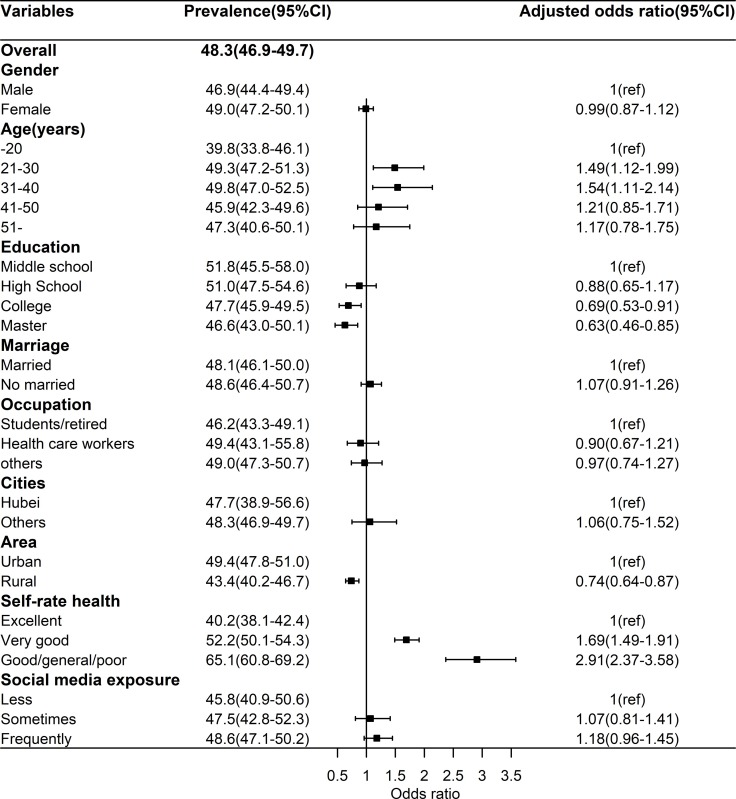
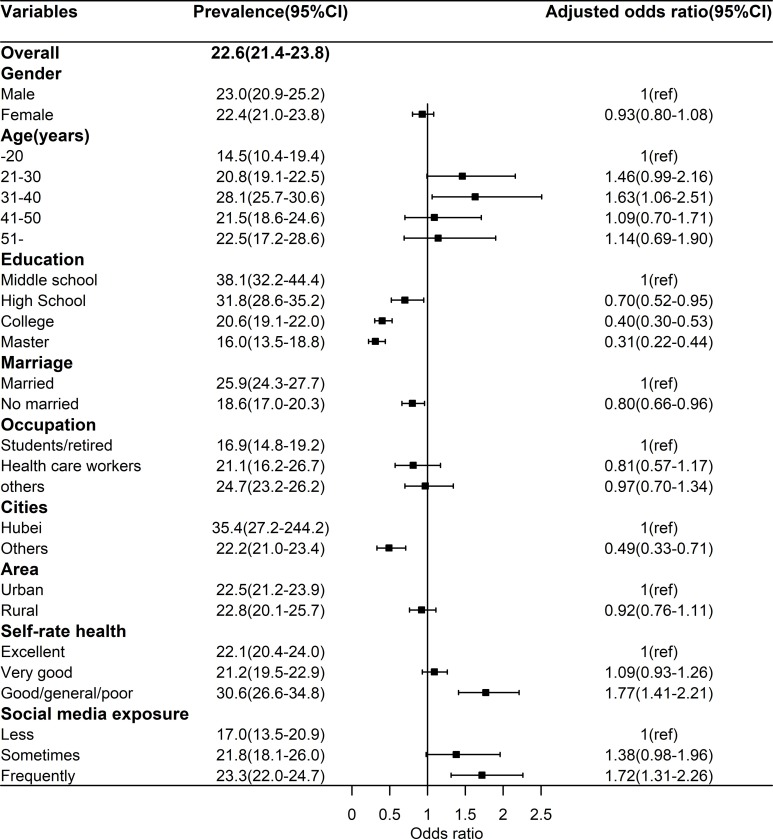
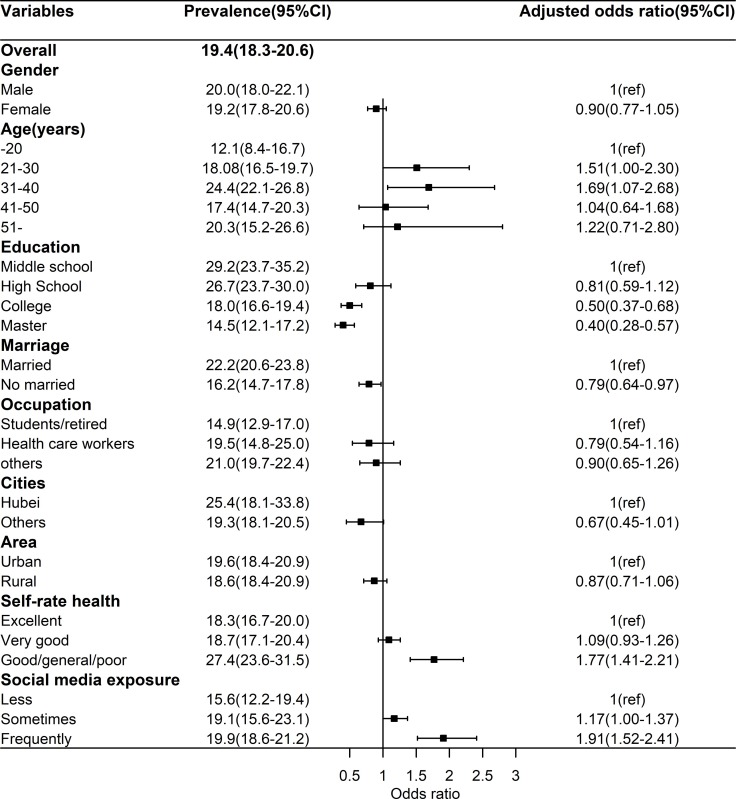
Huge citizens expose to social media during a novel coronavirus disease (COVID-19) outbroke in Wuhan, China. We assess the prevalence of mental health problems and examine their association with social media exposure. A cross-sectional study among Chinese citizens aged≥18 years old was conducted during Jan 31 to Feb 2, 2020. Online survey was used to do rapid assessment. Total of 4872 participants from 31 provinces and autonomous regions were involved in the current study. Besides demographics and social media exposure (SME), depression was assessed by The Chinese version of WHO-Five Well-Being Index (WHO-5) and anxiety was assessed by Chinese version of generalized anxiety disorder scale (GAD-7). multivariable logistic regressions were used to identify associations between social media exposure with mental health problems after controlling for covariates. The prevalence of depression, anxiety and combination of depression and anxiety (CDA) was 48.3% (95%CI: 46.9%-49.7%), 22.6% (95%CI: 21.4%-23.8%) and 19.4% (95%CI: 18.3%-20.6%) during COVID-19 outbroke in Wuhan, China. More than 80% (95%CI:80.9%-83.1%) of participants reported frequently exposed to social media. After controlling for covariates, frequently SME was positively associated with high odds of anxiety (OR = 1.72, 95%CI: 1.31-2.26) and CDA (OR = 1.91, 95%CI: 1.52-2.41) compared with less SME. Our findings show there are high prevalence of mental health problems, which positively associated with frequently SME during the COVID-19 outbreak. These findings implicated the government need pay more attention to mental health problems, especially depression and anxiety among general population and combating with "infodemic" while combating during public health emergency.
Overview
CoChat Summary
## TL;DR
This cross-sectional online survey of 4,872 Chinese adults during the COVID-19 outbreak found high prevalence of depression, anxiety, and co-occurring depression/anxiety. Frequent social media exposure was positively associated with anxiety and with the combination of depression and anxiety, but not significantly with depression alone after adjustment.
## Key findings
- Among 4,827 participants in the results, the prevalence was 48.3% for depression, 22.6% for anxiety, and 19.4% for combination of depression and anxiety (CDA).
- 82.0% of participants reported frequent social media exposure; only 8.8% reported less exposure and 9.2% reported sometimes exposure.
- After controlling for covariates, frequent SME was associated with higher odds of anxiety (OR = 1.72, 95% CI 1.31–2.26) and CDA (OR = 1.91, 95% CI 1.52–2.41) compared with less SME.
- Frequent SME was not significantly associated with depression after adjustment.
- Depression, anxiety, and CDA were all reported as much higher than the cited national sample estimates in China during the same period.
## Methods
- Design: Cross-sectional online survey conducted Jan 31 to Feb 2, 2020 during the COVID-19 outbreak.
- Sample/data: Chinese citizens aged 18 years or older recruited via the Wenjuanxing platform; 5,851 participated and 4,872 completed questionnaires from 31 provinces and autonomous regions were included.
- Measures/analysis: Depression was assessed with the WHO-5 (score <13), anxiety with the GAD-7 (score ≥10), and social media exposure was categorized as less, sometimes, or frequently. The authors used chi-square/trend tests and multivariable logistic regression adjusting for demographic and other covariates.
## Limitations
- The paper states that, because the study is cross-sectional, it is difficult to determine causal relationships between SME and mental health.
- The paper notes possible respondent bias from the online survey, including few elder citizens’ participation.
- The paper states that residual confounding from unmeasured factors cannot be excluded.
- Evident from the text: the sample was online and self-selected, so it may not be fully representative of all Chinese adults.
Model-written summary. Check it against the paper before relying on it.
Integrity signals
Registry
Cites
Statistics
Figures
Verification
Claims the paper makes
7 Valid · 1 Not valid · 6 Not checked · 13 Own results and interpretations
The cited sources support only part of this claim — read each source’s verdict below.
In the paper
“It indicated that participants from Hubei province- the infectious focus directly expose to public health emergency, and may suffer more mental health problemes[17,19].”
§ Mental health problems and social media exposure during COVID-19 outbreak > Discussion
What the sources say
- Not checked — no full text of the sourcecites [17] Xie Z, Xu J, Wu Z. Mental health problems among survivors in hard-hit areas of the 5.12 Wenchuan and 4.20 Lushan earthquakes. J Ment Health 2017; 26(1): 43– 9. 10.1080/09638237.2016.1276525 28084103 source
- Partly supportedcites [19] Mak IW, Chu CM, Pan PC, Yiu MG, Chan VL. Long-term psychiatric morbidities among SARS survivors. Gen Hosp Psychiatry 2009; 31(4): 318– 26. 10.1016/j.genhosppsych.2009.03.001 19555791 PMC7112501 sourceExperimental — accuracy not yet measured
The Introduction describes SARS survivors as direct victims of an outbreak, and the Results (Subgroup analysis of HCWs; page unavailable) report more chronic PTSD among health care workers than other survivors. This supports the general possibility of greater mental-health burden with outbreak exposure, but the paper studies SARS survivors in Hong Kong, not participants from Hubei province or a comparison based on residence in an infectious focus. (LLM, conf=0.82)
hedgedstates a possible cause- Asserted: passes — The authors put it forward as true.
- Checkable: passes — It can be checked against evidence.
- Load-bearing: passes — The paper’s conclusions depend on it.
- Based: passes — The paper gives a reason why it holds.
The cited sources that could be checked couldn’t confirm or dispute this claim.
In the paper
“Besides, many citizens expressed their negative feelings, such as fear, worry, nervous, anxiety et al. on social media, which are contagious social network[21,22].”
§ Mental health problems and social media exposure during COVID-19 outbreak > Discussion
What the sources say
- Not checked — no full text of the sourcecites [21] Kramer AD, Guillory JE, Hancock JT. Experimental evidence of massive-scale emotional contagion through social networks. Proc Natl Acad Sci U S A 2014; 111(24): 8788– 90. 10.1073/pnas.1320040111 24889601 PMC4066473 source
- Could not verifycites [22] Niederkrotenthaler T, Stack S, Till B, et al Association of Increased Youth Suicides in the United States With the Release of 13 Reasons Why. JAMA Psychiatry 2019; 76(9): 933– 40. PMC6547137 31141094 sourceExperimental — accuracy not yet measured
The Discussion and Conclusions discuss possible suicide contagion following a fictional television portrayal, using social-media activity to gauge attention to the show. They do not address whether fear, worry, anxiety, or other negative feelings expressed on social media spread through social networks; searches for negative feelings and emotional contagion found no such passage. The indexed passages provide section labels but no page numbers. (LLM, conf=0.77)
plainstates a cause- Asserted: passes — The authors put it forward as true.
- Checkable: passes — It can be checked against evidence.
- Load-bearing: passes — The paper’s conclusions depend on it.
- Based: passes — The paper gives a reason why it holds.
The sources with a verdict support this claim; the rest weren’t checked yet, have no full text we could read, or their verdicts aren’t rated yet.
In the paper
“These findings are consistent with the previous studies’ that exposing public health emergency can cause public mental health problems, such as Wenchuan and Lushan earthquakes[17], 2014 Ebola Outbreak[7,18], and SARS[19].”
§ Mental health problems and social media exposure during COVID-19 outbreak > Discussion
What the sources say
- Not checked — no full text of the sourcecites [17] Xie Z, Xu J, Wu Z. Mental health problems among survivors in hard-hit areas of the 5.12 Wenchuan and 4.20 Lushan earthquakes. J Ment Health 2017; 26(1): 43– 9. 10.1080/09638237.2016.1276525 28084103 source
- Not checked — no full text of the sourcecites [7] Shultz JM, Baingana F, Neria Y. The 2014 Ebola Outbreak and Mental Health: Current Status and Recommended Response. JAMA 2015; 313(6): 567– 8. 10.1001/jama.2014.17934 25532102 source
- Supportedcites [18] Ji D, Ji YJ, Duan XZ, et al Prevalence of psychological symptoms among Ebola survivors and healthcare workers during the 2014–2015 Ebola outbreak in Sierra Leone: a cross-sectional study. Oncotarget 2017; 8(8): 12784– 91. 10.18632/oncotarget.14498 28061463 PMC5355054 source
For the Ebola example attributed to this source, the Discussion reports pronounced psychological symptoms among Ebola survivors and Sierra Leonean healthcare workers exposed during the outbreak. The Introduction also describes public fear and panic. The earthquake and SARS examples have separate citations and are not attributed to this paper. (LLM, conf=0.90)
- Supportedcites [19] Mak IW, Chu CM, Pan PC, Yiu MG, Chan VL. Long-term psychiatric morbidities among SARS survivors. Gen Hosp Psychiatry 2009; 31(4): 318– 26. 10.1016/j.genhosppsych.2009.03.001 19555791 PMC7112501 source
The citation is attached to SARS, not to the earthquakes or Ebola outbreak. The Discussion (Clinical implications) states that SARS can cause significant, prolonged psychiatric problems, and the Discussion (Range of psychiatric disorders and functional outcome) identifies PTSD, depression, and anxiety disorders among survivors. (LLM, conf=0.90)
plainstates a cause- Asserted: passes — The authors put it forward as true.
- Checkable: passes — It can be checked against evidence.
- Load-bearing: unclear — It is unclear whether the paper’s conclusions depend on it.
- Based: passes — The paper gives a reason why it holds.
A result the paper reports from its own data — it cites no other source for it, so there is none to check. The quote shows it is in the paper.
In the paper
“higher frequency of SME was insignificantly positively associated with the adjusted odds of depression after controlling for all covariates.”
§ Mental health problems and social media exposure during COVID-19 outbreak > Results > Depression and SME
plainstates an association- Asserted: passes — The authors put it forward as true.
- Checkable: passes — It can be checked against evidence.
- Load-bearing: passes — The paper’s conclusions depend on it.
- Based: passes — The paper gives a reason why it holds.
A result the paper reports from its own data — it cites no other source for it, so there is none to check. The quote shows it is in the paper.
In the paper
“After controlling for covariates, frequently SME was positively associated with high odds of anxiety (OR = 1.72, 95%CI: 1.31–2.26) and CDA (OR = 1.91, 95%CI: 1.52–2.41) compared with less SME.”
- Also stated in: § Combination of depression and anxiety and SME · plain
“frequently SME can increase the adjusted odds (OR = 1.91, 95%CI: 1.52–2.41) of CDA compared with less SEM after controlling for all covariates.”
- Also stated in: § Discussion · plain
“frequently SME associated high odds of anxiety and CDA”
§ Mental health problems and social media exposure during COVID-19 outbreak > Abstract Huge citizens expose to social media during a novel coronavirus disease (COVID-19) outbroke in Wuhan, China. We assess the prevalence of mental health problems and examine their association with social media exposure. A cross-sectional study among Chinese citizens aged≥18 years old was conducted during Jan 31 to Feb 2, 2020. Online survey was used to do rapid assessment. Total of 4872 participants from 31 provinces and autonomous regions were involved in the current study. Besides demographics and social media exposure (SME), depression was assessed by The Chinese version of WHO-Five Well-Being Index (WHO-5) and anxiety was assessed by Chinese version of generalized anxiety disorder scale (GAD-7). multivariable logistic regressions were used to identify associations between social media exposure with mental health problems after controlling for covariates. The prevalence of depression, anxiety and combination of depression and anxiety (CDA) was 48.3% (95%CI: 46.9%-49.7%), 22.6% (95%CI: 21.4%-23.8%) and 19.4% (95%CI: 18.3%-20.6%) during COVID-19 outbroke in Wuhan, China. More than 80% (95%CI:80.9%-83.1%) of participants reported frequently exposed to social media. After controlling for covariates, frequently SME was positively associated with high odds of anxiety (OR = 1.72, 95%CI: 1.31–2.26) and CDA (OR = 1.91, 95%CI: 1.52–2.41) compared with less SME. Our findings show there are high prevalence of mental health problems, which positively associated with frequently SME during the COVID-19 outbreak. These findings implicated the government need pay more attention to mental health problems, especially depression and anxiety among general population and combating with “infodemic” while combating during public health emergency.
plainstates an associationn = 4,872- Asserted: passes — The authors put it forward as true.
- Checkable: passes — It can be checked against evidence.
- Load-bearing: passes — The paper’s conclusions depend on it.
- Based: passes — The paper gives a reason why it holds.
- Also stated in: § Combination of depression and anxiety and SME · plain
10 more claims
Create a free account to see all 27 claims and every source verdict.
- Probably not a substantial claim. 8
- It may state two separate claims as one. 4
- The quote only partly states this claim. 1
Claims other papers make about this one
Each is checked against this paper’s own text: does it say what the citing paper says it does?
The source backs part of the claim, not all of it — or backs it for a different population, condition or comparison.
In the citing paper
“In the current pandemic, the additional layer of extensive social media use and exposure to often sensationalized online news while in physical isolation may add new complexities to implementing emotional epidemiology in managing concerns, fears, and misconceptions [96,97], as these tools have been argued to bear negative effects on psychological well-being [97,98].”
From Psychosocial Effects of the COVID-19 Pandemic: Large-scale Quasi-Experimental Study on Social Media (2020) · cites this paper as [96]
Experimental — accuracy not yet measuredThe source backs part of the claim, not all of it — or backs it for a different population, condition or comparison.
In the citing paper
“Recent research has shown that, in the general public, the COVID-19 pandemic is associated with greater levels of psychological distress and a range of psychopathological problems such as depression, anxiety, and post-traumatic stress symptoms (e.g., Gao et al., 2020; Qiu et al., 2020; Wang et al., 2020).”
From Why did all the toilet paper disappear? Distinguishing between panic buying and hoarding during COVID-19 (2021) · cites this paper as Gao et al., 2020
Experimental — accuracy not yet measuredThe source backs part of the claim, not all of it — or backs it for a different population, condition or comparison.
In the citing paper
“Misleading content overload and the distortion of information affect users' stress levels and create mental health problems (Gao et al., 2020).”
From The Psycho-Emotive Effects of AI-Generated Fake News on Social Media Users (2026) · cites this paper as Gao et al., 2020
Experimental — accuracy not yet measuredThe source backs part of the claim, not all of it — or backs it for a different population, condition or comparison.
In the citing paper
“It is known that exposure to news about the process on social media also increases the levels of psychological distress and that the use of social media is higher in young people.[47]”
From Psychological Distress of Breast Cancer Survivors During the COVID-19 Pandemic and Related Factors: A Controlled Study. (2023) · cites this paper as [47]
Experimental — accuracy not yet measuredThe source backs part of the claim, not all of it — or backs it for a different population, condition or comparison.
In the citing paper
“Studies have concluded that perceived poor health status during the COVID-19 period is associated with increased anxiety levels.[47]”
From Psychological Distress of Breast Cancer Survivors During the COVID-19 Pandemic and Related Factors: A Controlled Study. (2023) · cites this paper as [47]
Experimental — accuracy not yet measured
4 more claims about this paper
Create a free account to see every claim other papers make about this one.
Self-check
Percentages, sums and reported differences re-computed from the paper’s own numbers.
Each contradiction between two passages listed here was confirmed by an independent check.
Rated major: it would touch a result — a value a result rests on, reported and recomputed p-values on opposite sides of the significance level, two passages that conflict with no sign which is right, or a cited work retracted before this paper was published.
In the paper
§ Mental health problems and social media exposure during COVID-19 outbreak > Materials and methods > Design and participants
“After removing the participants without completed questionnaires, 4872 participants from 31 provinces and autonomous regions were involved in the current study.”
§ Mental health problems and social media exposure during COVID-19 outbreak > Results > Social media exposure
“Of all 4827 participants, the mean age of was 32.3±10.0 years (ranged 18–85),”
Rated minor: it would not touch a result — a value no result rests on, a p-value that stays on the same side of the significance level, or a conflict that is clerical, resolved elsewhere in the paper, or outside its own findings.
In the paper
§ Mental health problems and social media exposure during COVID-19 outbreak > Abstract
“Total of 4872 participants from 31 provinces and autonomous regions were involved in the current study.”
§ Mental health problems and social media exposure during COVID-19 outbreak > Results > Social media exposure
“Of all 4827 participants, the mean age of was 32.3±10.0 years (ranged 18–85), the proportion of “less”, “sometimes”, and “frequently” of SME was 8.8%(95%CI:8.0%-9.6%), 9.2%(95%CI:8.4%-10.0%) and 82.0%(95%CI:80.9%-83.1%).”
Citations
Cites
A Brief Measure for Assessing Generalized Anxiety Disorder: The GAD-7
Spitzer, R. L., Kroenke, K., Williams, J. B. W., & Löwe, B. (2006) · Archives of Internal Medicine · doi:10.1001/archinte.166.10.1092 · Cited by 31,765 · cited 2×
“Anxiety was assessed by Chinese version of generalized anxiety disorder scale (GAD-7) [15, 16] , which consists 7 symptoms.”
BackgroundMethodExperimental evidence of massive-scale emotional contagion through social networks
Kramer, A. D. I., Guillory, J. E., & Hancock, J. T. (2014) · Proceedings of the National Academy of Sciences · doi:10.1073/pnas.1320040111 · Cited by 3,687 · cited 1×
“on social media, which are contagious social network[21,22].”
BackgroundPrevalence of mental disorders in China: a cross-sectional epidemiological study
Huang, Y., Wang, Y., Wang, H., Liu, Z., Yu, X., Yan, J., Yu, Y., Kou, C., Xu, X., Lu, J., et al. (2019) · The Lancet Psychiatry · doi:10.1016/s2215-0366(18)30511-x · Cited by 2,335 · cited 2×
“So, the current study aims to describes the prevalence and distribution of two major mental disorders-anxiety and depression among Chinese population [13], and examine their associations with social media exposure by rapid assessment during COVID-19 outbreak.”
BackgroundSelf-citationThe mental health of medical workers in Wuhan, China dealing with the 2019 novel coronavirus.
Kang, L., Li, Y., Hu, S., Chen, M., Yang, C., Yang, B. X., Wang, Y., Hu, J., Lai, J., Ma, X., et al. (2020) · The Lancet Psychiatry · doi:10.1016/s2215-0366(20)30047-x · Cited by 2,061 · cited 8×
“%) during COVID-19 outbroke in Wuhan, China.”
BackgroundInfluentialSelf-citation2019-nCoV epidemic: Address mental health care to empower society
Bao, Y., Sun, Y., Meng, S., Shi, J., & Lu, L. (2020) · The Lancet · doi:10.1016/s0140-6736(20)30309-3 · Cited by 2,038 · cited 11×
“%) during COVID-19 outbroke in Wuhan, China.”
BackgroundInfluentialShigemura, J., Ursano, R. J., Morganstein, J. C., Kurosawa, M., & Benedek, D. M. (2020) · Psychiatry and Clinical Neurosciences · doi:10.1111/pcn.12988 · Cited by 1,959 · cited 1×
“The outbreak of COVID-19 in China has caused mental health problems among the public in China[3] and Japan[4] and medical workers in Wuhan[5].”
BackgroundLong-term psychiatric morbidities among SARS survivors
Mak, I. W. C., Chu, C. M., Pan, P. C., Yiu, M. G. C., & Chan, V. L. (2009) · General Hospital Psychiatry · doi:10.1016/j.genhosppsych.2009.03.001 · Cited by 1,018 · cited 2×
“It indicated that participants from Hubei province- the infectious focus directly expose to public health emergency, and may suffer more mental health problemes[17,19].”
BackgroundResultThe 2014 Ebola Outbreak and Mental Health: Current Status and Recommended Response
Shultz, J. M., Baingana, F., & Neria, Y. (2015) · JAMA · doi:10.1001/jama.2014.17934 · Cited by 324
Ji, D., Ji, Y.-J., Duan, X.-Z., Li, W.-G., Sun, Z.-Q., Song, X.-A., Meng, Y.-H., Tang, H.-M., Chu, F., Niu, X.-X., et al. (2017) · Oncotarget · doi:10.18632/oncotarget.14498 · Cited by 257 · cited 1×
“These findings are consistent with the previous studies’ that exposing public health emergency can cause public mental health problems, such as Wenchuan and Lushan earthquakes[17], 2014 Ebola Outbreak[7,18], and SARS[19].”
ResultThe impact of social media on risk perceptions during the MERS outbreak in South Korea
Choi, D.-H., Yoo, W., Noh, G.-Y., & Park, K. (2017) · Computers in Human Behavior · doi:10.1016/j.chb.2017.03.004 · Cited by 246 · cited 1×
“A previous study also shown social media exposure may positively related to forming risk perceptions during the MERS outbreak in South Korea [12] .”
Result
Research works printed but not linked: 2
- Florian Roth, Brönnimann G. Focal Report 8: Risk Analysis Using the Internet for Public Risk Communication. https://www.researchgate.net/publication/256126259. (accessed Feb 12, 2020)
- Xu WF PY, Chen BQ. Assessment of Anxiety and Depression by Self-rating Scales of GAD-7 and PHQ-9 in Cardiovascular Outpatients. World Latest Medicine Information (Electronic Version), 2018, 18(16): 12– 14. (in Chinese)
Cited by
Impact of COVID-19 pandemic on mental health in the general population: a systematic review
Xiong, J., Lipsitz, O., Nasri, F., Lui, L. M. W., Gill, H., Phan, L., Chen-Li, D., Iacobucci, M., Ho, R., Majeed, A., et al. (2020) · Journal of Affective Disorders · doi:10.1016/j.jad.2020.08.001 · Cited by 5,204
Pappa, S., Ntella, V., Giannakas, T., Giannakoulis, V. G., Papoutsi, E., & Katsaounou, P. (2020) · Brain Behavior and Immunity · doi:10.1016/j.bbi.2020.05.026 · Cited by 3,617
COVID-19 pandemic and mental health consequences: Systematic review of the current evidence
Vindegaard, N., & Benros, M. E. (2020) · Brain, Behavior, and Immunity · doi:10.1016/j.bbi.2020.05.048 · Cited by 3,221
Prevalence of depression symptoms in US adults before and during the COVID-19 pandemic
Ettman, C. K., Abdalla, S. M., Cohen, G. H., Sampson, L., Vivier, P. M., & Galea, S. (2020) · JAMA Network Open · doi:10.1001/jamanetworkopen.2020.19686 · Cited by 2,138
How mental health care should change as a consequence of the COVID-19 pandemic
Moreno, C., Wykes, T., Galderisi, S., Nordentoft, M., Crossley, N., Jones, N., Cannon, M., Correll, C. U., Byrne, L., Carr, S., et al. (2020) · The Lancet Psychiatry · doi:10.1016/s2215-0366(20)30307-2 · Cited by 1,840
Luo, M., Guo, L., Yu, M., Jiang, W., & Wang, H. (2020) · Psychiatry Research · doi:10.1016/j.psychres.2020.113190 · Cited by 1,615
O'Connor, R. C., Wetherall, K., Cleare, S., McClelland, H., Melson, A. J., Niedzwiedz, C. L., O'Carroll, R. E., O'Connor, D. B., Platt, S., Scowcroft, E., et al. (2021) · The British Journal of Psychiatry · doi:10.1192/bjp.2020.212 · Cited by 1,042
The impact of COVID-19 lockdown on child and adolescent mental health: systematic review
Panchal, U., Salazar de Pablo, G., Franco, M., Moreno, C., Parellada, M., Arango, C., & Fusar-Poli, P. (2023) · European Child & Adolescent Psychiatry · doi:10.1007/s00787-021-01856-w · Cited by 1,028
Cénat, J. M., Blais-Rochette, C., Kokou-Kpolou, C. K., Noorishad, P.-G., Mukunzi, J. N., McIntee, S.-E., Dalexis, R. D., Goulet, M.-A., & Labelle, P. R. (2021) · Psychiatry Research · doi:10.1016/j.psychres.2020.113599 · Cited by 952
Depression and Anxiety in Hong Kong during COVID-19
Choi, E. P. H., Hui, B. P. H., & Wan, E. Y. F. (2020) · International Journal of Environmental Research and Public Health · doi:10.3390/ijerph17103740 · Cited by 893
Islam, M. A., Barna, S. D., Raihan, H., Khan, M. N. A., & Hossain, M. T. (2020) · PLOS ONE · doi:10.1371/journal.pone.0238162 · Cited by 834
Prevalence of depression during the COVID-19 outbreak: A meta-analysis of community-based studies
Bueno-Notivol, J., Gracia-García, P., Olaya, B., Lasheras, I., López-Antón, R., & Santabárbara, J. (2021) · International Journal of Clinical and Health Psychology · doi:10.1016/j.ijchp.2020.07.007 · Cited by 820
Huang, L., Lei, W., Xu, F., Liu, H., & Yu, L. (2020) · PLOS ONE · doi:10.1371/journal.pone.0237303 · Cited by 827
Sundarasen, S., Chinna, K., Kamaludin, K., Nurunnabi, M., Baloch, G. M., Khoshaim, H. B., Hossain, S. F. A., & Sukayt, A. (2020) · International Journal of Environmental Research and Public Health · doi:10.3390/ijerph17176206 · Cited by 739
Varma, P., Junge, M., Meaklim, H., & Jackson, M. L. (2021) · Progress in Neuro-Psychopharmacology and Biological Psychiatry · doi:10.1016/j.pnpbp.2020.110236 · Cited by 719
Gruber, J., Prinstein, M. J., Clark, L. A., Rottenberg, J., Abramowitz, J. S., Albano, A. M., Aldao, A., Borelli, J. L., Chung, T., Davila, J., et al. (2021) · American Psychologist · doi:10.1037/amp0000707 · Cited by 697
What social media told us in the time of COVID-19: A scoping review
Tsao, S.-F., Chen, H., Tisseverasinghe, T., Yang, Y., Li, L., & Butt, Z. A. (2021) · The Lancet Digital Health · doi:10.1016/s2589-7500(20)30315-0 · Cited by 816
Self-citationNochaiwong, S., Ruengorn, C., Thavorn, K., Hutton, B., Awiphan, R., Phosuya, C., Ruanta, Y., Wongpakaran, N., & Wongpakaran, T. (2021) · Scientific Reports · doi:10.1038/s41598-021-89700-8 · Cited by 681
Effects of Covid-19 Lockdown on Mental Health and Sleep Disturbances in Italy
Gualano, M. R., Lo Moro, G., Voglino, G., Bert, F., & Siliquini, R. (2020) · International Journal of Environmental Research and Public Health · doi:10.3390/ijerph17134779 · Cited by 651
The impact of the COVID‐19 pandemic on eating disorder risk and symptoms
Rodgers, R. F., Lombardo, C., Cerolini, S., Franko, D. L., Omori, M., Fuller‐Tyszkiewicz, M., Linardon, J., Courtet, P., & Guillaume, S. (2020) · International Journal of Eating Disorders · doi:10.1002/eat.23318 · Cited by 650
“Although frequency of social media use may vary across cultural contexts, preliminary data on use during the pandemic have shown association with mental health concerns in Asia (Gao et al., 2020; Kantar, 2020; Ni et al., 2020).”
BackgroundJungmann, S. M., & Witthöft, M. (2020) · Journal of Anxiety Disorders · doi:10.1016/j.janxdis.2020.102239 · Cited by 635
Benke, C., Autenrieth, L. K., Asselmann, E., & Pané-Farré, C. A. (2020) · Psychiatry Research · doi:10.1016/j.psychres.2020.113462 · Cited by 585
Saraswathi, I., Saikarthik, J., Senthil Kumar, K., Madhan Srinivasan, K., Ardhanaari, M., & Gunapriya, R. (2020) · PeerJ · doi:10.7717/peerj.10164 · Cited by 608
The role of perceived social support on depression and sleep during the COVID-19 pandemic
Grey, I., Arora, T., Thomas, J., Saneh, A., Tohme, P., & Abi-Habib, R. (2020) · Psychiatry Research · doi:10.1016/j.psychres.2020.113452 · Cited by 587
“Furthermore, existing meta-analytic studies examining the relationship between these two types of support do not support the traditional view that received support is the primary constituent factor in perceived support (Haber et al., 2007).”
Emotional, Behavioral, and Psychological Impact of the COVID-19 Pandemic
Pedrosa, A. L., Bitencourt, L., Fróes, A. C. F., Cazumbá, M. L. B., Campos, R. G. B., de Brito, S. B. C. S., & Simões e Silva, A. C. (2020) · Frontiers in Psychology · doi:10.3389/fpsyg.2020.566212 · Cited by 579
Salari, N., Khazaie, H., Hosseinian-Far, A., Khaledi-Paveh, B., Kazeminia, M., Mohammadi, M., Shohaimi, S., Daneshkhah, A., & Eskandari, S. (2020) · Human Resources for Health · doi:10.1186/s12960-020-00544-1 · Cited by 577
Nearchou, F., Flinn, C., Niland, R., Subramaniam, S. S., & Hennessy, E. (2020) · International Journal of Environmental Research and Public Health · doi:10.3390/ijerph17228479 · Cited by 577
“Frequent social media exposure during this pandemic has been associated with increased likelihood of depression and anxiety in adults [68].”
BackgroundKrishnamoorthy, Y., Nagarajan, R., Saya, G. K., & Menon, V. (2020) · Psychiatry Research · doi:10.1016/j.psychres.2020.113382 · Cited by 550
Impacts of COVID-19 pandemic on urban park visitation: a global analysis
Geng, D. (., Innes, J., Wu, W., & Wang, G. (2021) · Journal of Forestry Research · doi:10.1007/s11676-020-01249-w · Cited by 531
What drives unverified information sharing and cyberchondria during the COVID-19 pandemic?
Laato, S., Islam, A. K. M. N., Islam, M. N., & Whelan, E. (2020) · European Journal of Information Systems · doi:10.1080/0960085x.2020.1770632 · Cited by 515
Domestic Violence During the COVID-19 Pandemic: A Systematic Review
Kourti, A., Stavridou, A., Panagouli, E., Psaltopoulou, T., Spiliopoulou, C., Tsolia, M., Sergentanis, T. N., & Tsitsika, A. (2023) · Trauma, Violence, & Abuse · doi:10.1177/15248380211038690 · Cited by 467
“…symptoms with suicidal, self-harm thoughts, and sleep disorders were observed (Ammerman et al., 2021; Asiamah et al., 2021; Boserup et al., 2020; Gao et al., 2020; Iob et al., 2020; Pfitzner et al., 2020; Stiegler & Bouchard, 2020; Wang et al., 2020; Wright et al., 2020a, Xiang et al., 2020).”
BackgroundDeng, J., Zhou, F., Hou, W., Silver, Z., Wong, C. Y., Chang, O., Drakos, A., Zuo, Q. K., & Huang, E. (2021) · Psychiatry Research · doi:10.1016/j.psychres.2021.113863 · Cited by 474
Charles, N. E., Strong, S. J., Burns, L. C., Bullerjahn, M. R., & Serafine, K. M. (2021) · Psychiatry Research · doi:10.1016/j.psychres.2021.113706 · Cited by 459
Aknin, L. B., De Neve, J.-E., Dunn, E. W., Fancourt, D. E., Goldberg, E., Helliwell, J. F., Jones, S. P., Karam, E., Layard, R., Lyubomirsky, S., et al. (2022) · Perspectives on Psychological Science · doi:10.1177/17456916211029964 · Cited by 418
“Meanwhile, more time spent following COVID-19 news predicted higher depression, higher anxiety, and lower life satisfaction in numerous data sets (Bu, Steptoe, Mak, & Fancourt, 2020; Gao et al., 2020; Huckins et al., 2020; Lades et al., 2020; Planchuelo-Gómez et al., 2020; Wathelet et al., 2020).”
BackgroundPrevalence of anxiety in the COVID-19 pandemic: An updated meta-analysis of community-based studies
Santabárbara, J., Lasheras, I., Lipnicki, D. M., Bueno-Notivol, J., Pérez-Moreno, M., López-Antón, R., De la Cámara, C., Lobo, A., & Gracia-García, P. (2021) · Progress in Neuro-Psychopharmacology and Biological Psychiatry · doi:10.1016/j.pnpbp.2020.110207 · Cited by 426
Prowse, R., Sherratt, F., Abizaid, A., Gabrys, R. L., Hellemans, K. G. C., Patterson, Z. R., & McQuaid, R. J. (2021) · Frontiers in Psychiatry · doi:10.3389/fpsyt.2021.650759 · Cited by 429
Prevalence of Depression, Anxiety, and Stress during COVID-19 Pandemic
Lakhan, R., Agrawal, A., & Sharma, M. (2020) · Journal of Neurosciences in Rural Practice · doi:10.1055/s-0040-1716442 · Cited by 421
Rodríguez-Hidalgo, A. J., Pantaleón, Y., Dios, I., & Falla, D. (2020) · Frontiers in Psychology · doi:10.3389/fpsyg.2020.591797 · Cited by 408
Arpaci, I., Karataş, K., & Baloğlu, M. (2020) · Personality and Individual Differences · doi:10.1016/j.paid.2020.110108 · Cited by 413
Students’ mental health problems before, during, and after COVID-19 lockdown in Italy
Meda, N., Pardini, S., Slongo, I., Bodini, L., Zordan, M. A., Rigobello, P., Visioli, F., & Novara, C. (2021) · Journal of Psychiatric Research · doi:10.1016/j.jpsychires.2020.12.045 · Cited by 398
Terror management theory and the COVID-19 pandemic
Pyszczynski, T., Lockett, M., Greenberg, J., & Solomon, S. (2021) · Journal of Humanistic Psychology · doi:10.1177/0022167820959488 · Cited by 389
“A recent study found that social media exposure during the pandemic is associated with poorer mental health as it likely contributes to the persistent salience of the virus and its mortality threat (Gao et al., 2020).”
BackgroundBendau, A., Petzold, M. B., Pyrkosch, L., Mascarell Maricic, L., Betzler, F., Rogoll, J., Große, J., Ströhle, A., & Plag, J. (2021) · European Archives of Psychiatry and Clinical Neuroscience · doi:10.1007/s00406-020-01171-6 · Cited by 376
Rogowska, A. M., Kuśnierz, C., & Bokszczanin, A. (2020) · Psychology Research and Behavior Management · doi:10.2147/prbm.s266511 · Cited by 388
Di Renzo, L., Gualtieri, P., Cinelli, G., Bigioni, G., Soldati, L., Attinà, A., Bianco, F. F., Caparello, G., Camodeca, V., Carrano, E., et al. (2020) · Nutrients · doi:10.3390/nu12072152 · Cited by 386
Wang, Y., Kala, M. P., & Jafar, T. H. (2020) · PLOS ONE · doi:10.1371/journal.pone.0244630 · Cited by 382
Self-citationSuicide Ideation and Attempts in a Pediatric Emergency Department Before and During COVID-19
Hill, R. M., Rufino, K., Kurian, S., Saxena, J., Saxena, K., & Williams, L. (2021) · Pediatrics · doi:10.1542/peds.2020-029280 · Cited by 380
Fiorillo, A., Sampogna, G., Giallonardo, V., Del Vecchio, V., Luciano, M., Albert, U., Carmassi, C., Carrà, G., Cirulli, F., Dell’Osso, B., et al. (2020) · European Psychiatry · doi:10.1192/j.eurpsy.2020.89 · Cited by 375
(2021) · doi:10.1007/s10755-021-09552-y · Cited by 358
Li, Y., Zhao, J., Ma, Z., McReynolds, L. S., Lin, D., Chen, Z., Wang, T., Wang, D., Zhang, Y., Zhang, J., et al. (2021) · Journal of Affective Disorders · doi:10.1016/j.jad.2020.11.109 · Cited by 344
Hamouche, S. (2023) · Journal of Management & Organization · doi:10.1017/jmo.2021.15 · Cited by 332
Jia, R., Ayling, K., Chalder, T., Massey, A., Broadbent, E., Coupland, C., & Vedhara, K. (2020) · BMJ Open · doi:10.1136/bmjopen-2020-040620 · Cited by 329
COVID-19 anxiety symptoms associated with problematic smartphone use severity in Chinese adults
Elhai, J. D., Yang, H., McKay, D., & Asmundson, G. J. G. (2020) · Journal of Affective Disorders · doi:10.1016/j.jad.2020.05.080 · Cited by 325
“In fact, more frequent social media exposure to COVID-19 has been shown to be positively associated with anxiety symptoms (Gao et al., 2020).”
InfluentialCOVID-19 Pandemic: Age-Related Differences in Measures of Stress, Anxiety and Depression in Canada
Nwachukwu, I., Nkire, N., Shalaby, R., Hrabok, M., Vuong, W., Gusnowski, A., Surood, S., Urichuk, L., Greenshaw, A. J., & Agyapong, V. I. O. (2020) · International Journal of Environmental Research and Public Health · doi:10.3390/ijerph17176366 · Cited by 323
Lee, J. J., Kang, K.-A., Wang, M. P., Zhao, S. Z., Wong, J. Y. H., O'Connor, S., Yang, S. C., & Shin, S. (2020) · Journal of Medical Internet Research · doi:10.2196/22205 · Cited by 317
Zhao, N., & Zhou, G. (2020) · Applied Psychology: Health and Well-Being · doi:10.1111/aphw.12226 · Cited by 314
Forced Social Isolation and Mental Health: A Study on 1,006 Italians Under COVID-19 Lockdown
Pancani, L., Marinucci, M., Aureli, N., & Riva, P. (2021) · Frontiers in Psychology · doi:10.3389/fpsyg.2021.663799 · Cited by 375
COVID-19 and employees’ mental health: stressors, moderators and agenda for organizational actions
Hamouche, S. (2020) · Emerald Open Research · doi:10.35241/emeraldopenres.13550.1 · Cited by 303
Sandín, B., Valiente, R. M., García-Escalera, J., & Chorot, P. (2020) · Revista de Psicopatología y Psicología Clínica · doi:10.5944/rppc.27569 · Cited by 291
“Journal of Psychopathology and Clinical Psychology / Revista de Psicopatología y Psicología Clínica 2020, Vol. 25 (1), 1-22 Tres estudios examinaron el impacto psicológico del brote de coronavirus en población general de China (Cao et al., 2020; Gao et al., 2020) y de la India (Roy et al., 2020).”
BackgroundInfluentialHolman, E. A., Thompson, R. R., Garfin, D. R., & Silver, R. C. (2020) · Science Advances · doi:10.1126/sciadv.abd5390 · Cited by 285
Davide, P., Andrea, P., Martina, O., Andrea, E., Davide, D., & Mario, A. (2020) · Psychiatry Research · doi:10.1016/j.psychres.2020.113213 · Cited by 278
Puccinelli, P. J., da Costa, T. S., Seffrin, A., de Lira, C. A. B., Vancini, R. L., Nikolaidis, P. T., Knechtle, B., Rosemann, T., Hill, L., & Andrade, M. S. (2021) · BMC Public Health · doi:10.1186/s12889-021-10470-z · Cited by 277
Faisal, R. A., Jobe, M. C., Ahmed, O., & Sharker, T. (2022) · International Journal of Mental Health and Addiction · doi:10.1007/s11469-020-00458-y · Cited by 275
Necho, M., Tsehay, M., Birkie, M., Biset, G., & Tadesse, E. (2021) · International Journal of Social Psychiatry · doi:10.1177/00207640211003121 · Cited by 271
Kunzler, A. M., Röthke, N., Günthner, L., Stoffers-Winterling, J., Tüscher, O., Coenen, M., Rehfuess, E., Schwarzer, G., Binder, H., Schmucker, C., et al. (2021) · Globalization and Health · doi:10.1186/s12992-021-00670-y · Cited by 262
“Anxiety, worries, fear 24 (18 GP, [45, 47, 49, 50, 52, 57, 63, 66, 68, 69, 71, 77, 93](1) [73, 84, 87](1,2) 6 M [132, 140, 145](1) [134, 139, 144](1,2)) 0.”
BackgroundInfluentialOzamiz-Etxebarria, N., Idoiaga Mondragon, N., Dosil Santamaría, M., & Picaza Gorrotxategi, M. (2020) · Frontiers in Psychology · doi:10.3389/fpsyg.2020.01491 · Cited by 246
Alzueta, E., Perrin, P., Baker, F. C., Caffarra, S., Ramos‐Usuga, D., Yuksel, D., & Arango‐Lasprilla, J. C. (2021) · Journal of Clinical Psychology · doi:10.1002/jclp.23082 · Cited by 255
Basu, A., Kim, H. H., Basaldua, R., Choi, K. W., Charron, L., Kelsall, N., Hernandez-Diaz, S., Wyszynski, D. F., & Koenen, K. C. (2021) · PLOS ONE · doi:10.1371/journal.pone.0249780 · Cited by 254
Cheikh Ismail, L., Osaili, T. M., Mohamad, M. N., Al Marzouqi, A., Jarrar, A. H., Abu Jamous, D. O., Magriplis, E., Ali, H. I., Al Sabbah, H., Hasan, H., et al. (2020) · Nutrients · doi:10.3390/nu12113314 · Cited by 254
COVID-19 e os impactos na saúde mental: uma amostra do Rio Grande do Sul, Brasil
Duarte, M. D. Q., Santo, M. A. D. S., Lima, C. P., Giordani, J. P., & Trentini, C. M. (2020) · Ciência & Saúde Coletiva · doi:10.1590/1413-81232020259.16472020 · Cited by 253
Yao, X., Yasmeen, R., Hussain, J., & Hassan Shah, W. U. (2021) · Energy · doi:10.1016/j.energy.2021.120063 · Cited by 251
Luijten, M. A. J., van Muilekom, M. M., Teela, L., Polderman, T. J. C., Terwee, C. B., Zijlmans, J., Klaufus, L., Popma, A., Oostrom, K. J., van Oers, H. A., et al. (2021) · Quality of Life Research · doi:10.1007/s11136-021-02861-x · Cited by 243
The Need for a Mental Health Technology Revolution in the COVID-19 Pandemic
Figueroa, C. A., & Aguilera, A. (2020) · Frontiers in Psychiatry · doi:10.3389/fpsyt.2020.00523 · Cited by 227
Ning, L., Niu, J., Bi, X., Yang, C., Liu, Z., Wu, Q., Ning, N., Liang, L., Liu, A., Hao, Y., et al. (2020) · BMC Public Health · doi:10.1186/s12889-020-09892-y · Cited by 245
Holingue, C., Badillo-Goicoechea, E., Riehm, K. E., Veldhuis, C. B., Thrul, J., Johnson, R. M., Fallin, M. D., Kreuter, F., Stuart, E. A., & Kalb, L. G. (2020) · Preventive Medicine · doi:10.1016/j.ypmed.2020.106231 · Cited by 235
“Although the media represents an important avenue for disseminating information during public health disasters and causality cannot be inferred from our analysis, this finding is consistent with prior studies demonstrating a positive association between increased exposure to disaster-related media content and poor men…”
ResultPrevalence of Internet-based addictive behaviors during COVID-19 pandemic: a systematic review
Masaeli, N., & Farhadi, H. (2021) · Journal of Addictive Diseases · doi:10.1080/10550887.2021.1895962 · Cited by 235
“As well as fear and anxiety caused by the COVID-19, other factors may negatively impact the mental health of people in lock-down.(8,9) As the Internet has become an inevitable part of the modern lifestyle,(10) “Problematic behavior of human interactions with information and communication technologies” increased concer…”
BackgroundBermes, A. (2021) · Journal of Retailing and Consumer Services · doi:10.1016/j.jretconser.2021.102555 · Cited by 233
Guo, J., Feng, X. L., Wang, X. H., & van IJzendoorn, M. H. (2020) · International Journal of Environmental Research and Public Health · doi:10.3390/ijerph17113857 · Cited by 227
“But more distal exposure to the pandemic through the media might also promote mental health problems as individuals may feel intense empathic concern and distress witnessing or constantly hearing about other people’s painful struggles with the coronavirus [3].”
BackgroundDetermining depression and related factors in a society affected by COVID-19 pandemic
Ustun, G. (2021) · International Journal of Social Psychiatry · doi:10.1177/0020764020938807 · Cited by 225
Psycho-social factors associated with mental resilience in the Corona lockdown
Veer, I. M., Riepenhausen, A., Zerban, M., Wackerhagen, C., Puhlmann, L. M. C., Engen, H., Köber, G., Bögemann, S. A., Weermeijer, J., Uściłko, A., et al. (2021) · Translational Psychiatry · doi:10.1038/s41398-020-01150-4 · Cited by 223
Mental health implications of COVID-19 pandemic and its response in India
Roy, A., Singh, A. K., Mishra, S., Chinnadurai, A., Mitra, A., & Bakshi, O. (2021) · International Journal of Social Psychiatry · doi:10.1177/0020764020950769 · Cited by 224
Winkler, P., Formanek, T., Mlada, K., Kagstrom, A., Mohrova, Z., Mohr, P., & Csemy, L. (2020) · Epidemiology and Psychiatric Sciences · doi:10.1017/s2045796020000888 · Cited by 223
Geirdal, A. Ø., Ruffolo, M., Leung, J., Thygesen, H., Price, D., Bonsaksen, T., & Schoultz, M. (2021) · Journal of Mental Health · doi:10.1080/09638237.2021.1875413 · Cited by 217
Al Dhaheri, A. S., Bataineh, M. F., Mohamad, M. N., Ajab, A., Al Marzouqi, A., Jarrar, A. H., Habib-Mourad, C., Abu Jamous, D. O., Ali, H. I., Al Sabbah, H., et al. (2021) · PLOS ONE · doi:10.1371/journal.pone.0249107 · Cited by 217
A Proposed Sentiment Analysis Deep Learning Algorithm for Analyzing COVID-19 Tweets
Kaur, H., Ahsaan, S. U., Alankar, B., & Chang, V. (2021) · Information Systems Frontiers · doi:10.1007/s10796-021-10135-7 · Cited by 217
Zhou, Y., Wang, W., Sun, Y., Qian, W., Liu, Z., Wang, R., Qi, L., Yang, J., Song, X., Zhou, X., et al. (2020) · Journal of Affective Disorders · doi:10.1016/j.jad.2020.08.059 · Cited by 207
Liu, S., Liu, Y., & Liu, Y. (2020) · Psychiatry Research · doi:10.1016/j.psychres.2020.113070 · Cited by 207
“Other surveys conducted during the same period found that exposure to social media was positively correlated with negative emotions, such as depression and anxiety (Gao et al., 2020; Jinghui et al., 2020).”
Leonhardt, M., & Overå, S. (2021) · International Journal of Environmental Research and Public Health · doi:10.3390/ijerph18116085 · Cited by 207
Arora, T., Grey, I., Östlundh, L., Lam, K. B. H., Omar, O. M., & Arnone, D. (2022) · Journal of Health Psychology · doi:10.1177/1359105320966639 · Cited by 200
Yáñez, J. A., Afshar Jahanshahi, A., Alvarez-Risco, A., Li, J., & Zhang, S. X. (2020) · The American Journal of Tropical Medicine and Hygiene · doi:10.4269/ajtmh.20-0800 · Cited by 200
Masi, A., Mendoza Diaz, A., Tully, L., Azim, S. I., Woolfenden, S., Efron, D., & Eapen, V. (2021) · Journal of Paediatrics and Child Health · doi:10.1111/jpc.15285 · Cited by 199
Problematic Social Media Use and Its Relationship with Depression or Anxiety: A Systematic Review
Lopes, L. S., Valentini, J. P., Monteiro, T. H., Costacurta, M. C. D. F., Soares, L. O. N., Telfar-Barnard, L., & Nunes, P. V. (2022) · Cyberpsychology, Behavior, and Social Networking · doi:10.1089/cyber.2021.0300 · Cited by 197
“37,40,51,53,66 In other studies, 67,95,108,109,112,115,116 higher social media use had a relationship with gaming.”
Xiao, H., Shu, W., Li, M., Li, Z., Tao, F., Wu, X., Yu, Y., Meng, H., Vermund, S. H., & Hu, Y. (2020) · International Journal of Environmental Research and Public Health · doi:10.3390/ijerph17145047 · Cited by 197
(Indoor) isolation, stress, and physical inactivity: Vicious circles accelerated by COVID‐19?
Burtscher, J., Burtscher, M., & Millet, G. P. (2020) · Scandinavian Journal of Medicine & Science in Sports · doi:10.1111/sms.13706 · Cited by 196
Luo, W., Zhong, B.-L., & Chiu, H. F.-K. (2021) · Epidemiology and Psychiatric Sciences · doi:10.1017/s2045796021000202 · Cited by 195
Ransing, R., Adiukwu, F., Pereira-Sanchez, V., Ramalho, R., Orsolini, L., Teixeira, A. L. S., Gonzalez-Diaz, J. M., Pinto da Costa, M., Soler-Vidal, J., Bytyçi, D. G., et al. (2020) · Asian Journal of Psychiatry · doi:10.1016/j.ajp.2020.102085 · Cited by 191
Mental Health During the Covid-19 Outbreak in China: a Meta-Analysis
Ren, X., Huang, W., Pan, H., Huang, T., Wang, X., & Ma, Y. (2020) · Psychiatric Quarterly · doi:10.1007/s11126-020-09796-5 · Cited by 190
What drives unverified information sharing and cyberchondria during the COVID-19 pandemic?
Laato, S., Islam, A. K. M. N., Islam, M. N., & Whelan, E. (2020) · Arrow@dit (Dublin Institute of Technology) · Cited by 190
Tanir, Y., Karayagmurlu, A., Kaya, İ., Kaynar, T. B., Türkmen, G., Dambasan, B. N., Meral, Y., & Coşkun, M. (2020) · Psychiatry Research · doi:10.1016/j.psychres.2020.113363 · Cited by 186
“Although studies are increasingly focusing on the mental health effects of pandemics on adult patients (Gao et al., 2020; Wang et al., 2020), relatively few studies focus on the effects of pandemics on children and adolescents (Chen et al.”
Sentimental Analysis of COVID-19 Tweets Using Deep Learning Models
Chintalapudi, N., Battineni, G., & Amenta, F. (2021) · Infectious Disease Reports · doi:10.3390/idr13020032 · Cited by 188
Deep learning via LSTM models for COVID-19 infection forecasting in India
Chandra, R., Jain, A., & Singh Chauhan, D. (2022) · PLOS ONE · doi:10.1371/journal.pone.0262708 · Cited by 186
Metadata
- Authors
- Gao, J., Zheng, P., Jia, Y., Chen, H., Mao, Y., Chen, S., Wang, Y., Fu, H., & Dai, J.
- Affiliations
- Fudan University (CN)
- Corresponding author
- Dai, Junming
- ORCID
- Venue
- PLoS ONE
- Publisher
- Public Library of Science (PLoS)
- Published
- 2020-04-16
- Volume
- 15
- Issue
- 4
- Pages
- e0231924
- ISSN
- 1932-6203 (ISSN-L)
- PMC
- PMC7162477
- OpenAlex
- W3011720761
- Semantic Scholar
- e6352661273fcd34e64ee831c1033952c75f1bee
- Cited by
- 2,830
- References
- 14
- Citations by year
- 2026: 55 · 2025: 140 · 2024: 211 · 2023: 392 · 2022: 599 · 2021: 965 · 2020: 463
- FWCI
- 241.45
- Type
- journal article
- Language
- en
- Open access
- gold
- doi.org
- Licence
- Locations
- PLoS ONE (publishedVersion, cc-by)
- SSRN Electronic Journal (publishedVersion)
- PubMed Central (publishedVersion, cc-by)
- PubMed (publishedVersion)
- RePEc: Research Papers in Economics (submittedVersion, cc-by)
- DOAJ (DOAJ: Directory of Open Access Journals) (submittedVersion, cc-by-sa)
- Figshare (submittedVersion, cc-by)
- Funders
- National key R&D Program of China (2018YFC2002000 & 2018YFC2002001)
- National Natural Science Foundation of China (71573048)
- Topics
- Social Sciences › Psychology › Clinical Psychology › COVID-19 and Mental Health
- Social Sciences › Sociology and Political Science › Impact of Technology on Adolescents
- Social Sciences › Communication › Communication and COVID-19 Impact
- Keywords
- COVID-19 pandemic, social media exposure, mental health, depression, anxiety, infodemic, public health emergencies, prevalence, Wuhan
- MeSH terms
- Betacoronavirus, COVID-19, SARS-CoV-2, Adolescent, Adult, Aged, Aged, 80 and over, Anxiety, Depression, Disease Outbreaks, Female, Humans, Male, Mental Health, Middle Aged, Pneumonia, Viral, Coronavirus Infections, Young Adult, Pandemics, Social Media
About these checks
Registry, retraction, Cites and statistics results are computed, not judged, with one exception: a printed reference that no index lists is read once by a model before it counts as a citation error. Claims are extracted by a model and kept only when their quote appears verbatim in the text; each cited source is then checked, with a model’s help, for whether it says what the claim relies on. Those verdicts can be wrong — read the claim’s quote and the cited source before relying on one.
The claim verdicts this report counts are experimental: their accuracy is not yet measured.
A language model drew the claims from the paper on 2026-10-10, under version 3 of the claim definition (model deepseek-v4.1-flash, prompt extract-v3).
A second model labelled each claim on 2026-10-10 (model jev-1.13-20260917, definition revision gold-guideline-v0.2).
Cited sources are checked with a language model’s help (gpt-6-sol).
Statistics and arithmetic are recomputed, not judged.
Confidence bands are shown only for fields calibrated on our annotated test set. None is calibrated yet, so no band is shown.
What counts as a claim ›How we measure confidence ›How we check this ›
Are you an author, or do you see a problem with this page? Request a review
Data sources
Bibliographic data: Semantic Scholar, OpenAlex, Crossref.
Contains information from the Semantic Scholar Academic Graph Datasets, made available under the ODC Attribution License (ODC-BY 1.0).
Semantic Scholar’s data is described in: Kinney, R., et al. (2023). The Semantic Scholar Open Data Platform. arXiv:2301.10140.
