

Treatment of stimulant use disorder: A systematic review of reviews
Open accessThe DOI matches its Crossref record; 76 of the 76 references it cites were found in a registry or an index.
Abstract
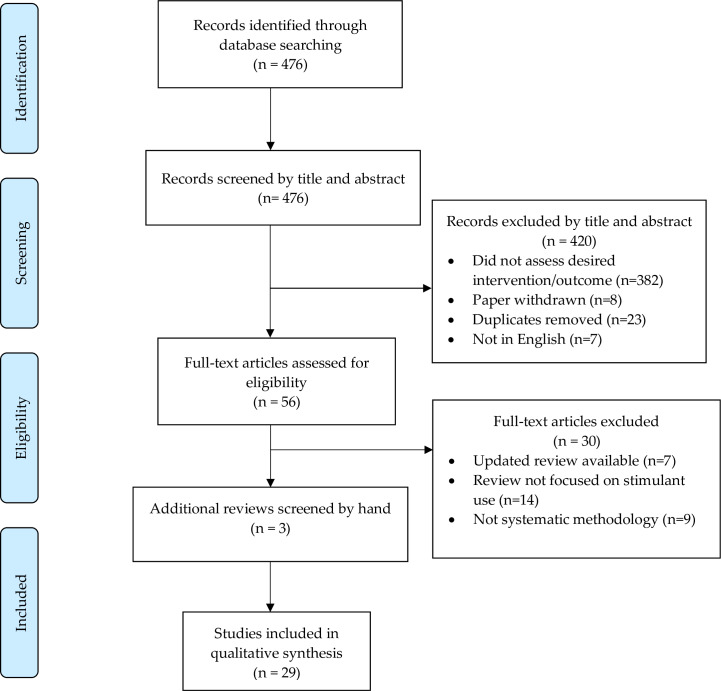
AIMS: Stimulant use disorder contributes to a substantial worldwide burden of disease, although evidence-based treatment options are limited. This systematic review of reviews aims to: (i) synthesize the available evidence on both psychosocial and pharmacological interventions for the treatment of stimulant use disorder; (ii) identify the most effective therapies to guide clinical practice, and (iii) highlight gaps for future study. METHODS: A systematic database search was conducted to identify systematic reviews and meta-analyses. Eligible studies were those that followed standard systematic review methodology and assessed randomized controlled trials focused on the efficacy of interventions for stimulant use disorder. Articles were critically appraised using an assessment tool adapted from Palmeteer et al. and categorized for quality as 'core' or 'supplementary' reviews. Evidence from the included reviews were further synthesized according to pharmacological or non-pharmacological management themes. RESULTS: Of 476 identified records, 29 systematic reviews examining eleven intervention modalities were included. The interventions identified include: contingency management, cognitive behavioural therapy, acupuncture, antidepressants, dopamine agonists, antipsychotics, anticonvulsants, disulfiram, opioid agonists, N-Acetylcysteine, and psychostimulants. There was sufficient evidence to support the efficacy of contingency management programs for treatment of stimulant use disorder. Psychostimulants, n-acetylcysteine, opioid agonist therapy, disulfiram and antidepressant pharmacological interventions were found to have insufficient evidence to support or discount their use. Results of this review do not support the use of all other treatment options. CONCLUSIONS: The results of this review supports the use of contingency management interventions for the treatment of stimulant use disorder. Although evidence to date is insufficient to support the clinical use of psychostimulants, our results demonstrate potential for future research in this area. Given the urgent need for effective pharmacological treatments for stimulant use disorder, high-quality primary research focused on the role of psychostimulant medications for the treatment of stimulant use disorder is needed.
Overview
The claims and statistics of this paper haven’t been checked yet.
Free: it reads the open-access text and checks the first 5 claims that cite a source we can check. Create a free account to check every claim.
Integrity signals
Registry
Cites
Statistics
Figures
Verification
Claims the paper makes
The claims and statistics of this paper haven’t been checked yet.
Free: it reads the open-access text and checks the first 5 claims that cite a source we can check. Create a free account to check every claim.
Claims other papers make about this one
Each is checked against this paper’s own text: does it say what the citing paper says it does?
The source backs part of the claim, not all of it — or backs it for a different population, condition or comparison.
In the citing paper
“Cochrane reviews have consistently highlighted the insufficiency of evidence to establish the effectiveness of certain psychotherapies for various SUDs, whether accompanied by comorbidity or not.”
From Navigating the Complex Intersection of Substance Use and Psychiatric Disorders: A Comprehensive Review (2024) · cites this paper as [48]
Experimental — accuracy not yet measuredThe source backs part of the claim, not all of it — or backs it for a different population, condition or comparison.
In the citing paper
“Evidence-based strategies, including contingency management (CM), cognitive-behavioral therapy (CBT), dialectical behavior therapy (DBT), motivational interviewing (MI), acceptance and commitment therapy (ACT), and family-based interventions, have demonstrated their effectiveness in reducing substance use and enhancing treatment outcomes”
From Navigating the Complex Intersection of Substance Use and Psychiatric Disorders: A Comprehensive Review (2024) · cites this paper as [48]
Experimental — accuracy not yet measuredThe cited source says what the claim attributes to it.
In the citing paper
“An example of this shortfall is the inadequacy of high-quality research regarding the effectiveness of CBT in the treatment of stimulant use disorders [47,48,58].”
From Navigating the Complex Intersection of Substance Use and Psychiatric Disorders: A Comprehensive Review (2024) · cites this paper as [48]
Self-check
Percentages, sums and reported differences re-computed from the paper’s own numbers.
The self-check needs the paper’s full text.
Citations
Cites
Diagnostic and Statistical Manual of Mental Disorders
American Psychiatric Association (2013) · doi:10.1176/appi.books.9780890425596 · Cited by 116,369
Diagnostic and Statistical Manual of Mental Disorders
Williams, J. B. W., & First, M. (2013) · Encyclopedia of Social Work · doi:10.1093/acrefore/9780199975839.013.104 · Cited by 109,519
Preferred Reporting Items for Systematic Reviews and Meta-Analyses: the PRISMA statement
Moher, D., Liberati, A., Tetzlaff, J., Altman, D. G., & for the PRISMA Group (2009) · BMJ · doi:10.1136/bmj.b2535 · Cited by 83,823
Preferred Reporting Items for Systematic Reviews and Meta-Analyses: The PRISMA Statement
Moher, D., Liberati, A., Tetzlaff, J., Altman, D. G., & The PRISMA Group (2009) · PLoS Medicine · doi:10.1371/journal.pmed.1000097 · Cited by 64,042
Preferred reporting items for systematic reviews and meta-analyses: the PRISMA Statement.
(2009) · PubMed Central · Cited by 44,859
Methadone maintenance therapy versus no opioid replacement therapy for opioid dependence
Mattick, R. P., Breen, C., Kimber, J., & Davoli, M. (2009) · Cochrane Database of Systematic Reviews · doi:10.1002/14651858.cd002209.pub2 · Cited by 1,654
Methodology in conducting a systematic review of systematic reviews of healthcare interventions
Smith, V., Devane, D., Begley, C. M., & Clarke, M. (2011) · BMC Medical Research Methodology · doi:10.1186/1471-2288-11-15 · Cited by 1,227
Polysubstance use: diagnostic challenges, patterns of use and health
Connor, J. P., Gullo, M. J., White, A., & Kelly, A. B. (2014) · Current Opinion in Psychiatry · doi:10.1097/yco.0000000000000069 · Cited by 461
Management of opioid use disorders: a national clinical practice guideline
Bruneau, J., Ahamad, K., Goyer, M.-È., Poulin, G., Selby, P., Fischer, B., Wild, T. C., & Wood, E. (2018) · Canadian Medical Association Journal · doi:10.1503/cmaj.170958 · Cited by 412
Self-citationPeirce, J. M., Petry, N. M., Stitzer, M. L., Blaine, J., Kellogg, S., Satterfield, F., Schwartz, M., Krasnansky, J., Pencer, E., Silva-Vazquez, L., et al. (2006) · Archives of General Psychiatry · doi:10.1001/archpsyc.63.2.201 · Cited by 304 · cited 2×
“In a trial by Peirce et al., the intervention was successful at just $1.46 per participant per day, rather than an average cost of $120 per day that has been previously reported [54].”
Influential
Research works printed but not linked: 3
- Kelly M, Swann C, Killoran A, Naidoo B, Barnett-Paige E, Morgan A. Methodological problems in constructing the evidence base in public health. Health Development Agency Public Health Evidence Steering Group Methodology Reference Group Starter Paper. 2002; 9.
- Ellis S, Barnett-Page E, Morgan A, Taylor L, Walters R, Goodrich J. HIV prevention: A review of reviews assessing the effectiveness of interventions to reduce the risk of sexual transmission: Evidence briefing 2003.
- Castells X, Kosten TR, Capella D, Vidal X, Colom J, Casas M. Efficacy of opiate maintenance therapy and adjunctive interventions for opioid dependence with comorbid cocaine use disorders: A systematic review and meta-analysis of controlled clinical trials. 20180662
Cited by
Items 201–222 of 222
Bozman, M., Collier, B. S., Malhotra, A., McPherson, G. E., & Li, L. (2026) · Frontiers in Psychiatry · doi:10.3389/fpsyt.2026.1740412
Wellness-enhanced contingency management for stimulant use: A formative qualitative study
Deshais, M. A., Norton, L., Tkac, V., Digioia-laird, V., & Swarbrick, M. A. (2026) · Digital Health · doi:10.1177/20552076261426320
Barkil-Oteo, A., Rayes, D., El‐Khani, A., & Almoshmosh, N. (2026) · International Review of Psychiatry · doi:10.1080/09540261.2026.2628306
“Contingency Management (providing motivational incentives for verified abstinence) and Cognitive Behavioral Therapy (CBT) are the most evidence-based interventions for stimulant use disorders (Ronsley et al., 2020).”
Владимирович, Л. Е., Shustov, D. I., Дмитриевна, Т. О., Петров, Д. С., & Fedotov, I. A. (2026) · Vestnik nevrologii psihiatrii i nejrohirurgii (Bulletin of Neurology Psychiatry and Neurosurgery) · doi:10.33920/med-01-2602-08
Kumar, J., Iezhitsa, I. N., & Agarwal, R. (2026) · Discover Neuroscience · doi:10.1186/s13064-026-00249-6 · Cited by 2
McKenzie, K. L., Getz, T., Ebersole, J., Steck, A., Lynch, A. L., Patel, K., Johnson, L., McKee, S. A., Wheatley, M., Giordano, N. A., et al. (2026) · Journal of the American College of Emergency Physicians Open · doi:10.1016/j.acepjo.2026.100359
Transdiagnostic Pharmacology of Addictions: Current Evidence and Future Perspectives
da Silveira, S. P. L., de Aguiar, B. B., Ruwel, A. G., Martins, P. F., Lewis, D. G., Moura, H. F., Peglow, M. T., DIEMEN, L. V., Gil, A., & Kessler, F. H. P. (2026) · Future Pharmacology · doi:10.3390/futurepharmacol6020019
“…studies addressing impulsivity point to the central involvement of cortico–striato–thalamo–cortical (CSTC) networks, encompassing prefrontal cortices (orbitofrontal, anterior cingulate, and dorsolateral), the nucleus accumbens, and the direct, indirect, and hyperdirect striatal pathways [55,68,69].”
German, D., Nassau, T., Yenokyan, K., Li, X., Bornstein, S., Drezner, K., Hoj, T. H., Gribbin, M., Flynn, C. P., Brady, K. A., et al. (2026) · AIDS and Behavior · doi:10.1007/s10461-026-05098-2
“Recently released clinical practice guidelines for stimulant use disorder treatment [13] highlight the urgency of developing effective therapeutics [ 56, 57] - as there are currently no FDA-approved pharmacological treatments for stimulants - and the need for appropriate interventions for sexual…”
Service utilization patterns in cocaine use disorder: A data-driven study
Riemerschmid, C., Schwarzkopf, L., Koller, G., de Matos, E. G., Neumeier, E., Olderbak, S. G., & Hoch, E. (2026) · Drug and Alcohol Dependence Reports · doi:10.1016/j.dadr.2026.100447
“However, CM is rarely implemented in routine care often due to financial constraints or ethical concerns (Bentzley et al., 2021; Kampman, 2019; Ronsley et al., 2020).”
Vroom, E. B., Finley, E. P., & Potter, J. S. (2026) · Addiction Science & Clinical Practice · doi:10.1186/s13722-026-00678-y
“For example, contingency management, supported by decades of robust evidence for treating cocaine and methamphetamine use disorders, is still rarely implemented due to stigma (e.g., it can be seen as rewarding drug use), cost, and implementation challenges [4, 10].”
Piot, A., Sharpe, C., Vuckovic, C., McGaff, C., Scott, J., Hope, V. D., Platt, L., & Harris, M. (2026) · International Journal of Drug Policy · doi:10.1016/j.drugpo.2026.105371
de la Peña, I., Row, J., & Shi, W.-X. (2026) · Expert Opinion on Pharmacotherapy · doi:10.1080/14656566.2026.2697064
“The integration of pharmacotherapy with CM, CBT, community reinforcement approaches, and peer recovery support services represents the current standard for optimizing outcomes [13,28–30].”
Medical Symptoms and Psychiatric Comorbidities in People with Methamphetamine Use Disorder
Marín-Navarrete, R., Sánchez-Domínguez, R., Fernández-Cáceres, C., & Saracco-Álvarez, R. A. (2026) · Journal of Dual Diagnosis · doi:10.1080/15504263.2026.2686086
“Also, there are currently no records of psychosocial (De Crescenzo et al., 2018; Ronsley et al., 2020) and pharmacological (Chan et al., 2019; Ronsley et al., 2020) interventions that have been shown to be effective for methamphetamine use.”
Garrod, E., Robinson, K., McCrae, K., Nicholson, M., Choi, J., Socias, M. E., & Fairbairn, N. S. (2026) · Journal of Addiction Medicine · doi:10.1097/adm.0000000000001730
Self-citationPham, J., Harrison, T. K., Mariano, E. R., Kumar, G., & Hunter, O. O. (2026) · Journal of Addiction Medicine · doi:10.1097/adm.0000000000001752
Challenges in Anti-addiction Drug Development: Lost in Translation?
Li, J. (2026) · Neuropharmacology and Therapy · doi:10.15212/npt-2026-0011
Gündüz, G. B., Dedeler, M., Vatansever, M., Kaya, H., & Erden, G. (2026) · Current Psychology · doi:10.1007/s12144-026-09821-z
“…hinder effective rehabilitation and successful social reintegration, as evi - dence indicates that treatment outcomes and recidivism are strongly influenced by the type of justice response and the level of criminal justice involvement (Moore et al., 2020; Ronsley et al., 2020 ; Tomaz et al., 2023).”
DePew, R. E., Dussault, N. E., Quirk, K. C., Vipler, E., Borris, J. B., DiScala, S., Scheel, T., Nickels, K., Robbins-Welty, G. A., & Ho, J. (2026) · Journal of Palliative Medicine · doi:10.1177/10966218261478398
A Systematic Review on the Effectiveness of Cognitive Behavioral Therapy in Substance Use Disorders
Gülsatar, E. C., & Balkır, F. (2026) · Addiction Science Reviews · doi:10.35365/asr.26.2.09
Hodgins, D. C., Yi, J., Wallace, A., Lynch, L. M., Ethier, A. R., Long, L., & Cowie, M. (2026) · The Canadian Journal of Psychiatry · doi:10.1177/07067437261477550
The use of Drosophila to study sleep impairments in stimulant use disorder
Miles, M., Karatas, M., & Rothenfluh, A. (2026) · Frontiers in Cell and Developmental Biology · doi:10.3389/fcell.2026.1913395
Vroom, E. B., Finley, E. P., Bolton, C. D., Karns-Wright, T., & Potter, J. S. (2026) · Drug and Alcohol Review · doi:10.1111/dar.70247 · Cited by 1
Metadata
- Authors
- Ronsley, C., Nolan, S., Knight, R., Hayashi, K., Klimas, J., Walley, A., Wood, E., & Fairbairn, N.
- Affiliations
- University of British Columbia (CA)
- Simon Fraser University (CA)
- Boston University (US)
- Corresponding author
- Fairbairn, Nadia
- Venue
- PLOS ONE
- Publisher
- Public Library of Science (PLoS)
- Published
- 2020-06-18
- Volume
- 15
- Issue
- 6
- Pages
- e0234809
- ISSN
- 1932-6203 (ISSN-L)
- PMC
- PMC7302911
- OpenAlex
- W3036747176
- Cited by
- 222
- References
- 76
- Citations by year
- 2026: 29 · 2025: 46 · 2024: 48 · 2023: 40 · 2022: 27 · 2021: 26 · 2020: 6
- FWCI
- 3.61
- Type
- journal article
- Language
- en
- Open access
- gold
- doi.org
- Licence
- Locations
- PLoS ONE (publishedVersion, cc-by)
- PubMed Central (publishedVersion, cc-by)
- PubMed (publishedVersion)
- Lenus, The Irish Health Repository (Dr Steevens Hospital Library) (submittedVersion)
- Arrow@dit (Dublin Institute of Technology) (submittedVersion, cc-by-nc-nd)
- RePEc: Research Papers in Economics (submittedVersion)
- DOAJ (DOAJ: Directory of Open Access Journals) (submittedVersion, cc-by-sa)
- Research Repository UCD (University College Dublin) (submittedVersion, cc-by-nc-nd)
- Lenus, The Irish Health Repository (Dr Steevens Hospital Library) (submittedVersion, cc-by)
- Funders
- Michael Smith Foundation for Health Research
- St. Paul's Foundation
- Canada Research Chair in Addiction Medicine
- Canadian Institute of Health Research (MSH - 141971)
- University of British Columbia Steven Diamond Professorship in Addiction Care Innovation
- European Commission (701698)
- Collaboration for Leadership in Applied Health Research and Care - Greater Manchester (671 397968, 422332)
- Topics
- Health Sciences › Medicine › Epidemiology › Substance Abuse Treatment and Outcomes
- Health Sciences › Medicine › Public Health, Environmental and Occupational Health › Opioid Use Disorder Treatment
- Social Sciences › Psychology › Clinical Psychology › Gambling Behavior and Treatments
- Keywords
- stimulant use disorder, cocaine dependence, treatment efficacy, contingency management, psychostimulants, N-acetylcysteine, opioid substitution therapy, disulfiram, antidepressants, dopamine agonists, antipsychotic drugs, antiepileptic drugs, acupuncture, cognitive behavioral therapy, psychosocial interventions, pharmacological interventions
- MeSH terms
- Central Nervous System Stimulants, Anticonvulsants, Antidepressive Agents, Humans, Antipsychotic Agents, Cognitive Behavioral Therapy, Dopamine Agonists, Substance-Related Disorders, Acupuncture
About these checks
Registry, retraction, Cites and statistics results are computed, not judged, with one exception: a printed reference that no index lists is read once by a model before it counts as a citation error. Claims are extracted by a model and kept only when their quote appears verbatim in the text; each cited source is then checked, with a model’s help, for whether it says what the claim relies on. Those verdicts can be wrong — read the claim’s quote and the cited source before relying on one.
Statistics and arithmetic are recomputed, not judged.
Confidence bands are shown only for fields calibrated on our annotated test set. None is calibrated yet, so no band is shown.
What counts as a claim ›How we measure confidence ›How we check this ›
Are you an author, or do you see a problem with this page? Request a review
Data sources
Bibliographic data: Semantic Scholar, OpenAlex, Crossref.
Contains information from the Semantic Scholar Academic Graph Datasets, made available under the ODC Attribution License (ODC-BY 1.0).
Semantic Scholar’s data is described in: Kinney, R., et al. (2023). The Semantic Scholar Open Data Platform. arXiv:2301.10140.
