

An exploratory Study of EEG Alpha Oscillation and Pupil Dilation in Hearing-Aid Users During Effortful listening to Continuous Speech
Open accessThe DOI matches its Crossref record; 72 of the 72 references it cites were found in a registry or an index; 5 of the 77 sources its claims cite were checked for support.
Abstract
Individuals with hearing loss allocate cognitive resources to comprehend noisy speech in everyday life scenarios. Such a scenario could be when they are exposed to ongoing speech and need to sustain their attention for a rather long period of time, which requires listening effort. Two well-established physiological methods that have been found to be sensitive to identify changes in listening effort are pupillometry and electroencephalography (EEG). However, these measurements have been used mainly for momentary, evoked or episodic effort. The aim of this study was to investigate how sustained effort manifests in pupillometry and EEG, using continuous speech with varying signal-to-noise ratio (SNR). Eight hearing-aid users participated in this exploratory study and performed a continuous speech-in-noise task. The speech material consisted of 30-second continuous streams that were presented from loudspeakers to the right and left side of the listener (±30° azimuth) in the presence of 4-talker background noise (+180° azimuth). The participants were instructed to attend either to the right or left speaker and ignore the other in a randomized order with two different SNR conditions: 0 dB and -5 dB (the difference between the target and the competing talker). The effects of SNR on listening effort were explored objectively using pupillometry and EEG. The results showed larger mean pupil dilation and decreased EEG alpha power in the parietal lobe during the more effortful condition. This study demonstrates that both measures are sensitive to changes in SNR during continuous speech.
Overview
CoChat Summary
TL;DR
In eight hearing-aid users listening to 30-second continuous Danish news clips, lower SNR (more effortful) produced larger mean pupil dilation and lower parietal EEG alpha power, while frontal theta did not change. Pupillometry and alpha were each sensitive to SNR but did not correlate with each other.
Key findings
- Behavioral performance was significantly higher in high SNR than low SNR: 76.7% vs. 61.8% correct, t(7) = 5.56, p = 0.001.
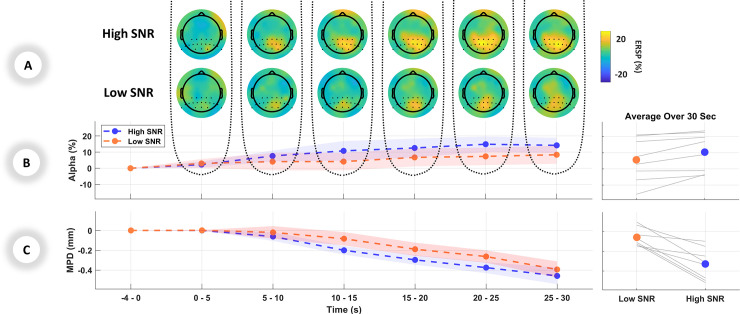
- Mean pupil dilation (MPD) was significantly larger in low SNR than high SNR, F(1,46) = 18.65, p < 0.001; no SNR × Time interaction was found (p = 0.836), and the difference in MPD was not significant (F(1,46) = 2.685, p = 0.108).
- Parietal alpha ERSP was significantly lower in low SNR than high SNR, F(1,46) = 4.63, p = 0.037; no SNR × Time interaction was found (p = 0.899). Frontal theta showed no significant SNR effect, F(1,46) = 0.860, p = 0.358.
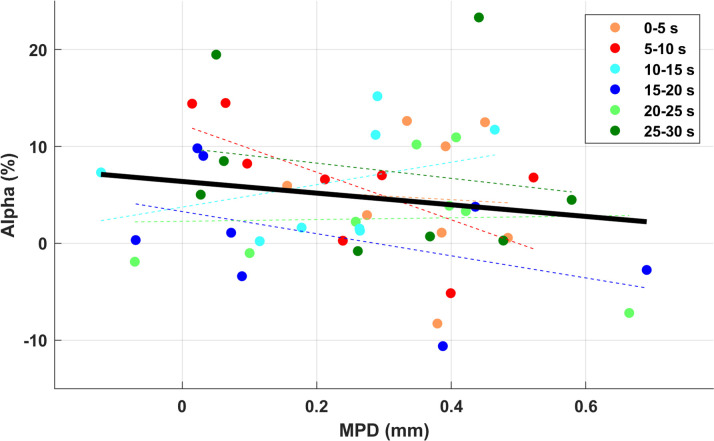
- No significant partial correlation was found between MPD difference and alpha power difference with Time as covariate, r(45) = -0.168, p = 0.258; alpha lateralization also showed no significant difference between hemispheres, F(1,46) = 0.049, p = 0.826.
Methods
- Eight native Danish-speaking hearing-aid users (2 females), average age 70 ± 12 years, with symmetrical mild sensorineural hearing loss and pure-tone average of 31 ± 5.5 dB HL; fitted binaurally with Oticon Opn1 mRITE hearing aids with noise reduction and directional microphones deactivated.
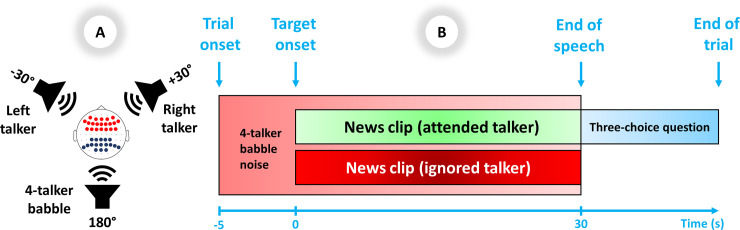
- Continuous speech-in-noise task: 108 trials (54 per SNR), with 30-second Danish news clips presented from ±30° azimuth and 4-talker babble from +180° azimuth at SNRs of 0 dB and -5 dB; a three-choice question followed each trial.
- Pupillometry measured MPD, and EEG measured event-related spectral perturbation for theta (4–8 Hz) and alpha (8–13 Hz); repeated-measures ANCOVA used SNR as predictor and Time as covariate, plus partial correlation between MPD and alpha differences.
Limitations
- Stated: the low number of participants (n = 8) limits statistical validation, although normality was checked with Kolmogorov-Smirnov and Q-Q plots.
- Stated: the study manipulated task demand via SNR but could not rule out individual-related or motivational factors shaping listening effort.
- Evident from the text: this was an exploratory study with no retention phase; the null MPD–alpha correlation and null alpha lateralization are unexplained, and the authors suggest background babble and bilateral aiding may have obscured lateralization.
Model-written summary. Check it against the paper before relying on it.
Integrity signals
Registry
Cites
Statistics
Figures
Verification
Claims the paper makes
2 Valid · 2 Not valid · 38 Not checked · 49 Own results and interpretations
Some cited sources support this claim and some don’t — read each source’s verdict below.
In the paper
“After all, the driving mechanisms for pupil dilation and alpha power originate from different areas in the nervous system.”
§ An exploratory Study of EEG Alpha Oscillation and Pupil Dilation in Hearing-Aid Users During Effortful listening to Continuous Speech > Discussion > Pupil dilation and alpha power correlation
What the sources say
- Partly supportedcites [63] Murphy P. R., O’Connell R. G., O’Sullivan M., Robertson I. H., and Balsters J. H., “ Pupil diameter covaries with BOLD activity in human locus coeruleus,” Hum. Brain Mapp., 2014. PMC6869043 24510607 sourceExperimental — accuracy not yet measured
Our copy of Murphy et al. (2014) supports only the pupil-dilation half of the claim: the DISCUSSION (p. ~4150) ties pupillary dynamics to brainstem autonomic nuclei ('the dorsal pontine activation cluster extended rostral and medial to the LC proper... correlations between pupil diameter and the activity of several autonomic nuclei residing in this general area that are known to directly regulate pupillary dynamics [e.g., the Edinger-Westphal nucleus]'), alongside peri-LC BOLD coupling (Abstract; RESULTS) and sympathetic/ventral-medulla contributions (MATERIALS AND METHODS; DISCUSSION). The paper is a simultaneous pupillometry–fMRI study of the LC–NA system and contains no EEG or alpha-band content: searches for 'alpha power oscillations EEG', 'alpha band oscillation neuroelectric' and 'pupil dilation and alpha power different nervous system origins' returned no passage mentioning alpha power at all. Thus the comparative assertion that the driving mechanisms of pupil dilation and alpha power originate in *different* nervous-system areas is not attributable to this source; only the neural-origin side concerning the pupil is. (LLM, conf=0.70)
- Disputedcites [64] Reimer J. et al., “ Pupil fluctuations track rapid changes in adrenergic and cholinergic activity in cortex,” Nat. Commun., 2016. PMC5105162 27824036 sourceExperimental — accuracy not yet measured
Our copy argues the opposite of the attributed point: the Abstract states that rapid variations in cortical state 'during both quiet waking and locomotion, are highly correlated with fluctuations in the activity of corticopetal noradrenergic and cholinergic projections' and that 'the pupil can be used to sensitively track the activity in multiple neuromodulatory transmitter systems as they control the state of the waking brain' — i.e., a shared, overlapping neuromodulatory basis for pupil diameter and cortical state rather than separate origins. The Discussion ('What are the neural pathways that couple brain state and pupil diameter together?'; 'unique, but overlapping, contributions to the control of cortical networks') frames LC-noradrenergic and basal-forebrain-cholinergic inputs as jointly coupling both. Moreover, the paper never measures alpha power; it refers only to suppression of low-frequency rhythmic cortical activity/LFP, so the specific pupil-versus-alpha contrast is not something this source reports. (LLM, conf=0.68)
Checked by a reasoning model — may be wrong.
- Partly supportedcites [21] Obleser J., Wostmann M., Hellbernd N., Wilsch A., and Maess B., “ Adverse Listening Conditions and Memory Load Drive a Common Alpha Oscillatory Network,” J. Neurosci., 2012. PMC6621258 22956828 sourceExperimental — accuracy not yet measured
Our copy of Obleser et al. (2012) supplies only the alpha side of the comparison: the Discussion (Source localization / Discussion pp.) states that delay-period alpha power emerged mainly from posterior parietal cortex, extending into the SMG/TPJ, precuneus and posterior cingulate cortex, i.e. a defined cortical parieto-cingulate generator network. However, the paper never mentions pupil dilation, pupillometry or autonomic/locus-coeruleus drivers (searched: pupil dilation, pupillometry, autonomic sympathetic arousal; the only ocular measure is the bipolar EOG used for artifact rejection), so the asserted contrast between the two measures' driving origins is not made in this source. (LLM, conf=0.65)
plain- Asserted: passes — The authors put it forward as true.
- Checkable: passes — It can be checked against evidence.
- Load-bearing: passes — The paper’s conclusions depend on it.
- Based: passes — The paper gives a reason why it holds.
- Partly supported
The cited sources support only part of this claim — read each source’s verdict below.
In the paper
“While both pupil dilation and EEG alpha power have been widely used for detecting changes in listening effort, they have not been reported to correlate to one other during tasks involving short duration stimuli [36].”
§ An exploratory Study of EEG Alpha Oscillation and Pupil Dilation in Hearing-Aid Users During Effortful listening to Continuous Speech > Introduction
What the sources say
- Partly supportedcites [36] Miles K. et al., “ Objective Assessment of Listening Effort: Coregistration of Pupillometry and EEG,” Trends Hear., 2017. PMC5536372 28752807 sourceExperimental — accuracy not yet measured
Our copy supports the framing half of the claim: the Abstract states pupil dilation and EEG are 'the most-cited physiological measures' with clinical potential to assess listening effort, and the Results ('Correlation Between Pupil Size and Alpha Power Change', plus Table 1) report no significant within-individual correlation between the two, with stimuli that were brief (BKB-A sentences ending at the 3.5 s timepoint, EEG epoch −1 to 5 s). However, the paper never asserts the broader literature-level negative the claim carries — that a correlation 'has not been reported' specifically for tasks involving short-duration stimuli; stimulus duration is not offered as a qualifier anywhere, and the Discussion instead credits the non-correlation to prior work in speech (McMahon et al., 2016) and in the reading domain (Scharinger, Kammerer, & Gerjets, 2015). So the source is a study showing no correlation under short stimuli, not a statement that no such correlation has ever been reported. (LLM, conf=0.72)
plain- Asserted: passes — The authors put it forward as true.
- Checkable: passes — It can be checked against evidence.
- Load-bearing: passes — The paper’s conclusions depend on it.
- Based: passes — The paper gives a reason why it holds.
- Partly supported
The cited sources support only part of this claim — read each source’s verdict below.
In the paper
“They have shown that in more difficult acoustic scenarios, larger PPD and MPD are measures of increased listening effort [25].”
§ An exploratory Study of EEG Alpha Oscillation and Pupil Dilation in Hearing-Aid Users During Effortful listening to Continuous Speech > Introduction
What the sources say
- Partly supportedcites [25] Zekveld A. A., Koelewijn T., and Kramer S. E., “ The Pupil Dilation Response to Auditory Stimuli: Current State of Knowledge,” Trends in Hearing. 2018. PMC6156203 30249172 sourceExperimental — accuracy not yet measured
The review supports the substance of the claim: the Discussion ("Regarding the studies to the effect of external factors...") states that increasing the degradation level will generally increase the pupil dilation response as long as demands on capacity do not exceed available capacity, and the Results section records a "general consensus (in line with Beatty, 1982) that, independent from the analysis method, the larger the task-evoked pupil dilation response, the higher the cognitive resource allocation." What the source does not support is the specific dual attribution to peak pupil dilation (PPD) and mean pupil dilation (MPD): the Results section explicitly says the parameters differed between studies (examples given are absolute pupil size and peak response relative to baseline) and that "we do not compare the specific parameters analyzed in the reviewed studies," and the Discussion frames the choice of which measure to use as still open (citing Pichora-Fuller et al., 2016). Mean pupil dilation is not treated as a validated listening-effort measure anywhere in our copy, and the claim also drops the source's caveat that the response is inverse-U-shaped, falling at very low intelligibility levels (Results, "Input-Related Demands and the Task-Evoked Pupil Dilation Response"). (LLM, conf=0.72)
boostedstates an association- Asserted: passes — The authors put it forward as true.
- Checkable: passes — It can be checked against evidence.
- Load-bearing: passes — The paper’s conclusions depend on it.
- Based: passes — The paper gives a reason why it holds.
- Partly supported
A result the paper reports from its own data — it cites no other source for it, so there is none to check. The quote shows it is in the paper.
In the paper
“The partial correlation between the difference of MPD and alpha power with Time factor as covariance did not show any significant result [r(45) = -0.168, p = 0.258]”
§ An exploratory Study of EEG Alpha Oscillation and Pupil Dilation in Hearing-Aid Users During Effortful listening to Continuous Speech > Results > Listening effort
plain- Asserted: passes — The authors put it forward as true.
- Checkable: passes — It can be checked against evidence.
- Load-bearing: unclear — It is unclear whether the paper’s conclusions depend on it.
- Based: passes — The paper gives a reason why it holds.
A result the paper reports from its own data — it cites no other source for it, so there is none to check. The quote shows it is in the paper.
In the paper
“For alpha lateralization, the difference between “attended right” and “attended left” in the right and left hemispheres did not show any significant difference [F(1,46) = 0.049, p = 0.826]”
§ An exploratory Study of EEG Alpha Oscillation and Pupil Dilation in Hearing-Aid Users During Effortful listening to Continuous Speech > Results > Alpha lateralization
plain- Asserted: passes — The authors put it forward as true.
- Checkable: passes — It can be checked against evidence.
- Load-bearing: unclear — It is unclear whether the paper’s conclusions depend on it.
- Based: passes — The paper gives a reason why it holds.
29 more claims
Create a free account to see all 91 claims and to verify the 71 references still open.
- It may state two separate claims as one. 25
- Probably not a substantial claim. 44
Claims other papers make about this one
Each is checked against this paper’s own text: does it say what the citing paper says it does?
In the citing paper
“In a design similar to our current study, an increase of parietal alpha power under higher SNRs was found (Seifi Ala et al., 2020).”
From Hearing Aid Noise Reduction Lowers the Sustained Listening Effort During Continuous Speech in Noise—A Combined Pupillometry and EEG Study (2021) · cites this paper as Seifi Ala et al., 2020
Statistics recomputed
Every reported test result, recomputed from its test statistic and degrees of freedom. A result shows as not adding up only once an independent check has confirmed it.
- Consistentt(7) = 5.56reported p = .001 · recomputed p < .001
“t(7) = 5.56, p = .001”
- ConsistentF(1, 46) = 18.65reported p < .001 · recomputed p < .001
“F(1,46) = 18.65, p < .001”
- ConsistentF(1, 46) = 0.044reported p = .836 · recomputed p = .835
“F(1,46) = 0.044, p = .836”
- ConsistentF(1, 46) = 2.685reported p = .108 · recomputed p = .108
“F(1,46) = 2.685, p = .108”
- ConsistentF(1, 46) = 2.132reported p = .151 · recomputed p = .151
“F(1,46) = 2.132, p = .151”
6 more recomputed tests
Create a free account to see every test the Stats check recomputed.
Self-check
Percentages, sums and reported differences re-computed from the paper’s own numbers.
Self-check results appear here once an independent check has confirmed them.
Citations
Cites
Delorme, A., & Makeig, S. (2004) · Journal of Neuroscience Methods · doi:10.1016/j.jneumeth.2003.10.009 · Cited by 24,371
(2017) · Cited by 16,319
Welch, P. (1967) · IEEE Transactions on Audio and Electroacoustics · doi:10.1109/tau.1967.1161901 · Cited by 12,277
Alpha-band oscillations, attention, and controlled access to stored information
Klimesch, W. (2012) · Trends in Cognitive Sciences · doi:10.1016/j.tics.2012.10.007 · Cited by 3,310 · cited 1×
“One theory explains that increased alpha is a sign of suppression of unattended sound sources [56] and inhibition of task-irrelevant cortical regions [57], which as a consequence should increase alpha with increased difficulty.”
BackgroundShaping Functional Architecture by Oscillatory Alpha Activity: Gating by Inhibition
Jensen, O., & Mazaheri, A. (2010) · Frontiers in Human Neuroscience · doi:10.3389/fnhum.2010.00186 · Cited by 3,237
Gevins, A. (1997) · Cerebral Cortex · doi:10.1093/cercor/7.4.374 · Cited by 1,623
(2002) · Cited by 1,481
Hearing Impairment and Cognitive Energy: The Framework for Understanding Effortful Listening (FUEL)
Pichora-Fuller, M. K., Kramer, S. E., Eckert, M. A., Edwards, B., Hornsby, B. W. Y., Humes, L. E., Lemke, U., Lunner, T., Matthen, M., Mackersie, C. L., et al. (2016) · Ear & Hearing · doi:10.1097/aud.0000000000000312 · Cited by 1,318 · cited 2×
“Listening effort has been defined as “the deliberate allocation of mental resources to overcome obstacles in goal pursuit when carrying out a [listening] task” [19].”
BackgroundSelf-citationJensen, O. (2002) · Cerebral Cortex · doi:10.1093/cercor/12.8.877 · Cited by 1,203
Pupil fluctuations track rapid changes in adrenergic and cholinergic activity in cortex
Reimer, J., McGinley, M. J., Liu, Y., Rodenkirch, C., Wang, Q., McCormick, D. A., & Tolias, A. S. (2016) · Nature Communications · doi:10.1038/ncomms13289 · Cited by 926 · cited 1×
“Pupil diameter is suggested to reflect different neuro-modulatory systems such as locus coeruleus– noradrenergic (LC-NE) which increases task-relevant neuronal gain in cerebral cortex in rapid dilations [63] or basal forebrain which modulates the state of cortical activity during sustained activity [64].”
Background
Research works printed but not linked: 3
- Mathers C., Smith A., and Concha M., “ Global burden of hearing loss in the year 2000,” Glob. Burd. Dis., 2001.
- Teplan M., “ xxFundamentals of EEG measurement,” Meas. Sci. Rev., 2002.
- Wisniewski M. G., Iyer N., Thompson E. R., and Simpson B. D., “ Sustained frontal midline theta enhancements during effortful listening track working memory demands,” Hear. Res., vol. 358, pp. 37– 41, 2018 10.1016/j.heares.2017.11.009 29249546 · DOI · Paper page
Cited by
COVID-19 and Sudden Sensorineural Hearing Loss: A Systematic Review
Meng, X., Wang, J., Sun, J., & Zhu, K. (2022) · Frontiers in Neurology · doi:10.3389/fneur.2022.883749 · Cited by 92
Fiedler, L., Seifi Ala, T., Graversen, C., Alickovic, E., Lunner, T., & Wendt, D. (2021) · Ear & Hearing · doi:10.1097/aud.0000000000001050 · Cited by 80
Self-citationCreating Clarity in Noisy Environments by Using Deep Learning in Hearing Aids
Andersen, A. H., Santurette, S., Pedersen, M. S., Alickovic, E., Fiedler, L., Jensen, J., & Behrens, T. R. (2021) · Seminars in Hearing · doi:10.1055/s-0041-1735134 · Cited by 69
Self-citationPaul, B. T., Chen, J., Le, T., Lin, V., & Dimitrijevic, A. (2021) · PLoS ONE · doi:10.1371/journal.pone.0254162 · Cited by 65
Electrophysiological biomarkers of behavioral dimensions from cross-species paradigms
Cavanagh, J. F., Gregg, D., Light, G. A., Olguin, S. L., Sharp, R. F., Bismark, A. W., Bhakta, S. G., Swerdlow, N. R., Brigman, J. L., & Young, J. W. (2021) · Translational Psychiatry · doi:10.1038/s41398-021-01562-w · Cited by 51
EEG alpha and pupil diameter reflect endogenous auditory attention switching and listening effort
Haro, S., Rao, H. M., Quatieri, T. F., & Smalt, C. J. (2022) · European Journal of Neuroscience · doi:10.1111/ejn.15616 · Cited by 41
Shields, C., Sladen, M., Bruce, I. A., Kluk, K., & Nichani, J. (2023) · Trends in Hearing · doi:10.1177/23312165221137116 · Cited by 43
Eye Movements Decrease during Effortful Speech Listening
Cui, M. E., & Herrmann, B. (2023) · Journal of Neuroscience · doi:10.1523/jneurosci.0240-23.2023 · Cited by 33
Bsharat-Maalouf, D., Degani, T., & Karawani, H. (2023) · Trends in Hearing · doi:10.1177/23312165231205107 · Cited by 27
Prince, P., Paul, B. T., Chen, J., Le, T., Lin, V. W., & Dimitrijevic, A. (2021) · European Journal of Neuroscience · doi:10.1111/ejn.15365 · Cited by 27
EEG power spectral dynamics associated with listening in adverse conditions
Wisniewski, M. G., Zakrzewski, A. C., Bell, D. R., & Wheeler, M. (2021) · Psychophysiology · doi:10.1111/psyp.13877 · Cited by 24
Alpha Oscillations During Effortful Continuous Speech: From Scalp EEG to Ear-EEG
Ala, T. S., Aličković, E., Cabrera, A. F., Whitmer, W. M., Hadley, L. V., Rank, M. L., Lunner, T., & Graversen, C. (2022) · IEEE Transactions on Biomedical Engineering · doi:10.1109/tbme.2022.3214428 · Cited by 23
Self-citationKraus, F., Tune, S., Obleser, J., & Herrmann, B. (2023) · Journal of Neuroscience · doi:10.1523/jneurosci.2181-22.2023 · Cited by 20
Keur‐Huizinga, L., Kramer, S. E., de Geus, E. J. C., & Zekveld, A. A. (2024) · Ear and Hearing · doi:10.1097/aud.0000000000001508 · Cited by 21
Combining Multiple Psychophysiological Measures of Listening Effort: Challenges and Recommendations
Richter, M. M., Buhiyan, T., Bramsløw, L., Innes-Brown, H., Fiedler, L., Hadley, L. V., Naylor, G., Saunders, G. H., Wendt, D., Whitmer, W. M., et al. (2023) · Seminars in Hearing · doi:10.1055/s-0043-1767669 · Cited by 18
Self-citationCarta, S., Aličković, E., Zaar, J., Valdés, A. L., & Liberto, G. M. D. (2024) · PLoS ONE · doi:10.1371/journal.pone.0308554 · Cited by 18
Time Scales and Moments of Listening Effort Revealed in Pupillometry
Winn, M. B. (2023) · Seminars in Hearing · doi:10.1055/s-0043-1767741 · Cited by 17
Kahya, M., Liao, K., Gustafson, K. M., Akinwuntan, A., Manor, B. D., & Devos, H. (2022) · Sensors · doi:10.3390/s22155594 · Cited by 16
Speech recognition in noise task among children and young-adults: a pupillometry study
Trau-Margalit, A., Fostick, L., Harel-Arbeli, T., Gannot, R. N., & Taitelbaum‐Swead, R. (2023) · Frontiers in Psychology · doi:10.3389/fpsyg.2023.1188485 · Cited by 15
Cartocci, G., Inguscio, B. M. S., Giliberto, G., Vozzi, A., Giorgi, A., Greco, A., Babiloni, F., & Attanasio, G. (2023) · Brain Sciences · doi:10.3390/brainsci13071084 · Cited by 15
Impact of Effortful Word Recognition on Supportive Neural Systems Measured by Alpha and Theta Power
Ryan, D. B., Eckert, M. A., Sellers, E. W., Schairer, K. S., McBee, M. T., Jones, M. R., & Smith, S. L. (2022) · Ear and Hearing · doi:10.1097/aud.0000000000001211 · Cited by 13
Speech to noise ratio improvement induces nonlinear parietal phase synchrony in hearing aid users
Baboukani, P. S., Graversen, C., Alickovic, E., & Østergaard, J. (2022) · Frontiers in Neuroscience · doi:10.3389/fnins.2022.932959 · Cited by 13
Self-citationXiu, B., Paul, B. T., Chen, J. M., Le, T., Lin, V., & Dimitrijevic, A. (2022) · Frontiers in Human Neuroscience · doi:10.3389/fnhum.2022.1043499 · Cited by 13
An Exploratory Study of the Effect of Tinnitus on Listening Effort Using EEG and Pupillometry
Sendesen, E., Kılıç, S., Erbil, N., Aydın, Ö., & Türkyılmaz, M. D. (2023) · Otolaryngology · doi:10.1002/ohn.367 · Cited by 13
Cartocci, G., Inguscio, B. M. S., Giorgi, A., Vozzi, A., Leone, C. A., Grassia, R., Nardo, W. D., Cesare, T. D., Fetoni, A. R., Freni, F., et al. (2023) · PLoS ONE · doi:10.1371/journal.pone.0288461 · Cited by 13
Attention Mobilization as a Modulator of Listening Effort: Evidence From Pupillometry
Johns, M., Calloway, R. C., Karunathilake, I. M. D., Decruy, L. P., Anderson, S., Simon, J. Z., & Kuchinsky, S. E. (2024) · Trends in Hearing · doi:10.1177/23312165241245240 · Cited by 13
He, X., Raghavan, V., & Mesgarani, N. (2025) · Imaging Neuroscience · doi:10.1162/imag.a.126 · Cited by 11
EEG Phase Synchrony Reflects SNR Levels During Continuous Speech-in-Noise Tasks
Baboukani, P. S., Graversen, C., Alickovic, E., & Østergaard, J. (2021) · Annual International Conference of the IEEE Engineering in Medicine and Biology Society (EMBC) · doi:10.1109/embc46164.2021.9630139 · Cited by 11
Self-citationVillard, S., Perrachione, T. K., Lim, S.-J., Alam, A., & Kidd, G. D. (2023) · The Journal of the Acoustical Society of America · doi:10.1121/10.0020539 · Cited by 10
Effortful Listening Produces Both Enhancement and Suppression of Alpha in the EEG
Wisniewski, M. G., & Zakrzewski, A. C. (2023) · Auditory Perception & Cognition · doi:10.1080/25742442.2023.2218239 · Cited by 10
Woods, S. J., Silcox, J. W., & Payne, B. R. (2024) · Auditory Perception & Cognition · doi:10.1080/25742442.2024.2395217 · Cited by 8
Eye movements of younger and older adults decrease during story listening in background noise
Herrmann, B., Scharf, F., & Widmann, A. (2025) · Hearing Research · doi:10.1016/j.heares.2025.109447 · Cited by 7
Acoustically Transparent Hearing Aids Increase Physiological Markers of Listening Effort
Kemper, M., Denk, F., Husstedt, H., & Obleser, J. (2025) · Trends in Hearing · doi:10.1177/23312165251333225 · Cited by 6
Impact of Single‐Side Deafness on Listening Effort: A Prospective Comparative Study
Su, W., Xia, Y., Xia, C., Zhang, Y., Zhang, Y., & Liu, Y. (2025) · Laryngoscope Investigative Otolaryngology · doi:10.1002/lio2.70185 · Cited by 6
Neural correlates of listening to nonnative-accented speech in multi-talker background noise
Liu, Y., & van Hell, J. G. (2024) · Neuropsychologia · doi:10.1016/j.neuropsychologia.2024.108968 · Cited by 7
Pouliot, J. J., Ward, R. T., Traiser, C. M., Chiasson, P., Gilbert, F. E., & Keil, A. (2025) · Journal of Cognitive Neuroscience · doi:10.1162/jocn_a_02276 · Cited by 6
Hunter, C. R. (2022) · Frontiers in Neuroscience · doi:10.3389/fnins.2022.915349 · Cited by 6
Streamlining experiment design in cognitive hearing science using OpenSesame
Sulas, E., Hasan, P.-Y., Zhang, Y., & Patou, F. (2022) · Behavior Research Methods · doi:10.3758/s13428-022-01886-5 · Cited by 6
Neurophysiology of Effortful Listening: Decoupling Motivational Modulation from Task Demands
Kraus, F., Roß, B., Herrmann, B., & Obleser, J. (2024) · Journal of Neuroscience · doi:10.1523/jneurosci.0589-24.2024 · Cited by 6
Plain, B., Pielage, H., Kramer, S. E., Richter, M. M., Saunders, G. H., Versfeld, N. J., Zekveld, A. A., & Bhuiyan, T. A. (2024) · Trends in Hearing · doi:10.1177/23312165241232551 · Cited by 5
Carta, S., Aličković, E., Zaar, J., Valdés, A. L., & Liberto, G. M. D. (2026) · PLoS Biology · doi:10.1371/journal.pbio.3003876 · Cited by 4
Using Alpha-Band Power to Evaluate Hearing Aid Directionality Based on Multistream Architecture
Slugocki, C., Kuk, F. K., & Korhonen, P. (2024) · American Journal of Audiology · doi:10.1044/2024_aja-24-00117 · Cited by 4
Polo, E. M., Simeone, D., Mollura, M., Paglialonga, A., & Barbieri, R. (2024) · Journal of Neuroscience Methods · doi:10.1016/j.jneumeth.2024.110348 · Cited by 3
Reduced listening effort with adaptive binaural beamforming in realistic noisy environments
Valderrama, J. T., Mejia, J., Wong, A., Herbert, N. C., & Edwards, B. (2025) · Scientific Reports · doi:10.1038/s41598-025-95045-3 · Cited by 3
Aperiodic neural activity during speech comprehension in aging: Insights into cognitive effort
Woods, S. J., Silcox, J. W., & Payne, B. R. (2025) · Cognitive Affective & Behavioral Neuroscience · doi:10.3758/s13415-025-01356-3 · Cited by 2
Baboukani, P. S., Aličković, E., Østergaard, J., & Eskelund, K. (2026) · European Journal of Neuroscience · doi:10.1111/ejn.70466 · Cited by 2
Sendesen, E., & Türkyılmaz, M. D. (2025) · Brain and Behavior · doi:10.1002/brb3.70306 · Cited by 2
Changes in pupil size track self-control failure
O’Bryan, S. R., Price, M., Alquist, J. L., Davis, T. H., & Scolari, M. (2024) · Experimental Brain Research · doi:10.1007/s00221-024-06781-3 · Cited by 2
Herrmann, J., Fiedler, L., Wendt, D., Santurette, S., Husstedt, H., & Jürgens, T. (2025) · Trends in Hearing · doi:10.1177/23312165251336652 · Cited by 1
Self-citationResolving competition in auditory cortex: effects of emotional content and misophonia sensitivity
Ahumada, L., Gilbert, F. E., Ward, R. T., Pouliot, J. J., Mears, R. P., & Keil, A. (2026) · Cerebral Cortex · doi:10.1093/cercor/bhag021 · Cited by 1
Objective assessment of the "listening effort" in audiology
Ghiselli, S., & Cuda, D. (2021) · Otorhinolaryngology · doi:10.23736/s2724-6302.21.02373-2 · Cited by 1
Chen, Z., Zhang, Y., Zhang, Z., Ren, L., Wei, C., & Liu, Y. (2021) · Research Square · doi:10.21203/rs.3.rs-732585/v1 · Cited by 1
Xiu, B. (2022) · TSpace (University of Toronto) · Cited by 1
Evaluating listening effort with electroencephalography in ecological situations
Ala, T. S. (2022) · Nottingham ePrints (University of Nottingham) · Cited by 1
MAESTRO: a Multimodal Auditory-attention Egocentric Speech-TRacking Open corpusPreprint
Hassan, K. M. N., Alavi, A., & Williamson, D. S. (2026) · arXiv (Cornell University) · doi:10.48550/arxiv.2609.31898 · Cited by 1
From Global to local Functional Connectivity: Application to Listening Effort
Baboukani, P. S. (2022) · VBN Forskningsportal (Aalborg Universitet) · doi:10.54337/aau527272197
Effort allocation during speech perception: Insights from pupillometry
Lebiecka-Johansen, P. A. (2023) · doi:10.5463/thesis.332
CORTICAL CHARACTERISTICS OF LISTENING EFFORT
Mohammadi, Y. (2023) · VBN Forskningsportal (Aalborg Universitet) · doi:10.54337/aau561816351
Validity and reliability of self‐reported and neural measures of listening effort
Mohammadi, Y., Østergaard, J., Graversen, C., Andersen, O. K., & Manresa, J. A. B. (2023) · European Journal of Neuroscience · doi:10.1111/ejn.16187
Self-citationThe Cardiovascular Response During Speech Reception
Samra, B. J. (2024) · doi:10.5463/thesis.894
The Parietal Local Connectivity Reflects Impacts of Hearing Aids Noise Reduction on Listening Effort
Baboukani, P. S., Alickovic, E., & Østergaard, J. (2025) · International Conference on Information Fusion (FUSION) · doi:10.23919/fusion65864.2025.11123892
Self-citationYao, X., Liu, H., Gu, F., Jin, Y., Zhang, X., Ni, T., Si, J., Ding, X., Zhao, Y., & Zheng, Y. (2025) · Ear and Hearing · doi:10.1097/aud.0000000000001727
Listening effort in age-related hearing loss
Slade, K., & McGarrigle, R. (2025) · Elsevier eBooks · doi:10.1016/b978-0-443-29198-2.00008-4
Visual Speech Reduces Cognitive Effort as Measured by EEG Theta Power and Pupil Dilation
Man, B. K. L., Wendt, D., Ng, E. H. N., Eskelund, K., & Andersen, T. (2025) · eNeuro · doi:10.1523/eneuro.0288-25.2025
Self-citationPepper, J. L. (2025) · Lancaster EPrints (Lancaster University) · doi:10.17635/lancaster/thesis/2715
Algorismes per a processament del so en persones autistes amb hiperacusia
Castaño Martos, A., & d'Enginyeria, U. A. D. B. E. (2025) · Dipòsit Digital de Documents de la UAB (Universitat Autònoma de Barcelona)
Speech Perception and Auditory Attention in Noisy and Multi-Talker Environments
Haro, S. (2023) · Digital Access to Scholarship at Harvard (DASH) (Harvard University)
Şenli, F. D., Ozkan, A., Acartürk, C., & Çınar, B. Ç. (2026) · European Archives of Oto-Rhino-Laryngology · doi:10.1007/s00405-025-10000-2
Yogarajah, P. P. (2025) · TSpace (University of Toronto)
Baboukani, P. S., Ordoñez, R., Gravesen, C., Østergaard, J., Rank, M. L., Aličković, E., & Cabrera, A. F. (2026) · bioRxiv (Cold Spring Harbor Laboratory) · doi:10.64898/2026.03.13.711289
Use of pupillometry in the assessment of listening effort : a methodological approach
Seropian, L. (2021) · theses.fr (ABES) · doi:10.70675/40b9e683z4f4bz4536zbb99z0f7a7a72d5ee
Kang, S., Lee, S. M., Baik, S., & Seol, H. Y. (2026) · Institute of Brain-based Education Korea National University of Education · doi:10.31216/bdl.2026.16.1.1
Dimitrijevic, A., & Paul, B. (2021) · OSF Preprints (OSF Preprints)
Malekmohammadi, A., Rauschecker, J. P., & Cheng, G. (2026) · NeuroImage · doi:10.1016/j.neuroimage.2026.122073
Signal-specific performance of in-ear EEG: strengths and limitations
Frei, V., Mainar, P., Fritz, T., Chardon, J.-M., & Giroud, N. (2026) · Frontiers in Neuroscience · doi:10.3389/fnins.2026.1859327
Naderipalangi, F. (2026) · UTUPub (University of Turku)
Physiology-Informed Audio Quality and Listening Effort EstimationPreprint
McGuire, N., & Emmanouilidou, D. (2026) · arXiv (Cornell University) · doi:10.48550/arxiv.2610.36865
Baboukani, P. S., Graversen, C., Alickovic, E., & Østergaard, J. (2022) · doi:10.3389/fnins.2022.932959.s001
Self-citation
Metadata
- Authors
- Seifi Ala, T., Graversen, C., Wendt, D., Alickovic, E., Whitmer, W. M., & Lunner, T.
- Affiliations
- Oticon (Denmark) (DK)
- Linköping University (SE)
- University of Nottingham (GB)
- Venue
- PLOS ONE
- Publisher
- Public Library of Science (PLoS)
- Published
- 2020-07-10
- Volume
- 15
- Issue
- 7
- Pages
- e0235782
- ISSN
- 1932-6203 (ISSN-L)
- PMC
- PMC7351195
- OpenAlex
- W3041288035
- Semantic Scholar
- a4b9ed1b2558ff11d2a853011fa6c7df5da87099
- Cited by
- 80
- References
- 72
- Citations by year
- 2026: 12 · 2025: 15 · 2024: 12 · 2023: 16 · 2022: 14 · 2021: 11
- FWCI
- 8.89
- Type
- journal article
- Language
- en
- Open access
- gold
- doi.org
- Licence
- Locations
- PLoS ONE (publishedVersion, cc-by)
- Repository@Nottingham (University of Nottingham) (publishedVersion, cc-by)
- PubMed (publishedVersion)
- PubMed Central (publishedVersion, cc-by)
- DiVA (Linkoping University) (submittedVersion, other-oa)
- DOAJ (DOAJ: Directory of Open Access Journals) (submittedVersion, cc-by-sa)
- Technical University of Denmark, DTU Orbit (Technical University of Denmark, DTU) (submittedVersion, other-oa)
- Funders
- H2020 Marie Skłodowska-Curie Actions (765329)
- Medical Research Council (MR/S003576/1)
- Topics
- Health Sciences › Health Professions › Speech and Hearing › Hearing Loss and Rehabilitation
- Physical Sciences › Computer Science › Signal Processing › Speech and Audio Processing
- Life Sciences › Neuroscience › Sensory Systems › Hearing, Cochlea, Tinnitus, Genetics
- Keywords
- listening effort, hearing loss, hearing aids, speech perception in noise, connected speech, signal-to-noise ratio, pupil dilation, pupillometry, EEG alpha power, parietal lobe, sustained attention, auditory attention
- MeSH terms
- Aged, Aged, 80 and over, Auditory Perception, Electroencephalography, Female, Hearing, Hearing Aids, Hearing Tests, Humans, Male, Middle Aged, Pupil, Speech Perception, Signal-To-Noise Ratio
About these checks
Registry, retraction, Cites and statistics results are computed, not judged, with one exception: a printed reference that no index lists is read once by a model before it counts as a citation error. Claims are extracted by a model and kept only when their quote appears verbatim in the text; each cited source is then checked, with a model’s help, for whether it says what the claim relies on. Those verdicts can be wrong — read the claim’s quote and the cited source before relying on one.
The claim verdicts this report counts are experimental: their accuracy is not yet measured.
A language model drew the claims from the paper on 2026-11-19, under version 3 of the claim definition (model deepseek-v4.1-flash, prompt extract-v3).
A second model labelled each claim on 2026-11-19 (model jev-1.13-20260917, definition revision gold-guideline-v0.2).
Cited sources are checked with a language model’s help (qwen3.8-omni-flash).
Statistics and arithmetic are recomputed, not judged.
Confidence bands are shown only for fields calibrated on our annotated test set. None is calibrated yet, so no band is shown.
What counts as a claim ›How we measure confidence ›How we check this ›
Are you an author, or do you see a problem with this page? Request a review
Data sources
Bibliographic data: Semantic Scholar, OpenAlex, Crossref.
Contains information from the Semantic Scholar Academic Graph Datasets, made available under the ODC Attribution License (ODC-BY 1.0).
Semantic Scholar’s data is described in: Kinney, R., et al. (2023). The Semantic Scholar Open Data Platform. arXiv:2301.10140.
