

The DOI matches its Crossref record; 96 of the 96 references it cites were found in a registry or an index.
The female side of pharmacotherapy for ADHD—A systematic literature review
Open accessAbstract
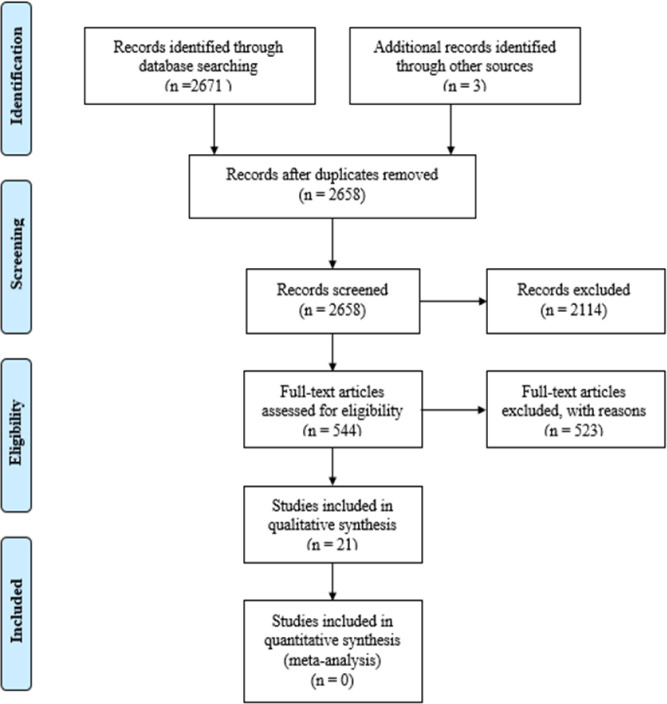
OBJECTIVE: This comprehensive review examined sex differences in prescription rates and efficacy or effectiveness of pharmacotherapy treatment in girls and women with attention deficit hyperactivity disorder (ADHD), while identifying gaps in the scientific knowledge on this topic. METHOD: A rigorous electronic database search was carried out in order to identify all published studies on female-specific effects of stimulants and non-stimulants in the treatment of ADHD. In total, 2672 studies were screened of which 21 studies (seven on prescription rates, 14 on effects of pharmacotherapy) met the inclusion criteria and were included for analysis. RESULTS: In all seven studies on ADHD prescription rates, girls received significantly less prescriptions than boys, a difference however no longer seen in adults with the exception of one study. Each of the 14 studies on effectiveness / efficacy found at least one sex-difference in the effects of ADHD pharmacotherapy. CONCLUSION: Several sex-differences are demonstrated in the prescription, usage and efficacy /effectiveness of both stimulant and non-stimulant ADHD pharmacotherapy. A single daily use of MPH may possibly not be optimal for girls with ADHD and ATX may be a promising medication for girls and women with ADHD. The robustness of this result requires further investigation.
Overview
The claims and statistics of this paper haven’t been checked yet.
Run the check — free, no account needed. It reads the open-access text and checks the sources it cites.
Integrity signals
Registry
Cites
Statistics
Figures
Verification
Claims the paper makes
The claims and statistics of this paper haven’t been checked yet.
Run the check — free, no account needed. It reads the open-access text and checks the sources it cites.
Claims other papers make about this one
Each is checked against this paper’s own text: does it say what the citing paper says it does?
The source backs part of the claim, not all of it — or backs it for a different population, condition or comparison.
In the citing paper
“Additionally, during periods of low oestrogen, increased ADHD symptoms [30,41,91,92] and decreased response to psychostimulant medication [25,42,93,94,95] have been described.”
From A Female-Specific Treatment Group for ADHD—Description of the Programme and Qualitative Analysis of First Experiences (2024) · cites this paper as [25]
Experimental — accuracy not yet measuredThe source backs part of the claim, not all of it — or backs it for a different population, condition or comparison.
In the citing paper
“We developed this female-specific treatment option in response to the dire need expressed by many [1,17,19,23,24,25,26,28,41,55,85], including patients.”
From A Female-Specific Treatment Group for ADHD—Description of the Programme and Qualitative Analysis of First Experiences (2024) · cites this paper as [25]
Experimental — accuracy not yet measured
Self-check
Percentages, sums and reported differences re-computed from the paper’s own numbers.
The self-check needs the paper’s full text.
Citations
Cites
Diagnostic and Statistical Manual of Mental Disorders
American Psychiatric Association (2013) · doi:10.1176/appi.books.9780890425596 · Cited by 116,369
Diagnostic and Statistical Manual of Mental Disorders
Williams, J. B. W., & First, M. B. (2013) · Oxford University Press eBooks · doi:10.1093/acrefore/9780199975839.013.104 · Cited by 109,845
Attention Deficit Hyperactivity Disorder: A Handbook for Diagnosis and Treatment
Barkley, R. A., & Poillion, M. J. (1994) · Behavioral Disorders · doi:10.1177/019874299401900205 · Cited by 4,635
Subcommittee on Attention-Deficit/Hyperactivity Disorder, S. C. O. Q. I. A. M. (2011) · Pediatrics · doi:10.1542/peds.2011-2654 · Cited by 2,185
The Prevalence of DSM-IV Attention-Deficit/Hyperactivity Disorder: A Meta-Analytic Review
Willcutt, E. G. (2012) · Neurotherapeutics · doi:10.1007/s13311-012-0135-8 · Cited by 2,160
Attention Deficit Hyperactivity Disorder. A Handbook for Diagnosis and Treatment
Silver, L. B. (1991) · Journal of the American Academy of Child & Adolescent Psychiatry · doi:10.1097/00004583-199107000-00040 · Cited by 1,395
Danielson, M. L., Bitsko, R. H., Ghandour, R. M., Holbrook, J. R., Kogan, M. D., & Blumberg, S. J. (2018) · Journal of Clinical Child & Adolescent Psychology · doi:10.1080/15374416.2017.1417860 · Cited by 1,181
Greenhill, L. L., Pliszka, S., & Dulcan, M. K. (2002) · Journal of the American Academy of Child & Adolescent Psychiatry · doi:10.1097/00004583-200202001-00003 · Cited by 927
A Meta-Analytic Review of Gender Differences in ADHD
Gershon, J., & Gershon, J. (2002) · Journal of Attention Disorders · doi:10.1177/108705470200500302 · Cited by 875
Attention-Deficit Hyperactivity Disorder: A Handbook for Diagnosis and Treatmen, 3rd ed.
Lyon, G. J., & Coffey, B. J. (2008) · The Journal of Clinical Psychiatry · doi:10.4088/jcp.v69n0621a · Cited by 757
Research works printed but not linked: 2
- P. Hodgkins, 2012, Amfetamine and methylphenidate pharmacotherapys for attention-deficit/hyperactivity disorder: Complementary treatment options. European Child &, Adolescent Psychiatry, 21, 477, 10.1007/s00787-012-0286-5 · DOI · Paper page
- J. M. Swanson, 1992, School-based assessments and interventions for ADD students
Cited by
Sorted by citations
Hinshaw, S. P., Nguyen, P. T., O’Grady, S. M., & Rosenthal, E. A. (2022) · Journal of Child Psychology and Psychiatry · doi:10.1111/jcpp.13480 · Cited by 424
Sex and gender in neurodevelopmental conditions
Bölte, S., Neufeld, J., Marschik, P. B., Williams, Z. J., Gallagher, L., & Lai, M.-C. (2023) · Nature Reviews Neurology · doi:10.1038/s41582-023-00774-6 · Cited by 249
Why are females less likely to be diagnosed with ADHD in childhood than males?
Martin, J. (2024) · The Lancet Psychiatry · doi:10.1016/s2215-0366(24)00010-5 · Cited by 200
Brikell, I., Yao, H., Li, L., Astrup, A., Gao, L., Gillies, M. B., Xie, T., Zhang‐James, Y., Dalsgaard, S., Engeland, A., et al. (2023) · The Lancet Psychiatry · doi:10.1016/s2215-0366(23)00332-2 · Cited by 96
Methylphenidate for attention-deficit/hyperactivity disorder in adults: a narrative review
Jaeschke, R. R., Sujkowska, E., & Sowa-Kućma, M. (2021) · Psychopharmacology · doi:10.1007/s00213-021-05946-0 · Cited by 105
Metadata
- Authors
- Kok, F. M., Groen, Y., Fuermaier, A. B. M., & Tucha, O.
- Affiliations
- University of Groningen (NL)
- Corresponding author
- Kok, Francien M.
- Venue
- PLOS ONE
- Publisher
- Public Library of Science (PLoS)
- Published
- 2020-09-18
- Volume
- 15
- Issue
- 9
- Pages
- e0239257
- ISSN
- 1932-6203 (ISSN-L)
- PMC
- PMC7500607
- OpenAlex
- W3087626112
- Cited by
- 86
- References
- 95
- Citations by year
- 2026: 12 · 2025: 26 · 2024: 14 · 2023: 13 · 2022: 15 · 2021: 6
- FWCI
- 1.41
- Type
- journal article
- Language
- en
- Open access
- gold
- doi.org
- Licence
- Locations
- PLoS ONE (publishedVersion, cc-by)
- PubMed Central (publishedVersion, cc-by)
- PubMed (publishedVersion)
- University of Groningen research database (University of Groningen / Centre for Information Technology) (publishedVersion, cc-by)
- DOAJ (DOAJ: Directory of Open Access Journals) (submittedVersion, cc-by-sa)
- University of Groningen research database (University of Groningen / Centre for Information Technology) (submittedVersion, cc-by)
- Topics
- Health Sciences › Medicine › Psychiatry and Mental health › Attention Deficit Hyperactivity Disorder
- Health Sciences › Medicine › Pediatrics, Perinatology and Child Health › Pharmaceutical studies and practices
- Social Sciences › Arts and Humanities › Philosophy › Neuroethics, Human Enhancement, Biomedical Innovations
- Keywords
- attention deficit hyperactivity disorder, ADHD medication, sex differences, girls, women, stimulant medication, non-stimulant medication, methylphenidate, atomoxetine, prescription rates, treatment efficacy
- MeSH terms
- Atomoxetine Hydrochloride, Adolescent, Adult, Central Nervous System Stimulants, Attention Deficit Disorder with Hyperactivity, Child, Child, Preschool, Female, Humans, Male, Men, Methylphenidate, Drug Prescriptions, Sex Characteristics, Databases, Factual, Young Adult
About these checks
Registry, retraction, Cites and statistics results are computed, not judged, with one exception: a printed reference that no index lists is read once by a model before it counts as a citation error. Claims are extracted by a model and kept only when their quote appears verbatim in the text; each cited source is then checked, with a model’s help, for whether it says what the claim relies on. Those verdicts can be wrong — read the claim’s quote and the cited source before relying on one.
Statistics and arithmetic are recomputed, not judged.
Confidence bands are shown only for fields calibrated on our annotated test set. None is calibrated yet, so no band is shown.
What counts as a claim ›How we measure confidence ›How we check this ›
Are you an author, or do you see a problem with this page? Request a review
