

The DOI matches its Crossref record; 56 of the 56 references it cites were found in a registry or an index.
Twitter reveals human mobility dynamics during the COVID-19 pandemic
Open accessAbstract
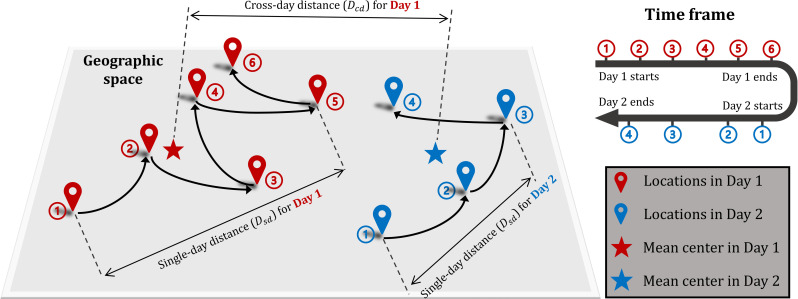
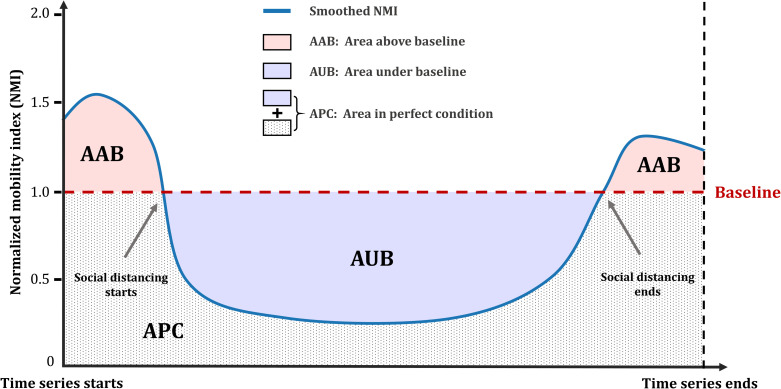
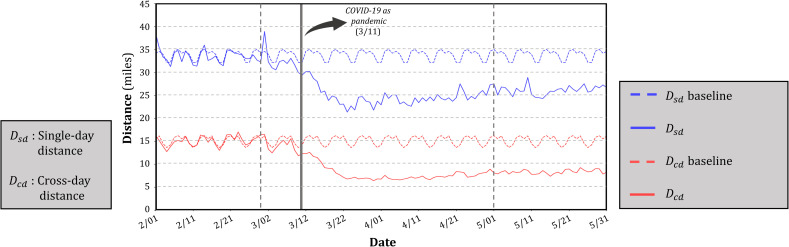
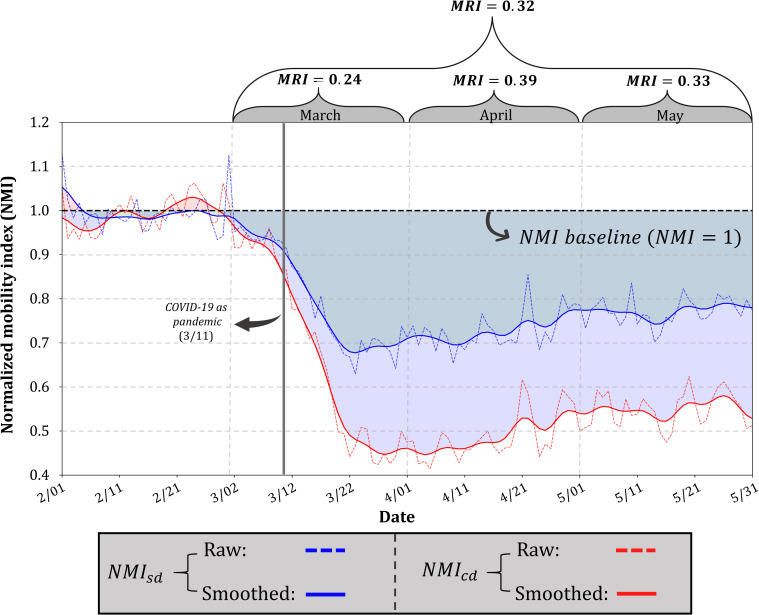
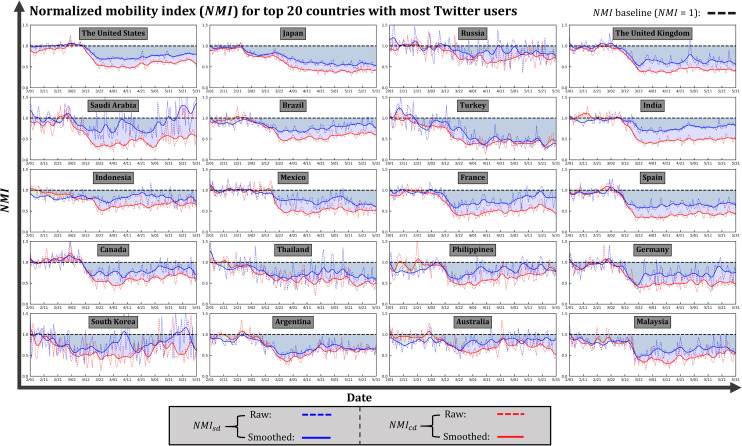
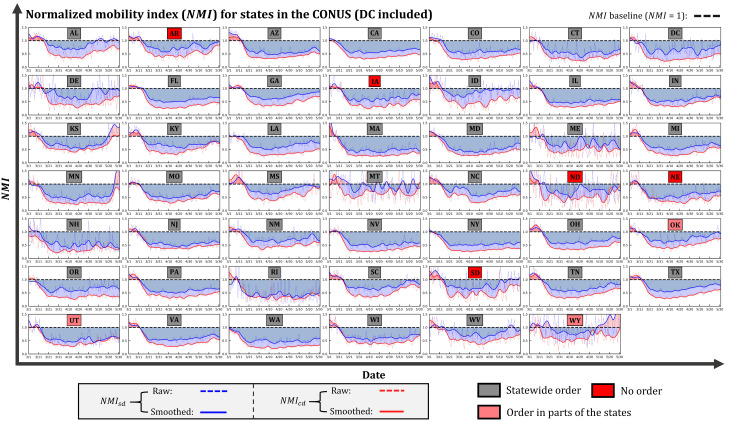
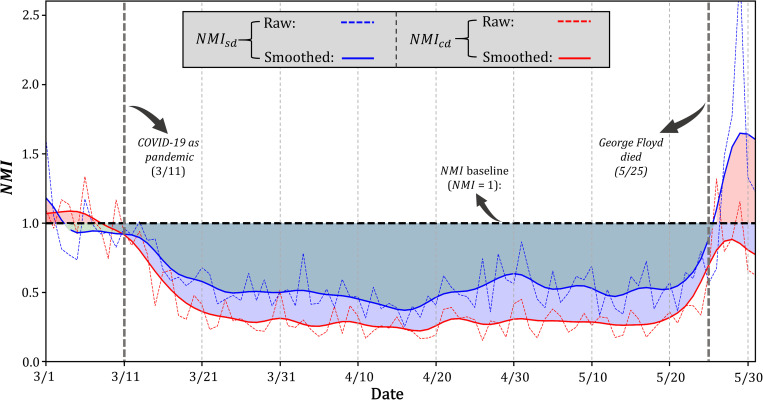
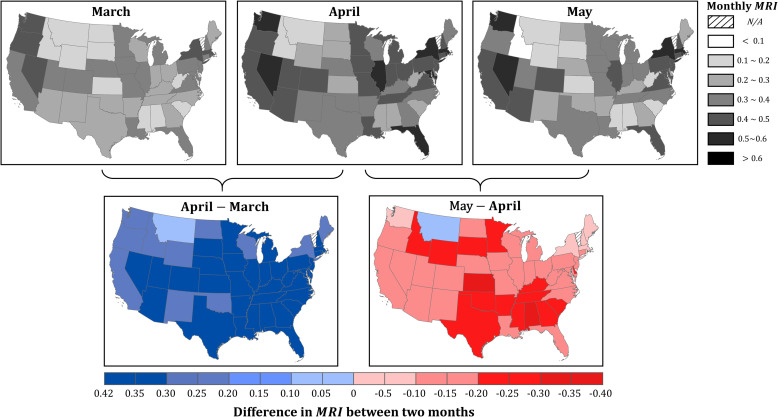
The current COVID-19 pandemic raises concerns worldwide, leading to serious health, economic, and social challenges. The rapid spread of the virus at a global scale highlights the need for a more harmonized, less privacy-concerning, easily accessible approach to monitoring the human mobility that has proven to be associated with viral transmission. In this study, we analyzed over 580 million tweets worldwide to see how global collaborative efforts in reducing human mobility are reflected from the user-generated information at the global, country, and U.S. state scale. Considering the multifaceted nature of mobility, we propose two types of distance: the single-day distance and the cross-day distance. To quantify the responsiveness in certain geographic regions, we further propose a mobility-based responsive index (MRI) that captures the overall degree of mobility changes within a time window. The results suggest that mobility patterns obtained from Twitter data are amenable to quantitatively reflect the mobility dynamics. Globally, the proposed two distances had greatly deviated from their baselines after March 11, 2020, when WHO declared COVID-19 as a pandemic. The considerably less periodicity after the declaration suggests that the protection measures have obviously affected people’s travel routines. The country scale comparisons reveal the discrepancies in responsiveness, evidenced by the contrasting mobility patterns in different epidemic phases. We find that the triggers of mobility changes correspond well with the national announcements of mitigation measures, proving that Twitter-based mobility implies the effectiveness of those measures. In the U.S., the influence of the COVID-19 pandemic on mobility is distinct. However, the impacts vary substantially among states.
Overview
The claims and statistics of this paper haven’t been checked yet.
Run the check — free, no account needed. It reads the open-access text and checks the sources it cites.
Integrity signals
Registry
Cites
Statistics
Figures
Verification
Claims the paper makes
The claims and statistics of this paper haven’t been checked yet.
Run the check — free, no account needed. It reads the open-access text and checks the sources it cites.
Self-check
Percentages, sums and reported differences re-computed from the paper’s own numbers.
The self-check needs the paper’s full text.
Citations
Cites
Understanding individual human mobility patterns
González, M. C., Hidalgo, C. A., & Barabási, A.-Ĺ. (2008) · Nature · doi:10.1038/nature06958 · Cited by 6,186 · cited 1×
“Studies have shown that mobility may vary regularly on a monthly basis [62, 63], and the variations differ geographically due to the different cultural and societal settings.”
Background4 What Is Web 2.0? Design Patterns and Business Models for the Next Generation of Software
O’Reilly, T. (2012) · New York University Press eBooks · doi:10.18574/nyu/9780814764077.003.0008 · Cited by 5,623
Citizens as sensors: the world of volunteered geography
Goodchild, M. F. (2007) · GeoJournal · doi:10.1007/s10708-007-9111-y · Cited by 4,611 · cited 2×
“Since the initial outbreak of COVID-19, numerous efforts have been made, by incorporating the emerging concept of “Web 2.0” [14], “Big Data” [15], and “Citizen as Sensors” [16], to obtain timely information regarding whether people are actively reducing their exposure to COVID-19 by reducing distances traveled, and by…”
BackgroundInfluentialQiu, J., Shen, B., Zhao, M., Wang, Z., Xie, B., & Xu, Y. (2020) · General Psychiatry · doi:10.1136/gpsych-2020-100213 · Cited by 4,307
The effect of travel restrictions on the spread of the 2019 novel coronavirus (COVID-19) outbreak
Chinazzi, M., Davis, J. T., Ajelli, M., Gioannini, C., Litvinova, M., Merler, S., Pastore y Piontti, A., Mu, K., Rossi, L., Sun, K., et al. (2020) · Science · doi:10.1126/science.aba9757 · Cited by 3,694
Big Data : The Management Revolution
マカフィー, ア., ブリニョルフソン, エ., & 有賀, 裕. (2013) · Harvard business review · Cited by 3,545
The effect of human mobility and control measures on the COVID-19 epidemic in China
Kraemer, M. U. G., Yang, C.-H., Gutiérrez, B., Wu, C., Klein, B., Pigott, D. M., open COVID-19 data working group, du Plessis, L., Faria, N. R., Li, R., et al. (2020) · Science · doi:10.1126/science.abb4218 · Cited by 2,987 · cited 2×
“An initial outbreak of COVID-19 was first declared in Wuhan, China in January 2020 [2], before cases were reported in European countries, most notably Italy, France, and the UK.”
Method(2012) · PubMed · Cited by 2,326
Gender Differences in Negative Campaigning: The Impact of Party Environments
Ennser‐Jedenastik, L., Dolezal, M., & Müller, W. C. (2016) · Politics & Gender · doi:10.1017/s1743923x16000532 · Cited by 1,661
Spread and dynamics of the COVID-19 epidemic in Italy: Effects of emergency containment measures
Gatto, M., Bertuzzo, E., Mari, L., Miccoli, S., Carraro, L., Casagrandi, R., & Rinaldo, A. (2020) · Proceedings of the National Academy of Sciences · doi:10.1073/pnas.2004978117 · Cited by 1,046 · cited 1×
“This mobility pattern coincides with strong early travel restrictions implemented in Europe and Asia at the beginning of March [6, 46].”
Background
Cited by
Sorted by citations
Items 101–200 of 242
Exploring Feasibility of Multivariate Deep Learning Models in Predicting COVID-19 Epidemic
Chen, S., Paul, R., Janies, D. A., Murphy, K., Feng, T., & Thill, J. (2021) · Frontiers in Public Health · doi:10.3389/fpubh.2021.661615 · Cited by 12
Bouzouina, L., Kourtit, K., & Nijkamp, P. J. (2022) · Regional Science Policy & Practice · doi:10.1111/rsp3.12565 · Cited by 11
“…unit root tests are applied to examine each data series for non-stationarity: The cross-sectionally augmented Im, Pesaran and Shin (CIPS) test (Im et al., 2003; Pesaran, 2007); the Fourier augmented Dickey–Fuller (FADF) test (Enders & Lee, 2012); the cross-sectionally augmented Dickey–Fuller…”
MethodMazanec, J., Harantová, V., Štefancová, V., & Foltýnová, H. B. (2023) · International Journal of Environmental Research and Public Health · doi:10.3390/ijerph20054600 · Cited by 11
An, R., Tong, Z., Liu, X., Tan, B., Xiong, Q., Pang, H., Liu, Y., & Xu, G. (2022) · Travel Behaviour and Society · doi:10.1016/j.tbs.2022.11.003 · Cited by 10
Wang, S., Zhang, M., Hu, T., Fu, X., Gao, Z., Halloran, B., & Liu, Y. (2021) · Sustainability · doi:10.3390/su13105372 · Cited by 10
The Effect of Twitter App Policy Changes on the Sharing of Spatial Information through Twitter Users
Cao, J., Hochmair, H. H., & Basheeh, F. (2022) · Geographies · doi:10.3390/geographies2030033 · Cited by 11
Ozaki, J., Shida, Y., Hideki Takayasu, C., & Takayasu, M. (2022) · Scientific Reports · doi:10.1038/s41598-022-22420-9 · Cited by 11
“R e (t) = ∑ τ βai(τ)Sai(τ)mi(τ)τ(t), (19)”
He, Y., Seminara, P. J., Huang, X., Yang, D., Fang, F., & Song, C. (2023) · ISPRS International Journal of Geo-Information · doi:10.3390/ijgi12020045 · Cited by 10
Self-citationPerformance Comparison of Apache Hadoop and Apache Spark for COVID-19 data sets
George, M. M., & Rasmi, P. S. (2022) · International Conference on Smart Systems and Inventive Technology (ICSSIT) · doi:10.1109/icssit53264.2022.9716232 · Cited by 10
“An example of how Hadoop can be applied to analytics of COVID-19 big data is shown in recent work by Huang et al who have analysed over 580 million tweets worldwide for the purpose of reporting on human mobility — a causal factor in the spread of the disease [25].”
MethodWhere do migrants and natives belong in a community: a Twitter case study and privacy risk analysis
Kim, J., Pratesi, F., Rossetti, G., Sîrbu, A., & Giannotti, F. (2022) · Social Network Analysis and Mining · doi:10.1007/s13278-022-01017-0 · Cited by 9
“Moreover, they are extensive (covering large spatial areas), easily accessible and at low cost (Huang et al. 2020).”
BackgroundStiebe, M. (2024) · European Transport Research Review · doi:10.1186/s12544-024-00651-3 · Cited by 9
“While Twitter has been extensively used for mobility and transport related research [5, 8, 15, 29, 31, 39, 51], studies utilizing Instagram data analysis are comparatively limited [19, 40, 44, 47].”
BackgroundIdentifying counter-urbanisation using Facebook's user count data
Duan, Q., Steele, J. E., Cheng, Z., Cleary, E., Ruktanonchai, N., Voepel, H., O’Riordan, T., Tatem, A. J., Sorichetta, A., Lai, S., et al. (2024) · Habitat International · doi:10.1016/j.habitatint.2024.103113 · Cited by 9
“…Meredith et al., 2021; Steele et al., 2021; Woods et al., 2022), Google data (Lai et al., 2021; Rogers et al., 2023; Ruktanonchai et al., 2018) and data collected from social media platforms (Fiorio et al., 2017; Hawelka et al., 2014; Huang et al., 2020; Luo et al., 2016; Shepherd et al., 2021).”
Jiang, Y., Liu, Q., Zhao, S., Zhang, T., Fan, X., Zhong, R. Y., & Huang, G. Q. (2024) · Digital engineering. · doi:10.1016/j.dte.2024.100014 · Cited by 10
Self-citationShida, Y., Ozaki, J., Hideki Takayasu, C., & Takayasu, M. (2022) · Scientific Reports · doi:10.1038/s41598-022-13789-8 · Cited by 9
Urban Green Space Accessibility in Ilorin City, Nigeria
Abdulraheem, M. O., Oloyede, I. O., Amuda-Yusuf, G., Raheem, W. M., Alade, A. K., & Chukwu, M. (2022) · Malaysian journal of real estate/International journal of real estate studies · doi:10.11113/intrest.v16n1.108 · Cited by 10
Migrants vs. stayers in the pandemic – A sentiment analysis of Twitter content
Czeranowska, O., Chlasta, K., Miłkowski, P., Grabowska, I., Kocoń, J., Hwaszcz, K., Wieczorek, J. S., & Jastrzębowska, A. (2023) · Telematics and Informatics Reports · doi:10.1016/j.teler.2023.100059 · Cited by 9
Mai, Z., He, M., Zhuge, C., Tang, J. H. C. G., Huang, Y., Yang, X., & Wang, S. (2023) · Smart Construction and Sustainable Cities · doi:10.1007/s44268-023-00014-2 · Cited by 9
“The case studies in Hong Kong were conducted by Kan et al. [19] and Huang et al. [18].”
Introducing Twitter Daily Estimates of Residents and Non-Residents at the County Level
Martín, Y., Li, Z., Ge, Y., & Huang, X. (2021) · Social Sciences · doi:10.3390/socsci10060227 · Cited by 9
Self-citationUniversal scaling of human flow remain unchanged during the COVID-19 pandemic
Shida, Y., Hideki Takayasu, C., Havlin, S., & Takayasu, M. (2021) · Applied Network Science · doi:10.1007/s41109-021-00416-0 · Cited by 9
“to the effects of stay-at-home order in each country (Jeffrey et al. 2020; Lutu et al. 2020; Gao et al. 2020; Huang et al. 2020; Yabe et al. 2020; Bonaccorsi et al. 2020; Engle et al. 2020; Jia et al. 2020; Orro et al. 2020).”
BackgroundTwitter-aided decision making: a review of recent developments
Zhang, Y., Shirakawa, M., Wang, Y., Li, Z., & Hara, T. (2022) · Applied Intelligence · doi:10.1007/s10489-022-03241-9 · Cited by 13
“Huang et al. proposed to use Twitter data to track people’s mobility around the globe [38].”
BackgroundSelf-citationHarantová, V., Kalašová, A., Kubíková, S., Mazanec, J., & Jordová, R. (2022) · Mathematics · doi:10.3390/math10091394 · Cited by 9
Huang, X., Zhang, R., Li, X., Dadashova, B., Zhu, L., Zhang, K., Li, Y., & Shen, B. (2022) · Advances in experimental medicine and biology · doi:10.1007/978-981-16-8969-7_8 · Cited by 8
Self-citationImpacto urbano del COVID: seis barrios, tres ciudades y tres países en las redes sociales
Serrano-Estrada, L., Ciriquián, P. M., Bernabeu-Bautista, Á., & Ruiz-Santacruz, J. S. (2022) · VLC arquitectura Research Journal · doi:10.4995/vlc.2022.17762 · Cited by 8
Nia, Z. M., Asgary, A., Bragazzi, N. L., Garcia, B. R. M., Orbinski, J., Wu, J., & Kong, J. D. (2022) · Frontiers in Public Health · doi:10.3389/fpubh.2022.952363 · Cited by 9
“Previous works have used the change in geolocation of the geotagged tweets in a certain time period to identify mobility and travel (42, 43).”
MethodZhang, C., Liu, X., Ren, J., Yu, H., Huang, J., & Luo, X. (2025) · Transport Policy · doi:10.1016/j.tranpol.2025.06.028 · Cited by 7
Wang, S., Zhang, M., Huang, X., Hu, T., Li, Z., Sun, Q. C., & Liu, Y. (2022) · Cambridge Journal of Regions Economy and Society · doi:10.1093/cjres/rsac025 · Cited by 6
Self-citationNugent, J. R., & Balzer, L. B. (2023) · American Journal of Epidemiology · doi:10.1093/aje/kwad005 · Cited by 7
ODT Flow Explorer: Extract, Query, and Visualize Human MobilityPreprint
Li, Z., Huang, X., Ye, X., & Li, X. (2020) · PubMed · doi:10.48550/arxiv.2011.12958 · Cited by 7
“The concept of single-day and cross-day movements was introduced in Huang et al. (2020). In general, the single-day movement represents the users’ daily maximum travel distance of all locations relative to the initial location, and cross-day movement measures the mean center shift between two consecutive days.”
BackgroundSelf-citationMeasuring Global Multi-Scale Place Connectivity using Geotagged Social Media Data.Preprint
Li, Z., Huang, X., Ye, X., Jiang, Y., Martín, Y., Ning, H., Hodgson, M. E., & Li, X. (2021) · PubMed · Cited by 7
Self-citationvan der Koogh, M., Wolbertus, R., & Heller, R. (2023) · World Electric Vehicle Journal · doi:10.3390/wevj14030067 · Cited by 6
Huang, X., Martín, Y., Wang, S., Zhang, M., Gong, X., Ge, Y., & Li, Z. (2022) · Cartography and Geographic Information Science · doi:10.1080/15230406.2021.2023366 · Cited by 6
“…new sources of data to dynamically track population movements, both in regular situations (e.g. migration studies; Kumar et al., 2011; Zagheni & Weber, 2012) and during and after extra-ordinary events such as mass evacuations caused by impending threats (Huang et al., 2020a; Martín et al., 2017).”
BackgroundMethodInfluentialSelf-citationHow do measure the triangle of human mobility in urban nightlife?
Najarsadeghi, M., & Dorostkar, E. (2022) · Cities · doi:10.1016/j.cities.2022.103944 · Cited by 6
Walking through a pandemic: How did utilitarian walking change during COVID-19?
Delclòs‐Alió, X., Gutiérrez, A., Tomàs‐Porres, J., Vich, G., & Miravet, D. (2022) · International Journal of Sustainable Transportation · doi:10.1080/15568318.2022.2155893 · Cited by 6
Yin, J., & Chi, G. (2022) · Urban Informatics · doi:10.1007/s44212-022-00020-2 · Cited by 6
“Particularly, both data sources were utilized to assess the socioeconomic impacts of the COVID-19 pandemic through the changes in human mobility patterns (Levin et al., 2021; Chang et al., 2021; X. Huang et al., 2020).”
MethodVohra, I., Nigam, M. S., Sakaria, A., Kudari, A., & Rangaswamy, N. (2022) · IEEE/ACM International Conference on Advances in Social Networks Analysis and Mining (ASONAM) · doi:10.1109/asonam55673.2022.10068667 · Cited by 6
“break using crowd sourced data [7], quantitative correlations with public health data by applying a topic model to health-related tweets [5] were reported.”
MethodDistributed Computing in a Pandemic
Alnasir, J. J. (2022) · ADCAIJ ADVANCES IN DISTRIBUTED COMPUTING AND ARTIFICIAL INTELLIGENCE JOURNAL · doi:10.14201/adcaij.27337 · Cited by 6
Meng, Y., Ho, H. C., & Wong, M. S. (2024) · Cities · doi:10.1016/j.cities.2024.105205 · Cited by 5
GIS-based classroom management system to support COVID-19 social distance planning
Lokhande, T., Yang, X., Xie, Y., Cook, K., Liang, J., LaBelle, S., & Meyers, C. (2022) · Computational Urban Science · doi:10.1007/s43762-022-00040-3 · Cited by 5
“Geospatial technology has also been used to report on population mobility and the effectiveness of stay-at-home orders by analyzing travel patterns via cell phone data (Gao et al., 2020; Huang et al., 2022) and social media data (Huang et al., 2020).”
MethodZeng, C., Zhang, J., Li, Z., Sun, X., Olatosi, B., Weissman, S., & Li, X. (2021) · medRxiv · doi:10.1101/2021.01.02.21249119 · Cited by 5
“of extracting daily population movement (origin-destination flows) from geotagged tweets has been described in detailed elsewhere.(17,18) Briefly, geotagged tweets during the study periods were collected and used for calculation.”
MethodSelf-citationWang, S., Zhang, M., Hu, T., Fu, X., Gao, Z., & Halloran, B. (2021) · Preprints.org · doi:10.20944/preprints202103.0421.v1 · Cited by 4
“Such social media data contain spatial and temporal information obtained from users when they choose to post contents with locations, generating diverse index-based mobility data at the aggregated levels, such as the mobility-based responsive index [7,37].”
Jiang, Y., Han, S. Y., Li, Z., Ning, H., & Kim, J. (2025) · Annals of GIS · doi:10.1080/19475683.2025.2487984 · Cited by 4
“Human mobility datasets have emerged as essentials in related scientific research (Benita 2021; Hu et al. 2021; Lessani et al. 2023; Huang, Li, Jiang, et al. 2020).”
Self-citationGeoreferenced X (formerly twitter) data as a proxy of mobility behaviour: case study of Norway
Gutiérrez, M. D., Babri, S., Dahl, E., & Malmin, O. K. (2024) · European Transport Research Review · doi:10.1186/s12544-024-00675-9 · Cited by 4
“…and dynamics in retail locations [57], mobility patterns between residence locations and public spaces in a medium-size city [70], differences of mobility patterns between visitors and residents [56], commuting patterns [60, 65], mobility dynamics before and after the pandemic [41, 74, 98].”
BackgroundAn open framework for assessing urban mobility resilience: evidence from New York City
Liu, Y., & Chen, M. (2026) · npj Urban Sustainability · doi:10.1038/s42949-026-00368-3 · Cited by 4
Shen, J., Huang, Z., Zhou, W., & Zhao, D. (2022) · Annals of GIS · doi:10.1080/19475683.2022.2090435 · Cited by 4
“Social media data are also a very popular source for studying population movement (Wu et al. 2014; Huang et al. 2020; Ye, Li, and Peng 2021).”
BackgroundDiscovering the urban pattern through human mobility and virtual space
Dorostkar, E. (2025) · Journal of Urban Management · doi:10.1016/j.jum.2025.01.004 · Cited by 5
Associations Between Mobility Indices and the COVID-19 Pandemic in Thailand
Inthisorn, P., & Puttanapong, N. (2022) · Nakhara Journal of Environmental Design and Planning · doi:10.54028/nj202221215 · Cited by 4
Evolving Social Media Background Representation with Frequency Weights and Co-Occurrence Graphs
Zhang, Y., Fang, X. S., & Hara, T. (2023) · ACM Transactions on Knowledge Discovery from Data · doi:10.1145/3585389 · Cited by 4
“used Twitter volumes as an indicator of mobility for monitoring pandemic prevention measures [21].”
BackgroundMethodImpacts on Human Movement in Australian Cities Related to the COVID-19 Pandemic
Weiss, D. J., Boyhan, T. F., Connell, M., Alene, K. A., Dzianach, P. A., Symons, T. L., Vargas-Ruiz, C. A., Gething, P. W., & Cameron, E. (2023) · Tropical Medicine and Infectious Disease · doi:10.3390/tropicalmed8070363 · Cited by 7
Businesses in high-income zip codes often saw sharper visit reductions during the COVID-19 pandemic
Kulkarni, A., Kim, M., Bhattacharya, J., & Bhattacharya, J. (2023) · Humanities and Social Sciences Communications · doi:10.1057/s41599-023-02116-9 · Cited by 4
Challenges and Limitations of Geospatial Data and Analyses in the Context of COVID-19
Young, S. G., Datta, J., Kar, B., Huang, X., Williamson, M., Tullis, J. A., & Cothren, J. D. (2021) · Human dynamics in smart cities · doi:10.1007/978-3-030-72808-3_8 · Cited by 4
Self-citationHarvesting social media with artificial intelligence for medical threats mapping and analytics
David, W., King‐Okoye, M., Capone, A., Sensidoni, G., & Piovan, S. (2021) · Proceedings of the ICA · doi:10.5194/ica-proc-4-24-2021 · Cited by 4
“For example, Huang et al. (2020, 2021) demonstrate the potentials in using geotagged tweets, among other sources of data, to examine human mobility through the pandemic.”
BackgroundMartin, S., Chepo, M., Deom, N., Khalid, A. F., & Vindrola‐Padros, C. (2022) · medRxiv · doi:10.1101/2022.07.20.22277865 · Cited by 6
Tackling the Information Overload
Vogler, D., & Meißner, F. (2022) · doi:10.1002/9781119678953.ch4 · Cited by 4
David, W., Garmendia-Doval, B., & King‐Okoye, M. (2023) · Lecture notes in computer science · doi:10.1007/978-3-031-31268-7_9 · Cited by 3
Uchiyama, M., Bekki, H., McMann, T., Li, Z., & Mackey, T. K. (2025) · JMIR Infodemiology · doi:10.2196/65610 · Cited by 3
“In response, researchers have leveraged social media platforms as a source of self-reported health information that can be analyzed for stigmatizing issues and topics discussed among hard-to-reach populations, including generating insights specific to certain demographics and geographies [20,21].”
Self-citationTwitterati on COVID-19 pandemic-environment linkage: Insights from mining one year of tweets
Malakar, K., Majumder, P. P., & Lu, C. (2023) · Environmental Development · doi:10.1016/j.envdev.2023.100835 · Cited by 3
Sharma, B., Karunanayake, I., Masood, R., & Ikram, M. (2023) · IEEE Access · doi:10.1109/access.2023.3260643 · Cited by 3
“[13] proposed Twitter data analysis as an efficient, cost-effective, and privacy-preserving method to assess human mobility dynamics during the pandemic.”
MethodDurable Change in U.S. Urban Mobility Networks, 2019–2022
Marlow, T., Makovi, K., & Abrahão, B. (2023) · Socius Sociological Research for a Dynamic World · doi:10.1177/23780231231198857 · Cited by 3
“Earlier work explored how mobility networks changed in the initial phases of the COVID-19 pandemic (Huang et al. 2020; Marlow et al. 2021; Toger et al. 2021; You 2022), but here we show for the first time how mobility networks continued to evolve in 2021 and 2022.”
BackgroundChukwu, M., Huang, X., Audu, K., Wang, H., & Das, S. (2025) · Urban forestry & urban greening · doi:10.1016/j.ufug.2025.129196 · Cited by 2
Self-citationZhang, Z., & Maruyama, T. (2025) · Transportation Research Part A Policy and Practice · doi:10.1016/j.tra.2025.104815 · Cited by 2
David, W., King‐Okoye, M., Mugambwa, I., & Garmendia-Doval, B. (2023) · Lecture notes in networks and systems · doi:10.1007/978-3-031-26754-3_13 · Cited by 2
Twitter as Passive Sensor to Understand How COVID-19 Pandemic Affected Human Mobility
Furini, M., & Montangero, M. (2023) · IEEE Consumer Communications and Networking Conference · doi:10.1109/ccnc51644.2023.10060726 · Cited by 2
“Figure 5 highlights this phenomenon: in 2020 and 2021, people moved less during the evening hours (March and April in particular), while in 2022 people moved more than in 2019 (except for February where Italy experienced an increase in COVID-19 cases).”
BackgroundInfluentialInfluence of social media on the fight against COVID-19 pandemic – literature review
Iberszer, K., Litwiniuk, M., Zaniuk, M., HURKAŁA, K., ANTONIK, D., Denys, B., Góra, K., Zdziennicki, W., Zimnicki, P., & Lato, M. (2023) · Journal of Education Health and Sport · doi:10.12775/jehs.2023.39.01.002 · Cited by 2
Zhang, G. (2024) · Cartography and Geographic Information Science · doi:10.1080/15230406.2023.2293891 · Cited by 2
“…voluntary data contribution efforts have produced VGI datasets capable of revealing the dynamics of a wide range of geographic phenomena at various spatiotemporal scales (Fink et al., 2020; Haklay & Weber, 2008; Huang et al., 2020; Zhang, Zhu, Huang, Ren, et al., 2018; Zook et al., 2010).”
Chepo, M., Martin, S., Deom, N., Khalid, A. F., & Vindrola‐Padros, C. (2024) · Journal of Medical Internet Research · doi:10.2196/50139 · Cited by 2
“People used Twitter during the COVID-19 pandemic for different purposes, such as world leaders communicating with citizens [14,15], organizations monitoring movement [16], scientists studying public discourse around the pandemic [17,18], and researchers performing sentiment analysis [19-21].”
Long-term validation of inner-urban mobility metrics derived from Twitter/X
Knoblauch, S., Groß, S., Lautenbach, S., Rocha, A. A. D. A., González, M. C., Resch, B., Arifi, D., Jänisch, T., Morales, I., & Zipf, A. (2024) · Environment and Planning B Urban Analytics and City Science · doi:10.1177/23998083241278275 · Cited by 2
“…of rescue efforts (Reynard and Shirgaokar, 2019; Wang and Taylor, 2018), social sensing of urban land use (Soliman et al., 2017), urban planning (Milusheva et al., 2021), as well as the early detection and analysis of disease outbreaks (Bisanzio et al., 2020a, 2020b; Huang et al., 2020a, 2020b).”
A diet perspective on the impact of the COVID ‐19 lockdown on urban bird assemblages
Woszczyło, P. K., Mikula, P., Jankowiak, Ł., Ondrejková, A., & Tryjanowski, P. (2024) · Ibis · doi:10.1111/ibi.13372 · Cited by 2
Zhang, J., Zhao, X., & Han, D. (2025) · International Journal of Digital Earth · doi:10.1080/17538947.2025.2454381 · Cited by 2
“It has also been used to assess and compare the differences in changes in human behaviour patterns across different regions (Beria and Lunkar 2021; Gao et al. 2020), population groups (Weill et al. 2020; Zhang et al. 2021), and scales (Huang et al. 2020).”
Retransmitting Messages on Social Media in Disasters
Liu, F., Burton‐Jones, A., Wang, W., & Xu, D. (2025) · Journal of Global Information Management · doi:10.4018/jgim.367967 · Cited by 2
“Due to their different capabilities, their messages could show very different characteristics (Huang et al., 2020; Perreault & Ruths, 2011).”
Social Isolation, Digital Connection: COVID-19’s Impact on Twitter Ego Networks
Cekini, K., Biondi, E., Boldrini, C., Passarella, A., & Conti, M. (2025) · Lecture notes in computer science · doi:10.1007/978-3-031-78977-9_17 · Cited by 3
High-Performance Geospatial Computing and Computationally Reproducible Human Geography
Huang, X., & Kang, J. (2025) · Springer geography · doi:10.1007/978-3-031-87421-5_9 · Cited by 2
Self-citationExploring Store Visit Changes During the COVID-19 Pandemic Using Mobile Phone Location Data
Liang, Y., McNair, K., Gao, S., & Göçmen, Z. A. (2021) · Human dynamics in smart cities · doi:10.1007/978-3-030-72808-3_13 · Cited by 2
Rosato, C., Moore, R. E., Carter, M., Heap, J., Harris, J. P., Storópoli, J., & Maskell, S. R. (2023) · Information · doi:10.3390/info14030170 · Cited by 2
Crowdsourced geospatial data in human and Earth observations: opportunities and challenges
Huang, X., Li, X., Yang, D., & Zou, L. (2023) · Elsevier eBooks · doi:10.1016/b978-0-323-98983-1.00007-7 · Cited by 2
Self-citationXu, P., Broniatowski, D. A., & Dredze, M. H. (2024) · Scientific Reports · doi:10.1038/s41598-024-51555-0 · Cited by 2
“Following research that uses social media data for public health 21–25 , work during the COVID-19 pandemic (and in previous epidemics 26 ) has turned to Twitter as an alternative source of mobility data 27,28 .”
MethodA Sensor-Based Simulation Method for Spatiotemporal Event Detection
Jiang, Y., Popov, A. A., Li, Z., Hodgson, M. E., & Huang, B. (2024) · ISPRS International Journal of Geo-Information · doi:10.3390/ijgi13050141 · Cited by 2
“These data are derived from diverse sources including cell phone records [9–11], geolocated social media posts [12,13], and travel records [14,15].”
BackgroundSelf-citationUnderstanding Adverse Population Sentiment Towards the Spread of COVID-19 in the United StatesPreprint
Hohl, A., Choi, M., Medina, R., Wan, N., & Wen, M. (2021) · medRxiv · doi:10.1101/2021.07.15.21260543 · Cited by 2
“In addition, urban areas tend to be overrepresented in tweet samples [63].”
BackgroundZeng, C., Zhang, J., Li, Z., Sun, X., Olatosi, B., Weissman, S., & Li, X. (2021) · doi:10.2196/preprints.27045 · Cited by 2
Self-citationYu, H. A. N., Huang, X., Ye, X., & Dadashova, B. (2021) · Landscape Architecture Frontiers · doi:10.15302/j-laf-1-030031 · Cited by 1
Self-citationMagyar, M., Ala‐Hulkko, T., Antikainen, H., Lankila, T., & Kotavaara, O. (2025) · Journal of Transport Geography · doi:10.1016/j.jtrangeo.2025.104326 · Cited by 1
Ruan, S., Khan, T. S., Xin, M., Züfle, A. E., & Pfoser, D. (2025) · Computational Urban Science · doi:10.1007/s43762-025-00214-9 · Cited by 1
“Geotagged social media and mobile device check-in data, e.g. Twitter and Safegraph, capture semantic trajectories of human activity in real time (Huang et al. 2020).”
Mukherjee, S., Ranjan, P., & Bhattacharya, J. (2025) · Asia Pacific Journal of Tourism Research · doi:10.1080/10941665.2025.2574034 · Cited by 3
“Research has explored UGC on platforms like Facebook (Li et al., 2023), Twitter (Huang et al., 2020), YouTube (Chang, 2022), Instagram (i Agustí, 2021; Volo & Irimias, 2021), and Snap-chat (Jeffrey et al., 2019).”
Luo, W., Wu, X., Li, R., Fitzpatrick, M. C., Charurat, M., Blanco, N., Stafford, K. A., Naranbhai, V., Abimiku, A., Winters, A., et al. (2025) · PLoS ONE · doi:10.1371/journal.pone.0329621 · Cited by 1
Dorostkar, E., & Najarsadeghi, M. (2025) · F1000Research · doi:10.12688/f1000research.163427.1 · Cited by 1
“Moreover, it is a platform for gathering data to evaluate urban areas against strategic importance, physical travel patterns, and activity routines (Wang and Stefanone, 2013; Longley and Adnan, 2016), providing real-time behavioral insights about humans (Huang et al., 2020).”
The Impact of COVID-19 on Twitter Ego Networks: Structure, Sentiment, and Topics
Cekini, K., Biondi, E., Boldrini, C., Passarella, A., & Conti, M. (2026) · Machine Learning · doi:10.1007/s10994-026-07007-z · Cited by 1
“As a result, BertTweet is well-equipped to handle Twitter’s distinctive linguistic features, such as abbreviations, slang, emojis, and platform-specific symbols(Huang et al. 2020).”
Islamic State's Terrorist Attacks Disengage Their Supporters: Robust Evidence from Twitter
Barceló, J., & Labzina, E. (2022) · British Journal of Political Science · doi:10.1017/s0007123421000582 · Cited by 1
“…change over time as a response to naturally occurring events, such as terrorist attacks (Barceló and Labzina 2020; Fischer-Preßler, Schwemmer, and Fischbach 2019; Garcia and Rimé 2019), electoral results (Mitts 2019), foreign policy (Jones and Silver 2020), and even pandemics (Huang et al. 2020).”
BackgroundQuantifying Mobility Perturbation in America’s Cities during COVID-19: A Network-Based Approach
Wang, R., Wang, Q., & Li, N. (2022) · ASCE International Conference on Computing in Civil Engineering (i3CE) · doi:10.1061/9780784483893.123 · Cited by 1
The Inequities in the United States During the COVID-19 Pandemic
Huang, X., Wang, S., & Li, X. (2022) · Global perspectives on health geography · doi:10.1007/978-3-031-11775-6_8 · Cited by 1
Self-citationCorona und Raumentwicklung: Zum transformativen Potenzial einer globalen Krise
Siedentop, S. (2022) · Jahrbuch StadtRegion · doi:10.1007/978-3-658-38941-3_6 · Cited by 1
Supanich, W., Kulkarineetham, S., & Vanishkorn, B. (2023) · World Conference on Computing and Communication Technologies (WCCCT) · doi:10.1109/wccct56755.2023.10052489 · Cited by 1
Firms, Cities, and Regions in the Economic Policy Response to COVID-19
Crescenzi, R., Giua, M., Martino, R., & Vezzani, A. (2023) · Springer eBooks · doi:10.1007/978-3-319-57365-6_408-1 · Cited by 1
Cummins, J. A., & Lipworth, A. D. (2023) · JMIR Formative Research · doi:10.2196/44603 · Cited by 1
Ramadona, A. L., Arisanti, R. R., Fuad, A., Imron, M. A., Indriani, C., & Ahmad, R. A. (2023) · Jurnal Epidemiologi Kesehatan Komunitas · doi:10.14710/jekk.v8i2.16646 · Cited by 1
Public Health Policy, Political Ideology, and Public Emotion Related to COVID-19 in the U.S
Gao, J., Gallegos, G. A., & West, J. F. (2023) · International Journal of Environmental Research and Public Health · doi:10.3390/ijerph20216993 · Cited by 1
OWUOR, I., & Hochmair, H. H. (2023) · Journal of Location Based Services · doi:10.1080/17489725.2023.2292363 · Cited by 1
“The analysis of Twitter data from 20 countries also found a reduction in daily travel distance which matched trends in the Google Community Mobility Report (Huang et al. 2020).”
BackgroundRoadmap Pengembangan Early warning system for Dengue (EWS) DBD di Dinas kesehatan Kota Yogyakarta
Auliyah, F. (2021) · Journal of Information Systems for Public Health · doi:10.22146/jisph.68043 · Cited by 1
Arjona, J. O. (2022) · GeoFocus Revista Internacional de Ciencia y Tecnología de la Información Geográfica · doi:10.21138/gf.789 · Cited by 1
Analysis of Foot Traffic due to COVID-19 using Mobile Network Big Data
Lee, A.-J., Park, T.-R., & Jwa, J.-W. (2023) · International Journal of Membrane Science and Technology · doi:10.15379/ijmst.v10i1.1453 · Cited by 1
“Some recent tourism research results suggest that changes in traveler perceptions during a pandemic can affect travel behavior post-pandemic (Y.H. Hwang & D. R. Fesenmaier, 2011; W, Huang, 2020).”
BackgroundMartín, Y., Li, Z., & Ge, Y. (2020) · arXiv (Cornell University) · doi:10.48550/arxiv.2011.13482 · Cited by 1
“In this sense, several recent publications have attempted to track the spread of the virus using geotagged tweets (Bisanzio et al. 2020) or measure the mobility response during the pandemic (Huang et al. 2020).”
Self-citationZhai, W., Bian, J., Zhang, J., & Bai, X. (2021) · medRxiv · doi:10.1101/2021.12.14.21267757 · Cited by 1
“Journal of Medical Internet Research 22 Huang et al. 2020 Social Media Behavioral Response Global PloS one 23 Islam et al. 2020 Social Media Psychological Response Bangladesh Technological Forecasting & Social Change 24 Krawczyk et al. 2021 Social Media, Legacy Media Behavioral…”
Background
Metadata
- Authors
- Huang, X., Li, Z., Jiang, Y., Li, X., & Porter, D.
- Affiliations
- University of South Carolina (US)
- Corresponding author
- Li, Zhenlong
- Venue
- PLOS ONE
- Publisher
- Public Library of Science (PLoS)
- Published
- 2020-11-10
- Volume
- 15
- Issue
- 11
- Pages
- e0241957
- ISSN
- 1932-6203 (ISSN-L)
- PMC
- PMC7654838
- OpenAlex
- W3105667161
- Cited by
- 242
- References
- 56
- Citations by year
- 2026: 12 · 2025: 21 · 2024: 22 · 2023: 49 · 2022: 72 · 2021: 61 · 2020: 5
- FWCI
- 41.68
- Type
- journal article
- Language
- en
- Open access
- gold
- doi.org
- Licence
- Locations
- PLoS ONE (publishedVersion, cc-by)
- PubMed Central (publishedVersion, cc-by)
- PubMed (publishedVersion)
- DOAJ (DOAJ: Directory of Open Access Journals) (submittedVersion, cc-by-sa)
- Funders
- National Science Foundatio (2028791)
- University of South Carolina Office of the Vice President for Research (135400-20-54176)
- Topics
- Social Sciences › Transportation › Human Mobility and Location-Based Analysis
- Physical Sciences › Mathematics › Modeling and Simulation › COVID-19 epidemiological studies
- Health Sciences › Medicine › Epidemiology › Data-Driven Disease Surveillance
- Keywords
- COVID-19 pandemic, human mobility, Twitter, social media data, travel behavior, mitigation measures, epidemic phases
- MeSH terms
- Betacoronavirus, COVID-19, SARS-CoV-2, Humans, Movement, Pneumonia, Viral, Coronavirus Infections, Pandemics, Social Media
About these checks
Registry, retraction, Cites and statistics results are computed, not judged, with one exception: a printed reference that no index lists is read once by a model before it counts as a citation error. Claims are extracted by a model and kept only when their quote appears verbatim in the text; each cited source is then checked, with a model’s help, for whether it says what the claim relies on. Those verdicts can be wrong — read the claim’s quote and the cited source before relying on one.
Statistics and arithmetic are recomputed, not judged.
Confidence bands are shown only for fields calibrated on our annotated test set. None is calibrated yet, so no band is shown.
What counts as a claim ›How we measure confidence ›How we check this ›
Are you an author, or do you see a problem with this page? Request a review
