

The DOI matches its Crossref record; 72 of the 73 references it cites were found in a registry or an index, and 1 are not checked yet.
Brain organoid formation on decellularized porcine brain ECM hydrogels
Open accessAbstract
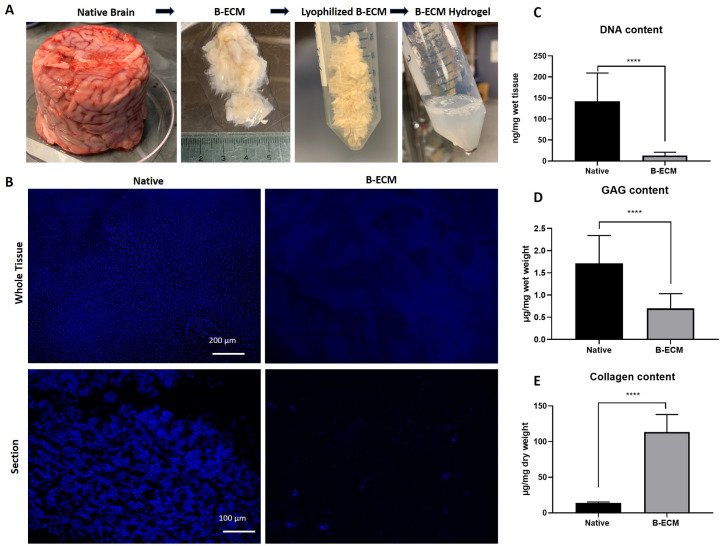
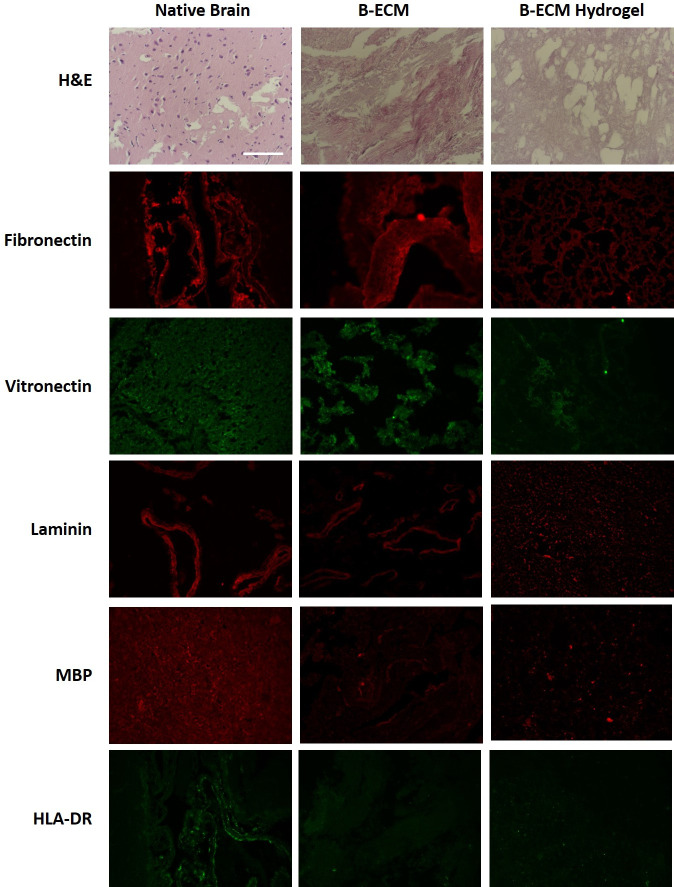
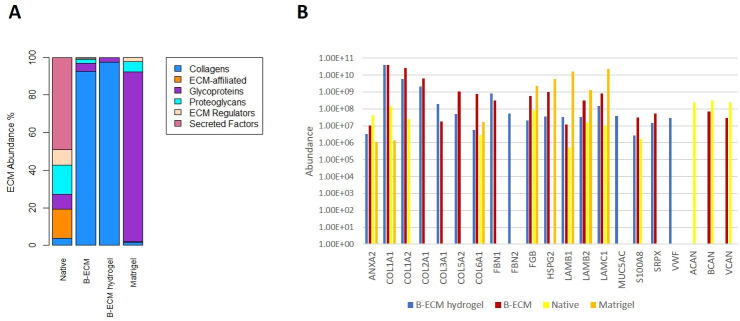
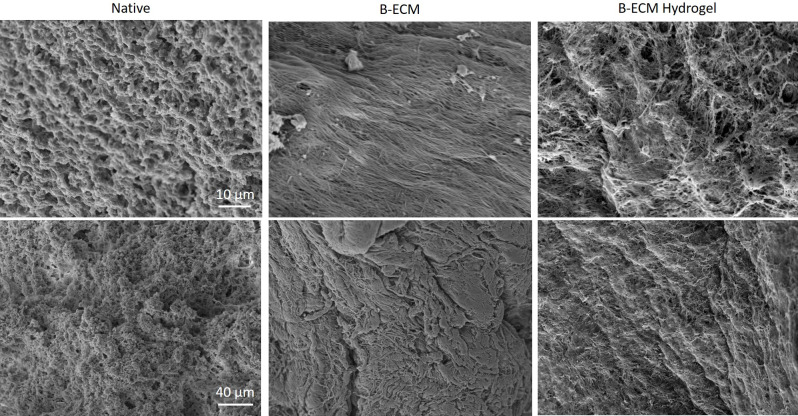
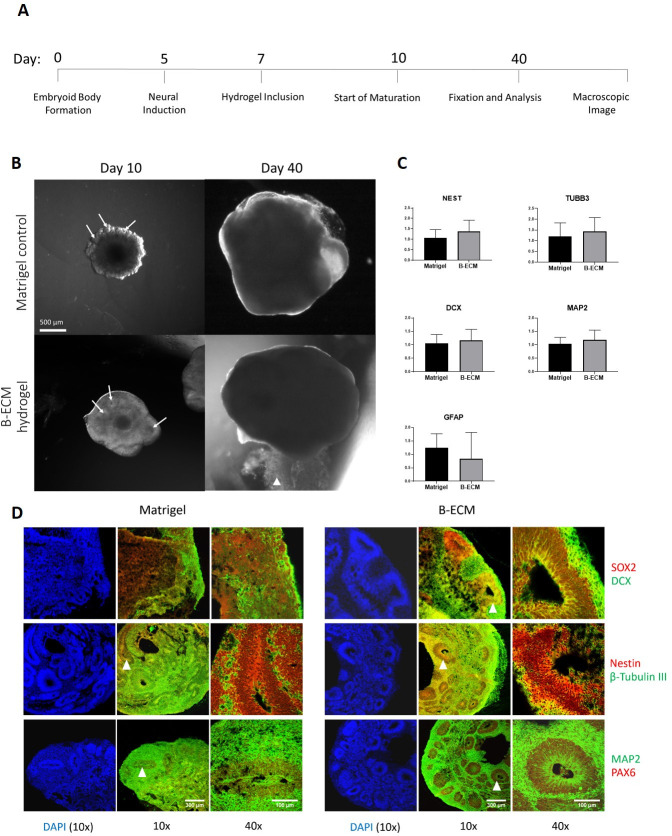
Human brain tissue models such as cerebral organoids are essential tools for developmental and biomedical research. Current methods to generate cerebral organoids often utilize Matrigel as an external scaffold to provide structure and biologically relevant signals. Matrigel however is a nonspecific hydrogel of mouse tumor origin and does not represent the complexity of the brain protein environment. In this study, we investigated the application of a decellularized adult porcine brain extracellular matrix (B-ECM) which could be processed into a hydrogel (B-ECM hydrogel) to be used as a scaffold for human embryonic stem cell (hESC)-derived brain organoids. We decellularized pig brains with a novel detergent- and enzyme-based method and analyzed the biomaterial properties, including protein composition and content, DNA content, mechanical characteristics, surface structure, and antigen presence. Then, we compared the growth of human brain organoid models with the B-ECM hydrogel or Matrigel controls in vitro. We found that the native brain source material was successfully decellularized with little remaining DNA content, while Mass Spectrometry (MS) showed the loss of several brain-specific proteins, while mainly different collagen types remained in the B-ECM. Rheological results revealed stable hydrogel formation, starting from B-ECM hydrogel concentrations of 5 mg/mL. hESCs cultured in B-ECM hydrogels showed gene expression and differentiation outcomes similar to those grown in Matrigel. These results indicate that B-ECM hydrogels can be used as an alternative scaffold for human cerebral organoid formation, and may be further optimized for improved organoid growth by further improving protein retention other than collagen after decellularization.
Overview
The claims and statistics of this paper haven’t been checked yet.
Run the check — free, no account needed. It reads the open-access text and checks the sources it cites.
Integrity signals
Registry
Cites
Statistics
Figures
Verification
Claims the paper makes
The claims and statistics of this paper haven’t been checked yet.
Run the check — free, no account needed. It reads the open-access text and checks the sources it cites.
Claims other papers make about this one
Each is checked against this paper’s own text: does it say what the citing paper says it does?
The cited source says what the claim attributes to it.
In the citing paper
“Simsa et al. discovered that hydrogels derived from decellularized adult porcine brain ECM (B‐ECM) served as scaffolds for brain organoids derived from human embryonic stem cells (hESCs).”
From Bioactive scaffolds for tissue engineering: A review of decellularized extracellular matrix applications and innovations (2025) · cites this paper as [198]
The cited source says what the claim attributes to it.
In the citing paper
“They could be further optimized for organoid growth by enhancing the preservation of proteins beyond collagen after decellularization.[ 198 ]”
From Bioactive scaffolds for tissue engineering: A review of decellularized extracellular matrix applications and innovations (2025) · cites this paper as [198]
Self-check
Percentages, sums and reported differences re-computed from the paper’s own numbers.
The self-check needs the paper’s full text.
Citations
Cites
Ror2 signaling regulates Golgi structure and transport through IFT20 for tumor invasiveness
Nishita, M., Park, S.-Y., Nishio, T., Kamizaki, K., Wang, Z., Tamada, K., Takumi, T., Hashimoto, R., Otani, H., Pazour, G. J., et al. (2017) · Scientific Reports · doi:10.1038/s41598-016-0028-x · Cited by 15,947
Matrix elasticity directs stem cell lineage specification
Engler, A. J., Sen, S., Sweeney, H. L., & Discher, D. E. (2006) · Cell · doi:10.1016/j.cell.2006.06.044 · Cited by 13,915
Cerebral organoids model human brain development and microcephaly
Lancaster, M. A., Renner, M., Martin, C.-A., Wenzel, D., Bicknell, L. S., Hurles, M. E., Homfray, T., Penninger, J. M., Jackson, A. P., & Knoblich, J. A. (2013) · Nature · doi:10.1038/nature12517 · Cited by 5,372
Rappsilber, J., Mann, M., & Ishihama, Y. (2007) · Nature Protocols · doi:10.1038/nprot.2007.261 · Cited by 4,641
The extracellular matrix at a glance
Frantz, C., Stewart, K. M., & Weaver, V. M. (2010) · Journal of Cell Science · doi:10.1242/jcs.023820 · Cited by 4,334
Decellularization of tissues and organs
Gilbert, T. W., Sellaro, T. L., & Badylak, S. F. (2006) · Biomaterials · doi:10.1016/j.biomaterials.2006.02.014 · Cited by 2,222
Brain-Region-Specific Organoids Using Mini-bioreactors for Modeling ZIKV Exposure
Qian, X., Nguyen, H. N., Song, M. M., Hadiono, C., Ogden, S. C., Hammack, C., Yao, B., Hamersky, G. R., Jacob, F., Zhong, C., et al. (2016) · Cell · doi:10.1016/j.cell.2016.04.032 · Cited by 2,127
The basics of brain development
Stiles, J., & Jernigan, T. L. (2010) · Neuropsychology Review · doi:10.1007/s11065-010-9148-4 · Cited by 2,009
Generation of cerebral organoids from human pluripotent stem cells
Lancaster, M. A., & Knoblich, J. A. (2014) · Nature Protocols · doi:10.1038/nprot.2014.158 · Cited by 1,823
Kulak, N. A., Pichler, G., Paron, I., Nagaraj, N., & Mann, M. (2014) · Nature Methods · doi:10.1038/nmeth.2834 · Cited by 1,719
Research works printed but not linked: 24
- TSP Rothenbücher, 2019, Future Neurol, FNL3
- EK Stachowiak, 2017, Transl Psychiatry, 6
- AS Monzel, 2017, Stem Cell Reports, 1144
- M Oksdath, 2018, APL Bioeng, 041501
- C Frantz, 2010, J Cell Sci, 4195
- A Alovskaya, 2007, Top tissue Eng
- R Simsa, 2018, PLoS One, e0209269
- R Simsa, 2019, PLoS One, e0220743
- D Lam, 2019, Sci Rep, 4159
- M Shayegan, 2016, Biophys J, 2404
- SD Sackett, 2018, Sci Rep, 10452
- M Kuljanin, 2017, Biomaterials, 130
- JJ O’brien, 2018, Ann Appl Stat, 2075
- J Wang, 2017, Sci Rep, 1
- DA Tonge, 2012, Brain Res, 8
- EE Antoine, 2014, Tissue Eng Part B Rev, 683
- A Erikson, 2008, Biopolymers, 135
- TJ Keane, 2015, Methods, 25
- S Geerts, 2016, Tissue Eng—Part C Methods, 671
- ER Aurand, 2012, J Funct Biomater, 839
- BH Davis, 2007, Ann Biomed Eng, 1414
- DA Brown, 2007, Biotechnol Bioeng, 962
- E Jabbari, 2016, Mater Today, 190
- J Stiles, 2010, Neuropsychol Rev, 327
Cited by
Sorted by citations
Brown, M., Li, J., Moraes, C., Tabrizian, M., & Li-Jessen, N. Y. K. (2022) · Biomaterials · doi:10.1016/j.biomaterials.2022.121786 · Cited by 282
Organoids: The current status and biomedical applications
Yang, S., Hu, H., Kung, H., Zou, R.-Q., Dai, Y.-S., Hu, Y.-F., Wang, T., Lv, T., Yu, J., & Li, F. (2023) · MedComm · doi:10.1002/mco2.274 · Cited by 300
Liu, J., Song, Q., Yin, W., Li, C., An, N., Le, Y., Wang, Q., Feng, Y., Hu, Y., & Wang, Y. (2025) · Exploration · doi:10.1002/exp.20230078 · Cited by 140
Advances in Spheroids and Organoids on a Chip
Fang, G., Chen, Y., Lu, H., & Jin, D. (2023) · Advanced Functional Materials · doi:10.1002/adfm.202215043 · Cited by 135
Engineering the Extracellular Matrix for Organoid Culture
Heo, J. H., Kang, D., Seo, S. J., & Jin, Y. (2022) · International Journal of Stem Cells · doi:10.15283/ijsc21190 · Cited by 116
Metadata
- Authors
- Simsa, R., Rothenbücher, T., Gürbüz, H., Ghosheh, N., Emneus, J., Jenndahl, L., Kaplan, D. L., Bergh, N., Serrano, A. M., & Fogelstrand, P.
- Affiliations
- Tufts University (US)
- Centro de Biología Molecular Severo Ochoa (ES)
- Technical University of Denmark (DK)
- University of Skövde (SE)
- Sahlgrenska University Hospital (SE)
- Corresponding author
- Simsa, Robin
- Rothenbücher, Theresa
- Gürbüz, Hakan
- Ghosheh, Nidal
- Jenndahl, Lachmi
- Kaplan, David L.
- Bergh, Niklas
- Fogelstrand, Per
- ORCID
- Venue
- PLOS ONE
- Publisher
- Public Library of Science (PLoS)
- Published
- 2021-01-28
- Volume
- 16
- Issue
- 1
- Pages
- e0245685
- ISSN
- 1932-6203 (ISSN-L)
- PMC
- PMC7842896
- OpenAlex
- W3124422938
- Cited by
- 114
- References
- 72
- Citations by year
- 2026: 10 · 2025: 26 · 2024: 24 · 2023: 27 · 2022: 21 · 2021: 6
- FWCI
- 18.32
- Type
- journal article
- Language
- en
- Open access
- gold
- doi.org
- Licence
- Locations
- PLoS ONE (publishedVersion, cc-by)
- PubMed Central (publishedVersion, cc-by)
- PubMed (publishedVersion)
- Diva portal (Dalarna University Library) (submittedVersion, other-oa)
- DIGITAL.CSIC (Spanish National Research Council (CSIC)) (submittedVersion, cc-by)
- DOAJ (DOAJ: Directory of Open Access Journals) (submittedVersion, cc-by-sa)
- Technical University of Denmark, DTU Orbit (Technical University of Denmark, DTU) (submittedVersion, other-oa)
- Funders
- Horizon 2020 (722779)
- MINECO SAF (2017-83241-R)
- ISC-III RETICS TerCel (RD16/0011/0032)
- ASCTN-Training (813851)
- National Institutes of Health (P41EB027062, R01NS092847)
- Topics
- Health Sciences › Medicine › Surgery › Tissue Engineering and Regenerative Medicine
- Physical Sciences › Engineering › Biomedical Engineering › 3D Printing in Biomedical Research
- Physical Sciences › Materials Science › Biomaterials › Hydrogels: synthesis, properties, applications
- Keywords
- brain organoids, porcine brain, hydrogels, scaffold materials, human embryonic stem cells, Matrigel alternative, decellularization, collagen, protein retention, hydrogel rheology, organoid differentiation
- MeSH terms
- Human Embryonic Stem Cells, Animals, Brain, Brain Chemistry, Cell Line, Extracellular Matrix, Humans, Organoids, Swine, Hydrogels
About these checks
Registry, retraction, Cites and statistics results are computed, not judged, with one exception: a printed reference that no index lists is read once by a model before it counts as a citation error. Claims are extracted by a model and kept only when their quote appears verbatim in the text; each cited source is then checked, with a model’s help, for whether it says what the claim relies on. Those verdicts can be wrong — read the claim’s quote and the cited source before relying on one.
Statistics and arithmetic are recomputed, not judged.
Confidence bands are shown only for fields calibrated on our annotated test set. None is calibrated yet, so no band is shown.
What counts as a claim ›How we measure confidence ›How we check this ›
Are you an author, or do you see a problem with this page? Request a review
