

The DOI matches its Crossref record; 45 of the 45 references it cites were found in a registry or an index.
The impact of COVID-19 pandemic on physical and mental health of Asians: A study of seven middle-income countries in Asia
Open accessAbstract
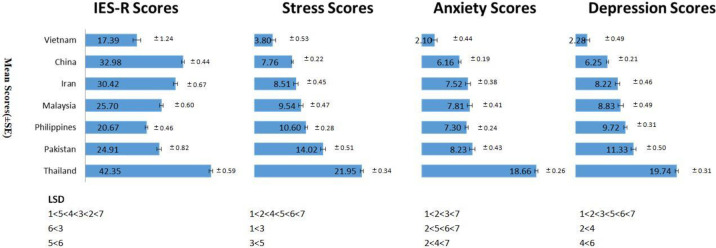
The coronavirus disease (COVID-19) pandemic has impacted the economy, livelihood, and physical and mental well-being of people worldwide. This study aimed to compare the mental health status during the pandemic in the general population of seven middle income countries (MICs) in Asia (China, Iran, Malaysia, Pakistan, Philippines, Thailand, and Vietnam). All the countries used the Impact of Event Scale–Revised (IES-R) and Depression, Anxiety and Stress Scale (DASS-21) to measure mental health. There were 4479 Asians completed the questionnaire with demographic characteristics, physical symptoms and health service utilization, contact history, knowledge and concern, precautionary measure, and rated their mental health with the IES-R and DASS-21. Descriptive statistics, One-Way analysis of variance (ANOVA), and linear regression were used to identify protective and risk factors associated with mental health parameters. There were significant differences in IES-R and DASS-21 scores between 7 MICs (p<0.05). Thailand had all the highest scores of IES-R, DASS-21 stress, anxiety, and depression scores whereas Vietnam had all the lowest scores. The risk factors for adverse mental health during the COVID-19 pandemic include age <30 years, high education background, single and separated status, discrimination by other countries and contact with people with COVID-19 (p<0.05). The protective factors for mental health include male gender, staying with children or more than 6 people in the same household, employment, confidence in doctors, high perceived likelihood of survival, and spending less time on health information (p<0.05). This comparative study among 7 MICs enhanced the understanding of metal health in the general population during the COVID-19 pandemic.
Overview
The claims and statistics of this paper haven’t been checked yet.
Run the check — free, no account needed. It reads the open-access text and checks the sources it cites.
Integrity signals
Registry
Cites
Statistics
Figures
Verification
Claims the paper makes
The claims and statistics of this paper haven’t been checked yet.
Run the check — free, no account needed. It reads the open-access text and checks the sources it cites.
Claims other papers make about this one
Each is checked against this paper’s own text: does it say what the citing paper says it does?
The cited source says what the claim attributes to it.
In the citing paper
“The baseline levels of stress and anxiety among our participants were significantly higher than those found in the same population of university students by previous research [42-44], as well as in the general population [45].”
Self-check
Percentages, sums and reported differences re-computed from the paper’s own numbers.
The self-check needs the paper’s full text.
Citations
Cites
Wang, C., Pan, R., Wan, X., Tan, Y., Xu, L., Ho, C. S., & Ho, R. C. (2020) · International Journal of Environmental Research and Public Health · doi:10.3390/ijerph17051729 · Cited by 9,923 · cited 2×
“Psychometric properties of the questionnaire were established in the initial phase and peak of the COVID-19 epidemic [8, 9].”
BackgroundMethodSelf-citationImpact of COVID-19 pandemic on mental health in the general population: a systematic review
Xiong, J., Lipsitz, O., Nasri, F., Lui, L. M. W., Gill, H., Phan, L., Chen-Li, D., Iacobucci, M., Ho, R., Majeed, A., et al. (2020) · Journal of Affective Disorders · doi:10.1016/j.jad.2020.08.001 · Cited by 5,204 · cited 1×
“A recent systematic review found that relatively high rates of symptoms of anxiety, depression, post-traumatic stress disorder and stress were reported in the general population and health care professionals during the COVID-19 pandemic globally [2, 3].”
BackgroundSelf-citationWang, C., Pan, R., Wan, X., Tan, Y., Xu, L., McIntyre, R. S., Choo, F. N., Tran, B., Ho, R., Sharma, V. K., et al. (2020) · Brain, Behavior, and Immunity · doi:10.1016/j.bbi.2020.04.028 · Cited by 2,571 · cited 2×
“Psychometric properties of the questionnaire were established in the initial phase and peak of the COVID-19 epidemic [8, 9].”
BackgroundSelf-citationHo, C. S., Chee, C. Y., & Ho, R. C. (2020) · Annals of the Academy of Medicine, Singapore · doi:10.47102/annals-acadmedsg.202043 · Cited by 1,699 · cited 1×
“High education background is a risk factor and online psychological interventions such as cognitive behaviour therapy (CBT) and mindfulness-based therapy could improve mental health for highly educated individual [40].”
BackgroundSelf-citationChew, N. W. S., Lee, G. K. H., Tan, B. Y. Q., Jing, M., Goh, Y., Ngiam, N. J. H., Yeo, L. L. L., Ahmad, A., Ahmed Khan, F., Napolean Shanmugam, G., et al. (2020) · Brain, Behavior, and Immunity · doi:10.1016/j.bbi.2020.04.049 · Cited by 1,650 · cited 1×
“The IES-R and DASS-21 scales were previously used in research related to the COVID19 epidemic [8, 12, 20, 21].”
MethodSelf-citationHo, C. S. H., Chee, C. Y., & Ho, R. (2020) · PubMed · Cited by 1,354
Self-citationPsychological impact of the COVID-19 pandemic on health care workers in Singapore
Tan, B. Y. Q., Chew, N. W. S., Lee, G. K. H., Jing, M., Goh, Y., Yeo, L. L. L., Zhang, K., Chin, H.-K., Ahmad, A., Khan, F. A., et al. (2020) · Annals of Internal Medicine · doi:10.7326/m20-1083 · Cited by 1,279 · cited 1×
“The IES-R and DASS-21 scales were previously used in research related to the COVID19 epidemic [8, 12, 20, 21].”
MethodSelf-citationHao, F., Tan, W., Jiang, L., Zhang, L., Zhao, X., Zou, Y., Hu, Y., Luo, X., Jiang, X., McIntyre, R. S., et al. (2020) · Brain, Behavior, and Immunity · doi:10.1016/j.bbi.2020.04.069 · Cited by 968 · cited 1×
“The IES-R and DASS-21 scales were previously used in research related to the COVID19 epidemic [8, 12, 20, 21].”
Self-citationPsychological impact of COVID-19 pandemic in the Philippines
Tee, M. L., Tee, C. A., Anlacan, J. P., Aligam, K. J. G., Reyes, P. W. C., Kuruchittham, V., & Ho, R. C. (2020) · Journal of Affective Disorders · doi:10.1016/j.jad.2020.08.043 · Cited by 634
Self-citationShahsavari, S., Holur, P., Wang, T., Tangherlini, T. R., & Roychowdhury, V. (2020) · Journal of Computational Social Science · doi:10.1007/s42001-020-00086-5 · Cited by 420 · cited 1×
“Mis-information related to the cause of COVID-19 [41], rumours [42] and inconsistent information [43] on COVID-19 symptoms, prevention, treatment and transmission mode were associated with negative psychological impact.”
Background
Cited by
Sorted by citations
Mahmud, S. A. S., Mohsin, M., Dewan, M. N., & Muyeed, A. (2022) · Trends in Psychology · doi:10.1007/s43076-021-00116-9 · Cited by 211
“A study found that the poor sanitation, lack of basic preventive measures, lack of proper testing, and medical facilities are the reasons behind the higher psychological disorder, COVID-19 cases, and deaths in those countries (Wang et al., 2021).”
BackgroundHamaideh, S. H., Al-Modallal, H. M., Tanash, M. I., & Hamdan‐Mansour, A. M. (2021) · Nursing Open · doi:10.1002/nop2.918 · Cited by 195
Chodavadia, P. A., Teo, I., Poremski, D., Fung, D. S. S., & Finkelstein, E. A. (2023) · BMC Psychiatry · doi:10.1186/s12888-023-04581-7 · Cited by 160
Mental Disorders of Bangladeshi Students During the COVID-19 Pandemic: A Systematic Review
Al‐Mamun, F., Hosen, I., Misti, J. M., Kaggwa, M. M., & Mamun, M. A. (2021) · Psychology Research and Behavior Management · doi:10.2147/prbm.s315961 · Cited by 152
“…to 50.9% anxiety, 48.3% depression, 53.8% post-traumatic stress disorder, 38% psychological distress, and 81.9% stress were found) among the general population globally, as consistent with other literatures concerned with either multi-centered cross-sectional studies, 19,20 or systematic reviews.”
InfluentialGabrielli, S., Rizzi, S., Bassi, G., Carbone, S., Maimone, R., Marchesoni, M., & Forti, S. (2021) · JMIR mHealth and uHealth · doi:10.2196/27965 · Cited by 125
“The baseline levels of stress and anxiety among our participants were significantly higher than those found in the same population of university students by previous research [42-44], as well as in the general population [45].”
Result
Metadata
- Authors
- Wang, C., Tee, M., Roy, A. E., Fardin, M. A., Srichokchatchawan, W., Habib, H. A., Tran, B. X., Hussain, S., Hoang, M. T., Le, X. T., Ma, W., Pham, H. Q., Shirazi, M., Taneepanichskul, N., Tan, Y., Tee, C., Xu, L., Xu, Z., Vu, G. T., Zhou, D., Koh, B. J., McIntyre, R. S., Ho, C., Ho, R. C., & Kuruchittham, V.
- Affiliations
- Huaibei Normal University (CN)
- University of the Philippines Manila (PH)
- Universiti Malaysia Sarawak (MY)
- Islamic Azad University, Zahedan Branch (IR)
- Chulalongkorn University (TH)
- University of Karachi (PK)
- Johns Hopkins University (US)
- Duy Tan University (VN)
- Hanoi Medical University (VN)
- University of Sistan and Baluchestan (IR)
- Trường ĐH Nguyễn Tất Thành (VN)
- National University of Singapore (SG)
- University Health Network (CA)
- National University Health System (SG)
- Southeast Asia One Health University Network (TH)
- Corresponding author
- Ho, Roger C.
- ORCID
- Venue
- PLOS ONE
- Publisher
- Public Library of Science (PLoS)
- Published
- 2021-02-11
- Volume
- 16
- Issue
- 2
- Pages
- e0246824
- ISSN
- 1932-6203 (ISSN-L)
- PMC
- PMC7877638
- OpenAlex
- W3126849703
- Cited by
- 460
- References
- 44
- Citations by year
- 2026: 13 · 2025: 25 · 2024: 53 · 2023: 111 · 2022: 171 · 2021: 86
- FWCI
- 71.79
- Type
- journal article
- Language
- en
- Open access
- gold
- doi.org
- Licence
- Locations
- PLoS ONE (publishedVersion, cc-by)
- PubMed Central (publishedVersion, cc-by)
- PubMed (publishedVersion)
- Research Explorer (The University of Manchester) (publishedVersion)
- Unimas Institutional Repository (Universiti Malaysia Sarawak) (acceptedVersion)
- National University of Singapore (submittedVersion, cc-by)
- DOAJ (DOAJ: Directory of Open Access Journals) (submittedVersion, cc-by-sa)
- Rare & Special e-Zone (The Hong Kong University of Science and Technology) (submittedVersion)
- Greater South Information System
- Funders
- Huaibei Normal University, China.
- National University of Singapore iHealthtech Other Operating Expenses (R-722-000-004-731)
- Vingroup Innovation Foundation (VINIF) COVID in Vietnam (VINIF.2020.Covid19.DA07)
- Topics
- Social Sciences › Psychology › Clinical Psychology › COVID-19 and Mental Health
- Health Sciences › Medicine › Psychiatry and Mental health › Mental Health Treatment and Access
- Health Sciences › Medicine › Public Health, Environmental and Occupational Health › Maternal Mental Health During Pregnancy and Postpartum
- Keywords
- COVID-19 pandemic, mental health, physical health, anxiety, depression, stress, middle-income countries, Asia, risk factors, protective factors, cross-national comparison, health care utilization, somatic symptoms
- MeSH terms
- COVID-19, SARS-CoV-2, Adolescent, Adult, Anxiety, Asia, Child, Cross-Sectional Studies, Depression, Female, Humans, Male, Mental Health, Middle Aged, Sex Factors, Socioeconomic Factors, Stress, Psychological, Young Adult, Protective Factors
About these checks
Registry, retraction, Cites and statistics results are computed, not judged, with one exception: a printed reference that no index lists is read once by a model before it counts as a citation error. Claims are extracted by a model and kept only when their quote appears verbatim in the text; each cited source is then checked, with a model’s help, for whether it says what the claim relies on. Those verdicts can be wrong — read the claim’s quote and the cited source before relying on one.
Statistics and arithmetic are recomputed, not judged.
Confidence bands are shown only for fields calibrated on our annotated test set. None is calibrated yet, so no band is shown.
What counts as a claim ›How we measure confidence ›How we check this ›
Are you an author, or do you see a problem with this page? Request a review
