

Academic performance of K-12 students in an online-learning environment for mathematics increased during the shutdown of schools in wake of the COVID-19 pandemic
Open accessThe DOI matches its Crossref record; 65 of the 72 references it cites were found in a registry or an index, and 6 are not checked yet.
Abstract
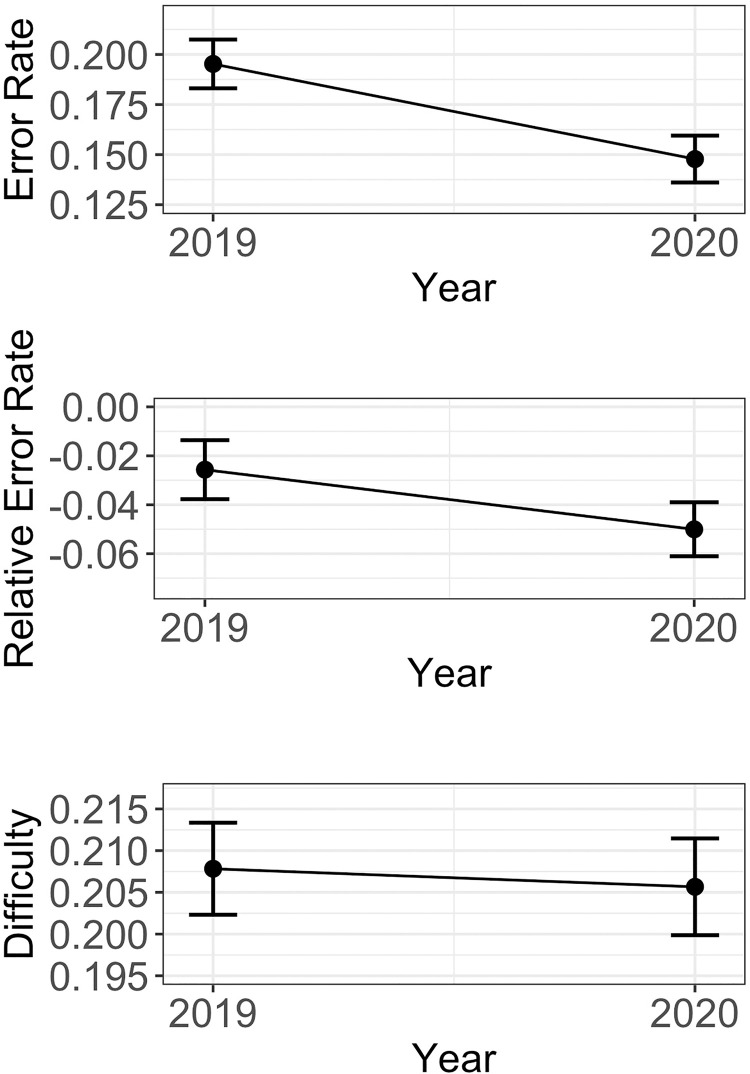
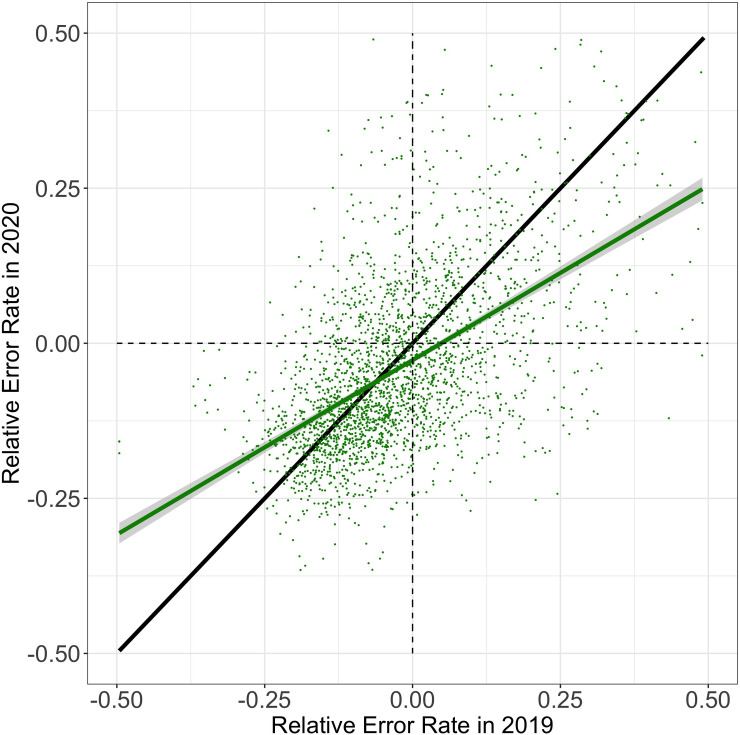
The shutdown of schools in response to the rapid spread of COVID-19 poses risks to the education of young children, including a widening education gap. In the present article, we investigate how school closures in 2020 influenced the performance of German students in a curriculum-based online learning software for mathematics. We analyzed data from more than 2,500 K-12 students who computed over 124,000 mathematical problem sets before and during the shutdown, and found that students’ performance increased during the shutdown of schools in 2020 relative to the year before. Our analyses also revealed that low-achieving students showed greater improvements in performance than high-achieving students, suggesting a narrowing gap in performance between low- and high-achieving students. We conclude that online learning environments may be effective in preventing educational losses associated with current and future shutdowns of schools.
Overview
The claims and statistics of this paper haven’t been checked yet.
Free: it reads the open-access text and checks the first 5 claims that cite a source we can check. Create a free account to check every claim.
Integrity signals
Registry
Cites
Statistics
Figures
Verification
Claims the paper makes
The claims and statistics of this paper haven’t been checked yet.
Free: it reads the open-access text and checks the first 5 claims that cite a source we can check. Create a free account to check every claim.
Claims other papers make about this one
Each is checked against this paper’s own text: does it say what the citing paper says it does?
The source backs part of the claim, not all of it — or backs it for a different population, condition or comparison.
In the citing paper
“Moreover, students increased the time using the online-learning software at home, were less distracted or experienced less time pressure in a home-schooling rather than classroom setting, or were presented with individualized assignments within the online program (see also Meeter, 2021; Spitzer and Musslick, 2021; van der Velde et al., 2021).”
From Effects of COVID-19-Related School Closures on Student Achievement-A Systematic Review (2021) · cites this paper as Spitzer and Musslick, 2021
Experimental — accuracy not yet measuredThe cited source says what the claim attributes to it.
In the citing paper
“Positive effects of the COVID-19-related school closures on student achievement were almost exclusively reported by studies using data from learning apps or online learning environments (Meeter, 2021;Spitzer & Musslick, 2021;van der Velde et al., 2021).”
From The Impact of COVID‐19‐Related School Closures on Student Achievement—A Meta‐Analysis (2022) · cites this paper as Spitzer & Musslick, 2021
The cited source says what the claim attributes to it.
In the citing paper
“Meeter (2021) and Spitzer and Musslick (2021) showed students to improve their mathematics achievement when learning with an online-learning software during the COVID-related school closures.”
From Effects of COVID-19-Related School Closures on Student Achievement-A Systematic Review (2021) · cites this paper as Spitzer and Musslick, 2021
The cited source says what the claim attributes to it.
In the citing paper
“Additionally, low-performing students might be less distracted in comparison to learning in a classroom setting (Spitzer and Musslick, 2021).”
From Effects of COVID-19-Related School Closures on Student Achievement-A Systematic Review (2021) · cites this paper as Spitzer and Musslick, 2021
The cited source says what the claim attributes to it.
In the citing paper
“Finally, low-performing students benefited more from systematic online-learning methods (Clark et al., 2020; Spitzer and Musslick, 2021).”
From Effects of COVID-19-Related School Closures on Student Achievement-A Systematic Review (2021) · cites this paper as Spitzer and Musslick, 2021
1 more claim about this paper
Create a free account to see every claim other papers make about this one.
Self-check
Percentages, sums and reported differences re-computed from the paper’s own numbers.
The self-check needs the paper’s full text.
Citations
Cites
1 retracted
Argyropoulos, K. V., Serrano, A., Hu, J., Black, M., Feng, X., Shen, G., Call, M., Kim, M. J., Lytle, A., Belovarac, B., et al. (2020) · The American Journal of Pathology · doi:10.1016/j.ajpath.2020.07.001 · Cited by 188
RetractedlmerTest Package: Tests in Linear Mixed Effects Models
Kuznetsova, A., Brockhoff, P. B., & Christensen, R. H. B. (2017) · Journal of Statistical Software · doi:10.18637/jss.v082.i13 · Cited by 24,346
Social Foundations of Thought and Action
Bandura, A. (2002) · The Health Psychology Reader · doi:10.4135/9781446221129.n6 · Cited by 9,902 · cited 1×
“, in mathematics, may adopt maladaptive beliefs about their own self-efficacy in learning, hampering further achievement [24, 25].”
BackgroundThe psychological impact of the COVID-19 epidemic on college students in China
Cao, W., Fang, Z., Hou, G., Han, M., Xu, X., Dong, J., & Zheng, J. (2020) · Psychiatry Research · doi:10.1016/j.psychres.2020.112934 · Cited by 5,843 · cited 1×
“While the full consequences of this outage will take years or even decades to unfold, preliminary data highlight immediate effects on student’s academic performance and well-being: the COVID-19 pandemic required students to be educated from home which has been linked to lower performance on national tests [1–10] (note…”
BackgroundStanovich, K. E. (1986) · Reading Research Quarterly · doi:10.1598/rrq.21.4.1 · Cited by 5,222
(2009) · US Department of Education · Cited by 3,654
The expected value of control: an integrative theory of anterior cingulate cortex function
Shenhav, A., Botvinick, M. M., & Cohen, J. D. (2013) · Neuron · doi:10.1016/j.neuron.2013.07.007 · Cited by 2,321
Learning loss due to school closures during the COVID-19 pandemic
Engzell, P., Frey, A., & Verhagen, M. D. (2021) · Proceedings of the National Academy of Sciences · doi:10.1073/pnas.2022376118 · Cited by 1,848
The Advanced Theory of Statistics
L., S., Kendall, M. G., & Stuart, A. (1963) · Population (French Edition) · doi:10.2307/1527192 · Cited by 1,827
Linear Regressions in Fishery Research
Ricker, W. E. (1973) · Journal of the Fisheries Research Board of Canada · doi:10.1139/f73-072 · Cited by 1,799 · cited 1×
“Such a bias can occur in the presence of measurement noise associated with both the predictor and the dependent variable [29].”
Background
Research works printed but not linked: 2
- Wößmann L, Freundl V, Grewenig E, Lergetporer P, Werner K, Zierow L. Coronavirus Crisis Cut the Time Children Spend on Schooling in Half. 2020. Available: https://www.ifo.de/en/node/57298.
- Musslick S, Botvinick MM, Cohen JD. A computational model of control allocation based on the Expected Value of Control. Reinforcement Learning and Decision Making Conference 2015. 2015.
Cited by
Effects of COVID-19-Related School Closures on Student Achievement-A Systematic Review
Hammerstein, S., König, C., Dreisörner, T., & Frey, A. (2021) · Frontiers in Psychology · doi:10.3389/fpsyg.2021.746289 · Cited by 588
“Additionally, low-performing students might be less distracted in comparison to learning in a classroom setting (Spitzer and Musslick, 2021).”
BackgroundInfluentialSchult, J., Mahler, N., Fauth, B., & Lindner, M. A. (2022) · School Effectiveness and School Improvement · doi:10.1080/09243453.2022.2061014 · Cited by 262
“Empirical studies of formative assessments during the first COVID-19 wave showed a performance increase compared to the regular classes in previous years (Meeter, 2021; for older students, see Spitzer & Musslick, 2021).”
ResultThe impact of Covid-19 on student achievement: Evidence from a recent meta-analysis
Di Pietro, G. (2023) · Educational Research Review · doi:10.1016/j.edurev.2023.100530 · Cited by 173
School Performance among Children and Adolescents during COVID-19 Pandemic: A Systematic Review
Panagouli, E. D., Stavridou, A., Savvidi, C., Kourti, A., Ψαλτοπούλου, Θ., Sergentanis, T. Ν., & Τσίτσικα, Ά. (2021) · Children · doi:10.3390/children8121134 · Cited by 174
“Low-achievement students, who either presented improvements [7,30,37] or performed poorly, acquired greater changes in performance [25,34].”
BackgroundResultInfluentialStudents’ Perceptions of Online Learning during COVID-19 Pandemic: A Qualitative Approach
Curelaru, M., Curelaru, V., & Cristea, M. (2022) · Sustainability · doi:10.3390/su14138138 · Cited by 146
“In another study on K–12 students, low-performing students showed greater improvements in performance than high-performing students, suggesting that online learning had different effects and narrowed the gap between lowand high-performing students [52].”
Metadata
- Authors
- Spitzer, M. W. H., & Musslick, S.
- Affiliations
- University of Freiburg (DE)
- Princeton University (US)
- Corresponding author
- Spitzer, Markus Wolfgang Hermann
- Venue
- PLOS ONE
- Publisher
- Public Library of Science (PLoS)
- Published
- 2021-08-03
- Volume
- 16
- Issue
- 8
- Pages
- e0255629
- ISSN
- 1932-6203 (ISSN-L)
- PMC
- PMC8330947
- OpenAlex
- W3192682282
- Cited by
- 138
- References
- 70
- Citations by year
- 2026: 9 · 2025: 21 · 2024: 26 · 2023: 31 · 2022: 42 · 2021: 9
- FWCI
- 47.48
- Type
- journal article
- Language
- en
- Open access
- gold
- doi.org
- Licence
- Locations
- PLoS ONE (publishedVersion, cc-by)
- PubMed Central (publishedVersion, cc-by)
- PubMed (publishedVersion)
- DOAJ (DOAJ: Directory of Open Access Journals) (submittedVersion, cc-by-sa)
- EdArXiv (OSF Preprints) (submittedVersion)
- EdArXiv (OSF Preprints) (submittedVersion, cc-by-nc-nd)
- Funders
- John Templeton Foundation (61434)
- Topics
- Social Sciences › Education › Education during COVID-19 pandemic
- Social Sciences › Education › Online Learning Methods and Innovations
- Physical Sciences › Computer Science › Computer Science Applications › Online Learning and Analytics
- Keywords
- COVID-19 school closures, online learning, mathematics achievement, K-12 students, educational inequality, low-achieving students, high-achieving students, educational losses, adaptive learning software, German students
- MeSH terms
- Academic Performance, COVID-19, SARS-CoV-2, Adolescent, Child, Child, Preschool, Germany, Humans, Mathematics, Software, Education, Distance, Pandemics
About these checks
Registry, retraction, Cites and statistics results are computed, not judged, with one exception: a printed reference that no index lists is read once by a model before it counts as a citation error. Claims are extracted by a model and kept only when their quote appears verbatim in the text; each cited source is then checked, with a model’s help, for whether it says what the claim relies on. Those verdicts can be wrong — read the claim’s quote and the cited source before relying on one.
Statistics and arithmetic are recomputed, not judged.
Confidence bands are shown only for fields calibrated on our annotated test set. None is calibrated yet, so no band is shown.
What counts as a claim ›How we measure confidence ›How we check this ›
Are you an author, or do you see a problem with this page? Request a review
Data sources
Bibliographic data: Semantic Scholar, OpenAlex, Crossref.
Contains information from the Semantic Scholar Academic Graph Datasets, made available under the ODC Attribution License (ODC-BY 1.0).
Semantic Scholar’s data is described in: Kinney, R., et al. (2023). The Semantic Scholar Open Data Platform. arXiv:2301.10140.
