

The DOI matches its Crossref record; 74 of the 74 references it cites were found in a registry or an index; 22 of the 54 sources its claims cite were checked for support.
A workplace Acceptance and Commitment Therapy (ACT) intervention for improving healthcare staff psychological distress: A randomised controlled trial
Open accessAbstract
The levels of psychological distress and burnout among healthcare staff are high, with negative implications for patient care. A growing body of evidence indicates that workplace programmes based on Acceptance and Commitment Therapy (ACT) are effective for improving employees’ general psychological health. However, there is a paucity of research examining the specific psychological and/or behavioural processes through which workplace ACT programmes transmit their beneficial effects. The aim of this randomised controlled trial was to investigate the outcomes and putative processes of change in a 4-session ACT training programme designed to reduce psychological distress among healthcare staff (n = 98). Ninety-eight employees of a healthcare organisation were randomly allocated to the ACT intervention or to a waiting list control group. Study measures were administered on four occasions (baseline, mid-intervention, post-intervention, and follow-up) over a three-month evaluation period. Results showed that the ACT intervention led to a significant decrease in symptoms of psychological distress and a less pronounced reduction in burnout. These effects were mediated primarily via an improvement in mindfulness skills and values-based behaviour and moderated by participants’ initial levels of distress. At four-week post-intervention, 48% of participants who received the ACT intervention showed reliable improvements in psychological distress, with just under half of the aforementioned improvements (46.15%) meeting criteria for clinically significant change. The results advance ACT as an effective stress management intervention for healthcare staff. The findings should be confirmed in a large scale randomised controlled trial with longer follow-up and cost-effectiveness analyses. © 2022 Prudenzi et al. This is an open access article distributed under the terms of the Creative Commons Attribution License, which permits unrestricted use, distribution, and reproduction in any medium, provided the original author and source are credited.
Overview
CoChat Summary
## TL;DR
This randomized controlled trial found that a 4-session workplace ACT intervention reduced psychological distress in NHS healthcare staff relative to a waitlist control, with effects mediated by mindfulness, values obstruction, and self-compassion. It also found a smaller effect on cognitive weariness, but no direct effect on patient safety, and the authors call for a larger trial with longer follow-up.
## Key findings
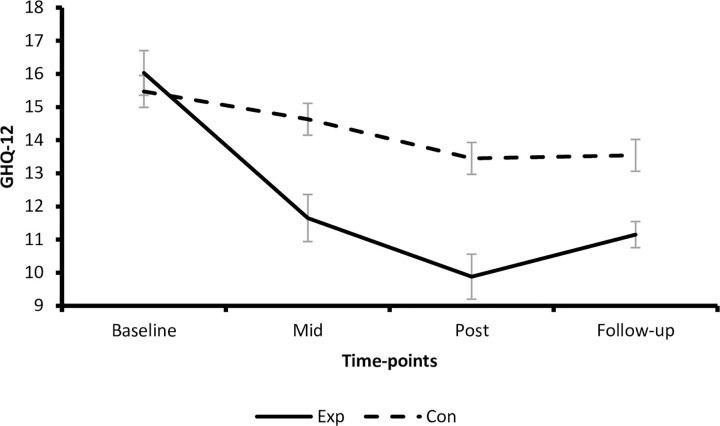
- In the primary outcome, the mixed ANOVA showed a significant Time × Condition interaction for psychological distress: F(2.12, 203) = 3.49, p = .03, partial η2 = .04.
- In the ACT group, psychological distress decreased from baseline to mid-intervention, post-intervention, and follow-up: F(1, 51) = 27.38, 39.59, and 350.65, respectively, all reported as significant.
- For burnout, the intervention had a significant effect on cognitive weariness with a Time × Condition interaction: F(2.32, 223.21) = 3.82, p = .02, partial η2 = .04; there was no significant Time × Condition interaction for physical exhaustion or emotional exhaustion.
- Mediation analyses found significant indirect effects on psychological distress through values obstruction (estimate = .17, BCa 95% CI [.02; .33]), mindfulness (.20, [.04; .37]), and self-compassion (.13, [.01; .31]); the same processes mediated cognitive weariness, and there was an indirect effect on patient safety perceptions via reduced psychological distress (estimate = -.09, BCa 95% CI [.01; .22]).
- At four-week post-intervention, 48% (25/52) of ACT participants met criteria for reliable change and 46.15% (24/52) met criteria for clinical significance; at follow-up, 52% (27/52) met reliable change and 50% (26/52) met clinical significance.
## Methods
- Parallel-group randomized controlled trial comparing a 4-session ACT intervention with a waitlist control among NHS staff in primary care settings in Yorkshire and Humberside.
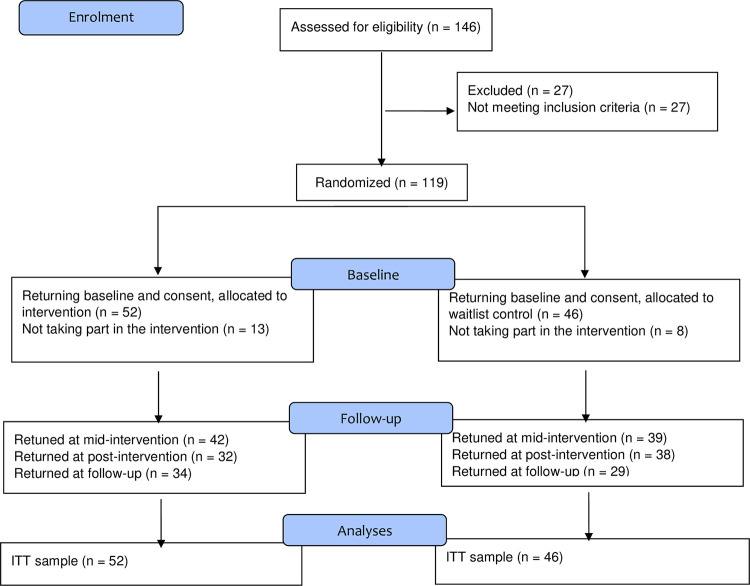
- 98 participants were included (52 ACT, 46 control); outcomes were measured at baseline, mid-intervention, post-intervention, and 14-week follow-up.
- Main analyses used mixed repeated-measures ANOVA/MANOVA, with bootstrapped mediation models for psychological processes and reliable/clinically significant change analyses for the GHQ-12.
## Limitations
- The paper states that attrition was relatively high: of 98 baseline participants, 63 completed all four time points; the authors also note that last observation carried forward can inflate the chance of finding an intervention effect, so the findings should be interpreted cautiously.
- The authors note that patient safety was measured with a single-item measure and that an objective measure would have been preferable.
- The authors state that the waitlist control was an inactive comparator, which is weaker than an active control.
- Evident from the text: the sample was mostly female (92.7%) and largely from NHS primary care in one region, which may limit generalizability.
Model-written summary. Check it against the paper before relying on it.
Integrity signals
Registry
Cites
Statistics
Figures
Verification
Claims the paper makes
13 Valid · 2 Not valid · 11 Not checked · 88 Own results and interpretations
Some cited sources support this claim and some don’t — read each source’s verdict below.
In the paper
“Although previous studies have found an indirect effect of mindfulness [29] or psychological flexibility [12, 75], to our knowledge, this is the first study to show a significant improvement in psychological distress of NHS staff through an improvement of values (specifically there was an influence on values obstruction facet).”
§ A workplace Acceptance and Commitment Therapy (ACT) intervention for improving healthcare staff psychological distress: A randomised controlled trial > Discussion
What the sources say
- Disputedcites [29] C.S. Waters, 2018, Acceptance and commitment therapy (ACT) for clinically distressed health care workers: Waitlist‐controlled evaluation of an ACT workshop in a routine practice setting, British Journal of Clinical Psychology sourceExperimental — accuracy not yet measured
The citation is attached to the statement that previous studies found an indirect effect through psychological flexibility, not to the citing authors’ claim about values obstruction. In the Results (pp. 15–16), this paper says only the mindfulness mediation model had statistically significant indirect effects; Table 4 (pp. 35–36) shows that the confidence interval for the psychological-flexibility indirect effect includes zero. The paper also states that it did not examine values-based behaviour (Limitations, p. 20). (LLM, conf=0.88)
Checked by a reasoning model — may be wrong.
- Supportedcites [12] P.E. Flaxman, 2010, A randomised worksite comparison of acceptance and commitment therapy and stress inoculation training, Behaviour research and therapy source
The citation is attached to the sentence’s statement that previous studies found an indirect effect of psychological flexibility, not to the citing authors’ claim about their own NHS staff study. The Mediation Analysis reports that increased psychological flexibility significantly mediated the effect of acceptance and commitment therapy on psychological distress. The source does not need to establish the separate values-obstruction finding. (LLM, conf=0.94)
- Not checked — no full text of the sourcecites [75] F.W. Bond, 2006, The ability of psychological flexibility and job control to predict learning, job performance, and mental health, Journal of Organizational Behavior Management source
hedgedstates a cause- Asserted: passes — The authors put it forward as true.
- Checkable: passes — It can be checked against evidence.
- Load-bearing: passes — The paper’s conclusions depend on it.
- Based: passes — The paper gives a reason why it holds.
- Disputed
The cited sources support only part of this claim — read each source’s verdict below.
In the paper
“Evidence suggests that worksite stress management interventions, particularly those based on Cognitive Behaviour Therapies (CBT), can be effective for improving the psychological health of staff working in healthcare and other organisational settings [5–8].”
§ A workplace Acceptance and Commitment Therapy (ACT) intervention for improving healthcare staff psychological distress: A randomised controlled trial > Introduction
What the sources say
- Partly supportedcites [5] K.C. Dreison, 2018, Job burnout in mental health providers: A meta-analysis of 35 years of intervention research, Journal of occupational health psychology sourceExperimental — accuracy not yet measured
The paper describes person-directed burnout interventions that often use cognitive-behavioral techniques, and its Discussion reports small reductions in burnout among mental health providers. The Comparison of Intervention Types section also finds person-directed interventions more effective than organization-directed ones for emotional exhaustion. It does not establish that CBT-based interventions specifically are more effective, or directly study psychological health across healthcare staff and other organizational settings. (LLM, conf=0.86)
- Not checked — no full text of the sourcecites [6] M. Panagioti, 2017, Controlled interventions to reduce burnout in physicians: a systematic review and meta-analysis, JAMA internal medicine source
- Not checked — no full text of the sourcecites [7] K.M. Richardson, 2008, Effects of occupational stress management intervention programs: a meta-analysis, Journal of occupational health psychology source
- Not checked — no full text of the sourcecites [8] C.P. West, 2016, Interventions to prevent and reduce physician burnout: a systematic review and meta-analysis, The Lancet source
hedgedstates a possible cause- Asserted: passes — The authors put it forward as true.
- Checkable: passes — It can be checked against evidence.
- Load-bearing: passes — The paper’s conclusions depend on it.
- Based: passes — The paper gives a reason why it holds.
- Partly supported
The sources with a verdict support this claim; the rest weren’t checked yet, have no full text we could read, or their verdicts aren’t rated yet.
In the paper
“Moreover, high levels of burnout and distress may have implications for the quality of patient care, potentially leading to reduced perceptions of patient safety and heightened risk of medical error [3, 4].”
§ A workplace Acceptance and Commitment Therapy (ACT) intervention for improving healthcare staff psychological distress: A randomised controlled trial > Introduction
What the sources say
- Supportedcites [3] L.H. Hall, 2016, Healthcare staff wellbeing, burnout, and patient safety: a systematic review, PloS one source
The Discussion reports that poor wellbeing and high burnout are associated with more self-reported errors, while cautioning that too few prospective studies establish causality. The Results (Burnout Findings) also report an association between higher burnout and a lower patient safety grade. The citing sentence’s tentative wording is consistent with those findings. (LLM, conf=0.91)
- Not checked — no full text of the sourcecites [4] D.B. O’Connor, 2000, The effect of job strain on British general practitioners’ mental health, Journal of Mental Health source
hedgedstates a possible cause- Asserted: passes — The authors put it forward as true.
- Checkable: passes — It can be checked against evidence.
- Load-bearing: passes — The paper’s conclusions depend on it.
- Based: passes — The paper gives a reason why it holds.
- Supported
The sources with a verdict support this claim; the rest weren’t checked yet, have no full text we could read, or their verdicts aren’t rated yet.
In the paper
“Based on previous RCT studies of ACT interventions in HCPs [24, 29], we estimated a small to medium effect size (f = 0.22). The estimated sample size necessary to detect a small to medium effect size at an alpha rate of 0.05 (two-tailed) using the G* Power 3 programme [37], was 104 participants.”
§ A workplace Acceptance and Commitment Therapy (ACT) intervention for improving healthcare staff psychological distress: A randomised controlled trial > Materials and method > Participants
What the sources say
- Not checked — no full text of the sourcecites [24] H. Brinkborg, 2011, Acceptance and commitment therapy for the treatment of stress among social workers: A randomized controlled trial, Behaviour research and therapy source
- Could not verifycites [29] C.S. Waters, 2018, Acceptance and commitment therapy (ACT) for clinically distressed health care workers: Waitlist‐controlled evaluation of an ACT workshop in a routine practice setting, British Journal of Clinical Psychology sourceExperimental — accuracy not yet measured
The Results (p. 14) report 35 participants and an observed between-group effect of d = 1.41, but do not give a power calculation or a required sample of 104. In the citing sentence, 104 is presented as the citing authors’ G*Power estimate, not a figure reported by Waters. Searched for the sample-size estimate, f = 0.22, and G*Power in our copy. (LLM, conf=0.77)
- Supportedcites [37] F. Faul, 2007, G* Power 3: A flexible statistical power analysis program for the social, behavioral, and biomedical sciences, Behavior research methods source
The citation identifies the G*Power 3 programme used for the citing authors’ sample-size calculation; it does not attribute the 104-participant estimate to Faul et al. The paper’s “A Priori Power Analyses” section describes computing sample size from the target power, significance level, and effect size. (LLM, conf=0.90)
hedgedn = 104- Asserted: passes — The authors put it forward as true.
- Checkable: passes — It can be checked against evidence.
- Load-bearing: unclear — It is unclear whether the paper’s conclusions depend on it.
- Based: passes — The paper gives a reason why it holds.
The cited sources that could be checked couldn’t confirm or dispute this claim.
In the paper
“First, workplace evaluations of ACT have focused predominantly on broad process of change variables, particularly overall levels of psychological flexibility and/or mindfulness [13, 19, 25].”
§ A workplace Acceptance and Commitment Therapy (ACT) intervention for improving healthcare staff psychological distress: A randomised controlled trial > Introduction > Why ACT interventions in the workplace?
What the sources say
- Not checked — no full text of the sourcecites [13] A. Reeve, 2018, Are acceptance and commitment therapy-based interventions effective for reducing burnout in direct-care staff? A systematic review and meta-analysis, Mental Health Review Journal source
- Could not verifycites [19] P.E. Flaxman, 2010, Worksite stress management training: Moderated effects and clinical significance, Journal of Occupational Health Psychology sourceExperimental — accuracy not yet measured
The Measures section (p. 11) describes assessment of psychological distress, while the SMT Program section (p. 12) describes mindfulness exercises used in the intervention. Neither establishes that workplace ACT evaluations predominantly measured psychological flexibility or mindfulness as processes of change. Searches for process measures and psychological flexibility found no passage making that broader claim. (LLM, conf=0.72)
- Not checked — no full text of the sourcecites [25] E. Frögéli, 2016, A randomized controlled pilot trial of acceptance and commitment training (ACT) for preventing stress-related ill health among future nurses, Anxiety, Stress, & Coping source
plain- Asserted: passes — The authors put it forward as true.
- Checkable: passes — It can be checked against evidence.
- Load-bearing: passes — The paper’s conclusions depend on it.
- Based: passes — The paper gives a reason why it holds.
68 more claims · 4 with their cited sources checked
Create a free account to see all 114 claims and every source verdict.
- Probably not a substantial claim. 26
- It may state two separate claims as one. 17
- The quote only partly states this claim. 4
Claims other papers make about this one
Each is checked against this paper’s own text: does it say what the citing paper says it does?
The source backs part of the claim, not all of it — or backs it for a different population, condition or comparison.
In the citing paper
“was verified as an intervention for stress and burnout management for various medical staff, including nurses [50].”
From Development of an artificial intelligence-based tailored mobile intervention for nurse burnout: single-arm trial (2024) · cites this paper as [50]
Experimental — accuracy not yet measuredThe source backs part of the claim, not all of it — or backs it for a different population, condition or comparison.
In the citing paper
“Acceptance and commitment therapy can help individuals reflect on, reconsider, and adjust their relationships with patients, potentially reducing client‐related burnout (Prudenzi et al. 2022; Towey‐Swift et al. 2023).”
From AI‐Assisted Tailored Intervention for Nurse Burnout: A Three‐Group Randomized Controlled Trial (2025) · cites this paper as Prudenzi et al. 2022
Experimental — accuracy not yet measuredIn the citing paper
“In recent years, ACT has been increasingly adopted to prevent and reduce professional staff burnout in medical and other workplace settings [50].”
From Development of an artificial intelligence-based tailored mobile intervention for nurse burnout: single-arm trial (2024) · cites this paper as [50]
Statistics that don’t add up
Each reported p-value recomputed from its test statistic and degrees of freedom.
Rated major: it would touch a result — a value a result rests on, reported and recomputed p-values on opposite sides of the significance level, two passages that conflict with no sign which is right, or a cited work retracted before this paper was published.
In the paper
“F (6, 91) = 2.219, p = .099”
§ A workplace Acceptance and Commitment Therapy (ACT) intervention for improving healthcare staff psychological distress: A randomised controlled trial > Results > Secondary outcomes: Perceived patient safety
Reported p = .099 · recomputed p = .048
Rated minor: it would not touch a result — a value no result rests on, a p-value that stays on the same side of the significance level, or a conflict that is clerical, resolved elsewhere in the paper, or outside its own findings.
In the paper
“F (6, 91) = 1.33, p = .910”
§ A workplace Acceptance and Commitment Therapy (ACT) intervention for improving healthcare staff psychological distress: A randomised controlled trial > Results > Secondary outcomes: Perceived patient safety
Reported p = .91 · recomputed p = .252
Rated minor: it would not touch a result — a value no result rests on, a p-value that stays on the same side of the significance level, or a conflict that is clerical, resolved elsewhere in the paper, or outside its own findings.
In the paper
“F (3, 288) = .980, p = .420”
§ A workplace Acceptance and Commitment Therapy (ACT) intervention for improving healthcare staff psychological distress: A randomised controlled trial > Results > Secondary outcomes: Work-related worry and rumination
Reported p = .42 · recomputed p = .403
Rated minor: it would not touch a result — a value no result rests on, a p-value that stays on the same side of the significance level, or a conflict that is clerical, resolved elsewhere in the paper, or outside its own findings.
In the paper
“F (3, 288) = 5.26, p = .004”
§ A workplace Acceptance and Commitment Therapy (ACT) intervention for improving healthcare staff psychological distress: A randomised controlled trial > Results > Secondary outcomes: Work-related worry and rumination
Reported p = .004 · recomputed p = .002
Rated minor: it would not touch a result — a value no result rests on, a p-value that stays on the same side of the significance level, or a conflict that is clerical, resolved elsewhere in the paper, or outside its own findings.
In the paper
“F (1.87, 187.03) = .96, p = .37”
§ A workplace Acceptance and Commitment Therapy (ACT) intervention for improving healthcare staff psychological distress: A randomised controlled trial > Results > Secondary outcomes: Burnout
Reported p = .37 · recomputed p = .380
Statistics recomputed
Every reported test result, recomputed from its test statistic and degrees of freedom. A result shows as not adding up only once an independent check has confirmed it.
- Doesn’t add upF(6, 91) = 2.219reported p = .099 · recomputed p = .048The two fall on opposite sides of .05
“F (6, 91) = 2.219, p = .099”
- Doesn’t add upF(1.87, 187.03) = 0.96reported p = .37 · recomputed p = .380
“F (1.87, 187.03) = .96, p = .37”
- Doesn’t add upF(3, 288) = 5.26reported p = .004 · recomputed p = .002
“F (3, 288) = 5.26, p = .004”
- Doesn’t add upF(3, 288) = 0.98reported p = .42 · recomputed p = .403
“F (3, 288) = .980, p = .420”
- Doesn’t add upF(6, 91) = 1.33reported p = .91 · recomputed p = .252
“F (6, 91) = 1.33, p = .910”
25 more recomputed tests
Create a free account to see every test the Stats check recomputed.
Self-check
Percentages, sums and reported differences re-computed from the paper’s own numbers.
Self-check results appear here once an independent check has confirmed them.
Citations
Cites
Faul, F., Erdfelder, E., Lang, A.-G., & Buchner, A. (2007) · Behavior Research Methods · doi:10.3758/bf03193146 · Cited by 65,971
The job demands-resources model of burnout.
Demerouti, E., Bakker, A. B., Nachreiner, F., & Schaufeli, W. B. (2001) · Journal of Applied Psychology · doi:10.1037/0021-9010.86.3.499 · Cited by 13,643 · cited 1×
“, support, autonomy, or feedback) [32].”
Maslach, C., Schaufeli, W. B., & Leiter, M. P. (2001) · Annual Review of Psychology · doi:10.1146/annurev.psych.52.1.397 · Cited by 12,852 · cited 1×
“Indeed, emotional exhaustion is often the result of chronic exposure to a stressful and demanding work environment, and therefore, will be more difficult to change at an individual level [70].”
A comparison of methods to test mediation and other intervening variable effects
MacKinnon, D. P., Lockwood, C. M., Hoffman, J. M., West, S. G., & Sheets, V. (2002) · Psychological Methods · doi:10.1037/1082-989x.7.1.83 · Cited by 9,406 · cited 1×
“A bootstrapping approach [57] was preferred given the size of the sample [58], and to test indirect effects [59].”
Jacobson, N. S., & Truax, P. (1991) · Journal of Consulting and Clinical Psychology · doi:10.1037/0022-006x.59.1.12 · Cited by 7,770 · cited 2×
“This calculator uses the methods for calculating reliable and clinically significant change delineated by Jacobson and Truax [61].”
Curran, P. J., West, S. G., & Finch, J. F. (1996) · Psychological Methods · doi:10.1037/1082-989x.1.1.16 · Cited by 5,512
Bond, F. W., Hayes, S. C., Baer, R. A., Carpenter, K. M., Guenole, N., Orcutt, H. K., Waltz, T., & Zettle, R. D. (2011) · Behavior Therapy · doi:10.1016/j.beth.2011.03.007 · Cited by 3,950
The Validity of Two Versions of the GHQ in the WHO Study of Mental Illness in General Health Care
GOLDBERG, D. P., GATER, R., SARTORIUS, N., USTUN, T. B., PICCINELLI, M., GUREJE, O., & RUTTER, C. (1997) · Psychological Medicine · doi:10.1017/s0033291796004242 · Cited by 3,657
Construction and factorial validation of a short form of the Self-Compassion Scale
Raes, F., Pommier, E., Neff, K. D., & Van Gucht, D. (2011) · Clinical Psychology & Psychotherapy · doi:10.1002/cpp.702 · Cited by 2,997
Baer, R. A., Smith, G. T., Lykins, E., Button, D., Krietemeyer, J., Sauer, S., Walsh, E., Duggan, D., & Williams, J. M. G. (2008) · Assessment · doi:10.1177/1073191107313003 · Cited by 2,930 · cited 2×
“Short-Form Five Facet Mindfulness Questionnaire [53].”
Research works printed but not linked: 6
- M. Williams, 2011, Mindfulness: A practical guide to finding peace in a frantic world
- K.L. Polk, 2016, The essential guide to the ACT Matrix: A step-by-step approach to using the ACT Matrix model in clinical practice
- D. Goldberg, 1992, General health questionnaire (GHQ-12) edn
- J. Cohen, 1988, , Statistical power analysis for the behavioral sciences2nd edn
- A.F. Hayes, 2013, Introduction to mediation, moderation, and conditional process analysis: Methodology in the Social Sciences, Kindle Edition, 193
- S. Morley, 2014, Manual for the Leeds Reliable Change Indicator: Simple Excel® applications for the analysis of individual patient and group data
Cited by
Haslam, A., Tuia, J., Miller, S. L., & Prasad, V. (2024) · The American Journal of Medicine · doi:10.1016/j.amjmed.2023.10.003 · Cited by 40
AI‐Assisted Tailored Intervention for Nurse Burnout: A Three‐Group Randomized Controlled Trial
Baek, G., & Cha, C. (2025) · Worldviews on Evidence-Based Nursing · doi:10.1111/wvn.70003 · Cited by 30
“Acceptance and commitment therapy can help individuals reflect on, reconsider, and adjust their relationships with patients, potentially reducing client-related burnout (Prudenzi et al. 2022; Towey-Swift et al. 2023).”
Cho, A., Cha, C., & Baek, G. (2024) · Journal of Medical Internet Research · doi:10.2196/54029 · Cited by 29
“Recently, it was provided to a group of employees in the workplace [49] and was verified as an intervention for stress and burnout management for various medical staff, including nurses [50].”
Impact of Media-Induced Uncertainty on Mental Health: Narrative-Based Perspective.
Kesner, L., Juríčková, V., Grygarová, D., & Horáček, J. (2025) · JMIR Mental Health · doi:10.2196/68640 · Cited by 23
Rogerson, O., O’Connor, R. C., & O'Connor, D. B. (2024) · Journal of Affective Disorders · doi:10.1016/j.jad.2024.02.029 · Cited by 31
Self-citation
Metadata
- Authors
- Prudenzi, A., Graham, C. D., Flaxman, P. E., Wilding, S., Day, F., & O’Connor, D. B.
- Affiliations
- University of Leeds (GB)
- Queen's University Belfast (GB)
- University of London (GB)
- Corresponding author
- Prudenzi, Arianna
- Venue
- PLoS ONE
- Publisher
- Public Library of Science (PLoS)
- Published
- 2022-04-20
- Volume
- 17
- Issue
- 4
- Pages
- e0266357
- ISSN
- 1932-6203 (ISSN-L)
- PMC
- PMC9020690
- OpenAlex
- W4224264108
- Cited by
- 93
- References
- 73
- Citations by year
- 2026: 30 · 2025: 24 · 2024: 21 · 2023: 16 · 2022: 2
- FWCI
- 12.23
- Type
- journal article
- Language
- en
- Open access
- gold
- doi.org
- Licence
- Locations
- PLoS ONE (publishedVersion, cc-by)
- PubMed Central (publishedVersion, cc-by)
- PubMed (publishedVersion)
- White Rose Research Online (University of Leeds, The University of Sheffield, University of York) (acceptedVersion)
- City Research Online (City University London) (submittedVersion)
- Research Portal (Queen's University Belfast) (submittedVersion, cc-by)
- Strathprints: The University of Strathclyde institutional repository (University of Strathclyde) (submittedVersion)
- RePEc: Research Papers in Economics (submittedVersion)
- DOAJ (DOAJ: Directory of Open Access Journals) (submittedVersion)
- DOAJ (DOAJ: Directory of Open Access Journals) (submittedVersion, cc-by-sa)
- OSF Preprints (OSF Preprints) (submittedVersion)
- Funders
- National Institute for Health Research Yorkshire and Humber Patient Safety Translational Research Centre
- NHS Clinical Commissioning Group
- University of Leeds
- Topics
- Social Sciences › Psychology › Clinical Psychology › Mindfulness and Compassion Interventions
- Social Sciences › Psychology › Social Psychology › Stress and Burnout Research
- Health Sciences › Medicine › Public Health, Environmental and Occupational Health › Occupational Health and Burnout
- Keywords
- acceptance and commitment therapy, workplace interventions, healthcare workers, psychological distress, burnout, mindfulness, stress management, mediation, moderation, workplace mental health
- MeSH terms
- Psychological Distress, Burnout, Professional, Delivery of Health Care, Humans, Workplace, Acceptance and Commitment Therapy
About these checks
Registry, retraction, Cites and statistics results are computed, not judged, with one exception: a printed reference that no index lists is read once by a model before it counts as a citation error. Claims are extracted by a model and kept only when their quote appears verbatim in the text; each cited source is then checked, with a model’s help, for whether it says what the claim relies on. Those verdicts can be wrong — read the claim’s quote and the cited source before relying on one.
The claim verdicts this report counts are experimental: their accuracy is not yet measured.
A language model drew the claims from the paper on 2026-10-11, under version 3 of the claim definition (model deepseek-v4.1-flash, prompt extract-v3).
A second model labelled each claim on 2026-10-11 (model jev-1.13-20260917, definition revision gold-guideline-v0.2).
Cited sources are checked with a language model’s help (gpt-6-sol).
Statistics and arithmetic are recomputed, not judged.
Confidence bands are shown only for fields calibrated on our annotated test set. None is calibrated yet, so no band is shown.
What counts as a claim ›How we measure confidence ›How we check this ›
Are you an author, or do you see a problem with this page? Request a review
How to cite
Cite CoChat for the checks on this page, and the paper for its own findings.
- This page
- CoChat. (2026). Citation check: A workplace Acceptance and Commitment Therapy (ACT) intervention for improving healthcare staff psychological distress: A randomised controlled trial. https://app.cochat.ai/papers/10.1371/journal.pone.0266357
- The paper
- Prudenzi, A., Graham, C. D., Flaxman, P. E., Wilding, S., Day, F., & O’Connor, D. B. (2022). A workplace Acceptance and Commitment Therapy (ACT) intervention for improving healthcare staff psychological distress: A randomised controlled trial. PLoS ONE. https://doi.org/10.1371/journal.pone.0266357
Data sources
Bibliographic data: Semantic Scholar, OpenAlex, Crossref.
Contains information from the Semantic Scholar Academic Graph Datasets, made available under the ODC Attribution License (ODC-BY 1.0).
Semantic Scholar’s data is described in: Kinney, R., et al. (2023). The Semantic Scholar Open Data Platform. arXiv:2301.10140.
