

A workplace Acceptance and Commitment Therapy (ACT) intervention for improving healthcare staff psychological distress: A randomised controlled trial
Open accessThe DOI matches its Crossref record; 72 of the 74 references it cites were found in a registry or an index, and 2 are not checked yet; 22 of the 54 sources its claims cite were checked for support.
Abstract
The levels of psychological distress and burnout among healthcare staff are high, with negative implications for patient care. A growing body of evidence indicates that workplace programmes based on Acceptance and Commitment Therapy (ACT) are effective for improving employees’ general psychological health. However, there is a paucity of research examining the specific psychological and/or behavioural processes through which workplace ACT programmes transmit their beneficial effects. The aim of this randomised controlled trial was to investigate the outcomes and putative processes of change in a 4-session ACT training programme designed to reduce psychological distress among healthcare staff (n = 98). Ninety-eight employees of a healthcare organisation were randomly allocated to the ACT intervention or to a waiting list control group. Study measures were administered on four occasions (baseline, mid-intervention, post-intervention, and follow-up) over a three-month evaluation period. Results showed that the ACT intervention led to a significant decrease in symptoms of psychological distress and a less pronounced reduction in burnout. These effects were mediated primarily via an improvement in mindfulness skills and values-based behaviour and moderated by participants’ initial levels of distress. At four-week post-intervention, 48% of participants who received the ACT intervention showed reliable improvements in psychological distress, with just under half of the aforementioned improvements (46.15%) meeting criteria for clinically significant change. The results advance ACT as an effective stress management intervention for healthcare staff. The findings should be confirmed in a large scale randomised controlled trial with longer follow-up and cost-effectiveness analyses. © 2022 Prudenzi et al. This is an open access article distributed under the terms of the Creative Commons Attribution License, which permits unrestricted use, distribution, and reproduction in any medium, provided the original author and source are credited.
Verified 2026-11-19 · 2 references not checked yet
Overview
CoChat Summary
## TL;DR
This randomized controlled trial found that a 4-session workplace ACT intervention reduced psychological distress in NHS healthcare staff relative to a waitlist control, with effects mediated by mindfulness, values obstruction, and self-compassion. It also found a smaller effect on cognitive weariness, but no direct effect on patient safety, and the authors call for a larger trial with longer follow-up.
## Key findings
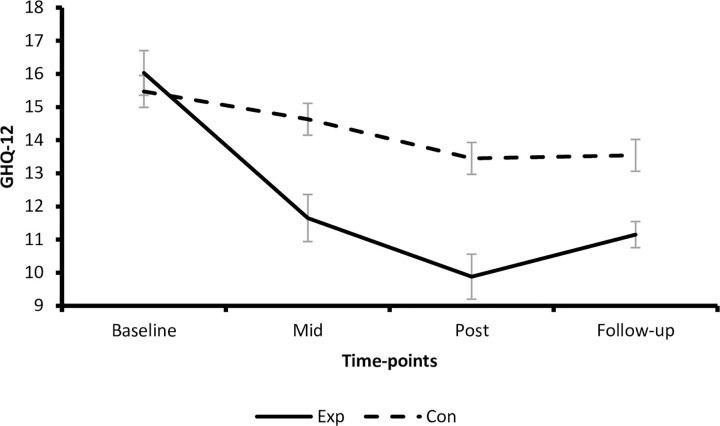
- In the primary outcome, the mixed ANOVA showed a significant Time × Condition interaction for psychological distress: F(2.12, 203) = 3.49, p = .03, partial η2 = .04.
- In the ACT group, psychological distress decreased from baseline to mid-intervention, post-intervention, and follow-up: F(1, 51) = 27.38, 39.59, and 350.65, respectively, all reported as significant.
- For burnout, the intervention had a significant effect on cognitive weariness with a Time × Condition interaction: F(2.32, 223.21) = 3.82, p = .02, partial η2 = .04; there was no significant Time × Condition interaction for physical exhaustion or emotional exhaustion.
- Mediation analyses found significant indirect effects on psychological distress through values obstruction (estimate = .17, BCa 95% CI [.02; .33]), mindfulness (.20, [.04; .37]), and self-compassion (.13, [.01; .31]); the same processes mediated cognitive weariness, and there was an indirect effect on patient safety perceptions via reduced psychological distress (estimate = -.09, BCa 95% CI [.01; .22]).
- At four-week post-intervention, 48% (25/52) of ACT participants met criteria for reliable change and 46.15% (24/52) met criteria for clinical significance; at follow-up, 52% (27/52) met reliable change and 50% (26/52) met clinical significance.
## Methods
- Parallel-group randomized controlled trial comparing a 4-session ACT intervention with a waitlist control among NHS staff in primary care settings in Yorkshire and Humberside.
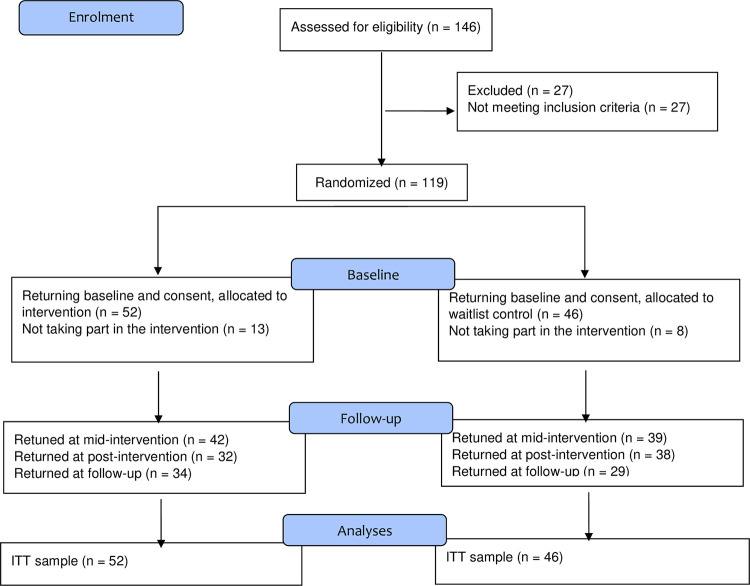
- 98 participants were included (52 ACT, 46 control); outcomes were measured at baseline, mid-intervention, post-intervention, and 14-week follow-up.
- Main analyses used mixed repeated-measures ANOVA/MANOVA, with bootstrapped mediation models for psychological processes and reliable/clinically significant change analyses for the GHQ-12.
## Limitations
- The paper states that attrition was relatively high: of 98 baseline participants, 63 completed all four time points; the authors also note that last observation carried forward can inflate the chance of finding an intervention effect, so the findings should be interpreted cautiously.
- The authors note that patient safety was measured with a single-item measure and that an objective measure would have been preferable.
- The authors state that the waitlist control was an inactive comparator, which is weaker than an active control.
- Evident from the text: the sample was mostly female (92.7%) and largely from NHS primary care in one region, which may limit generalizability.
Model-written summary. Check it against the paper before relying on it.
Integrity signals
Registry
Cites
Statistics
Figures
Verification
Claims the paper makes
13 Valid · 2 Not valid · 11 Not checked · 88 Own results and interpretations
Some cited sources support this claim and some don’t — read each source’s verdict below.
In the paper
“Although previous studies have found an indirect effect of mindfulness [29] or psychological flexibility [12, 75], to our knowledge, this is the first study to show a significant improvement in psychological distress of NHS staff through an improvement of values (specifically there was an influence on values obstruction facet).”
§ A workplace Acceptance and Commitment Therapy (ACT) intervention for improving healthcare staff psychological distress: A randomised controlled trial > Discussion
What the sources say
- Disputedcites [29] Waters C.S., et al., Acceptance and commitment therapy (ACT) for clinically distressed health care workers: Waitlist‐controlled evaluation of an ACT workshop in a routine practice setting. British Journal of Clinical Psychology, 2018. 57(1): p. 82– 98. 28857254 sourceExperimental — accuracy not yet measured
The citation is attached to the statement that previous studies found an indirect effect through psychological flexibility, not to the citing authors’ claim about values obstruction. In the Results (pp. 15–16), this paper says only the mindfulness mediation model had statistically significant indirect effects; Table 4 (pp. 35–36) shows that the confidence interval for the psychological-flexibility indirect effect includes zero. The paper also states that it did not examine values-based behaviour (Limitations, p. 20). (LLM, conf=0.88)
Checked by a reasoning model — may be wrong.
- Supportedcites [12] Flaxman P.E. and Bond F.W., A randomised worksite comparison of acceptance and commitment therapy and stress inoculation training. Behaviour research and therapy, 2010. 48(8): p. 816– 820. doi: 10.1016/j.brat.2010.05.004 20627269 source
The citation is attached to the sentence’s statement that previous studies found an indirect effect of psychological flexibility, not to the citing authors’ claim about their own NHS staff study. The Mediation Analysis reports that increased psychological flexibility significantly mediated the effect of acceptance and commitment therapy on psychological distress. The source does not need to establish the separate values-obstruction finding. (LLM, conf=0.94)
- Not checked — no full text of the sourcecites [75] Bond F.W. and Flaxman P.E., The ability of psychological flexibility and job control to predict learning, job performance, and mental health. Journal of Organizational Behavior Management, 2006. 26(1–2): p. 113– 130. source
hedgedstates a cause- Asserted: passes — The authors put it forward as true.
- Checkable: passes — It can be checked against evidence.
- Load-bearing: passes — The paper’s conclusions depend on it.
- Based: passes — The paper gives a reason why it holds.
- Disputed
The cited sources support only part of this claim — read each source’s verdict below.
In the paper
“Evidence suggests that worksite stress management interventions, particularly those based on Cognitive Behaviour Therapies (CBT), can be effective for improving the psychological health of staff working in healthcare and other organisational settings [5–8].”
§ A workplace Acceptance and Commitment Therapy (ACT) intervention for improving healthcare staff psychological distress: A randomised controlled trial > Introduction
What the sources say
- Partly supportedcites [5] Dreison K.C., et al., Job burnout in mental health providers: A meta-analysis of 35 years of intervention research. Journal of occupational health psychology, 2018. 23(1): p. 18. doi: 10.1037/ocp0000047 27643608 sourceExperimental — accuracy not yet measured
The paper describes person-directed burnout interventions that often use cognitive-behavioral techniques, and its Discussion reports small reductions in burnout among mental health providers. The Comparison of Intervention Types section also finds person-directed interventions more effective than organization-directed ones for emotional exhaustion. It does not establish that CBT-based interventions specifically are more effective, or directly study psychological health across healthcare staff and other organizational settings. (LLM, conf=0.86)
- Not checked — no full text of the sourcecites [6] Panagioti M., et al., Controlled interventions to reduce burnout in physicians: a systematic review and meta-analysis. JAMA internal medicine, 2017. 177(2): p. 195– 205. doi: 10.1001/jamainternmed.2016.7674 27918798 source
- Not checked — no full text of the sourcecites [7] Richardson K.M. and Rothstein H.R., Effects of occupational stress management intervention programs: a meta-analysis. Journal of occupational health psychology, 2008. 13(1): p. 69. doi: 10.1037/1076-8998.13.1.69 18211170 source
- Not checked — no full text of the sourcecites [8] West C.P., et al., Interventions to prevent and reduce physician burnout: a systematic review and meta-analysis. The Lancet, 2016. 388(10057): p. 2272– 2281. doi: 10.1016/S0140-6736(16)31279-X 27692469 source
hedgedstates a possible cause- Asserted: passes — The authors put it forward as true.
- Checkable: passes — It can be checked against evidence.
- Load-bearing: passes — The paper’s conclusions depend on it.
- Based: passes — The paper gives a reason why it holds.
- Partly supported
The sources with a verdict support this claim; the rest weren’t checked yet, have no full text we could read, or their verdicts aren’t rated yet.
In the paper
“Moreover, high levels of burnout and distress may have implications for the quality of patient care, potentially leading to reduced perceptions of patient safety and heightened risk of medical error [3, 4].”
§ A workplace Acceptance and Commitment Therapy (ACT) intervention for improving healthcare staff psychological distress: A randomised controlled trial > Introduction
What the sources say
- Supportedcites [3] Hall L.H., et al., Healthcare staff wellbeing, burnout, and patient safety: a systematic review. PloS one, 2016. 11(7): p. e0159015. doi: 10.1371/journal.pone.0159015 27391946 PMC4938539 source
The Discussion reports that poor wellbeing and high burnout are associated with more self-reported errors, while cautioning that too few prospective studies establish causality. The Results (Burnout Findings) also report an association between higher burnout and a lower patient safety grade. The citing sentence’s tentative wording is consistent with those findings. (LLM, conf=0.91)
- Not checked — no full text of the sourcecites [4] O’Connor D.B., O’Connor R.C., White B.L., Bundred P.E., The effect of job strain on British general practitioners’ mental health. Journal of Mental Health, 2000. 9(6): p. 637– 654. source
hedgedstates a possible cause- Asserted: passes — The authors put it forward as true.
- Checkable: passes — It can be checked against evidence.
- Load-bearing: passes — The paper’s conclusions depend on it.
- Based: passes — The paper gives a reason why it holds.
- Supported
The sources with a verdict support this claim; the rest weren’t checked yet, have no full text we could read, or their verdicts aren’t rated yet.
In the paper
“Based on previous RCT studies of ACT interventions in HCPs [24, 29], we estimated a small to medium effect size (f = 0.22). The estimated sample size necessary to detect a small to medium effect size at an alpha rate of 0.05 (two-tailed) using the G* Power 3 programme [37], was 104 participants.”
§ A workplace Acceptance and Commitment Therapy (ACT) intervention for improving healthcare staff psychological distress: A randomised controlled trial > Materials and method > Participants
What the sources say
- Not checked — no full text of the sourcecites [24] Brinkborg H., et al., Acceptance and commitment therapy for the treatment of stress among social workers: A randomized controlled trial. Behaviour research and therapy, 2011. 49(6–7): p. 389– 398. doi: 10.1016/j.brat.2011.03.009 21513917 source
- Could not verifycites [29] Waters C.S., et al., Acceptance and commitment therapy (ACT) for clinically distressed health care workers: Waitlist‐controlled evaluation of an ACT workshop in a routine practice setting. British Journal of Clinical Psychology, 2018. 57(1): p. 82– 98. 28857254 sourceExperimental — accuracy not yet measured
The Results (p. 14) report 35 participants and an observed between-group effect of d = 1.41, but do not give a power calculation or a required sample of 104. In the citing sentence, 104 is presented as the citing authors’ G*Power estimate, not a figure reported by Waters. Searched for the sample-size estimate, f = 0.22, and G*Power in our copy. (LLM, conf=0.77)
- Supportedcites [37] Faul F., et al., G* Power 3: A flexible statistical power analysis program for the social, behavioral, and biomedical sciences. Behavior research methods, 2007. 39(2): p. 175– 191. doi: 10.3758/bf03193146 17695343 source
The citation identifies the G*Power 3 programme used for the citing authors’ sample-size calculation; it does not attribute the 104-participant estimate to Faul et al. The paper’s “A Priori Power Analyses” section describes computing sample size from the target power, significance level, and effect size. (LLM, conf=0.90)
hedgedn = 104- Asserted: passes — The authors put it forward as true.
- Checkable: passes — It can be checked against evidence.
- Load-bearing: unclear — It is unclear whether the paper’s conclusions depend on it.
- Based: passes — The paper gives a reason why it holds.
The cited sources that could be checked couldn’t confirm or dispute this claim.
In the paper
“First, workplace evaluations of ACT have focused predominantly on broad process of change variables, particularly overall levels of psychological flexibility and/or mindfulness [13, 19, 25].”
§ A workplace Acceptance and Commitment Therapy (ACT) intervention for improving healthcare staff psychological distress: A randomised controlled trial > Introduction > Why ACT interventions in the workplace?
What the sources say
- Not checked — no full text of the sourcecites [13] Reeve A., Tickle A., and Moghaddam N., Are acceptance and commitment therapy-based interventions effective for reducing burnout in direct-care staff? A systematic review and meta-analysis. Mental Health Review Journal, 2018. doi: 10.1108/MHRJ-01-2018-0001 30464703 PMC6201820 source
- Could not verifycites [19] Flaxman P.E. and Bond F.W., Worksite stress management training: Moderated effects and clinical significance. Journal of Occupational Health Psychology, 2010. 15(4): p. 347. doi: 10.1037/a0020522 21058850 sourceExperimental — accuracy not yet measured
The Measures section (p. 11) describes assessment of psychological distress, while the SMT Program section (p. 12) describes mindfulness exercises used in the intervention. Neither establishes that workplace ACT evaluations predominantly measured psychological flexibility or mindfulness as processes of change. Searches for process measures and psychological flexibility found no passage making that broader claim. (LLM, conf=0.72)
- Not checked — no full text of the sourcecites [25] Frögéli E., et al., A randomized controlled pilot trial of acceptance and commitment training (ACT) for preventing stress-related ill health among future nurses. Anxiety, Stress, & Coping, 2016. 29(2): p. 202– 218. doi: 10.1080/10615806.2015.1025765 25759942 source
plain- Asserted: passes — The authors put it forward as true.
- Checkable: passes — It can be checked against evidence.
- Load-bearing: passes — The paper’s conclusions depend on it.
- Based: passes — The paper gives a reason why it holds.
68 more claims · 4 with their cited sources checked
Create a free account to see all 114 claims and every source verdict.
- Probably not a substantial claim. 26
- It may state two separate claims as one. 17
- The quote only partly states this claim. 4
Claims other papers make about this one
Each is checked against this paper’s own text: does it say what the citing paper says it does?
The source backs part of the claim, not all of it — or backs it for a different population, condition or comparison.
In the citing paper
“was verified as an intervention for stress and burnout management for various medical staff, including nurses [50].”
From Development of an artificial intelligence-based tailored mobile intervention for nurse burnout: single-arm trial (2024) · cites this paper as [50]
Experimental — accuracy not yet measuredThe source backs part of the claim, not all of it — or backs it for a different population, condition or comparison.
In the citing paper
“Acceptance and commitment therapy can help individuals reflect on, reconsider, and adjust their relationships with patients, potentially reducing client‐related burnout (Prudenzi et al. 2022; Towey‐Swift et al. 2023).”
From AI‐Assisted Tailored Intervention for Nurse Burnout: A Three‐Group Randomized Controlled Trial (2025) · cites this paper as Prudenzi et al. 2022
Experimental — accuracy not yet measuredIn the citing paper
“In recent years, ACT has been increasingly adopted to prevent and reduce professional staff burnout in medical and other workplace settings [50].”
From Development of an artificial intelligence-based tailored mobile intervention for nurse burnout: single-arm trial (2024) · cites this paper as [50]
Statistics that don’t add up
Each reported p-value recomputed from its test statistic and degrees of freedom.
Rated major: it would touch a result — a value a result rests on, reported and recomputed p-values on opposite sides of the significance level, two passages that conflict with no sign which is right, or a cited work retracted before this paper was published.
In the paper
“F (6, 91) = 2.219, p = .099”
§ A workplace Acceptance and Commitment Therapy (ACT) intervention for improving healthcare staff psychological distress: A randomised controlled trial > Results > Secondary outcomes: Perceived patient safety
Reported p = .099 · recomputed p = .048
Rated minor: it would not touch a result — a value no result rests on, a p-value that stays on the same side of the significance level, or a conflict that is clerical, resolved elsewhere in the paper, or outside its own findings.
In the paper
“F (1.87, 187.03) = .96, p = .37”
§ A workplace Acceptance and Commitment Therapy (ACT) intervention for improving healthcare staff psychological distress: A randomised controlled trial > Results > Secondary outcomes: Burnout
Reported p = .37 · recomputed p = .380
Rated minor: it would not touch a result — a value no result rests on, a p-value that stays on the same side of the significance level, or a conflict that is clerical, resolved elsewhere in the paper, or outside its own findings.
In the paper
“F (3, 288) = .980, p = .420”
§ A workplace Acceptance and Commitment Therapy (ACT) intervention for improving healthcare staff psychological distress: A randomised controlled trial > Results > Secondary outcomes: Work-related worry and rumination
Reported p = .42 · recomputed p = .403
Rated minor: it would not touch a result — a value no result rests on, a p-value that stays on the same side of the significance level, or a conflict that is clerical, resolved elsewhere in the paper, or outside its own findings.
In the paper
“F (6, 91) = 1.33, p = .910”
§ A workplace Acceptance and Commitment Therapy (ACT) intervention for improving healthcare staff psychological distress: A randomised controlled trial > Results > Secondary outcomes: Perceived patient safety
Reported p = .91 · recomputed p = .252
Rated minor: it would not touch a result — a value no result rests on, a p-value that stays on the same side of the significance level, or a conflict that is clerical, resolved elsewhere in the paper, or outside its own findings.
In the paper
“F (3, 288) = 5.26, p = .004”
§ A workplace Acceptance and Commitment Therapy (ACT) intervention for improving healthcare staff psychological distress: A randomised controlled trial > Results > Secondary outcomes: Work-related worry and rumination
Reported p = .004 · recomputed p = .002
Statistics recomputed
Every reported test result, recomputed from its test statistic and degrees of freedom. A result shows as not adding up only once an independent check has confirmed it.
- Doesn’t add upF(6, 91) = 2.219reported p = .099 · recomputed p = .048The two fall on opposite sides of .05
“F (6, 91) = 2.219, p = .099”
- Doesn’t add upF(1.87, 187.03) = 0.96reported p = .37 · recomputed p = .380
“F (1.87, 187.03) = .96, p = .37”
- Doesn’t add upF(3, 288) = 5.26reported p = .004 · recomputed p = .002
“F (3, 288) = 5.26, p = .004”
- Doesn’t add upF(3, 288) = 0.98reported p = .42 · recomputed p = .403
“F (3, 288) = .980, p = .420”
- Doesn’t add upF(6, 91) = 1.33reported p = .91 · recomputed p = .252
“F (6, 91) = 1.33, p = .910”
25 more recomputed tests
Create a free account to see every test the Stats check recomputed.
Self-check
Percentages, sums and reported differences re-computed from the paper’s own numbers.
Self-check results appear here once an independent check has confirmed them.
Citations
Cites
Faul, F., Erdfelder, E., Lang, A.-G., & Buchner, A. (2007) · Behavior Research Methods · doi:10.3758/bf03193146 · Cited by 65,971
The job demands-resources model of burnout.
Demerouti, E., Bakker, A. B., Nachreiner, F., & Schaufeli, W. B. (2001) · Journal of Applied Psychology · doi:10.1037/0021-9010.86.3.499 · Cited by 13,643 · cited 1×
“, support, autonomy, or feedback) [32].”
Maslach, C., Schaufeli, W. B., & Leiter, M. P. (2001) · Annual Review of Psychology · doi:10.1146/annurev.psych.52.1.397 · Cited by 12,852 · cited 1×
“Indeed, emotional exhaustion is often the result of chronic exposure to a stressful and demanding work environment, and therefore, will be more difficult to change at an individual level [70].”
A comparison of methods to test mediation and other intervening variable effects
MacKinnon, D. P., Lockwood, C. M., Hoffman, J. M., West, S. G., & Sheets, V. (2002) · Psychological Methods · doi:10.1037/1082-989x.7.1.83 · Cited by 9,406 · cited 1×
“A bootstrapping approach [57] was preferred given the size of the sample [58], and to test indirect effects [59].”
Jacobson, N. S., & Truax, P. (1991) · Journal of Consulting and Clinical Psychology · doi:10.1037/0022-006x.59.1.12 · Cited by 7,770 · cited 2×
“This calculator uses the methods for calculating reliable and clinically significant change delineated by Jacobson and Truax [61].”
Curran, P. J., West, S. G., & Finch, J. F. (1996) · Psychological Methods · doi:10.1037/1082-989x.1.1.16 · Cited by 5,512
Bond, F. W., Hayes, S. C., Baer, R. A., Carpenter, K. M., Guenole, N., Orcutt, H. K., Waltz, T., & Zettle, R. D. (2011) · Behavior Therapy · doi:10.1016/j.beth.2011.03.007 · Cited by 3,950
The Validity of Two Versions of the GHQ in the WHO Study of Mental Illness in General Health Care
GOLDBERG, D. P., GATER, R., SARTORIUS, N., USTUN, T. B., PICCINELLI, M., GUREJE, O., & RUTTER, C. (1997) · Psychological Medicine · doi:10.1017/s0033291796004242 · Cited by 3,657
Construction and factorial validation of a short form of the Self-Compassion Scale
Raes, F., Pommier, E., Neff, K. D., & Van Gucht, D. (2011) · Clinical Psychology & Psychotherapy · doi:10.1002/cpp.702 · Cited by 2,997
Baer, R. A., Smith, G. T., Lykins, E., Button, D., Krietemeyer, J., Sauer, S., Walsh, E., Duggan, D., & Williams, J. M. G. (2008) · Assessment · doi:10.1177/1073191107313003 · Cited by 2,930 · cited 2×
“Short-Form Five Facet Mindfulness Questionnaire [53].”
Interventions to prevent and reduce physician burnout: a systematic review and meta-analysis
West, C. P., Dyrbye, L. N., Erwin, P. J., & Shanafelt, T. D. (2016) · The Lancet · doi:10.1016/s0140-6736(16)31279-x · Cited by 2,362
Healthcare staff wellbeing, burnout, and patient safety: a systematic review
Hall, L. H., Johnson, J., Watt, I., Tsipa, A., & O’Connor, D. B. (2016) · PLOS ONE · doi:10.1371/journal.pone.0159015 · Cited by 1,683 · cited 3×
“Moreover, high levels of burnout and distress may have implications for the quality of patient care, potentially leading to reduced perceptions of patient safety and heightened risk of medical error [3, 4].”
Self-citationControlled Interventions to Reduce Burnout in Physicians: A Systematic Review and Meta-analysis
Panagioti, M., Panagopoulou, E., Bower, P., Lewith, G., Kontopantelis, E., Chew-Graham, C., Dawson, S., van Marwijk, H., Geraghty, K., & Esmail, A. (2017) · JAMA Internal Medicine · doi:10.1001/jamainternmed.2016.7674 · Cited by 1,395 · cited 1×
“This finding is in line with the patient safety literature [2, 4, 6] that suggests that psychological distress is a strong proxy of perceived safety practices.”
Effects of occupational stress management intervention programs: A meta-analysis.
Richardson, K. M., & Rothstein, H. R. (2008) · Journal of Occupational Health Psychology · doi:10.1037/1076-8998.13.1.69 · Cited by 1,374
Mindfulness-based cognitive therapy for depression
Kumari, D., & Satyapal, N. (2025) · Industrial Psychiatry Journal · doi:10.4103/ipj.ipj_127_24 · Cited by 997
Current Directions in Mediation Analysis
MacKinnon, D. P., & Fairchild, A. J. (2009) · Current Directions in Psychological Science · doi:10.1111/j.1467-8721.2009.01598.x · Cited by 940 · cited 1×
“A bootstrapping approach [57] was preferred given the size of the sample [58], and to test indirect effects [59].”
A comparison of the construct validity of two burnout measures in two groups of professionals.
Shirom, A., & Melamed, S. (2006) · International Journal of Stress Management · doi:10.1037/1072-5245.13.2.176 · Cited by 763
Resilience training in the workplace from 2003 to 2014: A systematic review
Robertson, I. T., Cooper, C. L., Sarkar, M., & Curran, T. (2015) · Journal of Occupational and Organizational Psychology · doi:10.1111/joop.12120 · Cited by 724 · cited 1×
“, lack of workplace support, feedback, or job control), while secondary interventions, such as CBT and mindfulness-based interventions, equip employees with psychological skills and resources that increase resilience to stress [10].”
Acceptance and Commitment Therapy as a Unified Model of Behavior Change
Hayes, S. C., Pistorello, J., & Levin, M. E. (2012) · The Counseling Psychologist · doi:10.1177/0011000012460836 · Cited by 718 · cited 3×
“The “passengers on the bus” metaphor [11] was proposed to help participants understand their psychological barriers.”
InfluentialThe Role of Acceptance and Job Control in Mental Health, Job Satisfaction, and Work Performance
Bond, F. W., & Bunce, D. (2003) · Journal of Applied Psychology · doi:10.1037/0021-9010.88.6.1057 · Cited by 711 · cited 1×
“Higher levels of psychological flexibility have been shown to be associated with improved mental health, job performance and absenteeism in UK workers [21, 22].”
A Systematic Review of the Job-stress Intervention Evaluation Literature, 1990–2005
Lamontagne, A. D., Keegel, T., Louie, A. M., Ostry, A., & Landsbergis, P. A. (2007) · International Journal of Occupational and Environmental Health · doi:10.1179/oeh.2007.13.3.268 · Cited by 704
(2009) · Cited by 655
Mediators of change in emotion-focused and problem-focused worksite stress management interventions
Bond, F. W., & Bunce, D. (2000) · Journal of Occupational Health Psychology · doi:10.1037/1076-8998.5.1.156 · Cited by 607 · cited 5×
“In only a small proportion of workplace studies, ACT has been found to improve performance-related outcomes [15, 16].”
InfluentialGámez, W., Chmielewski, M., Kotov, R., Ruggero, C., & Watson, D. (2011) · Psychological Assessment · doi:10.1037/a0023242 · Cited by 524
Exploring the relationship between work-related rumination, sleep quality, and work-related fatigue
Querstret, D., & Cropley, M. (2012) · Journal of Occupational Health Psychology · doi:10.1037/a0028552 · Cited by 401 · cited 1×
“, intrusive and/or annoying) ruminative thoughts about work during non-work time, and has demonstrated good psychometric properties among various samples of UK workers [47, 49].”
Jacobson, N. S., & Truax, P. (1992) · Methodological issues & strategies in clinical research. · doi:10.1037/10109-042 · Cited by 384
Johnson, J., Hall, L. H., Berzins, K., Baker, J., Melling, K., & Thompson, C. (2018) · International Journal of Mental Health Nursing · doi:10.1111/inm.12416 · Cited by 371
Hayes, S. C., Bissett, R., Roget, N., Padilla, M., Kohlenberg, B. S., Fisher, G., Masuda, A., Pistorello, J., Rye, A. K., Berry, K., et al. (2004) · Behavior Therapy · doi:10.1016/s0005-7894(04)80022-4 · Cited by 358 · cited 1×
“This finding is consistent with a few ACT studies in the workplace [23, 27, 67].”
Development of the Valuing Questionnaire (VQ)
Smout, M., Davies, M., Burns, N., & Christie, A. (2014) · Journal of Contextual Behavioral Science · doi:10.1016/j.jcbs.2014.06.001 · Cited by 350
O. B. O. T. C.-S. G., Grant, S., Mayo-Wilson, E., Montgomery, P., Macdonald, G., Michie, S., Hopewell, S., & Moher, D. (2018) · Trials · doi:10.1186/s13063-018-2735-z · Cited by 348
ORGANIZATIONAL STRESS THROUGH THE LENS OF CONSERVATION OF RESOURCES (COR) THEORY
Westman, M., Hobfoll, S. E., Chen, S., Davidson, O. B., & Laski, S. (2004) · Research in Occupational Stress and Well-being · doi:10.1016/s1479-3555(04)04005-3 · Cited by 334
Fallacies of last observation carried forward analyses
Lachin, J. M. (2016) · Clinical Trials · doi:10.1177/1740774515602688 · Cited by 328 · cited 1×
“Although this is a simple method to account for missing data in repeated-measures studies that maximizes the number of observations, it can inflate the probability of finding a significant intervention effect when it does not exist; therefore we urge some caution until the current findings are replicated in a future,…”
The Relation of Post‐work Ruminative Thinking with Eating Behaviour
Cropley, M., Michalianou, G., Pravettoni, G., & Millward, L. J. (2012) · Stress and Health · doi:10.1002/smi.1397 · Cited by 271
Imo, U. O. (2017) · BJPsych Bulletin · doi:10.1192/pb.bp.116.054247 · Cited by 268
Job burnout in mental health providers: A meta-analysis of 35 years of intervention research
Dreison, K. C., Luther, L., Bonfils, K. A., Sliter, M. T., McGrew, J. H., & Salyers, M. P. (2018) · Journal of Occupational Health Psychology · doi:10.1037/ocp0000047 · Cited by 244
Bond, F. W., Flaxman, P. E., & Bunce, D. (2008) · Journal of Applied Psychology · doi:10.1037/0021-9010.93.3.645 · Cited by 235
Self-citationBrinkborg, H., Michanek, J., Hesser, H., & Berglund, G. (2011) · Behaviour Research and Therapy · doi:10.1016/j.brat.2011.03.009 · Cited by 235 · cited 4×
“This finding is consistent with the positive findings of ACT interventions for distress observed in a number of RCT studies in workplace contexts [12, 15, 24, 29, 66, 67].”
InfluentialBond, F. W., & Flaxman, P. E. (2006) · Journal of Organizational Behavior Management · doi:10.1300/j075v26n01_05 · Cited by 221 · cited 2×
“These results are also consistent with previous ACT interventions in the workplace [12, 29, 75].”
Better together? Examining profiles of employee recovery experiences
Bennett, A. A., Gabriel, A. S., Calderwood, C., Dahling, J. J., & Trougakos, J. P. (2016) · Journal of Applied Psychology · doi:10.1037/apl0000157 · Cited by 219
Research priorities for the COVID‐19 pandemic and beyond: A call to action for psychological science
O'Connor, D. B., Aggleton, J. P., Chakrabarti, B., Cooper, C. L., Creswell, C., Dunsmuir, S., Fiske, S. T., Gathercole, S., Gough, B., Ireland, J. L., et al. (2020) · British Journal of Psychology · doi:10.1111/bjop.12468 · Cited by 210 · cited 1×
“Moreover, researchers ought to consider developing and testing the feasibility of online, digital versions of the current ACT intervention in order to increase accessibility and reach and to ensure easy roll out in any future pandemics [77].”
Self-citationFlaxman, P. E., & Bond, F. W. (2010) · Behaviour Research and Therapy · doi:10.1016/j.brat.2010.05.004 · Cited by 197
Self-citationLloyd, J., Bond, F. W., & Flaxman, P. E. (2013) · Work & Stress · doi:10.1080/02678373.2013.782157 · Cited by 175 · cited 3×
“This finding is consistent with a few ACT studies in the workplace [23, 27, 67].”
Self-citationMcCracken, L. M. (2013) · The Journal of Pain · doi:10.1016/j.jpain.2013.02.009 · Cited by 172 · cited 1×
“Psychological flexibility is defined as “the ability to persist or to change behaviour in a setting of competing psychological influences, guided by values and goals dependent on what the situation at hand affords” [17].”
Lundin, A., Hallgren, M., Theobald, H., Hellgren, C., & Torgén, M. (2016) · Public Health · doi:10.1016/j.puhe.2016.03.005 · Cited by 172 · cited 1×
“For calculation of clinically significant change, we additionally included comparison norms from a [63, 64] representative population survey comprising 213, 365 data points (Mean = 1.”
Flaxman, P. E., Ménard, J., Bond, F. W., & Kinman, G. (2012) · Journal of Applied Psychology · doi:10.1037/a0028055 · Cited by 162 · cited 2×
“Work-related worry and rumination was assessed using two scales: the Affective Rumination Scale [47], and the Perseverative Cognition Scale [48].”
Self-citationWorksite stress management training: Moderated effects and clinical significance
Flaxman, P. E., & Bond, F. W. (2010) · Journal of Occupational Health Psychology · doi:10.1037/a0020522 · Cited by 126 · cited 6×
“In workplace settings, this ability may involve: 1) greater willingness to experience unpleasant thoughts and emotions that arise while performing at work; 2) an ability to bring present moment awareness to current tasks, inner experiences, and external interactions and situations; and 3) consistent engagement in work…”
InfluentialSelf-citationA randomized trial of ACT bibliotherapy on the mental health of K-12 teachers and staff
Jeffcoat, T., & Hayes, S. C. (2012) · Behaviour Research and Therapy · doi:10.1016/j.brat.2012.05.008 · Cited by 115
Frögéli, E., Djordjevic, A., Rudman, A., Livheim, F., & Gustavsson, P. (2016) · Anxiety, Stress, & Coping · doi:10.1080/10615806.2015.1025765 · Cited by 114
Rudaz, M., Twohig, M. P., Ong, C. W., & Levin, M. E. (2017) · Journal of Contextual Behavioral Science · doi:10.1016/j.jcbs.2017.10.001 · Cited by 107
Multidisciplinary team functioning and decision making within forensic mental health
Haines‐Delmont, A., Perkins, E., Evans, E. A., & McCabe, R. (2018) · Mental Health Review Journal · doi:10.1108/mhrj-01-2018-0001 · Cited by 104
McConachie, D. A. J., McKenzie, K., Morris, P. G., & Walley, R. M. (2014) · Research in Developmental Disabilities · doi:10.1016/j.ridd.2014.03.005 · Cited by 103 · cited 1×
“This finding is consistent with the positive findings of ACT interventions for distress observed in a number of RCT studies in workplace contexts [12, 15, 24, 29, 66, 67].”
Varra, A. A., Hayes, S. C., Roget, N., & Fisher, G. (2008) · Journal of Consulting and Clinical Psychology · doi:10.1037/0022-006x.76.3.449 · Cited by 101 · cited 2×
“Moreover, ACT interventions have also been found to lead to improvements in various other indicators of employee wellbeing and performance including increasing innovation in the workplace [12, 15, 16].”
(2013) · Cited by 97
Self-citationThe Mindful Way Workbook: An 8-Week Program to Free Yourself from Depression and Emotional Distress
Teasdale, J. D., Williams, J. M. G., Segal, Z. V., & Kabat‐Zinn, J. (2013) · Medical Entomology and Zoology · Cited by 94
Factors affecting psychological well-being: Evidence from two nationally representative surveys
Oskrochi, G., Bani‐Mustafa, A., & Oskrochi, Y. (2018) · PLoS ONE · doi:10.1371/journal.pone.0198638 · Cited by 87 · cited 1×
“For calculation of clinically significant change, we additionally included comparison norms from a [63, 64] representative population survey comprising 213, 365 data points (Mean = 1.”
A psychological flexibility -based intervention for Burnout:A randomized controlled trial
Puolakanaho, A., Tolvanen, A., Kinnunen, S. M., & Lappalainen, R. (2020) · Journal of Contextual Behavioral Science · doi:10.1016/j.jcbs.2019.11.007 · Cited by 82
Gerhart, J. I., O’Mahony, S., Abrams, I., Grosse, J., Greene, M., & Levy, M. M. (2016) · Journal of Contextual Behavioral Science · doi:10.1016/j.jcbs.2016.04.003 · Cited by 79
The effect of job strain on British general practitioners' mental health
O'Connor, D. B., O’Connor, R. C., White, B. L., & Bundred, P. E. (2000) · Journal of Mental Health · doi:10.1080/jmh.9.6.637.654 · Cited by 74
Self-citationBethay, J. S., Wilson, K. G., Schnetzer, L. W., Nassar, S. L., & Bordieri, M. J. (2012) · Mindfulness · doi:10.1007/s12671-012-0103-8 · Cited by 66
Prudenzi, A., Graham, C. D., Clancy, F., Hill, D., O'Driscoll, R., Day, F., & O'Connor, D. B. (2021) · Journal of Affective Disorders · doi:10.1016/j.jad.2021.07.084 · Cited by 64
Self-citationPakenham, K. I. (2015) · Clinical Psychology & Psychotherapy · doi:10.1002/cpp.1924 · Cited by 58
Prudenzi, A., D. Graham, C., Flaxman, P. E., & O’Connor, D. B. (2022) · Psychology, Health & Medicine · doi:10.1080/13548506.2021.1898651 · Cited by 58 · cited 1×
“The current study compares well with a cross-sectional study conducted to explore the predictive influences of psychological flexibility (mindfulness and values) and self-compassion on psychological distress, burnout and perceived patient practices [69].”
Self-citationWaters, C. S., Frude, N., Flaxman, P. E., & Boyd, J. (2018) · British Journal of Clinical Psychology · doi:10.1111/bjc.12155 · Cited by 50 · cited 6×
“These results are also consistent with previous ACT interventions in the workplace [12, 29, 75].”
InfluentialSelf-citationReeve, A., Tickle, A., & Moghaddam, N. (2018) · Mental Health Review Journal · doi:10.1108/mhrj-11-2017-0052 · Cited by 49 · cited 7×
“In workplace settings, this ability may involve: 1) greater willingness to experience unpleasant thoughts and emotions that arise while performing at work; 2) an ability to bring present moment awareness to current tasks, inner experiences, and external interactions and situations; and 3) consistent engagement in work…”
InfluentialSelf-help for stress and burnout without therapist contact: An online randomised controlled trial
Hofer, P. D., Waadt, M., Aschwanden, R., Milidou, M., Acker, J., Meyer, A. H., Lieb, R., & Gloster, A. T. (2018) · Work & Stress · doi:10.1080/02678373.2017.1402389 · Cited by 48
The effect of job strain on British general practitioners’ mental health
O'Connor, D., O'Connor, R., White, B., & Bundred, P. (2000) · Journal of Mental Health · doi:10.1080/713680290 · Cited by 37
Self-citationAcceptance and commitment therapy: Applications for educational psychologists within schools
Gillard, D., Flaxman, P., & Hooper, N. (2018) · Educational Psychology in Practice · doi:10.1080/02667363.2018.1446911 · Cited by 32
Self-citationLouch, G., O’Hara, J., Gardner, P., & O’Connor, D. B. (2016) · International Journal of Nursing Studies · doi:10.1016/j.ijnurstu.2016.02.010 · Cited by 31
Self-citationDereix-Calonge, I., Ruiz, F. J., Sierra, M. A., Peña-Vargas, A., & Ramírez, E. S. (2019) · Journal of Contextual Behavioral Science · doi:10.1016/j.jcbs.2019.02.005 · Cited by 29
Employee Burnout and Health: Current Knowledge and Future Research Paths
Shirom, A. (2010) · Contemporary Occupational Health Psychology · doi:10.1002/9780470661550.ch4 · Cited by 25 · cited 1×
“Consistent with these principles, the Conservation of Resources theory [33, 34] conceptualises burnout as an over-depletion of energy resources resulting from prolonged exposure to job stress without adequate periods of recovery.”
Louch, G., O’Hara, J., Gardner, P., & O’Connor, D. B. (2017) · International Journal of Behavioral Medicine · doi:10.1007/s12529-017-9655-2 · Cited by 24
Self-citation(2012) · Kent Academic Repository (University of Kent) · Cited by 12
(2012) · doi:10.1037/17335-004 · Cited by 2
Morrison, L., & Gillies, J. (2015) · British Journal of General Practice · doi:10.3399/bjgp15x685609
Research works printed but not linked: 6
- Williams M. and Penman D., Mindfulness: A practical guide to finding peace in a frantic world. 2011: Hachette UK.
- Polk K.L., et al., The essential guide to the ACT Matrix: A step-by-step approach to using the ACT Matrix model in clinical practice. 2016: New Harbinger Publications.
- Goldberg D., General health questionnaire (GHQ-12) edn. NFER-Nelson: Windsor, UK, 1992.
- Cohen J., Statistical power analysis for the behavioral sciences, 2nd edn. Á/L. 1988, Erbaum Press, Hillsdale, NJ, USA.
- Hayes A.F., Introduction to mediation, moderation, and conditional process analysis: Methodology in the Social Sciences. Kindle Edition, 2013. 193.
- Morley S. and Dowzer C., Manual for the Leeds Reliable Change Indicator: Simple Excel® applications for the analysis of individual patient and group data. University of Leeds, Leeds, UK. 2014.
Cited by
Haslam, A., Tuia, J., Miller, S. L., & Prasad, V. (2024) · The American Journal of Medicine · doi:10.1016/j.amjmed.2023.10.003 · Cited by 40
AI‐Assisted Tailored Intervention for Nurse Burnout: A Three‐Group Randomized Controlled Trial
Baek, G., & Cha, C. (2025) · Worldviews on Evidence-Based Nursing · doi:10.1111/wvn.70003 · Cited by 30
“Acceptance and commitment therapy can help individuals reflect on, reconsider, and adjust their relationships with patients, potentially reducing client-related burnout (Prudenzi et al. 2022; Towey-Swift et al. 2023).”
Cho, A., Cha, C., & Baek, G. (2024) · Journal of Medical Internet Research · doi:10.2196/54029 · Cited by 29
“Recently, it was provided to a group of employees in the workplace [49] and was verified as an intervention for stress and burnout management for various medical staff, including nurses [50].”
Impact of Media-Induced Uncertainty on Mental Health: Narrative-Based Perspective.
Kesner, L., Juríčková, V., Grygarová, D., & Horáček, J. (2025) · JMIR Mental Health · doi:10.2196/68640 · Cited by 23
Rogerson, O., O’Connor, R. C., & O'Connor, D. B. (2024) · Journal of Affective Disorders · doi:10.1016/j.jad.2024.02.029 · Cited by 31
Self-citation
Metadata
- Authors
- Prudenzi, A., Graham, C. D., Flaxman, P. E., Wilding, S., Day, F., & O’Connor, D. B.
- Affiliations
- University of Leeds (GB)
- Queen's University Belfast (GB)
- University of London (GB)
- Corresponding author
- Prudenzi, Arianna
- Venue
- PLoS ONE
- Publisher
- Public Library of Science (PLoS)
- Published
- 2022-04-20
- Volume
- 17
- Issue
- 4
- Pages
- e0266357
- ISSN
- 1932-6203 (ISSN-L)
- PMC
- PMC9020690
- OpenAlex
- W4224264108
- Cited by
- 93
- References
- 73
- Citations by year
- 2026: 30 · 2025: 24 · 2024: 21 · 2023: 16 · 2022: 2
- FWCI
- 12.23
- Type
- journal article
- Language
- en
- Open access
- gold
- doi.org
- Licence
- Locations
- PLoS ONE (publishedVersion, cc-by)
- PubMed Central (publishedVersion, cc-by)
- PubMed (publishedVersion)
- White Rose Research Online (University of Leeds, The University of Sheffield, University of York) (acceptedVersion)
- City Research Online (City University London) (submittedVersion)
- Research Portal (Queen's University Belfast) (submittedVersion, cc-by)
- Strathprints: The University of Strathclyde institutional repository (University of Strathclyde) (submittedVersion)
- RePEc: Research Papers in Economics (submittedVersion)
- DOAJ (DOAJ: Directory of Open Access Journals) (submittedVersion)
- DOAJ (DOAJ: Directory of Open Access Journals) (submittedVersion, cc-by-sa)
- OSF Preprints (OSF Preprints) (submittedVersion)
- Funders
- National Institute for Health Research Yorkshire and Humber Patient Safety Translational Research Centre
- NHS Clinical Commissioning Group
- University of Leeds
- Topics
- Social Sciences › Psychology › Clinical Psychology › Mindfulness and Compassion Interventions
- Social Sciences › Psychology › Social Psychology › Stress and Burnout Research
- Health Sciences › Medicine › Public Health, Environmental and Occupational Health › Occupational Health and Burnout
- Keywords
- acceptance and commitment therapy, workplace interventions, healthcare workers, psychological distress, burnout, mindfulness, stress management, mediation, moderation, workplace mental health
- MeSH terms
- Psychological Distress, Burnout, Professional, Delivery of Health Care, Humans, Workplace, Acceptance and Commitment Therapy
About these checks
Registry, retraction, Cites and statistics results are computed, not judged, with one exception: a printed reference that no index lists is read once by a model before it counts as a citation error. Claims are extracted by a model and kept only when their quote appears verbatim in the text; each cited source is then checked, with a model’s help, for whether it says what the claim relies on. Those verdicts can be wrong — read the claim’s quote and the cited source before relying on one.
The claim verdicts this report counts are experimental: their accuracy is not yet measured.
A language model drew the claims from the paper on 2026-10-11, under version 3 of the claim definition (model deepseek-v4.1-flash, prompt extract-v3).
A second model labelled each claim on 2026-10-11 (model jev-1.13-20260917, definition revision gold-guideline-v0.2).
Cited sources are checked with a language model’s help (gpt-6-sol).
Statistics and arithmetic are recomputed, not judged.
Confidence bands are shown only for fields calibrated on our annotated test set. None is calibrated yet, so no band is shown.
What counts as a claim ›How we measure confidence ›How we check this ›
Are you an author, or do you see a problem with this page? Request a review
Data sources
Bibliographic data: Semantic Scholar, OpenAlex, Crossref.
Contains information from the Semantic Scholar Academic Graph Datasets, made available under the ODC Attribution License (ODC-BY 1.0).
Semantic Scholar’s data is described in: Kinney, R., et al. (2023). The Semantic Scholar Open Data Platform. arXiv:2301.10140.
