

Modelling microplastic bioaccumulation and biomagnification potential in the Galápagos penguin ecosystem using Ecopath and Ecosim (EwE) with Ecotracer
Open accessThe DOI matches its Crossref record; 99 of the 101 references it cites were found in a registry or an index, and 1 are not checked yet; 15 of the 34 sources its claims cite were checked for support.
Abstract
Bioaccumulation and biomagnification of anthropogenic particles are crucial factors in assessing microplastic impacts to marine ecosystems. Microplastic pollution poses a significant threat to iconic and often endangered species but examining their tissues and gut contents for contaminant analysis via lethal sampling is challenging due to ethical concerns and animal care restrictions. Incorporating empirical data from prey items and fecal matter into models can help trace microplastic movement through food webs. In this study, the Galápagos penguin food web served as an indicator species to assess microplastic bioaccumulation and biomagnification potential using trophodynamic Ecopath with Ecosim (EwE) modelling with Ecotracer. Empirical data collected from surface seawater near Galápagos penguin colonies, zooplankton, penguin prey, and penguin scat in October 2021 were used to inform the ecosystem model. Multiple scenarios, including a 99% elimination rate, were employed to assess model sensitivity. Model predictions revealed that microplastics can bioaccumulate in all predator-prey relationships, but biomagnification is highly dependent on the elimination rate. It establishes the need for more research into elimination rates of different plastics, which is a critical missing gap in current microplastic ecotoxicological and bioaccumulation science. Compared to empirical data, modelling efforts underpredicted microplastic concentrations in zooplankton and over-predicted concentrations in fish. Ultimately, the ecosystem modelling provides novel insights into potential microplastics' bioaccumulation and biomagnification risks. These findings can support regional marine plastic pollution management efforts to conserve native and endemic species of the Galápagos Islands and the Galápagos Marine Reserve.
Verified 2026-11-22 · 1 reference not checked yet
Overview
CoChat Summary
## TL;DR
This study used two Ecopath with Ecosim food-web models plus Ecotracer to simulate microplastic movement in the Galápagos penguin ecosystem and compare model outputs to field data. It found that microplastics can bioaccumulate in all predator-prey relationships and that biomagnification occurs in most scenarios, but is highly dependent on elimination/egestion rate.
## Key findings
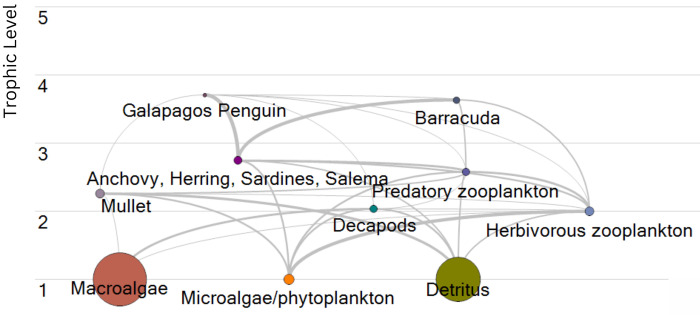
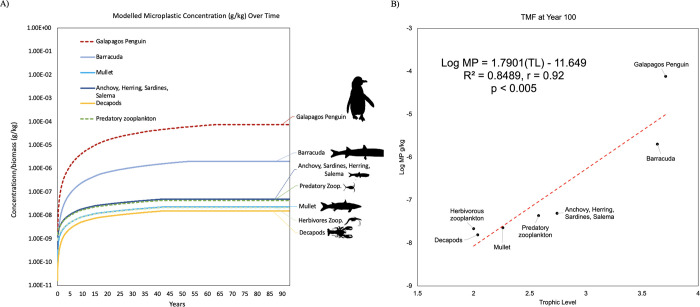
- In the Galápagos penguin (GP) food web model, microplastic concentration in the penguin plateaued at 7.6 × 10^-5 g/kg, while its primary prey (planktivorous fish) plateaued at 4.93 × 10^-8 g/kg.
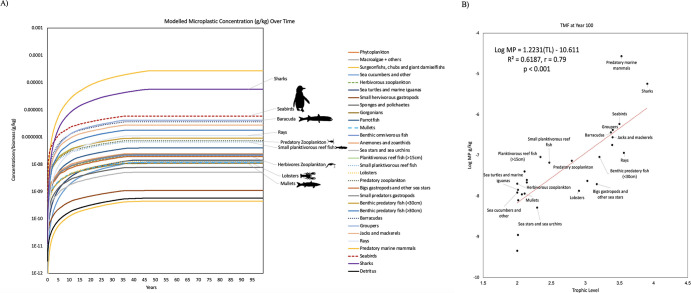
- In the Bolivar Channel Ecosystem (BCE) model, seabirds plateaued at about 5.9 × 10^-7 g/kg, and planktivorous fish at 6.63 × 10^-8 g/kg.
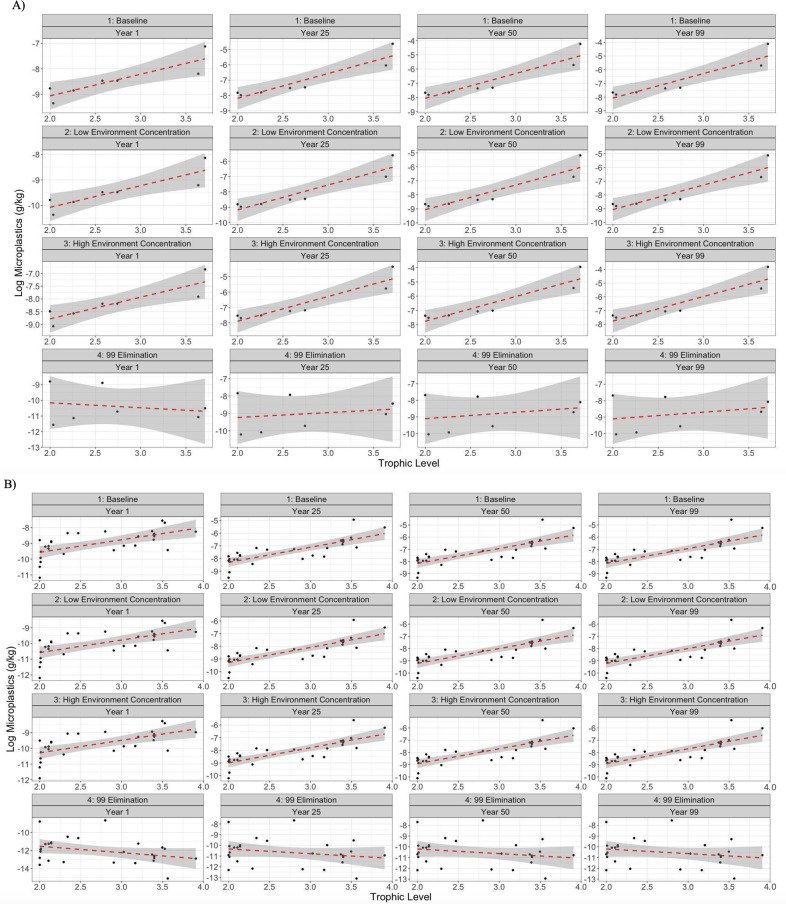
- Baseline simulations showed biomagnification: the GP model’s TMF increased from 7.08 at year 1 to 61.7 at year 100 with a slope of 1.79 (p < 0.05); the BCE model’s TMF ranged from 6.17 to 16.6, with a slope of 1.22 (p < 0.001).
- The 99% elimination rate scenario was the main exception: it showed no trophic magnification (non-significant negative slopes, p > 0.05) and much lower BAF/BCF values, reported as 2 to 4 orders of magnitude lower than the other scenarios.
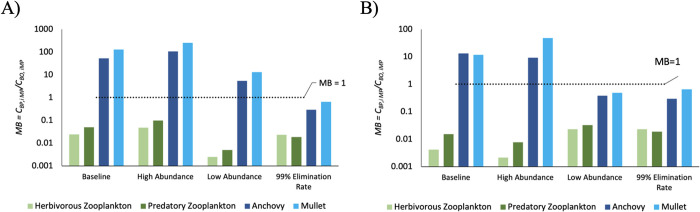
- Model-bias comparisons with empirical data showed systematic underprediction in zooplankton and overprediction in fish; for zooplankton, MB ranged from 0.002 to 0.1 in the GP model and 0.002 to 0.08 in the BCE model, while fish showed overprediction with MB values up to 105.1 for anchovies and 252.3 for mullets.
## Methods
- The study built two trophodynamic EwE models: a simplified Galápagos penguin food web with 10 functional groups, and a more complex Bolivar Channel Ecosystem model with 30 functional groups; both were run with Ecotracer.
- Input data came from empirical field measurements collected in October 2021 (surface seawater near penguin colonies, zooplankton, penguin prey, and penguin scat), plus literature and existing EwE models.
- The authors ran four scenarios in each model: baseline, high environmental concentration, low environmental concentration, and 99% egestion/elimination rate; they assessed BAF, BCF, BMFTL, TMF, sensitivity, and model bias against observed zooplankton, anchovy, and mullet concentrations.
## Limitations
- The paper states that microplastic elimination/egestion rates are a knowledge gap and are critical for determining biomagnification potential.
- It also states that biomagnification of microplastics remains unclear, and that more studies are needed; this is a stated limitation of the broader evidence base.
- Evident from the text: the GP model relied on limited available dietary data and several plausible assumptions about prey composition, biomass, and excluded groups (for example, cephalopods were removed due to insufficient biomass data), so the model is intentionally simplified.
Model-written summary. Check it against the paper before relying on it.
Integrity signals
Registry
Cites
Statistics
Figures
Verification
Claims the paper makes
13 Valid · 0 Not valid · 11 Not checked · 55 Own results and interpretations
The cited sources support only part of this claim — read each source’s verdict below.
In the paper
“Galápagos seabirds, including the Galápagos penguin (Spheniscus mendiculus), may serve as sentinel species for biomonitoring microplastic pollution [46].”
§ Modelling microplastic bioaccumulation and biomagnification potential in the Galápagos penguin ecosystem using Ecopath and Ecosim (EwE) with Ecotracer > 1. Introduction
What the sources say
- Partly supportedcites [46] Boersma PD. Penguins as marine sentinels. Bioscience. 2008 Jul 1; 58(7): 597– 607. sourceExperimental — accuracy not yet measured
The section “Penguins as marine environmental sentinels” says penguin populations reflect the state of the oceans, and “Impacts of environmental cycles on temperate penguins” discusses Galápagos penguins as indicators of El Niño effects. The paper does not address microplastics or propose Galápagos seabirds as sentinels for biomonitoring microplastic pollution; a search for those terms found no supporting passage. (LLM, conf=0.88)
hedgedstates an association- Asserted: passes — The authors put it forward as true.
- Checkable: passes — It can be checked against evidence.
- Load-bearing: passes — The paper’s conclusions depend on it.
- Based: passes — The paper gives a reason why it holds.
- Partly supported
The sources with a verdict support this claim; the rest weren’t checked yet, have no full text we could read, or their verdicts aren’t rated yet.
In the paper
“evidence for biomagnification of microplastics between trophic levels is lacking [29, 42, 43].”
§ Modelling microplastic bioaccumulation and biomagnification potential in the Galápagos penguin ecosystem using Ecopath and Ecosim (EwE) with Ecotracer > 1. Introduction
What the sources say
- Not checked — no full text of the sourcecites [29] Miller ME, Motti CA, Hamann M, Kroon FJ. Assessment of microplastic bioconcentration, bioaccumulation and biomagnification in a simple coral reef food web. Science of the Total Environment. 2023 Feb 1; 858: 159615. doi: 10.1016/j.scitotenv.2022.159615 36309288 source
- Supportedcites [42] Miller ME, Hamann M, Kroon FJ. Bioaccumulation and biomagnification of microplastics in marine organisms: A review and meta-analysis of current data. PLOS One. 2020 Oct 16; 15(10): e0240792. doi: 10.1371/journal.pone.0240792 33064755 PMC7567360 source
The Discussion’s “Evidence for biomagnification” section says current published findings provide no evidence that microplastic accumulation increases from lower to higher trophic levels across a general marine food web. It cautions that this does not rule out biomagnification in particular food chains. (LLM, conf=0.93)
- Supportedcites [43] Covernton GA, Cox KD, Fleming WL, Buirs BM, Davies HL, Juanes F, et al. Large size (>100-μm) microplastics are not biomagnifying in coastal marine food webs of British Columbia, Canada. Ecological Applications. 2022 Oct; 32(7): e2654. 35543035 PMC9786919 source
The Introduction states that microplastics have been observed moving through food webs, but that magnification has not been confirmed. The Discussion section on trophic transfer and biomagnification also reports a lack of biomagnification in the food webs studied. (LLM, conf=0.92)
plain- Asserted: passes — The authors put it forward as true.
- Checkable: passes — It can be checked against evidence.
- Load-bearing: passes — The paper’s conclusions depend on it.
- Based: passes — The paper gives a reason why it holds.
The cited sources support only part of this claim — read each source’s verdict below.
In the paper
“Based on limited available dietary data, the Galápagos penguin is suggested to feed primarily on small planktivorous fish, including sardines (Sardinops sagax), piquitingas (Lile stolifera), and salema (Xenocys jessiae), as well as fry or juveniles of mullets (Mugil spp.) [48, 55–57; F. H. Vargas, pers. comm., 16 August 2023].”
§ Modelling microplastic bioaccumulation and biomagnification potential in the Galápagos penguin ecosystem using Ecopath and Ecosim (EwE) with Ecotracer > 2. Methods > 2.2 Model descriptions
What the sources say
- Not checked — no full text of the sourcecites [48] Vargas H, Harrison S, Rea S, Macdonald DW. Biological effects of El Niño on the Galápagos penguin. Biol. Conserv. 2006 Jan; 127(1): 107– 14. source
- Partly supportedcites [55] Mills KL. Diving behaviour of two Galápagos Penguins Spheniscus mendiculus. Marine Ornithology. 2000 Apr 15; 28: 75– 9. sourceExperimental — accuracy not yet measured
Our copy supports only part of what is attributed: the snorkelling-observations passage (section 'Mills: Diving behaviour of two Galápagos penguins') records penguins on Fernandina feeding on large schools of Pacific Sardines Sardinops sagax, and the Discussion ('Comparison between records') concludes the species 'feeds on prey that occurs close to shore and at relatively shallow depths'. However, no passage in our copy mentions piquitingas (Lile stolifera), salema (Xenocys jessiae), or fry/juveniles of mullets (Mugil spp.) — searches for those taxa returned nothing — and the paper makes no dietary-composition statement that the species feeds 'primarily on small planktivorous fish'; at Bartolomé the prey were 'unidentified single fish or fish in small schools'. So the taxon list beyond sardines and the 'primarily' generalisation are not supported by this source. (LLM, conf=0.78)
- Not checked — no full text of the sourcecites [56] Vargas H, Lougheed C, Snell H. Population size and trends of the Galápagos Penguin Spheniscus mendiculus. Ibis. 2005 Apr; 147(2): 367– 74. source
- Not checked — no full text of the sourcecites [57] Wilson RP, Wilson MPT. Foraging Ecology of Breeding Spheniscus Penguins. Penguin biology. 1990; 181– 206. source
hedged- Asserted: passes — The authors put it forward as true.
- Checkable: passes — It can be checked against evidence.
- Load-bearing: passes — The paper’s conclusions depend on it.
- Based: passes — The paper gives a reason why it holds.
A result the paper reports from its own data — it cites no other source for it, so there is none to check. The quote shows it is in the paper.
In the paper
“biomagnification is highly dependent on the elimination rate”
§ Modelling microplastic bioaccumulation and biomagnification potential in the Galápagos penguin ecosystem using Ecopath and Ecosim (EwE) with Ecotracer > Abstract Bioaccumulation and biomagnification of anthropogenic particles are crucial factors in assessing microplastic impacts to marine ecosystems. Microplastic pollution poses a significant threat to iconic and often endangered species but examining their tissues and gut contents for contaminant analysis via lethal sampling is challenging due to ethical concerns and animal care restrictions. Incorporating empirical data from prey items and fecal matter into models can help trace microplastic movement through food webs. In this study, the Galápagos penguin food web served as an indicator species to assess microplastic bioaccumulation and biomagnification potential using trophodynamic Ecopath with Ecosim (EwE) modelling with Ecotracer. Empirical data collected from surface seawater near Galápagos penguin colonies, zooplankton, penguin prey, and penguin scat in October 2021 were used to inform the ecosystem model. Multiple scenarios, including a 99% elimination rate, were employed to assess model sensitivity. Model predictions revealed that microplastics can bioaccumulate in all predator-prey relationships, but biomagnification is highly dependent on the elimination rate. It establishes the need for more research into elimination rates of different plastics, which is a critical missing gap in current microplastic ecotoxicological and bioaccumulation science. Compared to empirical data, modelling efforts underpredicted microplastic concentrations in zooplankton and over-predicted concentrations in fish. Ultimately, the ecosystem modelling provides novel insights into potential microplastics’ bioaccumulation and biomagnification risks. These findings can support regional marine plastic pollution management efforts to conserve native and endemic species of the Galápagos Islands and the Galápagos Marine Reserve.
boostedstates a cause- Asserted: passes — The authors put it forward as true.
- Checkable: passes — It can be checked against evidence.
- Load-bearing: passes — The paper’s conclusions depend on it.
- Based: passes — The paper gives a reason why it holds.
A result the paper reports from its own data — it cites no other source for it, so there is none to check. The quote shows it is in the paper.
In the paper
“over-predicted concentrations in fish”
§ Modelling microplastic bioaccumulation and biomagnification potential in the Galápagos penguin ecosystem using Ecopath and Ecosim (EwE) with Ecotracer > Abstract Bioaccumulation and biomagnification of anthropogenic particles are crucial factors in assessing microplastic impacts to marine ecosystems. Microplastic pollution poses a significant threat to iconic and often endangered species but examining their tissues and gut contents for contaminant analysis via lethal sampling is challenging due to ethical concerns and animal care restrictions. Incorporating empirical data from prey items and fecal matter into models can help trace microplastic movement through food webs. In this study, the Galápagos penguin food web served as an indicator species to assess microplastic bioaccumulation and biomagnification potential using trophodynamic Ecopath with Ecosim (EwE) modelling with Ecotracer. Empirical data collected from surface seawater near Galápagos penguin colonies, zooplankton, penguin prey, and penguin scat in October 2021 were used to inform the ecosystem model. Multiple scenarios, including a 99% elimination rate, were employed to assess model sensitivity. Model predictions revealed that microplastics can bioaccumulate in all predator-prey relationships, but biomagnification is highly dependent on the elimination rate. It establishes the need for more research into elimination rates of different plastics, which is a critical missing gap in current microplastic ecotoxicological and bioaccumulation science. Compared to empirical data, modelling efforts underpredicted microplastic concentrations in zooplankton and over-predicted concentrations in fish. Ultimately, the ecosystem modelling provides novel insights into potential microplastics’ bioaccumulation and biomagnification risks. These findings can support regional marine plastic pollution management efforts to conserve native and endemic species of the Galápagos Islands and the Galápagos Marine Reserve.
plain- Asserted: passes — The authors put it forward as true.
- Checkable: passes — It can be checked against evidence.
- Load-bearing: unclear — It is unclear whether the paper’s conclusions depend on it.
- Based: passes — The paper gives a reason why it holds.
39 more claims
Create a free account to see all 79 claims and to verify the 2 references still open.
- Probably not a substantial claim. 16
- It may state two separate claims as one. 24
- The quote only partly states this claim. 1
Citations
Cites
Lost at sea: where is all the plastic?
Thompson, R. C., Olsen, Y., Mitchell, R. P., Davis, A., Rowland, S. J., John, A. W. G., McGonigle, D., & Russell, A. E. (2004) · Science · doi:10.1126/science.1094559 · Cited by 7,765
Eriksen, M., Lebreton, L. C. M., Carson, H. S., Thiel, M., Moore, C. J., Borerro, J. C., Galgani, F., Ryan, P. G., & Reisser, J. (2014) · PLoS ONE · doi:10.1371/journal.pone.0111913 · Cited by 4,710
The Physical Impacts of Microplastics on Marine Organisms: A Review
Wright, S. L., Thompson, R. C., & Galloway, T. S. (2013) · Environmental Pollution · doi:10.1016/j.envpol.2013.02.031 · Cited by 4,524
Discovery and quantification of plastic particle pollution in human blood
Leslie, H. A., van Velzen, M. J. M., Brandsma, S. H., Vethaak, A. D., Garcia-Vallejo, J. J., & Lamoree, M. H. (2022) · Environment International · doi:10.1016/j.envint.2022.107199 · Cited by 3,906
United Nations Environment Programme
(1987) · International Organizations and the Law of the Sea 1985 · doi:10.1163/9789004634169_010 · Cited by 3,715
(2015) · Springer eBooks · doi:10.1007/978-3-319-16510-3 · Cited by 3,502
Plasticenta: First evidence of microplastics in human placenta
Ragusa, A., Svelato, A., Santacroce, C., Catalano, P., Notarstefano, V., Carnevali, O., Papa, F., Rongioletti, M. C. A., Baiocco, F., Draghi, S., et al. (2021) · Environment International · doi:10.1016/j.envint.2020.106274 · Cited by 3,474
Predicted growth in plastic waste exceeds efforts to mitigate plastic pollution
Borrelle, S. B., Ringma, J., Law, K. L., Monnahan, C. C., Lebreton, L., McGivern, A., Murphy, E., Jambeck, J., Leonard, G. H., Hilleary, M. A., et al. (2020) · Science · doi:10.1126/science.aba3656 · Cited by 3,219 · cited 1×
“In the Plasticene era, escalating plastic production has outpaced plastic elimination efforts, leading to its surge in the environment [1, 2].”
BackgroundMicroplastic ingestion by zooplankton
Cole, M., Lindeque, P., Fileman, E., Halsband, C., Goodhead, R., Moger, J., & Galloway, T. S. (2013) · Environmental Science & Technology · doi:10.1021/es400663f · Cited by 2,763
Interactions of microplastic debris throughout the marine ecosystem
Galloway, T. S., Cole, M., & Lewis, C. (2017) · Nature Ecology & Evolution · doi:10.1038/s41559-017-0116 · Cited by 1,955 · cited 1×
“These sublethal but chronic health impacts may have cascading effects at the species or ecosystem level [35].”
Background
Research works printed but not linked: 16
- Gobas FAPC Morrison HA. Bioconcentration and bioaccumulation in the aquatic environment. In: Boethling R, Mackay D, editors. Handbook of property estimation methods for chemicals: Environmental health sciences. CRC press; 2000 Mar 29. p. 189– 231.
- Christensen V, Walters CJ, Pauly D. Ecopath with Ecosim: A User’s Guide. 2005 [cited April 2023]. In: Fisheries Centre, University of British Columbia, Vancouver, Canada and ICLARM, Penang, Malaysia [Internet]. Available from: https://www.researchgate.net/publication/267193103
- Christensen V, Walters C, Pauly D, Forrest R. Lenfest Ocean Futures Project. Ecopath with Ecosim Version 6: User Guide. 2008 [cited April 2023]. In: Lenfest Ocean Futures Project 2008 [Internet]. Available from: https://repository.oceanbestpractices.org
- Colléter M, Valls A, Guitton J, Lyne M, Arreguín-Sánchez F, Christensen V, et al. EcoBase: a repository solution to gather and communicate information from EwE models. 2013 [cited April 2023] [Internet]. Available from: https://institut-agro-rennes-angers.hal.science/hal-01103442
- Constant P. Marine life of the Galápagos: the diver’s guide to fishes, whales, dolphins and marine invertebrates. Odyssey; 2007.
- Humann P, DeLoach N. Reef fish identification: Galápagos. New World Publications Incorporated; 2003.
- Froese R, Pauly D. FishBase. World Wide Web electronic publication; 2022.
- Palomares MLD, Pauly D. SeaLifeBase. World Wide Web electronic publication; 2022.
- Rafferty JP. Galapagos penguin. 2020 [cited April 2023]. In: Encyclopedia Britannica [Internet]. Available from: https://www.britannica.com/animal/Galapagos-penguin. 2020.
- Karpouzi VS. Modelling and mapping trophic overlap between fisheries and the world’s seabirds. M.Sc. Thesis. The University of British Columbia. 2005. Available from: https://open.library.ubc.ca/soa/cIRcle/collections/ubctheses/831/items/1.0074880
- Muck P, Rojas de Mendiola B, Antonietti E. Comparative studies on feeding in larval anchoveta (Engraulis ringens) and sardine (Sardinops sagax). In: Pauly D, Mendo J, Tsukayama I, editors. The Peruvian upwelling ecosystem: dynamics and interactions. ICLARM Conference Proceedings 18, 438 p. IMARPE, Callao, Peru; GTZ, Eschborn, Germany; and ICLARM, Manila, Philippines; 1989. p. 86– 96.
- Serra RT, Tsukayama I. Sinopsis de datos biologicos y pesqueros de la sardina Sardinops sagax sagax en el Pacifico sororiental. FAO Sinop. Pesca. 1988; 1: 60.
- Coombs AP. Marine mammals and human health in the eastern Bering Sea: Using an ecosystem-based food web model to track PCBs. M.Sc. Thesis. University of British Columbia. 2004. Available from: https://open.library.ubc.ca/soa/cIRcle/collections/ubctheses/831/items/1.0074886
- McMullen K. The Galápagos penguin as the “canary in the coal mine” for microplastics research in the Galápagos Marine Reserve & plastic pollution perceptions in Ecuadorian mangrove communities. M.Sc. Thesis. University of British Columbia. 2023. Available from: http://hdl.handle.net/2429/84664
- Alava JJ, Moreno-Báez M, McMullen K, Tekman MB, Barrows APW, Bergmann M, et al. Ecological Impacts of Marine Plastic Pollution, Microplastics’ Foodweb Bioaccumulation Modelling and Global Ocean Footprint: Insights into the Problems, the Management Implications and Coastal Communities Inequities. The Nippon Foundation-Ocean Litter Project (2019–2023). IOF Working Papers 2023 (01), 81 pp., Institute for the Oceans and Fisheries, University of British Columbia, Vancouver, Canada; 2023. Available from: https://oceans.ubc.ca/research/publications/working-papers/
- McMullen K, Vargas FH, Calle P, Alavarado-Cadena O, Pakhomov EA, Alava JJ (2024) Modelling microplastic bioaccumulation and biomagnification potential in the Galápagos penguin ecosystem using Ecopath and Ecosim (EwE) with Ecotracer. PLoS ONE 19(1): e0296788. doi: 10.1371/journal.pone.0296788 PMC10807758 38265981
Cited by
Brander, S. M., Senathirajah, K., Fernandez, M. O., Weis, J. S., Kumar, E., Jahnke, A., Hartmann, N. B., Alava, J. J., Farrelly, T. A., Almroth, B. C., et al. (2024) · The Science of The Total Environment · doi:10.1016/j.scitotenv.2024.174881 · Cited by 60
Self-citationRathikannu, S., Gautam, S., Joshi, S. K., Katharine, P., Mithra, K. E., Banusaranya, P., Amudhavarshini, V. M., Gayatri, R., & Ho, C.-H. (2025) · Scientific Reports · doi:10.1038/s41598-025-14507-w · Cited by 40
RetractedDo microplastics accumulate in penguin internal organs? Evidence from Svenner island, Antarctica
Bhattacharjee, S., Rathore, C., Naik, A., Saha, M., Tudu, P., Dastidar, P. G., Bhattacharyya, S., de Boer, J., & Chaudhuri, P. (2024) · The Science of The Total Environment · doi:10.1016/j.scitotenv.2024.175361 · Cited by 29
First evidence of microplastic inhalation among free-ranging small cetaceans
Dziobak, M. K., Fahlman, A., Wells, R. S., Takeshita, R., Smith, C. R., Gray, A., Weinstein, J. E., & Hart, L. B. (2024) · PLoS ONE · doi:10.1371/journal.pone.0309377 · Cited by 27
Zeng, Y., Cai, J., Zhu, Y., Wang, J., Guo, R. C., Li, J., Zheng, X., & Mai, B. (2024) · Journal of Hazardous Materials · doi:10.1016/j.jhazmat.2024.136607 · Cited by 21
Toxicological implications of emerging pollutants on aquatic organisms
Sefali, S., Ruby, R., Dimple, D., & Giri, A. (2026) · Discover Environment · doi:10.1007/s44274-026-00557-y · Cited by 35
Eguiguren, A., Ávila, I. C., Mesnick, S. L., Cantor, M., Hersh, T. A., Pérez‐Puig, H., Patricia Rosero, R., Rendell, L. E., Whitehead, H., Rojas, C., et al. (2025) · Philosophical Transactions of the Royal Society B Biological Sciences · doi:10.1098/rstb.2024.0142 · Cited by 18
“Microplastics have been detected in all water and organism samples across the ETP [68], including in zooplankton and fish around the Galápagos Islands [69,70].”
Self-citationElectrochemical approaches for detecting micro and nano-plastics in different environmental matrices
Kumar, D., Bhardwaj, G., Indhur, R., Wankhede, L., Brar, S. K., & Kumari, S. (2025) · International Journal of Electrochemical Science · doi:10.1016/j.ijoes.2025.101182 · Cited by 16
Sawma, M. J., Zayyat, R. M., Ghaddar, R., & Ayoub, G. M. (2024) · Water Emerging Contaminants & Nanoplastics · doi:10.20517/wecn.2024.36 · Cited by 19
Microplastics in the Amur tiger's habitat: Occurrence, characteristics, and risk assessment
Huang, Z., Liu, D., Cheng, W., Zhang, W., He, Z., Huang, B., Guo, S., Zhao, B., Wang, Y., Zhang, Y., et al. (2025) · Journal of Hazardous Materials · doi:10.1016/j.jhazmat.2025.138380 · Cited by 14
McMullen, K., Calle, P., Alvarado‐Cadena, O., Kowal, M. D., Espinoza, E., Domínguez, G. A., Tirapé, A., Vargas, F. H., Grant, E. R., Hunt, B. P. V., et al. (2024) · Environmental Toxicology and Chemistry · doi:10.1002/etc.5874 · Cited by 19
Self-citationMicroplastic Contamination in Field-Side Composting in Geneva, Switzerland (CH)
Berset, F. C. D., & Stoll, S. (2024) · Microplastics · doi:10.3390/microplastics3030030 · Cited by 11
D’Costa, A., Kunkolkar, A., Naik, G., Natekar, T., Sinha, A., Kundaikar, G., & Fernandes, S. (2025) · Environmental Monitoring and Assessment · doi:10.1007/s10661-025-13776-2 · Cited by 5
“This also suggests that the organism is retaining the MPs more effectively within its body than it is being eliminated (McMullen et al., 2024; Miller et al., 2020).”
Absar, M. N., Karim, M. R., Prantor, R. M., Islam, M. S., Das, H., Andaluri, G., Hasan, M. R., Arham, M. A., & Intisar, A. (2026) · Journal of environmental chemical engineering · doi:10.1016/j.jece.2026.121766 · Cited by 5
Ruiz‐Sagalés, M., Salvia, R., Halldórsson, S. D., Chosson, V., Sigurðsson, G. M., Aguilar, Á., Borrell, A., Ward, M. D., Pétriz, J., & Garcia‐Garin, O. (2026) · Environmental Research · doi:10.1016/j.envres.2026.124237 · Cited by 3
Microplastic pollution in an endangered Galapagos pinniped: A comprehensive regional assessment
Moreira‐Mendieta, A., Garcia‐Garin, O., Vivas-Vaca, W., Urquía, D. O., Drago, M., Ochoa‐Herrera, V., Riofrío‐Lazo, M., Borrell, A., & Páez‐Rosas, D. (2026) · Environmental Pollution · doi:10.1016/j.envpol.2026.127840 · Cited by 3
Introduction to Microplastics in the Environment
De-la-Torre, G. E. (2025) · The handbook of environmental chemistry · doi:10.1007/698_2025_1229 · Cited by 1
Benchmarking large language models for marine functional group classification
Spillias, S. (2026) · Ecological Informatics · doi:10.1016/j.ecoinf.2026.103984 · Cited by 2
Shadap, M., & Ayyasamy, S. (2026) · Springer series on polymer and composite materials · doi:10.1007/978-3-032-16034-8_27 · Cited by 2
Nazar, A., Hussain, S. M., Ali, S., Shahzad, M. M., Naeem, A., Naeem, E., Khalid, M. A., Rashid, E., & Ahmad, B. (2026) · Journal of Environmental Science and Health Part A · doi:10.1080/10934529.2026.2664324 · Cited by 2
Nanoplastics in aquatic ecosystems: Disruptions to fish digestive physiology and gut microbiota
Habib, S. S., Sohail, M., & Fazio, F. (2026) · Marine Pollution Bulletin · doi:10.1016/j.marpolbul.2026.119943 · Cited by 2
Mohammadpour, A., & Roomiani, L. (2026) · All Life · doi:10.1080/26895293.2026.2696658 · Cited by 1
Risk assessment of microplastics in red octopus (Octopus maya) from the southern Gulf of Mexico
Osten, J. R., Lara-Flores, M., Luna-Zavaleta, J., González-Euan, A., Sandoval-Gio, J. J., & Borges-Ramírez, M. M. (2026) · Regional Studies in Marine Science · doi:10.1016/j.rsma.2026.105306 · Cited by 1
Smith, C. A., Mandal, S. K., Fan, C., & Pramanik, S. K. (2024) · Microplastics · doi:10.3390/microplastics3020015 · Cited by 2
Ávila, E., Briceño-Vera, A. E., Rodríguez-Santiago, M. A., Celis-Hernández, O., Capparelli, M. V., & MOULATLET, G. M. (2025) · SSRN Electronic Journal · doi:10.2139/ssrn.5518868 · Cited by 1
Minimal Accumulation of Microplastics in Shorebirds at Migratory Stopover Sites in CanadaPreprint
Tavera, E. A., Drever, M. C., Bradley, D. W., et al. (2024) · SSRN Electronic Journal · doi:10.2139/ssrn.4826671
Self-citationJoshi, A., Akhtar, N., & Kumar, A. (2024) · Springer eBooks · doi:10.1007/978-981-97-4068-0_8
Construction of Semi-submersible Artificial Reef Ecosystem Model Based on Ecopath
Sun, Y. (2025) · Sustainable civil infrastructures · doi:10.1007/978-3-031-72509-8_80
Seyer, T., Faure, V., Charmasson, S., et al. (2025) · SSRN Electronic Journal · doi:10.2139/ssrn.5339444
Ecotracer set up to trace microplastics up the Black Sea marine food web
Serpetti, N., Piroddi, C., Walters, W., García‐Górriz, E., Miladinova, S., & Macias, D. M. (2025) · Ecological Modelling · doi:10.1016/j.ecolmodel.2025.111271
Bonilla-Martínez, I. B., Blanco, G., Gago, J., et al. (2025) · SSRN Electronic Journal · doi:10.2139/ssrn.5465455
Nanotechnology in the Restoration of Degraded and Polluted Soil
Perea-Vélez, Y. S., Gónzalez‐Chávez, M. D. C. A., Mejía-Méndez, J. L., & Carrillo‐González, R. (2025) · Springer eBooks · doi:10.1007/978-981-96-9756-4_2
Nanoparticles: An Emerging Health Hazard
Mangaly, L. F. (2025) · Springer proceedings in earth and environmental sciences · doi:10.1007/978-3-031-93444-5_64
Bonilla-Martínez, I. B., perez, J. M., Blanco, G., et al. (2025) · SSRN Electronic Journal · doi:10.2139/ssrn.5644861
Marine Microplastic Enters Food Chains and Challenges Human Nutritional Security
Medhe, S. V., Kamble, M. T., Chavan, B. R., Gabriel, N. N., Pirarat, N., Janmaimool, P., Kettawan, A., & Jeamsripong, S. (2026) · Springer eBooks · doi:10.1007/978-3-032-17411-6_2
Seyer, T., Faure, V., Charmasson, S., Durand, H., & Bănaru, D. (2026) · Ecological Modelling · doi:10.1016/j.ecolmodel.2026.111540
Prastiya, R. A., Susilowati, S., Mustofa, I., ساسي, س. م., Alghoul, N. M., & Tanojo, W. H. (2026) · Aquatic Toxicology · doi:10.1016/j.aquatox.2026.107818
Saha, S., Saha, R., Gupta, M., Saha, D., Paul, A., Surovi, R. O. Y., Bose, A., Chandra, S., Kundu, K., Korotkova, E. I., et al. (2026) · Microplastics · doi:10.3390/microplastics5020079 · Cited by 1
Cruz-García, R., Castillo‐Guerrero, J. A., Espino-Herrera, A., Amezcua, F., & Fernández, G. (2026) · Marine Pollution Bulletin · doi:10.1016/j.marpolbul.2026.120002
Al-Kharusi, I., Dobretsov, S., Jufaili, S. M. A., & Dutta, S. (2026) · Marine Pollution Bulletin · doi:10.1016/j.marpolbul.2026.120099
Assessing microplastics risk in marine habitats of Haizhou Bay based on an integrated approach
Wang, C., Shen, D., Zhang, C., Xu, B., Ji, Y., Ren, Y., & Xue, Y. (2026) · Environmental Research · doi:10.1016/j.envres.2026.125342
Nagendra, P. S., Datta, S. N., & Tewari, G. (2026) · Environmental Monitoring and Assessment · doi:10.1007/s10661-026-15782-4
“Trophic level (TL) and log-transformed MP concentration were used to compute TMF mathematically (Gao et al., 2024; McMullen et al., 2024).”
Microplastics and gut dysbiosis: links to cancer inflammation
Das, J., Bhui, U., Selim, S., Sridhar, S. B., Sah, A. K., Islam, A., Panigrahy, U. P., Mantry, S., Tariq, M., Debnath, B., et al. (2026) · Toxicology and Environmental Health Sciences · doi:10.1007/s13530-026-00335-6
Cepeda, G. E. M., Sarmiento, D. R., Rojas, R. A. S., González-Puetate, I. R., Torres-Lasso, P., Díaz-Cevallos, L., Cepeda-Sánchez, C., Carrillo-Fares, M., Holguín-Contreras, N., Bustillos-Huilca, R., et al. (2026) · SSRN Electronic Journal · doi:10.2139/ssrn.7572078
Metadata
- Authors
- McMullen, K., Vargas, F. H., Calle, P., Alavarado-Cadena, O., Pakhomov, E. A., & Alava, J. J.
- Affiliations
- University of British Columbia (CA)
- Escuela Superior Politecnica del Litoral (EC)
- Corresponding author
- McMullen, Karly
- Alava, Juan José
- Venue
- PLoS ONE
- Publisher
- Public Library of Science (PLoS)
- Published
- 2024-01-24
- Volume
- 19
- Issue
- 1
- Pages
- e0296788
- ISSN
- 1932-6203 (ISSN-L)
- PMC
- PMC10807758
- OpenAlex
- W4391164630
- Semantic Scholar
- 4ca2e2d76ef296831b23d77e6becc8e6717da5f8
- Cited by
- 46
- References
- 101
- Citations by year
- 2026: 22 · 2025: 14 · 2024: 10
- FWCI
- 4.57
- Type
- journal article
- Language
- en
- Open access
- gold
- doi.org
- Licence
- Locations
- PLoS ONE (publishedVersion, cc-by)
- PubMed Central (publishedVersion, cc-by)
- PubMed (publishedVersion)
- DOAJ (DOAJ: Directory of Open Access Journals) (submittedVersion, cc-by-sa)
- Funders
- Ocean Nexus Center, EarthLab, University of Washington (F19-02677 (NIPPFOUN 2019))
- Natural Sciences and Engineering Research Council of Canada (NSERC Discovery Grant RGPIN-2014-05107)
- Topics
- Physical Sciences › Environmental Science › Pollution › Microplastics and Plastic Pollution
- Physical Sciences › Environmental Science › Health, Toxicology and Mutagenesis › Environmental Toxicology and Ecotoxicology
- Physical Sciences › Environmental Science › Ecology › Isotope Analysis in Ecology
- Keywords
- microplastics, bioaccumulation, biomagnification, Galápagos penguin, food web modeling, Ecopath with Ecosim, elimination rate, zooplankton, plastic pollution, marine plastic pollution, Galapagos Marine Reserve, endangered species conservation
- MeSH terms
- Microplastics, Bioaccumulation, Animals, Plastics, Zooplankton, Ecosystem, Spheniscidae
About these checks
Registry, retraction, Cites and statistics results are computed, not judged, with one exception: a printed reference that no index lists is read once by a model before it counts as a citation error. Claims are extracted by a model and kept only when their quote appears verbatim in the text; each cited source is then checked, with a model’s help, for whether it says what the claim relies on. Those verdicts can be wrong — read the claim’s quote and the cited source before relying on one.
The claim verdicts this report counts are experimental: their accuracy is not yet measured.
A language model drew the claims from the paper on 2026-10-10, under version 3 of the claim definition (model deepseek-v4.1-flash, prompt extract-v3).
A second model labelled each claim on 2026-10-10 (model jev-1.13-20260917, definition revision gold-guideline-v0.2).
Cited sources are checked with a language model’s help (gpt-6-sol and qwen3.8-omni-flash).
Statistics and arithmetic are recomputed, not judged.
Confidence bands are shown only for fields calibrated on our annotated test set. None is calibrated yet, so no band is shown.
What counts as a claim ›How we measure confidence ›How we check this ›
Are you an author, or do you see a problem with this page? Request a review
Data sources
Bibliographic data: Semantic Scholar, OpenAlex, Crossref.
Contains information from the Semantic Scholar Academic Graph Datasets, made available under the ODC Attribution License (ODC-BY 1.0).
Semantic Scholar’s data is described in: Kinney, R., et al. (2023). The Semantic Scholar Open Data Platform. arXiv:2301.10140.
