

Investigation on the bond-slip behavior of recycled aggregate concrete-filled steel tube with studs
Open accessThe DOI matches its Crossref record; 49 of the 49 references it cites were found in a registry or an index; 2 of the 33 sources its claims cite were checked for support.
Abstract
This study investigates the influence of built-in studs on the bond behavior in recycled aggregate concrete-filled steel tube (RACFST) composite structures through push-out experiments. The effects of stud number, position, and rows on RACFST bond strength and steel tube surface strain are systematically analyzed. Furthermore, the bond-slip behavior evolution mechanism is examined, and a constitutive equation is established. A novel interfacial modeling approach is developed via secondary development of ABAQUS software to comprehensively simulate RACFST interfacial bond-slip behavior. The results demonstrate that insufficient stud quantity compromises interface integrity, reducing bond strength, while increased stud count enhances composite stiffness and bond performance. Studs positioned nearer the free end extend the natural bond length participating in shear resistance, thereby improving bond strength. Internal studs promote stress redistribution within the composite structure, significantly improving collaborative performance. The proposed constitutive equation shows good agreement with experimental results, and the developed interface program accurately captures bond-slip curve trends. These findings facilitate RACFST applications and provide guidance for shear stud arrangement in RACFST structures.
Overview
CoChat Summary
## TL;DR
This paper uses push-out tests and ABAQUS simulations to study how built-in studs affect bond-slip behavior in recycled aggregate concrete-filled steel tube (RACFST) specimens. It finds that stud number, position, and rows all improve bond performance when properly arranged, and proposes a constitutive equation plus a new interface modeling method that match the experiments well.
## Key findings
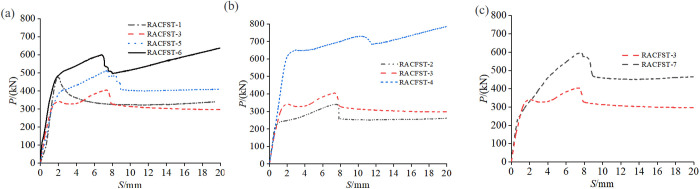
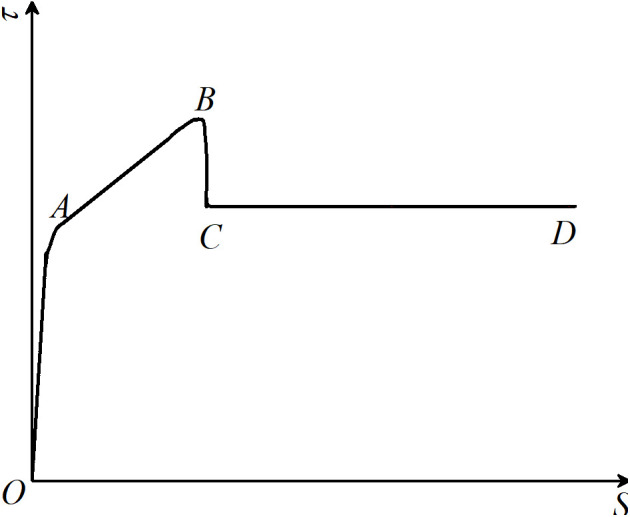
- Seven RACFST push-out specimens were tested; compared with the no-stud specimen (RACFST-1), built-in studs created an additional “stud-resistance stage” between about 2 mm and 8 mm slip, and the peak-slip value for studded specimens was about 8 mm versus about 2 mm for natural bonding.
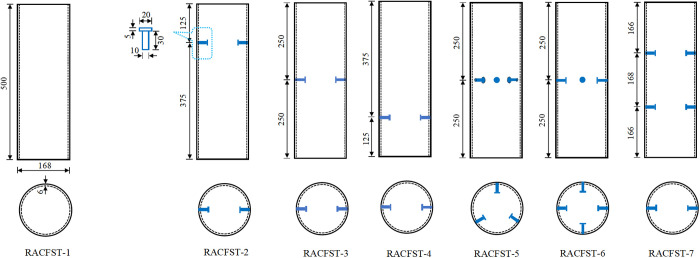
- Increasing circumferential stud count from 2 to 3 raised ultimate bonding force by 42.48%, and from 2 to 4 raised it by 76.70%.
- Moving studs closer to the free end increased bond strength; the paper states that a larger natural bond length participating in shear resistance leads to higher ultimate bond force.
- Changing from one stud row to two stud rows increased peak bonding force by 47.5%.
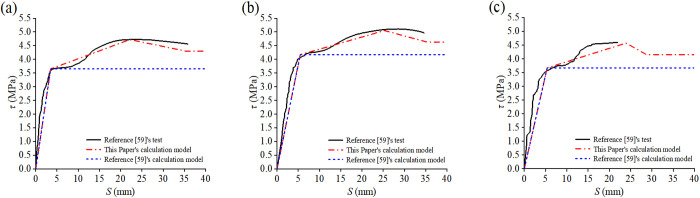
- The finite element model and proposed constitutive model had average errors within 7% versus experiments, and the paper states the proposed constitutive model predicted ultimate bond strength with errors within 0.1%.
## Methods
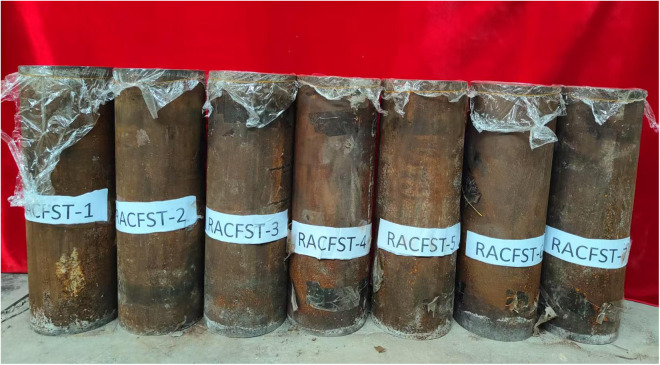
- Experimental design: 7 RACFST specimens were prepared for push-out tests, varying stud position, circumferential number of studs, and number of stud rows; one specimen had no inner-wall treatment.
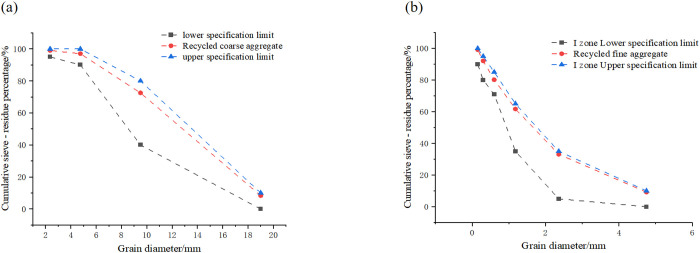
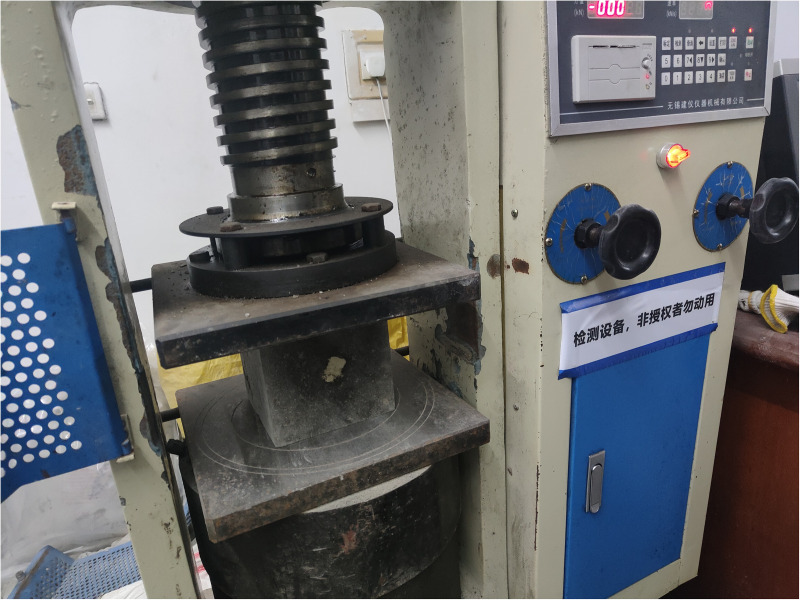
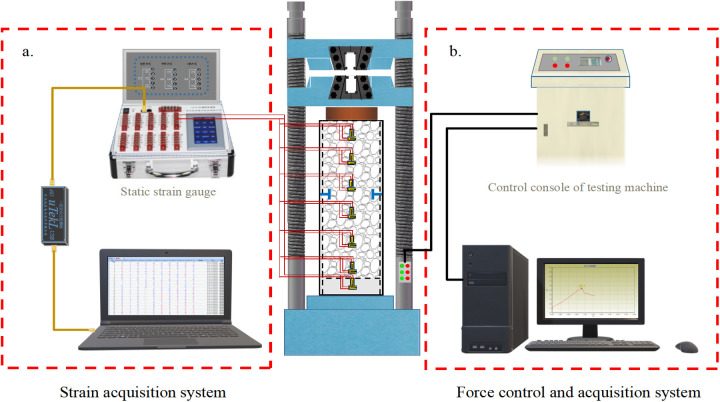
- Materials and setup: RAC strength grade C30, Q345 steel tubes with outer diameter 168 mm and thickness 6 mm; push-out loading was displacement-controlled at 1 mm/min up to 20 mm.
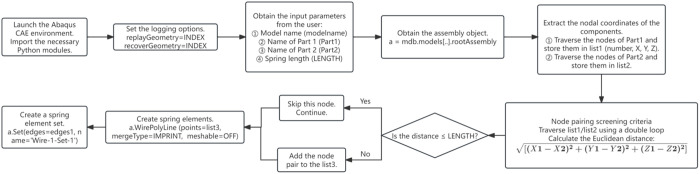
- Analysis: load-slip curves, steel-tube surface strain, bond-strength characteristic values, regression-based bond-strength formulas, and ABAQUS finite element simulations with a newly scripted interface-contact method were used.
## Limitations
- The paper states that the simulation discrepancy for RACFST-4 is relatively large because the stable slip stage is affected by macroscopic deviations, such as irregular tube roundness or inconsistent end dimensions, which were not accounted for in the numerical model.
- The paper says the model accuracy for Ps and Pr is more discrete than for Pu, so the calculation model “needs to be further optimized.”
- Based on the text: only 7 specimens were tested, so the conclusions are from a limited experimental set.
Model-written summary. Check it against the paper before relying on it.
Integrity signals
Registry
Cites
Statistics
Figures
Verification
Claims the paper makes
2 Valid · 2 Not valid · 25 Not checked · 94 Own results and interpretations
The cited sources support only part of this claim — read each source’s verdict below.
In the paper
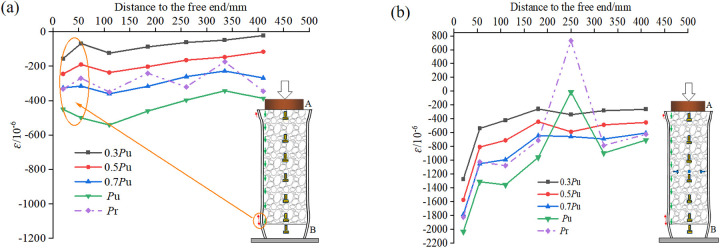
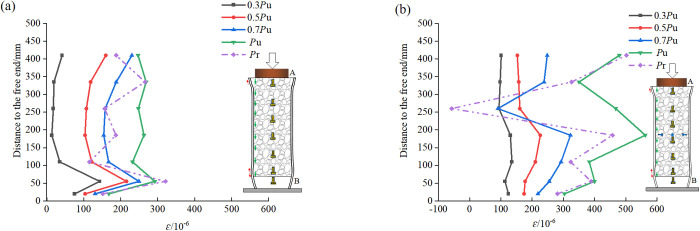
“The strain distribution on the surface of the steel tube during the push-out process reflects the transfer effect of the bonding force between the RAC and the steel tube, namely the cooperative working performance of the two [44].”
§ Investigation on the bond-slip behavior of recycled aggregate concrete-filled steel tube with studs > Experimental results and discussion > Strain analysis
What the sources say
- Partly supportedcites [44] Li D, Wu C, Song H, Li L, Lv G, Yang F. Experimental Investigation and Analysis of Bond–Slip Behavior between Geopolymer Concrete and Steel Tube with Varying Structural Measures. Buildings. 2024; 14(8): 2516. doi: 10.3390/buildings14082516 sourceExperimental — accuracy not yet measured
Section 3.3 (page unavailable) explains that bond stress transfers force from the core concrete to the steel tube and relates that transfer to the measured tube strains. The paper studies geopolymer concrete, however, not the recycled aggregate concrete (RAC) specified in the claim. (LLM, conf=0.86)
plainstates an associationSingle case- Asserted: passes — The authors put it forward as true.
- Checkable: passes — It can be checked against evidence.
- Load-bearing: passes — The paper’s conclusions depend on it.
- Based: passes — The paper gives a reason why it holds.
- Partly supported
The cited sources support only part of this claim — read each source’s verdict below.
In the paper
“The interfacial bonding performance serves as the foundation for this composite structure [8–10], directly influencing its mechanical properties and thus the safety of the component.”
§ Investigation on the bond-slip behavior of recycled aggregate concrete-filled steel tube with studs > Introduction
What the sources say
- Partly supportedcites [8] Guo X, Wu Z, Yang Y, Bai J, Zhou Q. A Study on the Bond-Slip Relationship of the CFRP-Steel Interface of CFRP Strengthened Steel. Materials (Basel). 2022; 15(12): 4187. doi: 10.3390/ma15124187 35744244 PMC9228769 sourceExperimental — accuracy not yet measured
The Introduction (page not provided) says the CFRP–steel bonding interface is a weak link and that reinforcement depends on its bond performance. The paper studies CFRP-strengthened steel, not RACFST, and does not establish the claimed effect on RACFST component safety. (LLM, conf=0.88)
- Not checked — no full text of the sourcecites [9] Sun G, Yang K. Bond-slip behavior between multi-partition steel tubes and concrete. Mater Struct. 2023; 56(3). doi: 10.1617/s11527-023-02155-3 source
- Not checked — no full text of the sourcecites [10] Chen R-S, Zhang H-Y, Hao X-K, Yu H-X, Shi T, Zhou H-S, et al. Experimental study on ultimate bearing capacity of short thin-walled steel tubes reinforced with high-ductility concrete. Structures. 2024; 68: 107109. doi: 10.1016/j.istruc.2024.107109 source
plainstates a cause- Asserted: passes — The authors put it forward as true.
- Checkable: passes — It can be checked against evidence.
- Load-bearing: passes — The paper’s conclusions depend on it.
- Based: passes — The paper gives a reason why it holds.
- Partly supported
A result the paper reports from its own data — it cites no other source for it, so there is none to check. The quote shows it is in the paper.
In the paper
“However, the slip corresponding to the peak point of the specimens with built-in studs is approximately 8 mm.”
§ Investigation on the bond-slip behavior of recycled aggregate concrete-filled steel tube with studs > Experimental results and discussion > Design parameter analysis
plain- Asserted: passes — The authors put it forward as true.
- Checkable: passes — It can be checked against evidence.
- Load-bearing: unclear — It is unclear whether the paper’s conclusions depend on it.
- Based: passes — The paper gives a reason why it holds.
A result the paper states — it cites no source for it, so there is none to check. The quote shows it is in the paper.
In the paper
“Under the same load gradient, from the loading end (upper end) to the free end (lower end) of the steel tube, the strain exhibits an ascending tendency.”
§ Investigation on the bond-slip behavior of recycled aggregate concrete-filled steel tube with studs > Experimental results and discussion > Strain analysis
plainstates an associationSingle case- Asserted: passes — The authors put it forward as true.
- Checkable: passes — It can be checked against evidence.
- Load-bearing: unclear — It is unclear whether the paper’s conclusions depend on it.
- Based: passes — The paper gives a reason why it holds.
A result the paper reports from its own data — it cites no other source for it, so there is none to check. The quote shows it is in the paper.
In the paper
“Nevertheless, their change trends are discrepant after the peak load Pu.”
§ Investigation on the bond-slip behavior of recycled aggregate concrete-filled steel tube with studs > Experimental results and discussion > Strain analysis
plainstates an association- Asserted: passes — The authors put it forward as true.
- Checkable: passes — It can be checked against evidence.
- Load-bearing: unclear — It is unclear whether the paper’s conclusions depend on it.
- Based: passes — The paper gives a reason why it holds.
60 more claims
Create a free account to see all 123 claims and to verify the 2 references still open.
- It may state two separate claims as one. 44
- Probably not a substantial claim. 20
Citations
Cites
Performance of concrete-filled thin-walled steel tubes under pure torsion
Han, L.-H., Yao, G.-H., & Tao, Z. (2007) · Thin-Walled Structures · doi:10.1016/j.tws.2007.01.008 · Cited by 1,389
Finite element modeling of push-out tests for large stud shear connectors
Nguyen, H. T., & Kim, S. E. (2009) · Journal of Constructional Steel Research · doi:10.1016/j.jcsr.2009.06.010 · Cited by 330
Bond behavior in concrete-filled steel tubes
Tao, Z., Song, T.-Y., Uy, B., & Han, L.-H. (2016) · Journal of Constructional Steel Research · doi:10.1016/j.jcsr.2015.12.030 · Cited by 296
Lyu, W.-Q., & Han, L.-H. (2019) · Journal of Constructional Steel Research · doi:10.1016/j.jcsr.2018.12.028 · Cited by 168
Post-fire bond between the steel tube and concrete in concrete-filled steel tubular columns
Tao, Z., Han, L.-H., Uy, B., & Chen, X. (2011) · Journal of Constructional Steel Research · doi:10.1016/j.jcsr.2010.09.006 · Cited by 152
Experimental study and design of bond behavior in concrete-filled steel tubes (CFST)
Wang, F., Xie, W., Li, B., & Han, L. (2022) · Engineering Structures · doi:10.1016/j.engstruct.2022.114750 · Cited by 105
Prediction model on compressive strength of recycled aggregate concrete filled steel tube columns
Nour, A. I., & Güneyisi, E. M. (2019) · Composites Part B Engineering · doi:10.1016/j.compositesb.2019.106938 · Cited by 93
Bond behaviour of concrete-filled steel tubes at the Arctic low temperatures
Yan, J.-B., Xie, W., Zhang, L., & Lin, X.-C. (2019) · Construction and Building Materials · doi:10.1016/j.conbuildmat.2019.03.168 · Cited by 90
Bond behavior of concrete-filled steel tubes at elevated temperatures
Song, T.-Y., Tao, Z., Han, L.-H., & Uy, B. (2017) · Journal of Structural Engineering · doi:10.1061/(asce)st.1943-541x.0001890 · Cited by 75
COMPARISON STUDY OF CONSTITUTIVE MODEL OF CONCRETE IN ABAQUS FOR STATIC ANALYSIS OF STRUCTURES
Jian-guo, N., & Wang, Y.-H. (2013) · 工程力学 · doi:10.6052/j.issn.1000-4750.2011.07.0420 · Cited by 71
Research works printed but not linked: 9
- Xiong MX, Chen GM, Long YL, Cui HR, Liu YM. Steel and FRP double-tube confined RAC columns under compression: Comparative study and stress-strain model. Steel Compos Struct. 2022; 43: 257– 70. doi: 10.12989/scs.2022.43.2.257 · doi:10.12989/scs.2022.43.2.257
- Sun B, Zhang J, Chen W, Zeng S, Zhang ZH. Influencing factors on bond-slip performance of recycled aggregate concrete filled steel tubes under repeated push-out. Constr Build Mater. 2023; 26: 970– 9.
- Chen JK, Chen BC, Liu JP. Shear performance of multi-studs between steel tube and core concrete. Eng Mech. 2017; 34: 178– 89.
- Xu KC, Bi LP, Chen MC. Experimental study on bond stress-slip constitutive relationship for CFST. J Build Struct. 2015; 36: 407– 12. doi: 10.14006/j.jzjgxb.2015.S1.062 · doi:10.14006/j.jzjgxb.2015.s1.062
- Li X, Wang R, Zhao H, Chen M-T, Lam D. Bond behaviour of round-ended recycled aggregate concrete filled steel tube (RE-RACFST) columns. J Constr Steel Res. 2023; 201: 107700. doi: 10.1016/j.jcsr.2022.107700 · DOI · Paper page
- Su XZ, Huang CX. Experiment and constitutive modeling of bond-slip behavior of steel plate-concrete interface with strength controlled by stud shear connectors. J Build Struct. 2018; 39: 167– 74.
- Xue JY, Zhou CF, Liu ZQ, Du ZY. Research on damage behavior and quantitative indexes for steel reinforced concrete column with irregular section. CSCD. 2020; 53: 1– 11. doi: 10.15951/j.tmgcxb.2020.02.001 · doi:10.15951/j.tmgcxb.2020.02.001
- Yu ZW, Shi WH, Kuang YC. Experimental study on mechanical properties of corroded stud. J Cent South Univ (Sci Tech). 2014; 45: 249– 55.
- Dong HY, Chen XP, Cao WL. Influence of studs and tie bars on the bond behavior of concrete-filled circular steel tubes. Huazhong Univ of Sci Tech (Natural Science Edition). 2020; 48: 113– 8. doi: 10.13245/j.hust.200620 · doi:10.13245/j.hust.200620
Cited by
Zhu, J., Hu, X., Zhang, Y., Yu, J., Ayough, P., Sun, Y., Wei, W., Xiao, Z., & Li, Y. (2026) · Buildings · doi:10.3390/buildings16163294
Metadata
- Authors
- Cai, G., Sun, B., Zeng, S., Yang, P., & Zhang, J.
- Affiliations
- University of South China (CN)
- Hainan University (CN)
- Corresponding author
- Sun, Bing
- Venue
- PLoS ONE
- Publisher
- Public Library of Science (PLoS)
- Published
- 2025-07-01
- Volume
- 20
- Issue
- 7
- Pages
- e0325279
- ISSN
- 1932-6203 (ISSN-L)
- PMC
- PMC12212574
- OpenAlex
- W4411869974
- Semantic Scholar
- b76e11d21e9f9060c11620d61ce8d32315f053d3
- Cited by
- 1
- References
- 49
- Citations by year
- 2026: 1
- FWCI
- 0.36
- Type
- journal article
- Language
- en
- Open access
- gold
- doi.org
- Licence
- Locations
- PLoS ONE (publishedVersion, cc-by)
- PubMed Central (publishedVersion, cc-by)
- PubMed (publishedVersion)
- DOAJ (DOAJ: Directory of Open Access Journals) (submittedVersion, cc-by-sa)
- Funders
- Natural Science Foundation of Hunan Province (No.2025JJ90163)
- Topics
- Physical Sciences › Engineering › Civil and Structural Engineering › Structural Load-Bearing Analysis
- Physical Sciences › Engineering › Building and Construction › Structural Behavior of Reinforced Concrete
- Physical Sciences › Engineering › Building and Construction › Recycled Aggregate Concrete Performance
- Keywords
- recycled aggregate concrete, concrete-filled steel tubes, bond-slip behavior, shear studs, composite structures, push-out test, bond strength, constitutive equations, interface modeling, ABAQUS user subroutines
- MeSH terms
- Construction Materials, Materials Testing, Models, Theoretical, Steel, Stress, Mechanical, Shear Strength, Recycling
About these checks
Registry, retraction, Cites and statistics results are computed, not judged, with one exception: a printed reference that no index lists is read once by a model before it counts as a citation error. Claims are extracted by a model and kept only when their quote appears verbatim in the text; each cited source is then checked, with a model’s help, for whether it says what the claim relies on. Those verdicts can be wrong — read the claim’s quote and the cited source before relying on one.
The claim verdicts this report counts are experimental: their accuracy is not yet measured.
A language model drew the claims from the paper on 2026-10-11, under version 3 of the claim definition (model deepseek-v4.1-flash, prompt extract-v3).
A second model labelled each claim on 2026-10-11 (model jev-1.13-20260917, definition revision gold-guideline-v0.2).
Cited sources are checked with a language model’s help (gpt-6-sol).
Statistics and arithmetic are recomputed, not judged.
Confidence bands are shown only for fields calibrated on our annotated test set. None is calibrated yet, so no band is shown.
What counts as a claim ›How we measure confidence ›How we check this ›
Are you an author, or do you see a problem with this page? Request a review
How to cite
Cite CoChat for the checks on this page, and the paper for its own findings.
- This page
- CoChat. (2026). Citation check: Investigation on the bond-slip behavior of recycled aggregate concrete-filled steel tube with studs. https://app.cochat.ai/papers/10.1371/journal.pone.0325279
- The paper
- Cai, G., Sun, B., Zeng, S., Yang, P., & Zhang, J. (2025). Investigation on the bond-slip behavior of recycled aggregate concrete-filled steel tube with studs. PLoS ONE. https://doi.org/10.1371/journal.pone.0325279
Data sources
Bibliographic data: Semantic Scholar, OpenAlex, Crossref.
Contains information from the Semantic Scholar Academic Graph Datasets, made available under the ODC Attribution License (ODC-BY 1.0).
Semantic Scholar’s data is described in: Kinney, R., et al. (2023). The Semantic Scholar Open Data Platform. arXiv:2301.10140.
