

Control of the C. albicans Cell Wall Damage Response by Transcriptional Regulator Cas5
Open accessThe DOI matches its Crossref record; 43 of the 43 references it cites were found in a registry or an index.
Abstract
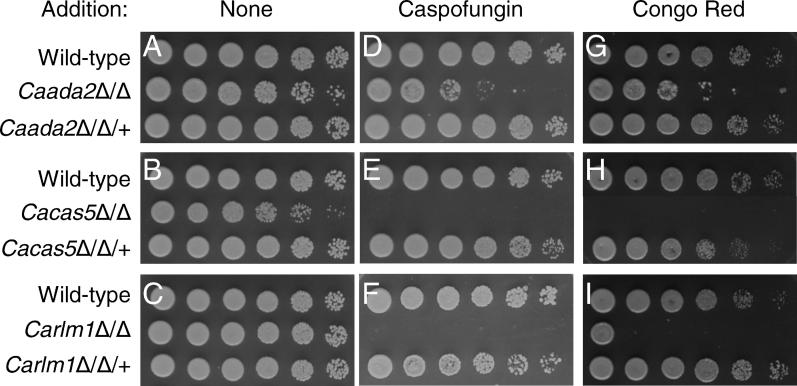
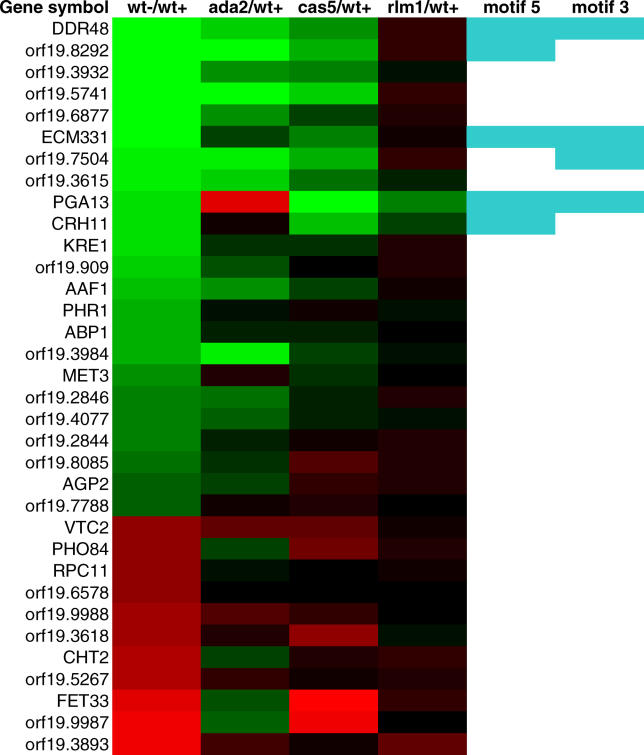
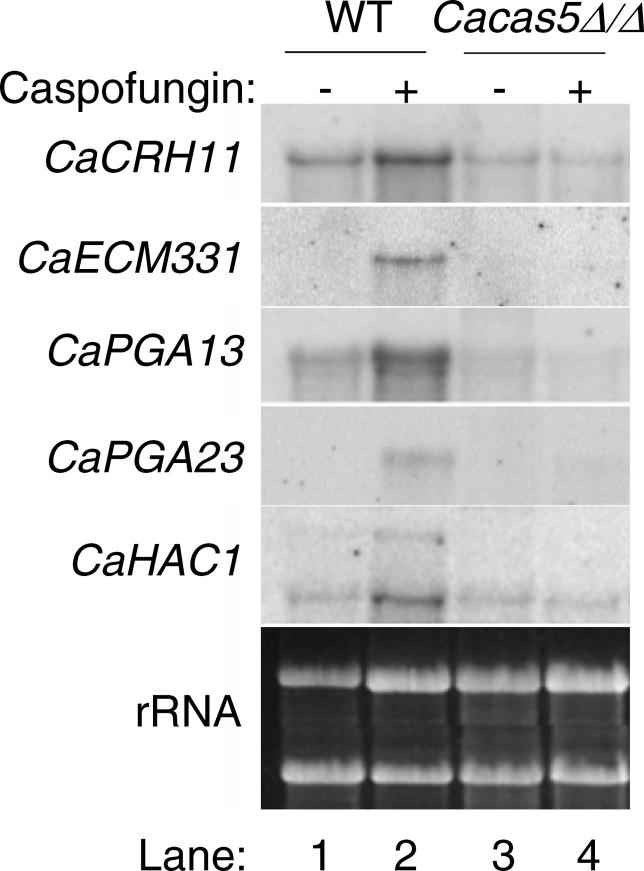
The fungal cell wall is vital for growth, development, and interaction of cells with their environment. The response to cell wall damage is well understood from studies in the budding yeast Saccharomyces cerevisiae, where numerous cell wall integrity (CWI) genes are activated by transcription factor ScRlm1. Prior evidence suggests the hypothesis that both response and regulation may be conserved in the major fungal pathogen Candida albicans. We have tested this hypothesis by using a new C. albicans genetic resource: we have screened mutants defective in putative transcription factor genes for sensitivity to the cell wall biosynthesis inhibitor caspofungin. We find that the zinc finger protein CaCas5, which lacks a unique ortholog in S. cerevisiae, governs expression of many CWI genes. CaRlm1 has a modest role in this response. The transcriptional coactivator CaAda2 is also required for expression of many CaCas5-dependent genes, as expected if CaCas5 recruits CaAda2 to activate target gene transcription. Many caspofungin-induced C. albicans genes specify endoplasmic reticulum and secretion functions. Such genes are not induced in S. cerevisiae, but promote its growth in caspofungin. We have used a new resource to identify a key C. albicans transcriptional regulator of CWI genes and antifungal sensitivity. Our gene expression findings indicate that both divergent and conserved response genes may have significant functional roles. Our strategy may be broadly useful for identification of pathogen-specific regulatory pathways and critical response genes.
Overview
The claims and statistics of this paper haven’t been checked yet.
Free: it reads the open-access text and checks the first 5 claims that cite a source we can check. Create a free account to check every claim.
Integrity signals
Registry
Cites
Statistics
Figures
Verification
Claims the paper makes
The claims and statistics of this paper haven’t been checked yet.
Free: it reads the open-access text and checks the first 5 claims that cite a source we can check. Create a free account to check every claim.
Claims other papers make about this one
Each is checked against this paper’s own text: does it say what the citing paper says it does?
The source backs part of the claim, not all of it — or backs it for a different population, condition or comparison.
In the citing paper
“Genes induced in this response include AGP2, KRE1, PGA13, RHR2, and CZF1; repressed genes include CHT2, PGA4 and SCW11, HAS1, CRZ1, and ENG1 (50–52).”
From Inhibition of Classical and Alternative Modes of Respiration in Candida albicans Leads to Cell Wall Remodeling and Increased Macrophage Recognition (2019) · cites this paper as [50]
Experimental — accuracy not yet measuredThe cited source says what the claim attributes to it.
In the citing paper
“A number of genes found to be differentially expressed upon SNP+SHAM treatment have been reported to be involved in the response to caspofungin.”
From Inhibition of Classical and Alternative Modes of Respiration in Candida albicans Leads to Cell Wall Remodeling and Increased Macrophage Recognition (2019) · cites this paper as [50]
The cited source says what the claim attributes to it.
In the citing paper
“In addition, PGA23, also a CS-induced gene [61], is persistently up-regulated in the phr1Δ mutant.”
From Genomic and functional analyses unveil the response to hyphal wall stress in Candida albicans cells lacking β(1,3)-glucan remodeling (2016) · cites this paper as [61]
The cited source says what the claim attributes to it.
In the citing paper
“In particular, a cell wall stress response mediated by Rlm1, Ada2, and Cas5 has been proposed to be required for cell wall integrity (Bruno et al., 2006; Sellam et al., 2009).”
From A Potential Antifungal Effect of Chitosan Against Candida albicans Is Mediated via the Inhibition of SAGA Complex Component Expression and the Subsequent Alteration of Cell Surface Integrity (2019) · cites this paper as Bruno et al., 2006
Self-check
Percentages, sums and reported differences re-computed from the paper’s own numbers.
The self-check needs the paper’s full text.
Citations
Cites
Bolstad, B. M., Irizarry, R. A., Åstrand, M., & Speed, T. P. (2003) · Bioinformatics · doi:10.1093/bioinformatics/19.2.185 · Cited by 8,266 · cited 2×
“loess R-function [39] implemented in an affy microarray analysis package [40].”
MethodFitting a mixture model by expectation maximization to discover motifs in biopolymers.
Bailey, T. L., & Elkan, C. (1994) · PubMed · Cited by 5,806
affy—analysis of Affymetrix GeneChip data at the probe level
Gautier, L., Cope, L., Bolstad, B. M., & Irizarry, R. A. (2004) · Bioinformatics · doi:10.1093/bioinformatics/btg405 · Cited by 5,218
Genomic Expression Programs in the Response of Yeast Cells to Environmental Changes
Gasch, A. P., Spellman, P. T., Kao, C. M., Carmel-Harel, O., Eisen, M. B., Storz, G., Botstein, D., & Brown, P. O. (2000) · Molecular Biology of the Cell · doi:10.1091/mbc.11.12.4241 · Cited by 4,815 · cited 1×
“ScHas1 is a putative helicase required for rRNA processing and ribosome biogenesis, and its expression is downregulated in response to numerous environmental stresses [28].”
Kaufman, R. J. (1999) · Genes & Development · doi:10.1101/gad.13.10.1211 · Cited by 2,248 · cited 1×
“Noteworthy also is up-regulation of CaHAC1 (Figure 4); its homolog ScHAC1 specifies the transcriptional activator of the unfolded protein response, an endoplasmic reticulum stressresponse pathway [26,27].”
Cell Wall Integrity Signaling in Saccharomyces cerevisiae
Levin, D. E. (2005) · Microbiology and Molecular Biology Reviews · doi:10.1128/mmbr.69.2.262-291.2005 · Cited by 1,136 · cited 1×
“phase cell cycle-regulated genes, but it has been implicated in the CWI pathway gene expression response though biochemical and functional analyses [9].”
Rapid Hypothesis Testing with Candida albicans through Gene Disruption with Short Homology Regions
Wilson, R. B., Davis, D., & Mitchell, A. P. (1999) · Journal of Bacteriology · doi:10.1128/jb.181.6.1868-1874.1999 · Cited by 762 · cited 1×
“All strains used in this study were derived from strain BWP17 (genotype: ura3D::kimm434/ ura3D::kimm434 his1::hisG/his1::hisG arg4::hisg/arg4::hisG [38]) through standard transformation methods [38].”
MethodSelf-citationRegulation of Cell-Surface Genes and Biofilm Formation by the C. albicans Transcription Factor Bcr1p
Nobile, C. J., & Mitchell, A. P. (2005) · Current Biology · doi:10.1016/j.cub.2005.05.047 · Cited by 464 · cited 3×
“RNA isolation, microarray analysis, and Northern analysis were performed as previously described [16].”
MethodInfluentialSelf-citationJung, U. S., & Levin, D. E. (1999) · Molecular Microbiology · doi:10.1046/j.1365-2958.1999.01667.x · Cited by 421 · cited 15×
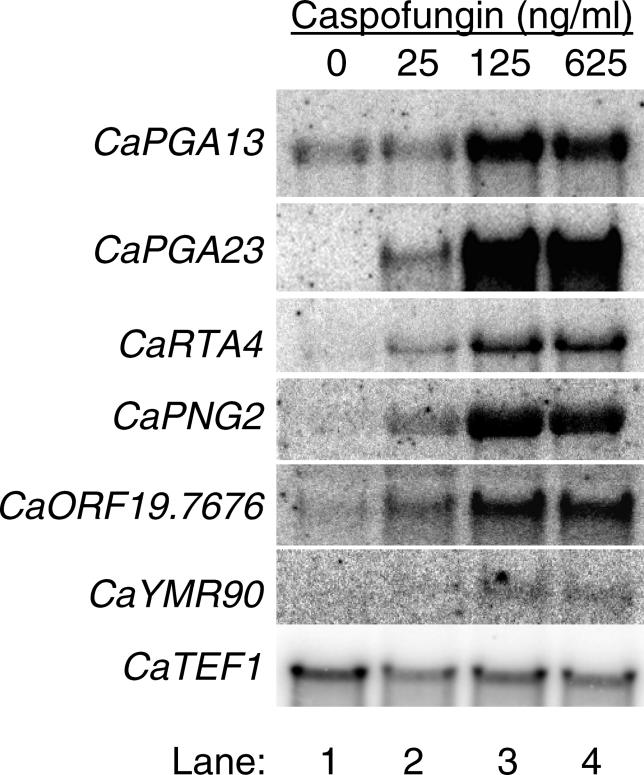
“Microarray studies show that caspofungin induces expression of several cell wall protein and cell wall maintenance genes [7], including two genes whose S. cerevisiae homologs are activated by ScRlm1.”
MethodInfluentialNiedenthal, R. K., Riles, L., Johnston, M., & Hegemann, J. H. (1996) · Yeast · doi:10.1002/(sici)1097-0061(19960630)12:8<723::aid-yea963>3.0.co;2-o · Cited by 383
Cited by
The Fungal Cell Wall: Structure, Biosynthesis, and Function
Gow, N. A. R., Latge, J.-P., & Munro, C. A. (2017) · Microbiology Spectrum · doi:10.1128/microbiolspec.funk-0035-2016 · Cited by 1,423
Antifungal Drug Resistance: Molecular Mechanisms in Candida albicans and Beyond
Lee, Y., Puumala, E., Robbins, N., & Cowen, L. E. (2021) · Chemical Reviews · doi:10.1021/acs.chemrev.0c00199 · Cited by 801
Antifungal Resistance and New Strategies to Control Fungal Infections
Vandeputte, P., Ferrari, S., & Coste, A. T. (2012) · International Journal of Microbiology · doi:10.1155/2012/713687 · Cited by 505
“First of all, treating strains with already known antifungal drugs and analyzing for example, growth modification and later transcriptional rewiring, some authors try to better understand drugs mechanisms of action and/or to find synergistic effect between them [272, 274].”
BackgroundCandida albicans Cell Wall Proteins
Chaffin, W. L. (2008) · Microbiology and Molecular Biology Reviews · doi:10.1128/mmbr.00032-07 · Cited by 515
A Candida Biofilm-Induced Pathway for Matrix Glucan Delivery: Implications for Drug Resistance
Taff, H. T., Nett, J. E., Zarnowski, R., Ross, K. M., Sanchez, H., Cain, M. T., Hamaker, J., Mitchell, A. P., & Andes, D. R. (2012) · PLoS Pathogens · doi:10.1371/journal.ppat.1002848 · Cited by 291
“Agents with various mechanisms of action known to impact cell integrity were tested [37,59].”
BackgroundSelf-citation
Metadata
- Authors
- Bruno, V. M., Kalachikov, S., Subaran, R., Nobile, C. J., Kyratsous, C., & Mitchell, A. P.
- Affiliations
- Columbia University (US)
- Corresponding author
- Mitchell, Aaron P
- Venue
- PLoS Pathogens
- Publisher
- Public Library of Science (PLoS)
- Published
- 2006-03-17
- Volume
- 2
- Issue
- 3
- Pages
- e21
- ISSN
- 1553-7366 (ISSN-L)
- 1553-7374
- PMC
- PMC1401495
- OpenAlex
- W2079004458
- Cited by
- 157
- References
- 42
- Citations by year
- 2026: 3 · 2025: 5 · 2024: 4 · 2023: 4 · 2022: 11 · 2021: 14 · 2020: 12 · 2019: 11 · 2018: 7 · 2017: 7 · 2016: 5 · 2015: 3 · 2014: 10 · 2013: 7 · 2012: 11
- FWCI
- 3.39
- Type
- journal article
- Language
- en
- Open access
- gold
- doi.org
- Locations
- PLoS Pathogens (publishedVersion, cc-by)
- Europe PMC (PubMed Central) (publishedVersion, cc-by)
- PubMed Central (publishedVersion, cc-by)
- PubMed (publishedVersion)
- DOAJ (DOAJ: Directory of Open Access Journals) (submittedVersion, cc-by-sa)
- Figshare (submittedVersion, cc-by)
- Funders
- National Institutes of Health
- National Institute of Allergy and Infectious Diseases (T32AI07161, R01AI050931, T32AI007161, R21AI055823)
- Topics
- Life Sciences › Biochemistry, Genetics and Molecular Biology › Molecular Biology › Fungal and yeast genetics research
- Health Sciences › Medicine › Infectious Diseases › Antifungal resistance and susceptibility
- Health Sciences › Medicine › Infectious Diseases › Fungal Infections and Studies
- Keywords
- Candida albicans, cell wall integrity, Rlm1, antifungal resistance, transcriptional regulation, endoplasmic reticulum, secretion, Saccharomyces cerevisiae comparison, fungal pathogens
- MeSH terms
- Caspofungin, Antifungal Agents, Candida albicans, Cell Wall, Genes, Mutation, Peptides, Cyclic, Transcription Factors, Transcription, Genetic, Echinocandins, Lipopeptides
About these checks
Registry, retraction, Cites and statistics results are computed, not judged, with one exception: a printed reference that no index lists is read once by a model before it counts as a citation error. Claims are extracted by a model and kept only when their quote appears verbatim in the text; each cited source is then checked, with a model’s help, for whether it says what the claim relies on. Those verdicts can be wrong — read the claim’s quote and the cited source before relying on one.
Statistics and arithmetic are recomputed, not judged.
Confidence bands are shown only for fields calibrated on our annotated test set. None is calibrated yet, so no band is shown.
What counts as a claim ›How we measure confidence ›How we check this ›
Are you an author, or do you see a problem with this page? Request a review
How to cite
Cite CoChat for the checks on this page, and the paper for its own findings.
- This page
- CoChat. (2026). Citation check: Control of the C. albicans Cell Wall Damage Response by Transcriptional Regulator Cas5. https://app.cochat.ai/papers/10.1371/journal.ppat.0020021
- The paper
- Bruno, V. M., Kalachikov, S., Subaran, R., Nobile, C. J., Kyratsous, C., & Mitchell, A. P. (2006). Control of the C. albicans Cell Wall Damage Response by Transcriptional Regulator Cas5. PLoS Pathogens. https://doi.org/10.1371/journal.ppat.0020021
Data sources
Bibliographic data: Semantic Scholar, OpenAlex, Crossref.
Contains information from the Semantic Scholar Academic Graph Datasets, made available under the ODC Attribution License (ODC-BY 1.0).
Semantic Scholar’s data is described in: Kinney, R., et al. (2023). The Semantic Scholar Open Data Platform. arXiv:2301.10140.
