

The DOI matches its Crossref record; 1 of the 1 references it cites were found in a registry or an index.
Mechanism of Genomic Instability in Cells Infected with the High-Risk Human Papillomaviruses
Overview
The claims and statistics of this paper haven’t been checked yet.
Run the check — free, no account needed. It reads the open-access text and checks the sources it cites.
Integrity signals
Registry
Cites
Statistics
Figures
Verification
Claims the paper makes
The claims and statistics of this paper haven’t been checked yet.
Run the check — free, no account needed. It reads the open-access text and checks the sources it cites.
Claims other papers make about this one
Each is checked against this paper’s own text: does it say what the citing paper says it does?
In the citing paper
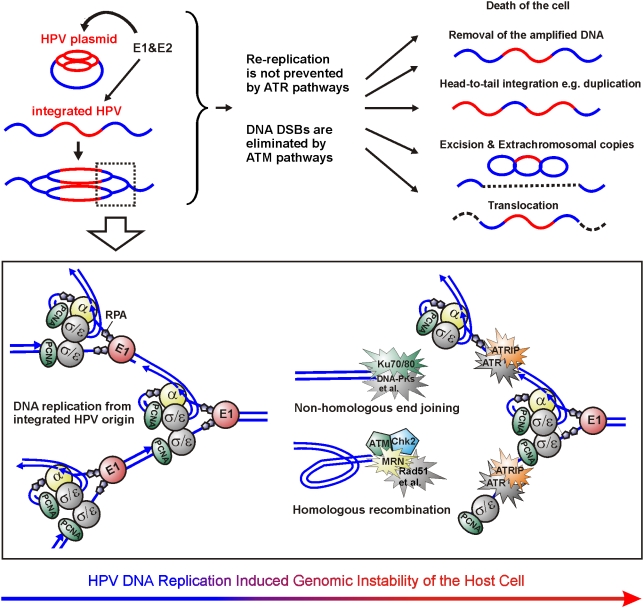
“An initial event in the induction of genomic instability in HPV infection, and probably responsible for cases of co-existing episomal and integrated HPV DNA, is the upsetting possibility of ‘onion skin’ type of HPV DNA replication, caused by activation of the viral origin of replication multiple times within a single cell cycle, leading to single- or double-strand breaks and recruitment of the DNA”
From The Not-So-Good, the Bad and the Ugly: HPV E5, E6 and E7 Oncoproteins in the Orchestration of Carcinogenesis (2021) · cites this paper as [322]
Self-check
Percentages, sums and reported differences re-computed from the paper’s own numbers.
The self-check needs the paper’s full text.
Citations
Cites
The endless tale of non-homologous end-joining
Weterings, E., & Chen, D. J. (2008) · Cell Research · doi:10.1038/cr.2008.3 · Cited by 418
Research works printed but not linked: 76
- M Ustav, 1991, Transient replication of BPV-1 requires two viral polypeptides encoded by the E1 and E2 open reading frames., Embo J, 10, 449, 10.1002/j.1460-2075.1991.tb07967.x · DOI
- CM Chiang, 1992, Viral E1 and E2 proteins support replication of homologous and heterologous papillomaviral origins., Proc Natl Acad Sci U S A, 89, 5799, 10.1073/pnas.89.13.5799 · DOI
- F Sverdrup, 1994, Replication of human papillomavirus (HPV) DNAs supported by the HPV type 18 E1 and E2 proteins., J Virol, 68, 505, 10.1128/JVI.68.1.505-509.1994 · DOI
- M Kadaja, 2009, Papillomavirus DNA replication - from initiation to genomic instability., Virology, 384, 360, 10.1016/j.virol.2008.11.032 · DOI
- L Yang, 1993, The E1 protein of bovine papilloma virus 1 is an ATP-dependent DNA helicase., Proc Natl Acad Sci U S A, 90, 5086, 10.1073/pnas.90.11.5086 · DOI
- J Sedman, 1998, The papillomavirus E1 protein forms a DNA-dependent hexameric complex with ATPase and DNA helicase activities., J Virol, 72, 6893, 10.1128/JVI.72.8.6893-6897.1998 · DOI
- M Ustav, 1991, Identification of the origin of replication of bovine papillomavirus and characterization of the viral origin recognition factor E1., Embo J, 10, 4321, 10.1002/j.1460-2075.1991.tb05010.x · DOI
- E Ustav, 1993, The bovine papillomavirus origin of replication requires a binding site for the E2 transcriptional activator., Proc Natl Acad Sci U S A, 90, 898, 10.1073/pnas.90.3.898 · DOI
- M Remm, 1992, The E2 binding sites determine the efficiency of replication for the origin of human papillomavirus type 18., Nucleic Acids Res, 20, 6015, 10.1093/nar/20.22.6015 · DOI
- J Russell, 1995, cis-Acting components of human papillomavirus (HPV) DNA replication: linker substitution analysis of the HPV type 11 origin., J Virol, 69, 651, 10.1128/JVI.69.2.651-660.1995 · DOI
- A Stenlund, 2003, Initiation of DNA replication: lessons from viral initiator proteins., Nat Rev Mol Cell Biol, 4, 777, 10.1038/nrm1226 · DOI
- JB Ravnan, 1992, Random-choice replication of extrachromosomal bovine papillomavirus (BPV) molecules in heterogeneous, clonally derived BPV-infected cell lines., J Virol, 66, 6946, 10.1128/JVI.66.12.6946-6952.1992 · DOI
- M Piirsoo, 1996, Cis and trans requirements for stable episomal maintenance of the BPV-1 replicator., Embo J, 15, 1, 10.1002/j.1460-2075.1996.tb00328.x · DOI
- K Cooper, 1991, Episomal and integrated human papillomavirus in cervical neoplasia shown by non-isotopic in situ hybridisation., J Clin Pathol, 44, 990, 10.1136/jcp.44.12.990 · DOI
- E Kristiansen, 1994, Coexistence of episomal and integrated HPV16 DNA in squamous cell carcinoma of the cervix., J Clin Pathol, 47, 253, 10.1136/jcp.47.3.253 · DOI
- W Alazawi, 2002, Changes in cervical keratinocyte gene expression associated with integration of human papillomavirus 16., Cancer Res, 62, 6959
- P Peitsaro, 2002, Single copy heterozygote integration of HPV 33 in chromosomal band 5p14 is found in an epithelial cell clone with selective growth advantage., Carcinogenesis, 23, 1057, 10.1093/carcin/23.6.1057 · DOI
- P Peitsaro, 2002, Integrated human papillomavirus type 16 is frequently found in cervical cancer precursors as demonstrated by a novel quantitative real-time PCR technique., J Clin Microbiol, 40, 886, 10.1128/JCM.40.3.886-891.2002 · DOI
- S Andersson, 2005, Type distribution, viral load and integration status of high-risk human papillomaviruses in pre-stages of cervical cancer (CIN)., Br J Cancer, 92, 2195, 10.1038/sj.bjc.6602648 · DOI · Paper page
- H Arias-Pulido, 2006, Human papillomavirus type 16 integration in cervical carcinoma in situ and in invasive cervical cancer., J Clin Microbiol, 44, 1755, 10.1128/JCM.44.5.1755-1762.2006 · DOI
- SM Kulmala, 2006, Early integration of high copy HPV16 detectable in women with normal and low grade cervical cytology and histology., J Clin Pathol, 59, 513, 10.1136/jcp.2004.024570 · DOI
- MR Pett, 2006, Selection of cervical keratinocytes containing integrated HPV16 associates with episome loss and an endogenous antiviral response., Proc Natl Acad Sci U S A, 103, 3822, 10.1073/pnas.0600078103 · DOI
- M Pett, 2007, Integration of high-risk human papillomavirus: a key event in cervical carcinogenesis?, J Pathol, 212, 356, 10.1002/path.2192 · DOI
- KL Dall, 2008, Characterization of naturally occurring HPV16 integration sites isolated from cervical keratinocytes under noncompetitive conditions., Cancer Res, 68, 8249, 10.1158/0008-5472.CAN-08-1741 · DOI
- MR Pett, 2004, Acquisition of high-level chromosomal instability is associated with integration of human papillomavirus type 16 in cervical keratinocytes., Cancer Res, 64, 1359, 10.1158/0008-5472.CAN-03-3214 · DOI
- S Jeon, 1995, Integration of human papillomavirus type 16 into the human genome correlates with a selective growth advantage of cells., J Virol, 69, 2989, 10.1128/JVI.69.5.2989-2997.1995 · DOI
- H Romanczuk, 1992, Disruption of either the E1 or the E2 regulatory gene of human papillomavirus type 16 increases viral immortalization capacity., Proc Natl Acad Sci U S A, 89, 3159, 10.1073/pnas.89.7.3159 · DOI
- H Romanczuk, 1990, Mutational analysis of cis elements involved in E2 modulation of human papillomavirus type 16 P97 and type 18 P105 promoters., J Virol, 64, 2849, 10.1128/JVI.64.6.2849-2859.1990 · DOI
- M Kadaja, 2007, Genomic instability of the host cell induced by the human papillomavirus replication machinery., Embo J, 26, 2180, 10.1038/sj.emboj.7601665 · DOI
- SA Corden, 1999, The integration of HPV-18 DNA in cervical carcinoma., Mol Pathol, 52, 275, 10.1136/mp.52.5.275 · DOI
- M Kalantari, 2001, Physical state of HPV16 and chromosomal mapping of the integrated form in cervical carcinomas., Diagn Mol Pathol, 10, 46, 10.1097/00019606-200103000-00008 · DOI
- M Peter, 2006, MYC activation associated with the integration of HPV DNA at the MYC locus in genital tumors., Oncogene, 25, 5985, 10.1038/sj.onc.1209625 · DOI · Paper page
- S Duensing, 2004, Mechanisms of genomic instability in human cancer: insights from studies with human papillomavirus oncoproteins., Int J Cancer, 109, 157, 10.1002/ijc.11691 · DOI
- S Duensing, 2002, The human papillomavirus type 16 E6 and E7 oncoproteins independently induce numerical and structural chromosome instability., Cancer Res, 62, 7075
- S Duensing, 2003, Human papillomavirus type 16 E7 oncoprotein can induce abnormal centrosome duplication through a mechanism independent of inactivation of retinoblastoma protein family members., J Virol, 77, 12331, 10.1128/JVI.77.22.12331-12335.2003 · DOI · Paper page
- V Bechtold, 2003, Human papillomavirus type 16 E2 protein has no effect on transcription from episomal viral DNA., J Virol, 77, 2021, 10.1128/JVI.77.3.2021-2028.2003 · DOI
- B Hirt, 1967, Selective extraction of polyoma DNA from infected mouse cell cultures., J Mol Biol, 26, 365, 10.1016/0022-2836(67)90307-5 · DOI
- S Cohen, 2003, Extrachromosomal circular DNA of tandemly repeated genomic sequences in Drosophila., Genome Res, 13, 1133, 10.1101/gr.907603 · DOI
- PA Dijkwel, 1999, Physical and genetic mapping of mammalian replication origins., Methods, 18, 418, 10.1006/meth.1999.0800 · DOI
- A Mannik, 2002, Induction of the bovine papillomavirus origin “onion skin”-type DNA replication at high E1 protein concentrations in vivo., J Virol, 76, 5835, 10.1128/JVI.76.11.5835-5845.2002 · DOI
- P Meister, 2007, Replication foci dynamics: replication patterns are modulated by S-phase checkpoint kinases in fission yeast., Embo J, 26, 1315, 10.1038/sj.emboj.7601538 · DOI
- AA Philimonenko, 2006, The microarchitecture of DNA replication domains., Histochem Cell Biol, 125, 103, 10.1007/s00418-005-0090-0 · DOI
- H Leonhardt, 2000, Dynamics of DNA replication factories in living cells., J Cell Biol, 149, 271, 10.1083/jcb.149.2.271 · DOI
- CS Swindle, 1999, Human papillomavirus DNA replication compartments in a transient DNA replication system., J Virol, 73, 1001, 10.1128/JVI.73.2.1001-1009.1999 · DOI
- MK el Awady, 1987, Molecular analysis of integrated human papillomavirus 16 sequences in the cervical cancer cell line SiHa., Virology, 159, 389, 10.1016/0042-6822(87)90478-8 · DOI
- JD Meissner, 1999, Nucleotide sequences and further characterization of human papillomavirus DNA present in the CaSki, SiHa and HeLa cervical carcinoma cell lines., J Gen Virol, 80(Pt 7), 1725, 10.1099/0022-1317-80-7-1725 · DOI
- K Szuhai, 2000, Simultaneous molecular karyotyping and mapping of viral DNA integration sites by 25-color COBRA-FISH., Genes Chromosomes Cancer, 28, 92, 10.1002/(SICI)1098-2264(200005)28:1<92::AID-GCC11>3.0.CO;2-2 · DOI
- M Macville, 1999, Comprehensive and definitive molecular cytogenetic characterization of HeLa cells by spectral karyotyping., Cancer Res, 59, 141
- R Bernardi, 2007, Structure, dynamics and functions of promyelocytic leukaemia nuclear bodies., Nat Rev Mol Cell Biol, 8, 1006, 10.1038/nrm2277 · DOI
- HM Shih, 2007, Daxx mediates SUMO-dependent transcriptional control and subnuclear compartmentalization., Biochem Soc Trans, 35, 1397, 10.1042/BST0351397 · DOI
- M Shrivastav, 2008, Regulation of DNA double-strand break repair pathway choice., Cell Res, 18, 134, 10.1038/cr.2007.111 · DOI · Paper page
- E Sonoda, 2006, Differential usage of non-homologous end-joining and homologous recombination in double strand break repair., DNA Repair (Amst), 5, 1021, 10.1016/j.dnarep.2006.05.022 · DOI
- S Matsuoka, 2000, Ataxia telangiectasia-mutated phosphorylates Chk2 in vivo and in vitro., Proc Natl Acad Sci U S A, 97, 10389, 10.1073/pnas.190030497 · DOI
- X Xu, 2002, Chk2 activation and phosphorylation-dependent oligomerization., Mol Cell Biol, 22, 4419, 10.1128/MCB.22.12.4419-4432.2002 · DOI
- G Buscemi, 2006, DNA damage-induced cell cycle regulation and function of novel Chk2 phosphoresidues., Mol Cell Biol, 26, 7832, 10.1128/MCB.00534-06 · DOI
- J Couturier, 1991, Integration of papillomavirus DNA near myc genes in genital carcinomas and its consequences for proto-oncogene expression., J Virol, 65, 4534, 10.1128/JVI.65.8.4534-4538.1991 · DOI
- AA Brink, 2002, Simultaneous mapping of human papillomavirus integration sites and molecular karyotyping in short-term cultures of cervical carcinomas by using 49-color combined binary ratio labeling fluorescence in situ hybridization., Cancer Genet Cytogenet, 134, 145, 10.1016/S0165-4608(01)00620-3 · DOI
- MG Frattini, 1996, In vitro synthesis of oncogenic human papillomaviruses requires episomal genomes for differentiation-dependent late expression., Proc Natl Acad Sci U S A, 93, 3062, 10.1073/pnas.93.7.3062 · DOI
- SC Holmgren, 2005, The minor capsid protein L2 contributes to two steps in the human papillomavirus type 31 life cycle., J Virol, 79, 3938, 10.1128/JVI.79.7.3938-3948.2005 · DOI
- JJ Blow, 2005, Preventing re-replication of chromosomal DNA., Nat Rev Mol Cell Biol, 6, 476, 10.1038/nrm1663 · DOI
- YJ Machida, 2005, Right place, right time, and only once: replication initiation in metazoans., Cell, 123, 13, 10.1016/j.cell.2005.09.019 · DOI
- M Botchan, 1979, Studies on simian virus 40 excision from cellular chromosomes., Cold Spring Harb Symp Quant Biol, 43 Pt 2, 709, 10.1101/SQB.1979.043.01.079 · DOI
- D Hanahan, 1980, Characteristics of an SV40-plasmid recombinant and its movement into and out of the genome of a murine cell., Cell, 21, 127, 10.1016/0092-8674(80)90120-8 · DOI
- P Bullock, 1984, DNA sequence studies of simian virus 40 chromosomal excision and integration in rat cells., J Mol Biol, 174, 55, 10.1016/0022-2836(84)90365-6 · DOI
- DO Ferguson, 2000, The nonhomologous end-joining pathway of DNA repair is required for genomic stability and the suppression of translocations., Proc Natl Acad Sci U S A, 97, 6630, 10.1073/pnas.110152897 · DOI
- ZE Karanjawala, 1999, The nonhomologous DNA end joining pathway is important for chromosome stability in primary fibroblasts., Curr Biol, 9, 1501, 10.1016/S0960-9822(00)80123-2 · DOI
- NE Sharpless, 2001, Impaired nonhomologous end-joining provokes soft tissue sarcomas harboring chromosomal translocations, amplifications, and deletions., Mol Cell, 8, 1187, 10.1016/S1097-2765(01)00425-7 · DOI
- Y Zhang, 2006, Chromatin structural elements and chromosomal translocations in leukemia., DNA Repair (Amst), 5, 1282, 10.1016/j.dnarep.2006.05.020 · DOI
- C Vaziri, 2003, A p53-dependent checkpoint pathway prevents rereplication., Mol Cell, 11, 997, 10.1016/S1097-2765(03)00099-6 · DOI
- IS Mihaylov, 2002, Control of DNA replication and chromosome ploidy by geminin and cyclin A., Mol Cell Biol, 22, 1868, 10.1128/MCB.22.6.1868-1880.2002 · DOI
- W Zhu, 2004, Rereplication by depletion of geminin is seen regardless of p53 status and activates a G2/M checkpoint., Mol Cell Biol, 24, 7140, 10.1128/MCB.24.16.7140-7150.2004 · DOI
- E Liu, 2007, The ATR-mediated S phase checkpoint prevents rereplication in mammalian cells when licensing control is disrupted., J Cell Biol, 179, 643, 10.1083/jcb.200704138 · DOI
- MR Lentz, 2006, A phosphorylation map of the bovine papillomavirus E1 helicase., Virol J, 3, 13, 10.1186/1743-422X-3-13 · DOI
- I Ilves, 2003, Two separate replication modes of the bovine papillomavirus BPV1 origin of replication that have different sensitivity to p53., Virus Res, 96, 75, 10.1016/S0168-1702(03)00174-6 · DOI
- P Karakaidos, 2004, Overexpression of the replication licensing regulators hCdt1 and hCdc6 characterizes a subset of non-small-cell lung carcinomas: synergistic effect with mutant p53 on tumor growth and chromosomal instability–evidence of E2F-1 transcriptional control over hCdt1., Am J Pathol, 165, 1351, 10.1016/S0002-9440(10)63393-7 · DOI
- Y Tatsumi, 2006, Deregulation of Cdt1 induces chromosomal damage without rereplication and leads to chromosomal instability., J Cell Sci, 119, 3128, 10.1242/jcs.03031 · DOI
Cited by
Identification and classification of chromosomal aberrations in human induced pluripotent stem cells
Mayshar, Y., Ben-David, U., Lavon, N., Biancotti, J.-C., Yakir, B., Clark, A. T., Plath, K., Lowry, W. E., & Benvenisty, N. (2010) · Cell stem cell · doi:10.1016/j.stem.2010.07.017 · Cited by 756
Basukala, O., & Banks, L. (2021) · Viruses · doi:10.3390/v13101892 · Cited by 137
Metadata
- Authors
- Kadaja, M., Isok-Paas, H., Laos, T., Ustav, E., & Ustav, M.
- Venue
- PLoS Pathogens
- Publisher
- Public Library of Science (PLoS)
- Published
- 2009-04-24
- Volume
- 5
- Issue
- 4
- Pages
- e1000397
- ISSN
- 1553-7374
- PMC
- PMC2666264
- Cited by
- 173
- References
- 1
- Language
- en
About these checks
Registry, retraction, Cites and statistics results are computed, not judged, with one exception: a printed reference that no index lists is read once by a model before it counts as a citation error. Claims are extracted by a model and kept only when their quote appears verbatim in the text; each cited source is then checked, with a model’s help, for whether it says what the claim relies on. Those verdicts can be wrong — read the claim’s quote and the cited source before relying on one.
Statistics and arithmetic are recomputed, not judged.
Confidence bands are shown only for fields calibrated on our annotated test set. None is calibrated yet, so no band is shown.
What counts as a claim ›How we measure confidence ›How we check this ›
Are you an author, or do you see a problem with this page? Request a review
How to cite
Cite CoChat for the checks on this page, and the paper for its own findings.
- This page
- CoChat. (2026). Citation check: Mechanism of Genomic Instability in Cells Infected with the High-Risk Human Papillomaviruses. https://app.cochat.ai/papers/10.1371/journal.ppat.1000397
- The paper
- Kadaja, M., Isok-Paas, H., Laos, T., Ustav, E., & Ustav, M. (2009). Mechanism of Genomic Instability in Cells Infected with the High-Risk Human Papillomaviruses. PLoS Pathogens. https://doi.org/10.1371/journal.ppat.1000397
