

HacA-Independent Functions of the ER Stress Sensor IreA Synergize with the Canonical UPR to Influence Virulence Traits in Aspergillus fumigatus
Open accessThe DOI matches its Crossref record; 63 of the 63 references it cites were found in a registry or an index.
Abstract
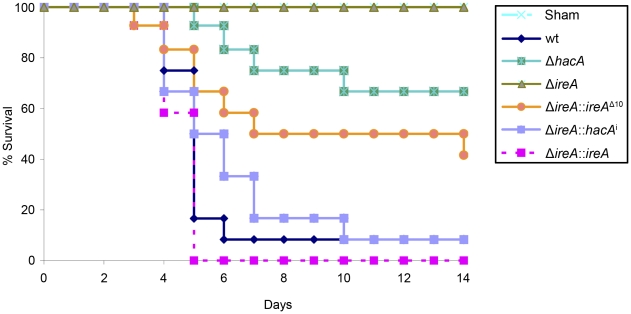
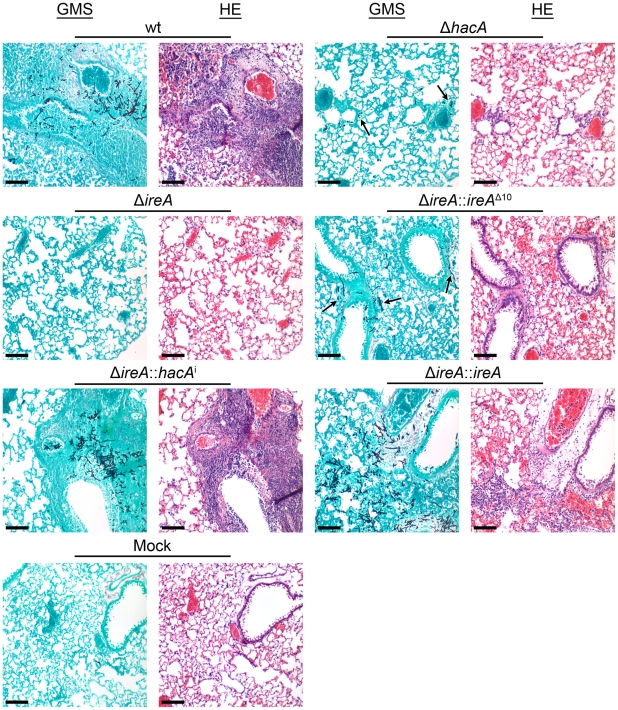
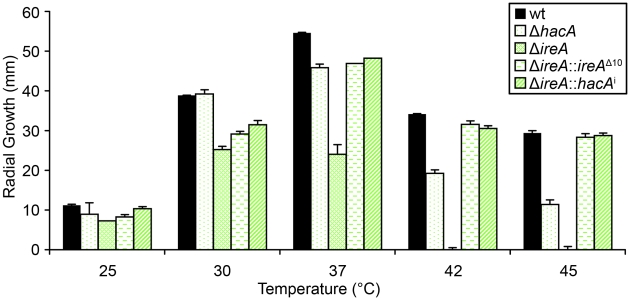
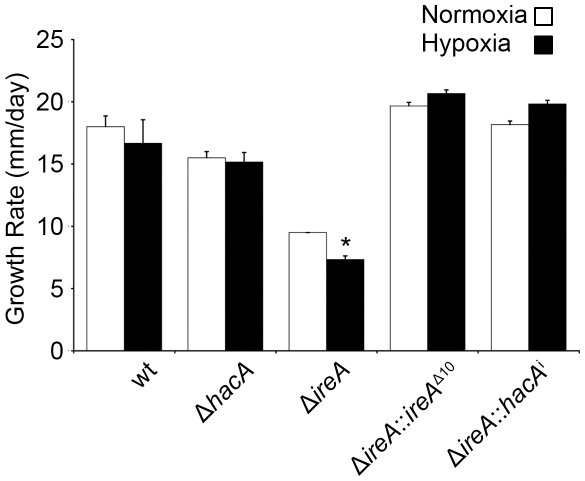
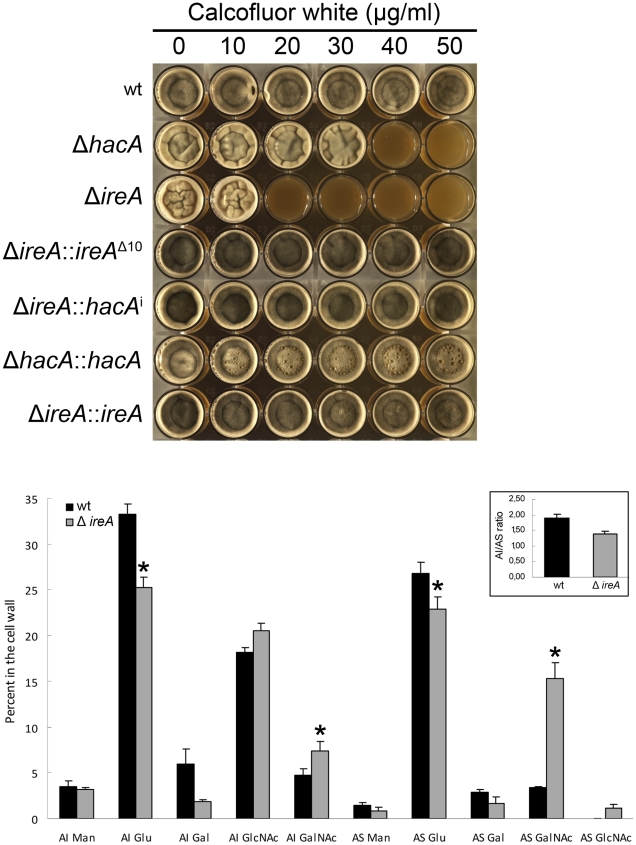
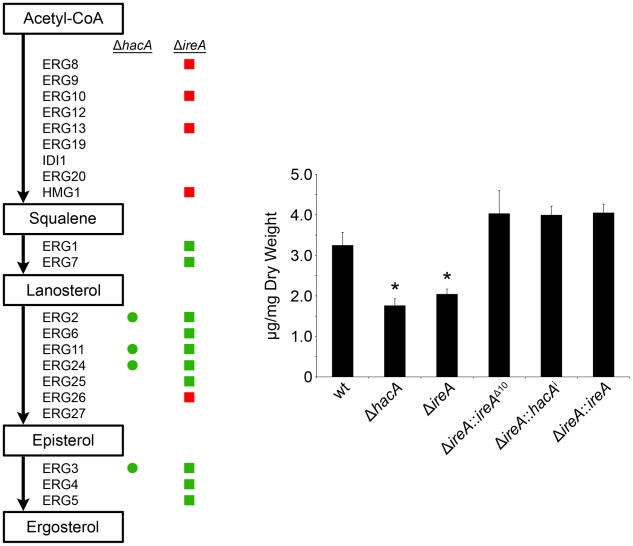
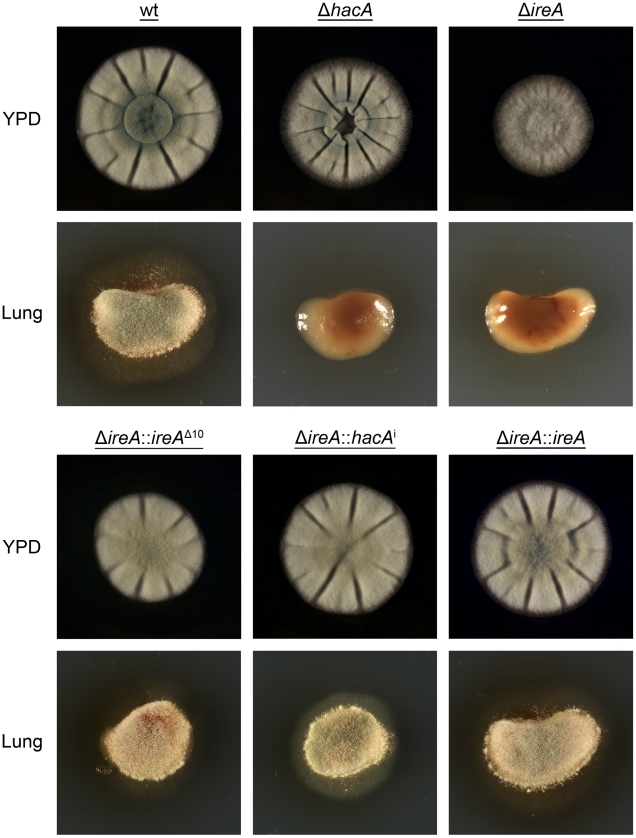
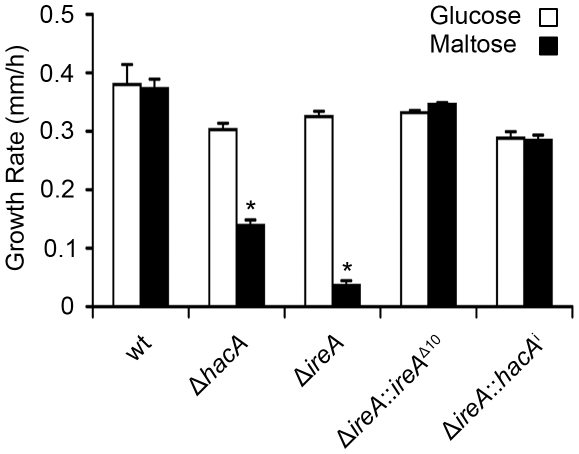
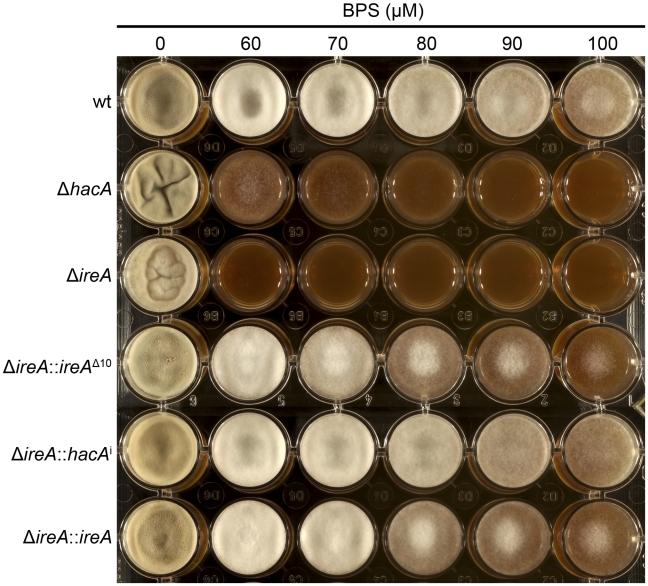
Endoplasmic reticulum (ER) stress is a condition in which the protein folding capacity of the ER becomes overwhelmed by an increased demand for secretion or by exposure to compounds that disrupt ER homeostasis. In yeast and other fungi, the accumulation of unfolded proteins is detected by the ER-transmembrane sensor IreA/Ire1, which responds by cleaving an intron from the downstream cytoplasmic mRNA HacA/Hac1, allowing for the translation of a transcription factor that coordinates a series of adaptive responses that are collectively known as the unfolded protein response (UPR). Here, we examined the contribution of IreA to growth and virulence in the human fungal pathogen Aspergillus fumigatus. Gene expression profiling revealed that A. fumigatus IreA signals predominantly through the canonical IreA-HacA pathway under conditions of severe ER stress. However, in the absence of ER stress IreA controls dual signaling circuits that are both HacA-dependent and HacA-independent. We found that a ΔireA mutant was avirulent in a mouse model of invasive aspergillosis, which contrasts the partial virulence of a ΔhacA mutant, suggesting that IreA contributes to pathogenesis independently of HacA. In support of this conclusion, we found that the ΔireA mutant had more severe defects in the expression of multiple virulence-related traits relative to ΔhacA, including reduced thermotolerance, decreased nutritional versatility, impaired growth under hypoxia, altered cell wall and membrane composition, and increased susceptibility to azole antifungals. In addition, full or partial virulence could be restored to the ΔireA mutant by complementation with either the induced form of the hacA mRNA, hacA(i), or an ireA deletion mutant that was incapable of processing the hacA mRNA, ireA(Δ10). Together, these findings demonstrate that IreA has both HacA-dependent and HacA-independent functions that contribute to the expression of traits that are essential for virulence in A. fumigatus.
Overview
The claims and statistics of this paper haven’t been checked yet.
Free: it reads the open-access text and checks the first 5 claims that cite a source we can check. Create a free account to check every claim.
Integrity signals
Registry
Cites
Statistics
Figures
Verification
Claims the paper makes
The claims and statistics of this paper haven’t been checked yet.
Free: it reads the open-access text and checks the first 5 claims that cite a source we can check. Create a free account to check every claim.
Claims other papers make about this one
Each is checked against this paper’s own text: does it say what the citing paper says it does?
The source backs part of the claim, not all of it — or backs it for a different population, condition or comparison.
In the citing paper
“Loss of HacA, the major transcription factor of the UPR, and of the stress sensor, IreA, impairs protein secretion, which results in attenuated virulence of these strains, which are then unable to extract sufficient nutrients from host tissues (605).”
From Aspergillus fumigatus and Aspergillosis in 2019 (2019) · cites this paper as [605]
Experimental — accuracy not yet measuredIn the citing paper
“iron assimilation is affected in these mutants, demonstrating again that nutritional versatility is a complex phenomenon resulting from interconnections of pathways not logically related (605).”
From Aspergillus fumigatus and Aspergillosis in 2019 (2019) · cites this paper as [605]
Self-check
Percentages, sums and reported differences re-computed from the paper’s own numbers.
The self-check needs the paper’s full text.
Citations
Cites
Cluster analysis and display of genome-wide expression patterns
Eisen, M. B., Spellman, P. T., Brown, P. O., & Botstein, D. (1998) · Proceedings of the National Academy of Sciences · doi:10.1073/pnas.95.25.14863 · Cited by 16,184 · cited 1×
“0 [60] and the cluster tree was visualized using JAVA Treeview [61].”
MethodThe KEGG resource for deciphering the genome
Kanehisa, M. (2004) · Nucleic Acids Research · doi:10.1093/nar/gkh063 · Cited by 5,104 · cited 1×
“KEGG pathways associated with Aspergillus fumigatus were downloaded from the KEGG database [59].”
MethodProtein folding and misfolding
Dobson, C. M. (2003) · Nature · doi:10.1038/nature02261 · Cited by 4,791 · cited 1×
“Misfolded proteins are prone to nonspecific interactions with other molecules in the crowded intracellular environment, resulting in nonfunctional protein aggregates that disrupt ER homeostasis [6].”
BackgroundJava Treeview—extensible visualization of microarray data
Saldanha, A. J. (2004) · Bioinformatics · doi:10.1093/bioinformatics/bth349 · Cited by 2,991 · cited 2×
“0 [60] and the cluster tree was visualized using JAVA Treeview [61].”
MethodInfluentialBoyle, E. I., Weng, S., Gollub, J., Jin, H., Botstein, D., Cherry, J. M., & Sherlock, G. (2004) · Bioinformatics · doi:10.1093/bioinformatics/bth456 · Cited by 2,067 · cited 1×
“Gene Ontology Term Enrichment was performed using AmiGO Term Enrichment [58].”
MethodRoles of N-Linked Glycans in the Endoplasmic Reticulum
Helenius, A., & Aebi, M. (2004) · Annual Review of Biochemistry · doi:10.1146/annurev.biochem.73.011303.073752 · Cited by 2,037 · cited 1×
“mRNAs with decreased abundance in DhacA, consistent with the prominent role of N-linked glycosylation in the maturation of secretory proteins [28].”
BackgroundTravers, K. J., Patil, C. K., Wodicka, L., Lockhart, D. J., Weissman, J. S., & Walter, P. (2000) · Cell · doi:10.1016/s0092-8674(00)80835-1 · Cited by 1,992
Genomic sequence of the pathogenic and allergenic filamentous fungus Aspergillus fumigatus
Nierman, W. C., Pain, A., Anderson, M. J., Wortman, J. R., Kim, H. S., Arroyo, J., Berriman, M., Abe, K., Archer, D. B., Bermejo, C., et al. (2005) · Nature · doi:10.1038/nature04332 · Cited by 1,391
Self-citationCox, J. S., Shamu, C. E., & Walter, P. (1993) · Cell · doi:10.1016/0092-8674(93)90648-a · Cited by 1,231 · cited 1×
“This is followed by high-order oligomerization of Ire1 in the ER membrane, which allows for trans-autophosphorylation and activation of the C-terminal endoribonuclease domain [11,12,13].”
BackgroundLee, K., Tirasophon, W., Shen, X., Michalak, M., Prywes, R., Okada, T., Yoshida, H., Mori, K., & Kaufman, R. J. (2002) · Genes & Development · doi:10.1101/gad.964702 · Cited by 1,054
Cited by
Items 101–112 of 112
Powers-Fletcher, M. M. (2013) · OhioLink ETD Center (Ohio Library and Information Network)
Self-citationSilva, P. A. (2017) · Digital Library of Theses and Dissertations (Universidade de São Paulo) · doi:10.11606/d.17.2017.tde-27012017-144118
Hampel, M. (2016) · eDiss (Georg-August-Universität Göttingen) · doi:10.53846/goediss-6026
Schmitz, L. (2019) · eDiss (Georg-August-Universität Göttingen) · doi:10.53846/goediss-7748
Kamath, M. M., Lightfoot, J. D., Adams, E. M., Wells, B. L., & Fuller, K. K. (2023) · bioRxiv (Cold Spring Harbor Laboratory) · doi:10.1101/2023.05.22.541860
Self-citationZhu, Y., Xu, Q., Zou, R., Liu, S., Tao, R., Liu, S., Li, X., Wen, L., Wu, J., & Wang, J. (2023) · SSRN Electronic Journal · doi:10.2139/ssrn.4467612
Mota, C., Thak, E. J., Song, S. W., & Kang, H. A. (2025) · Current Clinical Microbiology Reports · doi:10.1007/s40588-025-00260-1
“Disruptions of fungal genes encoding key UPR components, including IRE1 , HAC1 (or HXL1 ), and their down-stream effectors, impair fungal viability, secretion, and infectivity, underscoring the therapeutic potential of this pathway [30, 32–34, 76, 77].”
Li, T., Liu, Y., Zhu, H., Cao, L., Zhou, Y., Liu, D., & Shen, Q. (2024) · Figshare · doi:10.6084/m9.figshare.26708753
Understanding Repression Under Secretion Stress in Trichoderma reesei During Cellulase Expression
Jadhav, R., Uzel, G. D., Charest, J., Nikolaev, I., Barends, S., Mach, R. L., & Mach-Aigner, A. R. (2026) · Microorganisms · doi:10.3390/microorganisms14061371
Shimizu, Y., Matsumoto, Y., & Sugita, T. (2026) · bioRxiv (Cold Spring Harbor Laboratory) · doi:10.64898/2026.06.27.734954
Ikhrami, M. A., & Kimata, Y. (2026) · Cells · doi:10.3390/cells15201883
“[13], the ireA deletion mutant exhibited a more severe defect in virulence-related traits than the hacA deletion mutant in A. fumigatus , suggesting that IreA has a function other than hacA mRNA splicing.”
Metadata
- Authors
- Feng, X., Krishnan, K., Richie, D. L., Aimanianda, V., Hartl, L., Grahl, N., Powers-Fletcher, M. V., Zhang, M., Fuller, K. K., Nierman, W. C., Lu, L. J., Latgé, J.-P., Woollett, L., Newman, S. L., Cramer, R. A., Rhodes, J. C., & Askew, D. S.
- Affiliations
- University of Cincinnati (US)
- Institut Pasteur (FR)
- Montana State University (US)
- Cincinnati Children's Hospital Medical Center (US)
- J. Craig Venter Institute (US)
- Corresponding author
- Askew, David S.
- ORCID
- Venue
- PLoS Pathogens
- Publisher
- Public Library of Science (PLoS)
- Published
- 2011-10-20
- Volume
- 7
- Issue
- 10
- Pages
- e1002330
- ISSN
- 1553-7366 (ISSN-L)
- 1553-7374
- PMC
- PMC3197630
- OpenAlex
- W1985009919
- Cited by
- 112
- References
- 63
- Citations by year
- 2026: 4 · 2025: 4 · 2024: 5 · 2023: 12 · 2022: 4 · 2021: 6 · 2020: 8 · 2019: 7 · 2018: 7 · 2017: 6 · 2016: 6 · 2015: 6 · 2014: 9 · 2013: 24 · 2012: 3
- FWCI
- 5.68
- Type
- journal article
- Language
- en
- Open access
- gold
- doi.org
- Locations
- PLoS Pathogens (publishedVersion, cc-by)
- Europe PMC (PubMed Central) (publishedVersion, cc-by)
- PubMed Central (publishedVersion, cc-by)
- PubMed (publishedVersion)
- HAL (submittedVersion, other-oa)
- DOAJ (DOAJ: Directory of Open Access Journals) (submittedVersion, cc-by-sa)
- Figshare (submittedVersion, cc-by)
- Funders
- National Institutes of Health
- National Institute of Allergy and Infectious Diseases (F31AI064121, L40 AI084526, R01AI072297, AI064121, R01AI081838)
- National Center for Research Resources (P20RR020185)
- Topics
- Life Sciences › Biochemistry, Genetics and Molecular Biology › Cell Biology › Endoplasmic Reticulum Stress and Disease
- Life Sciences › Biochemistry, Genetics and Molecular Biology › Molecular Biology › Fungal and yeast genetics research
- Health Sciences › Medicine › Infectious Diseases › Antifungal resistance and susceptibility
- Keywords
- Aspergillus fumigatus, unfolded protein response, endoplasmic reticulum stress, fungal virulence, invasive aspergillosis, HAC1, IRE1, heat tolerance, hypoxia tolerance, cell wall composition, membrane composition, azole susceptibility, gene expression profiling, complementation
- MeSH terms
- Animals, Aspergillus fumigatus, Disease Models, Animal, Endoplasmic Reticulum, Female, Fungal Proteins, Gene Expression Regulation, Genes, Fungal, Humans, Lung, Membrane Glycoproteins, Mutation, Repressor Proteins, RNA, Messenger, Virulence, Gene Expression Profiling, Animals, Outbred Strains, Iron-Regulatory Proteins, Mice, Unfolded Protein Response
About these checks
Registry, retraction, Cites and statistics results are computed, not judged, with one exception: a printed reference that no index lists is read once by a model before it counts as a citation error. Claims are extracted by a model and kept only when their quote appears verbatim in the text; each cited source is then checked, with a model’s help, for whether it says what the claim relies on. Those verdicts can be wrong — read the claim’s quote and the cited source before relying on one.
Statistics and arithmetic are recomputed, not judged.
Confidence bands are shown only for fields calibrated on our annotated test set. None is calibrated yet, so no band is shown.
What counts as a claim ›How we measure confidence ›How we check this ›
Are you an author, or do you see a problem with this page? Request a review
Data sources
Bibliographic data: Semantic Scholar, OpenAlex, Crossref.
Contains information from the Semantic Scholar Academic Graph Datasets, made available under the ODC Attribution License (ODC-BY 1.0).
Semantic Scholar’s data is described in: Kinney, R., et al. (2023). The Semantic Scholar Open Data Platform. arXiv:2301.10140.
