

The DOI matches its Crossref record.
The HPV16 E6 Oncoprotein Causes Prolonged Receptor Protein Tyrosine Kinase Signaling and Enhances Internalization of Phosphorylated Receptor Species
Overview
The claims and statistics of this paper haven’t been checked yet.
Run the check — free, no account needed. It reads the open-access text and checks the sources it cites.
Integrity signals
Registry
Cites
Statistics
Figures
Verification
Claims the paper makes
The claims and statistics of this paper haven’t been checked yet.
Run the check — free, no account needed. It reads the open-access text and checks the sources it cites.
Claims other papers make about this one
Each is checked against this paper’s own text: does it say what the citing paper says it does?
In the citing paper
“expression of HPV-16 E6 can activate mTORC1 signalling and increase protein synthesis both under normal and limited growth factor conditions [232,233]”
From The Not-So-Good, the Bad and the Ugly: HPV E5, E6 and E7 Oncoproteins in the Orchestration of Carcinogenesis (2021) · cites this paper as [233]
In the citing paper
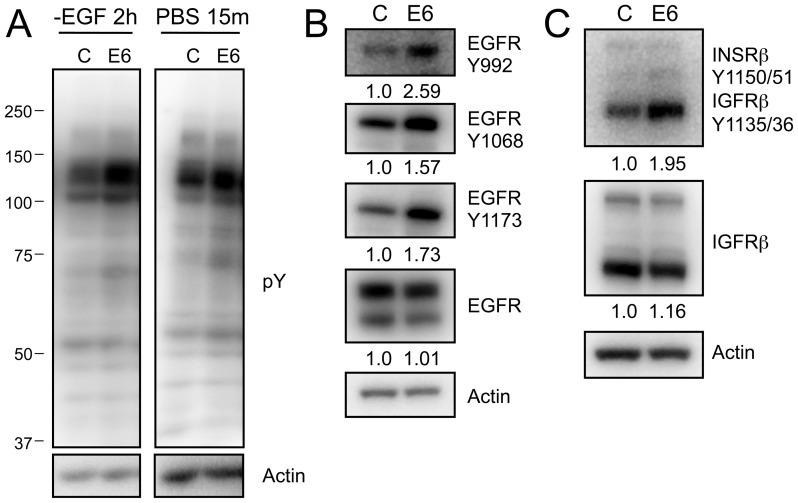
“HPV-16 E6 expression was shown to sustain the activation of receptor protein tyrosine kinases, including epidermal growth factor receptor (EGFR), insulin receptor beta, and insulin-like growth factor receptor beta, mediated via the signalling adaptor protein Growth Factor Receptor-Bound protein 2 (GRB2), which is upstream of the PI3K/AKT pathway [233]”
From The Not-So-Good, the Bad and the Ugly: HPV E5, E6 and E7 Oncoproteins in the Orchestration of Carcinogenesis (2021) · cites this paper as [233]
Self-check
Percentages, sums and reported differences re-computed from the paper’s own numbers.
The self-check needs the paper’s full text.
Citations
Cites
No references could be resolved yet.
Research works printed but not linked: 58
- ME McLaughlin-Drubin, 2009, Oncogenic activities of human papillomaviruses, Virus Res, 143, 195, 10.1016/j.virusres.2009.06.008 · DOI
- M Scheffner, 1993, The HPV-16 E6 and E6-AP complex functions as a ubiquitin-protein ligase in the ubiquitination of p53, Cell, 75, 495, 10.1016/0092-8674(93)90384-3 · DOI · Paper page
- D Gardiol, 1999, Oncogenic human papillomavirus E6 proteins target the discs large tumour suppressor for proteasome-mediated degradation, Oncogene, 18, 5487, 10.1038/sj.onc.1202920 · DOI · Paper page
- BA Glaunsinger, 2000, Interactions of the PDZ-protein MAGI-1 with adenovirus E4-ORF1 and high-risk papillomavirus E6 oncoproteins, Oncogene, 19, 5270, 10.1038/sj.onc.1203906 · DOI · Paper page
- M Jing, 2007, Degradation of tyrosine phosphatase PTPN3 (PTPH1) by association with oncogenic human papillomavirus E6 proteins, J Virol, 81, 2231, 10.1128/JVI.01979-06 · DOI
- T Kiyono, 1997, Binding of high-risk human papillomavirus E6 oncoproteins to the human homologue of the Drosophila discs large tumor suppressor protein, Proc Natl Acad Sci U S A, 94, 11612, 10.1073/pnas.94.21.11612 · DOI · Paper page
- SS Lee, 2000, Multi-PDZ domain protein MUPP1 is a cellular target for both adenovirus E4-ORF1 and high-risk papillomavirus type 18 E6 oncoproteins, J Virol, 74, 9680, 10.1128/JVI.74.20.9680-9693.2000 · DOI
- SS Lee, 1997, Binding of human virus oncoproteins to hDlg/SAP97, a mammalian homolog of the Drosophila discs large tumor suppressor protein, Proc Natl Acad Sci U S A, 94, 6670, 10.1073/pnas.94.13.6670 · DOI · Paper page
- S Nakagawa, 2000, Human scribble (Vartul) is targeted for ubiquitin-mediated degradation by the high-risk papillomavirus E6 proteins and the E6AP ubiquitin-protein ligase, Mol Cell Biol, 20, 8244, 10.1128/MCB.20.21.8244-8253.2000 · DOI · Paper page
- WC Spanos, 2008, The PDZ binding motif of human papillomavirus type 16 E6 induces PTPN13 loss, which allows anchorage-independent growth and synergizes with ras for invasive growth, J Virol, 82, 2493, 10.1128/JVI.02188-07 · DOI
- AJ Klingelhutz, 1996, Telomerase activation by the E6 gene product of human papillomavirus type 16, Nature, 380, 79, 10.1038/380079a0 · DOI · Paper page
- W Zwerschke, 1999, Modulation of type M2 pyruvate kinase activity by the human papillomavirus type 16 E7 oncoprotein, Proc Natl Acad Sci U S A, 96, 1291, 10.1073/pnas.96.4.1291 · DOI · Paper page
- X Zhou, 2009, Expression of the human papillomavirus type 16 E7 oncoprotein induces an autophagy-related process and sensitizes normal human keratinocytes to cell death in response to growth factor deprivation, Virology, 385, 192, 10.1016/j.virol.2008.12.003 · DOI
- A Eichten, 2004, Molecular pathways executing the “trophic sentinel” response in HPV-16 E7-expressing normal human diploid fibroblasts upon growth factor deprivation, Virology, 319, 81, 10.1016/j.virol.2003.11.008 · DOI
- GI Evan, 2001, Proliferation, cell cycle and apoptosis in cancer, Nature, 411, 342, 10.1038/35077213 · DOI · Paper page
- JM Spangle, 2010, The human papillomavirus type 16 E6 oncoprotein activates mTORC1 signaling and increases protein synthesis, J Virol, 84, 9398, 10.1128/JVI.00974-10 · DOI · Paper page
- Z Lu, 2004, Human papillomavirus 16 E6 oncoprotein interferences with insulin signaling pathway by binding to tuberin, J Biol Chem, 279, 35664, 10.1074/jbc.M403385200 · DOI · Paper page
- X Zhou, 2009, Expression of a viral oncoprotein in normal human epithelial cells triggers an autophagy-related process: is autophagy an “Achilles' heel” of human cancers, Autophagy, 5, 578, 10.4161/auto.5.4.8367 · DOI
- H Fernandes, 2001, Glycosylation-induced conformational modification positively regulates receptor-receptor association: a study with an aberrant epidermal growth factor receptor (EGFRvIII/DeltaEGFR) expressed in cancer cells, J Biol Chem, 276, 5375, 10.1074/jbc.M005599200 · DOI
- M Rojas, 1996, Controlling epidermal growth factor (EGF)-stimulated Ras activation in intact cells by a cell-permeable peptide mimicking phosphorylated EGF receptor, J Biol Chem, 271, 27456, 10.1074/jbc.271.44.27456 · DOI
- G Levkowitz, 1999, Ubiquitin ligase activity and tyrosine phosphorylation underlie suppression of growth factor signaling by c-Cbl/Sli-1, Mol Cell, 4, 1029, 10.1016/S1097-2765(00)80231-2 · DOI
- C Hernandez-Sanchez, 1995, The role of the tyrosine kinase domain of the insulin-like growth factor-I receptor in intracellular signaling, cellular proliferation, and tumorigenesis, J Biol Chem, 270, 29176, 10.1074/jbc.270.49.29176 · DOI
- MF White, 1988, A cascade of tyrosine autophosphorylation in the beta-subunit activates the phosphotransferase of the insulin receptor, J Biol Chem, 263, 2969, 10.1016/S0021-9258(18)69163-X · DOI
- S Sigismund, 2008, Clathrin-mediated internalization is essential for sustained EGFR signaling but dispensable for degradation, Dev Cell, 15, 209, 10.1016/j.devcel.2008.06.012 · DOI
- Q Wang, 2005, Control of epidermal growth factor receptor endocytosis by receptor dimerization, rather than receptor kinase activation, EMBO Rep, 6, 942, 10.1038/sj.embor.7400491 · DOI
- SJ McCormack, 1997, Activation of the focal adhesion kinase signal transduction pathway in cervical carcinoma cell lines and human genital epithelial cells immortalized with human papillomavirus type 18, Oncogene, 15, 265, 10.1038/sj.onc.1201186 · DOI
- SB Vande Pol, 1998, Association of Bovine Papillomavirus Type 1 E6 oncoprotein with the focal adhesion protein paxillin through a conserved protein interaction motif, Oncogene, 16, 43, 10.1038/sj.onc.1201504 · DOI
- CP Petersen, 2006, Short RNAs repress translation after initiation in mammalian cells, Mol Cell, 21, 533, 10.1016/j.molcel.2006.01.031 · DOI
- CF Yu, 2002, ERK negatively regulates the epidermal growth factor-mediated interaction of Gab1 and the phosphatidylinositol 3-kinase, J Biol Chem, 277, 19382, 10.1074/jbc.M200732200 · DOI
- Z Wang, 1996, Requirement for the adapter protein GRB2 in EGF receptor endocytosis, Science, 272, 1935, 10.1126/science.272.5270.1935 · DOI
- Y Romeo, 2012, Regulation and function of the RSK family of protein kinases, Biochem J, 441, 553, 10.1042/BJ20110289 · DOI
- H Zhou, 2010, mTOR signaling in cancer cell motility and tumor metastasis, Crit Rev Eukaryot Gene Expr, 20, 1, 10.1615/CritRevEukarGeneExpr.v20.i1.10 · DOI
- X Wang, 2007, NEDD4-1 is a proto-oncogenic ubiquitin ligase for PTEN, Cell, 128, 129, 10.1016/j.cell.2006.11.039 · DOI
- GP Lobo, 2008, ATP modulates PTEN subcellular localization in multiple cancer cell lines, Hum Mol Genet, 17, 2877, 10.1093/hmg/ddn185 · DOI
- A Contreras-Paredes, 2009, E6 variants of human papillomavirus 18 differentially modulate the protein kinase B/phosphatidylinositol 3-kinase (akt/PI3K) signaling pathway, Virology, 383, 78, 10.1016/j.virol.2008.09.040 · DOI · Paper page
- Y Zhou, 2007, Increased phosphorylation of p70 S6 kinase is associated with HPV16 infection in cervical cancer and esophageal cancer, Br J Cancer, 97, 218, 10.1038/sj.bjc.6603838 · DOI
- R McCloskey, 2010, Human papillomavirus type 16 E6/E7 upregulation of nucleophosmin is important for proliferation and inhibition of differentiation, J Virol, 84, 5131, 10.1128/JVI.01965-09 · DOI
- AC Hoover, 2009, Impaired PTPN13 phosphatase activity in spontaneous or HPV-induced squamous cell carcinomas potentiates oncogene signaling through the MAP kinase pathway, Oncogene, 28, 3960, 10.1038/onc.2009.251 · DOI
- GS Akerman, 2001, Human papillomavirus type 16 E6 and E7 cooperate to increase epidermal growth factor receptor (EGFR) mRNA levels, overcoming mechanisms by which excessive EGFR signaling shortens the life span of normal human keratinocytes, Cancer Res, 61, 3837
- N Sizemore, 1998, Transcriptional regulation of the EGF receptor promoter by HPV16 and retinoic acid in human ectocervical epithelial cells, Exp Cell Res, 244, 349, 10.1006/excr.1998.4179 · DOI
- D Johnston, 1999, Elevation of the epidermal growth factor receptor and dependent signaling in human papillomavirus-infected laryngeal papillomas, Cancer Res, 59, 968
- LK Goh, Multiple mechanisms collectively regulate clathrin-mediated endocytosis of the epidermal growth factor receptor, J Cell Biol, 189, 871
- AG Batzer, 1994, Hierarchy of binding sites for Grb2 and Shc on the epidermal growth factor receptor, Mol Cell Biol, 14, 5192, 10.1128/MCB.14.8.5192 · DOI
- EY Skolnik, 1993, The function of GRB2 in linking the insulin receptor to Ras signaling pathways, Science, 260, 1953, 10.1126/science.8316835 · DOI
- CE Bazenet, 1996, Phosphorylation of tyrosine 720 in the platelet-derived growth factor alpha receptor is required for binding of Grb2 and SHP-2 but not for activation of Ras or cell proliferation, Mol Cell Biol, 16, 6926, 10.1128/MCB.16.12.6926 · DOI
- RL Pratt, 2002, Activation of the EphA2 tyrosine kinase stimulates the MAP/ERK kinase signaling cascade, Oncogene, 21, 7690, 10.1038/sj.onc.1205758 · DOI
- K Talbert-Slagle, 2009, The bovine papillomavirus E5 protein and the PDGF beta receptor: it takes two to tango, Virology, 384, 345, 10.1016/j.virol.2008.09.033 · DOI
- DR Kaplan, 1987, Common elements in growth factor stimulation and oncogenic transformation: 85 kd phosphoprotein and phosphatidylinositol kinase activity, Cell, 50, 1021, 10.1016/0092-8674(87)90168-1 · DOI
- M Whitman, 1985, Association of phosphatidylinositol kinase activity with polyoma middle-T competent for transformation, Nature, 315, 239, 10.1038/315239a0 · DOI
- N Ichaso, 2001, Cell transformation by the middle T-antigen of polyoma virus, Oncogene, 20, 7908, 10.1038/sj.onc.1204859 · DOI
- SA Summers, 1998, Polyoma middle T antigen activates the Ser/Thr kinase Akt in a PI3-kinase-dependent manner, Biochem Biophys Res Commun, 246, 76, 10.1006/bbrc.1998.8575 · DOI
- M Shuda, 2011, Human Merkel cell polyomavirus small T antigen is an oncoprotein targeting the 4E-BP1 translation regulator, J Clin Invest, 9, 3623, 10.1172/JCI46323 · DOI
- CL Halbert, 1992, The E6 and E7 genes of human papillomavirus type 6 have weak immortalizing activity in human epithelial cells, J Virol, 66, 2125, 10.1128/JVI.66.4.2125-2134.1992 · DOI · Paper page
- SJ Baker, 1990, Suppression of human colorectal carcinoma cell growth by wild-type p53, Science, 249, 912, 10.1126/science.2144057 · DOI
- K Munger, 1989, The E6 and E7 genes of the human papillomavirus type 16 together are necessary and sufficient for transformation of primary human keratinocytes, J Virol, 63, 4417, 10.1128/JVI.63.10.4417-4421.1989 · DOI · Paper page
- JM Spangle, 2012, Activation of cap-dependent translation by mucosal human papillomavirus E6 proteins is dependent on the integrity of the LXXLL binding motif, J Virol, 14, 7466, 10.1128/JVI.00487-12 · DOI
- SA Sedman, 1991, The full-length E6 protein of human papillomavirus type 16 has transforming and trans-activating activities and cooperates with E7 to immortalize keratinocytes in culture, J Virol, 65, 4860, 10.1128/JVI.65.9.4860-4866.1991 · DOI
- ME McLaughlin-Drubin, 2008, Human papillomavirus type 16 E7 oncoprotein associates with E2F6, J Virol, 82, 8695, 10.1128/JVI.00579-08 · DOI · Paper page
Cited by
Basukala, O., & Banks, L. (2021) · Viruses · doi:10.3390/v13101892 · Cited by 137
Metadata
- Authors
- Spangle, J. M., & Munger, K.
- Venue
- PLoS Pathogens
- Publisher
- Public Library of Science (PLoS)
- Published
- 2013-03-14
- Volume
- 9
- Issue
- 3
- Pages
- e1003237
- ISSN
- 1553-7374
- PMC
- PMC3597533
- Cited by
- 76
- References
- 0
- Language
- en
About these checks
Registry, retraction, Cites and statistics results are computed, not judged, with one exception: a printed reference that no index lists is read once by a model before it counts as a citation error. Claims are extracted by a model and kept only when their quote appears verbatim in the text; each cited source is then checked, with a model’s help, for whether it says what the claim relies on. Those verdicts can be wrong — read the claim’s quote and the cited source before relying on one.
Statistics and arithmetic are recomputed, not judged.
Confidence bands are shown only for fields calibrated on our annotated test set. None is calibrated yet, so no band is shown.
What counts as a claim ›How we measure confidence ›How we check this ›
Are you an author, or do you see a problem with this page? Request a review
How to cite
Cite CoChat for the checks on this page, and the paper for its own findings.
- This page
- CoChat. (2026). Citation check: The HPV16 E6 Oncoprotein Causes Prolonged Receptor Protein Tyrosine Kinase Signaling and Enhances Internalization of Phosphorylated Receptor Species. https://app.cochat.ai/papers/10.1371/journal.ppat.1003237
- The paper
- Spangle, J. M., & Munger, K. (2013). The HPV16 E6 Oncoprotein Causes Prolonged Receptor Protein Tyrosine Kinase Signaling and Enhances Internalization of Phosphorylated Receptor Species. PLoS Pathogens. https://doi.org/10.1371/journal.ppat.1003237
