

Murine leukemia virus p12 tethers the capsid-containing pre-integration complex to chromatin by binding directly to host nucleosomes in mitosis
Open accessThe DOI matches its Crossref record; 54 of the 54 references it cites were found in a registry or an index.
Abstract
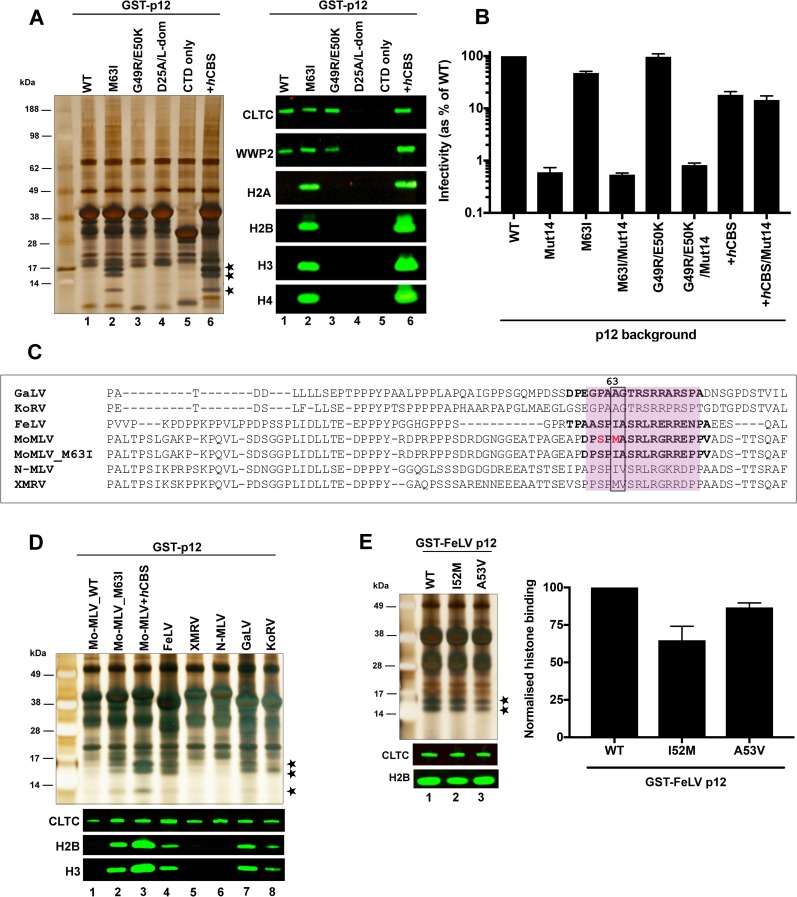
The murine leukaemia virus (MLV) Gag cleavage product, p12, is essential for both early and late steps in viral replication. The N-terminal domain of p12 binds directly to capsid (CA) and stabilises the mature viral core, whereas defects in the C-terminal domain (CTD) of p12 can be rescued by addition of heterologous chromatin binding sequences (CBSs). We and others hypothesised that p12 tethers the pre-integration complex (PIC) to host chromatin ready for integration. Using confocal microscopy, we have observed for the first time that CA localises to mitotic chromatin in infected cells in a p12-dependent manner. GST-tagged p12 alone, however, did not localise to chromatin and mass-spectrometry analysis of its interactions identified only proteins known to bind the p12 region of Gag. Surprisingly, the ability to interact with chromatin was conferred by a single amino acid change, M63I, in the p12 CTD. Interestingly, GST-p12_M63I showed increased phosphorylation in mitosis relative to interphase, which correlated with an increased interaction with mitotic chromatin. Mass-spectrometry analysis of GST-p12_M63I revealed nucleosomal histones as primary interactants. Direct binding of MLV p12_M63I peptides to histones was confirmed by biolayer-interferometry (BLI) assays using highly-avid recombinant poly-nucleosomal arrays. Excitingly, using this method, we also observed binding between MLV p12_WT and nucleosomes. Nucleosome binding was additionally detected with p12 orthologs from feline and gibbon ape leukemia viruses using both pull-down and BLI assays, indicating that this a common feature of gammaretroviral p12 proteins. Importantly, p12 peptides were able to block the binding of the prototypic foamy virus CBS to nucleosomes and vice versa, implying that their docking sites overlap and suggesting a conserved mode of chromatin tethering for different retroviral genera. We propose that p12 is acting in a similar capacity to CPSF6 in HIV-1 infection by facilitating initial chromatin targeting of CA-containing PICs prior to integration.
Overview
The claims and statistics of this paper haven’t been checked yet.
Free: it reads the open-access text and checks the first 5 claims that cite a source we can check. Create a free account to check every claim.
Integrity signals
Registry
Cites
Statistics
Figures




Verification
Claims the paper makes
The claims and statistics of this paper haven’t been checked yet.
Free: it reads the open-access text and checks the first 5 claims that cite a source we can check. Create a free account to check every claim.
Claims other papers make about this one
Each is checked against this paper’s own text: does it say what the citing paper says it does?
The source backs part of the claim, not all of it — or backs it for a different population, condition or comparison.
In the citing paper
“In MLV, the chromatin tethering function is accomplished by p12, a small phosphoprotein that is encoded within the gag gene, which acts in a manner seemingly indistinguishable from the PFV Gag CBS93–95.”
From Structure and function of retroviral integrase (2022) · cites this paper as [95]
Experimental — accuracy not yet measured
Self-check
Percentages, sums and reported differences re-computed from the paper’s own numbers.
The self-check needs the paper’s full text.
Citations
Cites
Sequence and structure-based prediction of eukaryotic protein phosphorylation sites
Blom, N., Gammeltoft, S., & Brunak, S. (1999) · Journal of Molecular Biology · doi:10.1006/jmbi.1999.3310 · Cited by 3,188
InterPro in 2017—beyond protein family and domain annotations
Finn, R. D., Attwood, T. K., Babbitt, P. C., Bateman, A., Bork, P., Bridge, A. J., Chang, H.-Y., Dosztányi, Z., El-Gebali, S., Fraser, M., et al. (2017) · Nucleic Acids Research · doi:10.1093/nar/gkw1107 · Cited by 1,482
The specificities of protein kinase inhibitors: an update
BAIN, J., McLAUCHLAN, H., ELLIOTT, M., & COHEN, P. (2003) · Biochemical Journal · doi:10.1042/bj20021535 · Cited by 1,369
Universal and Confident Phosphorylation Site Localization Using phosphoRS
Taus, T., Köcher, T., Pichler, P., Paschke, C., Schmidt, A., Henrich, C., & Mechtler, K. (2011) · Journal of Proteome Research · doi:10.1021/pr200611n · Cited by 870
Effect of mutations affecting the p6 gag protein on human immunodeficiency virus particle release
Göttlinger, H. G., Dorfman, T., Sodroski, J. G., & Haseltine, W. A. (1991) · Proceedings of the National Academy of Sciences · doi:10.1073/pnas.88.8.3195 · Cited by 647
Cytidine Deamination of Retroviral DNA by Diverse APOBEC Proteins
Bishop, K. N., Holmes, R. K., Sheehy, A. M., Davidson, N. O., Cho, S.-J., & Malim, M. H. (2004) · Current Biology · doi:10.1016/j.cub.2004.06.057 · Cited by 619
Self-citationThe Nucleosomal Surface as a Docking Station for Kaposi's Sarcoma Herpesvirus LANA
Barbera, A. J., Chodaparambil, J. V., Kelley-Clarke, B., Joukov, V., Walter, J. C., Luger, K., & Kaye, K. M. (2006) · Science · doi:10.1126/science.1120541 · Cited by 503
Quantitative proteomics combined with BAC TransgeneOmics reveals in vivo protein interactions
Hubner, N. C., Bird, A. W., Cox, J., Splettstoesser, B., Bandilla, P., Poser, I., Hyman, A., & Mann, M. (2010) · Journal of Cell Biology · doi:10.1083/jcb.200911091 · Cited by 440
Freed, E. O. (2002) · Journal of Virology · doi:10.1128/jvi.76.10.4679-4687.2002 · Cited by 425
Retroviral entry mediated by receptor priming and low pH triggering of an envelope glycoprotein
Mothes, W., Boerger, A. L., Narayan, S., Cunningham, J. M., & Young, J. A. T. (2000) · Cell · doi:10.1016/s0092-8674(00)00170-7 · Cited by 288
Cited by
Structure and function of retroviral integrase
Maertens, G. N., Engelman, A. N., & Cherepanov, P. (2022) · Nature Reviews Microbiology · doi:10.1038/s41579-021-00586-9 · Cited by 124
HIV-1 requires capsid remodelling at the nuclear pore for nuclear entry and integration
Guedán, A., Donaldson, C. D., Caroe, E. R., Cosnefroy, O., Taylor, I. A., & Bishop, K. N. (2021) · PLoS Pathogens · doi:10.1371/journal.ppat.1009484 · Cited by 51
Self-citationA point mutation in HIV-1 integrase redirects proviral integration into centromeric repeats
Winans, S., Yu, H. J., Santos, K. D. L., Wang, G. Z., KewalRamani, V. N., & Goff, S. P. (2022) · Nature Communications · doi:10.1038/s41467-022-29097-8 · Cited by 21
Structural Basis of Nucleosome Recognition and Modulation
Sundaram, R., & Vasudevan, D. (2020) · BioEssays · doi:10.1002/bies.201900234 · Cited by 20
Silencing of Unintegrated Retroviral DNAs
Goff, S. P. (2021) · Viruses · doi:10.3390/v13112248 · Cited by 19
Metadata
- Authors
- Wanaguru, M., Barry, D. J., Benton, D. J., O’Reilly, N. J., & Bishop, K. N.
- Affiliations
- The Francis Crick Institute (GB)
- Corresponding author
- Bishop, Kate N.
- Venue
- PLOS Pathogens
- Publisher
- Public Library of Science (PLoS)
- Published
- 2018-06-15
- Volume
- 14
- Issue
- 6
- Pages
- e1007117
- ISSN
- 1553-7366 (ISSN-L)
- 1553-7374
- PMC
- PMC6021111
- OpenAlex
- W2807878793
- Cited by
- 27
- References
- 54
- Citations by year
- 2026: 1 · 2025: 2 · 2024: 2 · 2023: 2 · 2022: 6 · 2021: 7 · 2020: 4 · 2019: 2
- FWCI
- 1.70
- Type
- journal article
- Language
- en
- Update notices
- new_version (2018-06-27)
- Open access
- gold
- doi.org
- Licence
- Locations
- PLoS Pathogens (publishedVersion, cc-by)
- Europe PMC (PubMed Central) (publishedVersion, cc-by)
- PubMed Central (publishedVersion, cc-by)
- PubMed (publishedVersion)
- DOAJ (DOAJ: Directory of Open Access Journals) (submittedVersion, cc-by-sa)
- Figshare (submittedVersion, cc-by)
- Funders
- The Francis Crick Institute (FC001042)
- Topics
- Life Sciences › Immunology and Microbiology › Virology › HIV Research and Treatment
- Life Sciences › Immunology and Microbiology › Immunology › T-cell and Retrovirus Studies
- Life Sciences › Biochemistry, Genetics and Molecular Biology › Genetics › Virus-based gene therapy research
- Keywords
- murine leukemia virus, p12, preintegration complex, chromatin tethering, nucleosome binding, mitotic chromatin, capsid protein, histone binding, C-terminal domain, phosphorylation, retroviral integration, CPSF6, HIV-1
- MeSH terms
- Animals, Capsid, Chromatin, Gene Expression Regulation, HeLa Cells, Histones, Humans, Mitosis, Mutation, Nucleosomes, Protein Binding, Virion, Virus Replication, Gene Products, gag, Virus Integration, Virus Assembly, Mice
About these checks
Registry, retraction, Cites and statistics results are computed, not judged, with one exception: a printed reference that no index lists is read once by a model before it counts as a citation error. Claims are extracted by a model and kept only when their quote appears verbatim in the text; each cited source is then checked, with a model’s help, for whether it says what the claim relies on. Those verdicts can be wrong — read the claim’s quote and the cited source before relying on one.
Statistics and arithmetic are recomputed, not judged.
Confidence bands are shown only for fields calibrated on our annotated test set. None is calibrated yet, so no band is shown.
What counts as a claim ›How we measure confidence ›How we check this ›
Are you an author, or do you see a problem with this page? Request a review
Data sources
Bibliographic data: Semantic Scholar, OpenAlex, Crossref.
Contains information from the Semantic Scholar Academic Graph Datasets, made available under the ODC Attribution License (ODC-BY 1.0).
Semantic Scholar’s data is described in: Kinney, R., et al. (2023). The Semantic Scholar Open Data Platform. arXiv:2301.10140.
