

The DOI matches its Crossref record; 10 of the 10 references it cites were found in a registry or an index.
Current Understanding of RANK Signaling in Osteoclast Differentiation and Maturation
Overview
The claims and statistics of this paper haven’t been checked yet.
Run the check — free, no account needed. It reads the open-access text and checks the sources it cites.
Integrity signals
Registry
Cites
Statistics
Figures
Verification
Claims the paper makes
The claims and statistics of this paper haven’t been checked yet.
Run the check — free, no account needed. It reads the open-access text and checks the sources it cites.
Claims other papers make about this one
Each is checked against this paper’s own text: does it say what the citing paper says it does?
In the citing paper
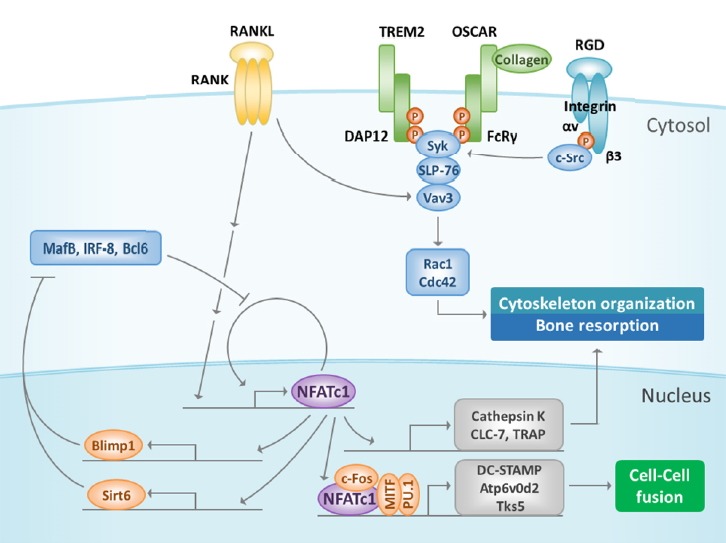
“Concurrently, negative regulators that impede the transcriptional activity of NFATc1, such as interferon regulatory factor-8 (IRF-8) and v-maf musculoaponeurotic fibrosarcoma oncogene family protein B (MafB), are downregulated by the transcriptional repressor B-lymphocyte-induced maturation protein 1 (Blimp1) during the course of osteoclast differentiation [25,26,27].”
From Anti-Osteoporotic Potential of Water Extract of Anethum graveolens L. Seeds (2023) · cites this paper as [27]
Self-check
Percentages, sums and reported differences re-computed from the paper’s own numbers.
The self-check needs the paper’s full text.
Citations
Cites
Osteoclast differentiation and activation
Boyle, W. J., Simonet, W. S., & Lacey, D. L. (2003) · Nature · doi:10.1038/nature01658 · Cited by 6,670 · cited 1×
“Osteoclasts are bone-resorbing multinucleated cells that originate from hematopoietic precursors that are formed in the bone marrow (Asagiri and Takayanagi, 2007; Boyle et al., 2003; Karsenty and Wagner, 2002; Teitelbaum, 2000).”
BackgroundMissing Pieces in the NF-κB Puzzle
Ghosh, S., & Karin, M. (2002) · Cell · doi:10.1016/s0092-8674(02)00703-1 · Cited by 3,638 · cited 2×
“ubiquitination to achieve optimal activation (Duran et al., 2004; Ghosh and Karin, 2002; Mizukami et al., 2002).”
Takayanagi, H., Kim, S., Koga, T., Nishina, H., Isshiki, M., Yoshida, H., Saiura, A., Isobe, M., Yokochi, T., Inoue, J.-I., et al. (2002) · Developmental Cell · doi:10.1016/s1534-5807(02)00369-6 · Cited by 2,701
Transcriptional regulation by calcium, calcineurin, and NFAT
Hogan, P. G., Chen, L., Nardone, J., & Rao, A. (2003) · Genes & Development · doi:10.1101/gad.1102703 · Cited by 1,991
Kong, Y.-Y., Feige, U., Sarosi, I., Bolon, B., Tafuri, A., Morony, S., Capparelli, C., Li, J., Elliott, R., McCabe, S., et al. (1999) · Nature · doi:10.1038/46303 · Cited by 1,856 · cited 1×
“Mice with genetic deletions of Tnfsf11 or Tnfrsf11a exhibit severe osteopetrosis accompanied by defective tooth eruption owing to the complete death of their osteoclasts (Dougall et al., 1999; Kong et al., 1999; Li et al., 2000).”
BackgroundLi, J., Sarosi, I., Yan, X.-Q., Morony, S., Capparelli, C., Tan, H.-L., McCabe, S., Elliott, R., Scully, S., Van, G., et al. (2000) · Proceedings of the National Academy of Sciences · doi:10.1073/pnas.97.4.1566 · Cited by 1,119
Skeletal remodeling in health and disease
Zaidi, M. (2007) · Nature Medicine · doi:10.1038/nm1593 · Cited by 1,069
Autoamplification of NFATc1 expression determines its essential role in bone homeostasis
Asagiri, M., Sato, K., Usami, T., Ochi, S., Nishina, H., Yoshida, H., Morita, I., Wagner, E. F., Mak, T. W., Serfling, E., et al. (2005) · The Journal of Experimental Medicine · doi:10.1084/jem.20051150 · Cited by 849
Matsumoto, M., Kogawa, M., Wada, S., Takayanagi, H., Tsujimoto, M., Katayama, S., Hisatake, K., & Nogi, Y. (2004) · Journal of Biological Chemistry · doi:10.1074/jbc.m408795200 · Cited by 436
PLCγ2 regulates osteoclastogenesis via its interaction with ITAM proteins and GAB2
Mao, D., Epple, H., Uthgenannt, B., Novack, D. V., & Faccio, R. (2006) · Journal of Clinical Investigation · doi:10.1172/jci28775 · Cited by 214
Research works printed but not linked: 60
- Aliprantis, 2008, NFATc1 in mice represses osteoprotegerin during osteoclastogenesis and dissociates systemic osteopenia from inflammation in cherubism, J Clin Invest, 118, 3775, 10.1172/JCI35711 · DOI
- Asagiri, 2007, The molecular understanding of osteoclast differentiation, Bone, 40, 251, 10.1016/j.bone.2006.09.023 · DOI · Paper page
- Cella, 2003, Impaired differentiation of osteoclasts in TREM-2-deficient individuals, J Exp Med, 198, 645, 10.1084/jem.20022220 · DOI
- Chambers, 2011, How are osteoclasts induced to resorb bone? Ann, N Y Acad Sci, 1240, 1, 10.1111/j.1749-6632.2011.06249.x · DOI
- Cheng, 2003, The TNF receptor superfamily: role in immune inflammation and bone formation, Immunol Res, 27, 287, 10.1385/IR:27:2-3:287 · DOI
- Choi, 2013, Early estrogen-induced gene 1, a novel RANK signaling component, is essential for osteoclastogenesis, Cell Res, 23, 524, 10.1038/cr.2013.33 · DOI
- Darnay, 1998, Characterization of the intracellular domain of receptor activator of NF-kappaB (RANK). Interaction with tumor necrosis factor receptor-associated factors and activation of NF-kappab and c-Jun N-terminal kinase, J Biol Chem, 273, 20551, 10.1074/jbc.273.32.20551 · DOI
- David, 2002, JNK1 modulates osteoclastogenesis through both c-Jun phosphorylation-dependent and-independent mechanisms, J Cell Sci, 115, 4317, 10.1242/jcs.00082 · DOI
- Dougall, 1999, RANK is essential for osteoclast and lymph node development, Genes Dev, 13, 2412, 10.1101/gad.13.18.2412 · DOI · Paper page
- Duran, 2004, The atypical PKC-interacting protein p62 is an important mediator of RANK-activated osteoclastogenesis, Dev Cell, 6, 303, 10.1016/S1534-5807(03)00403-9 · DOI · Paper page
- Faccio, 2005, Vav3 regulates osteoclast function and bone mass, Nat Med, 11, 284, 10.1038/nm1194 · DOI
- Franzoso, 1997, Requirement for NF-kappaB in osteoclast and B-cell development, Genes Dev, 11, 3482, 10.1101/gad.11.24.3482 · DOI · Paper page
- Fumoto, 2014, Physiological functions of osteoblast lineage and T cell-derived RANKL in bone homeostasis, J Bone Miner Res, 29, 830, 10.1002/jbmr.2096 · DOI
- Grigoriadis, 1994, c-Fos: a key regulator of osteoclast-macrophage lineage determination and bone remodeling, Science, 266, 443, 10.1126/science.7939685 · DOI
- He, 2011, Erk1 positively regulates osteoclast differentiation and bone resorptive activity, PLoS One, 6, e24780, 10.1371/journal.pone.0024780 · DOI
- Humphrey, 2006, TREM2, a DAP12-associated receptor, regulates osteoclast differentiation and function, J Bone Miner Res, 21, 237, 10.1359/JBMR.051016 · DOI · Paper page
- Ikeda, 2004, Critical roles of c-Jun signaling in regulation of NFAT family and RANKL-regulated osteoclast differentiation, J Clin Invest, 114, 475, 10.1172/JCI200419657 · DOI · Paper page
- Iotsova, 1997, Osteopetrosis in mice lacking NF-kappaB1 and NF-kappaB2, Nat Med, 3, 1285, 10.1038/nm1197-1285 · DOI
- Jang, 2011, Inactivation of glycogen synthase kinase-3beta is required for osteoclast differentiation, J Biol Chem, 286, 39043, 10.1074/jbc.M111.256768 · DOI
- Karsenty, 2002, Reaching a genetic and molecular understanding of skeletal development, Dev Cell, 2, 389, 10.1016/S1534-5807(02)00157-0 · DOI
- Kim, 2002, A novel member of the leukocyte receptor complex regulates osteoclast differentiation, J Exp Med, 195, 201, 10.1084/jem.20011681 · DOI
- Kim, 2007, MafB negatively regulates RANKL-mediated osteoclast differentiation, Blood, 109, 3253, 10.1182/blood-2006-09-048249 · DOI · Paper page
- Kim, 2008, NFATc1 induces osteoclast fusion via up-regulation of Atp6v0d2 and the dendritic cell-specific transmembrane protein (DC-STAMP), Mol Endocrinol, 22, 176, 10.1210/me.2007-0237 · DOI · Paper page
- Kim, 2009, Selective inhibition of RANK blocks osteoclast maturation and function and prevents bone loss in mice, J Clin Invest, 119, 813, 10.1172/JCI36809 · DOI
- Kobayashi, 2001, Segregation of TRAF6-mediated signaling pathways clarifies its role in osteoclastogenesis, EMBO J, 20, 1271, 10.1093/emboj/20.6.1271 · DOI
- Koga, 2004, Costimulatory signals mediated by the ITAM motif cooperate with RANKL for bone homeostasis, Nature, 428, 758, 10.1038/nature02444 · DOI
- Koga, 2005, NFAT and Osterix cooperatively regulate bone formation, Nat Med, 11, 880, 10.1038/nm1270 · DOI
- Lee, 2005, A crucial role for reactive oxygen species in RANKL-induced osteoclast differentiation, Blood, 106, 852, 10.1182/blood-2004-09-3662 · DOI
- Li, 2002, p38 MAPK-mediated signals are required for inducing osteoclast differentiation but not for osteoclast function, Endocrinology, 143, 3105, 10.1210/endo.143.8.8954 · DOI
- Lin, 2015, The scaffold protein RACK1 mediates the RANKL-dependent activation of p38 MAPK in osteoclast precursors, Sci Signal, 8, ra54, 10.1126/scisignal.2005867 · DOI
- Lomaga, 1999, TRAF6 deficiency results in osteopetrosis and defective interleukin-1, CD40, and LPS signaling, Genes Dev, 13, 1015, 10.1101/gad.13.8.1015 · DOI
- Miyauchi, 2010, The Blimp1-Bcl6 axis is critical to regulate osteoclast differentiation and bone homeostasis, J Exp Med, 207, 751, 10.1084/jem.20091957 · DOI
- Mizukami, 2002, Receptor activator of NF-kappaB ligand (RANKL) activates TAK1 mitogen-activated protein kinase kinase kinase through a signaling complex containing RANK, TAB2, and TRAF6, Mol Cell Biol, 22, 992, 10.1128/MCB.22.4.992-1000.2002 · DOI
- Moon, 2012, Akt induces osteoclast differentiation through regulating the GSK3beta/NFATc1 signaling cascade, J Immunol, 188, 163, 10.4049/jimmunol.1101254 · DOI
- Naito, 1999, Severe osteopetrosis, defective interleukin-1 signalling and lymph node organogenesis in TRAF6-deficient mice, Genes Cells, 4, 353, 10.1046/j.1365-2443.1999.00265.x · DOI
- Nakashima, 2011, Evidence for osteocyte regulation of bone homeostasis through RANKL expression, Nat Med, 17, 1231, 10.1038/nm.2452 · DOI · Paper page
- Ninomiya-Tsuji, 1999, The kinase TAK1 can activate the NIK-I kappaB as well as the MAP kinase cascade in the IL-1 signalling pathway, Nature, 398, 252, 10.1038/18465 · DOI
- Nishikawa, 2010, Blimp1-mediated repression of negative regulators is required for osteoclast differentiation, Proc Natl Acad Sci USA, 107, 3117, 10.1073/pnas.0912779107 · DOI
- Oikawa, 2012, Tks5-dependent formation of circumferential podosomes/invadopodia mediates cell-cell fusion, J Cell Biol, 197, 553, 10.1083/jcb.201111116 · DOI
- Park, 2016, Sirt6 cooperates with Blimp1 to positively regulate osteoclast differentiation, Sci Rep, 6, 26186, 10.1038/srep26186 · DOI
- Putney, 2005, Capacitative calcium entry: sensing the calcium stores, J Cell Biol, 169, 381, 10.1083/jcb.200503161 · DOI
- Sheridan, 2002, Protein kinase A negatively modulates the nuclear accumulation of NF-ATc1 by priming for subsequent phosphorylation by glycogen synthase kinase-3, J Biol Chem, 277, 48664, 10.1074/jbc.M207029200 · DOI
- Shin, 2014, PKCbeta positively regulates RANKL-induced osteoclastogenesis by inactivating GSK-3beta, Mol Cells, 37, 747, 10.14348/molcells.2014.0220 · DOI
- Shinohara, 2008, Tyrosine kinases Btk and Tec regulate osteoclast differentiation by linking RANK and ITAM signals, Cell, 132, 794, 10.1016/j.cell.2007.12.037 · DOI
- Taguchi, 2009, A unique domain in RANK is required for Gab2 and PLCgamma2 binding to establish osteoclastogenic signals, Genes Cells, 14, 1331, 10.1111/j.1365-2443.2009.01351.x · DOI
- Teitelbaum, 2000, Bone resorption by osteoclasts, Science, 289, 1504, 10.1126/science.289.5484.1504 · DOI · Paper page
- Teitelbaum, 2003, Genetic regulation of osteoclast development and function, Nat Rev Genet, 4, 638, 10.1038/nrg1122 · DOI
- Vaananen, 1990, Evidence for the presence of a proton pump of the vacuolar H(+)-ATPase type in the ruffled borders of osteoclasts, J Cell Biol, 111, 1305, 10.1083/jcb.111.3.1305 · DOI
- Wada, 2005, The molecular scaffold Gab2 is a crucial component of RANK signaling and osteoclastogenesis, Nat Med, 11, 394, 10.1038/nm1203 · DOI
- Wagner, 2002, Functions of AP1 (Fos/Jun) in bone development, Ann Rheum Dis, 61, ii40, 10.1136/ard.61.suppl_2.ii40 · DOI
- Wang, 1992, Bone and haematopoietic defects in mice lacking c-fos, Nature, 360, 741, 10.1038/360741a0 · DOI
- Wong, 1998, The TRAF family of signal transducers mediates NF-kappaB activation by the TRANCE receptor, J Biol Chem, 273, 28355, 10.1074/jbc.273.43.28355 · DOI
- Wong, 1999, TRANCE, a TNF family member, activates Akt/PKB through a signaling complex involving TRAF6 and c-Src, Mol Cell, 4, 1041, 10.1016/S1097-2765(00)80232-4 · DOI
- Xiong, 2011, Matrix-embedded cells control osteoclast formation, Nat Med, 17, 1235, 10.1038/nm.2448 · DOI · Paper page
- Yagi, 2007, Induction of DC-STAMP by alternative activation and downstream signaling mechanisms, J Bone Miner Res, 22, 992, 10.1359/jbmr.070401 · DOI
- Yamashita, 2007, NF-kappaB p50 and p52 regulate receptor activator of NF-kappaB ligand (RANKL) and tumor necrosis factor-induced osteoclast precursor differentiation by activating c-Fos and NFATc1, J Biol Chem, 282, 18245, 10.1074/jbc.M610701200 · DOI
- Yasuda, 1998, Osteoclast differentiation factor is a ligand for osteoprotegerin/osteoclastogenesis-inhibitory factor and is identical to TRANCE/RANKL, Proc Natl Acad Sci USA, 95, 3597, 10.1073/pnas.95.7.3597 · DOI
- Ye, 2002, Distinct molecular mechanism for initiating TRAF6 signalling, Nature, 418, 443, 10.1038/nature00888 · DOI
- Zhao, 2009, Interferon regulatory factor-8 regulates bone metabolism by suppressing osteoclastogenesis, Nat Med, 15, 1066, 10.1038/nm.2007 · DOI · Paper page
- Zou, 2007, Syk, c-Src, the alphavbeta3 integrin, and ITAM immunoreceptors, in concert, regulate osteoclastic bone resorption, J Cell Biol, 176, 877, 10.1083/jcb.200611083 · DOI
Cited by
SIRT2 regulates extracellular vesicle-mediated liver-bone communication
Lin, L., Guo, Z., He, E., Long, X., Wang, D., Zhang, Y., Guo, W., Wei, Q., He, W., Wu, W., et al. (2023) · Nature Metabolism · doi:10.1038/s42255-023-00803-0 · Cited by 88
Role and Regulation of Transcription Factors in Osteoclastogenesis
Jiang, T., Xia, T., Qiao, F., Wang, N., Jiang, Y., & Xin, H. (2023) · International Journal of Molecular Sciences · doi:10.3390/ijms242216175 · Cited by 60
Heterogeneity and Actin Cytoskeleton in Osteoclast and Macrophage Multinucleation
Takito, J., & Nakamura, M. (2020) · International Journal of Molecular Sciences · doi:10.3390/ijms21186629 · Cited by 50
García-Sánchez, D., González-González, A., Alfonso-Fernández, A., Del Dujo-Gutiérrez, M., & Pérez-Campo, F. M. (2023) · World Journal of Stem Cells · doi:10.4252/wjsc.v15.i5.421 · Cited by 32
SIRT2 deficiency prevents age-related bone loss in rats by inhibiting osteoclastogenesis
Jing, Y., Zhou, Y., Zhou, F., Wang, X., Tao, B., Sun, L., Liu, J., & Zhao, H. (2019) · Cellular and Molecular Biology · doi:10.14715/cmb/2019.65.7.12 · Cited by 22
Matrix-bound nanovesicles alleviate particulate-induced periprosthetic osteolysis
Liao, R., Dewey, M. J., Rong, J., Johnson, S. A., D’Angelo, W. A., Hussey, G. S., & Badylak, S. F. (2024) · Science Advances · doi:10.1126/sciadv.adn1852 · Cited by 20
Chen, Z., Yao, H., Encarnacion, A. M., Jeong, J., Choi, Y., Park, S., Lee, S., & Lee, T. (2024) · Antioxidants · doi:10.3390/antiox13070850 · Cited by 16
Self-citationRusso, R., Zito, F., & Lampiasi, N. (2021) · Biology · doi:10.3390/biology10111080 · Cited by 6
Anti-Osteoporotic Potential of Water Extract of Anethum graveolens L. Seeds
Jang, S.-A., Lee, S.-J., Hwang, Y.-H., & Ha, H. (2023) · Nutrients · doi:10.3390/nu15194302 · Cited by 2
Self-citation
Metadata
- Authors
- Park, J. H., Lee, N. K., & Lee, S. Y.
- Venue
- Molecules and Cells
- Publisher
- Elsevier BV
- Published
- 2017-10
- Volume
- 40
- Issue
- 10
- Pages
- 706-713
- ISSN
- 1016-8478
- PMC
- PMC5682248
- Cited by
- 645
- References
- 10
- Language
- en
About these checks
Registry, retraction, Cites and statistics results are computed, not judged, with one exception: a printed reference that no index lists is read once by a model before it counts as a citation error. Claims are extracted by a model and kept only when their quote appears verbatim in the text; each cited source is then checked, with a model’s help, for whether it says what the claim relies on. Those verdicts can be wrong — read the claim’s quote and the cited source before relying on one.
Statistics and arithmetic are recomputed, not judged.
Confidence bands are shown only for fields calibrated on our annotated test set. None is calibrated yet, so no band is shown.
What counts as a claim ›How we measure confidence ›How we check this ›
Are you an author, or do you see a problem with this page? Request a review
Data sources
Bibliographic data: Semantic Scholar, OpenAlex, Crossref.
Contains information from the Semantic Scholar Academic Graph Datasets, made available under the ODC Attribution License (ODC-BY 1.0).
Semantic Scholar’s data is described in: Kinney, R., et al. (2023). The Semantic Scholar Open Data Platform. arXiv:2301.10140.
