

The DOI matches its Crossref record; 31 of the 31 references it cites were found in a registry or an index.
AI-based Academic Advising Framework: A Knowledge Management Perspective
Open accessAbstract
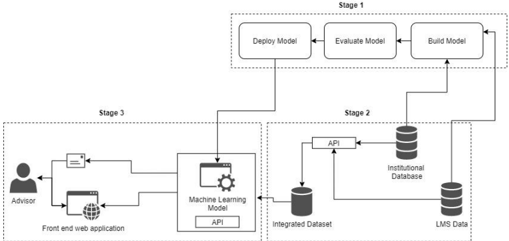
Academic advising has become a critical factor of students’ success as universities offer a variety of programs and courses in their curriculum. It is a student-centered initiative that fosters a student’s involvement with the institution by supporting students in their academic progression and career goals. Managing the knowledge involved in the advising process is crucial to ensure that the knowledge is available to those who need it and that it is used effectively to make good advising decisions that impact student persistence and success. The use of AI-based tools strengthens the advising process by reducing the workload of advisors and providing better decision support tools to improve the advising practice. This study explores the challenges associated with the current advising system from a knowledge management perspective and proposes an integrated AI-based framework to tackle the main advising tasks.
Overview
The claims and statistics of this paper haven’t been checked yet.
Free: it reads the open-access text and checks the first 5 claims that cite a source we can check. Create a free account to check every claim.
Integrity signals
Registry
Cites
Statistics
Figures
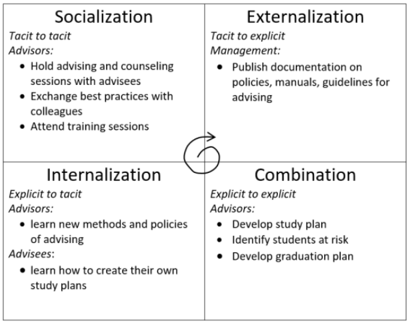
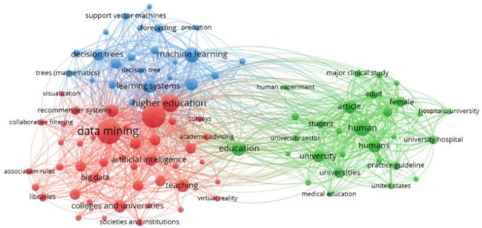
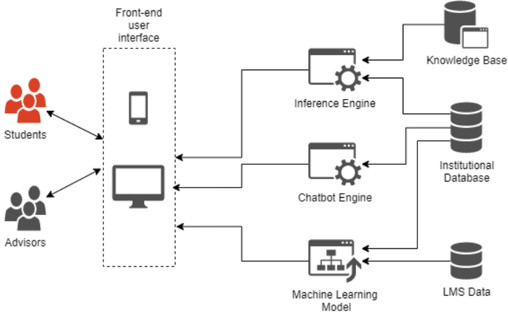
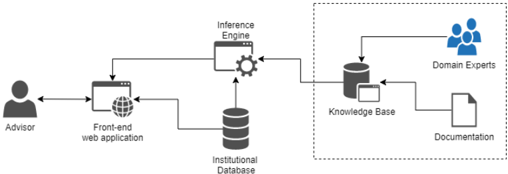
Verification
Claims the paper makes
The claims and statistics of this paper haven’t been checked yet.
Free: it reads the open-access text and checks the first 5 claims that cite a source we can check. Create a free account to check every claim.
Claims other papers make about this one
Each is checked against this paper’s own text: does it say what the citing paper says it does?
The cited source says what the claim attributes to it.
In the citing paper
“AI tools can assist in automating routine advising tasks, identifying at-risk students, recommending courses, and providing timely responses to student inquiries.”
From Integrating Generative Artificial Intelligence Tools and Competencies in Biomedical Engineering Education (2025) · cites this paper as [37]
The cited source says what the claim attributes to it.
In the citing paper
“These functionalities alleviate the workload of human advisors, allowing them to focus on more personalized and complex mentorship [37,38].”
From Integrating Generative Artificial Intelligence Tools and Competencies in Biomedical Engineering Education (2025) · cites this paper as [37]
Self-check
Percentages, sums and reported differences re-computed from the paper’s own numbers.
The self-check needs the paper’s full text.
Citations
Cites
Dropout from Higher Education: A Theoretical Synthesis of Recent Research
Tinto, V. (1975) · Review of Educational Research · doi:10.2307/1170024 · Cited by 7,888
The knowledge-creating company: How Japanese companies create the dynamics of innovation
Nonaka, I., & Takeuchi, H. (1996) · Long Range Planning · doi:10.1016/0024-6301(96)81509-3 · Cited by 5,774
Chatbots applications in education: A systematic review
Okonkwo, C. W., & Ade-Ibijola, A. (2021) · Computers and Education: Artificial Intelligence · doi:10.1016/j.caeai.2021.100033 · Cited by 879
Dropout Prediction in MOOCs: Using Deep Learning for Personalized Intervention
Xing, W., & Du, D. (2019) · Journal of Educational Computing Research · doi:10.1177/0735633118757015 · Cited by 321
The Role of Academic Advising in Student Retention and Persistence
Drake, J. K. (2011) · About Campus: Enriching the Student Learning Experience · doi:10.1002/abc.20062 · Cited by 273 · cited 1×
“Academic advising also offers extra support and guidance to students who need it the most [6], such as the students on probation or at risk of dropping out or failing a course.”
BackgroundAdnan, M., Habib, A., Ashraf, J., Mussadiq, S., Raza, A. A., Abid, M., Bashir, M., & Khan, S. U. (2021) · IEEE Access · doi:10.1109/access.2021.3049446 · Cited by 250
Academic advising: does it really impact student success?
Young‐Jones, A. D., Burt, T. D., Dixon, S., & Hawthorne, M. J. (2013) · Quality Assurance in Education · doi:10.1108/09684881311293034 · Cited by 218
LADA: A learning analytics dashboard for academic advising
Gutiérrez, F., Seipp, K., Ochôa, X., Chiluiza, K., Laet, T. D., & Verbert, K. (2018) · Computers in Human Behavior · doi:10.1016/j.chb.2018.12.004 · Cited by 187
Contrasting prediction methods for early warning systems at undergraduate level
Howard, E., Meehan, M., & Parnell, A. C. (2018) · The Internet and Higher Education · doi:10.1016/j.iheduc.2018.02.001 · Cited by 175
A Holistic View of the Knowledge Life Cycle: The Knowledge Management Cycle (KMC) Model
Evans, M. M., Dalkir, K. L., & Bidian, C. (2014) · Electronic Journal of Knowledge Management · Cited by 158
Research works printed but not linked: 4
- M. Alavi and D. E. Leidner, -Knowledge management and knowledge management systems: Conceptual foundations and research issues,‖ MIS Q., pp. 107-136, 2001.
- N. J. Van Eck and L. Waltman, -VOSviewer manual,‖ Leiden: Univeristeit Leiden, vol. 1, no. 1, pp. 1-53, 2013.
- G. M. S. Alfarsi, K. A. M. Omar, and M. J. Alsinani, -A Rule-Based System for Advising,‖ J. Theor. Appl. Inf. Technol., vol. 95, no. 11, 2017.
- K. E. Arnold and M. D. Pistilli, -Learning Analytics to Increase Student Success,‖ 2nd Int. Conf. Learn. Anal. Knowl., no. May, pp. 267-270, 2012.
Cited by
A Primer on Generative Artificial Intelligence
Kalota, F. (2024) · Education Sciences · doi:10.3390/educsci14020172 · Cited by 177
Investigating student acceptance of an academic advising chatbot in higher education institutions
Bilquise, G., Ibrahim, S., & Salhieh, S. M. (2024) · Education and Information Technologies · doi:10.1007/s10639-023-12076-x · Cited by 169
Self-citationArtificial Intelligence and Knowledge Management: Impacts, Benefits, and Implementation
Taherdoost, H., & Madanchian, M. (2023) · Computers · doi:10.3390/computers12040072 · Cited by 196
Fuchs, K., & Aguilos, V. (2023) · International Journal of Information and Education Technology · doi:10.18178/ijiet.2023.13.9.1939 · Cited by 118
Saihi, A., Ben-Daya, M., Hariga, M., & As'ad, R. (2024) · Computers and Education: Artificial Intelligence · doi:10.1016/j.caeai.2024.100274 · Cited by 75
Metadata
- Authors
- Bilquise, G., & Shaalan, K.
- Affiliations
- Higher Colleges of Technology (AE)
- Venue
- International Journal of Advanced Computer Science and Applications
- Published
- 2022
- Volume
- 13
- Issue
- 8
- ISSN
- 2156-5570 (ISSN-L)
- 2158-107X
- OpenAlex
- W4294685895
- Cited by
- 48
- References
- 31
- Citations by year
- 2026: 9 · 2025: 23 · 2024: 10 · 2023: 6
- FWCI
- 21.04
- Type
- journal article
- Language
- en
- Open access
- diamond
- doi.org
- Licence
- cc-by
- Locations
- International Journal of Advanced Computer Science and Applications (publishedVersion, cc-by)
- International Journal of Advanced Computer Science and Applications (submittedVersion, cc-by)
- Topics
- Social Sciences › Education › Knowledge Management in Higher Education
- Social Sciences › Education › Artificial Intelligence in Education
- Physical Sciences › Computer Science › Artificial Intelligence › Edcuational Technology Systems
- Keywords
- academic advising, artificial intelligence, knowledge management, decision support system, student persistence, student success
About these checks
Registry, retraction, Cites and statistics results are computed, not judged, with one exception: a printed reference that no index lists is read once by a model before it counts as a citation error. Claims are extracted by a model and kept only when their quote appears verbatim in the text; each cited source is then checked, with a model’s help, for whether it says what the claim relies on. Those verdicts can be wrong — read the claim’s quote and the cited source before relying on one.
Statistics and arithmetic are recomputed, not judged.
Confidence bands are shown only for fields calibrated on our annotated test set. None is calibrated yet, so no band is shown.
What counts as a claim ›How we measure confidence ›How we check this ›
Are you an author, or do you see a problem with this page? Request a review
How to cite
Cite CoChat for the checks on this page, and the paper for its own findings.
- This page
- CoChat. (2026). Citation check: AI-based Academic Advising Framework: A Knowledge Management Perspective. https://app.cochat.ai/papers/10.14569/ijacsa.2022.0130823
- The paper
- Bilquise, G., & Shaalan, K. (2022). AI-based Academic Advising Framework: A Knowledge Management Perspective. International Journal of Advanced Computer Science and Applications. https://doi.org/10.14569/ijacsa.2022.0130823
Data sources
Bibliographic data: Semantic Scholar, OpenAlex, Crossref.
Contains information from the Semantic Scholar Academic Graph Datasets, made available under the ODC Attribution License (ODC-BY 1.0).
Semantic Scholar’s data is described in: Kinney, R., et al. (2023). The Semantic Scholar Open Data Platform. arXiv:2301.10140.
