

The DOI matches its Crossref record; 74 of the 74 references it cites were found in a registry or an index.
Modified mRNA as an alternative to plasmid DNA (pDNA) for transcript replacement and vaccination therapy
Open accessAbstract
INTRODUCTION: Current gene therapy involves replacement of defective gene by delivery of healthy genetic material to precede normal function. Virus-mediated gene delivery is the most successful and efficient method for gene therapy, but it has been challenged due to serious safety concerns. Conversely, gene delivery using plasmid DNA (pDNA) is considered safer, but its transfection efficiency is much lower than virus-mediated gene transfer. Recently, mRNA has been suggested as an alternative option to avoid undesired insertion of delivered DNA sequences with higher transfection efficiency and stability. AREA COVERED: In this review, we summarize the currently available strategies of mRNA modification to increase the therapeutic efficacy; we also highlight the recent improvements of mRNA delivery for in vivo applications of gene therapy. EXPERT OPINION: The use of mRNA-based gene transfer could indeed be a promising new strategy for gene therapy. Notable advantages include no risk of integration into the genomic DNA, adjustable gene expression and easier modulation of the immune system. By reducing or utilizing the immunogenic properties, mRNA offers a promising tool for gene/or transcript replacement.
Overview
The claims and statistics of this paper haven’t been checked yet.
Run the check — free, no account needed. It reads the open-access text and checks the sources it cites.
Integrity signals
Registry
Cites
Statistics
Figures
Verification
Claims the paper makes
The claims and statistics of this paper haven’t been checked yet.
Run the check — free, no account needed. It reads the open-access text and checks the sources it cites.
Claims other papers make about this one
Each is checked against this paper’s own text: does it say what the citing paper says it does?
In the citing paper
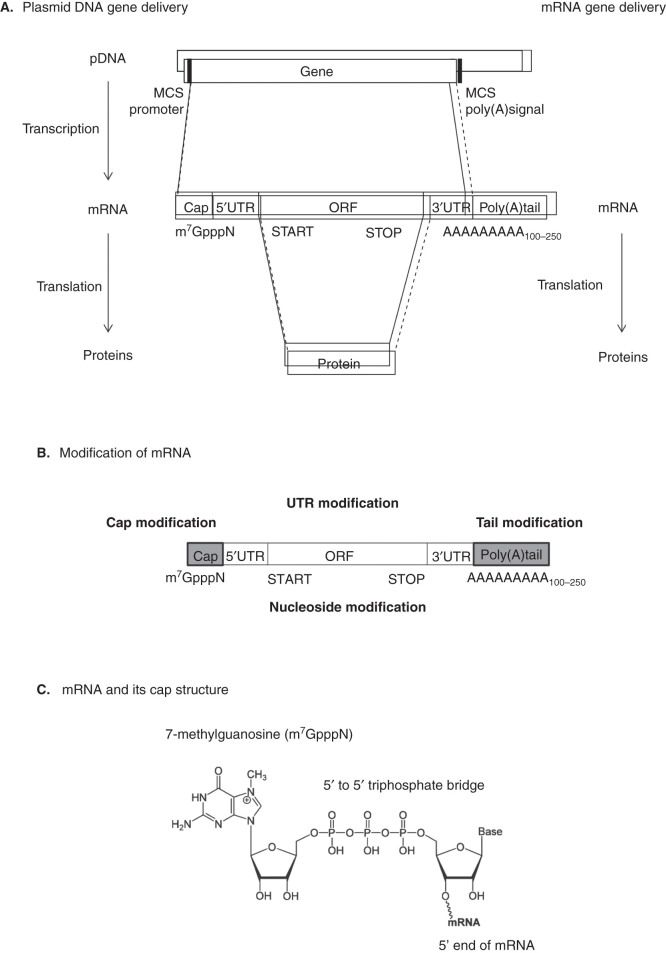
“A non-replicating mRNA contains an open reading frame (ORF) encoding the gene coding for the target antigen flanked by 5′ and 3′ UTR. The 5′ end contains a 7-methylguanosine cap structure (5′-cap, m7G), whereas the 3′ end contains a poly(A) tail structure.”
From Advances in COVID-19 mRNA vaccine development (2022) · cites this paper as [114]
Self-check
Percentages, sums and reported differences re-computed from the paper’s own numbers.
The self-check needs the paper’s full text.
Citations
Cites
Sharp, P. M., & Li, W.-H. (1987) · Nucleic Acids Research · doi:10.1093/nar/15.3.1281 · Cited by 3,992
Innate antiviral responses by means of TLR7-mediated recognition of single-stranded RNA
Diebold, S. S., Kaisho, T., Hemmi, H., Akira, S., & Reis e Sousa, C. (2004) · Science · doi:10.1126/science.1093616 · Cited by 3,444
Karikó, K., Buckstein, M., Ni, H., & Weissman, D. (2005) · Immunity · doi:10.1016/j.immuni.2005.06.008 · Cited by 2,728
eIF4 Initiation Factors: Effectors of mRNA Recruitment to Ribosomes and Regulators of Translation
Gingras, A., Raught, B., & Sonenberg, N. (1999) · Annual Review of Biochemistry · doi:10.1146/annurev.biochem.68.1.913 · Cited by 2,103
Caput, D., Beutler, B., Hartog, K., Thayer, R. M., Brown-Shimer, S. L., & Cerami, A. (1986) · Proceedings of the National Academy of Sciences · doi:10.1073/pnas.83.6.1670 · Cited by 1,504
P bodies and the control of mRNA translation and degradation
Parker, R., & Sheth, U. (2007) · Molecular Cell · doi:10.1016/j.molcel.2007.02.011 · Cited by 1,335
The highways and byways of mRNA decay
Garneau, N. L., Wilusz, J., & Wilusz, C. J. (2007) · Nature Reviews Molecular Cell Biology · doi:10.1038/nrm2104 · Cited by 1,294
Dendritic cells as therapeutic vaccines against cancer
Banchereau, J., & Palucka, A. K. (2005) · Nature reviews. Immunology · doi:10.1038/nri1592 · Cited by 1,216
Regulating the fate of mRNA: the control of cellular iron metabolism
Klausner, R. D., Rouault, T. A., & Harford, J. B. (1993) · Cell · doi:10.1016/0092-8674(93)90046-s · Cited by 1,210
mRNA is an endogenous ligand for toll-like receptor 3
Karikó, K., Ni, H., Capodici, J., Lamphier, M., & Weissman, D. (2004) · Journal of Biological Chemistry · doi:10.1074/jbc.m310175200 · Cited by 1,062
Research works printed but not linked: 6
- Stepinski J, 2001, RNA, 7, 1486
- Pasquinelli AE, 1995, RNA, 1, 957
- Grunebach F, 2005, Methods Mol Med, 109, 47
- Koch G, 1973, coli. Curr Top Microbiol Immunol, 62, 89
- Conry RM, 1995, Cancer Res, 55, 1397
- 10.1016/j.jconrel.2012.12.029 · DOI
Cited by
Sorted by citations
Items 101–114 of 114
A Possible Blue Print of Addressing mRNA Vaccine Efficacy
Li, B. (2023) · Highlights in Science Engineering and Technology · doi:10.54097/hset.v36i.6265
Naratippakorn, M. (2021) · Chula Digiverse · doi:10.58837/chula.the.2021.295
RNA therapies and medicines – general overview and pharmacological challenges
Mutafova, I., Handjieva‐Darlenska, T., Georgiev, K., Minchev, V. T., & Belcheva, V. (2023) · Annual for Hospital Pharmacy · doi:10.14748/ahp.v9i1.9240
mRNA-Based Biosimilars as Next-Generation Vaccines
Upadhyay, A., & Rani, V. (2025) · Advances in Science, Technology & Innovation/Advances in science, technology & innovation · doi:10.1007/978-3-031-80973-6_1
Engineering bone tissue with mRNA: from molecular design and delivery to clinical applications
Runzer, C. D. T., van Griensven, M., & Balmayor, E. R. (2025) · Materials Today · doi:10.1016/j.mattod.2025.11.002 · Cited by 1
Rapid expression of therapeutic antibodies in mammalian cells via mRNA transfection
Chavalparit, T., Barry, C. P., Gunter, H., Gillard, M., Mercer, T. R., & Marcellin, E. (2025) · mAbs · doi:10.1080/19420862.2025.2599584 · Cited by 1
Sung, H. W., & Hur, S. C. (2026) · Micromachines · doi:10.3390/mi17030359
Gäde, A. H. F., Schiegnitz, E., Eckert, A. W., Sagheb, K., Al‐Nawas, B., & Kupka, J. R. (2026) · Clinical Oral Investigations · doi:10.1007/s00784-026-06808-9
Sha, P., Maeshima, S., Koide, H., Kanetaka, S., Koge, T., Kurosaki, T., & Asai, T. (2026) · Journal of Pharmaceutical Sciences · doi:10.1016/j.xphs.2026.104292
Messenger RNA-encoded reporters for monitoring cellular stress and bioenergetics
Hwang, K. K.-L., Fang, Q., Nizard, C., Bulteau, A., & Woltjen, K. (2026) · Scientific Reports · doi:10.1038/s41598-026-49851-y
Electrospun PEO/gelatin nanofibers for pDNA and mRNA delivery
Akgün, B., Ayranci, C., & Uludağ, H. (2026) · Biomaterials Science · doi:10.1039/d6bm00687f
mRNA-based therapies: From molecular discovery to clinical revolution
de Oliveira, A. P., Sodré, F. M. C., Louzada-Neto, O., Zylberman, M. C., da Silva, J. R., Ferreira, L. C. D. S., & Menck, C. F. M. (2026) · Genetics and Molecular Biology · doi:10.1590/1678-4685-gmb-2026-0026
Sa‐Ard‐Iam, N., Naratippakorn, M., & Champaiboon, C. (2026) · International Journal of Dentistry · doi:10.1155/ijod/8805818
Metadata
- Authors
- Youn, H., & Chung, J.-K.
- Affiliations
- Seoul National University (KR)
- Corresponding author
- Chung, June-Key
- Venue
- Expert Opinion on Biological Therapy
- Publisher
- Informa UK Limited
- Published
- 2015-06-30
- Volume
- 15
- Issue
- 9
- Pages
- 1337-1348
- ISSN
- 1471-2598 (ISSN-L)
- 1744-7682
- PMC
- PMC4696419
- OpenAlex
- W1667670121
- Cited by
- 114
- References
- 73
- Citations by year
- 2026: 11 · 2025: 11 · 2024: 8 · 2023: 17 · 2022: 12 · 2021: 10 · 2020: 8 · 2019: 14 · 2018: 10 · 2017: 7 · 2016: 6
- FWCI
- 0.74
- Type
- journal article
- Language
- en
- Open access
- hybrid
- doi.org
- Licence
- cc-by-nc-nd
- Locations
- Expert Opinion on Biological Therapy (publishedVersion, cc-by-nc-nd)
- PubMed Central (publishedVersion, cc-by-nc-nd)
- PubMed (publishedVersion)
- Funders
- Deutsches Krebsforschungszentrum
- National Research Foundation (2011-0030001)
- Seoul National University (2011-0030001)
- Ministry of Science, ICT and Future Planning (2011‐0030001)
- Korea Health Industry Development Institute (HI14C1072, HI13C0826)
- National Research Foundation of Korea (2011‐0030001, HI14C1072)
- Seoul National University Hospital
- Topics
- Life Sciences › Biochemistry, Genetics and Molecular Biology › Molecular Biology › RNA Interference and Gene Delivery
- Life Sciences › Biochemistry, Genetics and Molecular Biology › Genetics › Virus-based gene therapy research
- Life Sciences › Immunology and Microbiology › Immunology › Immunotherapy and Immune Responses
- Keywords
- mRNA modification, plasmid DNA, gene therapy, therapeutic vaccination, mRNA delivery, transfection efficiency, immunogenicity, in vivo gene therapy
- MeSH terms
- Animals, Humans, Nucleosides, Plasmids, RNA Caps, RNA, Messenger, Transfection, Vaccination, Genetic Therapy, Immunotherapy, Active, Untranslated Regions
About these checks
Registry, retraction, Cites and statistics results are computed, not judged, with one exception: a printed reference that no index lists is read once by a model before it counts as a citation error. Claims are extracted by a model and kept only when their quote appears verbatim in the text; each cited source is then checked, with a model’s help, for whether it says what the claim relies on. Those verdicts can be wrong — read the claim’s quote and the cited source before relying on one.
Statistics and arithmetic are recomputed, not judged.
Confidence bands are shown only for fields calibrated on our annotated test set. None is calibrated yet, so no band is shown.
What counts as a claim ›How we measure confidence ›How we check this ›
Are you an author, or do you see a problem with this page? Request a review
