

The DOI matches its Crossref record; 58 of the 58 references it cites were found in a registry or an index.
Updating Beliefs under Perceived Threat
Open accessAbstract
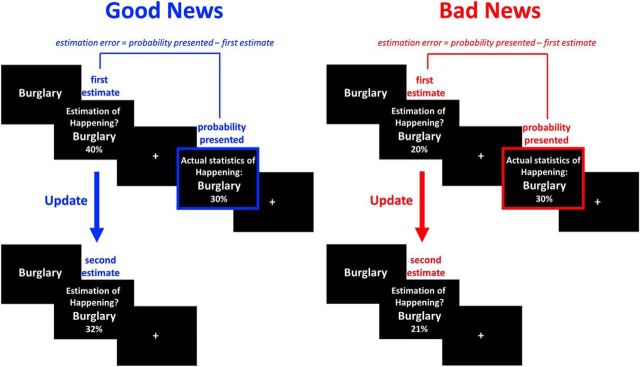
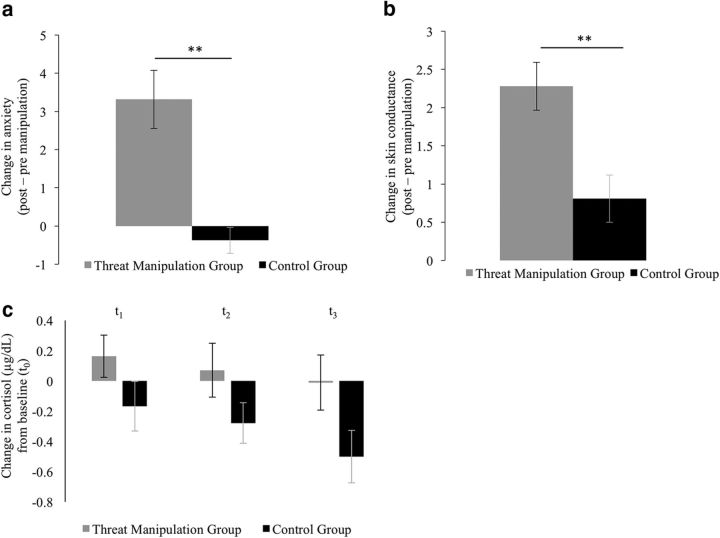
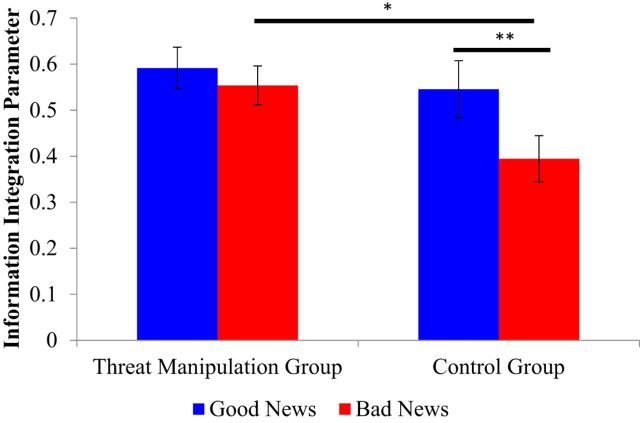
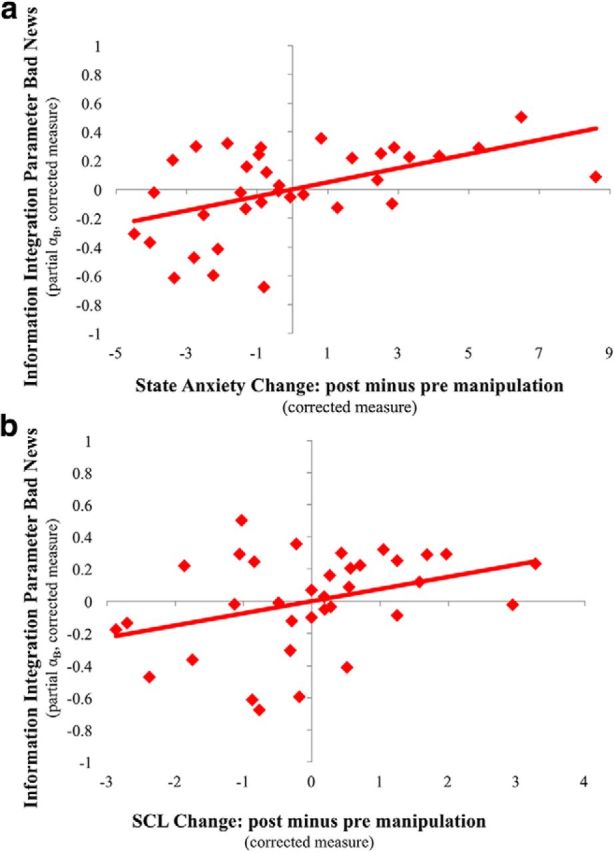
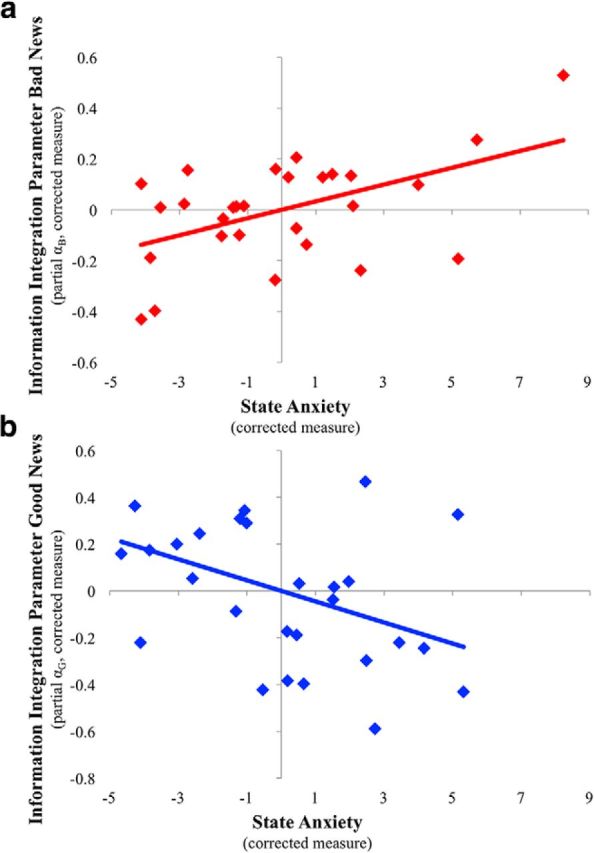
Humans are better at integrating desirable information into their beliefs than undesirable information. This asymmetry poses an evolutionary puzzle, as it can lead to an underestimation of risk and thus failure to take precautionary action. Here, we suggest a mechanism that can speak to this conundrum. In particular, we show that the bias vanishes in response to perceived threat in the environment. We report that an improvement in participants9 tendency to incorporate bad news into their beliefs is associated with physiological arousal in response to threat indexed by galvanic skin response and self-reported anxiety. This pattern of results was observed in a controlled laboratory setting (Experiment I), where perceived threat was manipulated, and in firefighters on duty (Experiment II), where it naturally varied. Such flexibility in how individuals integrate information may enhance the likelihood of responding to warnings with caution in environments rife with threat, while maintaining a positivity bias otherwise, a strategy that can increase well-being. SIGNIFICANCE STATEMENT The human tendency to be overly optimistic has mystified scholars and lay people for decades: How could biased beliefs have been selected over unbiased beliefs? Scholars have suggested that although the optimism bias can lead to negative outcomes, including financial collapse and war, it can also facilitate health and productivity. Here, we demonstrate that a mechanism generating the optimism bias, namely asymmetric information integration, evaporates under threat. Such flexibility could result in enhanced caution in dangerous environments while supporting an optimism bias otherwise, potentially increasing well-being.
Overview
The claims and statistics of this paper haven’t been checked yet.
Run the check — free, no account needed. It reads the open-access text and checks the sources it cites.
Integrity signals
Registry
Cites
Statistics
Figures
Verification
Claims the paper makes
The claims and statistics of this paper haven’t been checked yet.
Run the check — free, no account needed. It reads the open-access text and checks the sources it cites.
Claims other papers make about this one
Each is checked against this paper’s own text: does it say what the citing paper says it does?
The cited source says what the claim attributes to it.
In the citing paper
“This mech anism, also known as optimism bias, disappears when subjects perceive a threatening environment (Garrett et al., 2018).”
From Predictive coding in neuropsychiatric disorders: a systematic transdiagnostic review. (2025) · cites this paper as Garrett et al., 2018
Self-check
Percentages, sums and reported differences re-computed from the paper’s own numbers.
The self-check needs the paper’s full text.
Citations
Cites
Reinforcement Learning: An Introduction
Sutton, R. S., & Barto, A. G. (1998) · IEEE Transactions on Neural Networks · doi:10.1109/tnn.1998.712192 · Cited by 27,225
Reinforcement Learning: An Introduction
Sutton, R. S., & Barto, A. (2005) · IEEE Transactions on Neural Networks · doi:10.1109/tnn.2004.842673 · Cited by 25,268
A neural substrate of prediction and reward
Schultz, W., Dayan, P., & Montague, P. R. (1997) · Science · doi:10.1126/science.275.5306.1593 · Cited by 9,388
Human agency in social cognitive theory.
Bandura, A. (1989) · American Psychologist · doi:10.1037/0003-066x.44.9.1175 · Cited by 8,263
Influence of life stress on depression: moderation by a polymorphism in the 5-HTT gene
Caspi, A., Sugden, K., Moffitt, T. E., Taylor, A., Craig, I. W., Harrington, H., McClay, J., Mill, J., Martin, J., Braithwaite, A., et al. (2003) · Science · doi:10.1126/science.1083968 · Cited by 8,120
Illusion and well‐being: A social psychological perspective on mental health
Taylor, S. E., & Brown, J. D. (1988) · Psychological Bulletin · doi:10.1037/0033-2909.103.2.193 · Cited by 7,814
Marteau, T. M., & Bekker, H. (1992) · British Journal of Clinical Psychology · doi:10.1111/j.2044-8260.1992.tb00997.x · Cited by 3,238
The neurobiology of stress and development.
Gunnar, M., & Quevedo, K. (2007) · Annual Review of Psychology · doi:10.1146/annurev.psych.58.110405.085605 · Cited by 2,011 · cited 2×
“Change in cortisol, which is suggested to reflect the HPA axis component of the stress response (Gunnar and Quevedo, 2007), did not relate to information integration for bad news (F(1,16) 0.”
BackgroundInfluentialBy Carrot or by Stick: Cognitive Reinforcement Learning in Parkinsonism
Frank, M. J., Seeberger, L. C., & O'Reilly, R. C. (2004) · Science · doi:10.1126/science.1102941 · Cited by 1,964
Bechara, A., Tranel, D., Damasio, H., & Damasio, A. R. (1996) · Cerebral Cortex · doi:10.1093/cercor/6.2.215 · Cited by 1,179
Cited by
Sorted by citations
Items 101–110 of 110
‘Not my job!’ Comparative Optimism and Bias Regarding Automation and the Future of WorkPreprint
Vicsek, L., & Hajdu, G. (2026) · SSRN Electronic Journal · doi:10.2139/ssrn.6255659
Maciaszek, J., Aleinikova, J., Dybek, A., & Misiak, B. (2026) · Frontiers in Psychiatry · doi:10.3389/fpsyt.2026.1761027
Schreiber, R., Grichnik, D., Shepherd, D. A., Wincent, J., Tobler, P. N., & Gvozdanovic, G. (2026) · Journal of Business Venturing Insights · doi:10.1016/j.jbvi.2026.e00617
Moral inference under stress: When we doubt our beliefs about good people
Schulreich, S., Siegel, J. Z., Stöffel, T., Crockett, M. J., & Schwabe, L. (2026) · Psychoneuroendocrinology · doi:10.1016/j.psyneuen.2026.107972
Na, K. (2026) · Journal of Health Communication · doi:10.1080/10810730.2026.2716163
Lhardy, S., Guillet‐Descas, E., & Martinent, G. (2026) · Safety Science · doi:10.1016/j.ssci.2026.107399
Hay, D. E., Porat-Butman, S., Chen, S., Joormann, J., Klein, Z., Gilboa‐Schechtman, E., & Levy‐Gigi, E. (2026) · Behaviour Research and Therapy · doi:10.1016/j.brat.2026.105137
Optimistic Update Bias in Response to False Information
Razi, H., Sambrook, T. D., & Garrett, N. (2026) · Computational Brain & Behavior · doi:10.1007/s42113-026-00341-4
Metadata
- Authors
- Garrett, N., González-Garzón, A. M., Foulkes, L., Levita, L., & Sharot, T.
- Affiliations
- Princeton University (US)
- University College London (GB)
- University of Sheffield (GB)
- Corresponding author
- Garrett, Neil
- Sharot, Tali
- Venue
- The Journal of Neuroscience
- Publisher
- Society for Neuroscience
- Published
- 2018-08-06
- Volume
- 38
- Issue
- 36
- Pages
- 7901-7911
- ISSN
- 0270-6474 (ISSN-L)
- 1529-2401
- PMC
- PMC6125815
- OpenAlex
- W2885599406
- Cited by
- 109
- References
- 58
- Citations by year
- 2026: 14 · 2025: 16 · 2024: 13 · 2023: 14 · 2022: 17 · 2021: 12 · 2020: 17 · 2019: 6
- FWCI
- 7.31
- Type
- journal article
- Language
- en
- Open access
- hybrid
- doi.org
- Licence
- cc-by
- Locations
- Journal of Neuroscience (publishedVersion, cc-by)
- SSRN Electronic Journal (publishedVersion)
- Europe PMC (PubMed Central) (publishedVersion, cc-by)
- PubMed Central (publishedVersion, cc-by)
- PubMed (publishedVersion)
- White Rose Research Online (University of Leeds, The University of Sheffield, University of York) (acceptedVersion)
- UEA Digital Repository (University of East Anglia) (submittedVersion)
- UCL Discovery (University College London) (submittedVersion)
- Funders
- Wellcome Trust
- Topics
- Social Sciences › Decision Sciences › General Decision Sciences › Decision-Making and Behavioral Economics
- Life Sciences › Neuroscience › Cognitive Neuroscience › Neural and Behavioral Psychology Studies
- Social Sciences › Psychology › Applied Psychology › Optimism, Hope, and Well-being
- Keywords
- optimism bias, positivity bias, threat perception, risk underestimation, skin conductance, physiological arousal, anxiety, firefighters, belief updating, precautionary behavior
- MeSH terms
- Optimism, Adult, Anxiety, Arousal, Female, Galvanic Skin Response, Humans, Male, Stress, Psychological, Young Adult
About these checks
Registry, retraction, Cites and statistics results are computed, not judged, with one exception: a printed reference that no index lists is read once by a model before it counts as a citation error. Claims are extracted by a model and kept only when their quote appears verbatim in the text; each cited source is then checked, with a model’s help, for whether it says what the claim relies on. Those verdicts can be wrong — read the claim’s quote and the cited source before relying on one.
Statistics and arithmetic are recomputed, not judged.
Confidence bands are shown only for fields calibrated on our annotated test set. None is calibrated yet, so no band is shown.
What counts as a claim ›How we measure confidence ›How we check this ›
Are you an author, or do you see a problem with this page? Request a review
