

The DOI matches its Crossref record; 71 of the 71 references it cites were found in a registry or an index.
Circuitry for Associative Plasticity in the Amygdala Involves Endocannabinoid Signaling
Open accessAbstract
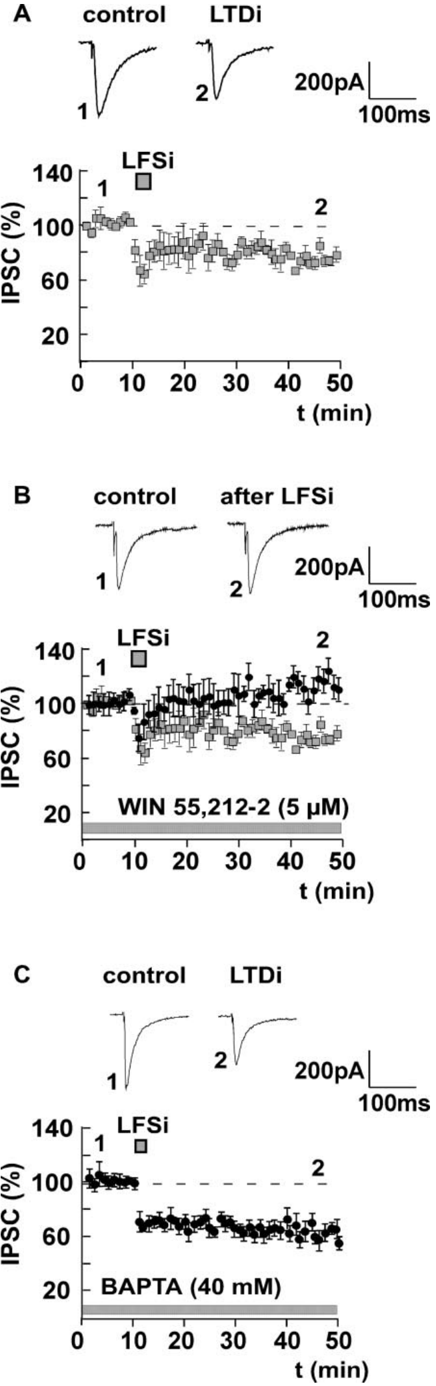
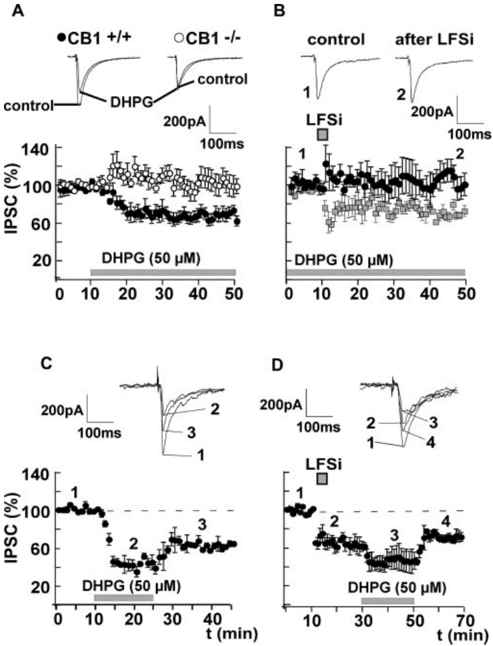
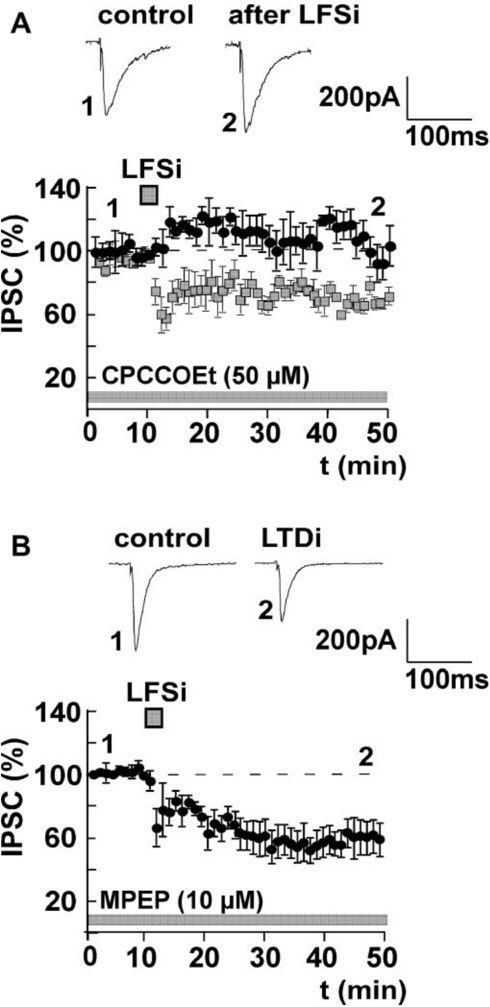
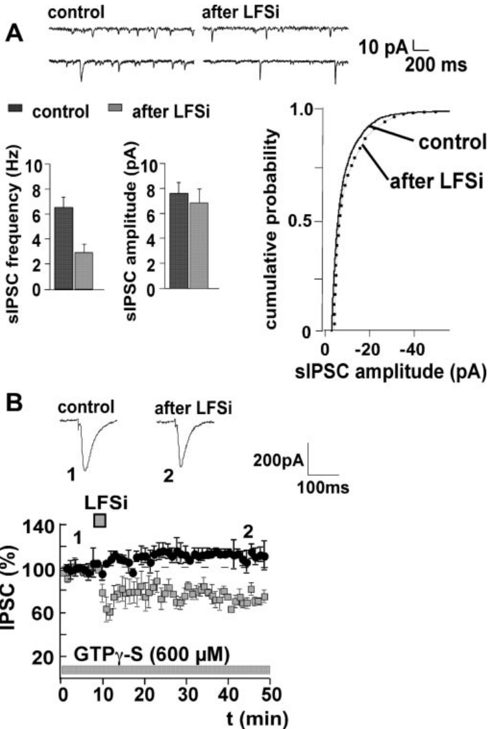
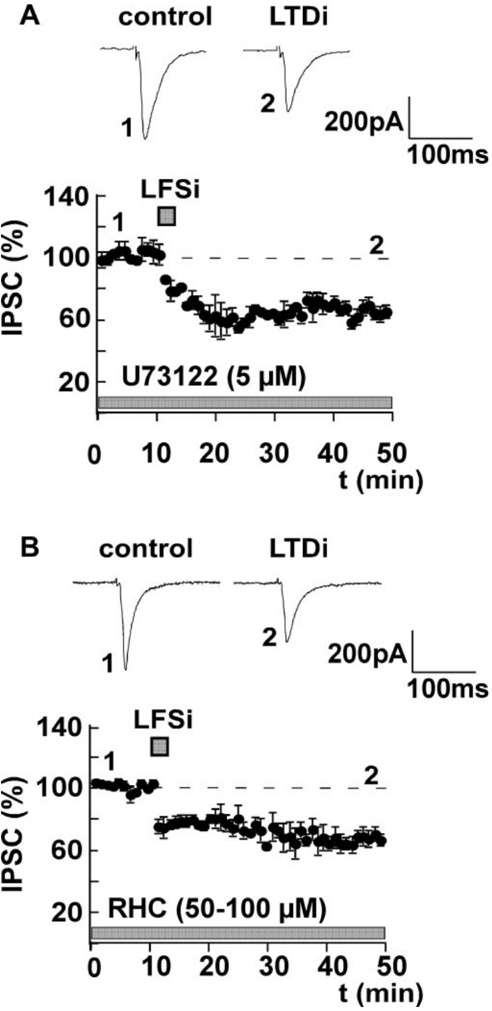
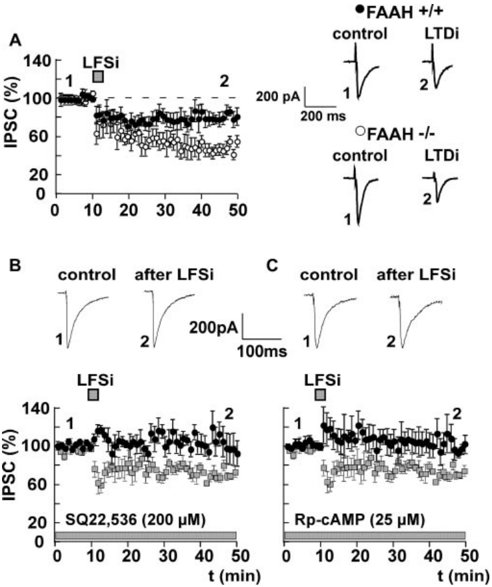
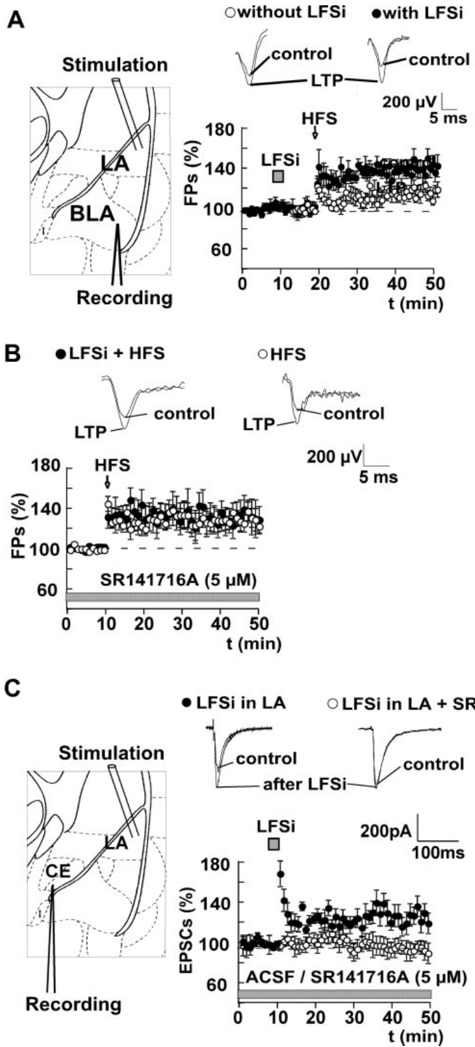
Endocannabinoids are crucial for the extinction of aversive memories, a process that considerably involves the amygdala. Here, we show that low-frequency stimulation of afferents in the lateral amygdala with 100 pulses at 1 Hz releases endocannabinoids postsynaptically from neurons of the basolateral amygdala of mice in vitro and thereby induces a long-term depression of inhibitory GABAergic synaptic transmission (LTDi) via a presynaptic mechanism. Lowering inhibitory synaptic transmission significantly increases the amplitude of excitatory synaptic currents in principal neurons of the central nucleus, which is the main output site of the amygdala. LTDi involves a selective mGluR1 (metabotropic glutamate receptor 1)-mediated calcium-independent mechanism and the activation of the adenylyl cyclase-protein kinase A pathway. LTDi is abolished by the cannabinoid type 1 (CB1) receptor antagonist SR141716A and cannot be evoked in CB1 receptor-deficient animals. LTDi is significantly enhanced in mice lacking the anandamide-degrading enzyme fatty acid amide hydrolase. The present findings show for the first time that mGluR activation induces a retrograde endocannabinoid signaling via activation of the adenylyl cyclase-protein kinase A pathway and the release of anandamide. Furthermore, the results indicate that anandamide decreases the activity of inhibitory interneurons in the amygdala. This disinhibition increases the activity of common output neurons and could provide a prerequisite for extinction by formation of new memory.
Overview
The claims and statistics of this paper haven’t been checked yet.
Run the check — free, no account needed. It reads the open-access text and checks the sources it cites.
Integrity signals
Registry
Cites
Statistics
Figures
Verification
Claims the paper makes
The claims and statistics of this paper haven’t been checked yet.
Run the check — free, no account needed. It reads the open-access text and checks the sources it cites.
Claims other papers make about this one
Each is checked against this paper’s own text: does it say what the citing paper says it does?
In the citing paper
“Additionally, inhibition of FAAH facilitates long-term fear extinction and rescues deficient fear extinction in rodent models by enhancing AEA–CB1 (cannabinoid type 1) receptor signaling and synaptic plasticity in the BLA.”
From Amygdala FAAH and anandamide: mediating protection and recovery from stress (2013) · cites this paper as [51]
In the citing paper
“By contrast, CB1R signaling generated by increased AEA can also produce long-term depression of inhibitory transmission in the BLA, a change in synaptic plasticity which can serve to promote excitability [50,51].”
From Amygdala FAAH and anandamide: mediating protection and recovery from stress (2013) · cites this paper as [51]
In the citing paper
“One notable finding is that a CB1R-dependent form of synaptic plasticity in BLA [51,86], long-term depression of inhibitory GABAergic transmission (LTDi), is enhanced by FAAH KO [51] and by the FAAH inhibitor AM3506 at doses that promote extinction [50].”
From Amygdala FAAH and anandamide: mediating protection and recovery from stress (2013) · cites this paper as [51]
In the citing paper
“This suggests a scheme in which AEA released during extinction relieves a tonic inhibitory brake on BLA output neurons [50,51,86] necessary for the encoding of extinction memories [102] (Figure 2).”
From Amygdala FAAH and anandamide: mediating protection and recovery from stress (2013) · cites this paper as [51]
Self-check
Percentages, sums and reported differences re-computed from the paper’s own numbers.
The self-check needs the paper’s full text.
Citations
Cites
LeDoux, J. E. (2000) · Annual Review of Neuroscience · doi:10.1146/annurev.neuro.23.1.155 · Cited by 8,444
The molecular logic of endocannabinoid signalling
Piomelli, D. (2003) · Nature Reviews Neuroscience · doi:10.1038/nrn1247 · Cited by 1,957
Neurons in medial prefrontal cortex signal memory for fear extinction
Milad, M. R., & Quirk, G. J. (2002) · Nature · doi:10.1038/nature01138 · Cited by 1,836
The endogenous cannabinoid system controls extinction of aversive memories
Marsicano, G., Wotjak, C. T., Azad, S. C., Bisogno, T., Rammes, G., Cascio, M. G., Hermann, H., Tang, J., Hofmann, C., Zieglgänsberger, W., et al. (2002) · Nature · doi:10.1038/nature00839 · Cited by 1,728
Self-citationRole of Endogenous Cannabinoids in Synaptic Signaling
Freund, T. F., Katona, I., & Piomelli, D. (2003) · Physiological Reviews · doi:10.1152/physrev.00004.2003 · Cited by 1,616
Endogenous cannabinoids mediate retrograde signalling at hippocampal synapses
Wilson, R. I., & Nicoll, R. A. (2001) · Nature · doi:10.1038/35069076 · Cited by 1,607
Formation and inactivation of endogenous cannabinoid anandamide in central neurons
Marzo, V. D., Fontana, A., Cadas, H., Schinelli, S., Cimino, G., Schwartz, J.-C., & Piomelli, D. (1994) · Nature · doi:10.1038/372686a0 · Cited by 1,585
A second endogenous cannabinoid that modulates long-term potentiation
Stella, N., Schweitzer, P., & Piomelli, D. (1997) · Nature · doi:10.1038/42015 · Cited by 1,496
Cravatt, B. F., Demarest, K., Patricelli, M. P., Bracey, M. H., Giang, D. K., Martin, B. R., & Lichtman, A. H. (2001) · Proceedings of the National Academy of Sciences · doi:10.1073/pnas.161191698 · Cited by 1,310
Endocannabinoid Signaling in the Brain
Wilson, R. I., & Nicoll, R. A. (2002) · Science · doi:10.1126/science.1063545 · Cited by 1,280
Cited by
Sorted by citations
Endocannabinoid-Mediated Control of Synaptic Transmission
Kano, M., Ohno‐Shosaku, T., Hashimotodani, Y., Uchigashima, M., & Watanabe, M. (2009) · Physiological Reviews · doi:10.1152/physrev.00019.2008 · Cited by 1,595
Myers, K. M., & Davis, M. (2007) · Molecular Psychiatry · doi:10.1038/sj.mp.4001939 · Cited by 1,277
Metaplasticity: tuning synapses and networks for plasticity
Abraham, W. C. (2008) · Nature reviews. Neuroscience · doi:10.1038/nrn2356 · Cited by 1,166
“Similarly, priming-stimulation-induced iLTD facilitates LTP that is induced at least 60–90 minutes late”
BackgroundPape, H.-C., & Pare, D. (2010) · Physiological Reviews · doi:10.1152/physrev.00037.2009 · Cited by 994
“Moreover, pharmacological blockade of CB1 receptors led to a similar deficit in wild-type mice (16), which was ameliorated with administration of a CCK2 receptor antagonist (72).”
Amygdala inhibitory circuits and the control of fear memory
Ehrlich, I., Humeau, Y., Grenier, F., Ciocchi, S., Herry, C., & Lüthi, A. (2009) · Neuron · doi:10.1016/j.neuron.2009.05.026 · Cited by 878
“A candidate mechanism for the acute changes could be a form of inhibitory long-term depression (LTDi) observed in BLA slices, which is CB1 receptor-dependent and mediated by a decrease in presynaptic GABA release (Azad et al., 2004; Marsicano et al., 2002).”
Background
Metadata
- Authors
- Azad, S. C., Monory, K., Marsicano, G., Cravatt, B. F., Lutz, B., Zieglgänsberger, W., & Rammes, G.
- Affiliations
- Max Planck Institute of Psychiatry (DE)
- Scripps Research Institute (US)
- TUM Klinikum (DE)
- Corresponding author
- Azad, Shahnaz C.
- Venue
- The Journal of Neuroscience
- Publisher
- Society for Neuroscience
- Published
- 2004-11-03
- Volume
- 24
- Issue
- 44
- Pages
- 9953-9961
- ISSN
- 0270-6474 (ISSN-L)
- 1529-2401
- PMC
- PMC6730232
- OpenAlex
- W2158593571
- Cited by
- 263
- References
- 71
- Citations by year
- 2026: 1 · 2025: 3 · 2024: 5 · 2023: 5 · 2022: 11 · 2021: 11 · 2020: 11 · 2019: 8 · 2018: 8 · 2017: 9 · 2016: 12 · 2015: 15 · 2014: 17 · 2013: 13 · 2012: 15
- FWCI
- 10.45
- Type
- journal article
- Language
- en
- Open access
- hybrid
- doi.org
- Licence
- Locations
- Journal of Neuroscience (publishedVersion, cc-by-nc-sa)
- PubMed Central (publishedVersion)
- PubMed (publishedVersion)
- Max Planck Institute for Plasma Physics (submittedVersion)
- mediaTUM (Technical University of Munich) (submittedVersion)
- Funders
- Deutsche Forschungsgemeinschaft (SFB 391)
- Topics
- Health Sciences › Medicine › Pharmacology (medical) › Cannabis and Cannabinoid Research
- Life Sciences › Neuroscience › Cognitive Neuroscience › Memory and Neural Mechanisms
- Life Sciences › Neuroscience › Cellular and Molecular Neuroscience › Neuroscience and Neuropharmacology Research
- Keywords
- endocannabinoid signaling, amygdala, associative plasticity, fear extinction, anandamide, CB1 receptor, mGluR1, long-term depression, synaptic inhibition, fatty acid amide hydrolase, basolateral amygdala, central amygdala, inhibitory interneurons, disinhibition, aversive memory
- MeSH terms
- Fatty Acid Amide Hydrolases, Adenylyl Cyclases, Amidohydrolases, Amygdala, Animals, Calcium, gamma-Aminobutyric Acid, Lipoprotein Lipase, Male, Mice, Inbred C57BL, Nerve Tissue Proteins, Neural Inhibition, Neuronal Plasticity, Type C Phospholipases, Synapses, Cyclic AMP-Dependent Protein Kinases, Receptors, Metabotropic Glutamate, Mice, Knockout, GTP-Binding Proteins, Receptor, Cannabinoid, CB1, Mice, Cannabinoid Receptor Modulators, Endocannabinoids, In Vitro Techniques
About these checks
Registry, retraction, Cites and statistics results are computed, not judged, with one exception: a printed reference that no index lists is read once by a model before it counts as a citation error. Claims are extracted by a model and kept only when their quote appears verbatim in the text; each cited source is then checked, with a model’s help, for whether it says what the claim relies on. Those verdicts can be wrong — read the claim’s quote and the cited source before relying on one.
Statistics and arithmetic are recomputed, not judged.
Confidence bands are shown only for fields calibrated on our annotated test set. None is calibrated yet, so no band is shown.
What counts as a claim ›How we measure confidence ›How we check this ›
Are you an author, or do you see a problem with this page? Request a review
