

The DOI matches its Crossref record; 34 of the 34 references it cites were found in a registry or an index.
Aberrant White Matter Microstructure in Children with 16p11.2 Deletions
Open accessAbstract
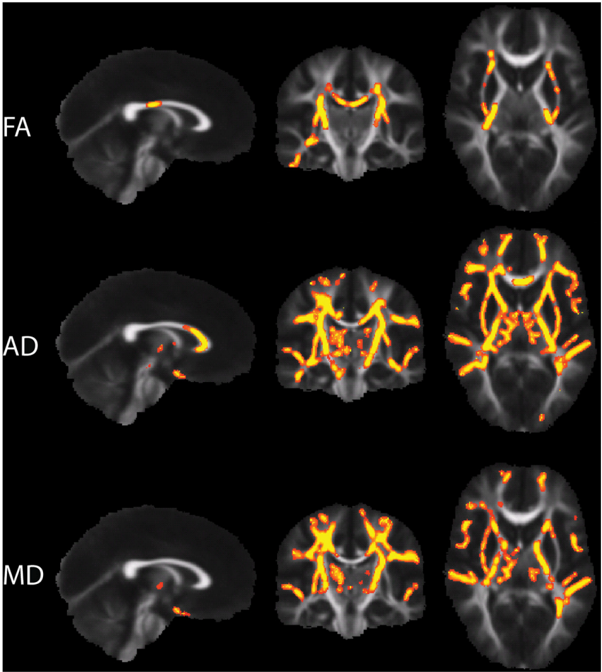
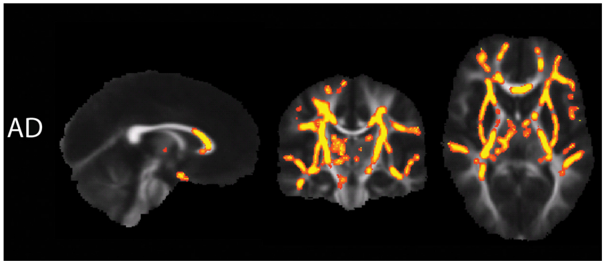
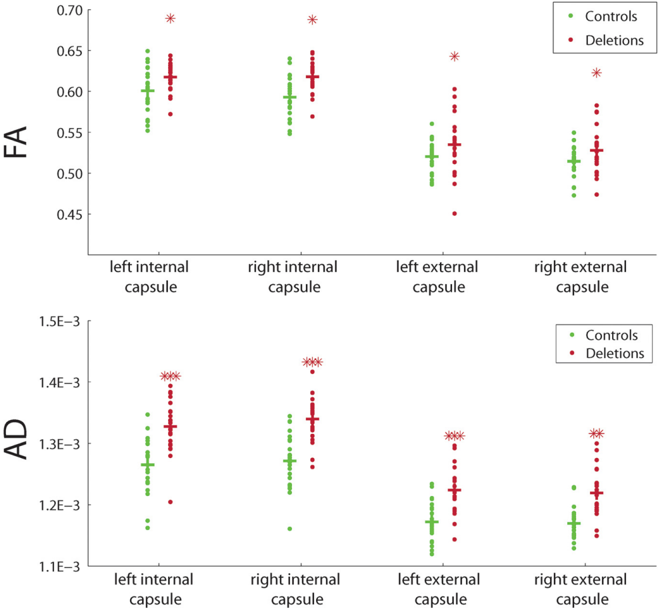
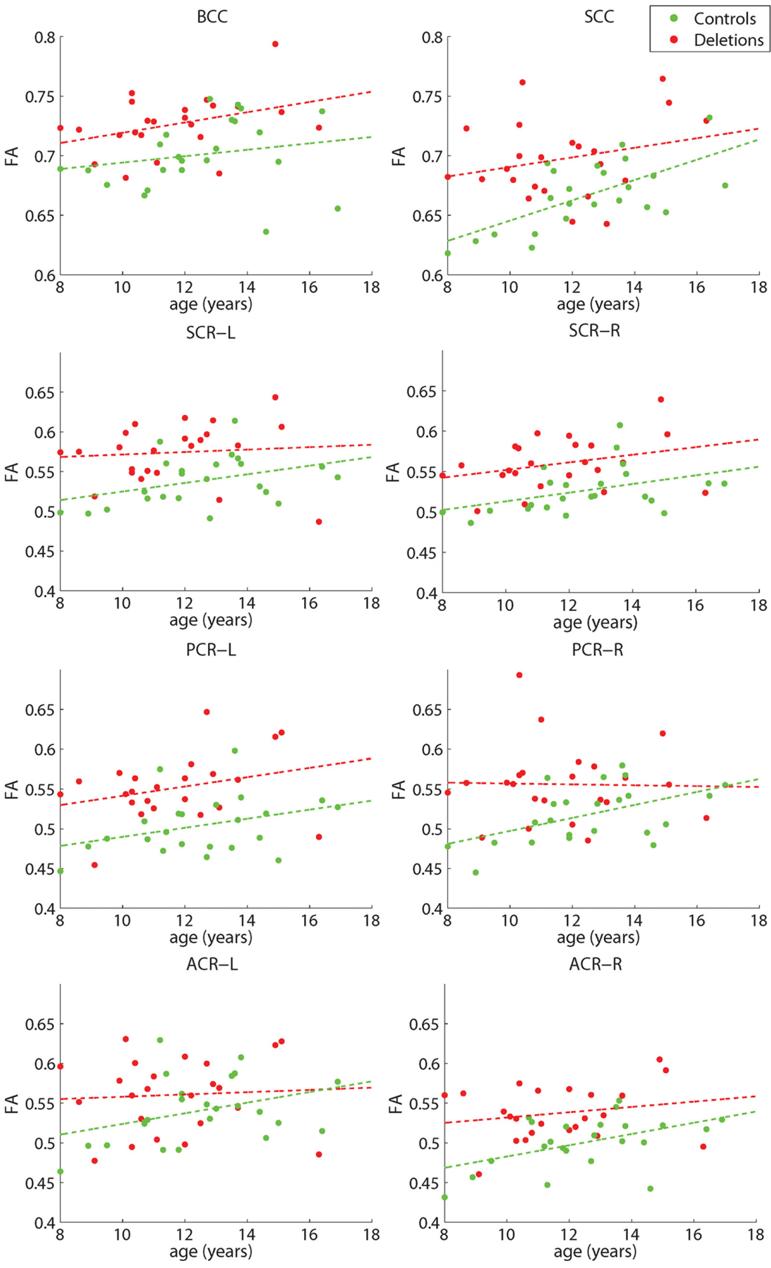
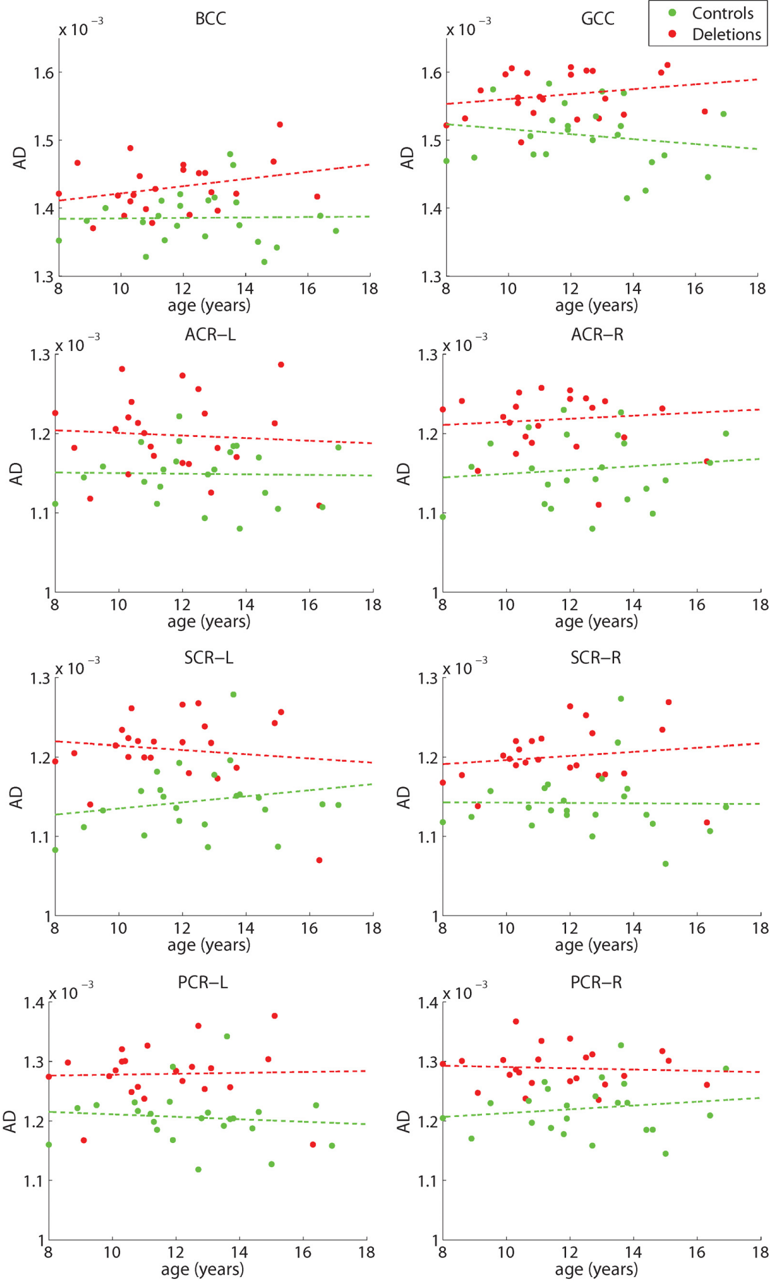
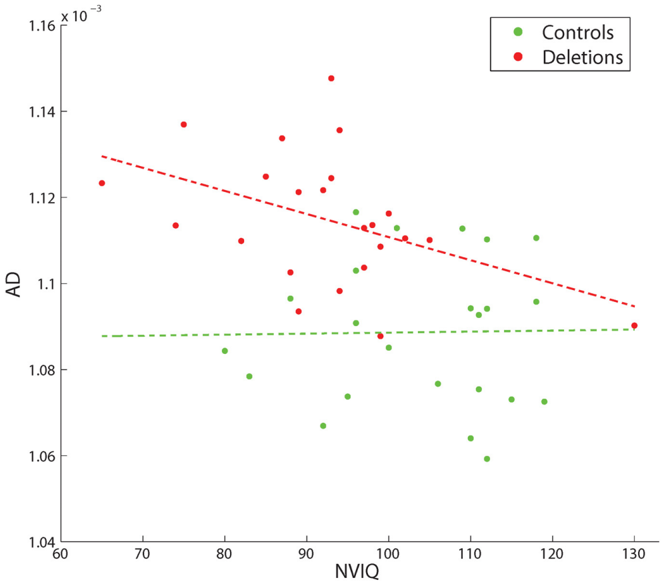
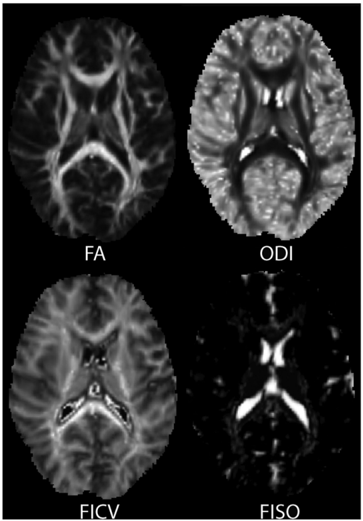
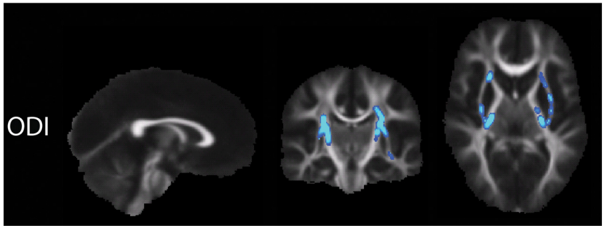
Copy number variants (CNVs) of the chromosomal locus 16p11.2, consisting of either deletions or duplications, have been implicated in autism, schizophrenia, epilepsy, and other neuropsychiatric disorders. Since abnormal white matter microstructure can be seen in these more broadly defined clinical disorders, we used diffusion magnetic resonance imaging and tract-based spatial statistics to investigate white matter microstructural integrity in human children with 16p11.2 deletions. We show that deletion carriers, compared with typically developing matched controls, have increased axial diffusivity (AD) in many major central white matter tracts, including the anterior corpus callosum as well as bilateral internal and external capsules. Higher AD correlated with lower nonverbal IQ in the deletion carriers, but not controls. Increases in fractional anisotropy and mean diffusivity were also found in some of the same tracts with elevated AD. Closer examination with neurite orientation dispersion and density imaging revealed that fiber orientation dispersion was decreased in some central white matter tracts. Notably, these alterations of white matter are unlike microstructural differences reported for any other neurodevelopmental disorders, including autism spectrum disorders that have phenotypic overlap with the deletion carriers. These findings suggest that deletion of the 16p11.2 locus is associated with a unique widespread pattern of aberrant white matter microstructure that may underlie the impaired cognition characteristic of this CNV.
Overview
The claims and statistics of this paper haven’t been checked yet.
Run the check — free, no account needed. It reads the open-access text and checks the sources it cites.
Integrity signals
Registry
Cites
Statistics
Figures
Verification
Claims the paper makes
The claims and statistics of this paper haven’t been checked yet.
Run the check — free, no account needed. It reads the open-access text and checks the sources it cites.
Self-check
Percentages, sums and reported differences re-computed from the paper’s own numbers.
The self-check needs the paper’s full text.
Citations
Cites
Jenkinson, M., Bannister, P., Brady, M., & Smith, S. (2002) · NeuroImage · doi:10.1006/nimg.2002.1132 · Cited by 11,888
Fischl, B. (2012) · NeuroImage · doi:10.1016/j.neuroimage.2012.01.021 · Cited by 9,526
Tract-based spatial statistics: Voxelwise analysis of multi-subject diffusion data
Smith, S. M., Jenkinson, M., Johansen‐Berg, H., Rueckert, D., Nichols, T. E., Mackay, C. E., Watkins, K. E., Ciccarelli, O., Cader, M. Z., Matthews, P. M., et al. (2006) · NeuroImage · doi:10.1016/j.neuroimage.2006.02.024 · Cited by 6,598
SMITH, S., & NICHOLS, T. (2009) · NeuroImage · doi:10.1016/j.neuroimage.2008.03.061 · Cited by 5,250
The basis of anisotropic water diffusion in the nervous system—A technical review.
Beaulieu, C. (2002) · NMR in Biomedicine · doi:10.1002/nbm.782 · Cited by 4,628
Probabilistic diffusion tractography with multiple fibre orientations: What can we gain?
Behrens, T. E. J., Berg, H. J., Jbabdi, S., Rushworth, M. F. S., & Woolrich, M. W. (2007) · NeuroImage · doi:10.1016/j.neuroimage.2006.09.018 · Cited by 3,471
NODDI: Practical in vivo neurite orientation dispersion and density imaging of the human brain
Zhang, H., Schneider, T., Wheeler-Kingshott, C. A., & Alexander, D. C. (2012) · NeuroImage · doi:10.1016/j.neuroimage.2012.03.072 · Cited by 3,288
Stereotaxic white matter atlas based on diffusion tensor imaging in an ICBM template
Mori, S., Oishi, K., Jiang, H., Jiang, L., Li, X., Akhter, K., Hua, K., Faria, A. V., Mahmood, A., Woods, R. P., et al. (2008) · NeuroImage · doi:10.1016/j.neuroimage.2007.12.035 · Cited by 1,832
Association between Microdeletion and Microduplication at 16p11.2 and Autism
Weiss, L. A., Shen, Y., Korn, J. M., Arking, D. E., Miller, D. T., Fossdal, R., Saemundsen, E., Stefansson, H., Ferreira, M. A. R., Green, T., et al. (2008) · New England Journal of Medicine · doi:10.1056/nejmoa075974 · Cited by 1,666
White matter structure in autism: preliminary evidence from diffusion tensor imaging
Barnea‐Goraly, N., Kwon, H., Menon, V., D, S. E. M., Lotspeich, L. J., & Reiss, A. L. (2004) · Biological Psychiatry · doi:10.1016/j.biopsych.2003.10.022 · Cited by 780
Research works printed but not linked: 1
- 10.1016/S1053-8119(02)91132-8 · DOI · Paper page
Cited by
Sorted by citations
Imaging brain microstructure with diffusion MRI: practicality and applications
Alexander, D. C., Dyrby, T. B., Nilsson, M., & Zhang, H. G. (2017) · NMR in Biomedicine · doi:10.1002/nbm.3841 · Cited by 456
Palacios, E. M., Owen, J. P., Yuh, E. L., Wang, M. B., Vassar, M. J., Ferguson, A. R., Diaz-Arrastia, R., Giacino, J. T., Okonkwo, D. O., Robertson, C. S., et al. (2020) · Science Advances · doi:10.1126/sciadv.aaz6892 · Cited by 194
Self-citationOpposing Brain Differences in 16p11.2 Deletion and Duplication Carriers
Qureshi, A. Y., Mueller, S., Snyder, A. Z., Mukherjee, P., Berman, J. I., Roberts, T. P. L., Nagarajan, S. S., Spiro, J. E., Chung, W. K., Sherr, E. H., et al. (2014) · The Journal of Neuroscience · doi:10.1523/jneurosci.1366-14.2014 · Cited by 183
Self-citationBingham–NODDI: Mapping anisotropic orientation dispersion of neurites using diffusion MRI
Tariq, M., Schneider, T., Alexander, D. C., Gandini Wheeler-Kingshott, C. A., & Zhang, H. (2016) · NeuroImage · doi:10.1016/j.neuroimage.2016.01.046 · Cited by 169
Richter, M., Murtaza, N., Scharrenberg, R., White, S. H., Johanns, O., Walker, S., Yuen, R. K. C., Schwanke, B., Bedürftig, B., Henis, M., et al. (2019) · Molecular Psychiatry · doi:10.1038/s41380-018-0025-5 · Cited by 169
Metadata
- Authors
- Owen, J. P., Chang, Y. S., Pojman, N. J., Bukshpun, P., Wakahiro, M. L. J., Marco, E. J., Berman, J. I., Spiro, J. E., Chung, W. K., Buckner, R. L., Roberts, T. P. L., Nagarajan, S. S., Sherr, E. H., & Mukherjee, P.
- Affiliations
- Children's Hospital of Philadelphia (US)
- University of California, San Francisco (US)
- Simons Foundation (US)
- Columbia University Irving Medical Center (US)
- Harvard University (US)
- ORCID
- Venue
- The Journal of Neuroscience
- Publisher
- Society for Neuroscience
- Published
- 2014-04-30
- Volume
- 34
- Issue
- 18
- Pages
- 6214-6223
- ISSN
- 0270-6474 (ISSN-L)
- 1529-2401
- PMC
- PMC6608115
- OpenAlex
- W2049115342
- Cited by
- 113
- References
- 34
- Citations by year
- 2025: 5 · 2024: 6 · 2023: 5 · 2022: 3 · 2021: 5 · 2020: 8 · 2019: 11 · 2018: 41 · 2017: 7 · 2016: 9 · 2015: 9 · 2014: 4
- FWCI
- 7.56
- Type
- journal article
- Language
- en
- Open access
- hybrid
- doi.org
- Licence
- Locations
- Journal of Neuroscience (publishedVersion, cc-by-nc-sa)
- PubMed Central (publishedVersion)
- PubMed (publishedVersion)
- eScholarship (California Digital Library) (submittedVersion, cc-by-nc-sa)
- Funders
- Simons Foundation Autism Research Initiative
- Topics
- Health Sciences › Medicine › Radiology, Nuclear Medicine and Imaging › Advanced Neuroimaging Techniques and Applications
- Life Sciences › Biochemistry, Genetics and Molecular Biology › Genetics › Genomic variations and chromosomal abnormalities
- Life Sciences › Biochemistry, Genetics and Molecular Biology › Genetics › Genetics and Neurodevelopmental Disorders
- Keywords
- 16p11.2 deletion, copy number variation, white matter microstructure, axial diffusivity, fractional anisotropy, corpus callosum, internal capsule, external capsule, nonverbal intelligence, neurodevelopmental disorders, children
- MeSH terms
- Adolescent, Autistic Disorder, Biophysics, Brain, Child, Chromosome Deletion, Chromosomes, Human, Pair 16, Cognition Disorders, Female, Humans, Image Processing, Computer-Assisted, Male, Intellectual Disability, Models, Neurological, Nerve Fibers, Myelinated, Statistics as Topic, Case-Control Studies, Anisotropy, Chromosome Disorders, Diffusion Magnetic Resonance Imaging, Leukoencephalopathies
About these checks
Registry, retraction, Cites and statistics results are computed, not judged, with one exception: a printed reference that no index lists is read once by a model before it counts as a citation error. Claims are extracted by a model and kept only when their quote appears verbatim in the text; each cited source is then checked, with a model’s help, for whether it says what the claim relies on. Those verdicts can be wrong — read the claim’s quote and the cited source before relying on one.
Statistics and arithmetic are recomputed, not judged.
Confidence bands are shown only for fields calibrated on our annotated test set. None is calibrated yet, so no band is shown.
What counts as a claim ›How we measure confidence ›How we check this ›
Are you an author, or do you see a problem with this page? Request a review
