

The DOI matches its Crossref record; 8 of the 8 references it cites were found in a registry or an index; none of the 18 sources its claims cite is checked for support yet.
Delay or avoidance of medical care because of COVID-19–related concerns—United States, June 2020.
Open accessAbstract
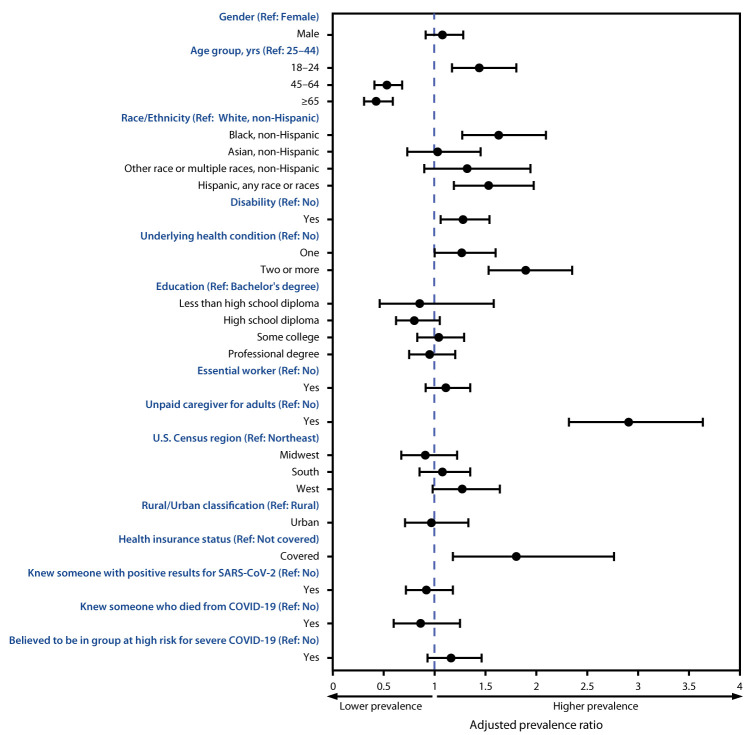
versus those without disabilities (aPR = 1.3). Given this widespread reporting of medical care avoidance because of COVID-19 concerns, especially among persons at increased risk for severe COVID-19, urgent efforts are warranted to ensure delivery of services that, if deferred, could result in patient harm. Even during the COVID-19 pandemic, persons experiencing a medical emergency should seek and be provided care without delay (3).
Overview
AI snapshot
Written from the paper’s full text.
TL;DR
In a nationwide web-based survey conducted June 24–30, 2020, 40.9% of U.S. adults reported delaying or avoiding medical care because of COVID-19 concerns, including 12.0% for urgent or emergency care and 31.5% for routine care. Avoidance was higher among unpaid caregivers for adults, persons with multiple underlying medical conditions, Black and Hispanic adults, young adults, and persons with disabilities.
Key findings
- Overall, 40.9% of 4,975 respondents reported delaying or avoiding any medical care because of COVID-19 concerns; 12.0% avoided urgent or emergency care and 31.5% avoided routine care.
- Adjusted prevalence ratios for urgent or emergency care avoidance were significantly higher among unpaid caregivers for adults versus noncaregivers (aPR = 2.9), persons with two or more selected underlying medical conditions versus none (aPR = 1.9), insured versus uninsured persons (aPR = 1.8), non-Hispanic Black adults (aPR = 1.6) and Hispanic adults (aPR = 1.5) versus non-Hispanic White adults, adults aged 18–24 versus 25–44 years (aPR = 1.5), and persons with disabilities versus without (aPR = 1.3).
- Groups with urgent or emergency care avoidance exceeding 20% and any care avoidance exceeding 50% included adults aged 18–24 years (30.9%; 57.2%), unpaid caregivers for adults (29.8%; 64.3%), Hispanic adults (24.6%; 55.5%), persons with disabilities (22.8%; 60.3%), persons with two or more selected underlying medical conditions (22.7%; 54.7%), and students (22.7%; 50.3%).
- In adjusted models for any care avoidance, unpaid caregiver status (aPR = 1.64), having health insurance (aPR = 1.61), disability (aPR = 1.33), believing oneself to be at high risk for severe COVID-19 (aPR = 1.33), and having two or more underlying conditions (aPR = 1.31) were significantly associated with greater avoidance.
Methods
- A web-based survey was administered by Qualtrics, LLC, during June 24–30, 2020, to a nationwide sample of U.S. adults aged ≥18 years; 5,412 (54.7%) of 9,896 eligible adults completed surveys, and 4,975 (91.9%) provided complete data for this analysis.
- Quota sampling and survey weighting were used to improve representativeness of the U.S. population by gender, age, and race/ethnicity.
- Delay or avoidance was assessed for emergency, urgent, and routine medical care; urgent and emergency responses were combined for analysis. Multivariable Poisson regression models with robust standard errors estimated adjusted prevalence ratios, 95% CIs, and p-values (α = 0.05).
Limitations
- Stated in the paper: self-reported data are subject to recall, response, and social desirability biases; the survey did not assess reasons for avoidance, baseline care-seeking patterns, or timing/duration of avoidance; perceptions of whether a condition was life-threatening might vary; and the web-based survey might not be fully representative for income, educational attainment, and access to technology.
- Evident from the text: the cross-sectional design cannot establish temporality or causality between COVID-19 concerns and care delay/avoidance.
- Evident from the text: urgent and emergency care responses were combined because respondents might interpret “life-threatening” differently, limiting separate estimates for emergency versus urgent care.
Model-written summary. Check it against the paper before relying on it.
Integrity signals
Registry
Cites
Statistics
Figures
Verification
Claims the paper makes
28 Own result · 11 Not checked yet · 11 Own method · 7 Own interpretation · 3 No basis given
A result the paper reports from its own data — it cites no other source for it, so there is none to check. The quote shows it is in the paper.
In the paper
“Overall, an estimated 40.9% of U.S. adults have avoided medical care during the pandemic because of concerns about COVID-19, including 12.0% who avoided urgent or emergency care and 31.5% who avoided routine care.”
- Also stated in: § Delay or Avoidance of Medical Care Because of COVID-19–Related Concerns — United States, June 2020 · plain
“As of June 30, 2020, among 4,975 U.S. adult respondents, 40.9% reported having delayed or avoided any medical care, including urgent or emergency care (12.0%) and routine care (31.5%), because of concerns about COVID-19 (Table 1).”
plain- Asserted: passes — The authors put it forward as true.
- Checkable: passes — It can be checked against evidence.
- Load-bearing: passes — The paper’s conclusions depend on it.
- Based: passes — The paper gives a reason why it holds.
- Rests on an assumption: The weighted survey sample is representative of the U.S. adult population.
- Rests on an assumption: Respondents' self-reported delay or avoidance of medical care accurately reflects their actual medical care behavior.
- Rests on an assumption: Respondents correctly attribute their delay or avoidance to COVID-19 concerns.
- Also stated in: § Delay or Avoidance of Medical Care Because of COVID-19–Related Concerns — United States, June 2020 · plain
A result the paper reports from its own data — it cites no other source for it, so there is none to check. The quote shows it is in the paper.
In the paper
“unpaid caregivers for adults* versus noncaregivers (adjusted prevalence ratio [aPR] = 2.9)”
- Also stated in: § Delay or Avoidance of Medical Care Because of COVID-19–Related Concerns — United States, June 2020 · plain
“unpaid caregivers for adults versus noncaregivers (2.9; 2.3–3.6)”
plaincorrelational- Asserted: passes — The authors put it forward as true.
- Checkable: passes — It can be checked against evidence.
- Load-bearing: passes — The paper’s conclusions depend on it.
- Based: passes — The paper gives a reason why it holds.
- Also stated in: § Delay or Avoidance of Medical Care Because of COVID-19–Related Concerns — United States, June 2020 · plain
A result the paper reports from its own data — it cites no other source for it, so there is none to check. The quote shows it is in the paper.
In the paper
“non-Hispanic Black (Black) adults (aPR = 1.6)”
- Also stated in: § Delay or Avoidance of Medical Care Because of COVID-19–Related Concerns — United States, June 2020 · plain
“Black adults (1.6; 1.3–2.1)”
plaincorrelational- Asserted: passes — The authors put it forward as true.
- Checkable: passes — It can be checked against evidence.
- Load-bearing: passes — The paper’s conclusions depend on it.
- Based: passes — The paper gives a reason why it holds.
- Also stated in: § Delay or Avoidance of Medical Care Because of COVID-19–Related Concerns — United States, June 2020 · plain
A result the paper reports from its own data — it cites no other source for it, so there is none to check. The quote shows it is in the paper.
In the paper
“persons with health insurance versus those without health insurance (aPR = 1.8)”
- Also stated in: § Delay or Avoidance of Medical Care Because of COVID-19–Related Concerns — United States, June 2020 · plain
“persons with health insurance versus those without health insurance (1.8; 1.2–2.8)”
plaincorrelational- Asserted: passes — The authors put it forward as true.
- Checkable: passes — It can be checked against evidence.
- Load-bearing: passes — The paper’s conclusions depend on it.
- Based: passes — The paper gives a reason why it holds.
- Also stated in: § Delay or Avoidance of Medical Care Because of COVID-19–Related Concerns — United States, June 2020 · plain
A result the paper reports from its own data — it cites no other source for it, so there is none to check. The quote shows it is in the paper.
In the paper
“Overall, an estimated 40.9% of U.S. adults have avoided medical care during the pandemic because of concerns about COVID-19, including 12.0% who avoided urgent or emergency care and 31.5% who avoided routine care.”
- Also stated in: § Delay or Avoidance of Medical Care Because of COVID-19–Related Concerns — United States, June 2020 · plain
“As of June 30, 2020, among 4,975 U.S. adult respondents, 40.9% reported having delayed or avoided any medical care, including urgent or emergency care (12.0%) and routine care (31.5%), because of concerns about COVID-19 (Table 1).”
plain- Asserted: passes — The authors put it forward as true.
- Checkable: passes — It can be checked against evidence.
- Load-bearing: passes — The paper’s conclusions depend on it.
- Based: passes — The paper gives a reason why it holds.
- Rests on an assumption: The weighted survey sample is representative of the U.S. adult population.
- Rests on an assumption: Respondents' self-reported delay or avoidance of medical care accurately reflects their actual medical care behavior.
- Rests on an assumption: Respondents correctly attribute their delay or avoidance to COVID-19 concerns.
- Also stated in: § Delay or Avoidance of Medical Care Because of COVID-19–Related Concerns — United States, June 2020 · plain
A result the paper reports from its own data — it cites no other source for it, so there is none to check. The quote shows it is in the paper.
In the paper
“persons with two or more selected underlying medical conditions† versus those without those conditions (aPR = 1.9)”
- Also stated in: § Delay or Avoidance of Medical Care Because of COVID-19–Related Concerns — United States, June 2020 · plain
“persons with two or more selected underlying medical conditions versus those without those conditions (1.9; 1.5–2.4)”
plaincorrelational- Asserted: passes — The authors put it forward as true.
- Checkable: passes — It can be checked against evidence.
- Load-bearing: passes — The paper’s conclusions depend on it.
- Based: passes — The paper gives a reason why it holds.
- Also stated in: § Delay or Avoidance of Medical Care Because of COVID-19–Related Concerns — United States, June 2020 · plain
A result the paper reports from its own data — it cites no other source for it, so there is none to check. The quote shows it is in the paper.
In the paper
“Overall, an estimated 40.9% of U.S. adults have avoided medical care during the pandemic because of concerns about COVID-19, including 12.0% who avoided urgent or emergency care and 31.5% who avoided routine care.”
- Also stated in: § Delay or Avoidance of Medical Care Because of COVID-19–Related Concerns — United States, June 2020 · plain
“As of June 30, 2020, among 4,975 U.S. adult respondents, 40.9% reported having delayed or avoided any medical care, including urgent or emergency care (12.0%) and routine care (31.5%), because of concerns about COVID-19 (Table 1).”
plain- Asserted: passes — The authors put it forward as true.
- Checkable: passes — It can be checked against evidence.
- Load-bearing: passes — The paper’s conclusions depend on it.
- Based: passes — The paper gives a reason why it holds.
- Rests on an assumption: The weighted survey sample is representative of the U.S. adult population.
- Rests on an assumption: Respondents' self-reported delay or avoidance of medical care accurately reflects their actual medical care behavior.
- Rests on an assumption: Respondents correctly attribute their delay or avoidance to COVID-19 concerns.
- Also stated in: § Delay or Avoidance of Medical Care Because of COVID-19–Related Concerns — United States, June 2020 · plain
A result the paper reports from its own data — it cites no other source for it, so there is none to check. The quote shows it is in the paper.
In the paper
“persons with disabilities (22.8%; 60.3%)”
plain- Asserted: passes — The authors put it forward as true.
- Checkable: passes — It can be checked against evidence.
- Load-bearing: unclear — It is unclear whether the paper’s conclusions depend on it.
- Based: passes — The paper gives a reason why it holds.
- Rests on an assumption: The weighted survey sample is representative of the U.S. adult population.
- Rests on an assumption: Respondents' self-reported delay or avoidance of medical care accurately reflects their actual medical care behavior.
- Rests on an assumption: Respondents correctly attribute their delay or avoidance to COVID-19 concerns.
A result the paper reports from its own data — it cites no other source for it, so there is none to check. The quote shows it is in the paper.
In the paper
“persons with disabilities§ versus those without disabilities (aPR = 1.3)”
- Also stated in: § Delay or Avoidance of Medical Care Because of COVID-19–Related Concerns — United States, June 2020 · plain
“persons with disabilities versus those without disabilities (1.3; 1.1–1.5)”
plaincorrelational- Asserted: passes — The authors put it forward as true.
- Checkable: passes — It can be checked against evidence.
- Load-bearing: passes — The paper’s conclusions depend on it.
- Based: passes — The paper gives a reason why it holds.
- Also stated in: § Delay or Avoidance of Medical Care Because of COVID-19–Related Concerns — United States, June 2020 · plain
The paper states this without a source or data behind it here, so there is nothing to check it against. The quote shows it is in the paper.
In the paper
“Avoidance of both urgent or emergency and routine medical care because of COVID-19 concerns was highly prevalent among unpaid caregivers for adults, respondents with two or more underlying medical conditions, and persons with disabilities.”
§ Delay or Avoidance of Medical Care Because of COVID-19–Related Concerns — United States, June 2020 > Discussion
plaincorrelational- Asserted: passes — The authors put it forward as true.
- Checkable: passes — It can be checked against evidence.
- Load-bearing: passes — The paper’s conclusions depend on it.
- Based: passes — The paper gives a reason why it holds.
- It may state two separate claims as one. 8
- Probably not a substantial claim. 18
A result the paper reports from its own data — it cites no other source for it, so there is none to check. The quote shows it is in the paper.
In the paper
“Avoidance of urgent or emergency care was more prevalent among unpaid caregivers for adults, persons with underlying medical conditions, Black adults, Hispanic adults, young adults, and persons with disabilities.”
§ Delay or Avoidance of Medical Care Because of COVID-19–Related Concerns — United States, June 2020 > Discussion > What is added by this report?
plaincorrelational- Asserted: passes — The authors put it forward as true.
- Checkable: passes — It can be checked against evidence.
- Load-bearing: passes — The paper’s conclusions depend on it.
- Based: passes — The paper gives a reason why it holds.
It may state two separate claims as one.
In the paper
“However, medical care delay or avoidance might increase morbidity and mortality risk associated with treatable and preventable health conditions and might contribute to reported excess deaths directly or indirectly related to COVID-19 (2).”
What the sources say
- Not checked yetcites [2] CDC, National Center for Health Statistics. Excess deaths associated with COVID-19. Atlanta, GA: US Department of Health and Human Services, CDC, National Center for Health Statistics; 2020. https://www.cdc.gov/nchs/nvss/vsrr/covid19/excess_deaths.htm
hedgedconditional- Asserted: passes — The authors put it forward as true.
- Checkable: passes — It can be checked against evidence.
- Load-bearing: passes — The paper’s conclusions depend on it.
- Based: passes — The paper gives a reason why it holds.
It may state two separate claims as one.
What the paper did — it cites no source for this, so there is none to check. The quote shows it is in the paper.
In the paper
“Third, the survey did not assess baseline patterns of care-seeking or timing or duration of care avoidance.”
§ Delay or Avoidance of Medical Care Because of COVID-19–Related Concerns — United States, June 2020 > Discussion
plain- Asserted: passes — The authors put it forward as true.
- Checkable: passes — It can be checked against evidence.
- Load-bearing: fails — The paper’s conclusions may not depend on it.
- Based: passes — The paper gives a reason why it holds.
Probably not a substantial claim. The paper’s conclusions may not depend on it.
What the paper did — it cites no source for this, so there is none to check. The quote shows it is in the paper.
In the paper
“Second, the survey did not assess reasons for COVID-19–associated care avoidance, such as adherence to public health recommendations; closure of health care provider facilities; reduced availability of public transportation; fear of exposure to infection with SARS-CoV-2; or availability, accessibility, and acceptance or recognition of telemedicine as a means of providing care in lieu of in-person”
§ Delay or Avoidance of Medical Care Because of COVID-19–Related Concerns — United States, June 2020 > Discussion
plain- Asserted: passes — The authors put it forward as true.
- Checkable: passes — It can be checked against evidence.
- Load-bearing: fails — The paper’s conclusions may not depend on it.
- Based: passes — The paper gives a reason why it holds.
Probably not a substantial claim. The paper’s conclusions may not depend on it.
What the paper did — it cites no source for this, so there is none to check. The quote shows it is in the paper.
In the paper
“Comparisons within all these subgroups were evaluated using multivariable Poisson regression models§§§ with robust standard errors to estimate prevalence ratios adjusted for all covariates, 95% confidence intervals, and p-values to evaluate statistical significance (α = 0.05)”
plain- Asserted: passes — The authors put it forward as true.
- Checkable: passes — It can be checked against evidence.
- Load-bearing: passes — The paper’s conclusions depend on it.
- Based: passes — The paper gives a reason why it holds.
Probably not a substantial claim.
In the paper
“Increased prevalences of reported urgent or emergency care avoidance among Black adults and Hispanic adults compared with White adults are especially concerning given increased COVID-19-associated mortality among Black adults and Hispanic adults (8).”
§ Delay or Avoidance of Medical Care Because of COVID-19–Related Concerns — United States, June 2020 > Discussion
What the sources say
- Not checked yetcites [8] Wortham, 2020, Characteristics of persons who died with COVID-19—United States, February 12–May 18, 2020., MMWR Morb Mortal Wkly Rep source
plaincorrelational- Asserted: passes — The authors put it forward as true.
- Checkable: passes — It can be checked against evidence.
- Load-bearing: fails — The paper’s conclusions may not depend on it.
- Based: passes — The paper gives a reason why it holds.
Probably not a substantial claim. The paper’s conclusions may not depend on it.
A conclusion the paper draws from its own results — it cites no other source for it, so there is none to check. The quote shows it is in the paper.
In the paper
“Medical services for persons with disabilities might also be disrupted because of reduced availability of accessible transportation, reduced communication in accessible formats, perceptions of SARS-CoV-2 exposure risk, and specialized needs that are difficult to address with routine telehealth delivery during the pandemic response.”
§ Delay or Avoidance of Medical Care Because of COVID-19–Related Concerns — United States, June 2020 > Discussion
hedgedconditional- Asserted: passes — The authors put it forward as true.
- Checkable: fails — It may be too vague to check against evidence.
- Load-bearing: fails — The paper’s conclusions may not depend on it.
- Based: fails — The paper may give no reason why it holds.
Probably not a substantial claim. It may be too vague to check against evidence. The paper’s conclusions may not depend on it. The paper may give no reason why it holds.
What the paper did — it cites no source for this, so there is none to check. The quote shows it is in the paper.
In the paper
“Finally, although quota sampling methods and survey weighting were employed to improve cohort representativeness, this web-based survey might not be fully representative of the U.S. population for income, educational attainment, and access to technology.”
§ Delay or Avoidance of Medical Care Because of COVID-19–Related Concerns — United States, June 2020 > Discussion
plaindirect- Asserted: passes — The authors put it forward as true.
- Checkable: passes — It can be checked against evidence.
- Load-bearing: fails — The paper’s conclusions may not depend on it.
- Based: passes — The paper gives a reason why it holds.
Probably not a substantial claim. The paper’s conclusions may not depend on it.
What the paper did — it cites no source for this, so there is none to check. The quote shows it is in the paper.
In the paper
“Given the potential for variation in interpretation of whether conditions were life-threatening, responses for urgent and emergency care delay or avoidance were combined for analysis.”
plain- Asserted: passes — The authors put it forward as true.
- Checkable: passes — It can be checked against evidence.
- Load-bearing: passes — The paper’s conclusions depend on it.
- Based: passes — The paper gives a reason why it holds.
Probably not a substantial claim.
In the paper
“and that excess deaths directly or indirectly related to COVID-19 have increased in 2020 versus prior years (2).”
§ Delay or Avoidance of Medical Care Because of COVID-19–Related Concerns — United States, June 2020 > Discussion
What the sources say
- Not checked yetcites [2] CDC, National Center for Health Statistics. Excess deaths associated with COVID-19. Atlanta, GA: US Department of Health and Human Services, CDC, National Center for Health Statistics; 2020. https://www.cdc.gov/nchs/nvss/vsrr/covid19/excess_deaths.htm
plaindirect- Asserted: passes — The authors put it forward as true.
- Checkable: passes — It can be checked against evidence.
- Load-bearing: fails — The paper’s conclusions may not depend on it.
- Based: passes — The paper gives a reason why it holds.
Probably not a substantial claim. The paper’s conclusions may not depend on it.
In the paper
“In the United States, the age-adjusted COVID-19 hospitalization rates are approximately five times higher among Black persons and four times higher among Hispanic persons than are those among White persons (9).”
§ Delay or Avoidance of Medical Care Because of COVID-19–Related Concerns — United States, June 2020 > Discussion
What the sources say
- Not checked yetcites [9] CDC. Coronavirus disease 2019 (COVID-19): health equity considerations and racial and ethnic minority groups. Atlanta, GA: US Department of Health and Human Services, CDC; 2020. https://www.cdc.gov/coronavirus/2019-ncov/need-extra-precautions/racial-ethnic-minorities.html
hedgedcorrelational- Asserted: passes — The authors put it forward as true.
- Checkable: passes — It can be checked against evidence.
- Load-bearing: fails — The paper’s conclusions may not depend on it.
- Based: passes — The paper gives a reason why it holds.
Probably not a substantial claim. The paper’s conclusions may not depend on it. It may state two separate claims as one.
None of the sources cited for this claim have been checked yet.
In the paper
“These findings align with recent reports that hospital admissions, overall emergency department (ED) visits, and the number of ED visits for heart attack, stroke, and hyperglycemic crisis have declined since the start of the pandemic (3–5), and that excess deaths directly or indirectly related to COVID-19 have increased in 2020 versus prior years (2).”
§ Delay or Avoidance of Medical Care Because of COVID-19–Related Concerns — United States, June 2020 > Discussion
What the sources say
- Not checked yetcites [3] Lange, 2020, Potential indirect effects of the COVID-19 pandemic on use of emergency departments for acute life-threatening conditions—United States, January–May 2020., MMWR Morb Mortal Wkly Rep source
- Not checked yetcites [4] Oseran SA, Nash D, Kim C, Changes in hospital admissions for urgent conditions during COVID-19 pandemic. Am J Manag Care 2020. Epub July 8, 2020. https://www.ajmc.com/view/changes-in-hospital-admissions-for-urgent-conditions-during-covid19-pandemic
- Not checked yetcites [5] Hartnett, 2020, Impact of the COVID-19 pandemic on emergency department visits—United States, January 1, 2019–May 30, 2020., MMWR Morb Mortal Wkly Rep source
- Not checked yetcites [2] CDC, National Center for Health Statistics. Excess deaths associated with COVID-19. Atlanta, GA: US Department of Health and Human Services, CDC, National Center for Health Statistics; 2020. https://www.cdc.gov/nchs/nvss/vsrr/covid19/excess_deaths.htm
plaincorrelational- Asserted: passes — The authors put it forward as true.
- Checkable: passes — It can be checked against evidence.
- Load-bearing: unclear — It is unclear whether the paper’s conclusions depend on it.
- Based: passes — The paper gives a reason why it holds.
It may state two separate claims as one.
A conclusion the paper draws from its own results — it cites no other source for it, so there is none to check. The quote shows it is in the paper.
In the paper
“For persons with disabilities, accessing medical services might be challenging because of disruptions in essential support services, which can result in adverse health outcomes.”
§ Delay or Avoidance of Medical Care Because of COVID-19–Related Concerns — United States, June 2020 > Discussion
hedgedconditional- Asserted: passes — The authors put it forward as true.
- Checkable: fails — It may be too vague to check against evidence.
- Load-bearing: fails — The paper’s conclusions may not depend on it.
- Based: fails — The paper may give no reason why it holds.
Probably not a substantial claim. It may be too vague to check against evidence. The paper’s conclusions may not depend on it. The paper may give no reason why it holds. It may state two separate claims as one.
A conclusion the paper draws from its own results — it cites no other source for it, so there is none to check. The quote shows it is in the paper.
In the paper
“However, if routine care avoidance were to be sustained, adults could miss opportunities for management of chronic conditions, receipt of routine vaccinations, or early detection of new conditions, which might worsen outcomes.”
§ Delay or Avoidance of Medical Care Because of COVID-19–Related Concerns — United States, June 2020 > Discussion
hedgedconditional- Asserted: passes — The authors put it forward as true.
- Checkable: unclear — It is unclear whether it could be checked against evidence.
- Load-bearing: passes — The paper’s conclusions depend on it.
- Based: passes — The paper gives a reason why it holds.
It may state two separate claims as one.
- Rests on an assumption: Delayed or avoided medical care can increase morbidity and mortality associated with both chronic and acute health conditions.
None of the sources cited for this claim have been checked yet.
In the paper
“These findings align with recent reports that hospital admissions, overall emergency department (ED) visits, and the number of ED visits for heart attack, stroke, and hyperglycemic crisis have declined since the start of the pandemic (3–5)”
§ Delay or Avoidance of Medical Care Because of COVID-19–Related Concerns — United States, June 2020 > Discussion
What the sources say
- Not checked yetcites [3] Lange, 2020, Potential indirect effects of the COVID-19 pandemic on use of emergency departments for acute life-threatening conditions—United States, January–May 2020., MMWR Morb Mortal Wkly Rep source
- Not checked yetcites [4] Oseran SA, Nash D, Kim C, Changes in hospital admissions for urgent conditions during COVID-19 pandemic. Am J Manag Care 2020. Epub July 8, 2020. https://www.ajmc.com/view/changes-in-hospital-admissions-for-urgent-conditions-during-covid19-pandemic
- Not checked yetcites [5] Hartnett, 2020, Impact of the COVID-19 pandemic on emergency department visits—United States, January 1, 2019–May 30, 2020., MMWR Morb Mortal Wkly Rep source
plain- Asserted: passes — The authors put it forward as true.
- Checkable: passes — It can be checked against evidence.
- Load-bearing: fails — The paper’s conclusions may not depend on it.
- Based: passes — The paper gives a reason why it holds.
Probably not a substantial claim. The paper’s conclusions may not depend on it. It may state two separate claims as one.
A conclusion the paper draws from its own results — it cites no other source for it, so there is none to check. The quote shows it is in the paper.
In the paper
“Moreover, persons at increased risk for severe COVID-19 might have avoided health care facilities because of perceived or actual increased risk of exposure to SARS-CoV-2, particularly at the onset of the pandemic.”
§ Delay or Avoidance of Medical Care Because of COVID-19–Related Concerns — United States, June 2020 > Discussion
hedgedconditional- Asserted: passes — The authors put it forward as true.
- Checkable: passes — It can be checked against evidence.
- Load-bearing: fails — The paper’s conclusions may not depend on it.
- Based: passes — The paper gives a reason why it holds.
Probably not a substantial claim. The paper’s conclusions may not depend on it.
A conclusion the paper draws from its own results — it cites no other source for it, so there is none to check. The quote shows it is in the paper.
In the paper
“The higher prevalence of medical care delay or avoidance among respondents with health insurance versus those without insurance might reflect differences in medical care-seeking behaviors.”
§ Delay or Avoidance of Medical Care Because of COVID-19–Related Concerns — United States, June 2020 > Discussion
hedgedconditional- Asserted: passes — The authors put it forward as true.
- Checkable: passes — It can be checked against evidence.
- Load-bearing: fails — The paper’s conclusions may not depend on it.
- Based: passes — The paper gives a reason why it holds.
Probably not a substantial claim. The paper’s conclusions may not depend on it.
What the paper did — it cites no source for this, so there is none to check. The quote shows it is in the paper.
In the paper
“Fourth, perceptions of whether a condition was life-threatening might vary among respondents.”
§ Delay or Avoidance of Medical Care Because of COVID-19–Related Concerns — United States, June 2020 > Discussion
hedged- Asserted: passes — The authors put it forward as true.
- Checkable: fails — It may be too vague to check against evidence.
- Load-bearing: fails — The paper’s conclusions may not depend on it.
- Based: fails — The paper may give no reason why it holds.
Probably not a substantial claim. It may be too vague to check against evidence. The paper’s conclusions may not depend on it. The paper may give no reason why it holds.
What the paper did — it cites no source for this, so there is none to check. The quote shows it is in the paper.
In the paper
“First, self-reported data are subject to recall, response, and social desirability biases.”
§ Delay or Avoidance of Medical Care Because of COVID-19–Related Concerns — United States, June 2020 > Discussion
plain- Asserted: passes — The authors put it forward as true.
- Checkable: passes — It can be checked against evidence.
- Load-bearing: fails — The paper’s conclusions may not depend on it.
- Based: passes — The paper gives a reason why it holds.
Probably not a substantial claim. The paper’s conclusions may not depend on it.
What the paper did — it cites no source for this, so there is none to check. The quote shows it is in the paper.
In the paper
“Among the 5,412 participants, 4,975 (91.9%) provided complete data for all variables in this analysis.”
plainn = 5,412- Asserted: passes — The authors put it forward as true.
- Checkable: passes — It can be checked against evidence.
- Load-bearing: fails — The paper’s conclusions may not depend on it.
- Based: passes — The paper gives a reason why it holds.
Probably not a substantial claim. The paper’s conclusions may not depend on it.
A conclusion the paper draws from its own results — it cites no other source for it, so there is none to check. The quote shows it is in the paper.
In the paper
“For caregivers who reported caring for adults at increased risk for severe COVID-19, concern about exposure of care recipients might contribute to care avoidance.”
§ Delay or Avoidance of Medical Care Because of COVID-19–Related Concerns — United States, June 2020 > Discussion
hedgedconditional- Asserted: passes — The authors put it forward as true.
- Checkable: passes — It can be checked against evidence.
- Load-bearing: fails — The paper’s conclusions may not depend on it.
- Based: passes — The paper gives a reason why it holds.
Probably not a substantial claim. The paper’s conclusions may not depend on it.
In the paper
“Persons with underlying medical conditions that increase their risk for severe COVID-19 (6) are more likely to require care to monitor and treat these conditions, potentially contributing to their more frequent report of avoidance.”
§ Delay or Avoidance of Medical Care Because of COVID-19–Related Concerns — United States, June 2020 > Discussion
What the sources say
- Not checked yetcites [6] Stokes, 2020, Coronavirus disease 2019 case surveillance—United States, January 22–May 30, 2020., MMWR Morb Mortal Wkly Rep source
hedgedconditional- Asserted: passes — The authors put it forward as true.
- Checkable: passes — It can be checked against evidence.
- Load-bearing: unclear — It is unclear whether the paper’s conclusions depend on it.
- Based: passes — The paper gives a reason why it holds.
It may state two separate claims as one.
- Rests on an assumption: Persons with underlying medical conditions that increase their risk for severe COVID-19 are more likely to require care to monitor and treat these conditions.
What the paper did — it cites no source for this, so there is none to check. The quote shows it is in the paper.
In the paper
“a total of 5,412 (54.7%) of 9,896 eligible adults¶ completed web-based COVID-19 Outbreak Public Evaluation Initiative surveys”
plainn = 5,412- Asserted: passes — The authors put it forward as true.
- Checkable: passes — It can be checked against evidence.
- Load-bearing: fails — The paper’s conclusions may not depend on it.
- Based: passes — The paper gives a reason why it holds.
Probably not a substantial claim. The paper’s conclusions may not depend on it.
- Rests on an assumption: Survey respondents who completed the survey are not systematically different from eligible nonrespondents in ways that affect the prevalence estimates.
The paper relies on this without support.
The weighted survey sample is representative of the U.S. adult population.
“a nationwide representative sample of U.S. adults aged ≥18 years”
“Quota sampling and survey weighting¶¶ were employed to improve cohort representativeness of the U.S. population by gender, age, and race/ethnicity.”
The paper relies on this without support.
Respondents' self-reported delay or avoidance of medical care accurately reflects their actual medical care behavior.
““Have you delayed or avoided medical care due to concerns related to COVID-19?””
“40.9% reported having delayed or avoided any medical care”
The paper relies on this without support.
Respondents correctly attribute their delay or avoidance to COVID-19 concerns.
“because of concerns about COVID-19”
““Have you delayed or avoided medical care due to concerns related to COVID-19?””
The paper relies on this without support.
Selected underlying medical conditions (obesity, diabetes, high blood pressure, cardiovascular disease, and any type of cancer) increase the risk for severe COVID-19.
“Selected underlying medical conditions known to increase the risk for severe COVID-19 included in this analysis were obesity, diabetes, high blood pressure, cardiovascular disease, and any type of cancer.”
The paper relies on this without support.
Survey respondents who completed the survey are not systematically different from eligible nonrespondents in ways that affect the prevalence estimates.
“a total of 5,412 (54.7%) of 9,896 eligible adults¶ completed web-based COVID-19 Outbreak Public Evaluation Initiative surveys”
The paper relies on this without support.
Delayed or avoided medical care can increase morbidity and mortality associated with both chronic and acute health conditions.
“Delayed or avoided medical care might increase morbidity and mortality associated with both chronic and acute health conditions.”
The paper relies on this without support.
Health care facilities are implementing important safety precautions to reduce the risk of SARS-CoV-2 infection among patients and personnel.
“However, health care facilities are implementing important safety precautions to reduce the risk of SARS-CoV-2 infection among patients and personnel.”
The paper relies on this without support.
Persons with underlying medical conditions that increase their risk for severe COVID-19 are more likely to require care to monitor and treat these conditions.
“Persons with underlying medical conditions that increase their risk for severe COVID-19 (6) are more likely to require care to monitor and treat these conditions, potentially contributing to their more frequent report of avoidance.”
Citations
Cites
Coronavirus disease 2019 case surveillance—United States, January 22–May 30, 2020.
Stokes, E. K., Zambrano, L. D., Anderson, K. N., Marder, E. P., Raz, K. M., El Burai Felix, S., Tie, Y., & Fullerton, K. E. (2020) · MMWR Morbidity and Mortality Weekly Report · doi:10.15585/mmwr.mm6924e2 · Cited by 1,538 · cited 1×
“Persons with underlying medical conditions that increase their risk for severe COVID-19 (6) are more likely to require care to monitor and treat these conditions, potentially contributing to their more frequent report of avoidance.”
BackgroundHartnett, K. P., Kite-Powell, A., DeVies, J., Coletta, M. A., Boehmer, T. K., Adjemian, J., Gundlapalli, A. V., & Practice, N. S. S. P. C. O. (2020) · MMWR Morbidity and Mortality Weekly Report · doi:10.15585/mmwr.mm6923e1 · Cited by 1,139
Santoli, J. M., Lindley, M. C., DeSilva, M. B., Kharbanda, E. O., Daley, M. F., Galloway, L., Gee, J., Glover, M., Herring, B., Kang, Y., et al. (2020) · MMWR. Morbidity and Mortality Weekly Report · doi:10.15585/mmwr.mm6919e2 · Cited by 701 · cited 1×
“Temporary disruptions in routine and nonemergency medical care access and delivery have been observed during periods of considerable community transmission of SARS-CoV-2, the virus that causes coronavirus disease 2019 (COVID-19) (1).”
BackgroundExcess deaths from COVID-19 and other causes, March–April 2020.
Woolf, S. H., Chapman, D. A., Sabo, R. T., Weinberger, D. M., & Hill, L. (2020) · JAMA · doi:10.1001/jama.2020.11787 · Cited by 541 · cited 1×
“In a recent study, states with large numbers of COVID-19–associated deaths also experienced large proportional increases in deaths from other underlying causes, including diabetes and cardiovascular disease (7).”
BackgroundLange, S. J., Ritchey, M. D., Goodman, A. B., Dias, T., Twentyman, E., Fuld, J., Schieve, L. A., Imperatore, G., Benoit, S. R., Kite-Powell, A., et al. (2020) · MMWR Morbidity and Mortality Weekly Report · doi:10.15585/mmwr.mm6925e2 · Cited by 367
Characteristics of persons who died with COVID-19—United States, February 12–May 18, 2020.
Wortham, J. M., Lee, J. T., Althomsons, S., Latash, J., Davidson, A., Guerra, K., Murray, K., McGibbon, E., Pichardo, C., Toro, B., et al. (2020) · MMWR Morbidity and Mortality Weekly Report · doi:10.15585/mmwr.mm6928e1 · Cited by 241 · cited 1×
“Increased prevalences of reported urgent or emergency care avoidance among Black adults and Hispanic adults compared with White adults are especially concerning given increased COVID-19-associated mortality among Black adults and Hispanic adults (8).”
BackgroundThe uninsured do not use the emergency department more—they use other care less.
Zhou, R. A., Baicker, K., Taubman, S., & Finkelstein, A. N. (2017) · Health Affairs · doi:10.1377/hlthaff.2017.0218 · Cited by 112 · cited 1×
“Before the pandemic, persons without insurance sought medical care much less frequently than did those with insurance (10), resulting in fewer opportunities for medical care delay or avoidance.”
BackgroundChanges in Hospital Admissions for Urgent Conditions During COVID-19 Pandemic
Oseran, A. S. (2020) · The American Journal of Managed Care · doi:10.37765/ajmc.2020.43837 · Cited by 91
Cited by
Sorted by citations
Items 501–600 of 1,000
Rural–Urban Differences in Telehealth Utilization and Delayed Care During the COVID-19 Pandemic
Johannes, B. L., Janevic, M. R., & Qin, W. (2023) · Telemedicine Journal and e-Health · doi:10.1089/tmj.2022.0497 · Cited by 9
The impact of the covid-19 outbreak on unmet health care needs in istanbul
Tokatlıoğlu, Y., & Sülkü, S. N. (2023) · Preventive Medicine Reports · doi:10.1016/j.pmedr.2023.102400 · Cited by 9
Mudenda, S., Daka, V., Matafwali, S. K., Kanaan, M. H. G., Abdullah, S. S., Mohamed, S., Mufwambi, W., Kasanga, M., Mulenga, B., Chabalenge, B., et al. (2023) · Open Journal of Social Sciences · doi:10.4236/jss.2023.1110021 · Cited by 10
Ross, A. N., Duchesne, E., Lewis, J., Norman, P. A., Bartels, S. A., Walker, M., & Rocca, N. A. (2023) · BMC Public Health · doi:10.1186/s12889-023-16991-z · Cited by 9
The effect of the pandemic on colorectal cancer in the United States: An increased disease burden
Violante, T., Ferrari, D., Day, C. N., Mathis, K. L., Dozois, E. J., & Larson, D. W. (2024) · Surgical Oncology Insight · doi:10.1016/j.soi.2024.100014 · Cited by 9
Nanthan, K. R., Plantener, E., Coia, J. E., Engberg, J., Andersen, L. P., Marmolin, E. S., Hartmeyer, G. N., Nielsen, H. L., Stensvold, C. R., Engsbro, A. L., et al. (2024) · Microorganisms · doi:10.3390/microorganisms12061224 · Cited by 10
Yuan, X., Stewart, E., Colahan, C., et al. (2024) · Military Medicine · doi:10.1093/milmed/usae248 · Cited by 9
Estimating Total Excess Mortality During a Coronavirus Disease 2019 Outbreak in Stockholm, Sweden
Pimenoff, V. N., Elfström, M. K., Baussano, I., et al. (2020) · Clinical Infectious Diseases · doi:10.1093/cid/ciaa1593 · Cited by 9
Cannon, D. J., Lewis, S., García, J. R., et al. (2022) · Seminars in Arthroplasty JSES · doi:10.1053/j.sart.2022.02.011 · Cited by 9
Impact of COVID-19 on emergency department management of stroke and STEMI. A narrative review
Banfield, W., Elghawy, O., Dewanjee, A., & Brady, W. J. (2022) · The American Journal of Emergency Medicine · doi:10.1016/j.ajem.2022.04.033 · Cited by 9
Dispensing anti-osteoporotic drugs changed during the COVID-19 pandemic
Kocijan, R., Stockinger, T., Haschka, J., et al. (2022) · Bone · doi:10.1016/j.bone.2022.116477 · Cited by 9
Jalan, M., Riehm, K. E., Nekkanti, M., Agarwal, S., Gibson, D. G., Labrique, A. B., & Thrul, J. (2022) · Preventive Medicine · doi:10.1016/j.ypmed.2022.107195 · Cited by 9
Guerra, J. D., Santiago, A. B. D., Reed, S., et al. (2022) · Clinical Rheumatology · doi:10.1007/s10067-022-06335-4 · Cited by 9
Lee, J., Howard, K. J., Leong, C., Grigsby, T. J., & Howard, J. T. (2023) · Clinical Nursing Research · doi:10.1177/10547738231177332 · Cited by 9
Osborne, T. F., Veigulis, Z. P., Vaidyanathan, A., Arreola, D. M., & Schramm, P. J. (2023) · The Journal of Climate Change and Health · doi:10.1016/j.joclim.2023.100256 · Cited by 9
Shiraz, M., Capaldi, C. A., Ooi, L. L., & Roberts, K. C. (2024) · Health Promotion and Chronic Disease Prevention in Canada · doi:10.24095/hpcdp.44.1.03 · Cited by 8
Transitioning Virtual-Only Group Therapy for Substance Use Disorder Patients to a Hybrid Model
Oesterle, T., Bormann, N. L., Ochal, D., Arndt, S. V., & Breitinger, S. A. (2024) · Substance Abuse and Rehabilitation · doi:10.2147/sar.s460024 · Cited by 8
Daoudi, S., John, K., Chalhoub, F. M., Chee, J., Infeld, M. M., Elbaz‐Greener, G., Homoud, M. K., Ruskin, J. N., Heist, E. K., Madias, C. A., et al. (2024) · Journal of Clinical Medicine · doi:10.3390/jcm13164883 · Cited by 9
Bergman, M. J., Saffore, C. D., Kim, K. J., et al. (2021) · Advances in Therapy · doi:10.1007/s12325-021-01906-4 · Cited by 9
Hennelly, N., Lalor, G., Gibney, S., Kenny, R. A., & Ward, M. D. (2021) · HRB Open Research · doi:10.12688/hrbopenres.13336.1 · Cited by 8
The impact of the COVID-19 associated shutdown on orthopedic patient care
Hanreich, C., Boettner, F., DeNegre, S., Jungwirth-Weinberger, A., & Jerabek, S. A. (2022) · Archives of Orthopaedic and Trauma Surgery · doi:10.1007/s00402-022-04466-6 · Cited by 9
Lei, F., Lofwall, M. R., Freeman, P. R., Slade, E., Vickers‐Smith, R., & Slavova, S. S. (2022) · The Journal of Rural Health · doi:10.1111/jrh.12669 · Cited by 8
Testicular torsion during the COVID-19 pandemic: Results of a multicenter study in northern Italy
Zambaiti, E., Cerchia, E., Guanà, R., et al. (2022) · Journal of Pediatric Urology · doi:10.1016/j.jpurol.2022.06.010 · Cited by 9
Wong, E., Franceschini, N., Tinker, L. F., Thomas, S. W., Manson, J. E., Saquib, N., Liu, S., Vitolins, M. Z., Mouton, C. P., Pettinger, M. B., et al. (2022) · The Journals of Gerontology Series A · doi:10.1093/gerona/glac170 · Cited by 9
Annam, S., Fleming, M. F., Gulraiz, A., Zafar, M. T., Khan, S. A., Oghomitse-Omene, P. T., Saleemuddin, S., Patel, P., Ahsan, Z., & Qavi, M. S. (2022) · Cureus · doi:10.7759/cureus.29719 · Cited by 13
LaVela, S. L., Wu, J. C., Nevedal, A., Harris, A. H. S., Frayne, S. M., Arnow, K. D., Barreto, N. B., Davis‐Lopez, K. M., & Eisenberg, D. (2022) · Rehabilitation Psychology · doi:10.1037/rep0000469 · Cited by 9
Health Care Implications of the COVID-19 Pandemic for the Cardiovascular Practitioner
McAlister, F. A., Parikh, H., Lee, D. S., & Wijeysundera, H. C. (2022) · Canadian Journal of Cardiology · doi:10.1016/j.cjca.2022.11.014 · Cited by 9
The “Ups and Downs” of Living With Type 2 Diabetes Among Working Adults in the Rural South
Glenn, L. E., Thurlow, C. B., & Enriquez, M. (2022) · Journal of Primary Care & Community Health · doi:10.1177/21501319221143715 · Cited by 9
García-Olivé, I., Seguí, F. L., Guillamet, G. H., et al. (2023) · Medicina Clínica · doi:10.1016/j.medcli.2022.11.021 · Cited by 9
Federal pharmacist Paxlovid prescribing authority: A model policy or impediment to optimal care?
Adams, A. J., & Eid, D. D. (2023) · Exploratory Research in Clinical and Social Pharmacy · doi:10.1016/j.rcsop.2023.100244 · Cited by 9
Impact of the COVID-19 pandemic on the age-sex pattern of COVID-19 deaths in India
Samir, K. C., & Moradhvaj (2023) · Asian Population Studies · doi:10.1080/17441730.2023.2193077 · Cited by 8
Hypertension Call to Action: Will We Respond to the Call With Action?
Mayfield, S., Foti, K. E., Moran, A. E., Blakeman, D. E., & Frieden, T. R. (2021) · American Journal of Hypertension · doi:10.1093/ajh/hpab191 · Cited by 11
Fisher, A., Roberts, A., McKinlay, A. R., Fancourt, D. E., & Burton, A. (2020) · medRxiv · doi:10.1101/2020.12.03.20243246 · Cited by 9
Johnson, S. S., Czeisler, M. É., Howard, M. E., Rajaratnam, S. M. W., Sumner, J. A., Koenen, K. C., Kubzansky, L. D., Greenberger, H. M., Pande, R. L., & Mendell, G. (2021) · American Journal of Health Promotion · doi:10.1177/0890117120983982 · Cited by 9
Self-citationStone, M., Germanio, C. D., Wright, D. J., et al. (2021) · medRxiv · doi:10.1101/2021.05.01.21255576 · Cited by 9
Heart failure management at home: a non-randomised prospective case–controlled trial (HeMan at Home)
Helberg, J., Bensimhon, D., Katsadouros, V., et al. (2023) · Open Heart · doi:10.1136/openhrt-2023-002371 · Cited by 7
Constantin, J., & Wehby, G. L. (2024) · Health Services Research · doi:10.1111/1475-6773.14370 · Cited by 8
Kim, Y., Kim, S., Lee, S., Park, J., Koyanagi, A., Smith, L., Kim, M. S., Fond, G. B., Boyer, L., Sánchez, G. F. L., et al. (2024) · JMIR Public Health and Surveillance · doi:10.2196/51481 · Cited by 10
Post-COVID shifts and disparities in hypertension-related mortality in the United States.
Waqas, S. A., Hurjkaliani, S., Salim, H., Collins, P., & Ahmed, R. (2025) · Annals of Epidemiology · doi:10.1016/j.annepidem.2025.05.010 · Cited by 9
Maniya, M. T., Siddiqi, A. K., Shahzad, M., Ali, K. M., Chachar, M. A., Amin, S., Garcia, M. C., & Naeem, M. (2025) · Hellenic Journal of Cardiology · doi:10.1016/j.hjc.2025.06.001 · Cited by 9
Dennelly, L., Sousa, C., & Roberts, K. (2021) · Social Work · doi:10.1093/sw/swab046 · Cited by 9
Uda, A., Shigemura, K., Kitagawa, K., Osawa, K., Kusuki, M., Yan, Y., Yano, I., & Miyara, T. (2021) · Antibiotics · doi:10.3390/antibiotics10111426 · Cited by 8
Testing for Cryptococcosis at a Major Commercial Laboratory—United States, 2019–2021
Benedict, K., Gold, J. A. W., Dietz, S., Anjum, S. H., Williamson, P. R., & Jackson, B. R. (2022) · Open Forum Infectious Diseases · doi:10.1093/ofid/ofac253 · Cited by 8
Vakil, T., Svenne, D. C., Bolton, J. M., Jiang, D., Svenne, S., & Hensel, J. M. (2022) · BMC Psychiatry · doi:10.1186/s12888-022-04166-w · Cited by 7
Opportunistic non‐communicable diseases in times of COVID ‐19
Hegelund, M. H., Fjordside, L., Faurholt‐Jepsen, D., Christensen, D. L., & Bygbjerg, I. C. (2022) · Apmis · doi:10.1111/apm.13274 · Cited by 8
Cardiovascular services in Covid-19 - Impact of the pandemic and lessons learned
Josephson, R., & Gillombardo, C. B. (2023) · Progress in Cardiovascular Diseases · doi:10.1016/j.pcad.2023.01.005 · Cited by 7
Contingency Management in a Perinatal Substance Exposure Clinic
Major, E. (2023) · The American Journal of Accountable Care · doi:10.37765/ajac.2023.89380 · Cited by 7
Mahmassani, D. M., Helou, C. E., Ramlawi, A. A., et al. (2023) · BMJ Open · doi:10.1136/bmjopen-2023-072117 · Cited by 8
AlJaloud, A. M., Alsuwyed, A. S., Al-Zoman, K. H., Tabbaa, M. Y., Robert, A. A., Alnowaiser, A. M., Alotaibi, F., Alfaifi, M. A., & Al‐Mubarak, S. (2023) · Cureus · doi:10.7759/cureus.42450 · Cited by 8
Iovino, G., & Nadeau, L. (2023) · The Canadian Journal of Hospital Pharmacy · doi:10.4212/cjhp.3421 · Cited by 9
The impact of COVID-19 epidemic on emergency department visits of older patients in Taiwan
Chang, H., Chang, C.-C., Lin, P., Lee, Y., Huang, H., & Yen, D. H.-T. (2023) · BMC Geriatrics · doi:10.1186/s12877-023-04164-x · Cited by 9
Han, M., Wang, X., Yang, H., Wang, X., Zhu, H., & Song, M. (2023) · The Journal of Sexual Medicine · doi:10.1093/jsxmed/qdad117 · Cited by 9
Rising, K. L., Kemp, M., Leader, A. E., Chang, A. M., Monick, A. J., Guth, A., Camacho, T. E., Laynor, G., & Worster, B. K. (2023) · Telemedicine Reports · doi:10.1089/tmr.2023.0051 · Cited by 6
Hursman, A., Vang, C., Thooft, T., et al. (2024) · Journal of Pharmacy Technology · doi:10.1177/87551225231222426 · Cited by 8
Unveiling the Hidden Consequences: Initial Impact of COVID-19 on Colorectal Cancer Operation
Ferrari, D., Violante, T., Day, C. N., McKenna, N. P., Mathis, K. L., Dozois, E. J., & Larson, D. W. (2024) · Journal of the American College of Surgeons · doi:10.1097/xcs.0000000000001042 · Cited by 8
Lee, J., Howard, K. J., Greif, A., & Howard, J. T. (2024) · Journal of Racial and Ethnic Health Disparities · doi:10.1007/s40615-024-02115-9 · Cited by 8
Return on investments in social determinants of health interventions: what is the evidence?
Nikpay, S., Zhang, Z., & Karaca‐Mandic, P. (2024) · Health Affairs Scholar · doi:10.1093/haschl/qxae114 · Cited by 8
Siddiqi, A. K., Ali, K. M., Maniya, M. T., et al. (2024) · Current Problems in Cardiology · doi:10.1016/j.cpcardiol.2024.102842 · Cited by 8
Post-acute care management of a patient with COVID-19 using remote cardiorespiratory monitoring
Polsky, M. B., & Moraveji, N. (2021) · Respiratory Medicine Case Reports · doi:10.1016/j.rmcr.2021.101436 · Cited by 6
COVID‐19 and the impact on rural and black church Congregants: Results of the C‐M‐C project
Williams, L. B., Fernander, A., Azam, T., Gomez, M. L., Kang, J., Moody, C. L., Bowman, H. E., & Schoenberg, N. E. (2021) · Research in Nursing & Health · doi:10.1002/nur.22167 · Cited by 8
Changes in Care Provision During COVID-19 Impact Patient Well-Being
Wang, J. J., Levi, J. R., & Edwards, H. (2021) · Journal of Patient Experience · doi:10.1177/23743735211034068 · Cited by 8
Kho, R. M., Chang, O. H., Hare, A. M., Schaffer, J. I., Hamner, J., Northington, G. M., Metcalfe, N. D., Iglesia, C. B., Zelivianskaia, A. S., Hur, H.-C., et al. (2021) · Journal of Minimally Invasive Gynecology · doi:10.1016/j.jmig.2021.08.011 · Cited by 8
Juntos: A Model for Language Congruent Care to Better Serve Spanish-Speaking Patients with COVID-19
Arango, S. A., Tolson, T., Knight, A. M., Presny, S. K., Cruz-Oliver, D. M., Aloe, S., Contreras, J., Dzamko, N., Moore, A., Stewart, I., et al. (2021) · Health Equity · doi:10.1089/heq.2020.0124 · Cited by 8
Yu, Y., Ma, Y.-L., Luo, S., Wang, S., Zhao, J., Zhang, G., Li, L., Li, L., & Lau, J. T. F. (2022) · Vaccine · doi:10.1016/j.vaccine.2022.04.077 · Cited by 8
Roy, J., Heath, S. M., Wang, S., & Ramkrishna, D. (2022) · Scientific Reports · doi:10.1038/s41598-022-21559-9 · Cited by 7
Assefa, N., Abdullahi, Y. Y., Hemler, E. C., Lankoandé, B., Madzorera, I., Wang, D., Ismail, A., Chukwu, A. U., Workneh, F., Mapendo, F., et al. (2022) · American Journal of Tropical Medicine and Hygiene · doi:10.4269/ajtmh.22-0349 · Cited by 7
Joseph, C., Kobayashi, L. C., Frain, L. N., & Finlay, J. (2023) · Journal of Applied Gerontology · doi:10.1177/07334648221147918 · Cited by 8
Recent Developments in Pharmacotherapy of Depression: Bench to Bedside
Shad, M. U. (2023) · Journal of Personalized Medicine · doi:10.3390/jpm13050773 · Cited by 10
Gremke, N., Griewing, S., Bausch, E., Alymova, S., Wagner, U. A. G., Kostev, K., & Kalder, M. (2023) · Journal of Cancer Research and Clinical Oncology · doi:10.1007/s00432-023-05065-7 · Cited by 8
South African Health Review 2022: health systems recovery after COVID-19
Padarath, A., & Moeti, T. L. (2023) · South African Health Review · doi:10.61473/001c.87567 · Cited by 8
Boyce, R. M., Shook‐Sa, B. E., & Aiello, A. E. (2020) · Clinical Infectious Diseases · doi:10.1093/cid/ciaa1868 · Cited by 8
Huntley, K. S., Wahood, W., Mintz, J. A., Raine, S. R., Hardigan, P. C., & Haffizulla, F. S. (2021) · American Journal of Epidemiology · doi:10.1093/aje/kwab267 · Cited by 8
Using Telemedicine to Assess and Manage Psychosis Among Outpatients with Neurodegenerative Disease
Chepke, C., Shaughnessy, L. W., Brunton, S., Farmer, J. G., Rosenzweig, A. S., Grossberg, G. T., & Wright, W. M. (2021) · International Journal of General Medicine · doi:10.2147/ijgm.s335739 · Cited by 7
Douillet, D., Dupont, C., Leloup, N., et al. (2022) · Archives of Public Health · doi:10.1186/s13690-022-00797-3 · Cited by 8
Richardson, G. E., Gillespie, C. S., Mantle, O., Clynch, A. L., Ooi, S. Z. Y., Park, J. J., Bligh, E. R., Kundu, S., Georgiou, I., Bandyopadhyay, S., et al. (2022) · BMJ Open · doi:10.1136/bmjopen-2021-057467 · Cited by 7
Household factors and the risk of severe COVID-like illness early in the US pandemicPreprint
Nash, D., Qasmieh, S. A., Robertson, M. M., et al. (2020) · medRxiv · doi:10.1101/2020.12.03.20243683 · Cited by 8
Odunyemi, A., Sohrabi, H. R., & Alam, K. (2024) · PLoS ONE · doi:10.1371/journal.pone.0296301 · Cited by 7
Lee, J., Howard, K. J., Leong, C., Grigsby, T. J., & Howard, J. T. (2024) · Journal of Reproductive and Infant Psychology · doi:10.1080/02646838.2024.2353091 · Cited by 8
Vaccination Policy, Delayed Care and Health Expenditures
Aslım, E. G., Fu, W., Liu, C., & Tekin, E. (2024) · The Economic Journal · doi:10.1093/ej/ueae051 · Cited by 7
Stowell, J., Wing, I. S., Romitti, Y., Kinney, P. L., & Wellenius, G. A. (2024) · Environmental Research Health · doi:10.1088/2752-5309/ad976d · Cited by 8
Núñez, I., Belaunzarán-Zamudio, P. F., & Caro-Vega, Y. N. (2022) · Revista de investigaci�n Cl�nica · doi:10.24875/ric.21000542 · Cited by 7
COVID-19 and essential workers: Healthcare delays among organic farmers
Más, F. S., Nervi, L., Rosero, D. V., et al. (2022) · Journal of Healthcare Quality Research · doi:10.1016/j.jhqr.2022.02.001 · Cited by 7
The Law and Economics of Behavioral Regulation
Tor, A. (2022) · Review of Law & Economics · doi:10.1515/rle-2021-0081 · Cited by 7
Factors Associated With Health Care Delays Among Adults Over 50 During the COVID-19 Pandemic
Chan, A. C. Y., & Sneed, R. S. (2022) · The Journals of Gerontology Series A · doi:10.1093/gerona/glac174 · Cited by 7
Kaso, A. W., Getachew, H., Hareru, H. E., Kaso, T., Ashuro, Z., Talemahu, A. A., Jore, S. T., Kassa, R., Agero, G., & Hailu, A. (2022) · Infection and Drug Resistance · doi:10.2147/idr.s386566 · Cited by 7
Multimorbidity and Depressive Symptoms in Older Adults: A Contextual Approach
Mindlis, I., Revenson, T. A., Erblich, J., & Sedano, B. F. (2022) · The Gerontologist · doi:10.1093/geront/gnac186 · Cited by 7
Impact of an inclusive COVID-19 visitation policy on patient satisfaction and visitor safety
Nguyen, C. D. Q., Lampen, R. J., Grooms, A., et al. (2022) · American Journal of Infection Control · doi:10.1016/j.ajic.2022.11.020 · Cited by 7
The syndromic triad of COVID-19, type 2 diabetes, and malnutrition
Mechanick, J. I., Christofides, E. A., Marchetti, A. E., Hoddy, K. K., Joachim, J., Hegazi, R. A. F., & Hamdy, O. (2023) · Frontiers in Nutrition · doi:10.3389/fnut.2023.1122203 · Cited by 9
Marshall, E. G., Stock, D., Buote, R., Andrew, M. K., Breton, M., Cossette, B., Green, M., Isenor, J. E., Mathews, M., MacKenzie, A., et al. (2023) · CMAJ Open · doi:10.9778/cmajo.20220128 · Cited by 8
Oduro, M. S., Peprah, P., Morgan, A. K., & Agyemang‐Duah, W. (2023) · BMC Public Health · doi:10.1186/s12889-023-16282-7 · Cited by 8
Gustafson, C. R., Brooks, K. R., Meerza, S. I. A., & Yiannaka, A. (2023) · PLoS ONE · doi:10.1371/journal.pone.0286712 · Cited by 9
Gertz, A., Rader, B. M., Sewalk, K. C., et al. (2023) · JMIR Public Health and Surveillance · doi:10.2196/40216 · Cited by 7
Shao, Y., Shi, L., Nauman, E., Price‐Haywood, E. G., & Stoecker, C. (2023) · Diabetes Therapy · doi:10.1007/s13300-023-01508-z · Cited by 6
Higurashi, T., Tamura, S., Misawa, N., et al. (2023) · Diseases · doi:10.3390/diseases12010004 · Cited by 7
Hill, K. A., & Colón‐López, V. (2024) · Women s Health Issues · doi:10.1016/j.whi.2024.02.003 · Cited by 8
Osteopathic interventions via telehealth in a pediatric population: a retrospective case series
Kramer, J. L., & Asis, K. D. (2021) · Journal of Osteopathic Medicine · doi:10.1515/jom-2021-0124 · Cited by 7
Impact of COVID-19 on Primary Care Practice Sites and Their Vulnerable Patients
Singer, S. J., Glassman, J. R., Glaseroff, A., Joseph, G., Jauregui, A., Mulaney, B., Kelly, S., Thomas, S., Vilendrer, S. M., & Tietschert, M. V. (2021) · Emerald Group Publishing Limited eBooks · doi:10.1108/s1474-823120210000020009 · Cited by 7
Phillips, G. S. A., Wormald, J. C. R., Yoshimura, R., Gardiner, M. D., Rodrigues, J. N., & Collins, D. P. (2021) · Journal of Plastic Reconstructive & Aesthetic Surgery · doi:10.1016/j.bjps.2021.11.086 · Cited by 7
Cimba, M. J., Day, S., Rose, M. J., et al. (2021) · Journal of Oral and Maxillofacial Surgery · doi:10.1016/j.joms.2021.06.033 · Cited by 7
Winkler, M., Hooper, D. C., & Shenoy, E. S. (2022) · Infectious Disease Clinics of North America · doi:10.1016/j.idc.2022.01.001 · Cited by 11
Metadata
- Authors
- Czeisler, M. É., Marynak, K., Clarke, K. E. N., Salah, Z., Shakya, I., Thierry, J. M., Ali, N., McMillan, H., Wiley, J. F., Weaver, M. D., Czeisler, C. A., Rajaratnam, S. M. W., & Howard, M. E.
- Affiliations
- Brigham and Women's Hospital (US)
- Corresponding author
- Czeisler, Mark É.
- ORCID
- Venue
- MMWR. Morbidity and Mortality Weekly Report
- Published
- 2020-09-11
- Volume
- 69
- Issue
- 36
- Pages
- 1250-1257
- ISSN
- 0149-2195 (ISSN-L)
- 1545-861X
- PMC
- PMC7499838
- OpenAlex
- W3081553985
- Semantic Scholar
- 26adc3936e3a469aea50c096d625acca6166d56d
- Cited by
- 1,516
- References
- 7
- Citations by year
- 2026: 95 · 2025: 133 · 2024: 209 · 2023: 346 · 2022: 402 · 2021: 304 · 2020: 24
- FWCI
- 97.16
- Type
- journal article
- Language
- en
- Open access
- diamond
- doi.org
- Locations
- MMWR Morbidity and Mortality Weekly Report (publishedVersion)
- PubMed Central (publishedVersion, cc-by)
- PubMed (publishedVersion)
- Monash University Research Portal (Monash University) (submittedVersion, other-oa)
- Minerva Access (University of Melbourne) (submittedVersion, cc-by)
- Funders
- Brigham and Women's Hospital
- US-UK Fulbright Commission
- Fulbright Australia
- Monash University
- Kinghorn Foundation
- Centers for Disease Control and Prevention
- Office of Rural Health
- Topics
- Health Sciences › Medicine › Oncology › COVID-19 and healthcare impacts
- Social Sciences › Psychology › Clinical Psychology › COVID-19 and Mental Health
- Social Sciences › Health › Vaccine Coverage and Hesitancy
- Keywords
- COVID-19 pandemic, delayed care, health care utilization, severe COVID-19 risk, disability, emergency care, pandemic impact on healthcare
- MeSH terms
- COVID-19, Adolescent, Adult, Aged, Female, Humans, Male, Middle Aged, Pneumonia, Viral, United States, Treatment Refusal, Coronavirus Infections, Young Adult, Pandemics, Time-to-Treatment
About these checks
Registry, retraction, Cites and statistics results are computed, not judged, with one exception: a printed reference that no index lists is read once by a model before it counts as a citation error. Claims are extracted by a model and kept only when their quote appears verbatim in the text; each cited source is then checked, with a model’s help, for whether it says what the claim relies on. Those verdicts can be wrong — read the claim’s quote and the cited source before relying on one.
A language model drew the claims from the paper on 2026-10-08, under version 3 of the claim definition (model deepseek-v4.1-flash, prompt extract-v3).
A second model labelled each claim on 2026-10-08 (model jev-1.13-20260917, definition revision gold-guideline-v0.2).
Statistics and arithmetic are recomputed, not judged.
Confidence bands are shown only for fields calibrated on our annotated test set. None is calibrated yet, so no band is shown.
What counts as a claim ›How we measure confidence ›How we check this ›
Are you an author, or do you see a problem with this page? Request a review
