

The DOI matches its Crossref record; 8 of the 8 references it cites were found in a registry or an index.
Chronic Pain Among Adults — United States, 2019–2021
Open accessAbstract
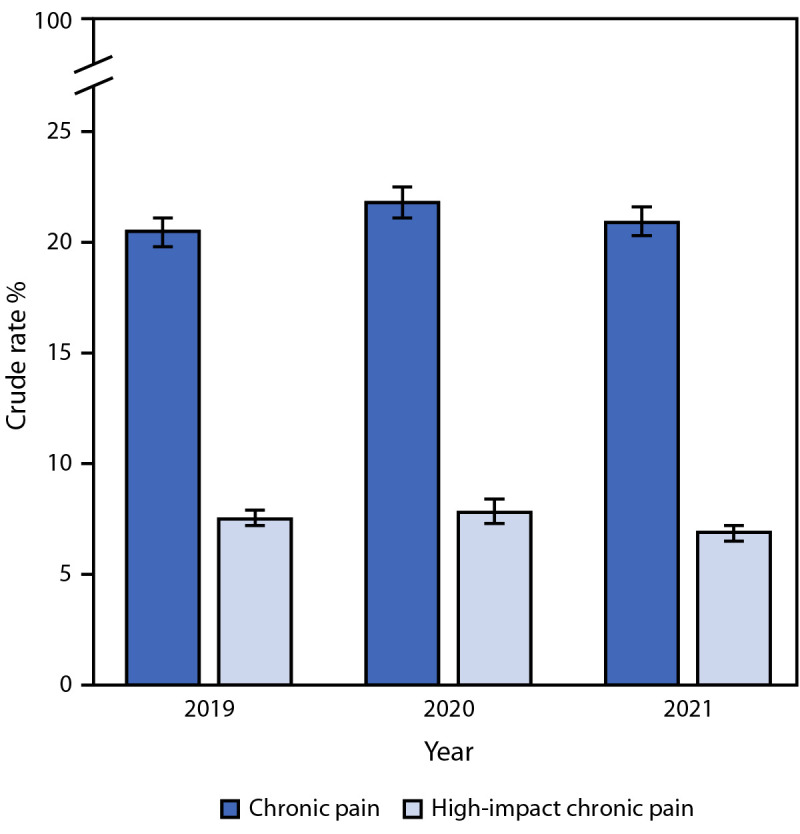
Chronic pain (i.e., pain lasting ≥3 months) is a debilitating condition that affects daily work and life activities for many adults in the United States and has been linked with depression (1), Alzheimer disease and related dementias (2), higher suicide risk (3), and substance use and misuse (4).During 2016, an estimated 50 million adults in the United States experienced chronic pain, resulting in substantial health care costs and lost productivity (5,6).Addressing chronic pain and improving the lives of persons living with pain is a public health imperative.Population research objectives in the National Pain Strategy, which was released in 2016 by the Interagency Pain Research Coordinating Committee, call for more precise estimates of the prevalence of chronic pain and high-impact chronic pain (i.e., chronic pain that results in substantial restriction to daily activities) in the general population and within various population groups to guide efforts to reduce the impact of chronic pain (3).Further, a 2022 review of U.S. chronic pain surveillance systems identified the National Health Interview Survey (NHIS) as the best source for pain surveillance data (7).CDC analyzed data from the 2019-2021 NHIS to provide updated estimates of the prevalence of chronic pain and highimpact chronic pain among adults in the United States and within population groups defined by demographic, geographic, socioeconomic, and health status characteristics.During 2021, an estimated 20.9% of U.S. adults (51.6 million persons) experienced chronic pain, and 6.9% (17.1 million persons) experienced high-impact chronic pain.New findings from this analysis include that non-Hispanic American Indian or Alaska Native (AI/AN) adults, adults identifying as bisexual, and adults who are divorced or separated are among the populations experiencing a higher prevalence of chronic pain and highimpact chronic pain.Clinicians, practices, health systems, and payers should vigilantly attend to health inequities and ensure access to appropriate, affordable, diversified, coordinated, and effective pain management care for all persons (8).NHIS is a cross-sectional, household survey of the civilian, noninstitutionalized population conducted annually by the National Center for Health Statistics (NCHS).*Data were analyzed using the 2019-2021 Sample Adult Interviews.† Survey questions used to estimate the prevalence of pain included, "In the past three months, how often did you have pain?Would you say never, some days, most days, or every day?" and "Over the past three months, how often did your pain limit your life or work activities?Would you say never, some days, most days, INSIDE 386 Secondary Cases of Invasive Disease Caused by Encapsulated and Nontypeable Haemophilus influenzae -10 U.S. Jurisdictions, 2011-2018 391 Update on Wild Poliovirus Type 1 Outbreak -Southeastern Africa, 2021-2022 398 Racial and Ethnic Disparities in Mpox Cases and Vaccination Among Adult Males -United States, May-December 2022 404 Epidemiologic and Clinical Features of Mpox-Associated Deaths -United States, May 10, 2022-March 7, 2023 411 Notes From the Field: Campylobacteriosis Outbreak Associated with Consumption of Raw Water -Montana, 2022 414 QuickStats
Overview
The claims and statistics of this paper haven’t been checked yet.
Run the check — free, no account needed. It reads the open-access text and checks the sources it cites.
Integrity signals
Registry
Cites
Statistics
Figures
Verification
Claims the paper makes
The claims and statistics of this paper haven’t been checked yet.
Run the check — free, no account needed. It reads the open-access text and checks the sources it cites.
Claims other papers make about this one
Each is checked against this paper’s own text: does it say what the citing paper says it does?
The source backs part of the claim, not all of it — or backs it for a different population, condition or comparison.
In the citing paper
“In the US, 30.1% of those with HICP are employed 2”
From Overview and Feasibility of a Novel Transdisciplinary Integrative Approach to High Impact Chronic Pain in Vermont (2024) · cites this paper as [2]
Experimental — accuracy not yet measuredThe source backs part of the claim, not all of it — or backs it for a different population, condition or comparison.
In the citing paper
“The mean age of the PATH participants (49.8 years) is also typical of the HICP population in the US (low 50s). 2”
From Overview and Feasibility of a Novel Transdisciplinary Integrative Approach to High Impact Chronic Pain in Vermont (2024) · cites this paper as [2]
Experimental — accuracy not yet measuredThe cited source says what the claim attributes to it.
In the citing paper
“Chronic pain is one of the most common chronic conditions in the United States based on multiple prevalence studies 1 with the most recent national estimate at 20.9% of US adults. 2”
From Overview and Feasibility of a Novel Transdisciplinary Integrative Approach to High Impact Chronic Pain in Vermont (2024) · cites this paper as [2]
The cited source says what the claim attributes to it.
In the citing paper
“The employment status, however, is not typical. In the US, 30.1% of those with HICP are employed 2 while 50% of the PATH participants are employed full-time, and 17% are employed part-time.”
From Overview and Feasibility of a Novel Transdisciplinary Integrative Approach to High Impact Chronic Pain in Vermont (2024) · cites this paper as [2]
The cited source says what the claim attributes to it.
In the citing paper
“67% of the participants were employed at least part-time vs only 30.1% of those with HICP in the US are employed. 2”
From Overview and Feasibility of a Novel Transdisciplinary Integrative Approach to High Impact Chronic Pain in Vermont (2024) · cites this paper as [2]
Self-check
Percentages, sums and reported differences re-computed from the paper’s own numbers.
The self-check needs the paper’s full text.
Citations
Cites
Prevalence of Chronic Pain and High-Impact Chronic Pain Among Adults — United States, 2016
Dahlhamer, J., Lucas, J., Zelaya, Nahin, R., Mackey, S., DeBar, L., Kerns, R., Von Korff, M., Porter, L., & Helmick, C. (2018) · MMWR. Morbidity and Mortality Weekly Report · doi:10.15585/mmwr.mm6736a2 · Cited by 2,598
The Economic Costs of Pain in the United States
Gaskin, D. J., & Richard, P. (2012) · The Journal of Pain · doi:10.1016/j.jpain.2012.03.009 · Cited by 2,359
CDC Clinical Practice Guideline for Prescribing Opioids for Pain — United States, 2022
Dowell, D., Ragan, K. R., Jones, C. M., Baldwin, G. T., & Chou, R. (2022) · MMWR. Recommendations and Reports · doi:10.15585/mmwr.rr7103a1 · Cited by 1,886
Depression and chronic pain in the elderly: links and management challenges
Zis, P., Daskalaki, A., Bountouni, I., Sykioti, P., Varrassi, G., & Paladini, A. (2017) · Clinical Interventions in Aging · doi:10.2147/cia.s113576 · Cited by 458
Ditre, J. W., Zale, E. L., & LaRowe, L. R. (2018) · Annual Review of Clinical Psychology · doi:10.1146/annurev-clinpsy-050718-095440 · Cited by 247
Racial and Ethnic Disparities in the Treatment of Chronic Pain
Morales, M. E., & Yong, R. J. (2020) · Pain Medicine · doi:10.1093/pm/pnaa427 · Cited by 224
A Review of Potential National Chronic Pain Surveillance Systems in the United States
Duca, L. M., Helmick, C. G., Barbour, K. E., Nahin, R. L., Korff, M. V., Murphy, L. B., Theis, K. A., Guglielmo, D., Dahlhamer, J. M., Porter, L. L., et al. (2022) · Journal of Pain · doi:10.1016/j.jpain.2022.02.013 · Cited by 45
Khalid, S., Sambamoorthi, U., Umer, A., Lilly, C. L., Gross, D. K., & Innes, K. E. (2021) · Journal of Aging and Health · doi:10.1177/08982643211036219 · Cited by 42
Cited by
Sorted by citations
Items 101–200 of 587
Licciardone, J. C., Middleton, C. N., Aboutaj, A., Allouche, T., & Siddiqui, I. (2024) · Journal of Osteopathic Medicine · doi:10.1515/jom-2024-0112 · Cited by 6
Silva, M. J. (2024) · Journal of Clinical Medicine · doi:10.3390/jcm13195923 · Cited by 7
“The prevalence of this condition is so high that the Centers for Disease Control have declared that efforts to improve the lives of people with CNCP are a public health imperative [1].”
BackgroundGinsberg, A. G., Lempka, S. F., Duan, B., Booth, V., & Crodelle, J. A. (2025) · PLoS Computational Biology · doi:10.1371/journal.pcbi.1012234 · Cited by 6
Zeliadt, S. B., DeFaccio, R., Carey, E., Etingen, B., Rosser, E. W., Suri, P., Chen, J. A., Bokhour, B. G., & Coggeshall, S. S. (2025) · Journal of Pain Research · doi:10.2147/jpr.s480718 · Cited by 6
Yan, Z., Zhang, H., Liu, S., Cui, J., Zhu, Y., Zhao, G., Liu, R., & Cui, R. (2025) · Lipids in Health and Disease · doi:10.1186/s12944-025-02496-8 · Cited by 6
Lee, S., & Edwards, S. (2025) · Physiology & Behavior · doi:10.1016/j.physbeh.2025.114867 · Cited by 6
“Chronic pain affects over 50 million individuals in the United States alone [10], a number that will likely increase over the next several decades given the aging population [11].”
Magnetic Field-Responsive Nanodrug to Regulate TRPV1 Pain Receptor
Santi, A. B., Muzzio, N., Gomez, A., & Romero, G. (2025) · ACS Applied Nano Materials · doi:10.1021/acsanm.5c01812 · Cited by 6
The leisure time and occupational physical activity paradox in persistent musculoskeletal pain
Johansson, M. S., Hartvigsen, J., Korshøj, M., Jensen, M. T., Holtermann, A., & Søgaard, K. (2025) · Scientific Reports · doi:10.1038/s41598-025-05815-2 · Cited by 9
“…by the longer time period in the pain question (i.e., pain within the past 6 months vs. 3-months and 14 days in other general population studies) 38,39,41 , and the relatively old study population as individuals ≥50 years appear to have a higher prevalence of chronic pain compared to younger…”
Association between chronic pain and substance use
Ripon, R. K., & Maleki, N. (2025) · Scientific Reports · doi:10.1038/s41598-025-04888-3 · Cited by 6
“Chronic pain affects approximately 20% of the U.S. population, posing significant social, economic, and health-related challenges 23 .”
Reckoning with the Ideal Worker Body: A Qualitative Study of Workers in Chronic Pain
Schinoff, B. S., Rocheville, K., Feldman, E. R., & Thomas, N. K. (2026) · Academy of Management Journal · doi:10.5465/amj.2023.0511 · Cited by 6
Martinez, C. I., Liktor‐Busa, E., & Largent‐Milnes, T. M. (2024) · Frontiers in Neurology · doi:10.3389/fneur.2024.1320791 · Cited by 6
Tramadol use in U.S. Adults With Commercial Health Insurance, 2005–2021
Basham, C. A., Edrees, H. H., Huybrechts, K. F., Hwang, C. S., Bateman, B. T., & Bykov, K. (2024) · American Journal of Preventive Medicine · doi:10.1016/j.amepre.2024.06.009 · Cited by 8
Trends on Nanomedicines as Novel therapeutics Approach in Targeting Nociceptors for Relieving Pain
Satapathy, T., Sahu, D. K., Sahu, H., Pandey, R. K., Shukla, S. S., & Gidwani, B. (2024) · Current Drug Targets · doi:10.2174/0113894501315521240725065617 · Cited by 7
Qaseem, A., Campos, K., MacDonald, S. T., Mount, C. A., Tierney, S., Fitterman, N., Fitterman, N., Basch, P., Basch, P., Choi, E. I., et al. (2024) · Annals of Internal Medicine · doi:10.7326/annals-24-00773 · Cited by 6
Impact of Intracellular Proteins on μ-Opioid Receptor Structure and Ligand Binding
Scott, C. E., Juechter, L. A., Rocha, J., Jones, L. D., Outten, B., Aishman, T. D., Ivers, A. R., & Shields, G. C. (2024) · The Journal of Physical Chemistry B · doi:10.1021/acs.jpcb.4c05214 · Cited by 7
Zhu, W., & Lin, Y. (2025) · Sensors · doi:10.3390/s25072086 · Cited by 6
“%) suffering from high-impact chronic pain during 2021 [1,2].”
Ren, Y., Huang, P., & Jin, X. (2025) · BMC Anesthesiology · doi:10.1186/s12871-025-03087-x · Cited by 6
The impact of chronic pain on brain gene expression
Collier, L., Seah, C., Hicks, E. M., Holtzheimer, P. E., Krystal, J. H., Girgenti, M. J., Huckins, L. M., & Johnston, K. J. A. (2025) · Pain · doi:10.1097/j.pain.0000000000003707 · Cited by 6
“Chronic pain affects roughly one-fifth of adults in the United States, 72,102 and chronic pain conditions (including low back pain and headache disorders) rank in the global top 10 noninfectious diseases contributing to disability-adjusted life years.”
Up-and-coming Radiotracers for Imaging Pain Generators
van der Heijden, R. A., & Biswal, S. (2023) · Seminars in Musculoskeletal Radiology · doi:10.1055/s-0043-1775745 · Cited by 6
Smith, A., & Pressler, S. J. (2024) · The Journal of Cardiovascular Nursing · doi:10.1097/jcn.0000000000001115 · Cited by 6
Sex Differences in Pain Scores and Medication Consumption for Chronic Non-Cancer Pain
Branger, A. G., Morales, S. D., Adkisson, F., & Knežević, N. N. (2024) · Diseases · doi:10.3390/diseases12120314 · Cited by 5
Zepeda-Morales, K., Bravo, D., Aránguiz-Barrera, J., Ampuero, E., Renard, G. M., Pélissier, T., Hernández, A., Retamal, J. S., & Constandil, L. (2024) · Pain · doi:10.1097/j.pain.0000000000003476 · Cited by 5
“21 Systematic studies indicate that the prevalence of chronic pain varies between 11% and over 40%, with a prevalence of 20.5 to 21.8% in the United States 56 and up to 43.5% in the United Kingdom.”
InfluentialNeuropsychological Symptoms and Functional Capacity in Older Adults with Chronic Pain
Ord, A. S., Coddington, K., Maksad, G. P., Swiatek, S. R., Saunders, J., Netz, D., Washburn, D., Braud, S., Holland, J., Eldridge, A. H., et al. (2024) · Gerontology and Geriatric Medicine · doi:10.1177/23337214241307537 · Cited by 5
“Chronic pain is a complex medical condition that affects an estimated 30% to 38.5% of adults over the age of 65 (Larsson et al., 2017; Rikard et al., 2023).”
InfluentialJones, A. F., Wang, Q., Rodríguez‐Graciani, K. M., Diaz, Z. T., Simon, L., & Gilpin, N. W. (2025) · Journal of Pain · doi:10.1016/j.jpain.2025.104789 · Cited by 5
Non-Pharmacological Interventions Addressing Chronic Pain in People Living with HIV
Chen, Y., & Safren, S. A. (2025) · Current HIV/AIDS Reports · doi:10.1007/s11904-025-00734-3 · Cited by 5
Mueth, M. G., Neufeld, P., Michael, M., McGrath‐Conwell, A., Grlickova‐Duzevik, E., King, T. E., Straub, C., & Harrison, B. J. (2025) · Neurobiology of Pain · doi:10.1016/j.ynpai.2025.100184 · Cited by 5
Opioid use and the risk of cancer incidence and mortality: a systematic review
Shrestha, S., Foot, H., Sheikh, M., Parat, M., & Caze, A. L. (2025) · Cancer and Metastasis Reviews · doi:10.1007/s10555-025-10268-0 · Cited by 5
“Similarly, chronic pain affects a substantial proportion of the general population [2].”
Barreto, M. C. A., Ávila, M. A., Cartes‐Velásquez, R., & de Castro, S. S. (2025) · European Journal of Pain · doi:10.1002/ejp.70080 · Cited by 5
“Although causality cannot be inferred due to the study's cross-sectional design, these findings align with patterns observed in the general population with chronic pain in Brazil and the United States (Carvalho et al. 2018; Rikard et al. 2023).”
InfluentialDoucette, M. L., Fisher, E., Chin, J., & Kitsantas, P. (2025) · Pharmacy · doi:10.3390/pharmacy13040096 · Cited by 5
What Drives Risky Prescription Opioid Use? Evidence From Migration
Finkelstein, A. N., Gentzkow, M. A., & Li, D. (2025) · The Quarterly Journal of Economics · doi:10.1093/qje/qjaf037 · Cited by 6
Novel approaches for drug development against chronic primary pain: A systematic review
Tékus, V., Borbély, É., Göebel, A., Baron, R., Hajna, Z., & Helyes, Z. (2025) · British Journal of Pharmacology · doi:10.1111/bph.70228 · Cited by 5
Chronic Pain: Epidemiology, Pathophysiology, and Clinical Management
Shang, Z., Tian, Z., Wang, Z., Yang, Z., Wang, Z., Wang, Z., Wang, Z., He, X., Yu, Y., Gong, Y., et al. (2026) · MedComm · doi:10.1002/mco2.70756 · Cited by 5
“In the United States, for instance, an estimated 20.9% of adults (approximately 51.6 million individuals) experienced chronic pain between 2019 and 2021 [ 20 ]; recent survey data from 2023 suggest this proportion has risen to approximately 24.3% [ 21 ].”
InfluentialBeneciuk, J., Michener, L. A., Sigman, E., Harrison, T., Buzzanca-Fried, K. E., Lu, X.-L., Shan, G., & Hill, J. (2024) · Journal of Pain · doi:10.1016/j.jpain.2024.01.340 · Cited by 6
Palfai, T. P., Morone, N. E., Kratzer, M. P. L., Murray, G. E., Otis, J. D., Maisto, S. A., & Rowland, B. H. P. (2024) · Drug and Alcohol Dependence · doi:10.1016/j.drugalcdep.2024.111121 · Cited by 6
Aram, J., Slopen, N. B., Cosgrove, C. M., Arria, A. M., Liu, H., & Dallal, C. M. (2024) · Substance Use & Misuse · doi:10.1080/10826084.2024.2340993 · Cited by 5
“Adults with disability also experience a disproportionately high prevalence of pain symptoms (Rikard et al., 2023), which, in turn, can function as a motivator for alcohol use (Ditre et al., 2022).”
BackgroundClinician Experiences With Integrative Group Medical Visits for Chronic Pain
Jackson, M., Gardiner, P. M., Leeman, J., & Roth, I. (2024) · Global Advances in Integrative Medicine and Health · doi:10.1177/27536130241304772 · Cited by 5
Zhang, G. Y., Cortella, A. M., Lai, J. C., & Rubin, J. B. (2024) · Hepatology Communications · doi:10.1097/hc9.0000000000000605 · Cited by 5
Talukdar, J. R., Zeraatkar, D., Thomas, A., & Busse, J. W. (2025) · Canadian Journal of Pain · doi:10.1080/24740527.2024.2443631 · Cited by 5
Bridging Gaps in Pain Management: A Qualitative Study of Nurse Navigator Roles
Coriasco, M., Feustel, E., Anderson, J. C., Brown, F. S., Thomas, E., Bindler, R. J., & Wilson, M. (2025) · Pain Management Nursing · doi:10.1016/j.pmn.2025.07.008 · Cited by 5
Sex Differences in Pain and Its Treatment
Zacharoff, K. L. (2023) · Handbook of experimental pharmacology · doi:10.1007/164_2023_686 · Cited by 5
The measurement of “high‐impact chronic pain”: Limitations and alternative methods
Riddle, D. L., & Dumenci, L. (2024) · European Journal of Pain · doi:10.1002/ejp.4710 · Cited by 5
“In a later version of the NHIS survey, the same two items were included but the time period of interest for chronic pain changed from 6 months to 3 months (Rikard et al., 2023).”
Valvi, N. R., Tamargo, J. A., Braithwaite, D., Fillingim, R. B., & Karanth, S. D. (2024) · Cancers · doi:10.3390/cancers16162847 · Cited by 5
“Chronic pain was defined as pain on most days or every day in the past 3 months vs. no pain on most days or every day in the past 3 months [6].”
BackgroundInfluentialRush, C. L., Brewer, J. R., Levey, N., Presciutti, A., McDermott, K. A., Pasinski, R., Yousif, N., Gholston, M., Raju, V., Greenberg, J., et al. (2024) · Family & Community Health · doi:10.1097/fch.0000000000000416 · Cited by 5
“6 Understanding barriers and facilitators of implementation of a pilot mind-body program for older adults with chronic pain in underserved clinics is important to make such programs more accessible and to minimize pain-related health disparities.”
Qin, P., Nicholl, B. I., Ho, F. K. W., Hanlon, P., Celis-Morales, C. A., & Pell, J. P. (2025) · European Journal of Preventive Cardiology · doi:10.1093/eurjpc/zwaf153 · Cited by 6
Exploring User Perspectives on Virtual Reality as a Therapeutic Tool for Chronic Pain Management
Porta, X., Nieto, R., Serrat, M., & Bourdin, P. (2025) · Musculoskeletal Care · doi:10.1002/msc.70101 · Cited by 4
Pain management in primary care
Collins, A. (2023) · The Nurse Practitioner · doi:10.1097/01.npr.0000000000000131 · Cited by 5
Long-range action of an HDAC inhibitor treats chronic pain in a spared nerve injury rat modelPreprint
Centeno, M. V., Alam†, M. S., Haldar, K., & Apkarian, A. V. (2023) · bioRxiv (Cold Spring Harbor Laboratory) · doi:10.1101/2023.12.13.571583 · Cited by 5
Plavin, J., Landau, J., Rose, G. L., Ziller, E., Nowak, S., Finley, H., Audy, L., & Porter, J. (2024) · Global Advances in Integrative Medicine and Health · doi:10.1177/27536130241271643 · Cited by 4
Pondelick, A. M., Moncayo, L. V., Donvito, G., McLane, V. D., Gillespie, J. C., Hauser, K. F., Spiegel, S., Lichtman, A. H., Sim‐Selley, L. J., & Selley, D. E. (2024) · Neuropharmacology · doi:10.1016/j.neuropharm.2024.110165 · Cited by 4
Di‐Bonaventura, S., Donado-Bermejo, A., Montero-Cuadrado, F., Barrero-Santiago, L., Pérez, L., Hernández, J. V., Fernández‐Carnero, J., & Peña, R. F. (2025) · Healthcare · doi:10.3390/healthcare13030269 · Cited by 8
Advancements and prospects of transcranial focused ultrasound in pain neuromodulation
Shi, Y., & Wu, W. (2025) · Pain · doi:10.1097/j.pain.0000000000003556 · Cited by 4
Hasoon, J. J., Chitneni, A., Viswanath, O., Urits, I., Imani, F., & Varrassi, G. (2025) · Psychopharmacology Bulletin · doi:10.64719/pb.4529 · Cited by 4
Abd-Elsayed, A. A., Argall, T. R., Henjum, L. J., McKindsey, D. M., Perkins, N., & Fiala, K. J. (2025) · Brain Sciences · doi:10.3390/brainsci15090915 · Cited by 4
“Approximately 50 million individuals in the United States suffer from chronic pain, defined by the International Association for the Study of Pain as pain persisting for more than three months [1,2].”
Positioned for success: ergonomics in anesthesiology
Ruskin, A. C., & Ruskin, K. J. (2025) · Current Opinion in Anaesthesiology · doi:10.1097/aco.0000000000001589 · Cited by 4
Mechanisms of transport and analgesic compounds recognition by glycine transporter 2
Wang, Y., Su, J., Zhao, J., Li, R., Bai, Q., Song, H., Meng, Y., Ma, Q., & Zhao, Y. (2025) · Proceedings of the National Academy of Sciences · doi:10.1073/pnas.2506722122 · Cited by 4
The Therapeutic Potential of Dual NMR (NOP/MOP) Agonism in Pain Management
Ciccocioppo, R., Gudin, J. A., Argoff, C. E., Offidani, E., Hackworth, J., Fam, D. S., & Potenziano, J. (2025) · Pain and Therapy · doi:10.1007/s40122-025-00794-8 · Cited by 5
“Indeed, the severity of acute postoperative pain in the first days after surgery has been found to be highly predictive of chronic pain [5], a condition affecting over 50 million Americans, a number destined to increase due to an aging population [6].”
Peptides for pain sensation and peptides for pain relief: Fighting fire with fire
Rahman, M. M., Shim, Y. W., Kim, Y. H., & Park, C. (2026) · Biomedicine & Pharmacotherapy · doi:10.1016/j.biopha.2026.118990 · Cited by 4
Zhang, X., Zhang, R., Lin, X., Lirong, Z., & Zhang, J. (2026) · BMC Geriatrics · doi:10.1186/s12877-026-07081-x · Cited by 6
Brezić, N., Gligorevic, S., Sič, A., Tseriotis, V., & Knežević, N. N. (2026) · Biomolecules · doi:10.3390/biom16020258 · Cited by 6
Şentürk, E., Geniş, B., Zorbozan, E., & Selcan, A. (2024) · Medical Bulletin of Haseki · doi:10.4274/haseki.galenos.2024.9393 · Cited by 4
“Chronic pain is a complex and burdensome condition with serious consequences that can affect people’s lives because of failed treatments, medication dependence, social isolation, work challenges, sleep disturbances, and emotional distress (3).”
BackgroundDiscovery of Novel Pain Regulators Through Integration of Cross‐Species High‐Throughput Data
Chen, Y., Bajpai, A. K., Li, N., Xiang, J., Wang, A., Gu, Q., Ruan, J., Zhang, R., Chen, G., & Lu, L. (2025) · CNS Neuroscience & Therapeutics · doi:10.1111/cns.70255 · Cited by 4
Manchikanti, L., Abd-Elsayed, A. A., Kaye, A. D., Sanapati, M. R., Knežević, N. N., Manocha, V., & Hirsch, J. A. (2025) · Current Pain and Headache Reports · doi:10.1007/s11916-025-01397-w · Cited by 4
Community engagement strategies improve recruitment and enrollment in a pragmatic clinical trial
Vance, K. G., Pedelty, J., Gorp, B. J. V., Vance, C. G. T., Johnson, E. M., Jiang, F., Lafontant, D.-E., Koepp, M., Post, A. A., Bayman, E. O., et al. (2025) · Journal of Clinical and Translational Science · doi:10.1017/cts.2025.10103 · Cited by 4
“Social determinants of health – including education, income, geographic location, race, and ethnicity – influence both the prevalence and impact of chronic pain [1,3 – 7].”
Patricio, P., & Massé‐Alarie, H. (2025) · Brain Sciences · doi:10.3390/brainsci15070760 · Cited by 5
Talbot, J. A., Jewell, C., Holston, B., Plavin, J., Rose, G. L., & Ziller, E. C. (2025) · The Journal of Rural Health · doi:10.1111/jrh.70058 · Cited by 4
Janela, D., Tong, X., Areias, A. C., Pires, D., Costa, F. M. T. A., & Fonseca, H. (2025) · PAIN Reports · doi:10.1097/pr9.0000000000001319 · Cited by 4
Rasooly, D., Moonesinghe, R., Fallon, E. A., Barbour, K. E., & Khoury, M. J. (2024) · Arthritis Care & Research · doi:10.1002/acr.25416 · Cited by 4
Rubenstein, D., Green, M. J., McClernon, F. J., McClernon, F. J., & Sweitzer, M. M. (2025) · Journal of Pain · doi:10.1016/j.jpain.2025.104776 · Cited by 4
The effects of socioeconomic position on endogenous pain modulation: A quasi-experimental approach
Raghuraman, N., Akintola, T., Rassu, F. S., O’Connor, T. D., Chen, S., Gruber‐Baldini, A. L., & Colloca, L. (2025) · Journal of Pain · doi:10.1016/j.jpain.2025.104778 · Cited by 4
Bunnell, A. A., Marshall, E. M., Estes, S. K., Deadmond, M. C., Loesgen, S., & Strother, J. A. (2025) · Behavioural Brain Research · doi:10.1016/j.bbr.2025.115526 · Cited by 4
“Chronic pain affects more than 20 % of U.S. adults and current therapeutic approaches often have limited effectiveness or severe side effects [1].”
Therapeutic Uses and Efficacy of Low-Dose Naltrexone: A Scoping Review
Leiber, K. K., & Parker, R. W. (2025) · Cureus · doi:10.7759/cureus.81086 · Cited by 4
“Despite over 50 million Americans experiencing chronic pain each year, there are still minimal efficacious, inexpensive, and non-addictive treatment options [2].”
Effects of aging on experimentally induced pain perception during a distraction task
Fernández-Palacios, F. G., Tejera-Alonso, Á., Pacho-Hernández, J. C., Naeimi, A., De-la-Llave-Rincón, A. I., Ambite‐Quesada, S., Ortega‐Santiago, R., Fernández‐de‐las‐Peñas, C., Valera‐Calero, J. A., & Cigarán‐Méndez, M. (2025) · Scientific Reports · doi:10.1038/s41598-025-94849-7 · Cited by 4
Centeno, M. V., Alam†, M. S., Haldar, K., & Apkarian, A. V. (2025) · Journal of Pain · doi:10.1016/j.jpain.2025.105396 · Cited by 8
Investigation of the Relationship Between Perceived Mental Workload and Chronic Pain
Colpitts, K. N., Dias, J. L., Faulkenberry, T. J., & Bozer, A. L. H. (2023) · Psi Chi Journal of Psychological Research · doi:10.24839/2325-7342.jn28.4.247 · Cited by 3
Outcomes of Psychotherapy for Co-Morbid Pain and Substance Use Disorders: A Review of the Literature
Araque, S. J. M., Nguyen, L. T., & Nadal, C. N. (2024) · Journal of Pain & Palliative Care Pharmacotherapy · doi:10.1080/15360288.2024.2393842 · Cited by 4
Lagunas, M.-A., Jin, J., Rivera, P. M., & Widman, C. (2025) · Journal of Health Psychology · doi:10.1177/13591053241312493 · Cited by 4
“About 15.4% of Hispanic and Latine adults in the U.S. experience chronic pain and 5.3% endorse high-impact pain that significantly disrupts daily activities (Rikard et al., 2023).”
InfluentialHolzer, K. J., Bernstein, H. W., Veasley, C., Haroutounian, S., Amtmann, D., Pederson, A. B., Reeve, B. B., Turk, D. C., Dworkin, R. H., & Langford, D. J. (2025) · Journal of Pain · doi:10.1016/j.jpain.2025.105358 · Cited by 3
Johnson, H., Carper, R., English, R. A., Xia, Y., & Uhl, T. L. (2025) · JOSPT open. · doi:10.2519/josptopen.2025.0111 · Cited by 3
Impact of Pain Self-Efficacy on Health Outcomes in High-Impact Chronic Pain
You, D. S., Lannon, E. W., Kim, S., Dildine, T. C., Weber, K. A., II, Raney, E., & Mackey, S. (2025) · Clinical Journal of Pain · doi:10.1097/ajp.0000000000001295 · Cited by 3
Ke, Y., Wu, C., Cheng, Z., & Liang, M. (2025) · Journal of Pain Research · doi:10.2147/jpr.s521606 · Cited by 3
Li, B., Huang, Y., Liu, Q., Xiao, P., Li, L., & Zeng, K. (2025) · BMJ Open · doi:10.1136/bmjopen-2025-101039 · Cited by 3
Babiloni, A. H., Alonso, B. F., Martel, M. O., Boggero, I. A., Lavigne, G. J., Goode, A. P., & Kapos, F. P. (2025) · Journal of Pain · doi:10.1016/j.jpain.2025.105541 · Cited by 3
Personalised Transdermal Therapy for Chronic Pain with Digital Twin Technology
Porwal, S., Malviya, R., Sridhar, S. B., Shareef, J., Warsi, M. H., & Wadhwa, T. (1970) · Current Drug Targets · doi:10.2174/0113894501395522250903070018 · Cited by 3
Taccardi, D., Zacharias, A. M., Gowdy, H. G. M., Knezic, M., Parisien, M., Bisson, E. J., Fang, Z. Y., Stickley, S. A., Brown, E., Camiré, D., et al. (2025) · Journal of Clinical Investigation · doi:10.1172/jci188620 · Cited by 3
“This disease substantially impairs quality of life, resulting in a higher risk of anxiety and depression as well as reduced work and wages, creating a dependence on prescribed opioids used to treat the pain (3, 4).”
Majid, U., Hoppe, T., Priest, P., Lacroix, L., Held, N. J., Pedlar, D., & Kuluski, K. (2025) · Healthcare · doi:10.3390/healthcare13202655 · Cited by 3
Yu, C., Barr, A. B., Yang, Y., & Grol-Prokopczyk, H. (2025) · The Journals of Gerontology Series B · doi:10.1093/geronb/gbaf220 · Cited by 3
“In 2021, approximately 20.9% of U.S. adults (i.e., 51.6 million) experienced chronic pain, and 6.9% (about 17.1 million) experienced high-impact (i.e., highly disabling) chronic pain (Rikard et al., 2023).”
InfluentialLawley, S., Green, A., Johnson, C., & Burton, M. D. (2025) · Neural Regeneration Research · doi:10.4103/nrr.nrr-d-25-00806 · Cited by 3
“The massive disease burden associated with chronic pain is an international health crisis estimated to affect 20.9% of U.S. adults and 27.5% of adults worldwide (Zimmer et al., 2022; Rikard, 2023).”
InfluentialInteroception-Based Yoga for Chronic Pain: A Pilot Feasibility Study
Voss, S., Patel, I., Skowron, C., Petruzzello, S. J., & Gothe, N. P. (2025) · Global Advances in Integrative Medicine and Health · doi:10.1177/27536130251400362 · Cited by 3
“…train interoceptive attention (eg, via intentional breath regulation and mindful movement), it is also possible that in the absence of speci fi c cues 1 can move through yoga postures with little awareness of the breath or without consideration for using discomfort to inform the use of variations.”
A real-world database analysis of the prevalence of pain medication use in the United States
Lopez, A., Menzie, A. M., Kenderes, M., & Rubin, J. L. (2026) · PAIN Reports · doi:10.1097/pr9.0000000000001396 · Cited by 3
Decoding chronic pain: integrating genetics, neuroimaging, and AI for precision management
Uckac, B., Ogonowski, N. S., García‐Marín, L. M., Díaz‐Torres, S., Farrell, S. F., Nyholt, D. R., & Rentería, M. E. (2026) · Frontiers in Pain Research · doi:10.3389/fpain.2026.1747942 · Cited by 3
“In the United States, 20.9% of adults report chronic pain, and 6.9% experience high-impact pain associated with substantial disability (8).”
InfluentialOliva, F., Merola, M., Olivero, A., & Leombruni, P. (2026) · International Journal of Environmental Research and Public Health · doi:10.3390/ijerph23030316 · Cited by 3
“This burden aligns with epidemiological evidence on chronic pain, including high-impact chronic pain, which contributes markedly to disability and healthcare demand [4,5].”
Schwandt, M. L., Ramchandani, V. A., Upadhyay, J., Ramsden, C. E., Diazgranados, N., & Goldman, D. A. (2024) · Alcohol · doi:10.1016/j.alcohol.2024.03.013 · Cited by 3
Li, P., Zhang, Q., Zheng, H., Qiao, Y., Snyder, G. L., Martin, T., Yao, W., Zhang, L., & Davis, R. E. (2024) · Journal of Medicinal Chemistry · doi:10.1021/acs.jmedchem.4c00480 · Cited by 3
Meert, L., Picavet, H. S. J., Vervullens, S., Meeus, M., van Kuijk, S. M. J., Verschuren, W. M. M., & Smeets, R. (2024) · Clinical Rheumatology · doi:10.1007/s10067-024-07251-5 · Cited by 3
Sundlof, M., Switalla, K. M., Jones, E., Bahr, M., Doering, M., Martin, D., McCormick-Deaton, J., Melton, G. B., & Tignanelli, C. J. (2025) · The Journal of Trauma: Injury, Infection, and Critical Care · doi:10.1097/ta.0000000000004529 · Cited by 4
Real-world healthcare utilization and costs of peripheral nerve stimulation with a micro-IPG system
Kalia, H., Thapa, B. B., Staats, P. S., Martin, P., Stetter, K., Feldman, B., & Marci, C. D. (2025) · Pain Management · doi:10.1080/17581869.2025.2449810 · Cited by 3
Justice, C., Haddow, S., Shafto, K., Reeves, T. J., Knox, J. E., & Prasad, A. (2025) · Global Advances in Integrative Medicine and Health · doi:10.1177/27536130251322501 · Cited by 3
Follistatin, A Novel Therapeutic Target for Chronic Pain
Nie, H., & Liu, B. (2025) · Neuroscience Bulletin · doi:10.1007/s12264-025-01369-5 · Cited by 3
“According to a recent survey, the prevalence of chronic pain is estimated to be > 20% among the population [2].”
Najib, U., Cheng, E. M., Singh, R. B. H., Ayub, N., Nelson, S. E., Bushard, P. J., Jordan, J. T., Sico, J. J., Turbes, M., & Anderson, W. E. (2025) · Neurology · doi:10.1212/wnl.0000000000213544 · Cited by 3
Madden, E. F., Daulys, G., Tingey, B., Frabis, F., Lagisetty, P., Kroth, P. J., & Qeadan, F. (2025) · PAIN Reports · doi:10.1097/pr9.0000000000001261 · Cited by 3
Metadata
- Authors
- Rikard, S. M., Strahan, A. E., Schmit, K. M., & Guy, G. P.
- Affiliations
- National Center for Injury Prevention and Control (US)
- Corresponding author
- Rikard, S. Michaela
- Venue
- MMWR. Morbidity and Mortality Weekly Report
- Published
- 2023-04-14
- Volume
- 72
- Issue
- 15
- Pages
- 379-385
- ISSN
- 0149-2195 (ISSN-L)
- 1545-861X
- PMC
- PMC10121254
- OpenAlex
- W4365442769
- Cited by
- 588
- References
- 8
- Citations by year
- 2026: 144 · 2025: 265 · 2024: 143 · 2023: 35
- FWCI
- 91.10
- Type
- journal article
- Language
- en
- Open access
- diamond
- doi.org
- Locations
- MMWR Morbidity and Mortality Weekly Report (publishedVersion)
- PubMed Central (publishedVersion, public-domain)
- PubMed (publishedVersion)
- Topics
- Health Sciences › Health Professions › Physical Therapy, Sports Therapy and Rehabilitation › Musculoskeletal pain and rehabilitation
- Health Sciences › Medicine › Public Health, Environmental and Occupational Health › Opioid Use Disorder Treatment
- Health Sciences › Medicine › Anesthesiology and Pain Medicine › Pain Management and Opioid Use
- Keywords
- chronic pain, high-impact chronic pain, prevalence, adults, health disparities, American Indian and Alaska Native adults, bisexuals, marital status, socioeconomic status, pain management, National Health Interview Survey, health equity
- MeSH terms
- Adult, Health Status, Humans, Population Surveillance, United States, Prevalence, American Indian or Alaska Native, Chronic Pain, Pain Management
About these checks
Registry, retraction, Cites and statistics results are computed, not judged, with one exception: a printed reference that no index lists is read once by a model before it counts as a citation error. Claims are extracted by a model and kept only when their quote appears verbatim in the text; each cited source is then checked, with a model’s help, for whether it says what the claim relies on. Those verdicts can be wrong — read the claim’s quote and the cited source before relying on one.
Statistics and arithmetic are recomputed, not judged.
Confidence bands are shown only for fields calibrated on our annotated test set. None is calibrated yet, so no band is shown.
What counts as a claim ›How we measure confidence ›How we check this ›
Are you an author, or do you see a problem with this page? Request a review
