

The DOI matches its Crossref record; 8 of the 8 references it cites were found in a registry or an index.
Chronic Pain Among Adults — United States, 2019–2021
Open accessAbstract
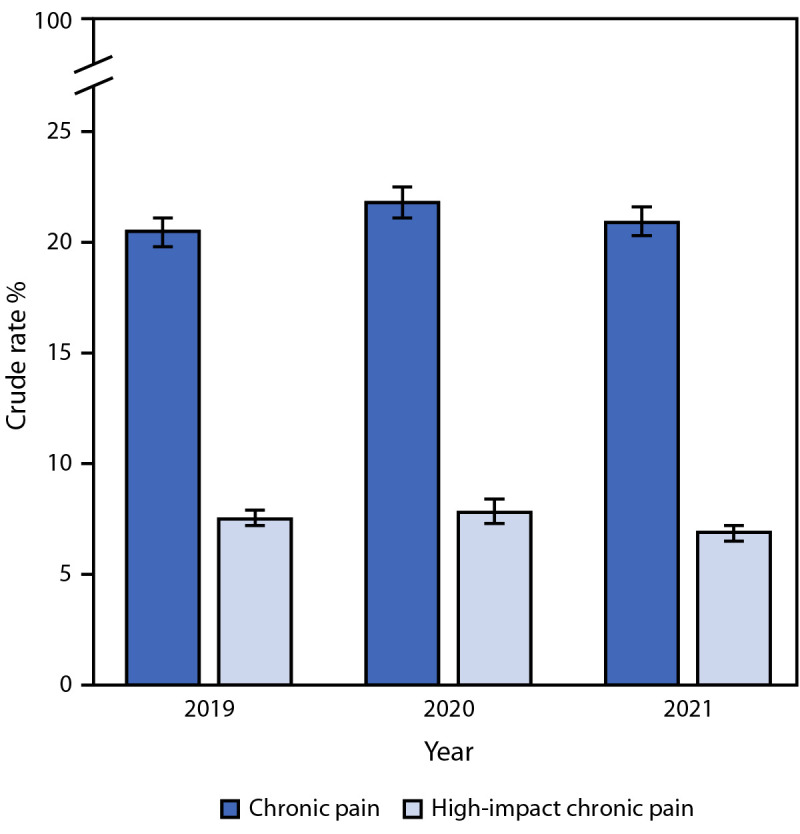
Chronic pain (i.e., pain lasting ≥3 months) is a debilitating condition that affects daily work and life activities for many adults in the United States and has been linked with depression (1), Alzheimer disease and related dementias (2), higher suicide risk (3), and substance use and misuse (4).During 2016, an estimated 50 million adults in the United States experienced chronic pain, resulting in substantial health care costs and lost productivity (5,6).Addressing chronic pain and improving the lives of persons living with pain is a public health imperative.Population research objectives in the National Pain Strategy, which was released in 2016 by the Interagency Pain Research Coordinating Committee, call for more precise estimates of the prevalence of chronic pain and high-impact chronic pain (i.e., chronic pain that results in substantial restriction to daily activities) in the general population and within various population groups to guide efforts to reduce the impact of chronic pain (3).Further, a 2022 review of U.S. chronic pain surveillance systems identified the National Health Interview Survey (NHIS) as the best source for pain surveillance data (7).CDC analyzed data from the 2019-2021 NHIS to provide updated estimates of the prevalence of chronic pain and highimpact chronic pain among adults in the United States and within population groups defined by demographic, geographic, socioeconomic, and health status characteristics.During 2021, an estimated 20.9% of U.S. adults (51.6 million persons) experienced chronic pain, and 6.9% (17.1 million persons) experienced high-impact chronic pain.New findings from this analysis include that non-Hispanic American Indian or Alaska Native (AI/AN) adults, adults identifying as bisexual, and adults who are divorced or separated are among the populations experiencing a higher prevalence of chronic pain and highimpact chronic pain.Clinicians, practices, health systems, and payers should vigilantly attend to health inequities and ensure access to appropriate, affordable, diversified, coordinated, and effective pain management care for all persons (8).NHIS is a cross-sectional, household survey of the civilian, noninstitutionalized population conducted annually by the National Center for Health Statistics (NCHS).*Data were analyzed using the 2019-2021 Sample Adult Interviews.† Survey questions used to estimate the prevalence of pain included, "In the past three months, how often did you have pain?Would you say never, some days, most days, or every day?" and "Over the past three months, how often did your pain limit your life or work activities?Would you say never, some days, most days, INSIDE 386 Secondary Cases of Invasive Disease Caused by Encapsulated and Nontypeable Haemophilus influenzae -10 U.S. Jurisdictions, 2011-2018 391 Update on Wild Poliovirus Type 1 Outbreak -Southeastern Africa, 2021-2022 398 Racial and Ethnic Disparities in Mpox Cases and Vaccination Among Adult Males -United States, May-December 2022 404 Epidemiologic and Clinical Features of Mpox-Associated Deaths -United States, May 10, 2022-March 7, 2023 411 Notes From the Field: Campylobacteriosis Outbreak Associated with Consumption of Raw Water -Montana, 2022 414 QuickStats
Overview
The claims and statistics of this paper haven’t been checked yet.
Run the check — free, no account needed. It reads the open-access text and checks the sources it cites.
Integrity signals
Registry
Cites
Statistics
Figures
Verification
Claims the paper makes
The claims and statistics of this paper haven’t been checked yet.
Run the check — free, no account needed. It reads the open-access text and checks the sources it cites.
Claims other papers make about this one
Each is checked against this paper’s own text: does it say what the citing paper says it does?
The source backs part of the claim, not all of it — or backs it for a different population, condition or comparison.
In the citing paper
“In the US, 30.1% of those with HICP are employed 2”
From Overview and Feasibility of a Novel Transdisciplinary Integrative Approach to High Impact Chronic Pain in Vermont (2024) · cites this paper as [2]
Experimental — accuracy not yet measuredThe source backs part of the claim, not all of it — or backs it for a different population, condition or comparison.
In the citing paper
“The mean age of the PATH participants (49.8 years) is also typical of the HICP population in the US (low 50s). 2”
From Overview and Feasibility of a Novel Transdisciplinary Integrative Approach to High Impact Chronic Pain in Vermont (2024) · cites this paper as [2]
Experimental — accuracy not yet measuredThe cited source says what the claim attributes to it.
In the citing paper
“Chronic pain is one of the most common chronic conditions in the United States based on multiple prevalence studies 1 with the most recent national estimate at 20.9% of US adults. 2”
From Overview and Feasibility of a Novel Transdisciplinary Integrative Approach to High Impact Chronic Pain in Vermont (2024) · cites this paper as [2]
The cited source says what the claim attributes to it.
In the citing paper
“The employment status, however, is not typical. In the US, 30.1% of those with HICP are employed 2 while 50% of the PATH participants are employed full-time, and 17% are employed part-time.”
From Overview and Feasibility of a Novel Transdisciplinary Integrative Approach to High Impact Chronic Pain in Vermont (2024) · cites this paper as [2]
The cited source says what the claim attributes to it.
In the citing paper
“67% of the participants were employed at least part-time vs only 30.1% of those with HICP in the US are employed. 2”
From Overview and Feasibility of a Novel Transdisciplinary Integrative Approach to High Impact Chronic Pain in Vermont (2024) · cites this paper as [2]
Self-check
Percentages, sums and reported differences re-computed from the paper’s own numbers.
The self-check needs the paper’s full text.
Citations
Cites
Prevalence of Chronic Pain and High-Impact Chronic Pain Among Adults — United States, 2016
Dahlhamer, J., Lucas, J., Zelaya, Nahin, R., Mackey, S., DeBar, L., Kerns, R., Von Korff, M., Porter, L., & Helmick, C. (2018) · MMWR. Morbidity and Mortality Weekly Report · doi:10.15585/mmwr.mm6736a2 · Cited by 2,598
The Economic Costs of Pain in the United States
Gaskin, D. J., & Richard, P. (2012) · The Journal of Pain · doi:10.1016/j.jpain.2012.03.009 · Cited by 2,359
CDC Clinical Practice Guideline for Prescribing Opioids for Pain — United States, 2022
Dowell, D., Ragan, K. R., Jones, C. M., Baldwin, G. T., & Chou, R. (2022) · MMWR. Recommendations and Reports · doi:10.15585/mmwr.rr7103a1 · Cited by 1,886
Depression and chronic pain in the elderly: links and management challenges
Zis, P., Daskalaki, A., Bountouni, I., Sykioti, P., Varrassi, G., & Paladini, A. (2017) · Clinical Interventions in Aging · doi:10.2147/cia.s113576 · Cited by 458
Ditre, J. W., Zale, E. L., & LaRowe, L. R. (2018) · Annual Review of Clinical Psychology · doi:10.1146/annurev-clinpsy-050718-095440 · Cited by 247
Racial and Ethnic Disparities in the Treatment of Chronic Pain
Morales, M. E., & Yong, R. J. (2020) · Pain Medicine · doi:10.1093/pm/pnaa427 · Cited by 224
A Review of Potential National Chronic Pain Surveillance Systems in the United States
Duca, L. M., Helmick, C. G., Barbour, K. E., Nahin, R. L., Korff, M. V., Murphy, L. B., Theis, K. A., Guglielmo, D., Dahlhamer, J. M., Porter, L. L., et al. (2022) · Journal of Pain · doi:10.1016/j.jpain.2022.02.013 · Cited by 45
Khalid, S., Sambamoorthi, U., Umer, A., Lilly, C. L., Gross, D. K., & Innes, K. E. (2021) · Journal of Aging and Health · doi:10.1177/08982643211036219 · Cited by 42
Cited by
Sorted by citations
Items 501–587 of 587
Welborn, K. G., & Gloria, A. M. (2026) · Journal of First-generation Student Success · doi:10.1080/26906015.2026.2643820
Ouyang, H., Kang, X., Xu, Y., Wu, Y., Ma, Z., Tang, Z., Chang, A., Liu, M., Zhai, H., & Cao, X. (2026) · Acta Psychologica · doi:10.1016/j.actpsy.2026.106807 · Cited by 1
Oyaga-Ruidiaz, K., Gómez-Díaz, M., Erazo, M., & Benavides‐Cruz, J. (2026) · Revista Mexicana de Anestesiología · doi:10.35366/122904
Youness, M., Keith, D. A., Rosén, A., Kulich, R. J., & Handa, S. (2026) · Oral Surgery Oral Medicine Oral Pathology and Oral Radiology · doi:10.1016/j.oooo.2026.04.002
Unfiltered chronic pain: Insights from women of color through a virtual photovoice study
Rahman, R., Prophet, J., Yazdani, A. T., Hassett, A. L., & Gentile, R. (2026) · BMC Women s Health · doi:10.1186/s12905-026-04486-z
“Chronic pain, defined as pain lasting more than three months, affects 20.9% of U.S. adults, with 6.9–7.8% experiencing high-impact pain that significantly limits daily activities [1, 2].”
InfluentialChemically diverse antagonists inhibit human TRPV1 through ligand-specific interaction networksPreprint
Lopez, K. E., Paduda, A. D., Derrick, M. J., & Horn, W. D. V. (2026) · bioRxiv (Cold Spring Harbor Laboratory) · doi:10.64898/2026.04.27.721197
Alshehri, F. A., Levett-Jones, T. L., & Pich, J. (2026) · Teaching and learning in nursing · doi:10.1016/j.teln.2026.01.024
O’Leary, S., Price, A. M., File, C., Patel, T., Fredricks, N. S., Patel, K. A., Lesage, A., Camarillo‐Rodriguez, L., Ogasawara, C. T., Costa, M., et al. (2026) · Operative Neurosurgery · doi:10.1227/ons.0000000000002039
Zebrowski, A., Fernandez, R. J., Pinkelton, C., Kitzmiller, R., Kiefer, A. W., Stanley, L., Mody, G. N., Moore, C., & Mazur, L. (2025) · JMIR XR and spatial computing · doi:10.2196/90626
Predictors and Clinical Outcomes of Long‐Term Opioid Therapy in Older Adults: A Systematic Review
Ahmed, I., Teo, N. E., Keshk, N., & Foster, D. R. (2026) · Pharmacotherapy The Journal of Human Pharmacology and Drug Therapy · doi:10.1002/phar.70151
Jumreornvong, O., Chindahporn, A., Kantagowit, P., Suenghataiphorn, T., Kia, A., & Nwaneshiudu, C. A. (2026) · doi:10.2196/preprints.100316
Cooled Radiofrequency Ablation of Cervical Nerves for Treating Cervicogenic Headache
Abd-Elsayed, A. A., Hashimoto, N., Reilly, M. J., Shiferaw, B. T., & Henjum, L. J. (2026) · Current Pain and Headache Reports · doi:10.1007/s11916-026-01510-7
Thérond, A., Robinson, C. L., Viswanath, O., Hasoon, J. J., & Yazdi, C. (2026) · Current Pain and Headache Reports · doi:10.1007/s11916-026-01509-0
“Chronic pain falls disproportionately on people with lower socioeconomic status, racial and ethnic minorities, and individuals in rural or underserved communities [19].”
New Technique for Tramadol Dose Accuracy: Are Dosing Pumps the Solution?
Alas‐Pineda, C., Coto-Tejeda, C., Pavón-Varela, D. J., Gaitán‐Zambrano, K., Medina-Mejía, J., & Ferrer, G. (2026) · Pharmaceuticals · doi:10.3390/ph19050796
“In the United States alone, 50 million individuals reported chronic pain in 2016 [3].”
Schneider, J. E. (2026) · Global perspectives on wealth and distribution · doi:10.1007/978-3-032-20355-7_3
Effects of acute alcohol on pain-related activity of the anterior and posterior insular cortices
Cushnie, A. K., Sevel, L. S., Bush, N. J., Nixon, S. J., Robinson, M. E., & Boissoneault, J. (2026) · Alcohol · doi:10.1016/j.alcohol.2026.05.003
Misalignment between subjective and objective sleep in chronic pain: The role of depressive symptoms
Chan, C., Weingarten, J. A., Weber, A., & Dubrovsky, B. (2026) · Sleep Medicine · doi:10.1016/j.sleep.2026.109050
Swift, A., Caillaud, M., Graur, A., Mckiver, B. D., Toma, W. B., Köşeli, E., Mann, J., Lynch, W. B., Beierle, J. A., Thareja, P., et al. (2026) · Journal of Pain · doi:10.1016/j.jpain.2026.106339
McCullough, M. B., Orton, N. R., Kemp, G., & Yang, A. Y. (2026) · Journal of Patient Experience · doi:10.1177/23743735261458016
Chronic pain: contemporary concepts and epidemiology
Aynbinder, S., & Marushchak, M. (2026) · Медсестринство · doi:10.11603/2411-1597.2026.2.16463
Bakhtiar, Y., Dewi, A., & Ilmansyah, R. (2026) · Journal of Pain & Palliative Care Pharmacotherapy · doi:10.1080/15360288.2026.2678983
“The Centers for Disease Control and Prevention (CDC) estimated that, in 2021, 20.9% of Americans, or about 51.6 million people, experienced chronic pain, with 6.9% (17.1 million individuals) experiencing high-impact chronic pain, which severely limits daily functioning (4).”
InfluentialMartin, L. F., Gómez, K., Park, J., Ismail, K., Masterson, K. A., Korah, H. E., Stratton, H. J., Allen, J., Palomino, S. M., Washington, S. M., et al. (2026) · Anesthesiology · doi:10.1097/aln.0000000000006077
Founding the Pain Medicine Academy of Advanced Practice Providers
Jackson, H. J., Adler, J. A., Zimmerman, A., Mallick‐Searle, T., Duffy, C., Hussaini, Z., & Wells, M. (2026) · The Journal for Nurse Practitioners · doi:10.1016/j.nurpra.2026.105989
Schneider, K. M., Limberg, D., Schneider, K. M., Balane, C., Barnes, J., Sandonato, B., & Blount, A. J. (2026) · Healthcare · doi:10.3390/healthcare14121622
“Chronic pain is similarly prevalent and debilitating, affecting approximately one in five adults in the United States [6,7].”
Lowe, S. J., Vincent, S., Sumida, M. F., & Dietrich, J. E. (2026) · Journal of Pediatric and Adolescent Gynecology · doi:10.1016/j.jpag.2026.06.011
Humphreys, S., George, V., Gomez, T., Koshy, S. C., Robinson‐Papp, J., Jordan, A. E., & Perlman, D. C. (2026) · Pain Management · doi:10.1080/17581869.2026.2686786
Evaluating clinical psychology doctoral students’ competence in delivering CBT for chronic pain
McCullough, M. B., & Kemp, G. (2026) · BMC Medical Education · doi:10.1186/s12909-026-09757-9
“Chronic pain, defined as pain persisting for three months or longer, affects approximately 20% of adults in the United States, impacting an estimated 51.6 million individuals [1].”
InfluentialAlipour‐Vaezi, M., Savla, J., Rukstalis, M. R., Rukstalis, D. B., Tsui, K., Penzien, D. B., McNamara, R. S., & Zhong, H. (2026) · PLoS ONE · doi:10.1371/journal.pone.0352339
“A 2021 study indicated that approximately 21% of adults in the U.S. experienced chronic pain [4].”
Shipman, D. (2026) · Springer eBooks · doi:10.1007/978-3-032-21675-5_8
Barriers to Patients Receiving Care
Lewis, T. L., Wellings, F. S., Kieck, D. M., & Iskander, P. (2026) · Springer eBooks · doi:10.1007/978-3-032-21675-5_26
Roth, I., Tomczak, P., Ferriola-Bruckenstein, K., Gardiner, P. M., & Leeman, J. (2026) · BMC Family Practice · doi:10.1186/s12875-026-03439-7
Kearns, O., Deuitch, N. T., Craft, K., Young, D. J., Liu, P. P., & Wiener, L. S. (2026) · Journal of Genetic Counseling · doi:10.1002/jgc4.70253
“Further, the involvement of these providers should be ongoing”
Farand, É., Farand, P., Martel, A., Dodier, A., St‐Pierre, V., Lacasse, A., & on behalf of the CEMPUS Cohort Research Group (2026) · Canadian Journal of Pain · doi:10.1080/24740527.2026.2680295
“Older people experience more chronic pain 2,5,6,31,32 and less food insecurity 13,16,41 than younger people.”
Villela, P. N. R., Balbona, J. V., Sarabudla, N., Hatoum, A. S., Haroutounian, S., Arpana Agrawal, A., & Johnson, E. C. (2026) · Journal of Pain · doi:10.1016/j.jpain.2026.106377
Prevalence and competing risk of psychiatric comorbidities in chronic low back pain by age group
Pontiff, R., Helm, A. F., Milani, S. A., Morrow, M. M. B., & Tucker, C. A. (2026) · PAIN Reports · doi:10.1097/pr9.0000000000001480
“28,35 Beyond its physiological basis, chronic pain is a complex biopsychosocial phenomenon that is among the most common reasons adults seek medical care and a major risk factor for opioid misuse, anxiety, and depression.”
InfluentialChoi, D., Villalba, R. M., Dalal, K., Paré, J., Dravid, S. M., & Smith, Y. (2026) · European Journal of Neuroscience · doi:10.1111/ejn.70607
Yamada, K., Nishizawa, D., Arita, H., Hanaoka, K., Yajima, C., Kato, J., Ogawa, S., Hiranuma, A., Hasegawa, J., Ebata, Y., et al. (2026) · PAIN Reports · doi:10.1097/pr9.0000000000001478
“2,18,39,59 Current therapeutic strategies for chronic pain, encompassing pharmacological, physical, and psychological interventions, exhibit considerable interindividual variability in efficacy, high-lighting the lack of a universally effective treatment approach.”
Schmerz, Geschlecht und Gender – Annäherung an ein noch (zu) wenig verstandenes Thema
Pogatzki-Zahn, E., & Raffaelli, B. (2026) · Der Schmerz · doi:10.1007/s00482-026-00962-5
McGoldrick, P., Becker, W. C., Wesolowicz, D. M., & Black, A. C. (2026) · Substance Use & Misuse · doi:10.1080/10826084.2026.2703195
Wu, J., Yu, Q., Xu, Z., Wang, B., Chen, Z., Li, Q., & Xu, T. (2026) · BMJ Open · doi:10.1136/bmjopen-2026-120106
Pellow, K., Harrison, J., & Harper, B. (2026) · Scandinavian Journal of Pain · doi:10.1515/sjpain-2026-0018
“It is estimated to a ff ect approximately 20.9 % (51.6 million) of adults in the United States, with 6.9 % (17.1 million) of those adults experiencing pain which severely impacts their ability to participate in daily activities [1].”
InfluentialMin, J., Hung, P., Bolin, J. N., Bora, R., Pace, S., Pitones, P., Wu, H., & Kawi, J. (2026) · Health Services Insights · doi:10.1177/11786329261472231
Editorial: Insights into pain mechanisms - 2024/2025
Liu, D.-Q., & Zhou, Y.-Q. (2026) · Frontiers in Pain Research · doi:10.3389/fpain.2026.1925507
Harrison, A., & Mirza, M. P. (2026) · Frontiers in Psychiatry · doi:10.3389/fpsyt.2026.1811843
“Another analysis of nationally representative data reported age-adjusted prevalence of chronic pain to be 32.9% among bisexual adults, compared to 20.7% of gay/lesbian adults and 19.3% among heter-osexuals (3).”
InfluentialKhadka, S., Thornton, J. D., Kamal, K. M., Higa, G. M., Kelly, K. M., & Nduaguba, S. O. (2026) · PLoS ONE · doi:10.1371/journal.pone.0352907
“Although definitions vary widely, chronic pain is defined as a condition in which a person has pain most days or every day for longer than three months [2–4].”
Giraldo‐Santiago, N., Cardoza-Contreras, M. N., Alvarez-Frank, N. A., Estey, E. E. E., Kim, Y., Schuman‐Olivier, Z., Vranceanu, A., & Greenberg, J. (2026) · Translational Behavioral Medicine · doi:10.1093/tbm/ibag047
Lau, C. C., Bonnell, L., Tompkins, B. J., Czarny, D., & Kennedy, A. G. (2026) · Current rheumatology research. · doi:10.46439/rheumatology.6.033
Spector, A. L., Flores, D., Aaby, D., & Coe, P. (2026) · Frontiers in Public Health · doi:10.3389/fpubh.2026.1905906
Extracorporeal Shockwave Therapy in Pain Management – an In-Depth Narrative Review
Ufondu, W., Ogunsola, O., Williams, A., Valenti, K., Herbert, G., Ezenekwe, E., Bufano, J., Suleiman, T., Esiso, F., Jevotovsky, D. S., et al. (2026) · Orthopedic Reviews · doi:10.52965/001c.154361
Williams, J., Osweiler, B. W., Siriprakorn, J. P., & Marotta, P. L. (2026) · medRxiv · doi:10.64898/2026.08.09.26359632
Kim, H., Nam, S., Park, B., Lee, K., Yu, S., Kim, J.-S., Yoo, Y., & Moon, J. Y. (2026) · Medicina · doi:10.3390/medicina62081549
“Roughly one in five adults experiences clinically significant pain at any time, and the proportion rises steeply with age and multimorbidity [7–9].”
Financial Barriers, Mental Health, and Medication Nonadherence Among Individuals With Chronic Pain
Sirotiak, Z. (2026) · Public Health Challenges · doi:10.1002/puh2.70345
“High-impact chronic pain is another significant concern, characterized by chronic pain that limits daily function and activities [ 4, 5 ].”
InfluentialRussin, N. H., Peterson, D. S., Pardon, K., & Martin, M. P. (2026) · Frontiers in Public Health · doi:10.3389/fpubh.2026.1863881
Oliveira, M., Pedro, M. O. P., Leopoldo, K., Crispim, D. H., & Castaldelli-Maia, J. M. (2026) · Drug and Alcohol Review · doi:10.1111/dar.70235
Braconnier, P., Charlier, M., Romanin, A., Gilbert, N., Desmet, N., & Hermans, E. (2026) · European Journal of Pain · doi:10.1002/ejp.70357
Evolving Solutions for the Next Generation of Intrathecal Drug Delivery Systems
Menéndez‐González, M. (2026) · Neuromethods · doi:10.1007/978-1-0716-5241-1_14
Playing by the Rules: A Review of the Modern Regulatory Framework for Regenerative Medicine
Rothkrug, A., & Robinson, C. L. (2026) · Current Pain and Headache Reports · doi:10.1007/s11916-026-01558-5
“The modern chronic pain treatment landscape is becoming more and more constrained despite a high prevalence and societal impact [38, 39].”
Bruton, A. M., Staab, C. A., Gray, O., Chua, W. R. (., Alsakhita, N., Goldenberg, J. Z., & Roberts, J. L. (2026) · BMJ Open · doi:10.1136/bmjopen-2026-123353
Adhamidhis, E., Srisaikaew, P., Michailidis, V., Latypov, T. H., Noorani, A., & Hodaie, M. (2026) · Brain Sciences · doi:10.3390/brainsci16090966
“Chronic pain poses an important and challenging health crisis, affecting approximately 30% of people worldwide [1–3].”
Psychological Adjustment and Mental Health Among Those Seeking Pain Rehabilitation Treatment
Umucu, E., Jang, J., Geed, S., Kulkarni, A. A., & Lee, B. (2026) · Physical Medicine and Rehabilitation Clinics of North America · doi:10.1016/j.pmr.2026.08.009
Abdallah, J., Manhas, N. S., Hyder, S., Ali, M., Truong, L., Brown, N., Bharat, K. T., Tran, D., & Pak, E. (2026) · Cureus · doi:10.7759/cureus.116278
“In 2021, an estimated 51.6 million U.S. adults (20.9% of the population) experienced chronic pain, with approximately 17.1 million adults reporting high-impact chronic pain [2].”
InfluentialCheatle, M. D., Lee, Y.-J., Zhu, J., Kass, G., & Rizvi, S. J. (2026) · Journal of Pain · doi:10.1016/j.jpain.2026.106445
Steffens, E. B., Hogans, B. B., & Buenaver, L. F. (2026) · Neurologic Clinics · doi:10.1016/j.ncl.2026.08.001
Vance, K. G., Teets, R., Doan, L., Whack, S., Ecklund, D. J., Wandner, L. D., Sluka, K. A., & Berardi, G. (2026) · Journal of Clinical and Translational Science · doi:10.1017/cts.2026.10821
Zhang, Y., Harris, T. G. W., Erb, C. J., Qiu, C., Sarhane, K. A., Hanwright, P. J., Slavin, B. R., Yao, Z.-C., Kong, J., Lee, E. B., et al. (2026) · Cell Biomaterials · doi:10.1016/j.celbio.2026.100594
Brady, B., Boland, R., & Veljanova, I. (2026) · IntechOpen eBooks · doi:10.5772/intechopen.1015395
Zendels, P. M., Gaston, S. A., Vitiello, M. V., Payne, C., Jackson, W. B., Nowakowski, S., & Jackson, C. L. (2026) · Sleep Medicine · doi:10.1016/j.sleep.2026.109291
Mostoufi, S. A., & Dolores-Rodriguez, A. (2026) · Elsevier eBooks · doi:10.1016/b978-0-443-23516-0.00094-5
Multigram-scale synthesis of the Nav1.7 inhibitor GDC-0310
Zhang, Y., Wu, Y., Zhang, B., Jia, D., Feng, C., Hou, Y., & Zhao, Y. (2026) · Chemical Papers · doi:10.1007/s11696-026-05671-y
Fall Risk of Older Adults in Pain Management
Lee, M. S., Lee, A. W., Yeh, C., Yeh, K., & Yeh, H.-J. J. (2026) · Communications in computer and information science · doi:10.1007/978-3-032-28463-1_23
Cannabis Legalization and Opioid Prescribing in Veterans Health Administration Patients: 2013–2022
Mannes, Z. L., Wall, M. M., Stohl, M., Malte, C. A., Olfson, M., Livne, O., Fink, D. S., Simpson, T., Wisell, C. G., Keyhani, S., et al. (2026) · Journal of General Internal Medicine · doi:10.1007/s11606-026-10733-8
Anwar, A. I., Jenkins, L. G., Branch, B. J., Cassagne, G. A., Daigle, G. M., Levin, M. J., Yaray, O., Crosby, S. D., & Kaye, A. D. (2026) · Biomolecules · doi:10.3390/biom16101410
“Chronic pain also affects some populations more than others, including women, individuals with lower socioeconomic status, rural residents, and veterans [4,6].”
Frye, S. K., & Nemirovsky, L. (2026) · Occupational Therapy In Health Care · doi:10.1080/07380577.2026.2733180
Understanding the Evidence‐to‐Practice Gap in Persistent Pain Management
Henderson, V. K., Covert, C., Pontiff, R. J., & Greenwood, R. (2026) · Pain Research and Management · doi:10.1155/prm/6171019
Younes, D. B., Mizher, H. A. A., Arabyat, S., & Zin, C. S. (2026) · Trends in Anaesthesia and Critical Care · doi:10.1016/j.tacc.2026.101797
Yarborough, B. J. H., Smith, N., Stumbo, S. P., Janoff, S. L., Keast, E. M., Wartko, P. D., Yeung, K., Zhu, W., Petronis, K. R., Ahmedani, B. K., et al. (2026) · Drug and Alcohol Dependence · doi:10.1016/j.drugalcdep.2026.113385
Low-Dose Buprenorphine Initiation Strategies for Pain
Jean, J., & Smith, M. A. (2026) · Annals of Pharmacotherapy · doi:10.1177/10600280261491998
Pain education in Brazilian medical schools: a national curriculum analysis
Silva, T. C. A., Domingues, F. M., de Medeiros, D. L., Gandolfi, A. C. D. C., & dos Reis, F. J. J. (2026) · Pain · doi:10.1097/j.pain.0000000000004129
Targeting pain where it CouNts: the role of neurotensin signaling in pain and analgesia
Chapman, A. D., Black, K. L., Leinninger, G. M., & Laumet, G. O. (2026) · Frontiers in Pharmacology · doi:10.3389/fphar.2026.1907900
“Migraine is one of the most common and disabling pain conditions among individuals under the age of 50 in the United States (Ashina, 2020; Cohen, 2024; Steiner et al., 2016).”
Tamargo, J. A., Zhang, Y., Abbas, M., Chen, L., Sparks, L. M., Mau, T., Hepple, R. T., Esser, K. A., & Cruz‐Almeida, Y. (2026) · Molecular Pain · doi:10.1177/17448069261499172
Chen, L., Mei, Z., Yin, X., Yin, T., Chen, T., & Luo, L. (2026) · Mindfulness · doi:10.1007/s12671-026-03004-4
McLaughlin, K. H., Fritz, J. M., Minick, K. I., Hunter, S., Moffit, S., Schneider, M., Lane, E., Ford, I., Romero, A., Colantuoni, E., et al. (2026) · BMJ Open · doi:10.1136/bmjopen-2026-118831
Beyond Therapy: ESWT as a Diagnostic Modality in Musculoskeletal Medicine
Ribeiro-Da-Silva, T., Costa, F. M., da Silva, B. G., Ferreira‐Silva, N., & Tortland, P. D. (2026) · Bioengineering · doi:10.3390/bioengineering13111245
Buprenorphine for Chronic Pain
Vettese, T. E. (2026) · Medical Clinics of North America · doi:10.1016/j.mcna.2026.09.002
Bialas, P., Tesarz, J., Brähler, E., & Häuser, W. (2026) · Der Schmerz · doi:10.1007/s00482-026-00979-w
Metadata
- Authors
- Rikard, S. M., Strahan, A. E., Schmit, K. M., & Guy, G. P.
- Affiliations
- National Center for Injury Prevention and Control (US)
- Corresponding author
- Rikard, S. Michaela
- Venue
- MMWR. Morbidity and Mortality Weekly Report
- Published
- 2023-04-14
- Volume
- 72
- Issue
- 15
- Pages
- 379-385
- ISSN
- 0149-2195 (ISSN-L)
- 1545-861X
- PMC
- PMC10121254
- OpenAlex
- W4365442769
- Cited by
- 588
- References
- 8
- Citations by year
- 2026: 144 · 2025: 265 · 2024: 143 · 2023: 35
- FWCI
- 91.10
- Type
- journal article
- Language
- en
- Open access
- diamond
- doi.org
- Locations
- MMWR Morbidity and Mortality Weekly Report (publishedVersion)
- PubMed Central (publishedVersion, public-domain)
- PubMed (publishedVersion)
- Topics
- Health Sciences › Health Professions › Physical Therapy, Sports Therapy and Rehabilitation › Musculoskeletal pain and rehabilitation
- Health Sciences › Medicine › Public Health, Environmental and Occupational Health › Opioid Use Disorder Treatment
- Health Sciences › Medicine › Anesthesiology and Pain Medicine › Pain Management and Opioid Use
- Keywords
- chronic pain, high-impact chronic pain, prevalence, adults, health disparities, American Indian and Alaska Native adults, bisexuals, marital status, socioeconomic status, pain management, National Health Interview Survey, health equity
- MeSH terms
- Adult, Health Status, Humans, Population Surveillance, United States, Prevalence, American Indian or Alaska Native, Chronic Pain, Pain Management
About these checks
Registry, retraction, Cites and statistics results are computed, not judged, with one exception: a printed reference that no index lists is read once by a model before it counts as a citation error. Claims are extracted by a model and kept only when their quote appears verbatim in the text; each cited source is then checked, with a model’s help, for whether it says what the claim relies on. Those verdicts can be wrong — read the claim’s quote and the cited source before relying on one.
Statistics and arithmetic are recomputed, not judged.
Confidence bands are shown only for fields calibrated on our annotated test set. None is calibrated yet, so no band is shown.
What counts as a claim ›How we measure confidence ›How we check this ›
Are you an author, or do you see a problem with this page? Request a review
