

The DOI matches its Crossref record; 8 of the 8 references it cites were found in a registry or an index.
Chronic Pain Among Adults — United States, 2019–2021
Open accessAbstract
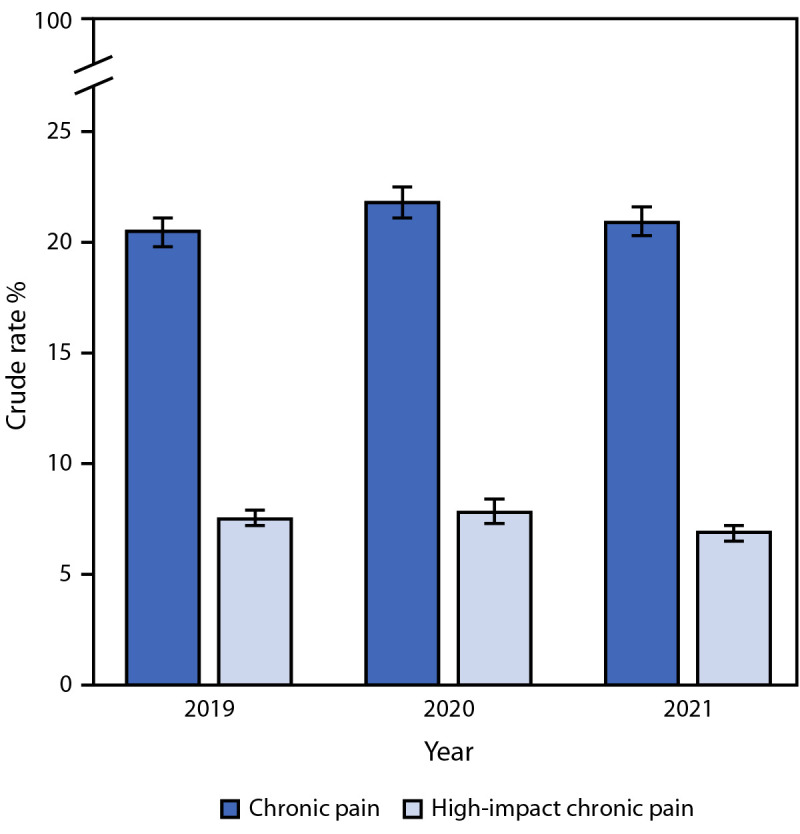
Chronic pain (i.e., pain lasting ≥3 months) is a debilitating condition that affects daily work and life activities for many adults in the United States and has been linked with depression (1), Alzheimer disease and related dementias (2), higher suicide risk (3), and substance use and misuse (4).During 2016, an estimated 50 million adults in the United States experienced chronic pain, resulting in substantial health care costs and lost productivity (5,6).Addressing chronic pain and improving the lives of persons living with pain is a public health imperative.Population research objectives in the National Pain Strategy, which was released in 2016 by the Interagency Pain Research Coordinating Committee, call for more precise estimates of the prevalence of chronic pain and high-impact chronic pain (i.e., chronic pain that results in substantial restriction to daily activities) in the general population and within various population groups to guide efforts to reduce the impact of chronic pain (3).Further, a 2022 review of U.S. chronic pain surveillance systems identified the National Health Interview Survey (NHIS) as the best source for pain surveillance data (7).CDC analyzed data from the 2019-2021 NHIS to provide updated estimates of the prevalence of chronic pain and highimpact chronic pain among adults in the United States and within population groups defined by demographic, geographic, socioeconomic, and health status characteristics.During 2021, an estimated 20.9% of U.S. adults (51.6 million persons) experienced chronic pain, and 6.9% (17.1 million persons) experienced high-impact chronic pain.New findings from this analysis include that non-Hispanic American Indian or Alaska Native (AI/AN) adults, adults identifying as bisexual, and adults who are divorced or separated are among the populations experiencing a higher prevalence of chronic pain and highimpact chronic pain.Clinicians, practices, health systems, and payers should vigilantly attend to health inequities and ensure access to appropriate, affordable, diversified, coordinated, and effective pain management care for all persons (8).NHIS is a cross-sectional, household survey of the civilian, noninstitutionalized population conducted annually by the National Center for Health Statistics (NCHS).*Data were analyzed using the 2019-2021 Sample Adult Interviews.† Survey questions used to estimate the prevalence of pain included, "In the past three months, how often did you have pain?Would you say never, some days, most days, or every day?" and "Over the past three months, how often did your pain limit your life or work activities?Would you say never, some days, most days, INSIDE 386 Secondary Cases of Invasive Disease Caused by Encapsulated and Nontypeable Haemophilus influenzae -10 U.S. Jurisdictions, 2011-2018 391 Update on Wild Poliovirus Type 1 Outbreak -Southeastern Africa, 2021-2022 398 Racial and Ethnic Disparities in Mpox Cases and Vaccination Among Adult Males -United States, May-December 2022 404 Epidemiologic and Clinical Features of Mpox-Associated Deaths -United States, May 10, 2022-March 7, 2023 411 Notes From the Field: Campylobacteriosis Outbreak Associated with Consumption of Raw Water -Montana, 2022 414 QuickStats
Overview
The claims and statistics of this paper haven’t been checked yet.
Run the check — free, no account needed. It reads the open-access text and checks the sources it cites.
Integrity signals
Registry
Cites
Statistics
Figures
Verification
Claims the paper makes
The claims and statistics of this paper haven’t been checked yet.
Run the check — free, no account needed. It reads the open-access text and checks the sources it cites.
Claims other papers make about this one
Each is checked against this paper’s own text: does it say what the citing paper says it does?
The source backs part of the claim, not all of it — or backs it for a different population, condition or comparison.
In the citing paper
“In the US, 30.1% of those with HICP are employed 2”
From Overview and Feasibility of a Novel Transdisciplinary Integrative Approach to High Impact Chronic Pain in Vermont (2024) · cites this paper as [2]
Experimental — accuracy not yet measuredThe source backs part of the claim, not all of it — or backs it for a different population, condition or comparison.
In the citing paper
“The mean age of the PATH participants (49.8 years) is also typical of the HICP population in the US (low 50s). 2”
From Overview and Feasibility of a Novel Transdisciplinary Integrative Approach to High Impact Chronic Pain in Vermont (2024) · cites this paper as [2]
Experimental — accuracy not yet measuredThe cited source says what the claim attributes to it.
In the citing paper
“Chronic pain is one of the most common chronic conditions in the United States based on multiple prevalence studies 1 with the most recent national estimate at 20.9% of US adults. 2”
From Overview and Feasibility of a Novel Transdisciplinary Integrative Approach to High Impact Chronic Pain in Vermont (2024) · cites this paper as [2]
The cited source says what the claim attributes to it.
In the citing paper
“The employment status, however, is not typical. In the US, 30.1% of those with HICP are employed 2 while 50% of the PATH participants are employed full-time, and 17% are employed part-time.”
From Overview and Feasibility of a Novel Transdisciplinary Integrative Approach to High Impact Chronic Pain in Vermont (2024) · cites this paper as [2]
The cited source says what the claim attributes to it.
In the citing paper
“67% of the participants were employed at least part-time vs only 30.1% of those with HICP in the US are employed. 2”
From Overview and Feasibility of a Novel Transdisciplinary Integrative Approach to High Impact Chronic Pain in Vermont (2024) · cites this paper as [2]
Self-check
Percentages, sums and reported differences re-computed from the paper’s own numbers.
The self-check needs the paper’s full text.
Citations
Cites
Prevalence of Chronic Pain and High-Impact Chronic Pain Among Adults — United States, 2016
Dahlhamer, J., Lucas, J., Zelaya, Nahin, R., Mackey, S., DeBar, L., Kerns, R., Von Korff, M., Porter, L., & Helmick, C. (2018) · MMWR. Morbidity and Mortality Weekly Report · doi:10.15585/mmwr.mm6736a2 · Cited by 2,598
The Economic Costs of Pain in the United States
Gaskin, D. J., & Richard, P. (2012) · The Journal of Pain · doi:10.1016/j.jpain.2012.03.009 · Cited by 2,359
CDC Clinical Practice Guideline for Prescribing Opioids for Pain — United States, 2022
Dowell, D., Ragan, K. R., Jones, C. M., Baldwin, G. T., & Chou, R. (2022) · MMWR. Recommendations and Reports · doi:10.15585/mmwr.rr7103a1 · Cited by 1,886
Depression and chronic pain in the elderly: links and management challenges
Zis, P., Daskalaki, A., Bountouni, I., Sykioti, P., Varrassi, G., & Paladini, A. (2017) · Clinical Interventions in Aging · doi:10.2147/cia.s113576 · Cited by 458
Ditre, J. W., Zale, E. L., & LaRowe, L. R. (2018) · Annual Review of Clinical Psychology · doi:10.1146/annurev-clinpsy-050718-095440 · Cited by 247
Racial and Ethnic Disparities in the Treatment of Chronic Pain
Morales, M. E., & Yong, R. J. (2020) · Pain Medicine · doi:10.1093/pm/pnaa427 · Cited by 224
A Review of Potential National Chronic Pain Surveillance Systems in the United States
Duca, L. M., Helmick, C. G., Barbour, K. E., Nahin, R. L., Korff, M. V., Murphy, L. B., Theis, K. A., Guglielmo, D., Dahlhamer, J. M., Porter, L. L., et al. (2022) · Journal of Pain · doi:10.1016/j.jpain.2022.02.013 · Cited by 45
Khalid, S., Sambamoorthi, U., Umer, A., Lilly, C. L., Gross, D. K., & Innes, K. E. (2021) · Journal of Aging and Health · doi:10.1177/08982643211036219 · Cited by 42
Cited by
Sorted by citations
Items 301–400 of 587
Alkafaji, H., Schmidt, J., Riis, J., Zintchouk, D., & Andersen, S. (2025) · Drugs & Aging · doi:10.1007/s40266-025-01256-8 · Cited by 1
“In older individuals (≥ 65 years), the proportion of people suffering from chronic pain is high, with estimates ranging from 25 to 80% [2, 3].”
Ruan, Y., Liu, X., Li, Y., Fu, A., Zheng, C., & Lin, F. (2025) · Journal of the National Medical Association · doi:10.1016/j.jnma.2025.10.003 · Cited by 1
Baltazar, G. A., Cao, M., Vleet, J. V., Hart, S., Jakubowski, A., Suree, N., Petrone, P., Islam, S., Machado, F., & Rubano, J. A. (2025) · Journal of Osteopathic Medicine · doi:10.1515/jom-2025-0115 · Cited by 1
“…(#i22-01545), we conducted a retrospective review of patients who presented to our level 1 trauma center ’ s outpatient OTP, reported injury as the etiology of chronic ( ≥ 3 months since injury) pain and mobility limitations from January 1, 2021 to December 31, 2022 (inclusion criterion) [19].”
Cerebellar tDCS and pain modulation: a critical integrative and systematic review
Betancur, D. F. A., Tarragó, M. D. G. L., Louzada, M. E., Peres, S. M., Torres, I. L. D. S., Fregni, F., & Caumo, W. (2025) · Frontiers in Neurology · doi:10.3389/fneur.2025.1681853 · Cited by 1
Cote, A. C., Johnston, K. J. A., Seah, C., Young, H. E., & Huckins, L. M. (2025) · EBioMedicine · doi:10.1016/j.ebiom.2025.106022 · Cited by 2
Psilocybin and Chronic Pain: A New Perspective for Future Pain Therapists?
Natoli, S., Cuomo, A., Marchesini, M., Luongo, L., Bianco, G. L., Guardamagna, V. A., & Yamaguchi, S. (2025) · Medical Sciences · doi:10.3390/medsci13040277 · Cited by 1
“Its substantial prevalence, roughly 20% of the population in Western countries [2], has led to heavy social and economic burdens, exacerbated by the inadequacy of current pharmacological interventions for many patients [3].”
Riley, S. P., Ware, E. E., Pitre, Z., Russell, N., & Flowers, D. W. (2025) · Journal of Manual & Manipulative Therapy · doi:10.1080/10669817.2025.2584158 · Cited by 1
“[4].”
Pain Affirming Care in Older Adults with Marginalized Experiences
Booker, S. Q., & Taylor, J. L. W. (2025) · Clinics in Geriatric Medicine · doi:10.1016/j.cger.2025.08.002 · Cited by 1
Peattie, A., Mark, S., Block, A., Cooper, B. A., Paul, S. M., Hammer, M. J., Cartwright, F., Conley, Y. P., Levine, J. D., & Miaskowski, C. A. (2025) · Supportive Care in Cancer · doi:10.1007/s00520-025-10151-2 · Cited by 1
Roth, I., Tomczak, P., Berhane, A., Lau, J., Gardiner, P. M., & Leeman, J. (2025) · Journal of Primary Care & Community Health · doi:10.1177/21501319251400225 · Cited by 1
Xu, Y., Xing, F., Wei, X., Wang, X., Shi, X., Wang, Z., Xing, N., Yuan, J., Li, Z., & Zhang, W. (2025) · EMBO Reports · doi:10.1038/s44319-025-00646-8 · Cited by 2
“Current therapeutic strategies, primarily relying on opioid analgesics and nonsteroidal anti-in fl ammatory drugs, are limited by their adverse effects and incomplete ef fi cacy (Rikard et al, 2023), underscoring the urgent need for novel mechanistic insights and therapeutic targets.”
Tanaka, K., Isaji, Y., Suzuki, K., Okuyama, K., Kurasawa, Y., Hayashi, M., & Kitagawa, T. (2025) · F1000Research · doi:10.12688/f1000research.166110.3 · Cited by 1
Stubbs, B., Chen, T., Vancampfort, D., Wu, M., Werneck, A. O., Firth, J., Solmi, M., & Wu, C. (2025) · Journal of Affective Disorders · doi:10.1016/j.jad.2025.120854 · Cited by 1
Ren, Y., Chen, Y., Jiang, C.-M., Chen, X., Qin, H.-J., Wei, Z., Rao, X., Wang, Y.-C., Jiang, N.-Z., Luo-Qian, J.-Y., et al. (2025) · International Immunopharmacology · doi:10.1016/j.intimp.2025.116059 · Cited by 1
Merchant, G., Ratri, A., Wolff, S. F., Stewart, N. H., Marsh, C. A., Jackson, Q., Flentje, A., McMillan, M., Schulze, E., Cusick, T., et al. (2025) · Pain · doi:10.1097/j.pain.0000000000003900 · Cited by 1
Abd-Elsayed, A. A., Jin, M. Y., Murphy, A. P., Henjum, L. J., & Shiferaw, B. T. (2025) · Current Pain and Headache Reports · doi:10.1007/s11916-025-01447-3 · Cited by 1
“About 20–21% of adults experience chronic pain, equating to over 51 million people [ 1 ].”
Contemporary Pain Neuroscience Knowledge and Attitudes Among Students: A Cross-Sectional Study
Curfman, S. E., Best, W., Williams, M. T., Schmidt, K., Rasmussen, A., & Austin, G. P. (2026) · Pain Management Nursing · doi:10.1016/j.pmn.2025.11.023 · Cited by 1
Transcranial photobiomodulation with near‐infrared laser induces analgesia in rats
Wang, Z., Wu, A., Liu, H., & Peng, Y. B. (2026) · The Journal of Physiology · doi:10.1113/jp289109 · Cited by 1
“According to the U.S. Centers for Disease Control and Prevention (CDC), it is estimated that 20.9% of adults in the U.S. experienced chronic pain during 2021, with 6.9% having high-impact chronic pain (Rikard et al., 2023).”
InfluentialZhang, Q., Xie, L., Zhu, C., Yang, S., Zhang, X., Huang, J., Wang, Y., Ji, Y., Wu, Z., Huang, C., et al. (2026) · BMC Medicine · doi:10.1186/s12916-026-04620-6 · Cited by 1
“This condition represents a substantial public health challenge, with epidemiological studies estimating that approximately one-fifth of adults experience debilitating symptoms linked to functional limitations and diminished quality of life [2].”
Mangohig, J., Kawi, J., Reyes, A. T., Serafica, R. C., Cacciata, M. C., Manilay-Robles, C., & Evangelista, L. S. (2026) · Healthcare · doi:10.3390/healthcare14020214 · Cited by 1
Almog, S., Weiner, M. D., Howarth, J., Becerra, J., Fux, J., & Berry, M. S. (2026) · Frontiers in Pain Research · doi:10.3389/fpain.2025.1675821 · Cited by 1
Novel Treatment Methods for Topical Pain Management
Thomas, R. G., Dey, A., Banga, A. K., Chen, H., & Zhao, C. (2026) · Advanced Functional Materials · doi:10.1002/adfm.202528249 · Cited by 1
Wang, H., Ren, Y., Zhou, S., Chen, J., Ding, D., & Song, S. (2026) · Journal of Affective Disorders · doi:10.1016/j.jad.2026.121251 · Cited by 1
Bernier, L., Murray, G. E., Kratzer, M. P. L., & Palfai, T. P. (2026) · Journal of Clinical Psychology in Medical Settings · doi:10.1007/s10880-026-10127-2 · Cited by 1
“Chronic pain represents one of the most frequent reasons that adults seek outpatient medical care in the US (Rikard et al., 2023).”
The analgesic effect of neuropeptide S (NPS) in alcohol-dependent male and female rats
Marendes, J., Young, C. L., & Tunstall, B. J. (2026) · Alcohol · doi:10.1016/j.alcohol.2026.01.159 · Cited by 1
Recanting Twins: Addressing Intermediate Confounding in Mediation Analysis
Vo, T., Williams, N., Liu, R., Rudolph, K. E., & Dı́az, I. (2026) · Statistics in Medicine · doi:10.1002/sim.70432 · Cited by 1
“In model 3 , we additionally assume separable intermediate confounders.”
Emotion regulation variability and chronic pain: An ecological momentary assessment study
Rogers, A. H., Zvolensky, M. J., Aaron, R. V., Lackner, J. M., Smit, T., Bakhshaie, J., & Gerhart, J. I. (2026) · Behaviour Research and Therapy · doi:10.1016/j.brat.2026.104977 · Cited by 1
Yang, W., Cai, S., Chen, X., Yan, D., Yang, F., Yang, H., Wang, R., Song, C., & Zhou, G. (2026) · Journal of Pain Research · doi:10.2147/jpr.s555970 · Cited by 1
Predicting the course of high-impact chronic pain using machine learning algorithms
Morris, M. C., Moradi, H., Aslani, M., Bruehl, S. P., Al’Absi, M., Sun, S., Han, G. T., Larach, D. B., Brintz, C., Stone, A. L., et al. (2026) · Journal of Pain · doi:10.1016/j.jpain.2026.106252 · Cited by 1
Low-Dose Naltrexone in Chronic Pain Management: Mechanisms, Evidence, and Clinical Implications
McKenzie, A., Bittar, T. G., Dombrower, R., Raman, D., Hussain, H., Theeraphapphong, N., McKenzie, S. M., & Abd-Elsayed, A. A. (2026) · Journal of Personalized Medicine · doi:10.3390/jpm16030151 · Cited by 1
“This proposed model suggests that brief receptor antagonism may be followed by changes in endogenous opioid activity, including β -endorphin and enkephalin signaling [1,8,15].”
InfluentialGómez‐Molinero, R., Dueñas, M., & Failde, I. (2026) · Scientific Reports · doi:10.1038/s41598-026-46265-8 · Cited by 1
Wang, J., Wang, X., Xu, X., Sang, Z., Llopis, C., Venture, C. S., Zaslawski, C., Skopalik, C., Zhang, C., Li, H., et al. (2026) · Sleep Medicine Reviews · doi:10.1016/j.smrv.2026.102292 · Cited by 1
Liu, Y., Ji, H., Bai, S. W., Tian, X., Zhang, W., & Jia, G. A. (2026) · Nursing Open · doi:10.1002/nop2.70539 · Cited by 1
“For example, in 2021, the prevalence of chronic pain among adults in the United States was 20.9% (Rikard et al. 2023).”
InfluentialDiezel, C. C., Majuta, L. A., Bahramnejad, E., Karlage, K. L., Partin, J. L., Barbour, S. M. D., Peterson, I. L., Flowers, M., von Hippel, S. T., Haveman, R., et al. (2026) · iScience · doi:10.1016/j.isci.2026.116085 · Cited by 1
Improving the Quality of Pain Management Through Clinical Nurse Specialist Practice
Healy, C., Attanasio, M. R., Rosier, P. K., & Whitehead, P. B. (2026) · Clinical Nurse Specialist · doi:10.1097/nur.0000000000000968 · Cited by 1
Targeting Cav2.2 channels for pain management: challenges, innovations, and future perspectives
Luo, F., Su, J., Ke, X., Chen, Y., & Chen, G. (2026) · Biochemical Pharmacology · doi:10.1016/j.bcp.2026.118199 · Cited by 1
Nett, S., Dang, R., Engert, L. C., Daniel, S., Wang, J., Albrecht, S., Taj, M., Sethna, N. F., & Haack, M. (2026) · European Journal of Pain · doi:10.1002/ejp.70392 · Cited by 1
“Chronic pain continues to be one of the most significant health burdens across the United States and the world, with an estimated 21% of US adults experiencing chronic pain (Rikard et al. 2023).”
Advances in Geriatrics and Gerontology - Challenges of the New Millennium
Palermo, S. (2023) · IntechOpen eBooks · doi:10.5772/intechopen.111024 · Cited by 1
Utilizing the Biopsychosocial Approach for Understanding and Treating Pain
Dabrowski, K. (2024) · Research Directs in Therapeutic Sciences · doi:10.53520/rdts2024.105113 · Cited by 1
“In 2021 alone, the incidence of chronic pain among adults in the United States was just shy of 21%, accounting for over 51 million individuals 2 .”
BackgroundBicket, M. C., Stone, E. M., Tormohlen, K. N., Pierre, R., & McGinty, E. E. (2024) · Health Affairs Scholar · doi:10.1093/haschl/qxae086 · Cited by 1
Poland Syndrome and Multimorbidity in a 79-Year-Old Male
Zhang, N., Qu, X., Kang, L., & Liu, X. (2024) · Cureus · doi:10.7759/cureus.63349 · Cited by 1
“The adverse effects of pain in the elderly are manifold, with depression being a common occurrence among elders experiencing pain [9].”
BackgroundEmbodied pain, chronic pain, and Grahek's legacy
Milojević, M., & Subotić, V. (2023) · Belgrade Philosophical Annual · doi:10.5937/bpa2302071m · Cited by 1
McHugh, R. K., Bailey, A. J., & Yusufov, M. (2024) · CBT: science into practice · doi:10.1007/978-3-031-62971-6_9 · Cited by 1
A pragmatic approach to teaching physician assistant students basic pain management
Hoffmann, C. M., & D'Souza, R. S. (2024) · Biomolecules and Biomedicine · doi:10.17305/bb.2024.11109 · Cited by 1
“According to the Centers for Disease Control and Prevention (CDC), an estimated 20.9% of U.S. adults (51.6 million individuals) experienced chronic pain in 2021 [1].”
InfluentialMannes, Z. L., Nowels, M., Mauro, C., Cook, S., Wheeler-Martin, K., Gutkind, S., Bruzelius, E., Doonan, S. M., Crystal, S., Davis, C. S., et al. (2024) · Journal of General Internal Medicine · doi:10.1007/s11606-024-09053-6 · Cited by 1
Cawley, D., Seton, B., Logullo, D., Pandey, R., Tickal, A., Onyeke, A., Jones, C., Saliba, N., Moralejo, L., & Pearson, W. G. (2024) · Journal of Bodywork and Movement Therapies · doi:10.1016/j.jbmt.2024.10.061 · Cited by 1
Miller-Matero, L. R., Pappas, C., Altairi, S., Sehgal, M., Chrusciel, T., Salas, J., Secrest, S., Wilson, L., Carpenter, R. W., Sullivan, M. D., et al. (2024) · Clinical Journal of Pain · doi:10.1097/ajp.0000000000001257 · Cited by 1
A Clinical Consult to Explain the Biofeedback Process
Sherman, R. A., & Evans, C. B. (2024) · Pain Management Nursing · doi:10.1016/j.pmn.2024.10.006 · Cited by 1
Svensson, N., Henriksen, M. G., & Møller, A. M. (2024) · Acta Anaesthesiologica Scandinavica · doi:10.1111/aas.14556 · Cited by 1
Rikard, S. M., Schmit, K. M., & Guy, G. P. (2024) · Journal of General Internal Medicine · doi:10.1007/s11606-024-09271-y · Cited by 1
Self-citationBale, L., Sevigny, M., & Hoffman, J. M. (2025) · Journal of Head Trauma Rehabilitation · doi:10.1097/htr.0000000000001030 · Cited by 1
Influence of Obesity, Race and Gender on Radiation Exposure for Epidural Procedures
Manchikanti, L., Kaye, A. D., Sanapati, M. R., Pampati, V., Shekoohi, S., & Hirsch, J. A. (2025) · Current Pain and Headache Reports · doi:10.1007/s11916-024-01327-2 · Cited by 1
“…(CDC) study on the prevalence of chronic pain, age-adjusted prevalence of both chronic pain and high impact chronic pain was notably higher among certain demographic population groups including females, adults currently unemployed, adults identifying as bisexual, and older adults [33, 34].”
Smith, A. B. (2025) · Nursing Made Incredibly Easy! · doi:10.1097/nme.0000000000000095 · Cited by 1
Bush, N. J., Cushnie, A. K., Boissoneault, J., Aghabeigi, S., Alexander, C., Staud, R. M., & Robinson, M. E. (2025) · Journal of Pain Research · doi:10.2147/jpr.s483157 · Cited by 1
Silva, M. D., & Linn, K. Z. (2025) · Journal of Pain & Palliative Care Pharmacotherapy · doi:10.1080/15360288.2025.2459169 · Cited by 1
Adamowicz, J. L., Sirotiak, Z., Thomas, E. B. K., Lund, B. C., Hadlandsmyth, K., & Driscoll, M. (2025) · European Journal of Integrative Medicine · doi:10.1016/j.eujim.2025.102443 · Cited by 1
Sailer, A., Latich, I., & Levey, A. O. (2025) · Seminars in Interventional Radiology · doi:10.1055/s-0045-1804492 · Cited by 1
Physiological-Based Comparison of Deep Learning Models for Pain Level Estimation
Zhu, W., & Lin, Y. (2024) · IEEE International Conference on Service Operations and Logistics, and Informatics (SOLI) · doi:10.1109/soli63266.2024.10956064 · Cited by 1
“%) suffering from high-impact chronic pain [2], [3].”
ASPECTOS NEUROFISIOLÓGICOS DA ACUPUNTURA NA ANALGESIA– REVISÃO NARRATIVA
Moura, P. H., Marcelino, G. C., Neves, H. C. F. A., Rodrigues, M. E. V., & Lemes, U. D. P. (2025) · Revista Foco · doi:10.54751/revistafoco.v18n5-035 · Cited by 1
Is There a Role for Acute or Chronic Opioid Therapy?
Whitfield, S. R., & Kissoon, N. R. (2025) · Neurologic Clinics · doi:10.1016/j.ncl.2025.04.003 · Cited by 1
Prajapati, P., Bazzazzadehgan, S., Yang, Y., Bhattacharya, K., Maharjan, S., Bentley, J. P., & Ramachandran, S. (2025) · Drug and Alcohol Dependence · doi:10.1016/j.drugalcdep.2025.112899 · Cited by 1
“Chronic pain, including both chronic non-cancer pain (CNCP) and cancer pain, poses a significant public health challenge in the United States (US), affecting more than 50 million adults (Rikard, 2023).”
Does Successful Aging Moderate the Link between Chronic Pain and Depressive Symptoms?
Naujalytė, K., & Sargautytė, R. (2025) · Psichologija · doi:10.15388/psichol.2025.73.7 · Cited by 1
Duarte, N., Martins, J. P., García-Domingo, M., García‐Pedraza, J. Á., & Santos, M. (2025) · Scientific Reports · doi:10.1038/s41598-025-28475-8 · Cited by 1
Disproportionate High-Risk Nonsteroidal Anti-inflammatory Drug (NSAID) Prescribing in Rural VirginiaPreprint
Rockwell, M. S., Grubb, C., Turner, J. K., Vinson, M., Yim, I., Hanlon, A. L., & Epling, J. W. (2025) · medRxiv · doi:10.1101/2025.01.03.25319965 · Cited by 1
Axon, D. R., Le, D., & Chien, J. (2023) · Journal of Clinical Medicine · doi:10.3390/jcm12165374
“Chronic pain is a prevalent condition; estimates of its prevalence vary in the literature (due to different definitions and study designs) from 25 million United States (US) adults in 2012 [2], 50 million US adults in both 2016 [3] and 2019 [4], and 51 million US adults in 2021 [5], and it contributes to frequent heal…”
BackgroundWebster, L. R., Backhaus, O., & Bianco, A. (2023) · Journal of Opioid Management · doi:10.5055/jom.2023.0795
Introduction to Special Issue: Translational Research on Pain and Pain Management in Later Life
Reid, M. C., & Pillemer, K. A. (2023) · Innovation in Aging · doi:10.1093/geroni/igad119
Gliedt, J. A., Anderson, B., Reynolds, M., Moonaz, S. H., Long, C. R., Russell, R., & Schneider, M. (2023) · Journal of Substance Use · doi:10.1080/14659891.2023.2293772
“%) adults in the US (Rikard et al., 2023).”
Zarco, E. P., Gibbone, A., & Matatyaho, H. (2024) · IntechOpen eBooks · doi:10.5772/intechopen.113974
Blaes, S. L., Lewis, B., Teitelbaum, S. A., Reisfield, G. M., & Boissoneault, J. (2024) · Journal of Substance Use and Addiction Treatment · doi:10.1016/j.josat.2024.209311
Chronic Pain and Comorbid Depression: A Narrative Review
Field, T. M. (2024) · doi:10.61440/jcpn.2024.v2.10
Introduction to Neuromodulation-Based Therapies for Chronic Pain
Wu, W. (2024) · Rehabilitation Medicine · doi:10.3724/sp.j.1329.2024.01001
(2024) · Springer Publishing Company eBooks · doi:10.1891/9780826180735.0001
Imagery, self-efficacy and chronic pain
Ross-Stewart, L., & Miles, L. (2024) · Journal of Imagery Research in Sport and Physical Activity · doi:10.1515/jirspa-2024-0014 · Cited by 1
Chen, W., Tariq, F., Ashraf, K. H., Norregaard, T., Youkilis, A., Kundu, B., & Siddiq, F. (2024) · PubMed Central
Longitudinal Pain Management Claims in Maryland
Zangaro, G. A., Howie, W. O., McMullen, P. C., & Howie, B. A. (2024) · Critical Care Nursing Clinics of North America · doi:10.1016/j.cnc.2024.04.005
Ciorli, M., Braga, A., Lattuada, C., Cappuccio, A., & Marini, M. G. (2024) · doi:10.2196/preprints.60133
Hu, J., & Kang, J. (2024) · Evidence-Based Nursing · doi:10.1136/ebnurs-2024-104091
Prevalence of Chronic Pain by Immigration Status and Latino Ethnicity
Stimpson, J. P., Park, S., Rivera‐González, A. C., Wilson, F. A., & Ortega, A. N. (2024) · Journal of Racial and Ethnic Health Disparities · doi:10.1007/s40615-024-02056-3
“First, we excluded persons 65 years and older to ensure the results were not driven by the inclusion of older persons that might be more likely to have unmeasured conditions associated with chronic pain [1–4].”
InfluentialDionicio, P., Gonzalez, E., Menendez, T., Barragan, N. C., Mendoza, C., Kuo, T., & Robles, B. (2024) · Journal of Integrative and Complementary Medicine · doi:10.1089/jicm.2023.0561
Orbeck, K., & Ullah, I. (2024) · International Journal of Advanced Community Medicine · doi:10.33545/comed.2024.v7.i3a.318
Barrett, J. E., & Terry, A. V. (2024) · Pharmacological Research · doi:10.1016/j.phrs.2024.107339
Emerging roles of the G-protein-coupled receptor 37 in neurological diseases and pain
Wang, X., Ju, J., Xie, Y., & Hang, L. (2024) · Neuroscience · doi:10.1016/j.neuroscience.2024.08.032
Impact of the pandemic on hospital care for chronic pain patients in Germany
Cegla, T. H., Hohenstein, S., Bollmann, A., Pellissier, V., Bencheva, V., & Schmiedl, S. (2024) · Frontiers in Medicine · doi:10.3389/fmed.2024.1393855
Larsen, P. D. (2024) · Rehabilitation Nursing · doi:10.1097/rnj.0000000000000475
Jones, L. K. (2024) · CONTINUUM Lifelong Learning in Neurology · doi:10.1212/con.0000000000001516
Boot, W. R., Dilanchian, A. T., Kalantari, S., & Czaja, S. J. (2024) · Synthesis lectures on technology and health · doi:10.1007/978-3-031-69220-8_8
Editorial: Chronic pain: what is the mechanism?
Adams, J. D., Jr., Hsieh, C., & Gualdani, R. (2024) · Frontiers in Pharmacology · doi:10.3389/fphar.2024.1496510
Four-Week Outcomes of Transforaminal Epidural Injections in Patients With Lumbar Radicular Pain
Bokhari, S. H. R., Awais, M. Z., & Iqbal, M. T. (2024) · Cureus · doi:10.7759/cureus.75929
Neuromodulation and Its Impact on Disability Due to Chronic Pain
Dabboucy, B., & Prud’homme, M. (2024) · Springer eBooks · doi:10.1007/978-3-031-40858-8_273-1
Trends in Pain Care for Patients with Chronic Low Back Pain Between 2012 and 2021
Candon, M. K., Sutherland, T. N., Solorzano, S. S., Mandell, D. S., & Cheatle, M. D. (2025) · Journal of General Internal Medicine · doi:10.1007/s11606-024-09198-4
Velho, G., de Araujo, F. X., da Silva, C. V., Machado, J. C., da Silva, F. C., Hoegh, M., & Silva, M. F. (2025) · International journal of osteopathic medicine · doi:10.1016/j.ijosm.2025.100751
Virtual Reality and Chronic Pain
Canieso, D., & Perez, J. M. (2025) · doi:10.1002/9781394278480.ch15
Do Physical Activities Prevent the Occurrence of Bothersome Pain?
Liu, B., Chen, Y., Mazumdar, M., Aldridge, M., Morrison, R. S., & Li, L. (2025) · Journal of Applied Gerontology · doi:10.1177/07334648251313883
“%) regardless of age (Rikard et al., 2023).”
InfluentialFirima, E., Fernández, L. G., Manthabiseng, M., Sematle, M. P., Bane, M., Khomolishoele, M., Lee, T. T., Chammartin, F., Gupta, R., McCrosky, S., et al. (2025) · Research Square · doi:10.21203/rs.3.rs-5819163/v1
Factors associated with patient no‐show rates in an academic pain management practice
Burshtein, A. L., & Shekane, P. (2025) · Pain Practice · doi:10.1111/papr.70003
A realist review of rural pain management: comprehensive and practical
Donato, M. F. D. (2024) · Pain · doi:10.1097/j.pain.0000000000003483
An Integrated Medical and Psychological Approach to Understanding and Assessing Chronic Pain
Mailis, A., Assimakopoulos, D., Lakha, S. F., & Hapidou, E. G. (2025) · Springer eBooks · doi:10.1007/978-3-031-69734-0_21 · Cited by 1
Pain Management for Patients With Opioid Use Disorders
Lyden, A., & Neu, R. (2025) · Orthopaedic Nursing · doi:10.1097/nor.0000000000001090
“Subacute pain is defined as pain present for 1–3 months and may evolve into chronic pain, classified as pain lasting >3 months (Banerjee & Argáez, 2019; Rikard et al., 2023).”
Ceïde, M. E. (2025) · American Journal of Geriatric Psychiatry · doi:10.1016/j.jagp.2025.02.002
Metadata
- Authors
- Rikard, S. M., Strahan, A. E., Schmit, K. M., & Guy, G. P.
- Affiliations
- National Center for Injury Prevention and Control (US)
- Corresponding author
- Rikard, S. Michaela
- Venue
- MMWR. Morbidity and Mortality Weekly Report
- Published
- 2023-04-14
- Volume
- 72
- Issue
- 15
- Pages
- 379-385
- ISSN
- 0149-2195 (ISSN-L)
- 1545-861X
- PMC
- PMC10121254
- OpenAlex
- W4365442769
- Cited by
- 588
- References
- 8
- Citations by year
- 2026: 144 · 2025: 265 · 2024: 143 · 2023: 35
- FWCI
- 91.10
- Type
- journal article
- Language
- en
- Open access
- diamond
- doi.org
- Locations
- MMWR Morbidity and Mortality Weekly Report (publishedVersion)
- PubMed Central (publishedVersion, public-domain)
- PubMed (publishedVersion)
- Topics
- Health Sciences › Health Professions › Physical Therapy, Sports Therapy and Rehabilitation › Musculoskeletal pain and rehabilitation
- Health Sciences › Medicine › Public Health, Environmental and Occupational Health › Opioid Use Disorder Treatment
- Health Sciences › Medicine › Anesthesiology and Pain Medicine › Pain Management and Opioid Use
- Keywords
- chronic pain, high-impact chronic pain, prevalence, adults, health disparities, American Indian and Alaska Native adults, bisexuals, marital status, socioeconomic status, pain management, National Health Interview Survey, health equity
- MeSH terms
- Adult, Health Status, Humans, Population Surveillance, United States, Prevalence, American Indian or Alaska Native, Chronic Pain, Pain Management
About these checks
Registry, retraction, Cites and statistics results are computed, not judged, with one exception: a printed reference that no index lists is read once by a model before it counts as a citation error. Claims are extracted by a model and kept only when their quote appears verbatim in the text; each cited source is then checked, with a model’s help, for whether it says what the claim relies on. Those verdicts can be wrong — read the claim’s quote and the cited source before relying on one.
Statistics and arithmetic are recomputed, not judged.
Confidence bands are shown only for fields calibrated on our annotated test set. None is calibrated yet, so no band is shown.
What counts as a claim ›How we measure confidence ›How we check this ›
Are you an author, or do you see a problem with this page? Request a review
