

The DOI matches its Crossref record; 50 of the 51 references it cites were found in a registry or an index, and 1 are not checked yet.
Relationship Between Facebook Problematic use and Pathological Personality Traits: a Systematic Review
Open accessAbstract
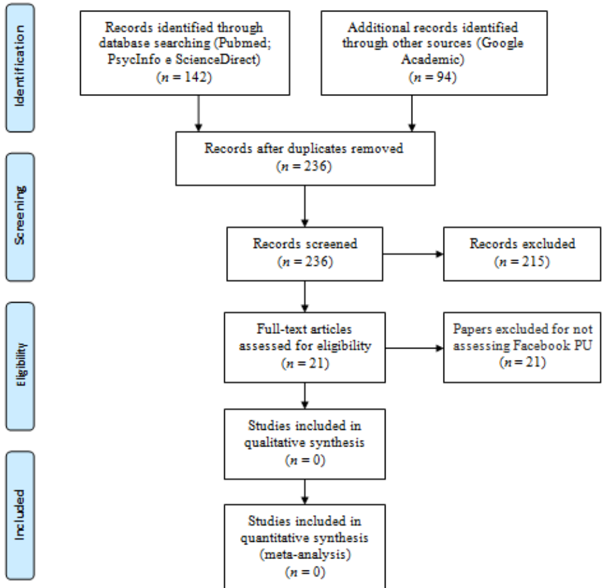
We aimed to investigate relationships between Facebook problematic use (Facebook PU) and pathological traits of personality, by a systematic review. The literature search was proceeded based on a search strategy including the keywords “Facebook”, “problematic use” and “personality”. We found a total of 236 publications and selected 21 papers for full verification. All of them were excluded, characterizing an empty review. As an attempt to increase the probability of finding eligible publications, first, we have broadened the search of the systematic review from “Facebook” to “social network sites” (and variations); and then from “social network sites” to “internet”. Regarding this last change, the final set of publications after full reading based on the eligibility criteria was composed by 15 papers. We emphasize that there was no empirical evidence on the relationship between Facebook PU and pathological traits of personality. Given the proximity between Facebook PU and internet addiction, it is possible to hypothesize that there is a relationship between pathological traits (i.e., Neuroticism, Impulsivity, and Psychoticism) and Facebook PU.
Overview
The claims and statistics of this paper haven’t been checked yet.
Free: it reads the open-access text and checks the first 5 claims that cite a source we can check. Create a free account to check every claim.
Integrity signals
Registry
Cites
Statistics
Figures
Verification
Claims the paper makes
The claims and statistics of this paper haven’t been checked yet.
Free: it reads the open-access text and checks the first 5 claims that cite a source we can check. Create a free account to check every claim.
Self-check
Percentages, sums and reported differences re-computed from the paper’s own numbers.
The self-check needs the paper’s full text.
Citations
Cites
Preferred Reporting Items for Systematic Reviews and Meta-Analyses: The PRISMA Statement
Moher, D., Liberati, A., Tetzlaff, J., Altman, D. G., & The PRISMA Group (2009) · PLoS Medicine · doi:10.1371/journal.pmed.1000097 · Cited by 64,042
Elm, E. V., Altman, D. G., Egger, M., Pocock, S. J., Gøtzsche, P. C., & Vandenbroucke, J. P. (2007) · BMJ · doi:10.1136/bmj.39335.541782.ad · Cited by 10,766
Internet Addiction: The Emergence of a New Clinical Disorder
YOUNG, K. S. (1998) · CyberPsychology & Behavior · doi:10.1089/cpb.1998.1.237 · Cited by 5,513
Moons, K. G. M., de Groot, J. A. H., Bouwmeester, W., Vergouwe, Y., Mallett, S., Altman, D. G., Reitsma, J. B., & Collins, G. S. (2014) · PLoS Medicine · doi:10.1371/journal.pmed.1001744 · Cited by 2,018
Development of a Facebook Addiction Scale
Andreassen, C. S., Torsheim, T., Brunborg, G. S., & Pallesen, S. (2012) · Psychological Reports · doi:10.2466/02.09.18.pr0.110.2.501-517 · Cited by 1,884
Issues for DSM-V: Internet Addiction
Block, J. J. (2008) · American Journal of Psychiatry · doi:10.1176/appi.ajp.2007.07101556 · Cited by 1,385
Online Social Network Site Addiction: A Comprehensive Review
Andreassen, C. S. (2015) · Current Addiction Reports · doi:10.1007/s40429-015-0056-9 · Cited by 1,212
Psychology of Computer Use: XL. Addictive Use of the Internet: A Case That Breaks the Stereotype
Young, K. S. (1996) · Psychological Reports · doi:10.2466/pr0.1996.79.3.899 · Cited by 1,108
Self-presentation 2.0: Narcissism and self-esteem on facebook
Mehdizadeh, S. (2010) · Cyberpsychology, Behavior, and Social Networking · doi:10.1089/cyber.2009.0257 · Cited by 1,064
High Impulsivity Predicts the Switch to Compulsive Cocaine-Taking
Belin, D., Mar, A. C., Dalley, J. W., Robbins, T. W., & Everitt, B. J. (2008) · Science · doi:10.1126/science.1158136 · Cited by 989
Research works printed but not linked: 2
- Griffiths M. D., 2014, Social networking addiction: an overview of preliminary findings, 119
- Laconi A., 2016, Problematic internet use, time spent online and personality traits, L’Encephala, 42, 214
Cited by
Real Delor, R. E., Mendoza Melgar, J. G., Gomes da Silva Neto, P., Oliveira Silva Gomes, C. B., Nascimento de Medeiros, G., & Pimenta Cavalcante, L. (2025) · Revista de la Facultad de Ciencias Médicas de Córdoba · doi:10.31053/1853.0605.v82.n3.48138 · Cited by 3
Daviccino, A. T., Chibas-Muñoz, E. E., Guevara, A., Davalos, J. M. H., Escalante, S. C. L., Benítez, L. E. O., Galeano, B. D. O., Gómez, C. G. P., Lezcano, E. A. R., Paniagua, R. R. R., et al. (2025) · Revista Virtual de la Sociedad Paraguaya de Medicina Interna · doi:10.18004/rvspmi/2312-3893/2025.e12122517 · Cited by 1
Metadata
- Authors
- Ferrari, B. L., Carvalho, L. D. F., & Sette, C. P.
- Affiliations
- Universidade São Francisco (BR)
- Venue
- Psico-USF
- Publisher
- FapUNIFESP (SciELO)
- Published
- 2021-09
- Volume
- 26
- Issue
- 3
- Pages
- 451-465
- ISSN
- 1413-8271 (ISSN-L)
- 2175-3563
- OpenAlex
- W4200481812
- Cited by
- 2
- References
- 47
- Citations by year
- 2025: 2
- FWCI
- 0.00
- Type
- journal article
- Language
- en
- Open access
- diamond
- doi.org
- Licence
- cc-by
- creativecommons.org/licenses/by/4.0/ (vor)
- creativecommons.org/licenses/by/4.0/ (am)
- creativecommons.org/licenses/by/4.0/ (tdm)
- Locations
- Psico-USF (publishedVersion, cc-by)
- LA Referencia (Red Federada de Repositorios Institucionales de Publicaciones Científicas) (publishedVersion, other-oa)
- DOAJ (DOAJ: Directory of Open Access Journals) (submittedVersion, cc-by-sa)
- Topics
- Social Sciences › Sociology and Political Science › Impact of Technology on Adolescents
- Social Sciences › Psychology › Clinical Psychology › Personality Traits and Psychology
- Social Sciences › Psychology › Clinical Psychology › Sexuality, Behavior, and Technology
- Keywords
- pathological personality traits, social network sites, internet addiction, neuroticism, impulsivity, psychoticism, Big Five personality traits
About these checks
Registry, retraction, Cites and statistics results are computed, not judged, with one exception: a printed reference that no index lists is read once by a model before it counts as a citation error. Claims are extracted by a model and kept only when their quote appears verbatim in the text; each cited source is then checked, with a model’s help, for whether it says what the claim relies on. Those verdicts can be wrong — read the claim’s quote and the cited source before relying on one.
Statistics and arithmetic are recomputed, not judged.
Confidence bands are shown only for fields calibrated on our annotated test set. None is calibrated yet, so no band is shown.
What counts as a claim ›How we measure confidence ›How we check this ›
Are you an author, or do you see a problem with this page? Request a review
How to cite
Cite CoChat for the checks on this page, and the paper for its own findings.
- This page
- CoChat. (2026). Citation check: Relationship Between Facebook Problematic use and Pathological Personality Traits: a Systematic Review. https://app.cochat.ai/papers/10.1590/1413-82712021260305
- The paper
- Ferrari, B. L., Carvalho, L. D. F., & Sette, C. P. (2021). Relationship Between Facebook Problematic use and Pathological Personality Traits: a Systematic Review. Psico-USF. https://doi.org/10.1590/1413-82712021260305
Data sources
Bibliographic data: Semantic Scholar, OpenAlex, Crossref.
Contains information from the Semantic Scholar Academic Graph Datasets, made available under the ODC Attribution License (ODC-BY 1.0).
Semantic Scholar’s data is described in: Kinney, R., et al. (2023). The Semantic Scholar Open Data Platform. arXiv:2301.10140.
